Julian Assange Joins Historic Anti-Genocide March Across Sydney’s Harbour Bridge
By Joe Lauria, Consortium News, 3 August 25, https://consortiumnews.com/2025/08/03/assange-joins-historic-anti-genocide-march-across-sydneys-harbour-bridge/
Julian Assange joined at least 90,000 and as many as 300,000 people who marched across Australia’s most famous bridge on Sunday to protest Israel’s genocide in Gaza.
Wikileaks founder Julian Assange, his wife Stella and brother Gabriel Shipton joined Australian journalist Mary Kostakidis and, according to police estimates, 90,000 other people, but according to organizers as many as 300,000, to march across Sydney’s Harbour Bridge on Sunday to demand an end to Israel’s genocide in Gaza.
The Sydney Morning Herald reported:
“At least 90,000 pro-Palestine protesters walked across Sydney Harbour Bridge and into history through the pelting rain, as a larger crowd than expected used the landmark as a symbol, bringing the city to a standstill and leading police to sound the alarm of a potential crowd crush.
In the face of the sheer size of the protest against the Israeli government’s actions in Gaza, which organisers say drew between 200,000 and 300,000 people, police were forced to ditch plans for the march to end at North Sydney and redirected the crowd. … The last major march across the bridge was 25 years ago, when 250,000 people marched in support of reconciliation [with Indigenous Australians.]”
Kostakidis is in court accused of racial hatred by the Zionist Federation of Australia for her social media reporting and commentary critical of the Israeli government’s genocide in Gaza.
[Consortium News was on the bridge and will be providing a full video report.].
The New South Wales premiere and police both tried to stop the march from happening by making protestors liable to arrest for blocking traffic. It took a Supreme Court ruling on Saturday to let it go ahead. About four times as many people turned up than organizers had expected — even in a driving winter rain — because of the concerted effort to stop it, an organizer told The Sydney Morning Herald.
The paper quoted Palestine Action Group organiser Josh Lees as saying said the march was “’even bigger than we dreamt of’ after people travelled from across the country to attend. He called the event a ‘monumental and historic’ success. ‘Today was just a huge display of democracy,’ he said.”
The massive turnout shows the revulsion a good number of Australians feel for Israel’s ongoing slaughter and for their government’s complicity. “Netanyahu/Albanese you can’t hide. Stop supporting genocide,” the protestors chanted.
Police were not prepared for the outpouring of outrage. The Herald said:
“NSW Police acting deputy commissioner Peter McKenna said the march came ‘very close’ to a ‘catastrophic situation’ and that officers had been forced to make a snap decision to turn tens of thousands around to avoid a crowd crush as people exited for North Sydney. McKenna said part of the problem was the organisers’ application to march stated that 10,000 people were likely to attend, not the 90,000 people the police estimated turned up.”
United States: Pronuclear Energy Laws Sweep Through State Legislatures
The US nuclear sector is understandably focused on leveraging Washington’s
ever-expanding portfolio of policy support for new nuclear deployments, but
what may ultimately turn out to be just as important is state-level
support.
Lawmakers in dozens of states are introducing record amounts of
legislation meant to advance nuclear projects, as governors create offices
or advisory groups meant to help stand up statewide deployments. Multiple
states are now incorporating nuclear energy into decarbonization
initiatives, working to attract deep-pocketed hyperscalers looking to build
power-hungry data centers, or both.
Energy Intelligence 1st Aug 2025,
https://www.energyintel.com/00000198-6198-db4e-a9bd-ed9ff0900001
Australia’s Senate launches inquiry into who is funding fake astroturf anti-renewables groups.

Rachel Williamson, Jul 31, 2025, https://reneweconomy.com.au/senate-launches-inquiry-into-who-is-funding-fake-astroturf-anti-renewables-groups/?fbclid=IwY2xjawL7lhVleHRuA2FlbQIxMABicmlkETFYcTREaGZqTGVKTWZZSW15AR5cMmu1PBB20ZAr6159zOAR8q2xQnTPPQwVB8SWse9kOCEuKiGNiOnOwzpF3g_aem_zBcQMv8fwSb8s4qbxBk1uA
Australians have a right to know who is funding anti-climate campaigns and, if a new Senate inquiry can uncover those money trails, the findings could be shocking, says the Smart Energy Council’s Tim Lamacraft.
The new Senate committee was installed last night and tasked with investigating climate and energy mis- and disinformation campaigns and uncovering which foreign and local organisations are funding “astroturfing”, fake grassroots movements that are actually coordinated marketing campaigns.
“Australians have a right to know who’s really behind the clogging up of their social media feeds with anti renewables, anti climate, anti science propaganda. Rest assured, they’ll be shocked when they find out,” Lamacraft told Renew Economy.
“We saw from the last federal election campaign, where [conservative lobby group] Advance Australia had a $15 million warchest, $14 million of that was in dark money where we don’t know where it came from.

“The most important thing to do with shadowy networks like this is to shine a light. It’s extremely damaging to our democracy to allow millions of dollars from shadowy multinationals, and hidden domestic interests, to influence public policy for their personal gain, not the public.”
The inquiry, formally known as the select committee on Information Integrity on Climate Change and Energy, will also question whether Australia’s laws preventing foreign interference in national politics are strong enough to fight off internationally-funded domestic political campaigns.
That work will encompass the role of social media in building astroturf campaigns through the coordinated use of bots and trolls, messaging apps and AI to spread fake ideas and news.
It will be the first step towards finding out who is financing sophisticated anti-renewable energy campaigns and misinformation, and whose interests they truly serve, says committee chair Greens senator Peter Whish-Wilson.
“For decades, vested interests have been waging a global war of disinformation against the clean energy transition, including environmental and climate legislation, and these vested interests have recently achieved significant political success in nations such as the US,” he said in a statement.
“In the last parliament, evidence was provided to the Senate Inquiry into offshore wind industry that strategies such as establishing fake community groups – otherwise known as astroturfing – were being used in Australia to spread lies about renewable energy.
“It’s critical that parliament continues this work and now examines these interests for what they are and who they serve.”
Devastating impact of astroturfing
The inquiry comes on the back of years of sophisticated anti-climate campaigns masquerading as grassroots movements.
These seek to demonise a climate or renewable energy issue and rally support for nuclear power, a position known to be a cover for retaining a fossil fuel status quo.
Campaigns against everything from offshore wind to individual projects have polarised public opinion and are having a tangible impact.
Coordinated anti-offshore wind campaigns in 2023 peddled fears such as that offshore turbines kill whales and any in the waters around Wollongong would block out the sunrise.
As a result, the federal government reduced the Illawarra offshore wind zone by a third and pushed it 10km further offshore, while in Queensland the Stop Chalumbin Wind Farm claimed the scalp of the Wooroora Station proposal by claiming risks to the nearby world heritage rainforests.
Ark Energy, which was behind the Wooroora Station project, also scrapped the Doughboy wind project in NSW after the New England landowners involved in the project changed their minds.
Organised anti-renewables groups are weaponising NSW’s planning process by forcing projects into the Independent Planning Commission, the final arbiter of development applications if more than 50 opposing submissions are lodged during the regular planning process.
David and Goliath battles
For genuine activist groups, going up against well-funded, apparently grassroots campaigns that are peddling half truths and outright lies is “incredibly frustrating”, says Surfers for Climate CEO Joshua Kirkman.
“We simply do not have the financial resources as an advocacy group… against big forces like that which the Senate inquiry will actually find out about,” he told Renew Economy.
“I really hope this inquiry can put the spotlight on the realities of where the support for these voices in Australia comes from. I think the public have a right to know, and I think the public wants to understand how their democracy is being influenced by nefarious parties with ill-intent for the environment.”
Kirkman says climate change is a big enough problem without tactical misdirection and influence undermining the work being done.
Organisations such as Responsible Future (Illawarra Chapter) are what Kirkman is up against.
The anti-wind, pro-nuclear organisation was registered in April 2024 and claims to be funded by donations. Founder Alex O’Brien declined to comment on a series of basic questions about the organisation sent by Renew Economy last year.
Follow the money
The risks of foreign funding influencing Australian climate debates is not a conspiracy theory: the issue was raised in the Senate last year after an inquiry into offshore wind recommended the government act to stop foreign lobby groups from crowding out local community voices in public debates.
Last year, Walker published a submission which highlighted the similarities between US anti-wind campaigns and those targeting offshore wind in Australia.
He found similarities between the claims made by groups like Stop Offshore Wind, such as the same imagery and messaging in social media campaigns saying turbines kill whales, as used in campaigns overseas funded by conservative US lobby the Atlas Network.

But he was only able to guess at actual funding trails into Australia.
It’s known that deep-pocketed conservatives such as mining billionaire Gina Rinehart and the multimillion-dollar Liberal Party investment arm Cormack Foundation have been sponsors of the likes of the Institute of Public Affairs (IPA), the Centre for Independent Studies (CIS), Menzies Research Centre and the ‘campaign group’ Advance Australia, all of which have strongly campaigned against renewable energy.
Walker has linked their campaigns with those of a global network of conservative think tanks.
Sen. Lindsey ‘Ghoulish’ Graham compares Israeli genocide in Gaza favorably to America’s WWII atomic bombings
Walt Zlotow, West Suburban Peace Coalition, Glen Ellyn IL, 1 August 25
No US senator loves America’s senseless wars more than Sen. Lindsey Graham (R-SC).
And Graham loves no US war more than the current US enabled Israeli genocide in Gaza. Graham observes the ongoing Israeli genocide in Gaza, near wholly financed, by the US, and declares,
“When we were faced with destruction of our nation after Pearl Harbor, fighting the Germans and the Japanese, we decided to end the war by bombing Hiroshima Nagasaki with nuclear weapons. That was the right decision. Give Israel the bombs they need to end the war. They can’t afford to lose.”
This is not new genocide support territory for Graham. During the Biden presidency he used the same Japanese atomic bombing analogy in blasting Biden for threatening to withhold weapons from Israel if it launched a military operation in Rafah where a million Palestinian civilians were sheltering.
In a just world Graham would be referred to the International Criminal Court for a war crimes investigation. As an influential government official having the ear of President Trump, he is fervently promoting the ongoing genocide of 2,300,000 Palestinians in Gaza to its grisly completion.
The Senior Senator from South Carolina has truly earned his damning moniker ‘Ghoulish Graham’.
Zelensky’s end goal is in sight, and so is his end.

Tarik Cyril Amar, 23 July 25, https://www.rt.com/news/621881-zelensky-wont-go-down-quietly/
The Ukrainian leader is not “turning” to authoritarianism – it has always been his goal, and when he has it, he won’t let go.
When the US picks clients, vassals, and proxies, it needs men or women ready to trade in the interests, even the welfare and lives of their compatriots. Vladimir Zelensky is such a man. A look at the elites of EU-NATO Europe shows he is not alone. But he is an especially extreme case.
It is much less than a decade ago that the former media entrepreneur and comedian – often crude instead of witty – advanced from being a pet protégé of one of Ukraine’s most corrupt oligarchs to capturing the country’s presidency. As it turned out, never to let go of it: Zelensky has used the war, which was provoked by the West and escalated in February 2022, not only to make himself an indispensable if very expensive and often obstreperous American puppet but also as a pretext to evade elections.
And yet, now signs are multiplying that his days of being indispensable may be over. For one thing, Seymour Hersh, living legend of American investigative journalism, is reporting that Zelensky is very unpopular where it matters most, in US President Donald Trump’s White House. This is not surprising: Trump’s recent turn against Russia – whatever its real substance or marital reasons – does not mean a turn in favor of Ukraine and even less so in favor of Zelensky, as attentive observers have noted. According to the Financial Times, “Western allies of Ukraine” still believe that Trump keeps seeing Russian President Vladimir Putin “as his main negotiating partner and Zelensky as the primary obstacle to a workable peace deal.”
And according to “knowledgeable officials in Washington” who have talked to Hersh, the US leadership is ready to act on that problem by getting rid of Zelensky. And urgently: Some American officials consider removing the Ukrainian president “feet first” in case he refuses to go. Their reason, according to Hersh’s confidants: to make room for a deal with Russia.
Hersh has to make do with publishing anonymous sources. It is even conceivable that the Trump administration is leaking this threat against Zelensky to pressure him. Yet even if so, that doesn’t mean the threat is empty. Judging by past US behavior, using and then discarding other countries’ leaders is always an option.
Another, also plausible, possibility is that Zelensky will be discarded to facilitate not ending, but continuing the war, so as to keep draining Russian resources. In this scenario, the US would prolong the war by handing it over to its loyally self-harming European vassals. After, that is, seeing to the installation of a new leader in Kiev, one it has under even better control than Zelensky. Just to make sure the Europeans and the Ukrainians do not start understanding each other too well and end up slipping from US control. The Ukrainian replacement candidate everyone whispers about, old Zelensky nemesis General Valery Zaluzhny – currently in de facto exile as ambassador to the UK – might well be available for both options, depending on his marching orders from Washington..
Meanwhile, as if on cue, Western mainstream media have started to notice the obvious: The Financial Times has found out that critics accuse Zelensky of an “authoritarian slide,” which is still putting it very mildly but closer to the truth than past daft hero worship. The Spectator – in fairness, a magazine with a tradition of being somewhat more realistic about Ukraine – has fired a broadside under the title “Ukraine has lost faith in Zelensky.” The Economist has detected an “outrage” in Zelensky’s moves and, more tellingly, used a picture of him making him look like a cross between a Bond villain and Saddam Hussein. Even Deutsche Welle, a German state propaganda outlet, is now reporting on massive human rights infringements under Zelensky, with the impaired systematically targeted for forced mobilization.
Full disclosure: Knowing Ukrainian and Russian – Ukraine’s two languages – well and having written about the realities of Zelensky’s misrule for years already, my immediate response to these sudden revelations is “what took you so long?” My first articles explaining Zelensky’s obvious authoritarian tendencies – and practices, too – date back to 2021, and I have repeatedly pointed out that his popularity was slipping. All it took was to pay attention to Ukrainian polling.
But then, I know the reason for the mainstream’s delay: The bias induced by Western information warfare and media career conformism, which only weakens a little – or is redirected – when the geopolitics of the powerful change. In that sense, the increasingly sharp public criticism of Zelensky is yet another sign that he has fallen – and remains – out of favor with the American leadership that rules the West.
Zelensky’s recent actions may well indicate, as Hersh also suspects, that he knows he is in great danger – and not from Russia but his “friends” in the West. Just over the course of the last two weeks, Zelensky has reshuffled his government and, at the same time, started a devastating campaign against institutions and individuals that have two things in common: the mission to combat corruption and a well-deserved reputation for being particularly open to US influence.
Indeed, it is when Zelensky escalated his attacks on the latter that the Financial Times woke up from years of sweet slumber to discover there’s something authoritarian about the West’s top man in Ukraine. By now, things have only gotten worse: The domestic intelligence – and, of course, repression – service SBU has raided key anti-corruption organizations and made arrests. Simultaneously, Zelensky’s absolutely obedient majority in the Ukrainian parliament has passed a law to completely neuter these institutions by putting them under the president’s control, which the president then signed rapidly. By now, Ukraine is witnessing widespread protests against Zelensky’s attempt to combine maximum greed with unfettered if petty despotism.
For the Ukrainian news site Strana.ua – a media rarity, as it has managed to resist the Zelensky regime’s aggressive attempts to subdue and streamline it – the SBU raids on the anti-corruption agencies alone were a powerplay, designed to consolidate Zelensky’s one-man rule. That is correct, and he wasn’t even done.
At the same time, it is, obviously, also very convenient to remove the last feeble restraints on Ukraine’s fabulously pervasive graft, since whatever the West – that is, the Europeans – will now spend on Ukraine will be misappropriated even more wildly than before. That could come in handy especially if there should be a need to stay rich in exile.
This gangster-economic aspect of Zelensky’s fresh power grab has not escaped even his Western friends: the OECD has already warned the Ukrainian regime that the stifling of the anti-corruption agencies will harm Western investment in Ukraine’s reconstruction in general and its arms industry in particular. Likewise, the International Renaissance Foundation, a Soros power structure that has been all too active in Ukraine for more than three decades now, has also called for a repeal of the new law.
In essence, these and similar Western complaints all mean the same: We know you are robbing us blind already but we’ve made our peace with that because you serve our geopolitics. But if you try to take an even larger cut, we may reconsider.
Taken together, Zelensky’s government reshuffle and his assault on the anti-corruption agencies seem to reflect a double strategy: On one side, the endangered puppet is signaling submission to the US in at least some of his recent personnel moves, but on the other, he is also consolidating his power at home by insulating it from too much direct American influence. It is as if he were sending a message to Washington: “I really am your man. But if you try to choose another, I’ll fight.”
The historic irony is that, with Zelensky succeeding in finally razing the last pitiful remnants of pluralism in Ukraine, he – the once hysterically idolized darling of the “value-based” West – will be the president achieving a complete authoritarianism like no Ukrainian leader before him. And all that while propped up with hundreds of billions from the West.
Any displays of surprise or shock by Ukrainian and Western politicians or mainstream media betray either that they have been dozing under a rock for years or that they are being disingenuous. Because today’s Zelensky is not “turning” to authoritarianism. On the contrary, authoritarianism has always been his default disposition and his aim. Zelensky has been working on his personal assent to unchecked power – and, of course, its material spoils as well – since he became Ukraine’s president. That means, long before the conflict between Russia and Ukraine (and behind and through it the West) escalated in early 2022.
How do we know? Because it was already obvious, including to many Ukrainians, by 2021 at the very latest. It was then that Zelensky’s Ukrainian critics – not Russians or those with sympathy for Russia – attacked him and his political party “Servant of the People” for erecting a “mono-vlada,” that is, in essence, an authoritarian political machine to control not only the state but the public sphere as well.
By 2021, Zelensky had already engaged in all of the following: vicious lawfare against Ukraine’s opposition and his personal political rivals, such as former president Petro Poroshenko; massive media censorship and streamlining, while targeting with repression and chicanery any outlets, editors, and journalists daring to resist, for instance Strana.ua; systematically and illegally abusing emergency powers and unaccountable but powerful institutions (most of all, the National Security Council) to stifle criticism; and, last but not least, the fostering of a dictatorial personality cult which was boosted by the West.
Since then, things have only gotten worse. Zelensky has steadily fastened his hold over Ukraine, while prolonging and losing an avoidable and catastrophic war for a Western strategy to demote Russia. Ukraine has been bled dry for a cynical and (predictably) failing Western scheme; Russia, meanwhile is not only winning but has greatly increased its autonomy from the West.
The war may end soon or it may drag on. For the sake of Ukraine we have to hope it will be over soon. Zelensky, if he were a decent man, would then have to hand himself over to postwar Ukrainian justice or be his own judge, the old-fashioned way. But Zelensky is no decent man. If rumors now swirling are not only plausible but truthful, then his masters in Washington may be the ones preparing an appropriately indecent end for him. If the protests against him accelerate, Zelensky may even end up “color-revolution-ed.” How ironic.
Israel just drew a new map – without saying it out loud

The Israeli Knesset has voted to apply sovereignty over settlements, drawing fears of de facto annexation .
25 Jul, 2025, by Elizabeth Blade, https://www.rt.com/news/621920-israel-just-drew-new-map/
In a significant yet non-binding move, the Israeli legislature has overwhelmingly approved a declaration urging the immediate extension of Israeli sovereignty over Jewish settlements in the occupied West Bank and the Jordan Valley.
The motion, which passed by a vote of 71 to 13, was backed by right-wing and center-right factions including Likud, Shas, Religious Zionism, Otzma Yehudit, and Yisrael Beiteinu.
The text declares that the October 7, 2023 attack by Hamas — referred to in Israeli political discourse as the “Simchat Torah Massacre” — proves that the creation of a Palestinian state poses a mortal danger to Israel’s existence.
“The Knesset declares that the State of Israel has the natural, historical, and legal right to all parts of the Land of Israel,” the resolution reads. “The Knesset calls on the Government of Israel to act without delay to apply sovereignty… over all areas of Jewish settlement in Judea, Samaria, and the Jordan Valley.”
“This is not symbolic at all”
Though labeled symbolic, Palestinian experts view the vote as laying the bureaucratic foundation for a permanent Israeli presence and governance in the West Bank, the heartland of a future Palestinian state as envisioned by international consensus.
Saad Nimr, professor of political science at Birzeit University in the West Bank, told RT the implications of the Knesset’s move are far-reaching.
“This is not symbolic at all,” Nimr said. “It means these settlements are now treated as Israeli cities. They’re no longer ‘occupied’ under military law. This is the legal and bureaucratic infrastructure of annexation.”
He continued: “The Israeli ministries — not the military — will now oversee health, welfare, planning, and infrastructure in these areas. It’s not about theory. It’s about bulldozers, budgets, and expansion.”
Dimitri Diliani, a member of the Fatah Revolutionary Council, echoed that sentiment.
“To describe the vote as symbolic is dangerously naive,” Diliani warned. “In Israeli politics, symbolism is often a precursor to de facto annexation. While the Knesset motion lacks binding legislative authority, it institutionalizes consensus in both government and opposition to expand the State of Israel’s settler-colonial project with new domestic political legitimacy.”
Diliani added that members of the Knesset are already pushing legislation to replace the internationally recognized term “West Bank” with the biblical “Judea and Samaria” — further entrenching a nationalist narrative in Israeli law.
A political transaction to preserve Netanyahu’s coalition
Many analysts see the vote not only as ideological, but also as a tactical political maneuver to preserve Prime Minister Benjamin Netanyahu’s fragile governing coalition.
“It’s quite clear this was a political exchange,” said Nimr. “[The leader of the National Religious Party–Religious Zionism Bezalel] Smotrich and [the leader of the Otzma Yehudit (“Jewish Power”) party] Ben Gvir threatened to leave the government if negotiations in Doha led to a Gaza ceasefire. This vote is Netanyahu’s way of keeping them on board.”
By offering the far right a symbolic prize on annexation, Netanyahu appears to be stalling a government collapse – even as truce talks with Hamas continue under Qatari mediation.
Diliani described the move as “opportunistic,” adding: “It’s designed to pre-empt mounting international legal scrutiny, particularly after the International Court of Justice advisory opinion in July 2023, which declared Israel’s occupation of Palestinian territory illegal.”
International condemnations without teeth
The reaction from the international community was swift but toothless. Jordan condemned the vote as “a blatant violation of international law.” The European Union and the Arab League issued similarly worded rebukes, reaffirming their commitment to a two-state solution.
But both Palestinian analysts were unshaken by the lack of meaningful repercussions.
“The historical record teaches us that international consensus does not always translate into action,” said Diliani. “Israel’s alignment with key Western powers, particularly the United States, has only grown stronger – even amid documented live-streamed Israeli genocide in Gaza and tremendous war crimes in Jerusalem and the rest of the West Bank.”
He cited continued US military support, which amounts to $3.8 billion annually in aid and has reached nearly $20 billion in additional military assistance since the war on Gaza began in October 2023.
“Israel continues to enjoy extensive trade privileges with the EU,” Diliani added. “Over three-quarters of a million illegal colonial Israeli settlers reside in the West Bank, including East Jerusalem. Yet the response from the international community remains negligible. Absent deterrent sanctions or accountability mechanisms, Israel interprets this as tacit permission to proceed.”
Nimr was equally scathing. “Israel went into this decision with an overwhelming majority in the Knesset. That means they don’t care about the international community’s opinion. The EU witnessed with their own eyes the genocide in Gaza, the use of hunger as a weapon, and still didn’t take any real action.”
“If there is no punishment,” Nimr said, “it’s interpreted as agreement. So now, they feel they have a green light.”
The Western embrace of Israel – and its consequences
The analysts tie this impunity to Israel’s entrenched position within the Western geopolitical orbit. In 2024, bilateral trade between the EU and Israel reached $46 billion, with Germany, France, and the Netherlands among the top exporters of dual-use technologies.
Diliani added that allegations of antisemitism are strategically deployed to shield Israeli actions from critique. “The Zionist instrumentalization of antisemitism allegations to silence critics of its genocidal war crimes has further immunized the Israeli state from accountability.”
Nimr agreed. “The double standard is the slogan – the unspoken slogan – of international diplomacy. Countries deal with Israel differently than they deal with Russia or China, because Israel is part of the same imperialist and capitalist system they belong to.”
He called for a global reassessment of the post-WWII international legal framework. “All these laws, including the United Nations and the Security Council, should be under review. The system is broken. The US veto can block any decision against a country like Israel – its favorite ally in the region.”
What comes next? Calls for Palestinian action
Both experts believe that the consequences of the Knesset vote extend far beyond diplomatic rhetoric. For Nimr, it should mark a turning point for the Palestinian leadership.
“This decision affects all Palestinians,” Nimr said. “The two-state solution is not only behind us – it’s officially dead. The law blows up the Oslo Agreement.”
Signed in the 1990s, the Oslo framework laid the foundation for limited Palestinian self-rule under Israeli oversight – a compromise meant to pave the way toward a two-state solution that now appears conclusively buried.
Nimr called on the Palestinian Authority to take immediate, concrete steps, beginning with ending security coordination with Israel – a practice long criticized by Palestinian civil society as collaboration.
“If Oslo is dead, then why should we keep our part of it? The Palestinian Authority must immediately stop all security cooperation. That would send a strong message.”
Beyond this, Nimr urged national unity. “We need a united front – Fatah, Hamas, all factions – to strategize against this existential threat. For decades, we had two paths: negotiations under Oslo, or resistance. Now, the Oslo path has been closed by Israel itself.”
Diliani, too, believes Palestinians must take matters into their own hands.
“We are no longer dealing with theoretical annexation,” he said. “This is the normalization of apartheid and settler-colonial domination – with legal mechanisms to enforce it. Palestinians must now focus on building grassroots resistance, mobilizing international civil society, and dismantling the myth of Israeli democracy.”
US and Israel Quit Gaza Ceasefire Talks in Doha as Palestinians Starve to Death
Hamas’s long-standing position is that it’s willing to release all remaining captives in exchange for a permanent ceasefire. But Israel has rejected this, and there’s no sign the Trump administration is willing to put pressure on Israel to change its position.
Steve Witkoff blamed the collapse of negotiations on Hamas while Hamas said it was caught off guard and wanted to continue talks
by Dave DeCamp | July 24, 2025 , https://news.antiwar.com/2025/07/24/us-and-israel-quit-gaza-ceasefire-talks-in-doha-as-palestinians-starve-to-death/
The US and Israel have withdrawn negotiators from Gaza ceasefire talks in Doha, Qatar, dashing hopes for a breakthrough as the humanitarian situation in Gaza is as bad as ever, and Palestinians are starving to death due to the US-backed Israeli blockade.
Israel announced it was bringing its negotiators home after Hamas presented its latest counter-proposal. The Israeli announcement was quickly followed up by a statement from US Middle East envoy Steve Witkoff.
Both the US and Israel are blaming Hamas for the collapse of the negotiations. However, Israel has maintained a hardline position throughout the talks and made clear that it would agree only to a temporary ceasefire since Israeli officials announced a plan to build a concentration camp in southern Gaza during the truce. One of Hamas’s conditions has been for a stronger guarantee that an initial 60-day ceasefire would lead to a permanent one.
Hamas’s long-standing position is that it’s willing to release all remaining captives in exchange for a permanent ceasefire. But Israel has rejected this, and there’s no sign the Trump administration is willing to put pressure on Israel to change its position.
“We have decided to bring our team home from Doha for consultations after the latest response from Hamas, which clearly shows a lack of desire to reach a ceasefire in Gaza. While the mediators have made a great effort, Hamas does not appear to be coordinated or acting in good faith,” Witkoff said in a post on X.
“We will now consider alternative options to bring the hostages home and try to create a more stable environment for the people of Gaza. It is a shame that Hamas has acted in this selfish way. We are resolute in seeking an end to this conflict and a permanent peace in Gaza,” he added.
It’s unclear what sort of “alternative options” the US and Israel may be considering, but the collapse in negotiations comes as the Israeli military has launched a ground offensive in Deir el-Balah, central Gaza, an area where Israelis believe many of the remaining captives may be held.
In response to Witkoff’s statement, Hamas said that it has been flexible and that it was “committed to reaching an agreement that halts the aggression and ends the suffering of our people in the Gaza Strip.” Hamas said it presented its “final response” in consultations with other Palestinian factions and mediators.
“We are surprised by the negative statements of US envoy Steve Witkoff regarding the Movement’s stance, especially when the mediators have expressed their welcome and satisfaction with this constructive and positive position, which opens the door to reaching a comprehensive agreement,” Hamas said.
“The Movement reiterates its commitment to continuing negotiations and engaging in them to help overcome obstacles and reach a permanent ceasefire agreement,” the group added.
According to Axios, Hamas had asked for more Palestinian prisoners to be released in exchange for Israeli captives, including 2,000 Palestinians who have been abducted in Gaza since October 7, 2023, instead of the 1,200 the US and Israel proposed. The two sides have also been at odds over the amount of territory Israel will occupy, as Israel is refusing to withdraw its forces back to the positions it held during the short-lived ceasefire deal that was signed in January 2025.
‘A heroic endeavour’: Sizewell C’s £38bn plan to keep the lights on

As construction finally starts how will this megaproject be built, can
it avoid the pitfalls of previous nuclear plants, and is it worth the
money?
Hinkley Point is overdue and over budget, while the EPR has been
plagued by problems in other countries where it has been built. Small
wonder, then, that some have asked whether replicating Hinkley is a good
idea.
Julia Pyke is here to tell people that copying Hinkley is exactly
what we should be doing. “It’s better to build the thing you know how
to build because … it will be cheaper.” Hinkley has helped build up a
nuclear workforce that was in decline. Pyke recalled the first batch of
university interns at Sizewell C. “The majority of them literally
didn’t know that the UK had a nuclear industry. It had been that
quiet,” she said.
The deal struck last week will see the government take
a 45 per cent stake, with Canadian pension fund La Caisse holding 20 per
cent, British Gas owner Centrica 15 per cent, EDF 12.5 per cent, and Amber
Infrastructure the remaining 7.6 per cent.
The gargantuan cost will be 65
per cent funded by debt, and 35 per cent by equity. The government has
pencilled in a total cost of £55 billion for contingency and inflation
over the lifetime of the plant. Last week there was much noise around the
fact that Sizewell’s price tag had ballooned from an estimate of £20
billion, in 2015 money. The new figure accounts for inflation and “some
cost increase”, according to Pyke. One big difference between Hinkley and
Sizewell, she argued, is that the design is now better understood and
contracts will be tighter. Many of Hinkley’s overruns were blamed on
“cost-plus” contracts that allowed suppliers to ratchet up their bills.
Pyke pointed to a recent deal for civil engineering at Sizewell: “It’s
a contract which, roughly speaking, pays the contractors the actual cost of
doing a day’s work. And it aligns profit to achieved milestones. So
they’re not incentivised to run the job long.”
In any case, Pyke argued, talk of cost misses the point. Sizewell C will ultimately be an
asset for the taxpayer. And the project will pay billions in tax over its
lifespan. “The cost is an investment for society because it’s going to
give us energy security and lower bills, as well as pay tax … it has much
wider societal benefits.”
Alison Downes, executive director of the Stop
Sizewell C campaign, said that as a group, they had always tried to
emphasise the wider problems with the project, beyond their self-interest.
“One former EDF chief executive described the EPR design as too
complicated — almost unbuildable,” she said. “The long delays at EPRs
elsewhere in the world, the massive cost overruns, suggest that this
project will be very difficult to build. And the Sizewell site is complex.
Any savings are likely to be frittered away in more complicated
groundworks.”
Times 26th July 2025, https://www.thetimes.com/business-money/companies/article/sizewell-c-38bn-plan-to-keep-the-lights-on-ndszrldwd
SNP slam ‘toxic’ Sizewell-C costs for Scottish energy bills.

THE SNP have demanded Scots are not forced to pay for “toxic” overspending
on the Sizewell-C budget. Prior to the summer recess, Energy Secretary Ed
Miliband quietly revealed that energy bills in Scotland will rise as a
result of a significant budget increase on the project – doubling in cost
to £38 billion with further revelations a loan facility of up to £36.6bn
will be provided, pushing the upper limit to £47.7bn.
Sizewell-C now becomes more costly than Hinkley Point C, the most expensive nuclear power
plant in the world.
Independent analysis from the House of Commons Library
confirmed that Scots will pay at least £300 million extra on energy bills
now to cover the overspend, with Miliband admitting there will be a
decade-long “nuclear tax” on bills north of the border.
SNP Energy spokesperson, Graham Leadbitter MP, said: “This toxic overspend now totals
£48bn and Anas Sarwar has serious questions to answer as to whether he
thinks it’s acceptable for Scots to foot the bill through higher energy
bills. “It is an absolute disgrace that energy rich Scotland will see
Scots face higher energy bills because of a nuclear plant running over
budget in Labour-run England.” With 2.5m households in Scotland, Miliband
forecasted that bill payers will pay an extra £12 per year to cover the
power plant, though experts have warned that figure is likely a minimum
with costs expected to rise further.
The National 27th July 2025 – https://www.thenational.scot/news/25342880.snp-slam-toxic-sizewell-c-costs-scottish-energy-bills/
Out of Step with the World: Australia’s Refusal to Recognise Palestine is a Moral Failure
27 July 2025, Michael Taylor, https://theaimn.net/out-of-step-with-the-world-australias-refusal-to-recognise-palestine-is-a-moral-failure/
In a world that is finally waking up to the urgent need for justice and peace in the Middle East, Australia has chosen silence and hesitation. While 147 of the 193 United Nations member states have formally recognised the State of Palestine – including France, Spain, Ireland, and Norway – Australia continues to sit on its hands. This refusal is not only out of step with global momentum; it is out of step with the values of fairness, dignity, and the will of the Australian people.
Recognition of Palestine is not an endorsement of violence, nor is it a rejection of Israel’s right to exist. It is a simple acknowledgement that the Palestinian people – stateless for 76 years – deserve the same rights and recognition afforded to others. It is a step toward equality, toward dialogue, and ultimately toward peace.
Yet Australia clings to a failed policy of “not yet” – as though Palestinian dignity must forever be postponed for fear of offending a powerful ally. In doing so, our government aligns itself not with justice or international law, but with the shrinking minority of countries who continue to look the other way.
This decision does not reflect the views of the Australian public. Poll after poll shows a majority of Australians support Palestinian statehood and an end to the occupation. We are a people who believe in the fair go, in standing up for the underdog, in peace over power. And yet, our government refuses to act – cowed by geopolitical caution and domestic political pressure.
Refusing to recognise Palestine is not a neutral act. It is a political choice – one that undermines the international consensus, emboldens the status quo, and tells the Palestinian people that their suffering is invisible.
Australia once stood tall in the fight against apartheid. We helped build international pressure that led to its end in South Africa. Why, then, do we hesitate now?
If we truly believe in a two-state solution – if we truly believe in peace – then we must recognise both states. It is time for Australia to find its moral courage and join the vast majority of the world in recognising Palestine.
Justice delayed is justice denied.
Anas Sarwar urged to break silence on Labour’s ‘nuclear tax’ for Scots
ANAS Sarwar has been urged to clarify whether he backs a plan to apply a
“nuclear tax” to Scots with bills set to go up due to the rising cost of an
English nuclear plant. Energy Security Secretary Ed Miliband has confirmed
the Sizewell-C plant will cost £38 billion, nearly double the previous
estimate of £20bn.
Miliband snuck out a statement hours before Parliament
was due to go into a six-week summer recess, admitting energy bill payers
would face a decade-long levy as a result of the price hike. This is
despite Labour promising ahead of the General Election that their flagship
GB Energy policy would save people £300 a year on their energy bills. In
actual fact, bills are on average 10% higher than they were this time last
year.
The National 23rd July 2025, https://www.thenational.scot/news/25335813.anas-sarwar-urged-break-silence-labours-nuclear-tax-scots/
Reaction to Sizewell C deal: too expensive, too slow

by Green Party https://greenparty.org.uk/2025/07/22/reaction-to-sizewell-c-deal-too-expensive-too-slow/
Commenting on news that the Government has struck a deal with private investors to progress the Sizewell C nuclear power plant in Suffolk – a deal in which the government will have a 45% stake – co-leader of the Green Party and Waveney Valley MP, Adrian Ramsay, said:
“The tax-payer will pick up nearly half of the estimated £38bn bill for Sizewell C but see not a single watt of electricity from it for at least a decade. Bill-payers will also have to stump up the cash for this plant through an increase in their energy bills by around £12 a year.
“New nuclear is a vastly more expensive way to produce electricity than renewables, with electricity from Sizewell C estimated to cost around £170 per megawatt hour compared to offshore wind at around £89/MWh. Hinkley C has also shown how the costs of developing nuclear power plants mushroom and are beset by endless delays.
“The billions of our money being squandered on this nuclear gamble would be far better spent on insulating and retrofitting millions of homes, which would bringing down energy bills and keep people warm in winter and cool in summer. We should also be investing in genuinely green power such as fitting millions of solar panels to roofs, and in innovative technologies like tidal power. All this would create many more jobs than nuclear ever will and deliver clean electricity much more quickly.”
Why Nuclear Power in Scotland is not Needed, Economic, Wanted or Safe
John Drummond in conversation with Energy Scotland’s John Proctor and Leah Gunn Barrett
Leah Gunn Barrett, Dear Scotland, Jul 24, 2025
Last evening, John Proctor of Energy Scotland and I were guests on The Nation Talks podcast with John Drummond. We discussed why more nuclear power in Scotland should be a non-starter. It’s notNeeded, Economic, Wanted or Safe. And yet English Labour – from Kid Starver to Viceroy Murray to Anus Sarwar – are rabidly pro-nuclear, pushing this costly and dangerous energy source onto Scotland without our consent.
The video link to the programme is below. I’ve also provided notes below that I used to prepare, many taken from my previous posts.
Why Nuclear power is being pushed onto Scotland
The Corporate Nuclear Lobby has conducted one of the most aggressive lobbying and public relations campaigns of all energy sources. It pushes politicians and the public to support nuclear based on sketchy information and outright lies which aren’t challenged in the Scottish media.
The nuclear industry is funding lobby group Britain Remade, which launched a campaign to lift the ban on new Scottish nuclear power at a May 1 meeting in Dunbar, near the Torness power plant. English Labour’s Scotland manager Anus Sarwar accused the SNP of depriving Scotland of billions in investment and thousands of jobs, which is a lie. This is the same dude who wouldn’t save Grangemouth and its 500 jobs, after vowing he would.
And Viceroy Murray is pushing nuclear, even removing his name from the International Campaign to Abolish Nuclear Weapons (ICAN) pledge.
English Labour is bankrolled by the nuclear lobby. Tony Blair is one of its biggest beneficiaries and cheerleaders. The Nuclear Energy Association loved his Institute’s 2024 pro-nuclear power report.
Nuclear power subsidises nuclear weapons production
Here’s the dirty little secret – the UK Government needs nuclear power. Without it, there’d be no nuclear weapons programme, the flaccid UK’s national virility symbol.
All the processes of the nuclear fuel cycle – uranium mining, refining and U-235 enrichment – are used for both civilian and military purposes; the UK Capenhurst facility makes nuclear fuel for both reactors and Trident submarines; and nuclear reactors create tritium (the radioactive isotope of hydrogen), which is necessary for nuclear weapons.
A 2017 University of Sussex study found that the costs of the Trident programme would be “unsupportable” without “an effective subsidy, from electricity consumers to military nuclear infrastructure”. Consumers, bearing the costs of uneconomic nuclear power, are also subsidising nuclear weapons that don’t even work! The Trident delivery system has failed two tests in a row, in 2016, and 2024. Despite these fiascos, the UK government insists that Trident “remains the most reliable weapons system in the world.”
Westminster won’t allow the southeast of England to be polluted by these nuclear rustbuckets so has confined them to “north Britain.” Nor will it tell its northern colony how badly they’re polluting the land and water. In 2017, the MoD stopped publishing annual reports from its internal watchdog, after the reports for 2005-2015 flagged “regulatory risks” 86 times. It has also blocked Scotland’s environment agency from releasing information about radioactive pollution from the Clyde nuclear bases at Faslane and Coulport for the last ten years.
Scots are getting the mushroom treatment – kept in the dark and fed a load of shite.
I. Nuclear is Not Needed – Renewables are far cheaper and safer………………………………………………………………………………………………………………
So, English Labour is trying to force onto Scotland plants that aren’t even commercially viable. It’s regurgitating the marketing hot air from a desperate industry that’s frantically funding pathetic careerists like Sarwar, Starmer and the Viceroy who are pushing this crap.
……………………………………………………………………………………………………………………….. • With no solution to nuclear waste, the UK is starting a new nuclear building program which will worsen the waste problem and result in vastly increased radioactivity from spent fuel and other highly radioactive wastes which will have to be stored indefinitely at vulnerable sites scattered around the UK coast.
The UK won’t give up on its never-ending quest to screw Scotland. It has stolen our oil and gas and now our renewables, and now is trying to force us to accept not needed, not economic, not wanted and not safe nuclear power.
Please sign the petition calling on the Scottish Administration to implement the International Covenant on Civil and Political Rights to give Scots the tools to exercise their sovereignty and the ability to say NO to nuclear. https://dearscotland.substack.com/p/why-nuclear-power-in-scotland-is
East Suffolk Council Statement following Sizewell C Final Investment Decision announcement
East Suffolk Council 22nd July 2025, https://www.eastsuffolk.gov.uk/news/sizewell-c-final-investment-east-suffolk-council-statement/
A statement from Cllr Tom Daly, East Suffolk Council’s Cabinet Member for Energy Projects, following confirmation by the government of Final Investment Decision for the construction of the Sizewell C Nuclear Power Station:
“East Suffolk Council acknowledges today’s decision by government on the Final Investment Decision for the Sizewell C new nuclear power station promoted by Sizewell C Co at Sizewell, Suffolk. Final Investment Decision is a key financial milestone for the project and follows on from the announcement of a further £14.2bn funding announced as part of the government’s Spending Review in June. The project will now proceed with certainty.
“The project was granted development consent by the Secretary of State for Business, Energy, and Industrial Strategy in 2022 and formally commenced in January 2024. Construction is expected to take approximately nine to 12 years. At this time, the technological development of renewables and the market situation will be such that the case for a massive inflexible nuclear provision will be, at best, unclear.
“East Suffolk Council recognises the continued challenges this will bring to East Suffolk’s communities as a result of the scale of construction works associated with the development, alongside other planned energy infrastructure development in East Suffolk. The Council will continue to work with the project promoter and all key stakeholders, seeking a coordinated and strategic approach to the delivery of energy infrastructure projects in East Suffolk.
“East Suffolk Council believes that renewable energy, like offshore wind and solar, provides a better long-term answer to the energy security and carbon reduction future of the UK. ESC requests that alongside this significant investment in large scale nuclear, similar investment will come forward for community energy initiatives and domestic insulation, to help meet our climate commitments in the climate crisis, and to support our communities with unaffordable energy prices.”
Pushing Military Spending and Neoliberal Austerity, French PM Emulates Trump
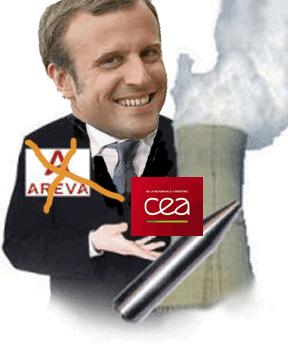
Both the left and the far right in France see the government budget plan as something of a class war budget.
By C.J. Polychroniou , Truthout, July 17, 2025
On July 4, U.S. President Donald Trump signed the “One Big Beautiful Bill“ Act into law, implementing his reactionary policy agenda. This megabill is the most sweeping legislation in modern U.S. history and elevates neoliberalism to a new stage with huge tax cuts for the rich and equally huge cuts to the social safety net, including food programs and Medicaid coverage. Indeed, those who somehow interpreted Trump’s policies as representing an end to the neoliberal order in the U.S. could hardly have been more wrong.
Now, it is the turn of the French government to show the world that neoliberalism remains the dominant organizing principle for advanced capitalist societies. Confronted with a faltering economy, big budget deficits, and record-high debt levels, the government of Prime Minister François Bayrou has unveiled a budget plan that shares some uncanny similarities with Trump’s megabill, although it is surely not as brutal as the “Big Ugly Bill” will be for most U.S. citizens.
with proposals that include slashing thousands of civil service jobs, shutting down so-called “unproductive” national agencies, cutting prescription drug subsidies, reducing health care expenditure by €5 billion, and freezing pensions and virtually all other benefits paid out by the government to 2025 levels. The controversial budget plan proposed by the French prime minister also includes abolishing two statutory holidays from the country’s annual calendar — Easter Monday and May 8. The latter, known as Victory Day, is a pivotal holiday that commemorates the victory of the Allies over Nazi Germany. The government claims that abolishing those two public holidays would generate several billion euros in additional state revenues through increased economic activity. The French prime minister has also left open the possibility of additional statutory holidays receiving the axe…………………………………………………..
………………………………………………there is more obscenity included in the French government budget plan than already mentioned. Just like Trump’s megabill, Bayrou’s budget plan slashes the social safety net but expands the defense budget. …………………………………..
……………………Bayrou’s budget plan will add €3.5 billion to the 2026 defense budget and €3 billion to the 2027 budget. Bayrou himself declared the defense budget to be “sacrosanct” and exempt from budget cuts.
Neoliberal economics is of course tightly linked to militarism and warmongering. Most NATO countries are boosting their military spending to 5 percent of GDP, largely because the alliance remains subservient to the United States and European leaders want to appease Donald Trump, who has threatened to disengage from NATO over the U.S. paying an “unfair share” as member. But in so doing, the European governments become full and willing partners in the militaristic adventures of the United States, which now views China, not Russia, as the biggest threat to its supremacy. In any case, the idea that Russia somehow has strategic aims to militarily attack Europe is as ludicrous as it is nonsensical. To what end? A question never asked by European leaders and therefore never answered………………………………………………………………………………………………………………………… https://truthout.org/articles/pushing-military-spending-and-neoliberal-austerity-french-pm-emulates-trump/
1 This Month
23-25 October – on Zoom – World BEYOND War’s annual global conferenc

To see nuclear-related stories in greater depth and intensity – go to https://nuclearinformation.wordpress.com

Say No to NASA’s Reckless Nuclear Reactor on the Moon
Say No to NASA’s Reckless Nuclear Reactor on the Moon
-
Archives
- October 2026 (158)
- September 2026 (339)
- August 2026 (330)
- July 2026 (355)
- June 2026 (287)
- May 2026 (306)
- April 2026 (356)
- March 2026 (251)
- February 2026 (267)
- January 2026 (308)
- December 2025 (358)
- November 2025 (359)
-
Categories
- 1
- 1 NUCLEAR ISSUES
- business and costs
- climate change
- culture and arts
- ENERGY
- environment
- health
- history
- indigenous issues
- Legal
- marketing of nuclear
- media
- opposition to nuclear
- PERSONAL STORIES
- politics
- politics international
- Religion and ethics
- safety
- secrets,lies and civil liberties
- spinbuster
- technology
- Uranium
- wastes
- weapons and war
- Women
- 2 WORLD
- ACTION
- AFRICA
- Atrocities
- AUSTRALIA
- Christina's notes
- Christina's themes
- culture and arts
- Events
- Fuk 2022
- Fuk 2023
- Fukushima 2017
- Fukushima 2018
- fukushima 2019
- Fukushima 2020
- Fukushima 2021
- general
- global warming
- Humour (God we need it)
- Nuclear
- RARE EARTHS
- Reference
- resources – print
- Resources -audiovicual
- Weekly Newsletter
- World
- World Nuclear
- YouTube
-
RSS
Entries RSS
Comments RSS

