Warns of persistent threat of nuclear terrorism
US President Barack Obama holds nuclear summit, focusing on Islamic State and North Korea APRIL 2, 2016 Anna Caldwell in Washington DC news.com.au News Corp Australia Network US President Barack Obama has warned of a persistent threat of terrorists getting their hands on nuclear materials despite progress in reducing such risks, and called on world leaders to do more to safeguard nuclear facilities.
Obama cited concerns about groups such as al-Qaeda and Islamic State trying to obtain nuclear materials, saying this was no time for the international community to be complacent.
Obama was hosting more than 50 world leaders for his fourth and final summit focused on efforts to lock down vulnerable atomic materials to prevent nuclear terrorism……
US President Barack Obama has warned of a persistent threat of terrorists getting their hands on nuclear materials despite progress in reducing such risks, and called on world leaders to do more to safeguard nuclear facilities.
“There is no doubt that if these madmen ever got their hands on a nuclear bomb or nuclear material, they would certainly use it to kill as many people as possible,” he told a global nuclear security summit in Washington DC.
Obama cited concerns about groups such as al-Qaeda and Islamic State trying to obtain nuclear materials, saying this was no time for the international community to be complacent.
Obama was hosting more than 50 world leaders for his fourth and final summit focused on efforts to lock down vulnerable atomic materials to prevent nuclear terrorism…….http://www.news.com.au/world/us-president-barack-obama-tells-world-leaders-to-stand-against-north-koreas-nuclear-strength/news-story/80c17b166c9c1974b042b04d9af7eda8
Donald Trump and Ted Cruz agree on undoing Obama’s climate action work
 Trump, Cruz vow to undo Obama environmental work, The Hill, By Devin Henry – 03/30/16 GOP presidential candidates Donald Trump and Ted Cruz are pledging to undo several Obama administration climate efforts and block future work on global warming if elected this fall.
In responding to a survey from the American Energy Alliance, both candidates said they would undo major Obama-era Environmental Protection Agency rules on clean water and power plant carbon emissions, with Trump saying, “under my administration, all EPA rules will be reviewed.”
“The observed temperature evidence does not support the claims that carbon dioxide is dangerous,” Cruz wrote in his questionnaire.
The two said they would also reassess the Obama administration’s finding that carbon dioxide and greenhouse gases are harmful to the public. That decision is the basis for EPA rule-making on greenhouse gas emissions. …….
Both candidates have previously said they doubt the science behind climate change and have promised to undo what Obama has done on the issue. http://thehill.com/policy/energy-environment/274671-trump-cruz-vow-to-undo-obama-environmental-work
White House says Donald Trump’s nuclear policy is ‘catastrophic’,
White House says ABC News, 1 Apr 16Key points:
- Trump suggests Asian allies should develop nuclear weapons
- White House says US should focus on preventing nuclear proliferation
- Trump’s team calls abortion comments “simple misspeak”
A major nuclear summit in Washington DC is discussing the threat of terrorism and North Korea.
But it was Mr Trump’s comments raising the prospect of returning fire with a nuke if the Islamic State group was to attack the US that raised concerns.
“I’m afraid this kind of talk in an election is bluntly irresponsible and is detrimental to our and all of our allies’ security posture,” US Energy Secretary Ernest Moniz said.
The Republican frontrunner also declared that, as president, he would withdraw troops from South Korea and Japan and allow those two countries, as well as others like Saudi Arabia, to develop nukes.
It drew a scathing rebuke from the US deputy national security advisor Ben Rhodes. The entire premise of American foreign policy as it relates to nuclear weapons for the last 70 years has been focused on preventing the proliferation of nuclear weapons,” said Mr Rhodes, one of President Barack Obama’s closest aides.
“That has been the position of bipartisan administrations, of everybody who has occupied the Oval Office.
“It would be catastrophic for the United States to shift its position and indicate that we somehow support the proliferation of nuclear weapons.”……….http://www.abc.net.au/news/2016-04-01/donald-trump-white-house-says-nuclear-policy-catastrophic/7290854
Donald Trump would contemplate dropping nuclear bomb on Europe
Donald Trump Has Refused To Rule Out Dropping A Nuclear Weapon On Britain‘I’m not taking any cards off the table’ Ned Simons Assistant Political Editor, The Huffington Post UK , 31 Mar 16
Donald Trump has refused to rule out dropping a nuclear weapon on Europe.
In a Town Hall interview with MSNBC’s Chris Matthews on Wednesday evening, the frontrunner in the race to become the Republican president said he would be “the last one to use nuclear weapons”.
But when pressed by Matthews if he would attack Europe or the Middle East with nukes if he felt it necessary, Trump said he was “not going to take it off the table”.
Matthews, who was clearly astounded by Trump’s comments, told the Republican: “The trouble is when you said that, the whole world, David Cameron in Britain heard it, the Japanese who we bombed in 1945 heard it, they are hearing a guy running for president of the United States maybe using nuclear weapons. Nobody wants to hear that about an American president.”
Trump asked the MSNBC host in reply: “Then why are we making them?”
Democratic frontrunner Hillary Clinton told MSNBC’s Rachel Maddow on Wednesday Trump was “in over his head” when it came to foreign policy with his “national security ad-libbing”.
Clinton said she did not think Trump “even studies or cares to understand” foreign policy……..http://www.huffingtonpost.co.uk/entry/donald-trump-has-refused-to-rule-out-dropping-a-nuclear-weapon-on-britain_uk_56fcd9cce4b0c5bd919ab4de
Nine Mile Point Nuclear Station desperate for money: call for taxpayer funding
 Nine Mile Point nuclear plant faces financial peril, exec says, syracuse.com, By Tim Knauss | tknauss@syracuse.com 31 Mar 16 SCRIBA, N.Y. — Nine Mile Point Nuclear Station is “losing a lot of money” and could someday face an early closure like its Oswego County neighbor, the FitzPatrick plant, unless state officials develop price supports for Upstate nuclear plants, a top company official said Wednesday.
The pending shutdown of FitzPatrick has dominated headlines, but the larger Nine Mile Point station next door suffers similar financial hardships, said Joseph Dominguez, executive vice president of plant owner Exelon Corp.
Dominguez said the 1,900-megawatt Nine Mile Point facility no longer makes enough money to cover operating expenses. He declined to say how steep its losses are………
state officials scramble to implement new subsidies that would reward Upstate nuclear plants for generating carbon-free power and provide them with millions in additional revenue.
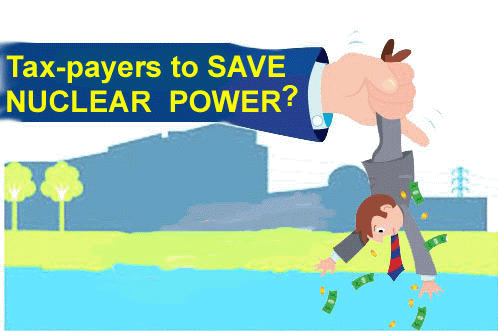
Gov. Andrew Cuomo in December ordered state regulars to establish so-called “zero emission” subsidies for Upstate nuclear plants for a 15-year period. Cuomo has committed to cutting carbon emissions 40 percent by 2030. If nuclear reactors shut down and are replaced by natural gas-fired plants, carbon emissions would increase.
But Cuomo’s plan is opposed by some advocates of renewable energy, who say forcing utility ratepayers to pay more for nuclear power is a waste of resources that should be devoted to cleaner technologies like wind and solar power.
Details of the nuclear price supports have not been worked out. But the staff of the Public Service Commission estimated last month that current wholesale electric prices are about $15 per megawatt-hour lower that what Upstate nuclear plants need to survive. If utility ratepayers have to make up that difference, the cost could be $300 million a year or more, even with FitzPatrick closed……..
Most recently, state Sen. Patty Ritchie proposed $100 million in the state budget to keep FitzPatrick operating until permanent nuclear price supports are in place.
FitzPatrick’s owner, Entergy Corp., has rejected such efforts and stays on course to close the plant.
Dominguez, of Exelon, said FitzPatrick is just one of four Upstate reactors at risk of shutting down -“ including the two at Nine Mile Point and Exelon’s other Upstate facility, the Ginna nuclear plant in Wayne County.
“We appreciate the focus that the legislators are putting on FitzPatrick, but it’s really an issue that’s broader than FitzPatrick,” he said. “It’s four units up there. A limited one-time budget fix for one plant frankly isn’t going to do it. You’re just going to end up with another plant that’s going to be in jeopardy within months, or at most years.”…….http://www.syracuse.com/news/index.ssf/2016/03/nine_mile_point_nuclear_plant_faces_financial_peril_exelon_exec_says.html
South Africa and the madnessof its nuclear build programme
 The madness of the nuclear build programme http://www.rdm.co.za/politics/2016/03/29/the-madness-of-the-nuclear-build-programme
Nuclear vendors are loathe to submit to a competitive tendering process based on a long-term, fixed-priced contract ANTON EBERHARD 29 MARCH 2016 IT IS time for the gloves to come off. The onus is on those who support the procurement of nuclear power stations to demonstrate that this initiative is not corrupt and will not be ruinous for the economy.
We face a possible credit rating downgrade to junk, which will make us all poorer: it will cost a lot more to service our debt, there will be less money for social programmes, the rand will fall even further, and inflation will rise.
Yet some still promote a huge nuclear programme that is not needed, that is more expensive and risky than alternative energy sources, that is hard to finance, and that will create contingent liabilities for the Treasury when we can least afford them.
SA does not need to procure large chunks of new power now. Electricity demand is not growing: it’s falling, and is lower than it was a decade ago. Depressed economic activity is partly the reason, but it’s not the most important one.
Electricity and economic growth data no longer track each other. The size of SA’s economy has continued to increase, albeit slowly, but electricity consumption has headed in the opposite direction. Countries such as Australia have seen a similar decoupling of energy and economic growth.
Could electricity demand in SA rebound if economic growth revives? Do we need to cater for depressed electricity demand as a result of Eskom supply constraints? Possibly. But we also need to recognise that there are profound changes to the energy-intensity of our economy, as smelters and mines close. The structure of our economy is changing. A fourfold increase in electricity prices in the past decade has accelerated energy-efficiency investments and energy conservation.
Official electricity demand forecasts and plans are obsolete. If demand for electricity were to reignite, it would fire off a lower base, and the rate of growth would be lower. When we project demand forward to 2030 or beyond, it’s obvious that we need a lot less power than was forecast in the Integrated Resource Plan of 2010 (the basis for the 9600MW nuclear commitment).
But we also need to replace old coal power plants, and compensate for the decline in the performance of Eskom’s existing power stations. I’ve taken all these arguments into account, and calculate that we need about 17GW of new electricity generating capacity by 2030. Some may calculate a slightly different number, but the required capacity will be close to this.
We have already ordered more power than we need by 2030. The new Eskom Medupi and Kusile coal power stations will add 9.6GW; its Ingula pumped storage scheme, 1.3GW. Two peaking power stations — Desisa and Avon, ordered by the Department of Energy — will add 1GW.
Contracted industrial co-generation and the department’s coal independent power producers (IPPs) will each add 1GW, with plans for more. In addition, 92 projects, totalling 6,347MW, have been contracted in the first four rounds of the department’s renewable energy IPP programme. Granted, this is intermittent power and will need to be complemented by gas power plants that the department plans to procure this year. More than 3GW are in the pipeline.
In the meantime, SA has negotiated 2.5GW of hydro power from the Inga 3 development in the Democratic Republic of Congo, and is considering further hydro imports from the region.
Together, these power procurements exceed what we need in the next 15 years.
Our cheapest sources of power are now wind and solar energy. The Department of Energy has awarded long-term, fixed-price contracts for wind energy as low as 57c/kWh, far below Eskom’s average cost of supply. Renewable energy combined with gas power can offer reliable base load supply at less than R1/kWh. Imported hydro and coal IPPs will also beat this.
I challenge any nuclear power vendor to sign a long-term power contract at less than R1/kWh. Whenever I ask them what nuclear power will cost in the country, they say “it depends”, and “it will need to be negotiated”.
This is the point: nuclear vendors are loathe to submit to a competitive tendering process based on a long-term, fixed-priced contract in which they take the risks of construction time and cost overruns. But all the other energy technology providers are prepared to do so. This has been the basis of the success of the IPP programme that has delivered such spectacular investment outcomes and price certainty for consumers. So why would we opt for a nuclear procurement programme that aims only to select a strategic partner, with subsequent price negotiations that have uncertain outcomes?
Nuclear power plants are also hard to finance. A couple of years ago in Davos, President Jacob Zuma was asked how 9,600MW of nuclear power would be financed. His answer, remarkably, was: “I’ll speak to my finance minister.”
He would have had that conversation by now and it will be clear that there is no fiscal space to finance a programme that will cost more than a half-a-trillion rand, when we raise just more than a trillion rand annually in taxes to fund all SA’s needs. Debt financing is now the fastest-growing component of the national budget and interest payments are more than twice the spend on higher education.
Our traditional mechanisms for funding power investments are also constrained. Eskom’s balance sheet is stressed, and it is struggling to raise sufficient debt on private capital markets to complete Medupi and Kusile. It has no possibility of raising finance for even one nuclear power station.
The private sector will not finance a nuclear plant in SA. The only possibility is funding from nuclear vendor countries. France will struggle: its nuclear company, Areva, is technically bankrupt and its latest UK nuclear contract — at £92.50/MWh (R2/kWh) — would be unaffordable for us.
Russia will not be able to finance all of its nuclear ambitions. China is a possibility, but financing will need to be backed by a long-term contract with an agreed electricity tariff, and the government will have to provide a sovereign guarantee and insurance cover, which will add contingent liabilities to the Treasury that will hasten a credit rating downgrade.
Eskom’s management recently expressed interest in further investments in large coal and nuclear projects. Its big coal, big nuclear, and big networks strategy is Neanderthal. Why would SA want to go down this route? It’s irrational. SA’s economic situation is precarious. The government now needs to act in concert and remove uncertainty about this nuclear folly. We don’t need it, it is too expensive, and we cannot afford it.
• Eberhard is a professor at the University of Cape Town’s Graduate School of Business
Donald Trump’s terrifyingly dangerous policies on nuclear weapons proliferation
Trump’s nuclear views are terrifying , USA Today, Mira Rapp-Hooper March 29, 2016
He’d ditch ‘predictable’ U.S. policies that have kept nuclear arms races in check for decades. The contours of Donald Trump’s foreign policy are becoming disturbingly clear. Newspapers have labeled his thinking on international affairs “isolationist” and “unabashedly non-interventionist,” yet those terms fail to capture the more alarming elements of his philosophy. Trump apparently is prepared to abandon the United States’ most important alliances, even at the risk of those countries acquiring nuclear weapons. In other words, he is prepared to end the decades-long U.S. policy of extended deterrence — protecting close partners against nuclear attack and thereby limiting the spread of nuclear weapons. Moreover, the presidential candidate gives little indication that he understands the implications of these radical policies for global security and stability.
One theme running through Trump’s foreign policy is his disdain for U.S. alliances and allies. In recent news media interviews, he has called U.S. treaties “one-sided,” labeled NATO “obsolete” and repeatedly called on South Korea and Japan to contribute more to U.S. basing costs overseas. Trump appeared surprised in a New York Times interview to learn that allies do pay a substantial portion of U.S. overseas basing costs, with none more supportive than Japan. Yet he also seemed unmoved by this information, insisting that allies should pay no less than a full 100% of U.S. overseas costs. A refusal to do so would force a President Trump to begin withdrawing troops, he told The Times. When told this might cause South Korea and Japan to acquire their own nuclear weapons, Trump demonstrated a flippant comfort, stating that the U.S. “may very well be better off.”
It hardly bears noting that abandoning U.S. treaty commitments and acquiescing to nuclear proliferation are completely at odds with decades of U.S. foreign policy……..
To understand why Trump’s views on extended deterrence are terrifying, one must examine his other positions on nuclear policy and strategy. In a December GOP debate, the candidate appeared to be unfamiliar with the nuclear triad, made up of the intercontinental ballistic missile, submarine-launched ballistic missiles, and bombers that can deliver nuclear weapons to their targets. Just days ago, he refused to rule out the use of a nuclear weapons against the Islamic State terrorist group. ……….
Perhaps most unsettling, Trump repeatedly insists that the United States must be more “unpredictable” in its national security policy — a chilling assertion, particularly when uttered in such close proximity to such irresponsible nuclear policies. Trump’s naiveté about the world’s most dangerous weapons leads one to infer that he might not have considered the fact that a nuclear Japan and South Korea could lead to dangerous arms racing with China and North Korea, proliferation by other states in East Asia and regional instability that invites major crises……..
this prospective commander in chief’s views are not just irresponsible: They are cataclysmically dangerous.
Mira Rapp-Hooper is a senior fellow with the Asia-Pacific Security Program at theCenter for a New American Security. Her Ph.D. dissertation, “Absolute Alliances,” was on the role of extended deterrence in international politics. http://www.usatoday.com/story/opinion/2016/03/29/donald-trump-nuclear-weapons-treaties-nato-terrifying-column/82341964/
Donald Trump says Japan and South Korea could have their own nuclear weapons.
Donald Trump says Japan and South Korea could have their own nuclear weapons The revelation came in perhaps his most extensive interview yet about his foreign policy plans, Independent Andrew Buncombe New York @AndrewBuncomb 27 Mar 16 Donald Trump has said he is open to the idea of both Japan and South Korea developing their own nuclear deterrents and would like to withdraw US troops from their soil.
In perhaps his most detailed explanation yet about his foreign policy plans if he were to be elected president, Mr Trump told a US newspaper that allowing the two countries to do this would reduce pressure on the US to come to their defence every time North Korea acted aggressively. He also said he would consider stopping oil purchases from Saudi Arabia unless the Saudi government provided troops to fight Isis.
“There’ll be a point at which we’re just not going to be able to do it any more. Now, does that mean nuclear? It could mean nuclear,” Mr Trump, the frontrunner for the Republican presidential nomination, told the New York Times.
Mr Trump said the US “cannot be the policeman of the world” and suggested that Tokyo and Seoul would move to develop their own weapons regardless, if the US continued along what he described as a path of “weakness”. “Would I rather have North Korea have [nuclear weapons] with Japan sitting there having them also? You may very well be better off if that’s the case,” Mr Trump said. “If Japan had that nuclear threat, I’m not sure that would be a bad thing for us.”…….http://www.independent.co.uk/news/world/americas/us-elections/donald-trump-says-japan-and-south-korea-could-have-their-own-nuclear-weapons-a695466
China wants big involvement in construction of Hinkley Point C nuclear station
 China wants hands-on role in UK nuclear, Building.co UK 24 March 2016 | By Yoosof Farah China General Nuclear says it wants to bring “expertise and experience” to UK
The Chinese nuclear developer part-funding Hinkley Point C has said it wants to be heavily involved in the construction of new nuclear plants in the UK.
Speaking to MPs on the Energy Select Committee, Zhu Minhong, general director of UK nuclear projects at China General Nuclear (CGN), said that in addition to its investment in EDF’s Somerset plant, his firm wants to bring its “expertise and experience” to Hinkley and further nuclear schemes in the UK.
At the same committee session EDF’s UK chief executive Vince de Rivaz was girlled by MPs over when the French client will make a final investment decision on Hinkley.
De Rivaz began his appearance by saying “clearly and categorically” that Hinkley Point C will go ahead, but he refused to commit to a date for when a decision will be made.
Under CGN’s funding deal with EDF, the Chinese nuclear giant has already agreed to help fund Hinkley and to partner on construction of further plants at Sizewell in Suffolk and Bradwell in Essex. At Bradwell CGN is expected to lead on development and construction itself.
Minhong told MPs the final terms of CGN’s funding deal with EDF for Hinkley is “practically completed” and the firm is “confident” it will go ahead. CGN has a 33% stake in the £18bn project. In China……..http://www.building.co.uk/news/china-wants-hands-on-role-in-uk-nuclear/5080898.article
Nuclear safety too costly for Japan- scraps 6th nuclear reactor
 Japan scraps 6th nuclear reactor since tsunami disaster over heavy safety costs http://www.straitstimes.com/asia/east-asia/japan-scraps-6th-nuclear-reactor-since-tsunami-disaster-over-heavy-safety-costsTOKYO (AFP) – Japanese nuclear power operator said on Friday (March 25) it would decommission an ageing reactor because of the cost of upgrading, the sixth to be scrapped due to tougher rules brought in after the Fukushima disaster.
Japan is pushing to restart its nuclear reactors, which were shuttered after a huge earthquake-triggered tsunami sent the Fukushima Daiichi nuclear plant into meltdown in 2011.
But safety regulations brought in after the disaster, which require companies to build structures to guard against huge waves and earthquakes, means it could cost billions to overhaul old reactors. Only two are on line after passing the tests, while power companies have already announced plans to scrap at least five other old reactors.
Shikoku Electric Power had planned to restart the No. 1 reactor at Ikata nuclear complex in Ehime, western Japan, but said Friday it would decommission the 39-year-old technology instead.
The Nikkei business daily estimated safety upgrades needed to meet the new safety standards could cost 200 billion yen (S$2.43 billion).
Japan set up an independent watchdog, the Nuclear Regulation Authority, after the Fukushima disaster, replacing the previous arrangement where the industry ministry both oversaw the regulator and promoted nuclear power.
Prime Minister Shinzo Abe and utility companies have been pushing for a return to nuclear power as the disaster forced Japan to turn to pricey fossil fuels to plug the energy gap left by the shutdowns.
According to Donald Trump – OK to nuclear bomb Syria?
Donald Trump open to nuclear retaliation after Brussels attack By REENA FLORES CBS NEWS March 24, 2016, Donald Trump is not ruling out the use of nuclear weapons in the U.S. fight against the Islamic State of Iraq and Syria (ISIS), according to an interview with the GOP front-runner that aired on Bloomberg TV Wednesday.
Asked if he would consider nuclear retaliation after this week’s terror attacks in Brussels, Trump responded: “Well, I’m never gonna rule anything out. And I wouldn’t wanna say. Even if I felt — it wasn’t going — I wouldn’t wanna tell you that because, at a minimum, I want them to think maybe that we would use it.”
“The fact is that we need unpredictability,” Trump said of his openness to using nuclear weapons. “When you ask a question like that, it’s a very – it is a very sad thing to have to answer it because the enemy is watching and I have a very good chance of winning. I frankly don’t want the enemy to know how I’m thinking. But with that being said, I don’t rule out anything.”
When pressed on whether he would have utilized America’s nuclear capabilities after September 11, Trump said that he would only have used it as a “last resort.”
During his interview, Trump emphasized that terrorists “are winning” and “we don’t do anything about it.”……http://www.cbsnews.com/news/donald-trump-open-to-nuclear-retaliation-after-brussels-attack/
Why are US media Presidential candidates ignoring $trillion nuclear weapons spending?
Only Bernie Sanders has adopted a position of outright rejection. In May 2015, shortly after declaring his candidacy, Sanders was asked at a public meeting about the trillion dollar nuclear weapons program. He replied: “What all of this is about is our national priorities. Who are we as a people? Does Congress listen to the military-industrial complex” that “has never seen a war that they didn’t like? Or do we listen to the people of this country who are hurting?” In fact, Sanders is one of only three US Senators who support the SANE Act, legislation that would significantly reduce US government spending on nuclear weapons. In addition, on the campaign trail, Sanders has not only called for cuts in spending on nuclear weapons, but has affirmed his support for their total abolition.
 The Trillion Dollar Question the Media Have Neglected to Ask Presidential Candidates, Moyers and company The American people will be footing the bill — but, by and large, they haven’t heard much about our country’s planned trillion-dollar nuclear weapons upgrade.BY LAWRENCE WITTNER | MARCH 21, 2016 ISN’T IT RATHER ODD THAT AMERICA’S LARGEST SINGLE PUBLIC EXPENDITURE SCHEDULED FOR THE COMING DECADES HAS RECEIVED NO ATTENTION IN THE 2015-2016 PRESIDENTIAL DEBATES?
The expenditure is for a 30-year program to “modernize” the US nuclear arsenal and production facilities. Although President Obama began his administration with a dramatic public commitment to build a nuclear weapons-free world, that commitment has long ago dwindled and died. It has been replaced by an administration plan to build a new generation of US nuclear weapons and nuclear production facilities to last the nation well into the second half of the 21st century. This plan, which has received almost no attention by the mass media, includes redesigned nuclear warheads, as well as new nuclear bombers, submarines, land-based missiles, weapons labs and production plants. The estimated cost? $1,000,000,000,000.00 — or, for those readers unfamiliar with such lofty figures, $1 trillion.
Critics charge that the expenditure of this staggering sum will either bankrupt the country or, at the least, require massive cutbacks in funding for other federal government programs. “We’re… wondering how the heck we’re going to pay for it,” admitted Brian McKeon, an undersecretary of defense. And we’re “probably thanking our stars we won’t be here to have to have to answer the question,” he added with a chuckle.
This nuclear “modernization” plan violates the terms of the 1968 nuclear Non-Proliferation Treaty, which requires the nuclear powers to engage in nuclear disarmament.
The plan is also moving forward despite the fact that the US government already possesses roughly7,000 nuclear weapons that can easily destroy the world. Although climate change might end up accomplishing much the same thing, a nuclear war does have the advantage of terminating life on earth more rapidly.
This trillion-dollar nuclear weapons buildup has yet to inspire any questions about it by the moderators during the numerous presidential debates. Even so, in the course of the campaign, the presidential candidates have begun to reveal their attitudes toward it.
On the Republican side, the candidates — despite their professed distaste for federal expenditures and “big government” — have been enthusiastic supporters of this great leap forward in the nuclear arms race. Donald Trump, the frontrunner, contended in his presidential announcement speech that “our nuclear arsenal doesn’t work,” insisting that it is out of date. Although he didn’t mention the $1 trillion price tag for “modernization,” the program is clearly something he favors, especially given his campaign’s focus on building a US military machine “so big, powerful and strong that no one will mess with us.”
His Republican rivals have adopted a similar approach. ………
On the Democratic side, Hillary Clinton has been more ambiguous about her stance toward a dramatic expansion of the US nuclear arsenal. Asked by a peace activist about the trillion dollar nuclear plan, she replied that she would “look into that,” adding: “It doesn’t make sense to me.” Even so, like other issues that the former secretary of state has promised to “look into,” this one remains unresolved. Moreover, the “National Security” section of her campaign website promises that she will maintain the “strongest military the world has ever known” — not a propitious sign for critics of nuclear weapons.
Only Bernie Sanders has adopted a position of outright rejection. In May 2015, shortly after declaring his candidacy, Sanders was asked at a public meeting about the trillion dollar nuclear weapons program. He replied: “What all of this is about is our national priorities. Who are we as a people? Does Congress listen to the military-industrial complex” that “has never seen a war that they didn’t like? Or do we listen to the people of this country who are hurting?” In fact, Sanders is one of only three US Senators who support the SANE Act, legislation that would significantly reduce US government spending on nuclear weapons. In addition, on the campaign trail, Sanders has not only called for cuts in spending on nuclear weapons, but has affirmed his support for their total abolition…….http://billmoyers.com/story/the-trillion-dollar-question-the-media-have-neglected-to-ask-presidential-candidates/#.VvGf-fJH-yw.twitter
UK govt getting resigned to the likely scrapping of Hinkley Point C nuclear project
 U.K. Sees No Power `Black Hole’ If EDF Scraps Nuclear Plan,Bloomberg, Alex Morales AlexJFMorales 24 Mar 16 The U.K. won’t struggle to keep the lights on if Electricite de France SA decides not to proceed with its 18 billion-pound ($25 billion) plan to build a new nuclear-power plant at Hinkley Point in southwest England, Energy Secretary Amber Rudd said.
Britain has nine years to fill any gap in generation created by the loss of a 3.2-gigawatt project that could produce 7 percent of the country’s electricity supply, Rudd said in an interview Thursday.
“If there were any delay, we would have plenty of time to arrange replacements,” Rudd said after giving a speech near Rochester in southeast England. “It’s absolutely not right to think that there will be some sort of black hole in 2025.”………
EDF executives and French Economy Minister Emmanuel Macron have reiterated this month that the company will take a final decision soon to go ahead with the project. Still, the company originally said that new nuclear power would be generated by Christmas 2017, a deadline that has since slipped to 2025…….
The U.K. network operator has signed contracts for 3.6 gigawatts of reserve power that it can use to meet shortfalls. National Grid can also ask shops and factories to reduce demand during peak times to help ease pressure on the system……..
Rudd spoke after giving a speech at the U.K. end of the new 1-gigawatt BritNed interconnector, which allows electricity to flow between the Netherlands and Britain. She made the case for Britain’s continued membership of the European Union, saying that a departure would risk inflating customer energy bills by 500 million pounds a year. http://www.bloomberg.com/news/articles/2016-03-24/u-k-sees-no-power-black-hole-if-edf-scraps-nuclear-plan
Bernie Sanders, Hillary Clinton agree on climate change, disagree on nuclear energy
Clinton, Sanders united on global warming, divided on nuclear energy, Idaho Statesman. BY ROCKY BARKER rbarker@idahostatesman.com 20 Mar 16
Both Bernie Sanders and Hillary Clinton have ambitious plans to shift the nation’s economy away from fossil fuels to clean energy to combat the global warming caused by their burning.
But as the two Democratic presidential candidates campaign and compete in Idaho in the days before the Tuesday caucus, the largest contrast is their views of the role nuclear power will play in the clean-energy future.
Little polling has been done in the state, but the last poll in February by Dan Jones and Associates for Idaho Politics Weekly showed Sanders with a tiny 47-45 percent lead, within the margin of error. That was a rise of 12 points for the Vermont senator from a poll earlier this year.
“It was very close,” said Dan Jones, the Salt Lake City pollster. “My guess is it is still close.”……….
CLIMATE CHANGE, INL AND CLEAN ENERGY
Sanders has made climate change action one of the central platforms of his campaign, helping to energize many of his youthful supporters. He has called for ending leases for coal, oil and gas on public lands and in the Arctic, which could affect leasing for gas drilling in Southwest Idaho.
Sanders also has called for a tax on carbon and an end to subsidies for the oil and gas industry. But his biggest contrast with Clinton is on nuclear energy, the central mission at the Idaho National Laboratory headquartered in Idaho Falls, which employs thousands of Idahoans.
“Transitioning toward a completely nuclear-free clean-energy system for electricity, heating and transportation is not only possible and affordable, it will create millions of good jobs, clean up our air and water, and decrease our dependence on foreign oil,” Sanders said on his website.
Clinton Policy Director Jake Sullivan said the former secretary of state sees it differently.
She believes nuclear energy has an important role to play in our clean-energy future,” Sullivan said. “With that in mind, the Idaho National Laboratory would be an important institution to promote our clean-energy policy.”
Sanders introduced a bill to spend $41 million on clean energy and transition workers out of the fossil fuel and nuclear industries, said spokesman Karthik Ganapathy.
“He believes we can run an economy entirely on clean, safe energy,” Ganapathy said. “He’s aware of the risks of nuclear energy.”
Clinton shifted early in the campaign to agree with Sanders on an eventual ban on oil, gas and coal leasing on public lands, an issue important in many western states, although less so here………http://www.idahostatesman.com/news/local/news-columns-blogs/letters-from-the-west/article67181847.html
New York looks to fees to save uneconomic nuclear power stations
NY eyes fee to save some nuclear plants Democrat and Chronicle March 20, 2016 ALBANY – New York’s energy regulators have a problem. ……… two of the state’s three upstate nuclear plants — the R.E. Ginna Nuclear Power Plant in Wayne County and the James A. FitzPatrick Nuclear Power Plant in Oswego County — are facing financial trouble and could close as soon as mid-2017. The third, Nine Mile Point, is also in Oswego County.
A fourth plant — the Indian Point Energy Center in Buchanan, Westchester County —is facing opposition from Gov. Andrew Cuomo as owner Entergy Corp. seeks new federal licenses.
The solution? Money……..

“Nuclear is one thing. Nuclear a stone’s throw from 20 million people when you have no evacuation plan is problematic,” Cuomo told reporters Wednesday in Rochester.
In December, Cuomo directed the Public Service Commission to install the state’s carbon-cutting goals into state regulations. As part of that, Cuomo — who appoints the commission’s members — directed the board to come up with a plan to help save the “upstate nuclear facilities,” but not Indian Point.
The commission outlined its plan in late January. And, as expected, the proposal excluded Indian Point: Only plants with valid federal licenses through 2029 would be eligible. And Indian Point’s licenses are technically expired, though it is awaiting federal approval.
The remaining three nuclear plants — Ginna, FitzPatrick and Nine Mile Point — would be eligible……
1 This Month
22 June – Virtual Event –Climate Change: New Data, New Debate

Monday, June 22, 2026 2:30 p.m. – 3:15 p.m. CT
YouTube. Register here

Protect Sazan Island from the Trump family! https://secure.avaaz.org/campaign/en/protect_sazan_island_from_the_trump_family_loc/?bqFCVab&v=174511&cl=22707147157&_checksum=5e9dde668860e8231c33699735e16a1fbf22ab2cb01da50c999fe8732b9775ef&utm_source=email&utm_medium=blast_email&utm_campaign=174511
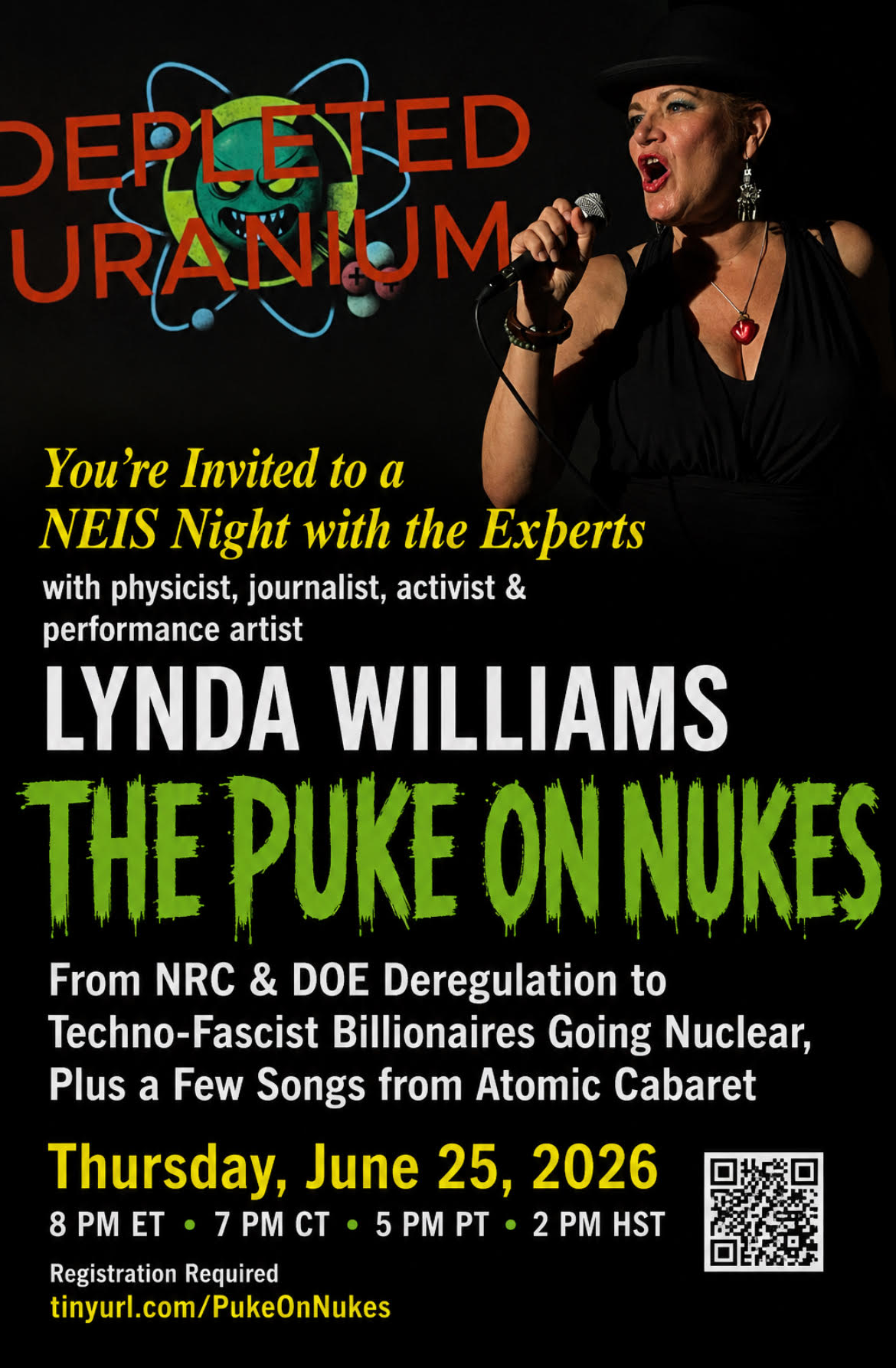
25 June- THE PUKE ON NUKES
Thursday, June 25, 2026
7pm Central Time (8pm ET, 6pm MT, 5pm PT) UTC – 5
From NRC & DOE Deregulation to Techno-Fascist Billionaires Going Nuclear, Plus a Few Songs from Atomic Cabaret REGISTER
26 June – Radiation Trainwreck at the NRC / Join the Protect Better Campaign – https://us02web.zoom.us/meeting/register/4ZlZ5_qLSHGiLSCg8FF6Bg#/registration


Cuba Is Not a Failed State – It Is a Besieged State
PETITION: “Global Appeal to Endorse Palestinian Right of Return of Refugees”
To see nuclear-related stories in greater depth and intensity – go to https://nuclearinformation.wordpress.com
-
Archives
- June 2026 (193)
- May 2026 (306)
- April 2026 (356)
- March 2026 (251)
- February 2026 (268)
- January 2026 (308)
- December 2025 (358)
- November 2025 (359)
- October 2025 (376)
- September 2025 (257)
- August 2025 (319)
- July 2025 (230)
-
Categories
- 1
- 1 NUCLEAR ISSUES
- business and costs
- climate change
- culture and arts
- ENERGY
- environment
- health
- history
- indigenous issues
- Legal
- marketing of nuclear
- media
- opposition to nuclear
- PERSONAL STORIES
- politics
- politics international
- Religion and ethics
- safety
- secrets,lies and civil liberties
- spinbuster
- technology
- Uranium
- wastes
- weapons and war
- Women
- 2 WORLD
- ACTION
- AFRICA
- Atrocities
- AUSTRALIA
- Christina's notes
- Christina's themes
- culture and arts
- Events
- Fuk 2022
- Fuk 2023
- Fukushima 2017
- Fukushima 2018
- fukushima 2019
- Fukushima 2020
- Fukushima 2021
- general
- global warming
- Humour (God we need it)
- Nuclear
- RARE EARTHS
- Reference
- resources – print
- Resources -audiovicual
- Weekly Newsletter
- World
- World Nuclear
- YouTube
-
RSS
Entries RSS
Comments RSS
 nuclear-news