All is not fine for India’s nuclear power programme
A study by the U.S.-based Institute for Energy Economics and Financial Analysis, that was released recently by the A.P.-Telangana-based voluntary organisation Human Rights Forum, warns India that GE-Hitachi and Westinghouse nuclear reactors are neither cost-effective nor power-efficient and that they have a huge risk factor.
This time round, the CPI(M) has decided to take up the cause in a big way. Senior party leader Prakash Karat visited Kovvada and other villages to interact with fishermen and farmers and addressed a public meeting there on July 16. The CPI(M) has given a call for a broad-based struggle against the nuclear plant at Kovvada, which Karat said would be a white elephant considering its steep projected cost. “This project is a bonanza for American business
 The coast isn’t clear for India’s nuclear power quest, THE HINDU, K. VENKATESHWARLU , 28 July 16 A cluster of plants promises to turn coastal Andhra Pradesh into the country’s nuclear energy hub, but at what cost? At Kovvada, first off the blocks, K. Venkateshwarlu discovers some uneasy answers. Continue reading
Nuclear industry astonished as British government stalls plans to build Hinkley C nuclear power station
 Plans to Build World’s Largest Nuclear Plant on Hold, EcoWatch, Climate News Network 29 July 16
The British government astonished the nuclear industry late last night by refusing to go ahead with plans to build the world’s largest nuclear plant until it has reviewed every aspect of the project.
The decision was announced hours after a bruising meeting of the board of the giant French energy company EDF, at which directors decided by 10 votes to seven to go ahead with the building of two 1,600 megawatt reactors at Hinkley Point in Somerset, southwest England………
critics of the controversial project were delighted. John Sauven, the executive director of Greenpeace, said: “Theresa May now has the chance to stop this radioactive white elephant in its tracks.”
“She should look at the evidence and see that this deal would be a monumental disaster for the taxpayers and the bill payers. Countless experts have warned that for British families this power station will be terrible value for money, Sauven added.”
Until last night, the UK was the most positive country in Europe about nuclear power and planned to build a total of 10 nuclear power plants, Hinkley Point being the first of them. This was despite the fact that nuclear costs continue to escalate while its main competitors—renewables of all kinds—fall in price.
The Hinkley Point project is now more expensive than offshore wind power, which is the most expensive renewable and is far more costly than solar and onshore wind. Biogas and small-scale hydro projects in Britain, all so far underdeveloped, are also cheaper than nuclear…….
Safety Fears
The price of all renewables is going down as they develop, while the price rises for nuclear power, with safety fears and threats from terrorism pushing costs up.
It is also argued, even by the UK’s national electricity grid, that the day of the large power plant is over, to be replaced by small local generators providing electricity near to homes and factories—something that renewables are ideally suited for.
Even France, which has 58 reactors and is building a Hinkley prototype at Flamanville in Normandy, has no plans to build any more. All its new energy projects are renewables and it has plentiful supplies of untapped wind and solar power, which are cheaper……..http://www.ecowatch.com/plans-to-build-worlds-largest-nuclear-plant-on-hold-1949913505.html
Hillary Clinton and Donald Trump on nuclear weapons

 How Close Are We to Nuclear War? By William Boardman Global Research, July 28, 2016 And what might we expect from the next American President?
“……….Republican Donald Trump seems to have published no formal policy on nuclear weapons or foreign policy. In interviews, Trump has indicated a dislike of nuclear proliferation, but has also said it’s probably “going to happen anyway,” and maybe the U.S. “may very well be better off” if countries like Saudi Arabia, Japan, and South Korea had their own nuclear weapons. He implied a willingness to use nuclear weapons against the Islamic State, or even in Europe under undefined circumstances: “I’m not going to take it off the table.” He also told the New York Times on July 20 that if Russia, for no particular reason, attacked one of the Baltic states, he’d want to make sure that they “have fulfilled their obligations to us” before coming to their defense. He did not address the U.S. treaty obligations under NATO. He has called for re-negotiating treaties that he says are too expensive for the U.S. But, in an odd and perhaps inadvertent way, his answer on the Baltic states speaks indirectly to the 20-year madness of putting Russia’s neighboring countries into the hostile NATO alliance. Trump has also spoken of pulling back forward deployments of American forces around the world, including elements of nuclear deterrence.
Democrat Hillary Clinton has called Trump’s positions “truly scary.” Clinton has indicated her willingness to use nuclear weapons – “massive retaliation” – against Iran in defense of Israel. She has expressed but limited support and limited opposition to the Obama administration plan to spend $1 trillion upgrading the U.S. nuclear arsenal. In an ad falsely claiming she was responsible for “securing a massive reduction in nuclear weapons,” Clinton has over-stated the impact of the new START treaty, which has been minimal in reducing nuclear weapons. As Secretary of State, Clinton appointed an utterly unqualified political donor to the International Security Advisory Board dealing with nuclear weapons. Clinton, like Trump, seems to have published no formal foreign policy on nuclear weapons of foreign policy. She has opposed the idea of Japan having its own nuclear arsenal, while at the same time falsely saying Trump “encouraged” the idea.
Where is the candidate who speaks truthfully of reality?………..
Those who don’t speak up are complicit in silence
In 1996, Secretary of Defense William J. Perry was the only member of President Clinton’s cabinet who got it right, including the President himself. Perry was the only cabinet member who opposed enlarging NATO with former Soviet bloc countries. Perry was the only cabinet member then, and perhaps since, to object to the American policy of steady, stealthy, soft aggression against Russia (including the Ukraine coup) that would lead inevitably to direct confrontation between the world’s largest nuclear weapons states. Perry has called for radical change in the U.S. nuclear force structure consistent with actual deterrence, actual defense, not aggressive war. He would reduce the nuclear triad (about which Trump apparently knew nothing last October), keeping only the sea-based missiles in nuclear submarines and eliminating nuclear bombers and nuclear missiles. This would save millions of dollars and reduce the risk of accidental nuclear war. But it is heresy among the believers in faith-based nuclear policy.
And yet, in an election year, “no one is discussing the major issues that trouble Perry,” as Jerry Brown wrote: “And why does most all of official Washington disagree with him and live in nuclear denial?” In January 2016, while promoting his book, Perry wrote:
What I am really advocating is not so much a particular force structure, but a serious national discussion on this issue, the outcome of which has hugely important security and financial consequences — for the U.S. and for the world. Considering the huge costs entailed, and, even more importantly, the transcendental security issues at stake, we must not simply drift into a decision….
And yet the country drifts on, blissfully unaware, and it’s a mystery why a man as accomplished and respected as Perry has not done more to wake the country out of its sleepwalking incomprehension. But it may be a tragedy that we have neither a President nor a would-be President who would or could confront our potentially fatal collective denial.
William M. Boardman has over 40 years experience in theatre, radio, TV, print journalism, and non-fiction, including 20 years in the Vermont judiciary. He has received honors from Writers Guild of America, Corporation for Public Broadcasting, Vermont Life magazine, and an Emmy Award nomination from the Academy of Television Arts and Sciences. http://www.globalresearch.ca/how-close-are-we-to-nuclear-war/5538453
Climate change will drive voter turnout in America
 DEMOCRATIC CONVENTION: Steyer: Climate change will drive voter turnout EE News Evan Lehmann, E&E reporter ClimateWire: Tuesday, July 26, 2016 PHILADELPHIA — Billionaire climate advocate Tom Steyer believes young Americans will cast more votes this year based on rising temperatures than in past presidential elections.
In an interview with ClimateWire last night, the founder of NextGen Climate also downplayed the idea of placing a price on carbon dioxide and dismissed the notion of swapping the Clean Power Plan for a carbon tax.
That’s a huge wedge issue,” Steyer said of young voters’ concern about climate change. “I think it’s a critical issue as to whether they turn out.”
NextGen is spending more than $25 million to encourage millennials to vote in November. Young adults currently account for the largest and most diverse population in the United States, and Steyer believes that could help Hillary Clinton beat Donald Trump on Nov. 8.
Separately, Steyer’s group is partnering with five different unions to canvass working-class and minority neighborhoods, where the issue of climate change could help compel young voters to turn out this fall. Large percentages of African Americans and Latinos believe that global warming is occurring, and Steyer’s group is trying to turn those concerns into electoral action.
We’re spending a lot of time trying to do voter-to-voter contact in the swing states, trying to make sure they are aware of the facts, know the difference between the candidates and know how important their vote is,” Steyer said.
Inside the Wells Fargo Center last night, Sen. Bernie Sanders of Vermont and other speakers raised their own concerns about climbing temperatures on the first day of the Democratic National Convention.
“This election is about climate change, the greatest environmental crisis facing our planet,” Sanders told the audience packing the basketball arena.
“Hillary Clinton is listening to the scientists who tell us that — unless we act boldly and transform our energy system in the very near future — there will be more drought, more floods, more acidification of the oceans, more rising sea levels. She understands that when we do that, we can create hundreds of thousands of good-paying jobs,” he said. “Donald Trump? Well, like most Republicans, he chooses to reject science. He believes that climate change is a ‘hoax,’ no need to address it.”
Trump aims for Bernie supporters
Last night’s program also included a short video on climate change and its impact on the Everglades.
“The effects of climate change can no longer be ignored,” the narrator in the video said, noting that warming threatens seagrass and mangroves in the Everglades, which absorb carbon. It touted the Obama administration’s $2.2 billion funding for restoration of the Everglades, which among other things will help improve the local drinking water supply.
The video was followed by a speech from Sen. Jeff Merkley (D-Ore.), the lone senator to endorse Sanders during the presidential primary campaign. He said Sanders “emboldened us” to push for 100 percent renewables but added, “We need to fight together with Bernie and Hillary.”…..Reporters Josh Kurtz, George Cahlink and Mike Soraghan contributed. http://www.eenews.net/stories/1060040774
Future of UK’s Bradwell and Sizewell nuclear projects now in doubt as government to review Hinkley plan

 Bradwell & Sizewell futures unclear after delayed Hinkley decision http://www.itv.com/news/anglia/story/2016-07-28/bradwell-sizewell-futures-unclear-after-delayed-hinkley-decision/
A late move by the government to review all of the component parts of the proposed nuclear power deal in the region has cast doubt that it will go ahead in its current form.
The French Energy giant EDF has agreed to fund a new nuclear power station at Hinkley Point in Somerset which was expected to pave the way for new plants to be constructed at Sizewell in Suffolk and Bradwell in Essex.
In a dramatic twist though, the Government says it now won’t decide whether to proceed with the projects until the autumn.
The £18 billion Hinkley project is “on ice” to allow the prime minister Theresa May to “make up her mind”, ITV News understands.
EDF approved UK Hinkley nuclear project, but now there’s a new delay
Hinkley nuclear plant faces fresh delay after EDF approves investment, Ft.com 28 July 16
Ministers announce new review immediately after EDF gives green light to £18bn project The plan to build an £18bn nuclear reactor at Hinkley Point was hit with a last-gasp delay on Thursday night as the government decided to hold a new review hours after EDF, the project’s French developer, gave it the go-ahead.
He said: “The UK needs a reliable and secure energy supply and the government believes that nuclear energy is an important part of the mix. The government will now consider carefully all the component parts of this project and make its decision in the early autumn.”
One person said the scheme was expected to proceed after the review but the fresh delay had been a surprise.
The news came after EDF had given the go-ahead for the UK’s first nuclear power plant in 20 years, approving the Hinkley Point scheme at a board meeting on Thursday.
Directors approved the long-delayed project during a meeting in Paris. But opposition from within the company was underlined by the resignation in protest of a board member as the meeting started. The board was more divided than had been expected…….
critics say the project could also risk the financial future of EDF, the highly indebted French utility, whose chief financial officer Thomas Piquemal quit in March, warning that its future was being put in danger by Hinkley Point.
The scheme has been subject to multiple delays and budget revisions since first being proposed in the mid-2000s as part of what Tony Blair’s government promised would be a “nuclear renaissance” for the UK.
New reactors are also being planned in north Wales and in Cumbria, while EDF wants to help develop two sites after Hinkley Point — at Sizewell in Suffolk and Bradwell in Essex.
EDF had hoped to take the final investment decision earlier this year but it was postponed amid growing opposition from board members and executives.
That opposition persisted until the end, despite the company’s decision to push ahead with the scheme. As the meeting got under way, Gérard Magnin quit as a state representative on EDF’s board, calling the company’s nuclear strategy “highly risky”.
In the end, the vote was carried by 10 to 7. It was closer than expected, with all six union representatives and one shareholder representative voting against the measure.
Ministers in the UK must now give their final sign-off to the scheme, having already agreed to pay £92.50 — double the current wholesale price — for each megawatt hour of electricity it produces for 35 years………https://next.ft.com/content/181077e2-54dc-11e6-befd-2fc0c26b3c60
Like Brexit, UK’s Hinkley nuclear plan is based on shaky politics, not on economic reality
Areva, the French state-owned company which makes the reactors, is being taken over by EDF but it is being investigated by France’s Nuclear Safety Authority over “irregularities” in 400 parts. Areva also faces a state aid investigation.
 Even many of the staff inside EDF think Hinkley is a colossal white elephant. The company’s unions, who are represented on the board, fear the project will sink the company and have started legal action to delay the decision, while its finance director resigned in March.
For Hinkley, as with Brexit itself, political chicanery has triumphed over economic reality.
Hinkley’s nuclear plant fails all tests – bar the politics https://www.theguardian.com/environment/damian-carrington-blog/2016/jul/28/hinkley-point-c-nuclear-plant-fails-all-tests-bar-the-politics
Huge, expensive and difficult to build, Hinkley is a throwback to the last century, just as the world is embracing the smart energy systems of the future, Guardian, Damian Carrington, 29 July 16 The new nuclear reactors now given the go-ahead at Hinkley Point have failed every test bar the one that finally mattered – political expediency.
The plant, to be paid for by UK energy customers, could cost them £37bn and is a leading contender for the most expensive object ever built on the face of the Earth. A former Conservative energy secretary calls it “one of the worst deals ever” for Britain.
It faces formidable commercial, technical and legal obstacles to getting built remotely on time or budget, or indeed at all. And while the rest of the world is accelerating ahead with the smart energy systems of the 21st century, Hinkley is a throwback to the nuclear age of the 20th.
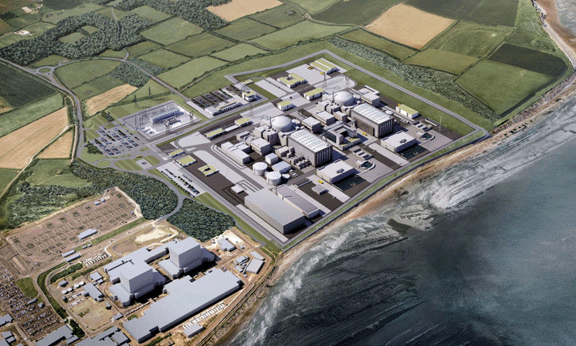
But the French government, which majority-owns Hinkley’s builders EDF, wants to preserve its national nuclear industry. The UK government, blinded by the dazzle of a mega-project, is happy to let its citizens pick up the bill.
It has taken almost a decade to get to this point. In 2007, EDF said British Christmas turkeys would be being roasted with its nuclear electricity in 2017. The earliest possible switch-on now is 2026, another decade away.
What is scary is that reaching the final decision to go ahead was the easy bit. Now they have to deliver a giant and fiendishly complex construction project, described by one nuclear engineer as like “building a cathedral within a cathedral”, that is, “unconstructable”.
EDF has never managed to build the types of reactors intended for Hinkley. Its two attempts so far, in France and Finland, remain many years behind schedule and many billions over budget. Perhaps they are hoping for third time lucky.
UK nuclear power generation is £27.5 more expensive per MWh than that generated by gas power plants
Yet the commercial foundations for this engineering miracle are incredibly shaky. EDF is on the ropes financially and had to be given a €3bn bailout in April by the French government. That may well be challenged under EU state aid rules, which would join an ongoing state aid legal case brought by Austria against UK subsidies for Hinkley.
It gets worse. The French Financial Markets Authority raided EDF this month, investigating allegations that it misrepresented the cost of Hinkley and other projects. Banks and other financial institutions already loathed the Hinkley plan, with EDF warned of further credit rating downgrades if it goes ahead, making its huge debt more expensive to maintain.
Areva, the French state-owned company which makes the reactors, is being taken over by EDF but it is being investigated by France’s Nuclear Safety Authority over “irregularities” in 400 parts. Areva also faces a state aid investigation.
Even many of the staff inside EDF think Hinkley is a colossal white elephant. The company’s unions, who are represented on the board, fear the project will sink the company and have started legal action to delay the decision, while its finance director resigned in March.
With foundations this unsound, you would think the UK could get out of the deal easily if it turns sour. But think again. The deal to be signed with EDF contains a “poison pill” which could leave taxpayers with a £22bn bill if a future UK government shuts the plant down.
The government is adamant that Hinkley, which could provide 7% of the UK’s electricity, is a vital part of a secure low-carbon future. But a barrage of recent reports from serious players say the opposite. The future is not gigantic centralised energy plants, but widespread networks of renewable energy and storage, interconnected across the continent, bolstered by energy efficiency measures and the smart management of demand.
Hinkley Point C will provide 7% of UK electricity when it starts to produce electricity in 2025
Bodies including the government’s own National Infrastructure Commission(NIC), the National Grid, industry group Energy UK, all point to a smart system that is more secure, cheaper and faster to build. They all use the same word – “revolution” – for the fast changes now happening in energy, while theInternational Energy Agency talks of a rapid “transition”.
Hinkley’s reactors are a revolution only in the sense that they overturn all logic. Energy efficiency could deliver six Hinkley’s worth of electricity by 2030, interconnector cables to Norway, Denmark and France could add another two or three Hinkleys to the grid by 2025 and four Hinkleys’ worth of electricity could be saved by 2030 by increasing the ability to store electricity and making the grid smarter, with the latter alone saving bill payers £8bn a year. Solar and wind power are also cheaper than Hinkley’s nuclear power.
EDF had said its decision on Hinkley would be made in September at the earliest. So why the sudden rush, after so many years of delay? The company’s announcement that the decision was being brought forward came on the evening after Theresa May, keen to signal post-Brexit Britain remains open for business, had met Francois Hollande for talks. For Hinkley, as with Brexit itself, political chicanery has triumphed over economic reality.
Hinkley Point nuclear station – not just a folly – but a massive folly
Why Hinkley Point is a nuclear folly of Titanic proportions https://www.newscientist.com/article/2099287-why-hinkley-point-is-a-nuclear-folly-of-titanic-proportions/ French utility company EDF is going ahead with plans for a massive new nuclear reactor in the UK, but there are many reasons to doubt it will ever be finished, says Michael Le Page
It’s also crucial for France, which largely owns EDF, the company that will build Hinkley. France needs the project to help cover the huge cost of revamping its ageing collection of nuclear plants, which currently supply three-quarters of the country’s electricity. And Hinkley matters to China, too, as one of its state-owned companies will be stumping up a third of the cost.
But despite today’s much-delayed decision by EDF to go ahead with the megaproject, its future still looks doubtful. There are huge financial, legal, technical and safety-related icebergs lurking in the seas ahead.
Behind schedule
One reason why is that the two reactors planned for Hinkley are based on a new design. The EPR design is supposed to be safer and more efficient, but it has proved so difficult to construct that not one has yet been completed.
EDF started building the first EPR, at Olkiluoto in Finland, in 2005. It was supposed to start up in 2009. Work on the second, at Flamanville in France, began in 2007 and was due to be finished in 2012. Another two EPRs are being built in Taishan, China. All four projects are years behind schedule and have cost billions more than expected.
There are also worries about the fact that a state-owned Chinese company will be supplying some of the parts and workers for the project. The UK’s intelligence agencies are said to be concerned that a “back door” could be built into the control systems, allowing China to shut down the plant if it wanted to.
Last but not least, there are various legal challenges pending. The Austrian government, for instance, is appealing against the European Commission’s decision to approve state aid for the project, saying it breaches European laws. Meanwhile, French authorities are investigating possible financial misreporting by EDF.
Even in the unlikely event that the Hinkley project dodges all these icebergs, there may not be a happy ending. Many analysts think it’s a bad deal for the UK, because it has had to promise to pay a very high price for Hinkley’s electricity.
The worst-case scenario is that the project sails on for many more years before finally sinking. That will be a disaster for everyone.
France’s State-owned nuclear company EDF decides to go ahead with UK’s Hinkley nuclear station
£18 billion Hinkley Point nuclear power station gets go ahead from EDF, Mirror, 28 JUL 2016 BY ALAN JONES , MIKEY SMITH
The French energy giant has decided to press ahead of a new plant in a crunch board meeting in Paris
EDF has given the go ahead to building a new nuclear power station at Hinkley Point, after a crunch board meeting in Paris.
The French energy giant had been expected to make the final investment decision today , clearing the way for the £18 billion project to go ahead.
Reports said the board voted by 10-7 in favour. EDF in the UK made no immediate comment.
John Sauven, Greenpeace executive director, said: “This deal was more riven with dissension in the EDF board than anyone expected. It’s unprecedented division and far closer than predicted.
“Countless experts have warned that for British families this power station will be terrible value for money.
“This is a bitter pill to swallow for hard up people who have been told that the Government is trying to keep bills down while dealing with energy security and lowering carbon emissions………..
A director opposed to the construction of Hinkley Point C resigned before the board met.
Gerard Magnin said in his resignation letter that Hinkley Point was “very risky”.
He did not attend the board meeting, leaving 17 directors to make the crucial decision. http://www.mirror.co.uk/news/uk-news/18-billion-hinkley-point-nuclear-8514859
South Africa’s nuclear company Eskom urging government to freeze renewable energy program
 Is Eskom building a case for nuclear power?, Business Day Live, BY SALIEM FAKIR JULY 28 2016, IT IS disconcerting that Eskom is advising the government to freeze a globally acclaimed renewable energy programme based on a perceived misunderstanding of the benefits of the renewable energy independent power producer (IPP) programme.
Eskom has justified its recent announcement not to sign further power purchase agreements with independent power producers with reasons that range from questions about the need for additional renewables and baseload IPPs, to improved operating performance, its large-scale new build programme, and protecting consumers from higher prices by not buying additional capacity.
Yet, the renewable energy programme is regarded as highly successful, and it delivers a wide range of benefits at the best prices given that it is a buyer’s market.
Eskom’s own 2016 financial report states that wind and solar are now cheaper than coal-generated electricity. The Treasury has stated that 92 renewable energy programme projects have attracted R193bn in private sector investment, totalling a contribution of 6,327 MW of capacity to the national grid. The total projected value of goods and services to be procured from broad-based black economic empowerment suppliers is put at more than R101bn.
Investment in renewables accounted for 85.8% of total direct foreign investment in SA in 2014. A Council for Scientific and Industrial Research report revealed that wind energy produced net savings of R1.8bn in the first half of 2015 and was also cash positive for Eskom by R300m.
The net savings can be attributed to avoiding diesel and coal fuel costs, as well as the economic costs of load shedding. Renewable energy in total generated a net benefit for the economy of up to R4bn. Renewable energy production has cut 4.4m tonnes of carbon dioxide.
At a policy level, the government has indicated that renewable energy has to be ramped up. The country’s energy vision and the National Development Plan call for a greater mix of energy sources and a greater diversity of IPPs in the energy industry, with the 2010 Integrated Resource Plan’s vision calling for 17,800 MW of renewable energy to be in place by 2030.
Internationally, SA is a signatory to the Intergovernmental Panel on Climate Change (IPCC) global climate change agreement to keep planet emissions beneath 1.5°C by honouring carbon emissions reduction targets.
Legally speaking, Eskom is a buyer of electricity, with the Department of Energy procuring capacity in line with ministerial determinations. The government’s commitment has been laudable. It is worrying that Eskom seems to wish to erode this………..
It seems Eskom is building a case for nuclear and this is the real reason behind the freeze on further renewable procurement. There is no guarantee that the proposed large nuclear new build programme will be cheap, considering that Medupi and Kusile are proving to be more expensive than some renewables. We would urge pragmatism and prudence on their part.
• Fakir is the head of the policy and futures unit with the World Wide Fund for Nature in SA. http://www.bdlive.co.za/opinion/2016/07/28/is-eskom-building-a-case-for-nuclear-power
Climate change a focus for the USA Democrats election policy
Finally, Climate Change Gets Stage Time At The Democratic Convention“This election is about climate change, the greatest environmental crisis facing our planet,” Sen. Bernie Sanders said. Huffington Post, 26/07/2016 Just one night into the Democratic National Convention, things are looking a whole lot brighter for the environment under a potential Hillary Clinton presidency than anything we heard in Cleveland last week.
Sen. Bernie Sanders (I-Vt.), long a champion of climate action, dedicated a large portion of his speech in Philadelphia on Monday addressing “the greatest environmental crisis on our planet.”……
Those sentiments were echoed by Sen. Elizabeth Warren (D-Mass.) just moments earlier. In her keynote address, Warren called out the fossil fuel industry while praising Clinton’s inclusion of climate action as a key part of her campaign……..
The inclusion of climate topics at the DNC is a far cry from the almost nonexistent mention of climate change and fossil fuel money at last week’s RNC. Republican nominee Donald Trump, who has called climate change a “hoax” and said he isn’t a “great believer” in man-made global warming, didn’t mention the environment onceduring his acceptance speech.
The only person to speak about the issue on the RNC stage was Harold Hamm, a fracking mogul who said, “climate change isn’t our biggest problem,” and instead called for more oil and gas production, Grist reported.
Scientists have long called for extreme action to halt the worst effect of climate change. Representatives from 195 nations reached a landmark deal in Paris last year pledging to lower greenhouse gas emissions…….http://www.huffingtonpost.com.au/entry/climate-change-dnc_us_5796e480e4b0d3568f84585a
French government propping up nuclear company EDF with a cash boost
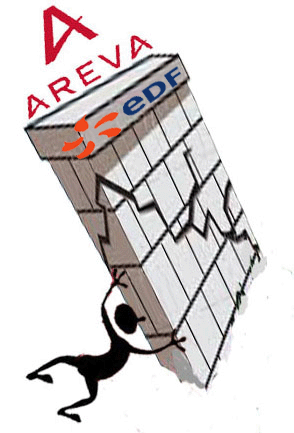
 French nuclear company EDF to get cash infusion http://www.dw.com/en/french-nuclear-company-edf-to-get-cash-infusion/a-19428058
The French government has said it will go ahead with a 4-billion-euro share issue for state-controlled electricity firm EDF. The move will help finance the construction of two controversial nuclear reactors in the UK. The French state – which holds 85 percent of EDF – said it will buy three billion euros’ worth of the newly issued EDF shares sometime this year. The fourth billion will be chipped in by other investors.
EDF’s board of directors is expected to give final investment approval this week for the construction of two EPR nuclear reactors at Hinkley Point in southwestern England, home to two old Magnox reactors that are no longer in operation and two AGR gas-cooled reactors whose construction began in 1967 and are still in operation, but whose decommissioning date is currently set for 2023.
EDF had delayed the final investment decision on the new Hinkley Point reactors several times, as it sought other investors to share the costs amid concerns the heavily indebted company will struggle to meet its financial commitments.
Internal skeptics abound The six labor-union representatives sitting on EDF’s 18-member board have repeatedly opposed the project. They wanted to see it delayed by three years to give EDF time to complete the construction of similar reactors in France, Finland and China, which are several years behind schedule.
The company’s works council secretary, Jean-Luc Magnaval, told the news agency Reuters that his union had filed a complaint on the matter with a Paris court, which has scheduled a hearing on the case for August 2.
EDF’s chief financial officer has resigned over the threat the project represents to the company’s finances.
EDF is also planning to speed up renovation of its 58 nuclear reactors in France, a task expected to cost about 51 billion euros.
EDF, which has already spent about 3 billion euros on Hinkley Point C, needs the project “to maintain its know-how and prepare for the retirement and renewal of its aging French and British nuclear fleet,” chief executive Jean-Bernard Levy told shareholders on Tuesday. He added that the new capital would also help the bolster the company’s credit rating and its ability to refinance its 37.4 billion euro debt.
Sparing no expense The Hinkley Point project is a joint venture between EDF and China General Nuclear Power Corporation. It’s one of the world’s most costly nuclear power plant projects.
The most recently projected price tag was a whopping 18 billion pounds ($24 billion, 21.7 billion euros), before Brexit lowered the value of the pound.
However, a complex system of subsidies approved by former UK finance minister, George Osborne, could cost up to 37 billion pounds, according to a recent estimate published by the UK Department of Energy and Climate Change.
Nuclear renaissance?
The UK’s environment secretary, Andrea Leadsom, recently reiterated that the Hinkley Point project will kick-start a “nuclear renaissance” in Britain that would see 18 gigawatts of new capacity added if sites at Sizewell, Bradwell, Moorside, Wylfa and Oldbury are developed along with Hinkley Point C.
Nuclear power accounts for around 16 percent of the UK’s energy requirements, which could drop to three per cent in 2030 unless new reactors are built in the meantime, Leadsom said.
EPR reactors are third-generation nuclear reactors which use pressurised water as their cooling fluid. At present, most operating reactors around the world are second-generation reactors; only around a dozen Generation 3 reactors are in operation so far.
A variety of Generation 4 reactor designs, which engineers hope will be more inherently safe and more cost-efficient than previous generations, are in various stages of prototype development, but none are expected to be commercially available before about 2030 or 2040.
By that time, however, renewable energy technologies and battery storage systems may have attainedsuch a low cost that construction of new nuclear power stations may prove a tough sell financially. That’s already the case for the Hinkley Point C project and for EDF’s other three existing EPR reactor projects around the world, all of which have proven to be far more expensive than optimistic early estimates, and very likely none of which would be getting built had they not been supported by heavy government subsidies.
Report questions value of new nuclear projects in Wales compared with renewables
 New nuclear projects in Wales must be ‘cost-competitive’ with renewables, say MPs , Business Green, 26 July 16 Planned nuclear sites in North Wales should only go ahead if government can prove development is ‘value for money’, as Business Secretary Greg Clark visits Japan to fan investor interest in UK nuclear projects
Lawmakers on the Welsh Affairs Committee have published a new report insisting that before proposed nuclear developments at Wylfa Newydd and Trawsfynydd in North Wales go ahead the government must prove the financial viability and community benefit of the projects.
“The government must prove that the cost of any nuclear development is well understood and competitive with renewable sources. These costs must be made public in a format that can be easily understood,” Committee chair David Davies MP said.
“There has to be a demonstrable benefit for the local community as well,” he added. “Local businesses must form a key part of the supply-chain and be given sufficient information to allow this to happen.”………
The report concludes the government should only support the development at Wylfa Newydd if the strike price for the project’s electricity is competitive with renewables and below that of Hinkley Point C, EDF’s controversial nuclear project in Somerset which is due to receive a final investment decision this week. Hinkley’s strike price is £92.50 per MWh – more than double the current market price of power. In comparison, the strike price for onshore wind is around £80 per MWh with some experts now arguing new onshore wind farms can be built at a lower levelised cost than new gas power plants. ……..
Cost estimates for Wylfa Newydd must cover the lifetime of the project, including decommissioning and waste disposal, MPs said, after concerns were raised during their investigation that nuclear power projects are often subject to delays and cost schedule overruns. Cost estimates for Hinkley Point C have ballooned from £16bn in 2012 to almost £21bn earlier this year, while last week EDF’s Paris headquarters were raided by the French finance authorities investigating concerns about its reporting of maintenance and development costs………http://www.businessgreen.com/bg/news/2465917/new-nuclear-projects-in-wales-must-be-cost-competitive-with-renewables-say-mps
 |
Click here to Reply or Forward
|
Nuclear industry to get a heft subsidy from New York residents
 A hefty nuclear subsidy Times Union, July 25, 2016 “……… It’s one thing to keep nuclear plants running temporarily while the state transitions to green energy. It’s another to hand nuclear plant operators billions of dollars that could instead be used to move New York that much more quickly to a clean energy future.
The nuclear subsidies are being proposed in the state’s Clean Energy Standard. The CES, also known as the “50-by-30” plan — because it seeks to achieve the 50 percent clean energy goal by 2030 — would shift more of the state’s electricity supply to sources like wind, solar, hydropower and biomass, and away from fossil fuels.
Some want nuclear power in the mix, too, but it has some not-insignificant problems — the risk of an accident, and the still-unresolved question of safe disposal of radioactive waste. It’s hard to see nuclear power plants as being part of an environmentally sound energy future.
As a short-term bridge to that future, however, they could play a part, if they can stand on their own. Supporters say they can’t in the current market.
So the CES would include a program of “zero emissions credits” — a charge that utilities and energy service companies would pay to keep nuclear plants open. Those costs are expected to start at $965 million for the first two years, rising to about $1 billion a year, paid for by, well, pretty much anyone with an electricity bill……
What, however, is a reasonable windfall? Just how much do these plants realistically need to stay open? Is the state fattening nuclear plant profits with money that could be used to fund more alternative energy, and more energy savings programs, and achieve the CES goals even sooner?…….http://www.timesunion.com/tuplus-opinion/article/Editorial-A-hefty-nuclear-subsidy-8416153.php
Hillary Clinton selects pro nuclear advocate Tim Kaine as running mate
GOP. 22 July 16 “………Kaine Supported Nuclear Power As A Solution To Meeting Virginia’s Energy Needs. “In Virginia last week, a panel on reducing climate change appointed by Gov. Timothy M. Kaine (D) considered adding nuclear power to its menu of recommendations. The governor’s energy plan also supports nuclear power as one solution to meeting the state’s energy needs, which are expected to grow by the equivalent of a million homes in the next decade.” (Lisa Rein and Christy Goodman, “Little Outcry On Nuclear Reactor Proposal,” The Washington Post, 8/4/08)…..https://gop.com/meet-tim-kaine/
1 This Month
15 October. Joint Appeal for Nuclear Abolition Day -presentation to the UN on October 15 will be live on UNWebTV
Endorse the Nuclear Abolition Day Appeal
23-25 October – on Zoom – World BEYOND War’s annual global conference

To see nuclear-related stories in greater depth and intensity – go to https://nuclearinformation.wordpress.com
-
Archives
- October 2026 (149)
- September 2026 (339)
- August 2026 (330)
- July 2026 (355)
- June 2026 (287)
- May 2026 (306)
- April 2026 (356)
- March 2026 (251)
- February 2026 (267)
- January 2026 (308)
- December 2025 (358)
- November 2025 (359)
-
Categories
- 1
- 1 NUCLEAR ISSUES
- business and costs
- climate change
- culture and arts
- ENERGY
- environment
- health
- history
- indigenous issues
- Legal
- marketing of nuclear
- media
- opposition to nuclear
- PERSONAL STORIES
- politics
- politics international
- Religion and ethics
- safety
- secrets,lies and civil liberties
- spinbuster
- technology
- Uranium
- wastes
- weapons and war
- Women
- 2 WORLD
- ACTION
- AFRICA
- Atrocities
- AUSTRALIA
- Christina's notes
- Christina's themes
- culture and arts
- Events
- Fuk 2022
- Fuk 2023
- Fukushima 2017
- Fukushima 2018
- fukushima 2019
- Fukushima 2020
- Fukushima 2021
- general
- global warming
- Humour (God we need it)
- Nuclear
- RARE EARTHS
- Reference
- resources – print
- Resources -audiovicual
- Weekly Newsletter
- World
- World Nuclear
- YouTube
-
RSS
Entries RSS
Comments RSS

