Donald Trump’s upsetting statements about nuclear weapons
 9 Terrifying Things Donald Trump Has Publicly Said About Nuclear Weapons, THINK PROGRESS
BY JUDD LEGUM AUG 4, 2016 On Wednesday, MSNBC’s Joe Scarborough passed on an intriguing piece of gossip: Donald Trump, speaking with a “foreign policy expert,” repeatedly asked “why can’t we use nuclear weapons.”
Scarborough’s claim was thinly sourced. He didn’t reveal the identity of the expert advising Trump or even where he learned the information. Information attributed to anonymous sources is inherently suspect.
But one need not rely on anonymous sources to glean Trump’s views on nuclear weapons. He has broached the subject repeatedly on the campaign trail. Several of his public comments are similar to Scarborough’s account while others are terrifying in their own way.
Trump said he might use nuclear weapons and questioned why we would make them if we wouldn’t use them [VIDEO]….
Trump said he was open to nuking Europe because it’s a “big place” [VIDEO]……
Trump said that “you want to be unpredictable” with nuclear weapons [VIDEO] ,……
Trump had no idea what the “nuclear triad” was [VIDEO]…….
Trump started talking about nuclear weapons in Pakistan and made no sense at all [VIDEO]…….
Trump said he’d be OK with a nuclear arms race in Asia [VIDEO]…..
The time he said it didn’t matter if Saudi Arabia acquired nuclear weapons because “it’s going to happen anyway” [VIDEO] …. http://thinkprogress.org/politics/2016/08/04/3804985/7-terrifying-things-donald-trump-publicly-said-nuclear-weapons/
UK: Conservatives against Hinkley nuclear power project

 Nu Clear News No 87 5 Aug 16 Anti-Hinkley Tories Perhaps most interesting amongst recent events has been the emergence of Conservative figures calling on the government to call time on the Hinkley proposals. The think-tank Bright Blue, whose advisory board includes Francis Maude, Nicky Morgan and former DECC minister Greg Barker, has said the government needs a new “plan A”. The group stresses that its position is not necessarily endorsed by all members of the organisation, which includes more than 100 parliamentarians. “The Government should abandon Hinkley C – pursuing it in light of all the evidence of cost reductions in other technologies would be deeply irresponsible,” said Ben Caldecott, associate fellow, Bright Blue. “We need a new ‘Plan A’. This must be focused on bringing forward sufficient renewables, electricity storage, and energy efficiency to more than close any gap left in the late 2020s by Hinkley not proceeding. This would be sensible, achievable, and cheap.” Zac Goldsmith, also a Bright Blue member, has welcomed the government’s rethink.
With UK and USA government help, NuScale hopes to go ahead with “mini” nuclear reactors
New Nuclear UK : fears Hinkley uncertainty will affect Wylfa, Moorside, Sizewell and Bradwell
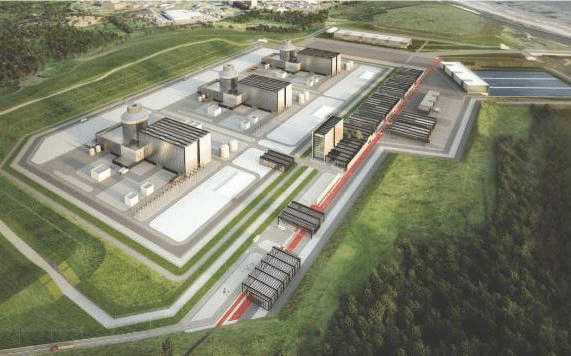 NucClear News No 87, 5 Aug 16 New Nuclear: Wylfa, Moorside, Sizewell and Bradwell. Horizon and NuGen are both insisting that their projects at Wylfa and Moorside are not dependent on EDF getting the go-ahead for Hinkley. But Industry experts have warned that confidence across the sector would be damaged if Theresa May pulls the plug, especially given the French energy giant has already invested £2.4bn in Hinkley with unstinting Government support until now. If Hinkley were cancelled without any reimbursement for EDF, this would “significantly undermine” other developers’ confidence and might prompt them to seek some sort of financial guarantee. (1)
Exelon nuclear snubbed by Illinois legislature, embraced by New York’s governor-appointed state regulators
Exelon finds a nuclear ally in New York after Illinois snub , Chicago Tribune, Mark Chediak and Jim Polson, Bloomberg, 4 Aug 16, In the end, the fate of Exelon Corp.’s money-losing reactors in Illinois and New York may have come down to one governor who desperately wanted to rescue them and another who wasn’t so sure.
New York Gov. Andrew Cuomo laid down his marker in December when he told the chairman of the state’s utility regulator that losing two upstate nuclear plants would gut a plan to cut global warming pollution and cost jobs. On Monday, the state agreed to a bailout and within hours, Exelon said it would invest $200 million in the two plants.
While Illinois Gov. Bruce Rauner also worried about job losses, he said any rescue plan must protect ratepayers and taxpayers and that corporate bailouts raise red flags. In June, Chicago-based Exelon said it would close two Illinois plants after the state legislature balked at a measure to stem their financial losses.
“In New York, it was the governor’s support that did it,” Bloomberg Intelligence analyst Kit Konolige said by phone Wednesday. “In Illinois, from what the governor said in public, it appeared he wasn’t all in.”
Debates over nuclear policy come at a critical time for the industry as U.S. reactors face tough competition from power generators that burn cheap natural gas flooding out of shale formations and rising solar and wind production. As of the end of July, 11 nuclear power plants have closed or are slated to be shut, according to data compiled by Bloomberg Intelligence.
In New York, Exelon benefited from Cuomo’s support and his determination to help upstate reactors as part of a clean energy plan even as he calls for the retirement of Entergy Corp.’s Indian Point nuclear plant near New York City. The state Public Service Commission vote Monday may also save Entergy’s James A. FitzPatrick nuclear plant near Oswego. Exelon said it would consider buying FitzPatrick if subsidies were approved.
Cuomo had the advantage of being able to tap governor-appointed state regulators to weigh the nuclear bailout instead of the legislature, according to Christine Tezak, an analyst at ClearView Energy Partners in Washington……..http://www.chicagotribune.com/business/ct-exelon-nuclear-plant-new-york-20160803-story.html
The Aftermath of a Nuclear War: The Top 1% and the Mission to Mars

The American Empire is Playing a Dangerous Game with its Nuclear Weapons Arsenal The Day After Nuclear Armageddon: Armchair Warriors, Chicken Hawks and the Colonization of Mars? By Timothy Alexander Guzman Global Research, August 01, 2016 “………In 2015, the main-stream media, in this case Newsweek published an article titled ‘Star Wars’ Class Wars: Is Mars the Escape Hatch for the 1 Percent? It claims that wealthy billionaires are planning an escape from planet earth and leave the rest of the human race behind:
It’s nice to know Elon Musk and Jeff Bezos have a plan. They will help the richest people in the world go to Mars and start over, leaving the other 99 percent to suffer on a dying, warring planet. The only solace for those of us left here will be that the Biebs should be prosperous enough to go with them
But those who have the political power and most of the world’s wealth at their disposal are in the midst of creating a plan to leave Earth in case of an apocalyptic scenario whether by a world war or an unstoppable life-threatening disease or any other catastrophe. They have it all figured out. The billionaire founder of Space X, Elon Musk and others like him have an ambitious dream and that is to colonize planet “Mars.” Yes, you heard this right the next planet closest to the sun. Maybe they want to step out into the sun and get an instant sun tan instead of heading out to their private beach or their local overpriced sun tan salons? Living on Mars does not seem like something the average human being would like to do at some point in their lives, maybe visit as a tourist but to live for the rest of their lives? I highly doubt it.
Perhaps Musk is not the only elite multi billionaire who would want to live on another planet or in space far away from the madness of our planet. Besides many of the financial and political elite created the situation that led to war, poverty and disease in the first place for their own benefit whether it was financial or political. According to an interesting article on Elon Musk’s vision of colonizing mars by www.science.com titled ‘Now Is the Time to Colonize Mars, Elon Musk Says’ quotes Musk who addressed an audience at the American Geophysical Union (AGU) and said“now is the first time in the history of Earth that the window is open, where it’s possible for us to extend life to another planet,” he continued “That window may be open for a long time — and hopefully it is — but it also may be open for a short time,” he added. “I think the wise move is to make life multiplanetary while we can.”
According to Newsweek, Musk wants humans to become a “multiplanet species” and maintain an outpost as an “insurance policy” if something catastrophic were to occur on earth
Colonizing Mars has long been a passion of Musk’s. Indeed, the entrepreneur has repeatedly said that he founded SpaceX in 2002 primarily to help make humanity a multiplanet species. Having a self-sustaining outpost on the Red Planet would serve as an insurance policy, making humanity’s extinction unlikely even if something goes terribly awry here on Earth, Musk said Tuesday. Colonizing Mars would have other benefits as well, he added; the effort would greatly advance science discoveries and technological capabilities, and it would help inspire and excite people from all walks of life and from all around the globe
I do agree that colonizing mars would “advance science” but that is as far as I would go for such a project. Musk’s plan to send “people from all walks of life and around the globe” sounds nice but in all actuality is unrealistic. Who would reach Mars? Those with wealth and fortune from mainly the West not the 99 percent will get to go to Mars (and of course if you are willing to live the rest of your life on the red planet)…..http://www.globalresearch.ca/the-american-empire-is-playing-a-dangerous-game-with-its-nuclear-weapons-arsenal/5539076
New York’s subsidy gift to the nuclear industry – the prelude for other States?
 “Nuclear power is not carbon-free,” wrote Michel Lee, head of the Council on Intelligent Energy & Conservation Policy based in Scarsdale. “If one stage,” reactors operation itself, “produces minimal carbon…every other stage produces prodigious amounts.” Thus the nuclear “industry is a big climate change polluter…Nuclear power is actually a chain of highly energy-intensive industrial processes whichcombinedconsume large amounts of fossil fuels and generate potent warming gasses. These include: uranium mining, milling enrichment, fuel fabrication, transport” and her list went on.
Reuters has reported that the nuclear “industry hopes that if New York succeeds, it could pressure other states to adopt similar subsides” for nuclear plants.
New York’s Woeful $7.6 Billion Nuclear Bailout Package http://www.commondreams.org/views/2016/08/02/new-yorks-woeful-76-billion-nuclear-bailout-package by Karl Grossman
New York Governor Andrew Cuomo—who appoints the members of the PSC—has called for the continued operation of the nuclear plants in order to, he says, save jobs at them. The bail-out would be part of a “Clean Energy Standard” advanced by Cuomo. Under it, 50 percent of electricity used in New York by 2030 would come from “clean and renewable energy sources”with nuclear power considered clean and renewable.
“Nuclear energy is neither clean nor renewable,” testified Pauline Salotti, vice chair of the Green Party of Suffolk County, Long Island at a recent hearing on the plan.

The “Clean Energy Standard” earmarks twice as much money for the nuclear power subsidy than it does for renewable energy sources such as solar and wind.
Anti war protest at USA’s Democratic Convention
 A Revealing Moment at the Democratic National Convention https://bracingviews.com/2016/07/28/a-revealing-moment-at-the-
 democratic-national-convention/by wjastore W.J. Astore
Yes, there was a revealing moment at last night’s Democratic National Convention. No, it wasn’t President Obama’s soaring speech, or Joe Biden’s heartfelt appeal, or Tim Kaine’s “believe me” lampoon of Donald Trump. All these were scripted.
It was the anti-war protesters who spoke out against drone assassinations and war while former CIA Director and Secretary of Defense Leon Panetta spoke.
Good for them. This democratic convention has been at pains to please the military. Last night, Panetta called the U.S. military our greatest national treasure. Obama repeated his claim that the U.S. military is the finest fighting force since Cain slew Abel. Tim Kaine opened his remarks by mentioning the Marines and shouting Semper Fi.
The Democrats are the new Republicans: they’re going “all in” on military boosterism and ra-ra patriotism.
Which is why the anti-war protest was so refreshing. End the wars — end the killing — what’s wrong with these protesters for expressing such crazy sentiments at a Democratic political rally? (An aside: my favorite sign read “Fauxmocracy.”)
The DNC response was swift. Apparently, they cut the lights to the section where the main body of protesters sat (the Oregon delegation), but the protesters simply pulled out their Smart phones for light. Panetta, of course, ignored them, carrying on with his prepared speech that vilified Trump for his remarks about Vladimir Putin and hacking. (Pretty dumb by The Donald, but the man is an empty barrel, an Archie Bunker who loves to make lots of noise.)
Most interesting of all was media response. I was watching MSNBC (I think) when a commentator attacked the anti-war protesters for undercutting Panetta’s speech against Trump. Yes, it was the protesters who were TOTALLY in the wrong! How dare they chant “no more war” at a former CIA Director and secretary of war? How dare they challenge an olympian like Panetta while he’s on the stage? How dare they organize and exercise their first amendment rights?
Expect more unbounded praise of the U.S. military tonight by Hillary Clinton. Expect more talk of war. Just don’t expect any honest talk about the cost of America’s wars or any vows about ending them in our lifetimes.
Update (7/28):
I just endured General Allen’s jingoistic speech/scream and all the “USA! USA!” chants, followed by a short speech by a Medal of Honor recipient in favor of Clinton.
After which Brian Williams of MSNBC said, “Sadly,” you could still hear faintly the voices of protesters shouting “No more war.” Why is that so sad, Brian Williams? Why is it so sad for Democrats to be against war? Why must they shut up when a general speaks, a general who boasts of making the U.S. military stronger with even better weaponry with which to kill?
That’s the real “sad” part, Brian Williams: How the Democratic Party has become the war party.
Theresa May not happy with Chinese nuclear investment plans for Britain
 Britain’s May worried by China investment, intervened to delay nuclear deal, SMH, Kate Holton , 31 July 16 London: British Prime Minister Theresa May was concerned about the security implications of a planned Chinese investment in the new Hinkley Point nuclear plant and intervened personally to delay the project, a former colleague and a source said.
The plan by France’s EDF to build two reactors with financial backing from a Chinese state-owned company was championed by Mrs May’s predecessor David Cameron as a sign of Britain’s openness to foreign investment.
But just hours before a signing ceremony was due to take place on Friday, Mrs May’s new government said it would review the project again, raising concerns that Britain’s approach to infrastructure deals, energy supply and foreign investment may be changing.
The decision could prove a test for Mrs May, with any attempt to renegotiate the terms of the project potentially straining relations with Paris and Beijing at a time when Britain is seeking to build trade deals following the country’s vote to leave the European Union.
“When we were in government Theresa May was quite clear she was unhappy about the rather gung-ho approach to Chinese investment that we had,” Vince Cable, Britain’s former business secretary and a leading member of the Liberal Democrats, who governed in coalition with Mr Cameron, told BBC Radio.
He later told Sky News her concerns over China’s involvement were linked to national security. “This was an issue that was raised in general but it was also raised specifically in relation to Hinkley,” he said……..http://www.smh.com.au/world/britains-may-worried-by-china-investment-intervened-to-delay-nuclear-deal-20160731-gqhkm7.html
After Brexit, concerns grow on Britain- Ireland nuclear agreements
Fears grow over nuclear power agreements with UK after Brexit Reports reveal ‘high operational risk’ if UK no longer has to adhere to EU rules on power plant , Independent ie Philip Ryan 31 July 16 senior Government officials have raised serious concerns over the impact Brexit will have on Ireland and Britain’s nuclear power agreements, the Sunday Independent can reveal. A risk assessment compiled by the Department of the Environment in the wake of the Brexit referendum warns of a “high operational risk” to arrangements Ireland has with the UK on nuclear policy.
The briefing document says environmental assessments and mandatory consultation processes “may prove more difficult” to enforce when Britain leaves the European Union (EU).
Ireland has bilateral agreements with Britain which entitle the government to information on the UK’s nuclear programme.
The UK will no longer be tied down by strict EU laws which underpin these agreements once it officially leaves the union.
Documents released following a Freedom of Information request reveal high-ranking civil servants fear information exchanges will be under threat once Britain leaves the EU.
Concerns were first raised two years ago in a risk assessment compiled by the Department of the Environment for the Taoiseach’s Office.
“There could be some issues for Ireland in the event of a change in the current EU/UK relationship in the area of nuclear policy,” the report said…….http://www.independent.ie/business/brexit/fears-grow-over-nuclear-power-agreements-with-uk-after-brexit-34925805.html
Forcible removal of Code Pink activist from Democratic Convention
Code Pink Activist Kicked Out of Democratic Convention
http://www.truthdig.com/avbooth/item/code_pink_activist_gets_kicked_out_of_dnc_20160729on Jul 29, 2016 On the final night of the Democratic National Convention, the mainstream media repeatedly focused on the convention hall full of compliant Hillary Clinton supporters. What they didn’t show was the peaceful protesters dragged out by security. Although aCode Pink’s Medea Benjamin made headlines by interrupting proceedings at last week’s Republican convention, such protests at the Democratic convention did not garner the same attention.
Truthdig’s Sonali Kolhatkar caught one such moment on film when Ariel Gold, a Code Pink activist, was forcibly ejected from the convention hall by Secret Service. Kolhatkar spoke with Benjamin to learn the details of Gold’s ejection.
“She interrupted Governor Cuomo because of the legislation that he has been promoting, to make BDS [the Boycott, Divestment and Sanctions movement] illegal, basically,” said Benjamin, before going on to explain why Palestine is such a crucial issue this election season. “Hillary Clinton is so bad on this issue…we feel she is really pandering to the Israeli government.”
World’s largest nuclear project, UK’s Hinkley Point C, now in doubt
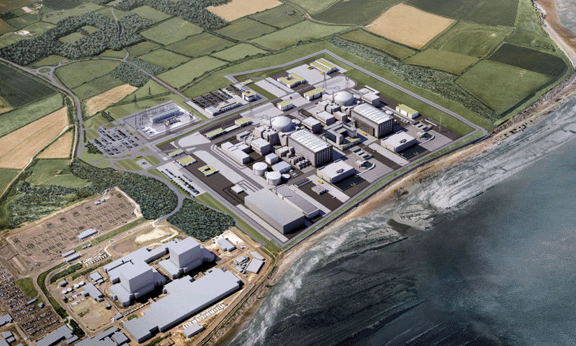 Britain casts doubt on EDF’s $24 billion nuclear project, Reuters LONDON | BY NINA CHESTNEY AND WILLIAM SCHOMBERG, 29 July 16 Britain has cast doubt on a $24 billion (18 billion pounds) project with French utility EDF to build the UK’s first new nuclear plant in decades, delaying a final decision on the plan just weeks after the Brexit vote ushered in a new prime minister.
The surprise decision to review the Hinkley Point C project was made public hours after the board of French state-controlled EDF voted to proceed with it.
The British government, which had been expected to sign contracts on Friday, said instead that it wanted to give the plans further consideration, postponing its verdict until early autumn.
The review came little more than a month after Britons voted to leave the EU in a referendum that forced the resignation of Prime Minister David Cameron – whose administration gave the initial go-ahead to the project – and the accession of Theresa May.
The vote, and the resulting economic uncertainty, threw doubt on the future of major British infrastructure projects, including the nuclear plant……..
Analysts and unions said the review under new Prime Minister May would likely delay the project further……..
Although EDF and Chinese partner China General Nuclear are responsible for the 18-billion-pound ($24 billion) cost of the project, Britain has committed to pay a minimum price for the power generated by the plant for 35 years.
Critics, including some British lawmakers and academics, say the country would be overpaying at that minimum price, which equates to double current market levels.
“Because of the fall in the energy price over the past 12 months, the project does look very expensive and there have been a lot of calls for other projects to be considered or for this to be taken back to the drawing board,” said Oliver Salvesen, analyst at investment bank Jefferies………
The British review could lead to increased resistance in France to the project, which was only narrowly approved by the EDF board on Thursday……
If the project goes ahead after the government’s review, the plant would not come online until the 2030s, industry experts estimate. EDF will still have to shoulder the costs of the long construction phase during which the investment will not generate any cash flow, which is credit negative for the firm, said Paul Marty, vice president and senior credit officer at Moody’s……..http://uk.reuters.com/article/uk-edf-britain-nuclear-idUKKCN1090EW
USA Democrats will mobilise huge action on climate change, if elected
 US Democrats endorse WW2-scale mobilisation on climate challenge http://www.climatechangenews.com/2016/07/28/us-democrats-endorse-ww2-scale-mobilisation-on-climate-challenge/ 28/07/2016, If elected president, Hillary Clinton will convene a climate summit in the first 100 days, according to platform endorsed at Democratic National Convention in Philadelphia By Megan Darby
Hillary Clinton will mobilise a global effort on a scale not seen since the second world war to tackle climate change, if elected US president in November.
Gov. Jerry Brown: ‘Climate change is the existential threat of our time
That became official Democrat policy on Wednesday at the party’s national convention in Philadelphia.
Within 100 days of assuming office, Clinton promises to bring together engineers, scientists, policy experts and activists “to chart a course to solve the global climate crisis”. The party called for a clean energy revolution and a federal investigation into fossil fuel companies accused of misleading the public about the risks of climate change.
It did not embrace all the most climate hawkish proposals, rejecting a carbon tax, fracking ban and climate test for new energy infrastructure.
California governor Jerry Brown used his speech to drive home the divide between Clinton and Republican nominee Donald Trump on global warming. “Combating climate change, the existential threat of our time, will take heroic efforts,” he said. “You would not know it to listen to Donald Trump.”
Trump did not mention climate change once in his 76-minute speech to last week’s Republican convention and recently denied that California was experiencing a drought, Brown noted: “Trump lies.”
Brown also rejected the idea there is a trade-off between economic growth and green policies, pointing out California is outpacing the US economy while embracing carbon cutting plans.
Philadelphia march of 10,000 protestors demanding climate action
Over 10,000 Climate Protesters March in Philadelphia on Day Before Democratic National Convention DeSmog Blog By Sharon Kelly • Monday, July 25, 2016 Thousands of climate activists, public health advocates and others arrived in the streets before the first day of the Democratic National Convention, despite blazing heat that was just one degree shy of the hottest July 24 on record in Philadelphia. With temperatures in the mid-90s, a crowd that organizers estimated included over 10,000 marchers converged on Independence Mall near the home of the Liberty Bell.
“We’ve just wrapped up a Republican National Convention filled with climate denial and extreme energy talking points. Tomorrow we start the Democratic Convention, and the question to all these leaders and politicians is: Are you willing to take the action that science demands, or are you just another kind of climate denier?” said Drew Hudson, Director of Environmental Action. “Science tells us we need to keep 80% or more of fossil fuels in the ground: that means a ban on fracking, a halt to dirty trade deals like the TPP, and no more use of eminent domain for polluter gain. I’m marching today to tell all elected officials, if you’re not down to #KeepItInTheGround, you’re just another climate denier.”
Many of the protesters were local — noteworthy in a city long regarded as a Democratic stronghold. ……..
The protests in Philadelphia were already larger than those that confronted Trump and the Republican party in Ohio, according to those who attended both events. No arrests were reported on Sunday in Philadelphia, though one person was transported by ambulance to receive medical care for heat exhaustion.
At one point, the crowd of marchers nearly stretched the full length of the route between City Hall and Independence Mall.
“Our elected leaders must listen to the people,” said Wenonah Hauter, Executive Director of Food & Water Watch, one of the main organizers of the protest, “which is why over a thousand groups from all 50 states endorsed the March for a Clean Energy Revolution and called for the need to keep fossil fuels in the ground and focus on renewable energy options that will create jobs, not destroy lives.” http://www.desmogblog.com/2016/07/25/over-10-000-climate-protesters-march-philadelphia-day-democratic-national-convention
New York on brink of decision to bail out nuclear industry
New York to Decide on $500 Million-a-Year Nuclear Power Lifeline, Jim Polson jpolson9 Bloomberg, 29 July 16
-
Upstate reactors may close if state bailout plan fails
-
Critics say subsidies will undermine clean energy goals
-
New York is poised to decide whether customers should spend about $500 million a year to save its money-losing nuclear reactors.
If New York approves the subsidies Monday, it would be the first state to throw such a lifeline to nuclear plants and the emission-free power they produce. The proposal is part of Governor Andrew Cuomo’s initiative to get half the state’s power from renewable sources by 2030. It’s a far cry from the approach in other states where reactors are being allowed to fail under their own weight.
Nuclear aid is among controversial measures the state Public Service Commission is weighing as renewable power becomes a larger part of its power portfolio. New York is also considering changes to regulations that require utilities to buy back excess power from homeowners and businesses with rooftop solar panels. So-called net metering rules have pitted utilities against renewable energy developers in states across the U.S.
- “The public service commission and the governor intend to throw away billions of dollars on uneconomical, dirty nuclear plants when we should be investing in renewables and efficiency,” Jessica Azulay, program director for the Alliance for a Green Economy, based in Syracuse, New York, said by phone July 28. “New York needs a plan for a real long-term decarbonization of our energy system, not short-sighted bailouts.”
Market Signals
Exelon Corp. said it may close its Ginna and Nine Mile Point 1 units before their licenses expire unless subsidies are approved by September. Entergy Corp. plans to shut its FitzPatrick reactor around year-end, though Exelon said it’s willing to buy that plant and keep it running if subsidies are approved. Both companies back the proposal.
Others aren’t so sure. Independent power producers say the financial aid will put them at a disadvantage by making their product more costly by comparison.
“The competitive market is signaling that the nuclear facilities should be retired,” according to a filing by a group that includes Calpine Corp. and Dynegy Inc.
The proposal would be a “a blatant exercise of buyer-side market power,” and would suppress revenue for other generators according to the filing………http://www.bloomberg.com/news/articles/2016-07-29/new-york-to-decide-on-500-million-a-year-nuclear-power-lifeline
1 This Month
15 October. Joint Appeal for Nuclear Abolition Day -presentation to the UN on October 15 will be live on UNWebTV
Endorse the Nuclear Abolition Day Appeal
23-25 October – on Zoom – World BEYOND War’s annual global conference

To see nuclear-related stories in greater depth and intensity – go to https://nuclearinformation.wordpress.com
-
Archives
- October 2026 (149)
- September 2026 (339)
- August 2026 (330)
- July 2026 (355)
- June 2026 (287)
- May 2026 (306)
- April 2026 (356)
- March 2026 (251)
- February 2026 (267)
- January 2026 (308)
- December 2025 (358)
- November 2025 (359)
-
Categories
- 1
- 1 NUCLEAR ISSUES
- business and costs
- climate change
- culture and arts
- ENERGY
- environment
- health
- history
- indigenous issues
- Legal
- marketing of nuclear
- media
- opposition to nuclear
- PERSONAL STORIES
- politics
- politics international
- Religion and ethics
- safety
- secrets,lies and civil liberties
- spinbuster
- technology
- Uranium
- wastes
- weapons and war
- Women
- 2 WORLD
- ACTION
- AFRICA
- Atrocities
- AUSTRALIA
- Christina's notes
- Christina's themes
- culture and arts
- Events
- Fuk 2022
- Fuk 2023
- Fukushima 2017
- Fukushima 2018
- fukushima 2019
- Fukushima 2020
- Fukushima 2021
- general
- global warming
- Humour (God we need it)
- Nuclear
- RARE EARTHS
- Reference
- resources – print
- Resources -audiovicual
- Weekly Newsletter
- World
- World Nuclear
- YouTube
-
RSS
Entries RSS
Comments RSS

