Polarisation on climate change – now worse than ever in America
global warming has joined God, guns, gays, and abortion as core elements of Republican identity, and this will be hard to change.
Americans Now More Politically Polarized On Climate ChangeThan Ever Before, Analysis 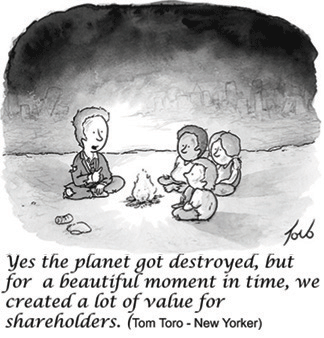 Finds http://www.skepticalscience.com/americans-more-polarized-on-climate-change.html
American voters and politicians are now more polarized than ever before across all aspects of climate change — from the cause, to the science and the impacts — a major new analysis has found.
Campaigns funded by vested fossil fuel interests and pushed by a network of ideological think tanks, many linked to the oil billionaire Koch brothers, have helped to widen the gap, pushing Republican politicians, elites and voters away from action ongreenhouse gas emissions.
Tracking Gallup opinion poll surveys going back to 2001 and congress voting patterns from 1970 onwards, the analysis authors warn that as the November election approaches, Americans are faced with a stark political choice.
The analysis is published in the respected journal Environment and comes from sociologists Associate Professor Aaron McCright of Michigan State University, Professor Riley Dunlap of Oklahoma State University, and PhD researcher Jerrod Yarosh also at Oklahoma.
The researchers found the widest gaps between Democrats and Republicans come when they are asked about the causes of climate change and if the media exaggerates the seriousness of the issue.
While virtually all climate scientists and the world’s leading scientific academies have long agreed that the burning of fossil fuels is causing climate change, only about half Republicans accept the science.
A Republican controlled Congress, the article says, would be a “huge step backward in our nation’s efforts to reduce greenhouse gas emissions” and could also undermine international cooperation, especially if Republican nominee Donald Trump won the Presidency.
“Whether, and how, individual Americans vote this November may well be the most consequential climate-related decision most of them will have ever taken,” the authors conclude.
Stark Choices
Dunlap told DeSmog the choice facing US voters was glaring.
“Looking back, Gore versus Bush was stark, although Bush hid his denial for a bit. But now the partisan differences on climate change are out in the open, and the choices from the top down are stark.”
The Koch brothers had led a network of “conservative mega-donors” that had created a “shadow GOP” that had managed to reduce the influence of the Republican National Committee, the analysis argues.
These efforts, the article explains, have blocked legislation, limited international negotiations and made rejection of climate science “normative” among Republican elites and activists.
Widening Gaps
Dunlap, McCright and Yarosh looked at how elected Democrats and Republicans had voted on environment and climate bills in both houses of Congress since 1970, using data from the League of Conservation Voters. The researchers found:
What was once a modest tendency for Congressional Republicans to be less pro-environmental than their Democratic counterparts has become a chasm—with Republicans taking near-unanimous anti-environmental stances on relevant legislation in recent years, especially 2015.
Since 2001 polling company Gallup has been asking US voters for their views on aspects of climate change, such as if they think it’s happening, if it’s caused by humans and if they are concerned about it.
In 2001, 53 percent of Republican voters agreed that global warming was caused by humans, compared with 70 percent of Democrats — a gap of 17 percentage points. But by 2016, this gap had blown out to 41 percentage points, with only 43 percent of Republican voters accepting climate change is human-caused.
These “partisan gaps” had widened across all areas since 2008, except when voters were asked if they thought global warming had already started, where the gap remained at 34 percentage points.
Bridging the Gap?
Alongside the analysis, the authors look at various attempts to bring Republicans closer to accepting the realities of climate change, such as changing communication strategies. The writers claim:
Does any persuasive framing strategy hold special promise for penetrating Republicans’ partisan/ideological identities? The evidence so far gives little basis for optimism.
The sociologists say one major reason why attempts to better communicate the realities of climate change to conservatives have failed is down to “motivated cognition” — described as the tendency for people to only accept information that reinforces their existing political beliefs and their views on the world.
Even when Republicans experience extreme weather events, there was little evidence that this was enough for those voters to change their views. Dunlap told DeSmog:
“I fear polarization will be difficult to overcome because Republican reluctance to accept the reality and seriousness of human-caused climate change is in a self-reinforcing loop.
There are top-down cues from Republican political elites and their supporters from conservative think tanks to conservative media — especially the Murdoch media— that influence voters, as well as bottom-up pressure from party activists such as Tea Party supporters who act as ‘enforcers’ of party principles, especially in primary elections to select Republican candidates.
The result is that global warming has joined God, guns, gays, and abortion as core elements of Republican identity, and this will be hard to change.”
Since 2001 polling company Gallup has been asking US voters for their views on aspects of climate change, such as if they think it’s happening, if it’s caused by humans and if they are concerned about it.
In 2001, 53 percent of Republican voters agreed that global warming was caused by humans, compared with 70 percent of Democrats — a gap of 17 percentage points. But by 2016, this gap had blown out to 41 percentage points, with only 43 percent of Republican voters accepting climate change is human-caused.
These “partisan gaps” had widened across all areas since 2008, except when voters were asked if they thought global warming had already started, where the gap remained at 34 percentage points.
Bridging the Gap?
Alongside the analysis, the authors look at various attempts to bring Republicans closer to accepting the realities of climate change, such as changing communication strategies. The writers claim:
Does any persuasive framing strategy hold special promise for penetrating Republicans’ partisan/ideological identities? The evidence so far gives little basis for optimism.
The sociologists say one major reason why attempts to better communicate the realities of climate change to conservatives have failed is down to “motivated cognition” — described as the tendency for people to only accept information that reinforces their existing political beliefs and their views on the world.
Even when Republicans experience extreme weather events, there was little evidence that this was enough for those voters to change their views. Dunlap told DeSmog:
“I fear polarization will be difficult to overcome because Republican reluctance to accept the reality and seriousness of human-caused climate change is in a self-reinforcing loop.
There are top-down cues from Republican political elites and their supporters from conservative think tanks to conservative media — especially the Murdoch media— that influence voters, as well as bottom-up pressure from party activists such as Tea Party supporters who act as ‘enforcers’ of party principles, especially in primary elections to select Republican candidates.
The result is that global warming has joined God, guns, gays, and abortion as core elements of Republican identity, and this will be hard to change.”
Britain’s Greens uncompromisingly oppose nuclear power and fracking
 Caroline Lucas: No compromise on fracking or nuclear http://www.bbc.com/news/uk-politics-37257618, 3 Sept 16, The Green Party has elected two leaders in a job-sharing arrangement they describe as a “first in Westminster politics”.
Caroline Lucas, the former leader and the party’s sole MP, will be co-leader with Jonathan Bartley, its work and pensions spokesman.
Ms Lucas got big cheers from members at the party’s conference in Birmingham when she discussed climate change and promised to oppose nuclear power and fracking.
England’s Tories are still pro nuclear enthusiasts
‘We’re still backing nuclear’ – New Energy Minister’s pledge 2 September 2016 THE new Energy Minister has underlined the Government’s commitment to nuclear energy, boosting hopes of a new power plant in west Cumbria.
Baroness Lucy Neville-Rolfe was making her first visit to Sellafield following her appointment as Energy Minister in July.
One of the first actions of Theresa May’s new administration was to delay a decision on a nuclear power station at Hinkley Point in Somerset.
The surprise announcement cast doubt on NuGen’s plans to build three nuclear reactors at Moorside, Sellafield.
But Baroness Neville-Rolfe made it clear that the Government remains committed to nuclear in principle, whatever reservations there may be about the Hinkley Point project……. ““Nuclear energy is clean and it doesn’t have the problems around discontinuity of supply that you see with wind power for example.” “Nuclear power plants are costly to build but they last for 60 years”……http://www.nwemail.co.uk/Were-still-backing-nuclear-New-Energy-Ministers-pledge-c794da03-6d39-49d3-b834-9547935d57c8-ds
UK plans nuclear reactors of 3 different types – a recipe for failure
 The special treatment the UK is granting to nuclear projects fails to take account of the fact that
 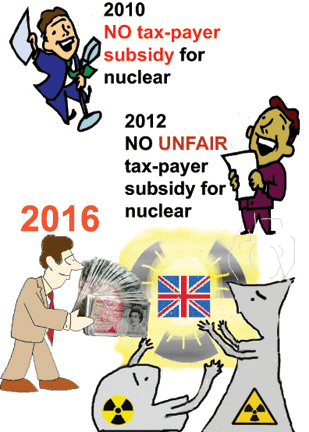 energy markets are undergoing a period of rapid change, “a revolution, not an evolution,” Schneider said. Electricity generation is going in the direction of ever smaller, more decentralized equipment like rooftop solar, integrated horizontally in networks. Nuclear, in Schneider’s view, represents an out-dated, over-priced paradigm of centralized power generation and distribution
 Puzzling path to new UK nuclear power stations, DW, 2 Sep 16 The UK plans to build several new nuclear reactors – of three different types, oddly, including a Franco-German design that has gone radically over-budget elsewhere. That’s a recipe for high costs, critics say. Over the past several years, a number of companies have put forth applications to build new nuclear reactors in the UK. But none have started construction, and now, there’s some doubt whether any of them will go forward. Continue reading
Disunity in Philippines Senate over revival of Bataan Nuclear Power Plant
Senators divided on revival of Bataan Nuclear Power Plant August 31, 2016 By KATHRINA CHARMAINE ALVAREZ, GMA News Senators have opposing positions on the possibility of the Bataan Nuclear Power Plant (BNPP) being revived to ensure the long-term supply of energy in the country.
At the hearing of the Senate committee on energy Wednesday, Energy Sec. Alfonso Cusi said he was in favor of reviving the 620-megawatt nuclear plant, declaring that it was “safe for use.”
“I have a bias. If I will make a decision, I will open it but it’s not for me to decide, it’s for the country to decide,” Cusi told the committee.
While Cusi assured that we have sufficient supply, reviving the Bataan plant would beef up power reserves, lowering the risk of parts of the country being placed under yellow and red alerts as what happened in recent months………
But Sen. Sherwin Gatchalian, chairman of the energy committee, opposed the plan, saying the needed $1-billion investment to refurbish the power plant would be better spent on “more feasible generation projects.”
Gatchalian added that the BNPP’s location atop a geological fault makes it a safety hazard for the entire Luzon island group.
He said the plant, built four decades ago, was simply outdated……..http://www.gmanetwork.com/news/story/579582/money/economy/senators-divided-on-revival-of-bataan-nuclear-power-plant
Niigata prefecture governor Hirohiko Izumida not seeking re-election: new hope for restarting Fukushima nuclear plant
 New Hope For The Fukushima Nuclear Power Plant, Oil Price, By Zainab Calcuttawala – Aug 31, 2016 Tokyo Electric Power Co. Holdings Inc.’s (TEPCO) plan to restart the defunct Fukushima nuclear power plant has an increased chance of being implemented after the prefecture governor, who has campaigned against its reopening, decided against running for re-election, according to a new report by Bloomberg.
TEPCO shares rose as much as 12 percent Wednesday morning – the largest price jump since May 2015, presumably in reaction to the announcement.
Niigata prefecture governor Hirohiko Izumida said he would not pursue a bid for a fourth term for the October 16th elections, according to a personal statement posted on his fan page.
The governor has long opposed plans to return the Kashiwazaki-Kariwa nuclear power plant – the largest of its kind in the world – to production. Japanese laws do not require that utility companies obtain the approval of local leaders before commencing operations, but it is the expected practice.
Izumida has previously demanded that TEPCO conduct further investigations into the causes of the triple meltdown at the Fukushima Dai-Ichi plant in 2011 before proposing plans to restart any of the firm’s reactors.
“The next Niigata governor will likely not make as many relentless demands as Izumida,” Japanese analyst Hidetoshi Shioda said…….
The New York Times reported on Monday that Japanese government has funded the construction of a $320 million block of man-made permafrost that would continue 100 feet underneath the Dai-Ichi plant to solve “an unrelenting flood of groundwater” that had been headed into the damaged reactors.
The project will stop the leak of radioactive water into the Pacific Ocean, which may be continuing at low levels to this day, The Times said.
TEPCO has applied to return reactors No. 6 and 7 to production at Kashiwazaki-Kariwa. The company expects to boost profits by $97 million a month for each reactor it restarts, TEPCO spokesperson Tatsuhiro Yamagishi said earlier this week. http://oilprice.com/Latest-Energy-News/World-News/New-Hope-For-The-Fukushima-Nuclear-Power-Plant.html
Sovereignty of Finland threatened by Fennovoima’s nuclear power plant project – Report
 Report: Fennovoima’s nuclear power project could undermine sovereignty of Finland, Helsinki Times, 01 SEPTEMBER 2016 Fennovoima’s nuclear power plant project in Pyhäjoki, Northern Ostrobothnia, is a high priority for Russia and threatens to undermine the national sovereignty of Finland, warns the Finnish Institute of International Affairs.
“Russia’s way of geo-economically utilising energy political dependencies is already undermining the national sovereignty of especially smaller target countries,” its researchers say in a newly-published analysis of changes in the foreign policy of Russia and their implications for Finland.
What say you, the National Coalition,” asks Niinistö.
Emma Kari (Greens) has similarly expressed her concerns that faith in nuclear energy has jeopardised the security of Finland.
“The Finnish Institute of Foreign Affairs’ report states explicitly that the nuclear power plant project of Rosatom in Pyhäjoki is under the manual control of [Russian President Vladimir] Putin. Rosatom’s nuclear power plant is a tool to exercise power politics, increase our dependence of Russia and erode the position and security of Finland,” she writes on Facebook.
The National Coalition, she adds, pushed the project through the Finnish Parliament irrespective of such concerns.
“The project is of such importance that even after Finnish companies abandoned it, Fortum, a state-owned energy utility, was strong-armed into participating in order to grant Putin’s power plant the Nordic Ecolabel,” she slams.
“It is now clear that the project is not in the best interests of this country.”…….http://www.helsinkitimes.fi/finland/finland-news/domestic/14199-report-fennovoima-s-nuclear-power-project-could-undermine-sovereignty-of-finland.html
Manila nuclear power conference: Philippines consider restarting nuclear power project
MANILA – The Philippines is looking into operating the country’s only nuclear power plant, built four decades ago at more than $2 billion but never used, to ensure the long-term supply of clean and cheap electricity, its energy minister said.
The Southeast Asian country is joining more than two dozen other countries looking to add nuclear power to their energy mix, including neighbors Indonesia, Vietnam, Malaysia and Thailand.
Energy Secretary Alfonso Cusi said on Tuesday reviving the mothballed 620-megawatt nuclear plant in Bataan province, northwest of Manila, will require a $1 billion investment.
Nuclear generation is one of the options for the Philippines to meet its growing power needs, with annual electricity demand expected to rise by an average 5 percent until 2030, he said. “We have to weigh all our options, with emphasis not just on meeting capacity requirements, but sustainability and environmental obligations as well,” Cusi said, speaking at the opening of a three-day international conference on nuclear power in Manila.
Cusi will revive a government task force created in 2007 to study nuclear power as an alternative to imported fuel oil and coal, which currently provide more than half of the country’s energy mix.
He said technical experts, including those from the International Atomic Energy Agency, have been invited to help the country identify the next steps and come up with a “well-informed” decision.
Cusi is not committing any timetable for the study, but he expects the move to reignite protests against the project, especially by environmentalists and the Catholic Church arguing restarting the plant is unsafe and expensive.
“We need to move away from fossil fuels like coal but nuclear energy is not safe and will also harm the people and environment,” said Zaira Patricia Baniaga of the Philippine Movement for Climate Justice in a statement issued before the conference.
The late Philippine dictator Ferdinand Marcos order the plant built in 1976 in response to rising energy prices and it was finished in 1984.
The facility never started generating electricity after it was declared unsafe because it sits on a major earthquake fault line and lies near the Pinatubo volcano, which was dormant at that time.
Pinatubo’s 1991 eruption had no effect on the Bataan plant, 70 km (45 miles) away, but the project was mothballed in the wake of the Chernobyl disaster in 1986.
A decade ago Manila looked into reopening the plant but the 2011 Fukushima nuclear incident renewed concerns about safety.
Ukraine’s nuclear powered electricity system near to collapse
When and Why Will Ukrainian Power Grid Collapse – UA Nuclear Reform Group Fort Russ, August 29th, 2016 Translated by Tatzhit Mihail Umanets, co-director of the reform committee for the atomic-industrial complex of Ukraine, and the former director of Chernobyl nuclear power plant:
USA govt urged by California to adopt a carbon tax
California has urged President Obama and Congress to tax carbon pollution Skeptical Science 29 August 2016 by dana1981 Last week, the California state senate passed Assembly Joint Resolution 43, urging the federal government to pass a revenue-neutral carbon tax:
WHEREAS, A national carbon tax would make the United States a leader in mitigating climate change and the advancing clean energy technologies of the 21st Century, and would incentivize other countries to enact similar carbon taxes, thereby reducing global carbon dioxide emissions without the need for complex international agreements; now, therefore, be it Resolved by the Assembly and the Senate of the State of California, jointly, That the Legislature hereby urges the United States Congress to enact, without delay, a tax on carbon-based fossil fuels; and be it further Resolved … That all tax revenue should be returned to middle- and low-income Americans to protect them from the impact of rising prices due to the tax
Copies of the Resolution were sent to President Obama, Vice President Biden, House Speaker Ryan, Senate Majority Leader McConnell, and to all members of Congress representing California. The document specifically calls for the type of revenue-neutral carbon tax advocated by the grassroots organization Citizens’ Climate Lobby. Studies have shown that a rising carbon tax with all revenue returned to taxpayers would have a modestly beneficial impact on the economy, while cutting carbon pollution at faster rates than current policies.
California exerts its climate leadership
California has become the US leader in tackling global warming. 10 years ago, the state passed the Global Warming Solutions Act, requiring that its greenhouse gas emissions in 2020 be no higher than 1990 levels. California achieved that goal in 2010, 10 years early, and is among the lowest per-capita carbon polluting states.
On the same day last week, the state legislature also passed a bill expanding the Global Warming Solutions Act, requiring a 40% cut in California’s carbon pollution from 1990 levels by 2030. In other words, California isn’t just calling on the federal government to take action on climate change; the state is leading the way…….http://www.skepticalscience.com/ca-urged-federal-carbon-tax.html
Nuclear supporters launche last-ditch push for approval of UK’s Hinkley Point project
Hinkley supporters in last-ditch push for approval Union leaders call for an end to ‘faffing’ over £18bn scheme, Ft.com by: Andrew Ward and Jim Pickard in London, 28 Aug 16
Supporters of the proposed Hinkley Point nuclear power station have launched a last-ditch push for approval as Theresa May, prime minister, nears a decision on whether to go ahead with the £18bn project.
UK union leaders on Sunday called for an end to the “faffing” over a scheme they say is crucial to keeping Britain’s lights on, after EDF, the French company planning to build the Somerset plant, sought to ease security concerns over Chinese involvement.
The comments signalled a fight back against critics of Hinkley, whose arguments have appeared to be in the ascendancy since Mrs May ordered a review of the politically sensitive project last month………https://www.ft.com/content/216e2eb0-6d14-11e6-9ac1-1055824ca907
South Africa nuclear electricity company non compliant with govt rules on advertising
 Eskom may re-advertise nuclear notices after noncomplaint E Cape notice http://www.engineeringnews.co.za/article/eskom-may-re-advertise-nuclear-notices-after-noncomplaint-e-cape-notice-2016-08-26 26TH AUGUST 2016 BY: TERENCE CREAMER CREAMER MEDIA EDITOR State-owned electricity utility Eskom may re-advertise notices relating to its NuclearInstallation Site Licence (NISL) applications for Thyspunt, in the Eastern Cape, and Duynefontyn, in the Western Cape, having acknowledged that a notice published in the Eastern Cape Provincial Gazette on August 8, failed to comply with the 30-day comment period prescribed in the National Nuclear Regulator (NNR) Act.
Earlier Eskom had insisted that it had complied with the NNR’s prescribed processes, after Organisation Undoing Tax Abuse (Outa) alleged that it was attempting to side-step public participation processes by publishing notices in provincial gazettes rather than the National Gazette, which had shortened the comment deadline to below the 30 days.
In a statement released on Friday, Eskom said it published NISL notices in ten newspapers in and around the two sites on July 29, as well as in the Western Cape Provincial Gazette.
However, the notice in Eastern Cape Provincial Gazette had been published on only August 8, which meant it failed to comply with the NNR Act’s prescribed 30 days for public comment.
Outa slammed the publication of the notice in the Eastern Cape Provincial Gazette and said the shortened comment period negated the “spirit and constitutional rights for the public to participate in decisions that affect them”.
Eskom said it was in discussions with the NNR to extend the comment period for interested and affected parties and indicated that it might re-advertise the notice in the Eastern Cape Provincial Gazette, as well as in the National Gazette to give more time for public comment.
“Eskom will communicate once the NNR has given a response,” Eskom said in a statement
Global nuclear industry ponders ways to get taxpayers to pay up for Small Modular Nuclear Reactors (SMRs)

Doncha love the way they leave the word “nuclear” out of “SMRs”, hoping that people somehow won’t notice that SMRs are nuclear reactors?
Can SMRs unlock financing? World Nuclear news, 24 August 2016 Whilst a project of the size and complexity
of Hinkley Point C faces a range of challenges which lessen the availability of limited-recourse financing, it is clear that nuclear plant construction violates the basic precepts of project finance due to the unpredictability of project costs and schedule, write Rory Connor and Ken Culotta of law firm King & Spalding…..
For the industry to flourish, even in the presence of strong government policy support, the ability to finance is critical. There is the possibility though that new technology and new construction techniques, in the form of small modular reactors (SMRs), may hold the key to overcoming such issues……..
……..a long-term, minimum-price, power purchase agreement (or equivalent) a fundamental bankability requirement.

The UK government’s Electricity Market Reform initiatives, including the flagship contract-for-difference, have shored up the bankability of nuclear power projects. However, in a controversial field like nuclear power, there remains a risk that political or public sentiment could change during the life a project; as happened in Germany, which effectively ended its nuclear power industry in the wake of the Fukushima disaster. Lenders will require assurances that changes in policy will not adversely affect their exposure. For Hinkley Point C, the UK government agreed to enter into a so-called Secretary of State Agreement with the project sponsors, which grants the sponsors a put-option against the government in the event of a political shutdown of the project, effectively requiring the government to compensate the sponsors for their loss of investment – project lenders would no doubt expect similar protection to cover the cost of repayment of all outstanding project debt.
Nevertheless, not even the package of the Hinkley Point C contract-for-difference (which guarantees a power price of more than double the prevailing market price over a 35-year term) and the Secretary of State Agreement was enough to satisfy prospective lenders or bond underwriters that the project represented a bankable proposal. The problem lurked elsewhere – construction risk……..
The first SMRs to be installed will doubtless surface interesting risk issues, particularly the perceived ‘new technology’ risk which would likely see lenders requiring extended warranties from SMR technology providers. …..
construction risk alone is not the only issue that makes project financing a challenge for nuclear projects – the highly regulated nature of nuclear power does not sit easily with many standard project financing instruments and techniques. In any event, the developer(s) of the first commercially deployed SMRs may decide to finance on-balance sheet or by other means.
But the fact is that SMRs are no longer just ‘pie in the sky’ – billions of dollars of investment has been committed to the development of this technology (including more than $200 million by the US Department of Energy and up to £250 million by the UK government) and, in the UK at least, the possibility of contracts-for-difference, and other government-backed credit enhancements, create an attractive framework for investment and financing. http://www.world-nuclear-news.org/V-Can-SMRs-unlock-financing-24081602.html
UK figuring out how to get out of the Hinkley nuclear power deal
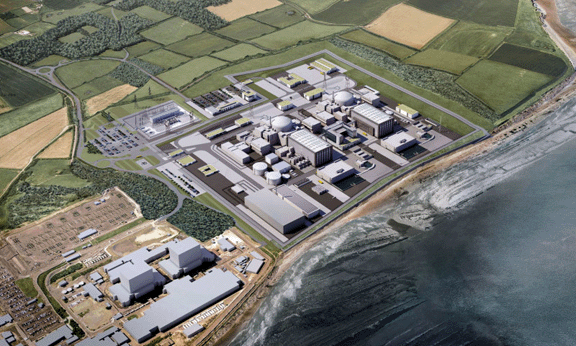 Hinkley Point nuclear power station: Whitehall officials ‘exploring ways UK could pull out of deal’ Theresa May’s administration called an unexpected halt to the project amid security and viability concerns, Independent Joe Watts Political Editor @JoeWatts_ Thursday 25 August 2016 Whitehall officials reviewing the massive Hinkley Point nuclear project are exploring how the UK might withdraw from the deal while minimising financial risk and damage to international relations, it has been claimed.
Westminster sources told The Independent civil servants are looking to see if there is any loophole, clause or issue in contracts yet to be signed that allow the Government to pull back without huge loss and while also saving face.
Ministers are acutely aware of the potential damage a withdrawal could do to relations with China, which is committed to pouring billions of pounds into the controversial project.
Former Chancellor George Osborne was an enthusiastic supporter of the £18 billion scheme, but since Theresa May’s arrival it is being reviewed by the new administration. A Whitehall source said: “There is a working assumption of people in government that the civil service is looking for a way out, a legal loophole, a clause.
“They are looking for anything that will allow the Government to withdraw and also allow the Chinese to withdraw while also saving face.”
It was expected last month when the board of French energy company EDF voted to go ahead with Hinkley C power station that the British Government would give its approval.
Instead new Business Secretary Greg Clark announced he needed more time to make a decision.
It followed claims that the price promised for Hinkley’s electricity at £92.50 per MWh, more than double the wholesale price, was too expensive……..
EDF may also have problems fulfilling its end of any agreement. The company’s finance director Thomas Piquemal resigned earlier this year, fearing Hinkley could lead to the firm’s insolvency.
title=”24 August 2016 16:26 London”>A senior Government figure said: “The other thing no-one is talking about is what happens after the French election.
“Hollande is not going to be there and it is not clear whether Sarkozy or Juppe are committed to it.”
A spokesperson from the Department for Business, Energy & Industrial Strategy said: “No contract has been signed and it is only right that a new Government considers all component parts carefully before making a final decision.” http://www.independent.co.uk/news/uk/politics/hinkley-point-edf-nuclear-power-station-deal-how-uk-could-pull-out-a7207776.html
Bulgaria seeks solution for costly blowout for Belene nuclear power plant
Bulgaria seeks least worst outcome for Belene nuclear fiasco BME IntelliNews, By Clare Nuttall in Bucharest August 25, 2016 More than two months after an international court ruled Bulgaria must compensate Russia’s Atomstroyexport for work carried out on the Belene nuclear power plant, Prime Minister Boiko Borissov’s government is still struggling to find ways to minimise the financial damage from the project, which was cancelled back in 2013.
A Geneva-based court under the auspices of the International Chamber of Commerce ruled on June 16 that Bulgaria’s state National Electricity Company (NEK) must pay €550mn to Atomstroyexport, a unit of Rosatom, for the nuclear reactor the Russian company has already produced.
While the figure is lower than the €1.2bn sought by Atomstroyexport, it is a substantial sum for Sofia, when taken in combination with the €708mn Bulgaria has already sunk into the project. In addition, Bulgaria faces a bill of around €170,000 in penalty interest per week.
In an analyst note issued after the ruling, Timothy Ash of Nomura wrote that the order to pay compensation was a “significant blow to Bulgaria, with a cost of well over 1% of GDP eventually likely to fall on public finances”.
The options for the Bulgarian government are limited; far from finding the optimal solution for the country, it is a case of searching for the least costly and damaging outcome……..
White elephant
The third option put forward by Sofia is instructing the country’s privatisation agency to sell the project to private investors, who would then complete it with the help of the state. Again, it is questionable how realistic this is – there have long been doubts as to whether Bulgaria needs additional generation capacity. However, on August 24 Novinite reported that Energy Minister Temenuzhka Petkova had met with representatives of China General Nuclear power Group (CGN) to discuss Belene, reportedly at the request of the Chinese company………
Reviving the project could therefore be a case of throwing good money after bad, as Sofia invests yet more money only to end up with a costly white elephant power plant. This is the argument put forward by Greenpeace Bulgaria, which campaigned against Belene together with several other environmental NGOs.
“The government is trying to find a pretty way out of the situation but in reality there is no accountability for the over €1bn spent on this project,” Greenpeace Bulgaria spokesperson Denitza Petrova told bne IntelliNews. She claims that Belene “has never been economically viable … There will be no private investor in it as it is risky and useless, and will not pay off the investment.”……..http://www.intellinews.com/bulgaria-seeks-least-worst-outcome-for-belene-nuclear-fiasco-104739/
1 This Month
15 October. Joint Appeal for Nuclear Abolition Day -presentation to the UN on October 15 will be live on UNWebTV
Endorse the Nuclear Abolition Day Appeal
23-25 October – on Zoom – World BEYOND War’s annual global conference

To see nuclear-related stories in greater depth and intensity – go to https://nuclearinformation.wordpress.com
-
Archives
- October 2026 (149)
- September 2026 (339)
- August 2026 (330)
- July 2026 (355)
- June 2026 (287)
- May 2026 (306)
- April 2026 (356)
- March 2026 (251)
- February 2026 (267)
- January 2026 (308)
- December 2025 (358)
- November 2025 (359)
-
Categories
- 1
- 1 NUCLEAR ISSUES
- business and costs
- climate change
- culture and arts
- ENERGY
- environment
- health
- history
- indigenous issues
- Legal
- marketing of nuclear
- media
- opposition to nuclear
- PERSONAL STORIES
- politics
- politics international
- Religion and ethics
- safety
- secrets,lies and civil liberties
- spinbuster
- technology
- Uranium
- wastes
- weapons and war
- Women
- 2 WORLD
- ACTION
- AFRICA
- Atrocities
- AUSTRALIA
- Christina's notes
- Christina's themes
- culture and arts
- Events
- Fuk 2022
- Fuk 2023
- Fukushima 2017
- Fukushima 2018
- fukushima 2019
- Fukushima 2020
- Fukushima 2021
- general
- global warming
- Humour (God we need it)
- Nuclear
- RARE EARTHS
- Reference
- resources – print
- Resources -audiovicual
- Weekly Newsletter
- World
- World Nuclear
- YouTube
-
RSS
Entries RSS
Comments RSS

