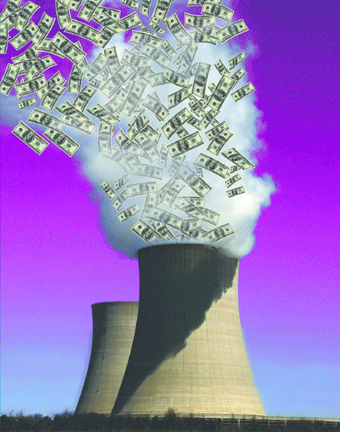
 Senate GOP Protests Obama’s Planned Nuclear Test Ban Push Warning to the White House concerns the Comprehensive Nuclear Test Ban Treaty, an international treaty prohibiting nuclear test explosions , WSJ, PAUL SONNE Sept. 8, 2016 The Obama administration’s pursuit of a possible United Nations Security Council resolution against nuclear weapons tests has riled a group of Republican lawmakers, who have warned President Barack Obama not to take action that would circumvent the U.S. Senate’s constitutional power to ratify treaties.
A group of 33 Republican senators sent a letter to Mr. Obama on Thursday threatening to withhold congressional funding for an existing international monitoring system for nuclear tests, if the administration signs up for any international obligations through the U.N. that the Senate has rejected previously.
“We urge you to respect your constitutional obligations and warn that if you do not, your efforts at the United Nations on this issue are likely to set back any supposed progress on achieving a testing ban,” the group of senators, including Marco Rubio (R., Fla.), John McCain(R., Ariz.) and Lindsey Graham (R., S.C.), wrote.
Their warning to the White House concerns the Comprehensive Nuclear Test Ban Treaty, or the CTBT, an international treatyprohibiting nuclear test explosions. Former President Bill Clintonsigned the treaty in 1996, but the Senate declined to ratify it in a vote three years later.
The Obama administration, which favors U.S. ratification of the test ban treaty but hasn’t won backing for its ratification in the Senate, now is pursuing action in the United Nations to reaffirm the U.S.’s support for the treaty and keep its spirit alive—part of a final push by Mr. Obama to advance his nuclear disarmament agenda before leaving office. The U.S. independently has obeyed a national moratorium on nuclear testing since 1992……..
The White House and the State Department say the administration is proposing a U.N. Security Council resolution and separate statement from the council’s five permanent members, known as the P5. The resolution will call for an end to nuclear testing and strengthen the detection system the test ban treaty established to monitor nuclear explosions around the world, which functions even though the treaty hasn’t entered into force…….
Thomas Graham Jr., a former State Dept. arms negotiator and supporter of the CTBT’s ratification, said nations poised to develop nuclear arms agreed decades ago to stand down on the condition that countries with nuclear arsenals would cease testing and development. He said nuclear weapons states must strengthen their resolve against tests to avoid proliferation stemming from an erosion of trust among those nonnuclear states.
Former State and Defense Department officials also said the White House may see the U.N. Security Council action as an additional way to put pressure on North Korea and further engage China in the effort to stop Pyongyang’s advancing nuclear program.
The U.N. Security Council is meeting Sept. 22 on the sidelines of the General Assembly in a special session on the CTBT. U.N. Security Council diplomats said they expect the Obama-introduced resolution to pass unanimously………http://www.wsj.com/articles/senate-gop-protests-obamas-planned-nuclear-test-ban-push-1473360939
September 10, 2016
Posted by Christina Macpherson |
politics, USA, weapons and war |
Leave a comment
In deciding when to review part of a national policy statement the Secretary of State must consider whether there has been a significant change in circumstances. If there has been a significant change in circumstances on which the policy regarding the need for new nuclear power stations was based; and if those changes were not anticipated at the time then the policy should be reviewed.
TASC concludes that the case for a review of EN-1 is unanswerable

 National Policy Statement on Energy NuClear News No 88 Sept 16 The government has a legal duty under section 6 of the 2008 Planning Act to review the National Policy Statement (NPS) on Energy, according to lawyers Leigh Day, because of dramatically changed circumstances over the last five years since the national policy statements enshrining the nuclear element were first published.
A report by Together Against Sizewell C (TASC) underlines the government’s duty to undertake a review and demonstrates why new nuclear has to be written out of the government’s energy policy.
The sections of the Overarching NPS on Energy (EN-1) which the TASC report says show the policy needs to be reviewed are section 3.5.1 to 3.5.11. Continue reading →
September 10, 2016
Posted by Christina Macpherson |
ENERGY, politics, UK |
Leave a comment
Wylfa NucClear News No 88 September 16 A second consultation on the proposed nuclear power plant in Anglesey has been launched. Horizon Nuclear Power estimates Wylfa Newydd, which will include two reactors with a total capacity of 2,700MW, will take around nine years to build and have an operational life of 60 years. The consultation will run until 25th October. (1)
Nearly two-thirds of people in Wales want all of Wales’ electricity to come from renewable sources, a poll for the conservation organisation WWF has found. They also want the Welsh Government to invest more in improving the energy efficiency of homes. First Minister Carwyn Jones will publish his Programme for Government during the next few weeks and the focus is likely to be on how Wales adapts to Brexit. WWF is calling on the Government not to sideline investment in reducing emissions and tackling climate change. http://www.no2nuclearpower.org.uk/nuclearnews/NuClearNewsNo88.pdf
September 10, 2016
Posted by Christina Macpherson |
politics, UK |
Leave a comment
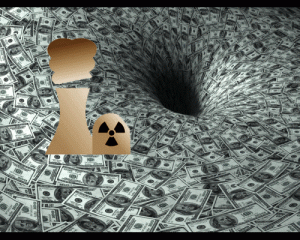 Hinkley Point deal out of date and too expensive, says energy chief, Telegraph, UK, Emily Gosden, energy editor 3 SEPTEMBER 2016 The head of energy giant ScottishPower has waded into the row over Hinkley Point, insisting that the controversial subsidy deal for EDF’s proposed nuclear plant should be renegotiated because it is too expensive.
Keith Anderson, the firm’s chief corporate officer, said the deal, provisionally agreed by the Government in 2013 following lengthy negotiations, no longer made sense in the light of lower gas and offshore wind costs.
“It looks like a contract that was written five years ago on a business case that was probably pulled together 10 years ago. It looks out of line with what’s going on in the market now,” he said.
In an interview with Telegraph, Mr Anderson praised Theresa May’s “brave” decision to review the £18bn project and urged her to look at it in its entirety, not just her apparent concerns over Chinese state nuclear firms’ involvement.Becoming the latest high-profile figure to criticise the deal, Mr Anderson said that it now looked “expensive” and that gas and offshore wind offered faster, easier and cheaper ways of keeping the lights on and decarbonising, respectively.
“I can’t understand why anybody feels we need to sign a contract of that size and over that time period, at that price,” he said.
ScottishPower is seeking government support to develop both offshore wind and gas-fired power stations.
Its East Anglia offshore wind farm project last year won a subsidy contract at nearly £120 per MWh for 15 years. However, costs are falling rapidly, with ministers setting a cap of £105 per MWh on future contracts and a target of £85. EDF has insisted the deal is good value……http://www.telegraph.co.uk/business/2016/09/03/hinkley-point-deal-out-of-date-and-too-expensive-says-energy-chi/
September 9, 2016
Posted by Christina Macpherson |
business and costs, politics, UK |
Leave a comment
 MPs told nuclear power could cost triple the estimate http://www.timeslive.co.za/thetimes/2016/09/08/MPs-told-nuclear-power-could-cost-triple-the-estimate JAN-JAN JOUBERT | 08 September, 2016
Parliament was warned yesterday that the final bill for nuclear power procurement could be three times higher than projected because of unpredictable cost escalations and the expense of decommissioning nuclear power plants.
The parliamentary budget office briefed MPs yesterday morning on the cost and other considerations of the country’s electricity generation options.
The office’s research on the costs incurred by more than 400 projects worldwide found that nuclear power generation costs exceeded the original estimates by an average of 117%, compared with 70% for hydroelectric power, 13% for thermal, including coal, 8% for wind power and 1% for solar power.
The office agreed with DA MP Gordon Mackay when he said that decommissioning added 100% to nuclear power costs. The office said the outlay for nuclear power was 67% higher than for gas and 16% more than for coal.
Mackay took the budget office to task for a lack of clarity on:
- The actual cost of the projected nuclear building programme, estimated at R600-million to R1.7-billion;
- Infrastructure construction costs not factored into projections for gas as an energy resource;
- No reference being made by the budget office to the energy preferences listed in the National Development Plan, which supposedly guided government policy;
- The budget office had not reached any conclusion on the costs to consumers of the energy options;
- The effect of each option on the country’s economic growth was not adequately estimated;
- The huge decline in South African energy demand was not sufficiently explained; and
- The decommissioning of the coal-fired power stations was not factored in.
Budget office head Mohammed Jahed said that Mackay’s objections fell outside the mandate given to his office by parliament’s appropriations committee but could be dealt with at a follow-up meeting.
September 9, 2016
Posted by Christina Macpherson |
business and costs, politics, South Africa |
Leave a comment

 SNC-Lavalin violated election rules with campaign donations, commissioner rules
CBC News September 8, 2016 The federal elections commissioner says SNC-Lavalin has entered into a compliance agreement for making nearly $118,000 in contributions that violated the Canada Elections Act over a seven-year period.
Problematic contributions made between 2004 and 2011 The Canadian Press Sep 08, 2016
The federal elections commissioner says SNC-Lavalin has entered into a compliance agreement for making nearly $118,000 in contributions that violated the Canada Elections Act over a seven-year period.
The commissioner says the contributions were made to the Liberals and Conservatives between March 9, 2004, and May 1, 2011.
In the past, CBC has reported on one instance of something similar, in which a number of SNC-Lavalin executives and their families donated $15,000 to the campaign of a conservative candidate in the 2011 election.
The commissioner’s report Thursday singles out almost $118,000 in contributions made to federal parties and subsequently reimbursed, including:
- Liberal Party of Canada: $83,534.51;
- Various registered riding associations of the Liberal Party of Canada: $13,552.13;
- Contestants in the Liberal Party of Canada’s 2006 leadership race: $12,529.12;
- Conservative Party of Canada: $3,137.73; and
- Various registered riding associations and candidates of the Conservative Party of Canada: $5,050.00.
- According to the compliance agreement, the commissioner says former senior executives with the Montreal-based engineering firm solicited employees to make political contributions and in some cases, those employees were reimbursed with false personal expenses, fictitious bonuses or other benefits……….http://www.cbc.ca/news/business/snc-lavalin-campaign-donations-1.3752869?cmp=rss
September 9, 2016
Posted by Christina Macpherson |
Canada, politics |
Leave a comment
South Africa: No Nuclear Deal Entered Into – Deputy President . All Afric a, 8 Sep 16 Cape Town — Deputy President Cyril Ramaphosa says no nuclear deal has been entered into with any country. The Deputy President said this when responding to oral questions at the National Council of Provinces (NCOP) on Wednesday.
A Member of Parliament had asked, among other questions, whether government has entered into a nuclear deal with any country.
“Government has not entered into a nuclear deal with any country,” the Deputy President said.
The Deputy President said government remains committed to an open, fair and transparent procurement process.
Government wants to implement the programme at a scale and pace that the country can afford.
“A request for proposals for a nuclear new build programme of 9,600 MW will be released to the market during this financial year in line with the Cabinet decision taken on 9 December 2015.
“The Department of Energy is currently consulting with relevant stakeholders to finalise the documentation,” he said…….http://allafrica.com/stories/201609081107.html
September 9, 2016
Posted by Christina Macpherson |
politics, South Africa |
Leave a comment
 Government quibbles over true cost of nuclear – but it’s going to be very expensive http://mg.co.za/article/2016-09-08-government-quibbles-over-true-cost-of-nuclear-but-its-going-to-be-very-expensive Phillip de Wet 08 Sep 2016 Any decision to proceed further with the nuclear build programme will only take place after the request for proposal process has been completed,” Deputy President Cyril Ramaphosa told the National Council of Provinces (NCOP) in Parliament during a question session on Wednesday afternoon.
Almost simultaneously, Energy Minister Tina Joemat-Pettersson told Parliament’s other house, the National Assembly: “As far as I’m concerned, a request for proposal will be issued on September 30 for the procurement process in which we have Cabinet approval to test the market on the procurement of nuclear.”
Both insisted that there is, as yet, no firm commitment to buy a fleet of nuclear power stations, which it is estimated will cost more than R1-trillion, despite long-standing signals of an obstinate political will to do so.
But even as these members of the executive were telling Parliament how the nuclear-build decision would unfold, a little-known parliamentary office was all but begging MPs not to let them.
“Within the range of conventional technologies considered, nuclear energy is the most expensive,” the parliamentary budget office said in a report it delivered to Parliament’s standing committee on appropriations, also on Wednesday.
Its 23-page report, Electricity Generation Technology Choice: Costs and Considerations, the office said “present the key factors that need to be considered by Members of Parliament concerned with public finances in considering technology choice”. The standing committee had requested the report.
Throughout its study, the office steered scrupulously clear of recommending or denigrating any type of electricity generation. Selection of technology is complicated, it explained, and needs to take into account everything from the carbon footprint to local industrialisation.
But nuclear fares very poorly, indeed, in the office’s analysis.
Nuclear is 16% more expensive than the most expensive type of coal electricity production, the office said, drawing on figures more current than any the department of energy has released and 67% more expensive than the most costly way of using natural gas to generate power.
Eskom, which was once excluded from the nuclear preparations, has recently claimed in a series of statements by its CEO, Brian Molefe, that nuclear generation is the cheapest way for South Africa to build additional base-load capacity.
The plans that supposedly underpin the plans to build new nuclear power stations are wildly out of date, the parliamentary budget office said. The official integrated resource plan (IRP) dates from 2010 and its 2013 update does not yet have official status — because, some have speculated, it provided an insufficiently rosy picture to justify a nuclear build.
“Using an out-of-date IRP will result in a sub-optimal mix of generation plants and higher electricity prices,” the office said, with graphs showing how electricity demand declined as prices soared and the economy stalled. Even the most pessimistic integrated resource plan projection had forecast fast-growing demand.
Overbuilding generation capacity based on mistaken assumptions can be costly, the office warned gently. And past experience shows that nuclear and hydropower projects are most prone to high cost overruns and delays — and are almost impossible to adjust once ground is broken.
“It may be prudent in situations of high uncertainty to avoid very large capital investments where the repayments of loans are certain but returns from the project are uncertain and possibly volatile,” it said.
“In pursuance of a suitable energy mix, government is determined that our investment in generation capacity should be evidence-based,” Ramaphosa told the NCOP.
September 9, 2016
Posted by Christina Macpherson |
business and costs, politics, South Africa |
Leave a comment
 News that nuclear deal will start by end-September is ‘reckless’, DA says http://www.bdlive.co.za/business/energy/2016/09/08/news-that-nuclear-deal-will-start-by-end-september-is-reckless-da-says BY LINDA ENSOR, ENERGY Minister Tina Joemat-Pettersson’s shock announcement that the first phase of the nuclear deal is to commence by the end of September was both “astonishing and reckless,” DA energy spokesperson Gordon Mackay said on Thursday.
The minister announced in the National Assembly on Wednesday that a request for proposals for the nuclear build programme would be issued on September 30. The government has decided to build nuclear plants that will generated 9,600MW.
“Not only is the proposed nuclear deal the subject of litigation in the Western Cape High Court, but the announcement will add yet further fuel to the fire that will see SA’s international credit rating go up in smoke,” Mackay said.
“Critically, the minister’s decision to commence with the first phase of the nuclear new build programme, despite the fact that not a single document with regard to the deal has ever been presented to Parliament, is a blatant abuse of power.”
Mackay said Joemat-Pettersson’s announcement came before October’s tabling of the medium-term budget statement by Finance Minister Pravin Gordhan, and represented a “blatant attempt to bully the Treasury into to coughing up the trillions of rand required to fund this unaffordable pet project of President Jacob Zuma”.
He said the DA would demand that all documentation relating to the nuclear deal be made available to Parliament’s energy committee and tabled in the National Assembly.
The DA was in possession of a parliamentary legal adviser opinion, which requires ministers to provide all necessary documentation to portfolio committees, irrespective of their so-called sensitivity.
September 9, 2016
Posted by Christina Macpherson |
politics, South Africa |
Leave a comment
 Obama to Stick With “First Strike” Nuclear War Doctrine, Claiming Deterrence Value https://www.districtsentinel.com/obama-stick-first-strike-nuclear-war-doctrine-claiming-deterrence-value/ September 6, 2016 by Sam Knight President Obama will not rule out the possibility of the United States conducting a first nuclear strike, keeping intact a policy that has been in place since the Cold War.
The New York Times reported Tuesday that Obama won’t attempt to revise the so-called “First Strike” doctrine before leaving office in January 2017.
The paper noted he had faced criticism, including some from “former senior aides,” over unfulfilled campaign and first-term promises, to work towards “a world without nuclear weapons.”
“For months, arms control advocates have argued for a series of steps to advance the pledge he made,” the Times said. “An unequivocal no-first-use pledge would have been the boldest of those measures.”
The source of complaints about the President’s about-face are from roughly six years ago. In 2010, when Obama renewed the START treaty with Russia, he also agreed to modernize the US nuclear arsenal, per Congressional Republicans’ demands.
The Times said that a shift away from First Strike would be mostly cosmetic, with US presidents dating back to Harry Truman, having pledged to only use nuclear weapons as a “last resort.”
History, however, casts a pall over these pledges.
Truman ordered the dropping of two atomic bombs on an already-battered Imperial Japan in 1945, despite the fact that some American military officials–at the time and, in the years after–expressed doubt that the nuclear bombings were needed to force a Japanese surrender. Those critics included Dwight Eisenhower, Pacific fleet commander Adm. Chester Nimitz, and Truman’s Chief of Staff, Adm. William Leahy. The United States is still the only nation in history to use nuclear weapons against an adversary.
According to The New York Times’ Tuesday report, President Obama had considered a move away from First Strike this summer, not long after he became the first US President to visit Hiroshima—the first of the two Japanese cities targeted by nuclear weapons, under orders from Truman.
Obama was, however, persuaded to move away from altering the policy by his cabinet. The Secretaries of Defense, State and Energy—Ash Carter, John Kerry, and Ernest Moniz—were all opposed to the move.
Kerry and Carter were particularly concerned about upsetting allies in East Asia, South Korea and Japan, in the context of perceived US “weakness,” in the face of possible North Korean military strikes.
The Times also noted Kerry objecting to “weaken[ing] the nuclear deterrent while Russia is running practice bombing runs over Europe and China is expanding its reach in the South China Sea.”
President Obama also ran the risk of adopting a policy that would be quickly reversed by the next administration, the paper noted.
“[Donald] Trump bristled at the idea [of abandoning first strike], saying he would never want to weaken America’s leverage,” The Times said. “[Hillary] Clinton has not spoken on the issue during her campaign.”
September 7, 2016
Posted by Christina Macpherson |
politics, USA, weapons and war |
2 Comments
 Pro-Clinton group warns of nuclear war if Trump elected http://thehill.com/blogs/ballot-box/presidential-races/294592-pro-clinton-group-warns-of-nuclear-war-if-trump-elected By Jonathan Easley , September 06, 2016, The largest pro-Hillary Clinton super-PAC on Tuesday released a new ad warning that Donald Trump could lead the nation into a nuclear war if he’s elected president.
The ad from Priorities USA, called “
I Love War,” juxtaposes Trump’s past remarks about his affinity for war and the power of nuclear energy against a backdrop of images of mushroom clouds, land stripped bare by massive explosions and old-time war reels. “I’m really good at war, I love war in a certain way,” Trump, the Republican presidential nominee, says in one clip.
“Including with nukes, yes, including with nukes,” he says.
Priorities USA is putting $5 million behind the ad, which will run begin running on Friday in six battleground states: North Carolina, Ohio, Florida, Nevada, Iowa and New Hampshire.
“Nuclear is just, the power, the devastation is very important to me,” Trump says in the ad.
“I want to be unpredictable,” he says as the spot concludes.
Allies of Clinton, the Democratic presidential nominee, are hammering Trump in a coordinated effort to portray him as unfit to be commander in chief.
The Trump campaign is pushing back, rolling out endorsements on Tuesday from 88 retired military figures who are backing Trump for president, calling him the leader to deal with “burgeoning threats” facing the country.
September 7, 2016
Posted by Christina Macpherson |
USA elections 2016 |
Leave a comment
 Only 10% of population returns to Fukushima town, September 04, 2016 The Yomiuri Shimbun Monday marks one year since the lifting of an evacuation order for Naraha, Fukushima Prefecture, that was imposed following the accident at Tokyo Electric Power Company Holdings, Inc.’s Fukushima No. 1 nuclear power plant.
However, less than 10 percent of the town’s registered population has returned.
The number of new housing built in the town this year reached 296 in June, 4½ times more than last year’s total. However, among Naraha’s registered population of 7,300, only 681 people had returned to live there as of Friday, according to the municipality.
Residents who have resumed farming, the town’s key industry, are also limited in number……http://www.the-japan-news.com/news/article/0003193419
September 5, 2016
Posted by Christina Macpherson |
Fukushima 2016, Japan, politics |
Leave a comment
 As coal companies sink into bankruptcy, who will pay to clean up their old mines? Peabody is the latest to make big promises to a bankruptcy judge. VOX David Roberts on September 2, 2016, In the context of US capitalism, corporate bankruptcy has become less an admission of failure or a final chapter than a kind of R&R, a chance to shed some flab and come back stronger. As anyone who has followed Donald Trump’s career knows, a big company declaring Chapter 11 bankruptcy is like Lindsay Lohan checking into rehab. They’ll be back.
So it is with Peabody Energy, the world’s largest private coal company, which entered bankruptcy back in April. It is currently undergoing its bankruptcy spa treatment — shedding workers and retirees, their health and pension benefits — and preparing to get back to work (or so it hopes).
In the case of Peabody and other coal companies, however, there’s another sort of flab, er, liability at issue, for which there is less precedent in bankruptcy court: namely, environmental remediation obligations.
Put more simply: Who’s going to pay to clean up all those old mines?
Coal companies promise to pay for mine cleanup, really and for true
The Surface Mining Control and Reclamation Act of 1977 says that coal companies have to clean up old mines and reverse their environmental damage, costs which can run to the hundreds of millions. Before they receive a permit for a new mine, coal companies have to prove that they can afford to clean it up. They do so by posting a bond.
These days, however, coal companies rarely have to meet this requirement. Instead, they are allowed to “self-bond,” which amounts to promising the states they operate in that they can pay for mine cleanups.
This cozy arrangement between coal companies and state regulators is longstanding, but it has come under increased scrutiny lately, as coal companies have tried to use bankruptcy to squirm out of those obligations. Wyoming just struck a deal with (bankrupt) Arch Coal to “accept up to $75 million in place of the company’s $486 million in bonding obligations.” That means if Arch Coal liquidates, Wyoming is first in line to collect at least $75 million in assets.
Who will cover the $411 million in remaining cleanup costs? Taxpayers.
And it’s not an isolated case; there’s a lot of dough at stake. In addition to the $9 billion in mine cleanup costs already outstanding under the Abandoned Mine Land Program(covering mines abandoned before 1977), “officials estimate that roughly $3.6 billion in self-bond liabilities could fall to taxpayers.”
That would amount to a $3.6 billion subsidy to big coal, the latest (maybe the last?) in a century-long tradition of subsidies.
Worries about self-bonding led WildEarth Guardians and other environmental groups tofile a petition to the Office of Surface Mining Reclamation and Enforcement (OSMRE) in March, asking the agency to ensure that “companies with a history of financial insolvency are not allowed to self-bond coal mining operations.”……..http://www.vox.com/2016/9/2/12757074/coal-bankruptcy-mine-cleanup
September 5, 2016
Posted by Christina Macpherson |
business and costs, ENERGY, politics |
Leave a comment
 Groups fear no nuclear debate in Niigata governor’s race http://www.asahi.com/ajw/articles/AJ201609040026.html By YUKO MATSUURA/ Staff Writer September 4, 2016 NIIGATA–Anti-nuclear groups are pleading with Niigata Governor Hirohiko Izumida to rescind his decision not to run for re-election, seeing him as the “last bastion” to block the restart of the Kashiwazaki-Kariwa nuclear power plant.
The groups fear that the absence of Izumida in the Oct. 16 Niigata gubernatorial election, whose official campaigning starts on Sept. 29, will cause a dearth in debate among candidates on the safety of the multiple-reactor nuclear plant operated by Tokyo Electric Power Co. in the prefecture.
“Governor (Izumida) is not aware of his value,” said Kunio Ueno, 66, secretary-general of the organizing committee for a gathering of anti-nuclear groups held in Kashiwazaki on Sept. 3.
Eighteen groups, based in and outside Niigata Prefecture, set up the organizing committee for the gathering and demanded the decommissioning of reactors at the plant.
“We will not allow candidates in the gubernatorial election to conceal a point of contention,” their declaration read. “We will make the issue of the nuclear power plant the biggest point of contention.”
Outside the site of the gathering, several citizens groups collected signatures to ask Izumida to run in the election.
On Aug. 30, Izumida, 53, who is in his third term as Niigata governor, announced he will not seek re-election, citing a report in a local newspaper that was not related to the nuclear issue.
The Nuclear Regulation Authority is currently conducting screenings toward the restart of reactors at the Kashiwazaki-Kariwa nuclear power plant.
But Izumida has insisted that the causes of the 2011 disaster at the Fukushima No. 1 nuclear power plant, also operated by TEPCO, must be verified before reactor operations can resume in his prefecture. As of now, only Tamio Mori, 67, mayor of Nagaoka in Niigata Prefecture, has announced he will run in the governor’s race.
On the issue of whether to restart the Kashiwazaki-Kariwa nuclear plant, Mori has only said, “I will strictly examine it based on protecting the security and safety of people in the prefecture.”
About 1,300 people took part in the Sept. 3 gathering.
Sayaka Sakazume, 32, of Niigata city, said: “It will be a problem for me if there are no candidates I can vote for based on my thoughts against the reactor restarts. I want a political situation in which we can choose a candidate.”
September 5, 2016
Posted by Christina Macpherson |
Japan, opposition to nuclear, politics |
Leave a comment
 Nuclear’s Last Stand? New York’s Cuomo Rushes in to Save Dying Plants Progressive.org, September 2, 2016 Harvey Wasserman Andrew Cuomo is trying to ram through a complex backdoor bailout package worth up to $11 billion to keep at least four dangerously decrepit nuclear reactors operating.
To many proponents of safe energy, the move comes as a shock. Its outcome will have monumental consequences for nuclear power and the future of our energy supply.
For years, Governor Cuomo has made a public show of working to shut down two Entergy-owned reactors at Indian Point, thirty-five miles north of Manhattan. He and New York Attorney General Eric Schneiderman have fought Entergy in court, trying to stop operations. They warn that the reactors are too dangerous to run so close to New York City, which cannot be evacuated in case of a major accident. More than ten million people live within a fifty-mile radius of Indian Point, whose two operating reactors opened in the 1970s.
Entergy is now trying to get the Nuclear Regulatory Commission to extend the expired operating licenses for the two plants, Indian Point Two and Three. (Indian Point Unit One was shut in October 1974 due to its lack of an Emergency Core Cooling System).
Cuomo claims he still wants to close Indian Point Two and Three. Like most aging reactors, they have been continually plagued with leaks, mechanical failures, structural collapse, and unplanned shutdowns. Recent revelations of major problems with critical bolts within Indian Point’s core structure, and tritium leaks into the broader environment, have deepened public opposition.
The national and local groups fighting to shut Indian Point, some for decades, include Riverkeepers, Clearwater, the Indian Point Safe Energy Coalition, the Nuclear Information & Resource Service, Beyond Nuclear, Friends of the Earth, and many more.
But now Cuomo wants to earmark more than $7 billion in public money, for starters, to keep four upstate nuclear reactors on line. One is the Ginna reactor, near Rochester; the other three—FitzPatrick, Nine Mile Point One, and Nine Mile Point Two—occupy a single site on Lake Ontario. Fitzpatrick is owned by Entergy. The rest are owned by Exelon, the nation’s largest nuclear power owner/operator.
All four reactors are in various stages of advanced deterioration and were slated for permanent closure. Without massive public subsidies, none can compete with natural gas or with wind and solar, which are rapidly dropping in price.
Entergy announced last fall that economic factors would force it to shut Fitzpatrick in January 2017. Exelon told the New York Public Service Commission that it would probably shut Nine Mile 1 and Ginna next year as well.
Environmentalists hailed the announcements. The aging U.S. fleet now involves about 100 reactors, down from a maximum of about 130, and 900 fewer than the 1,000 Richard Nixon predicted in 1974. Many of them, like Ginna, are well over forty years old. Many are known to be leaking various radioactive substances, most commonly tritium, as at Indian Point. Major leaks have also recently been revealed at FitzPatrick. Structural problems like Indian Point’s missing bolts and a crumbling shield building at Ohio’s Davis-Besse are rampant.
Nonetheless, in a complex twelve-year package ostensibly meant to promote clean energy, Cuomo’s PSC has passed a huge subsidy plan meant keep the four upstate reactors going.
The deal’s arcane terms involve a transfer of Fitzpatrick from Entergy to Exelon. The handouts from the public to the nuclear industry would be spread over more than a decade. Ironically, they could, under certain circumstances, also be used to keep open the two reactors at Indian Point.
Cuomo has made much of “saving” some 2,000 reactor jobs jobs in a depressed region where unemployment is rampant. But Stanford economist Mark Jacobson has shown that the billions spent to keep the reactors open could create tens of thousands of jobs throughout the state if spent on pursuing wind and solar energy and increased efficiency. Those sources could provide New York with far more energy at a much cheaper rate, without the long-term safety, ecological, and public health problems caused by the aging reactors………
Nuke operators throughout the United States are watching to see if New York’s proposed subsidies will keep set a precedent for states to jump in and keep money-losing reactors operating as they crumble. Exelon has lost a fight for billions in Illinois. Environmental, consumer, and even competing utilities are fighting huge bailout demands from FirstEnergy for its Davis-Besse reactor near Toledo.
At the turn of the twenty-first century, the industry fought for deregulation, arguing that its reactors would do well in a “free market economy.” But in the process it demanded (and got) about $100 billion in public handouts for “stranded costs” that it argued were unfairly imposed on its massively inefficient technology.
Now that the reactors are failing even after that huge cash infusion, the industry wants another round of huge subsidies…….
The reaction among New York anti-nuke groups to Cuomo’s handout has been fierce. The battle heads back to the PSC in the form of public comment, and then into the courts. Opponents are buoyed by the growing success of the state’s solar industry. As the interests tied to Solartopian technologies expand, their opposition to bailouts like this escalates.
It’s unclear how the battle over nuclear power in New York will be resolved. “The fight,” promises Tim Judson of the Nuclear Information and Resource Service, “is far from over.”
Harvey Wasserman, a co-founder of the global “No Nukes” movement, has been writing forThe Progressive since 1967. He is author of Solartopia! Our Green-Powered Earth, and editswww.nukefree.org. http://www.progressive.org/news/2016/09/188931/nuclear%E2%80%99s-last-stand-new-york%E2%80%99s-cuomo-rushes-save-dying-plants
September 3, 2016
Posted by Christina Macpherson |
politics, USA |
Leave a comment