Chaotic planning in South Africa: nuclear power not necessary
 Nuclear power call is based on outdated plans, warns Yelland, BD Live South Africa
BY CHARLOTTE MATHEWS, 16 SEPTEMBER 2016, SA DID not need to commission huge new inflexible nuclear power capacity because the government’s chaotic planning meant there was a big chance the country would have a surplus of electricity in the next few years, Chris Yelland, the MD of EE Publishers, said on Thursday.
“SA does not have an energy crisis, it has a management crisis,” he said.
Yelland was speaking at the launch of Powermode’s monitoring portal, shortly after Energy Minister Tina Joemat-Pettersson said a request for proposals for 9,600MW of nuclear power would be issued on September 30.
Yelland said government figures released in Parliament this week showed electricity demand since 2011 had trended significantly lower than in the low-growth scenario in the outdated 2010 Integrated Resource Plan, and its 2013 update. Flagging demand reflected slow global growth in recent years and an economy moving towards lower energy intensity.
“Government cannot forecast correctly for five years, let alone 50. If SA moves to nuclear newbuild, it is committing to one vendor for 9,600MW, based on 2010 estimates, which are clearly wrong.”………..
Members of the Energy Intensive Users Group, SA’s biggest power consumers, were installing more solar power to reduce their reliance on Eskom.
As Eskom’s market share was shrinking, its unit costs were rising, requiring ever-higher tariffs, which in turn forced more customers to become self-sufficient. Yelland said Eskom’s next application to recover costs was likely to be for a R22bn clawback, double what it was allowed in 2016.
In the past decade, Eskom’s tariffs have risen fourfold in nominal terms and were now increasing at double its historical average, adjusted for inflation.
Yelland said SA had to move away from centralised planning to a market-driven model for power-generation and create more distributed generation rather than generating most of its power on the Highveld. It needed a greater mix of different sources, not a large amount of new nuclear power. All this would provide the flexibility to meet changing demand patterns.http://www.bdlive.co.za/business/energy/2016/09/16/nuclear-power-call-is-based-on-outdated-plans-warns-yelland
South Africa: Jacob Zuma’s disastrous nuclear deal
Zupta’s nuclear deal: either we end it or it ends us, Politics Web, 16 Sept 16, Jacob Zuma’s nuclear deal will be disastrous for South Africa. It will literally bankrupt us, diverting billions of rands from poverty reduction projects, while producing a nuclear white elephant in two decades’ time. But it will make a lot of money for Zuma, the Guptas and ANC cronies in the short-term and they will be long gone by the time we feel the real pain.
In Parliament last week, Energy Minister Tina Joemat-Pettersson confirmed that government is going ahead with the nuclear procurement process and Public Enterprises Minister Lynne Brown confirmed that information on the process will not be made public. In other words: “We’re going to tie you into far more debt that you can ever repay, but this is none of your business.”
This morning, a DA-assisted Mail and Guardian investigation has revealed the first concrete signs of corruption associated with the nuclear deal. A R171 million contract for the “Nuclear New Build Programme Management System” has been issued, potentially irregularly, to the son of Vivian Reddy, a close friend and ally of President Jacob Zuma.
South Africans should be deeply concerned about the government’s nuclear project. Let’s be clear. It is in no way motivated by a genuine desire to secure South Africa’s energy future in the most cost effective and sustainable way. Rather, this huge project is going ahead because Zuma, the Guptas and other ANC elites stand to make millions in bribes and tenders.
Like the Arms Deal, Nkandla and the President’s new jet, there is no intention to use state resources judiciously in order to derive the maximum public benefit. And like these ill-conceived projects, the nuclear deal will have the ultimate effect of stealing from all of us, but particularly the poor, in order to enrich a small group of connected ANC cadres……….
In forging ahead with this ill-conceived plan, our hapless government is locking SA into an over-priced, outdated technology within Eskom’s monopoly, while blocking the development of renewables which are dynamic, increasingly cost-effective and more job-creating. It is no coincidence that Eskom is refusing to sign any new contracts with independent power producers…………http://www.politicsweb.co.za/opinion/zuptas-nuclear-deal-either-we-end-it-or-it-ends-us
Theresa May, under pressure from France and China caves in on Hinkley C nuclear go-ahead

The UK’s energy department, BEIS, today announced the go-ahead for the controversial Hinkley Point C (HPC) nuclear power plant in Somerset.
Only weeks ago Theresa May’s government delayed the signing of the deal with EDF to confirm its subsidy package which is likely to cost UK energy users anywhere from £30 billion to over £100 billion for 35 years after it opens.
The surprise move was widely welcomed due to a broad range of concerns about the HPC project, including:
- its very high cost, more than double the current wholesale power price and far more than the current cost of even high-cost renewable power from offshore wind;
- security concerns over China’s involvement in core UK infrastructure;
- the lack of any single example of a working EPR reactor anywhere in the world;
- the severe delays, cost overuns and technical problems at all EPR construction sites;
- and the low value of HPC’s contribution to UK energy supply in the new decentralised ‘smart grid’ era.
Pre-announcement spin indicated that the HPC deal would be subject to a number of“significant conditions” that would address these problems. But in the event energy secretary Greg Clarke is giving the go-ahead for HPC to almost precisely the same deal that was on the table before.
Ther only difference to be found in the energy department announcement is that arrangements have been put in place to allow the Government to “prevent the sale of EDF’s controlling stake prior to the completion of construction, without the prior notification and agreement of ministers.”
In particular the price remains unchanged……….
And as far as China is concerned, the UK is desperate to reach a trade deal with what is now by some measures the world’s largest economy and a major exporter to the UK. In particular the UK is seeking tariff-free access to the fast-gowing Chinese economy for UK manufactures, and the powerful financial services industry.
We can be sure that both countries leaders and ministers put the frighteners onto Theresa May and her entourage at the recent G20 summit to go ahead with HPC – and that she succumbed to that pressure at enormous cost to the UK, failing to win even the smallest concession on price.http://www.theecologist.org/News/news_analysis/2988131/hinkley_c_nuclear_goahead_may_caves_in_to_pressure_from_france_and_china.html
Nuclear industry will grind to a halt, if no waste disposal solution

 Progress on waste issue key to support for nuclear: US senator Washington (Platts)–15 Sep 2016 US Senator Dianne Feinstein of California said at an appropriations subcommittee hearing Wednesday that she cannot continue to support nuclear power if there is “no strategy for the long-term storage of the waste.”
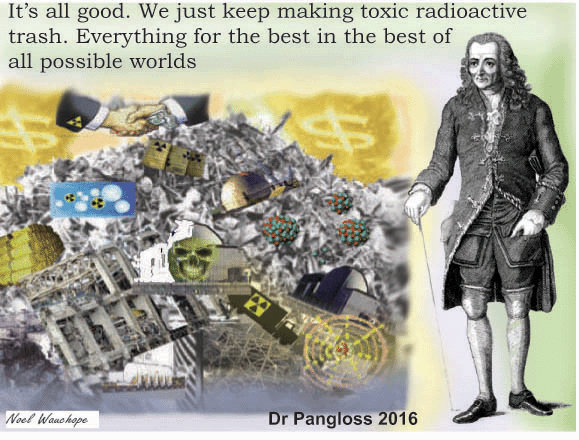
Feinstein, the senior Democrat on the Appropriations Subcommittee on Energy and Water Development, criticized the nuclear power industry in her opening statement on what she called its failure to speak with “one voice” on the need for interim storage of utility spent fuel. The country, she said, “should be working to establish interim [spent fuel] storage far away from reactors and population centers.” The hearing was scheduled to look at the future of nuclear power.
The lesson of the Yucca Mountain repository project is “any solution to nuclear waste needs to be voluntary,” Feinstein said. She and subcommittee chairman Lamar Alexander, a Tennessee Republican, and Senators Lisa Murkowski, an Alaska Republican and chairman of the Senate Energy and Natural Resources Committee, and Maria Cantwell of Washington, the ranking Democrat on the energy committee, have introduced legislation that would, among other things, establish a consent-based siting process. The bill has not moved out of committee, however.
Secretary of Energy Ernest Moniz told the subcommittee that a voluntary siting process is needed and that DOE will discuss during at a public meeting Thursday in Washington input the department received during eight public meetings held across the US on what a consent-based siting process should involve this year.
Support for a nuclear waste facility has to be aligned on the community, state and federal levels to avoid “bad surprises later on,” Moniz said.
In response to a question from Feinstein, Moniz said DOE’s general counsel has said the department has the authority, although not specifically stated, to use a private-sector facility to store utility spent fuel. He said DOE could move forward on setting up contracts with such facilities.
Currently, private-sector efforts are underway in Texas and New Mexico to site consolidated interim storage facilities that would have DOE as its only customer. http://www.platts.com/latest-news/electric-power/washington/progress-on-waste-issue-key-to-support-for-nuclear-21519625
Hillary Clinton’s role in the Fukushima nuclear disaster cover-up. Illegal hiding of emails
I am dumping these screen captures of all the Fukushima emails that I reviewed. I have all the PDFs downloaded and stored and backed up.
But I want to get this out there now, so you can view. Of this $400B dollar a year industry (nuclear), how much do you think they funneled to Hillary or some Super-Pac?
First off, she knew of the dangers of Fukushima, and the precautions that should have been taken, the next 3 graphics are from 1 email, March 12, 2011
 Hillary Clinton — Very Sick Person, Very Dangerous Person, Proof That She Is Willing to Kill Americans For Her Power http://nukeprofessional.blogspot.com.au/2016/09/hillary-clinton-very-sick-person-very.html?utm_source=feedburner&utm_medium=email&utm_campaign=Feed:+NukeProfessional+(Nuke+Professional)
Read below, this really spells it out very clearly. Hillary Clinton Threw American’s Under The Bus, Doubtless Costing Many Lives and Painful Diseases
Her emails, and lack of emails proves this clearly.
Here is the breakdown:
- Clinton was Secretary of State at the Time
- She was clearly briefed on the dangers of Fukushima
- She was getting several emails a day on Fukushima updates
- People in government were pushing her hard to make a trip to Japan even though she was very tired and overworked
- These same people were imploring her to “Go talk to Kissinger” about strategies for the Japan/Fukushima deal
- Hillary went and got a strategy from Kissinger, and decided to make the trip to Japan to meet one on one with top officials.
Now, with a big trip to a world super power and close allie, after the worst industrial accident in history, you know that there would be a lot of emails to coordinate the trip.
But after that meeting with Kissinger there was not a single Japan or Fukushima related email in what she turned over. Not one. They were all disappeared. Under penalty of contempt of court, a jailable offense, or worse, she had all those emails purged.
Why would anyone take a risk this large just to coverup a trip and discussion with one of our closest allies? 60 other top secret emails were released to the FBI (not disappeared), BUT the coverup of the Fukushima story was so important that Clinton and her group committed a felony by removing these from the record.
What is known and what is the most likely story that makes sense.
Uncertainty about Hinkley nuclear project, despite UK govarnment’s approval
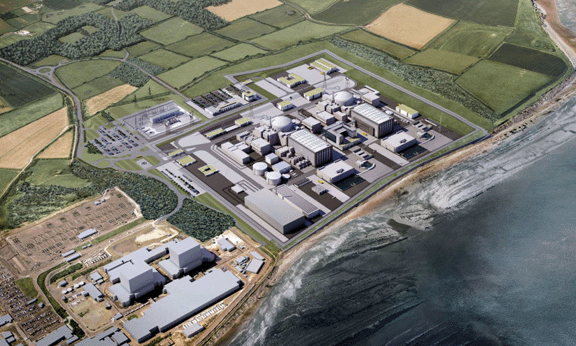 An amber light for China in UK nuclear power https://www.ft.com/content/40dbd3fa-7b2f-11e6-ae24-f193b105145e
Uncertainty about the £18bn Hinkley project survives a review After unexpectedly announcing a review at the end of July, the UK government has given the go-ahead for construction of the nuclear power station at Hinkley Point. This is the most important strategic decision since Theresa May became prime minister — one that has a bearing not only on the UK’s future competitiveness, but on its relations with China and France.
Regrettably, Mrs May has eschewed the chance to amend the commercial terms of the project, to be built at the gargantuan cost of £18bn by EDF, the French utility, with co-investment from the China National Nuclear Corporation (CNNC) and China Guangdong Nuclear Power. She has, though, announced a plan for new rules governing foreign investment in critical infrastructure. The impact of these on the nuclear programme is uncertain. If sufficiently stringent they could yet put the Hinkley project in doubt.
When it was first conceived a decade ago as part of plans to kick-start a nuclear “renaissance” as old coal-fired plants become obsolete, the Hinkley project was a more attractive proposition. Expected to be competitive with other power sources, it would also help Britain meet ever tougher emissions targets. A decade on — and at a time when the costs of wind power, solar energy and natural gas have all been falling — the price built into the deal is nearly four times higher. The French utility will receive more than double the present UK wholesale power price, indexed and guaranteed for 35 years. Questions therefore remain as to whether the project marries Britain’s energy needs with emission reduction targets in the most cost-effective way.
Mrs May ordered the review to assess concerns over the cost, the unproven technology involved and the role of Chinese investors in a plant that is due to meet about 7 per cent of domestic electricity demand. Her amendments all focus on national security. As part of a new, as yet unclear, legal framework for foreign investment in critical infrastructure, the government will in future hold a golden share in all nuclear power projects. Unexceptionally, this ensures that significant stakes cannot be sold without UK consent.
Of more concern potentially to Beijing is the additional security scrutiny to which the government plans to subject future nuclear projects. Again, the principle is sound from a UK perspective, but the details remain obscure.
China’s objective in putting £6bn into Hinkley Point was to be able to build its own reactors in the UK. During the “golden era” of Sino-UK relations proclaimed by the previous government of David Cameron when President Xi Jinping visited London last year, Beijing envisaged Hinkley as a springboard for its nuclear industry seeking other deals worldwide.
Both EDF and the Chinese have welcomed Mrs May’s decision to go ahead with the project. At least publicly, Beijing sees no obstacle towards its other planned investments with EDF. However, uncertainty over the long-delayed project has survived the review in important respects. Should additional regulatory scrutiny get in the way of Beijing’s other nuclear ambitions in the UK, notably a planned power plant at Bradwell, it could jeopardise the rationale for Chinese investment at Hinkley Point. EDF has warned that, without Chinese money, it may not proceed with the Hinkley scheme.
The last word on Hinkley may not have been written. Mrs May has addressed the concernsof security chiefs with a compromise that avoids an outright block. But she has deferred greater clarity on the extent to which she sees China playing a strategic role as an investor in the UK.
Hinkley nuclear station still might never happen
 Hinkley C nuclear go-ahead: May caves in to pressure from France and China, Ecologist Oliver Tickell 15th September 2016 It still might never happen
But despite today’s announcement there remains considerable uncertainty as to whether HPC will actually be built – among them legal challenges in the European Court to the unbelievably generous subsidy package for the project which appears to be incompatible with the EU’s ‘state aid’ regulations.
In addition both EDF and CGN, poised to take a 33.5% share in HPC, are unlikely to commit significant further capital to HPC until the Flamanville situation is resolved, and there is at least one working EPR to demonstrate that the design is constructable and operable – something that is still years away.
The highly risky (if potentially very profitable) project is also widely opposed within EDF as if it fails to ever generate power, or to operate reliably, it is likely to bankupt EDF. Also the company has yet to to line up the £16 billion (or more) it will need to finance its share of the project.
“This decision is unlikely to be the grand finale to this summer’s political soap opera”, said Greenpeace executive director John Sauven. “There are still huge outstanding financial, legal and technical obstacles that can’t be brushed under the carpet.
“There might be months or even years of wrangling over these issues. That’s why the Government should start supporting renewable power that can come online quickly for a competitive price.”
Richard Black, director of the Energy and Climate Intelligence Unit (ECIU), added:“Despite this being called a ‘final decision’ to build Hinkley C, other hurdles, including technical and legal challenges, may well lie ahead for the project.
“French trade unions don’t like it, nor do some of the likely candidates for the French Presidential Election next year, EDF’s finances are not the healthiest, and the French nuclear regulator is examining flaws in steel used for a similar reactor being built in France. So it may turn out not to be quite as ‘final’ as it looks now.
“Although China is reportedly happy with the new position, questions also remain over its main ambition – building its own nuclear reactors at Bradwell in Essex as a route into the Western market. The Chinese reactor hasn’t even begun the process of gaining UK safety approval, which usually takes four years, so negotiating a contract for Bradwell would fall to the next UK Government, not this one.
“And by then, electricity from other sources might look a whole lot cheaper than it does now.” http://www.theecologist.org/News/news_analysis/2988131/hinkley_c_nuclear_goahead_may_caves_in_to_pressure_from_france_and_china.html
New safeguards for Hinkley Point C nuclear power station “just window dressing”
Hinkley Point C nuclear power station gets government green light Labour and environmental groups say new safeguards for foreign investment are merely “window dressing”, Guardian, Rowena Mason, Simon Goodley, 16 Sept 16, Theresa May has been accused of backing down on security concerns about Chinese involvement in nuclear power after she gave the go-ahead to the £18bnHinkley Point C plant following a six-week review.
The government insisted the new plant in Somerset was only being approved with “significant new safeguards” to make sure China and other foreign investors could not own stakes in British nuclear plants without UK government approval.
However, Labour and environmental groups said the new security measures were merely “window dressing” and “hot air” that changed very little about the project, as the price remains the same and the new security powers already exist in law.
Under the proposals, EDF, the French firm building the plant with a £6bn investment from a Chinese state nuclear firm, will not be able to sell on its ownership without permission. For future projects, the UK government will own a “special share” that means it will have a veto over owners if there are national security concerns.
In a sign the new requirements do not appear to be overly stringent, both EDF and China General Nuclear said they were delighted by the approval, which they claimed will let them proceed with Hinkley and their wider plans for nuclear construction in the UK in future.
The Chinese are keen to proceed with a new plant at Bradwell in Essex in particular because it will be their own design built under the UK’s tough safety regulations, allowing the company to use it as a showcase to the rest of the world………
John Sauven, the Greenpeace executive director, also said the government’s review “appears to have been a lot of hot air”.
“The prime minister has baulked at the political embarrassment of irritating the French and offending the Chinese. Consequently, even if EDF manages to get the technology to work, the UK will pay the price by saddling themselves until 2060 with an out of date, flawed and expensive technology,” he said.
Clark, the business and energy secretary, said the new security restrictions were an improvement, claiming EDF would have been at liberty to sell its stake on without the revised contract.
His Department for Business, Energy and Industrial Strategy confirmed that this was the only new security requirement for Hinkley to proceed.
The controversial scheme in Somerset was approved six weeks after May unexpectedly placed the project under review, causing tensions with Beijing.
Following the review, the government is keeping a guaranteed price of £92.50 to EDF for every megawatt hour of electricity generated, despite concerns that is far higher than the market rate.
Chinese officials have previously given a series of veiled warnings that a decision by Britain to halt their investment in UK nuclear would be seen as a snub and would put at risk a supposed golden era of relations between the two countries.
The decision means Hinkley will be the first new nuclear reactor built in Britain in two decades……….https://www.theguardian.com/uk-news/2016/sep/15/hinkley-point-c-nuclear-power-station-gets-go-ahead
Hinkley nuclear and Brexit b- a bad deal for everyone concerned
How Hinkley delivers a bad deal for everyone http://blogs.reuters.com/breakingviews/2016/09/15/how-hinkley-delivers-a-bad-deal-for-everyone/ By John Foley
The economics of building Hinkley Point C for 18 billion pounds haven’t changed since last year, but they’re still not good. British energy users will effectively pay the difference between what operator EDF has been promised per megawatt hour, and the going market price. In September the UK government put that at 37 billion pounds over the contract’s 35-year life, or 15 billion pounds in today’s money.
It’s not much better for the French group. Should all go to plan, EDF could make a return on investment of around 9 percent a year, it says. But similar plants underway in France and Finland have run wildly over time and over budget.
Britain loses in another way too, because the new government is using Hinkley to launch a wide-ranging review of its authority to intervene in foreign takeovers of “critical infrastructure”. Over a decade ago, lawmakers deliberately took politics out of mergers. Interventions have been limited to matters of national security, media plurality and the stability of the financial system. The government now points out that other “major economies” have more stringent controls on foreign investment in infrastructure projects. That misses the point that Britain’s appeal has been that it is more open than places like France, China and the United States.
Why go ahead with such an unappealing project? The answer is Brexit. Voters’ decision to leave the European Union means Britain needs friends prepared to sign favourable trade deals. Scrapping Hinkley would poison the water for future talks with China, which is putting up a third of the cost of the project. Meanwhile, since almost half of Britain’s gas comes from continental Europe, developing more home-grown nuclear power may strengthen Britain’s hand ahead of negotiations over access to the single market.
Seen that way, going ahead with Hinkley may deliver a short-term benefit in the next couple of years, as Britain’s post-Brexit arrangements are hammered out. But the long-term disadvantages and financial costs will, like nuclear waste, contaminate the country for decades
Donald Trump not psychologically safe for military service, (but OK for President?)
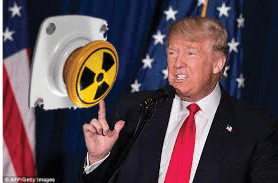 Author Eric Schlosser: That “emotionally unstable” Donald Trump could end up with the nuclear codes is “like the plot out of a science-fiction film”http://www.salon.com/2016/09/13/author-eric-schlosser-that-emotionally-unstable-donald-trump-could-end-up-with-the-nuclear-codes-is-like-the-plot-out-of-a-science-fiction-film/
Schlosser explained that in the military, Trump “would be forbidden from working with nuclear weapons Eric Schlosser, author of “Command and Control,” in a Facebook Live interview with Salon’s Andrew O’Hehir on Tuesday, warned of the dire possibility that GOP presidential nominee could wind up with sole control of the United States’ nuclear arsenal.
Schlosser explained that people who work with nuclear weapons in any capacity must pass a personnel reliability program — “basically a personality test to see if you should be let anywhere near nuclear weapons.”
“Donald Trump would fail that on every score,” he continued. “He’s a liar, he’s got all kinds of personal business problems and debts, he’s clearly emotionally unstable, and in the military he would be forbidden from working with nuclear weapons. And the notion of him being commander-in-chief, with the launch codes, capable of devastating cities and countries, is extraordinary. It’s like the plot out of a science-fiction film.”
New York downstate lawmakers resent subsidising upstate nuclear reactors
 Feeling the heat: Downstate legislators aren’t keen on subsidies for upstate nukes Watertown Daily Times , SEPTEMBER 12, 2016 Some downstate lawmakers don’t appreciate the fact that their constituents must now subsidize a form of energy produced in upstate regions.
The legislators take issue with the state Public Service Commission’s decision to include subsidies for nuclear power in the Clean Energy Standard approved Aug. 1. The CES calls for half of New York’s energy to come from renewable sources by 2030.
The nuclear energy subsidies, though, will benefit power plants located hundreds of miles away from the districts of these legislators.
“Members of the New York State Assembly, including James Brennan from Brooklyn, Amy Paulin from Westchester County, Jeffrey Dinowitz from the Bronx, and Charles Lavine and Stephen Englebright from Long Island, sent a letter to Audrey Zibelman, chair of the New York State Public Service Commission, saying that the commission’s order forcing downstate electric customers to pay nearly 60 percent of the electric rate increase to bailout the Exelon Corp. and keep four upstate nuclear units was unfair,” according to a news release issued Wednesday. “They said there was no way downstate electric customers used 60 percent of the output of the nuclear reactors and that the amounts should be reduced. Electric generation in the NYC-Westchester service territory, and purchases of electricity from other sources, account for the overwhelming percentage of the use of electricity there. Long Island’s situation is similar — the overwhelming percentage of its power does not come from upstate New York.”…
Trans Pacific Partnerships’ major problem – Investor-State Dispute Settlements
 The Big Problem With The Trans-Pacific Partnership’s Super
  Court That We’re Not Talking About, Huffington Post, David Dayen Financiers will use it to bet on lawsuits, while taxpayers foot the bill. August 30, 2016 A secretive super-court system called ISDS is threatening to blow up President Barack Obama’s highest foreign policy priority.
Investor-state dispute settlement — an integral part of the Trans-Pacific Partnership trade deal — allows companies to sue entire countries for costing them money when laws or regulations change. Cases are decided by extrajudicial tribunals composed of three corporate lawyers. Buzzfeed, in a multi-part investigation launched Sunday, called it “the court that rules the world.”
The ISDS system ― which is now written into over 3,000 international trade treaties, including NAFTA ― was designed to solve a specific problem. When corporations invest abroad, they fear that their factories might be nationalized or their products expropriated by governments that also control the local courts. ISDS is meant to give companies confidence that if a country seizes their accounts or factories, they’ll have a fair, neutral place to appeal.
Here’s how it works: Wealthy financiers with idle cash have purchased companies that are well placed to bring an ISDS claim, seemingly for the sole purpose of using that claim to make a buck. Sometimes, they set up shell corporations to create the plaintiffs to bring ISDS cases. And some hedge funds and private equity firms bankroll ISDS cases as third parties — just like billionaire Peter Thiel bankrolled Hulk Hogan in his lawsuit against Gawker Media.
It’s the same playbook that hedge funds were following when they bought up Argentine, Puerto Rican and other U.S. housing debt for pennies on the dollar. As The Huffington Post reported in May, the financiers were betting they could use lawsuits and lobbying to influence the political system in favor of the creditors like them and reap huge rewards.
Indeed, the damage of ISDS goes far beyond the money that investors manage to extract from public coffers and extends to the corruption of a political system by investors who buy off scholars, economists and politicians in pursuit of whatever policy outcome leads to a payoff. And there’s nothing stopping plutocrats with agendas that go beyond profit-making from getting involved ― again the way Thiel did with Gawker. That alone changes the power dynamic: If you’re the government of Thailand, the billionaire you’re negotiating with has one extra threat at his disposal.
If these investors are able to cement ISDS as part of the Trans-Pacific Partnership, the opportunities for hedge funds to do what they’ve already done to Argentina will be endless ― possibly even in cities and states under financial pressure in the U.S., like Detroit and Illinois.
So-called third-party funding of “international arbitration against foreign sovereigns” has been expanding quickly, according to Selvyn Seidel, a pioneer in the litigation finance industry and now CEO of the advisory firm Fulbrook Capital Management.
“You can get an award for billions of dollars when that award would never come out in domestic law,” said Gus van Harten, a professor at Osgoode Hall Law School at York University in Toronto. “It’s just a jackpot for speculators.”……….
Third-party funding shields corporations from the upfront costs of litigation, making it easier to sue. Since companies generally don’t have to disclose that they’ve received third-party funding for an ISDS case, and since international arbitration usually proceeds in comparative secrecy, pursuing a claim through ISDS can shield companies from the public criticism that accompanies challenging a law in regular courts. “You can actually ask for enormous amounts of money without anybody criticizing you,” said Verheecke of Corporate Europe Observatory.
With ISDS permitted under some 3,000 treaties, there are a huge number of opportunities to sue. And “unlike some other legal systems, the default remedy is a cash payment,” said Todd Tucker, a fellow at the Roosevelt Institute with a decade of experience researching trade and investment policy. The awards are also uncapped, meaning they can be enormous. If a corporation sought damages on future profits in perpetuity and the arbitrators agreed, the sovereign would have no recourse. Dozens of cases have resulted in awards of over $100 million, according to a 2016 report from van Harten, the law professor.
Those possibilities have the ISDS claim-financing industry booming. Hedge funds, private equity firms and institutional investors are flocking to fund lawsuits as they would any other speculative asset, according to experts in the field. And the lack of transparency means that lawyers acting as arbitrators or advocates in one case could be unnamed investors in other cases, and nobody would ever know.
Defenders of ISDS argue that the outcome of any case is uncertain and that companies win only about one-quarter of the time. But that’s only the cases that have been publicly identified and it doesn’t include settlements, where the corporation can also extract a monetary award. If funding ISDS suits was really such a bad bet, the industry probably wouldn’t be expanding so quickly.
Fulbrook Capital Management’s primer on the litigation finance industry, updated this year, includes a section entitled “International, the name of the game.” It lists numerous big-city hubs for arbitration: London, New York, Paris, Toronto. About ISDS in particular, the primer reads, “Investment claims against Sovereigns are often subject to Treaty and, within the Treaty, subject to arbitration. This promotes investments. … While investors are known to shy away from financing claims in ‘third world’ courts, particularly claims against the host court’s sovereign, they view international arbitration in a far more favorable light.”
Between 2009 and 2015, rulings in 16 ISDS cases have noted the existence of third-party funding, according to a report from Jean-Christophe Honlet, a partner at the global law firm Dentons. But the scale of third-party funding for ISDS cases is probably significantly larger than that number suggests. The International Council for Commercial Arbitration suggests that at least 60 percent of ISDS cases “enquired about (but not necessarily sought or obtained) third-party funding before their cases were lodged.” Just this month, Canadian gold mining company Rusoro won a $1.2 billion claim against Venezuela that was “third-party funded,” according to Global Arbitration Review………..
Giving financiers the ability to extract taxpayer dollars from around the globe transfers wealth upwards. It’s another way the rich get richer by accessing tools unavailable to most citizens. That has massive follow-on effects for economic and political power worldwide, including right here in the U.S.
Now, upcoming trade agreements would dramatically expand this system. Public Citizen estimates that 9,000 new companies would gain ISDS rights to sue the United States under TPP alone. That’s 9,000 new opportunities for financiers to reach down into state and local coffers, in addition to the federal government, to grab cash. TPP would also expand the “minimum standard of treatment” clause, which sets up the most flexible type of ISDS claim, to cover financial services companies, meaning almost any change in the expected future profits of a bank could be challenged. “TPP was a win for the banks on ISDS,” said van Harten, the law professor……..
the easiest way to fix ISDS is to throw it out. Several countries, including India,Indonesia and Ecuador, have told their trade partners they’re considering terminating bilateral treaties because of ISDS. Some experts question whether the system is necessary even in the situations it was originally designed for……http://www.huffingtonpost.com.au/entry/isds-lawsuit-financing-tpp_us_57c48e40e4b09cd22d91f660
Clinton Asserts USA Will Not Allow North Korea To Have Deliverable Nuclear Weapon

 US Will Not Allow North Korea To Have Deliverable Nuclear Weapon: Clinton, News 18.com September 11, 2016 Washington: The US will not allow North Korea to have deliverable nuclear weapons, Democratic presidential nominee Hillary Clinton said on Sunday.
“I absolutely believe that it has to be made very clear we will not allow North Korea to have a deliverable nuclear weapon, and we will approach this from a number of perspectives,” Clinton said.
we have got to make it clear missile defense is going in as quickly and broadly as possible,” Clinton said.
“Our message to the North Koreans and everyone else listening, they will not be permitted to acquire a nuclear weapon that has a deliverable capacity on a ballistic missile. And we have got to start intensifying our discussions with the Chinese, because they can’t possibly want this big problem on their doorstep,” she said……..http://www.news18.com/news/world/us-will-not-allow-north-korea-to-have-deliverable-nuclear-weapon-clinton-1291551.html
Iran building nuclear plant, estimated cost $10 billion – Russia helping
Iran Starts Construction On Second Nuclear Plant With Russian Help Radio Free Europe, September 10, 2016 Iran has begun building a second nuclear power plant with Russian help, Iranian and Russian media are reporting.
The project, known as Busherh-2, was officially launched on September 10 in the southern port city of Bushehr. The project will cost around $10 billion and produce 1,057 megawatts of electricity. The project is expected to be completed in 10 years.
It’s Iran’s first nuclear power project since the country reached a landmark nuclear deal with world powers in July 2015. It will be built by Rosatom, the Russian state nuclear power company.
Iran’s sole operational nuclear reactor — also built with Russian assistance in Bushehr — produces 1,000 megawatts. It went online in 2011, and the two countries have agreed to cooperate on future projects.
The Bushehr plant is not considered a proliferation risk because Russia supplies the fuel for the reactor and takes away spent fuel that could otherwise be used to make weapons-grade plutonium….http://www.rferl.org/content/iran-bushehr-2-nuclear-power-plant-russia/27978982.html
Latest roundup on news on Britain’s planned Hinkley nuclear station
Bridget Woodman, Course Director, MSc Energy Policy, at the University of Exeter, says the Hinkley delay makes it possible to start debating the sorts of options being considered widely around the world, with measures to encourage more flexible, smaller-scale, renewable systems incorporating demand-side measures and new technologies such as storage. These are extraordinary times for energy policy in the UK.
After years of resigned acceptance that Hinkley would be built no matter how much of a basket case it was, even though few people argued that it makes sense, there is now a potential to have a real and considered debate about what sort of future electricity system we need. Now is the time to start considering the sorts of options being considered widely around the world, with measures to encourage more flexible, smaller-scale, renewable systems incorporating demand-side measures and new technologies such as storage. A system that is the absolute antithesis of what Hinkley Point C represents. Suddenly UK energy policy has become very exciting

 Hinkley Notes NuClear News No. 888 September 16 The Downing Street review of the proposed Hinkley Point C nuclear power station is coming to an end – and a decision will have to be made soon, probably before the end of September. The latest wave of public relations activity from EDF, the company that hopes to build the plant, shows how nervous the company is about the outcome. Given the range of doubts about the costs, the construction risks, the reactor technology and the involvement of the Chinese, that nervousness is well justified. (1)
Here are the news highlights from the last month.
It’s about the security stupid! The Times says the review centres on the security threat posed by allowing a Chinese company to invest in critical infrastructure in the UK. But officials are also puzzling over cost and value for money. Continue reading
1 This Month
15 October. Joint Appeal for Nuclear Abolition Day -presentation to the UN on October 15 will be live on UNWebTV
Endorse the Nuclear Abolition Day Appeal
23-25 October – on Zoom – World BEYOND War’s annual global conference

To see nuclear-related stories in greater depth and intensity – go to https://nuclearinformation.wordpress.com
-
Archives
- October 2026 (149)
- September 2026 (339)
- August 2026 (330)
- July 2026 (355)
- June 2026 (287)
- May 2026 (306)
- April 2026 (356)
- March 2026 (251)
- February 2026 (267)
- January 2026 (308)
- December 2025 (358)
- November 2025 (359)
-
Categories
- 1
- 1 NUCLEAR ISSUES
- business and costs
- climate change
- culture and arts
- ENERGY
- environment
- health
- history
- indigenous issues
- Legal
- marketing of nuclear
- media
- opposition to nuclear
- PERSONAL STORIES
- politics
- politics international
- Religion and ethics
- safety
- secrets,lies and civil liberties
- spinbuster
- technology
- Uranium
- wastes
- weapons and war
- Women
- 2 WORLD
- ACTION
- AFRICA
- Atrocities
- AUSTRALIA
- Christina's notes
- Christina's themes
- culture and arts
- Events
- Fuk 2022
- Fuk 2023
- Fukushima 2017
- Fukushima 2018
- fukushima 2019
- Fukushima 2020
- Fukushima 2021
- general
- global warming
- Humour (God we need it)
- Nuclear
- RARE EARTHS
- Reference
- resources – print
- Resources -audiovicual
- Weekly Newsletter
- World
- World Nuclear
- YouTube
-
RSS
Entries RSS
Comments RSS

