Oh Hillary, did you have to sell out to the nuclear lobby?
 Hillary Takes the Nuclear-Energy Option, National Review, by ROBERT BRYCE September 22, 2016 She recognizes that public perceptions about nuclear power are becoming more positive. Amid the avalanche of criticism aimed at Hillary Clinton in recent weeks about Pneumonia-gate, the Clinton Foundation, and her never-ending e-mail troubles, the Democratic nominee actually made an important policy statement, one that puts her directly at odds with America’s biggest environmental groups as well as her own party’s platform. What did Clinton do?
USA House committee voted to remove a 2020 deadline for a nuclear power plant tax credit
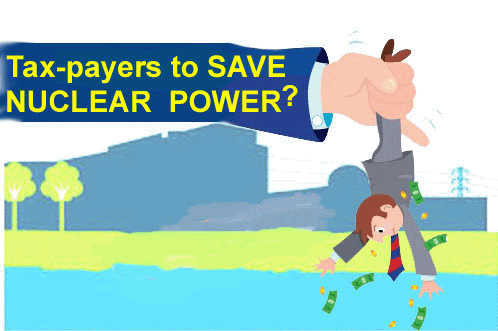 House committee votes to lift 2020 deadline on nuclear power tax credit http://www.utilitydive.com/news/house-committee-votes-to-lift-2020-deadline-on-nuclear-power-tax-credit/426850/ By Peter Maloney | September 23, 2016
Dive Brief:
- The House Ways and Means Committee has voted 23-9 on a bill to remove a 2020 deadline for a nuclear power plant tax credit, The Hill reports.
- The credit, enacted in 2005, will likely benefit the Vogtle nuclear reactors being built by Southern Co. in Georgia and the Summer reactors being built by SCANA in South Carolina.
- The bill would not change the 6,000-MW cap on the tax credit. Nuclear opponents called the bill a bailout for plant owners who have failed to deliver new reactor projects on time.
Dive Insight:
Nuclear plants are expensive to build — so expensive that until recently a nuclear plant had not entered construction for nearly 30 years. Notably the nuclear plants now under construction are all being done by regulated utilities, and they benefit from federal loans and tax credits.
That federal support is a key component for the financing of the projects, even if they are otherwise supported, ultimately, by ratepayers.
Both the Vogtle and Summer projects have been plagued by delays and cost overruns. The Vogtle units were originally due online in 2016 and 2017 and are now looking at a 2020 online date. The Summer reactors were originally due online in 2017 and are now slated for operation in 2019 and 2020.
If the revised timelines slip and the 2020 deadline on the tax credits remains, it could prove costly for the plant owners. The bill lifting the tax credit deadline would remove that risk.
“When Congress passed the 2005 act, it could not have contemplated the effort it would take to get a nuclear plant designed and licensed,” Rep. Tom Rice (R-SC) told The Hill.
China wants its nuclear industry to grow dauntingly fast
The Economist Sep 24th 2016 | LIANYUNGANG UPON learning (via a terse government statement) that their bustling port city in eastern China had been tipped as the likely site of a plant to recycle used nuclear fuel, residents of Lianyungang took to the streets last month in their thousands. Police, whose warnings against demonstrations were ignored, deployed with riot gear in large numbers but only scuffled with the protesters, who rallied, chanted and waved banners in the city centre for several days. “No one consulted us about this,” says one woman who participated in the protests. “We love our city. We have very little pollution and we don’t want a nuclear-fuel plant anywhere near us. The government says it is totally safe, but how can they be sure? How can we believe them?” she asks.Such scepticism is shared by many in Lianyungang, which already hosts a nuclear-power plant , and elsewhere in China, where the government plans to expand nuclear power massively. ……
UK Liberal Democrats oppose Hinkley nuclear plan – ‘very poor value for money’

 Lib Dems vote to oppose Hinkley nuclear plant in emergency conference motion, Left Foot Forward,
Adam Barnett 19 September, 2016 Project is ‘very poor value for money’ and we should use renewable energy instead, say members Liberal Democrats voted to oppose a new nuclear power station at Hinkley Point C today in an emergency policy motion at party conference.
The party agreed this morning that the new £18 billion plant in Somerset was ‘very poor value for money’ for consumers and proposed renewable energy instead.
The motion also noted that similar nuclear plants in France and Finland are both ‘years behind schedule and significantly over budget’.
It concludes:
‘Conference believes that construction of a new nuclear station at Hinkley Point is both entirely dependent on public subsidy and represents very poor value for money for UK consumers, and that therefore it should be opposed.
Conference calls for a UK energy strategy resting on investments in energy efficiency, renewable energy, storage and interconnection with European grids, thereby providing energy security, an end to fuel poverty and the reduction of greenhouse gas emissions at the same time as creating jobs, exports and prosperity.’……..https://leftfootforward.org/2016/09/lib-dems-vote-to-oppose-hinkley-nuclear-plant-in-emergency-conference-motion/
Further nuclear power development in China will need local public consent
 China nuclear developers must seek public consent: draft rules, http://www.reuters.com/article/us-china-nuclear-safety-idUSKCN11Q18K (Reporting by David Stanway; editing by Jason Neely), 20 Sept 16 China’s nuclear developers must seek the consent of local stakeholders before going ahead with new projects, according to draft rules published by the country’s cabinet on Monday.
Developers will need to assess the impact a nuclear project will have on social stability and solicit public opinion through hearings or announcements, the Legislative Affairs Office of the State Council said.
China is in the middle of a rapid nuclear reactor building program and aims to have 58 gigawatts (GW) of capacity in full commercial operation by the end of 2020, up from 30.7 GW at the end of July.
But despite a strong safety record at existing plants, the government has struggled to convince the public about the safety of nuclear power.
Protests in the eastern coastal city of Lianyungang last month led to the cancellation of a proposed $15 billion nuclear waste processing plant.
“Japan’s Fukushima accident once again created doubt about the safety of nuclear power among the public, and also caused feelings of fear and opposition to occur from time to time,” the Legislative Affairs Office said in a statement.
It said the new draft rules would improve information disclosure and allow the public to participate more actively in the construction and supervision of nuclear projects.
The Legislative Affairs Office has made the draft guidelines available to the public and will accept suggestions until Oct. 19, it said in a notice posted on its website (www.chinalaw.gov.cn).
A team of experts from the International Atomic Energy Agency said this month that China’s “unparalleled” nuclear expansion would pose challenges for its regulators, and more work needed to be done in areas such as waste management and the handling of ageing reactors.
South Africa’s Energy Minister is asked to release all nuclear-bid information

 Minister will have to release all nuclear-bid information’, IOL News, 21 September 2016, Craig Dodds Cape Town – The chairman of Parliament’s energy oversight committee is to write to Energy Minister Tina Joemat-Pettersson to request all documents related to nuclear procurement by October 11, after she refused to release them on the basis that they were “sensitive”.
This comes after a legal opinion sought by another parliamentary committee confirmed that it had the right in terms of the National Assembly rules to “summon any person to produce any document it requires in carrying out its functions”………
In a written reply to a request from Mackay earlier this month, Joemat-Pettersson refused to provide a number of key documents related to nuclear procurement.
Majola said the National Assembly rules provided a mechanism for the committee to deal with confidential documents, which gave the chairperson of the committee, and not the minister, the authority to determine what should be kept from public view, and how.
“We will have to ask for the documents. We will go through legal advice to see which of the documents can be dealt with by the committee differently, not which of the documents will not be seen by the committee,” Majola said.
He committed to write to Joemat-Pettersson immediately, requesting that the department furnish the committee with all the documents.http://www.iol.co.za/dailynews/news/minister-will-have-to-release-all-nuclear-bid-information-2070774
Wisconsin nuclear plant: licensee wants license to be terminated
Decommissioning Debate Continues At Former Nuclear Power Plant Near La Crosse
New License-Holder Wants Some Land Released From License Requirements Wisconsin Public Radio, September 20, 2016, By Chuck Quirmbach. The next step in decommissioning the former nuclear power plant in Genoa, Wisconsin, will be the subject of a public meeting Tuesday night.
The session will focus on the La Crosse Boiling Water Reactor, which was shut down in 1987.
La Crosse Solutions, the decommissioning firm that took over the license from Dairyland Power Cooperative this year, is seeking federal approval of its plan to officially close the books on the nuclear facility. Known as a license termination plan, it includes radiological information, decommissioning steps that need to be taken and plans for future radiation surveys of the site……..http://www.wpr.org/decommissioning-debate-continues-former-nuclear-power-plant-near-la-crosse
Donald Trump, geopolitics, Brexit, and climate catastrophe
 Why a Donald Trump Victory Could Make Climate Catastrophe Inevitable, Michael Klare on the forces moving us toward an uninhabitable planet. Mother Jones, MICHAEL KLARE, SEP. 17, 2016 “……., the fate of the planet rests on the questionable willingness of each of those countries to abide by that obligation, however sour or bellicose its relations with other signatories may be. As it happens, that part of the agreement has already been buffeted by geopolitical headwinds and is likely to face increasing turbulence in the years to come.
That geopolitics will play a decisive role in determining the success or failure of the Paris Agreement has become self-evident in the short time since its promulgation. While some progress has been made toward its formal adoption—the agreement will enter into force only after no fewer than 55 countries, accounting for at least 55 percent of global greenhouse gas emissions, have ratified it—it has also encountered unexpected political hurdles, signaling trouble to come…….
Great Britain’s astonishing Brexit vote has complicated the task of ensuring the European Union’s approval of the agreement, as European solidarity on the climate issue—a major factor in the success of the Paris negotiations—can no longer be assured. “There is a risk that this could kick EU ratification of the Paris Agreement into the long grass,” suggests Jonathan Grant, director of sustainability at PricewaterhouseCoopers.
The Brexit campaign itself was spearheaded by politicians who were also major critics of climate science and strong opponents of efforts to promote a transition from carbon-based fuels to green sources of energy. For example, the chair of the Vote Leave campaign, former Chancellor of the Exchequer Nigel Lawson, is also chairman of the Global Warming Policy Foundation, a think tank devoted to sabotaging government efforts to speed the transition to green energy. Many other top Leave campaigners, including former Conservative ministers John Redwood and Owen Paterson, were also vigorous climate deniers.
In explaining the strong link between these two camps, analysts at the Economistnoted that both oppose British submission to international laws and norms: “Brexiteers dislike EU regulations and know that any effective action to tackle climate change will require some kind of global cooperation: carbon taxes or binding targets on emissions. The latter would be the EU writ large and Britain would have even less say in any global agreement, involving some 200 nations, than in an EU regime involving 28.”……..
In his first major speech on energy, delivered in May, Trump—who has called global warming a Chinese hoax—pledged to “cancel the Paris climate agreement” and scrap the various measures announced by President Obama to ensure US compliance with its provisions. Echoing the views of his Brexit counterparts, hecomplained that “this agreement gives foreign bureaucrats control over how much energy we use on our land, in our country. No way.” He also vowed to revive construction of the Keystone XL pipeline (which would bring carbon-heavy Canadian tar sands oil to refineries on the Gulf Coast), to reverse any climate-friendly Obama administration acts, and to promote the coal industry. “Regulations that shut down hundreds of coal-fired power plants and block the construction of new ones—how stupid is that?” he said, mockingly……..
nationalistic exceptionalism could become something of the norm if Donald Trump wins in November, or other nations join those already eager to put the needs of a fossil-fuel-based domestic growth agenda ahead of global climate commitments. With that in mind, consider the assessment of future energy trends that the Norwegian energy giant Statoil recently produced. In it is a chilling scenario focused on just this sort of dystopian future………
Indeed, the future pace of climate change will be determined as much by geopolitical factors as technological developments in the energy sector. While it is evident that immense progress is being made in bringing down the price of wind and solar power in particular—far more so than all but a few analysts anticipated until recently—the political will to turn such developments into meaningful global change and so bring carbon emissions to heel before the planet is unalterably transformed may, as the Statoil authors suggest, be dematerializing before our eyes. If so, make no mistake about it: We will be condemning Earth’s future inhabitants, our own children and grandchildren, to unmitigated disaster…….
To avoid an Eaarth (as both Bill McKibben and the Statoil authors imagine it) and preserve the welcoming planet in which humanity grew and thrived, climate activists will have to devote at least as much of their energy and attention to the international political arena as to the technology sector. At this point, electing green-minded leaders, stopping climate deniers (or ignorers) from capturing high office, and opposing fossil-fueled ultranationalism is the only realistic path to a habitable planet.
Michael T. Klare is a professor of peace and world security studies at Hampshire College and the author, most recently, of The Race for What’s Left. http://www.motherjones.com/environment/2016/09/donald-trump-brexit-paris-accord-climate-change
Nuclear weapons cuts for USA? Obama tries, but has limited options
 Obama to decide on cuts to US nuclear arsenal in October Limited politically feasible options on table for president to cement a disarmer legacy, most far-reaching of which is a one-third cut to deployed strategic arsenal, Guardian, Julian Borger, 17 Sep 16, Barack Obama is expected to make a final decision next month on possible cuts to the US nuclear arsenal, in an attempt to consolidate his legacy as a disarmer before leaving office.
Options on the table include reducing the number of deployed strategic warheads, slimming down the reserve stockpile, cutting military stores of fissile material available for making new warheads, and putting off some modernisation plans, including the a controversial air force programme for developing an air-launched cruise missile.
The president is due to consult his principal national security officials in October on which, if any, of the options are still feasible in the time left before he leaves office.
Some more radical options, like changing the US nuclear posture to rule out first use of nuclear arms in a conflict and taking some of the nation’s intercontinental ballistic missiles off hair-trigger alert, have faced such strong opposition from allies abroad and the Pentagon that they are no longer being seriously considered………https://www.theguardian.com/world/2016/sep/17/obama-nuclear-arsenal-disarmament-russia-congress
Scotttish politicians slam the danger, secrecy, of hazardous air transport of nuclear wastes
 There’s no safe way to move nuclear waste’: Scottish Politicians slam nuke flight that needed armed cop convoy http://www.dailyrecord.co.uk/news/scottish-news/gun-cop-8859315, 18 SEP 2016 BY JIM LAWSON Green MP John Finnie and Caithness MP Paul Monaghan among those to voice concerns about flying nuclear waste to the US. THE first flight believed to be carrying British nuclear waste to America took off from Wick Airport amid tight security yesterday.
Scots politicians and anti-nuclear campaigners have slammed the deal, brokered by David Cameron and Barack Obama, to move the waste.
 The airport was closed from early morning as armed police patrolled the perimeter.
Twenty miles away in Thurso, more armed officers escorted a lorry from the 
Dounreay nuclear plant through the town. It was carrying two heavily reinforced containers.
At 11.40am, a police convoy brought the containers on to the runway.
A US Air Force transport plane landed 10 minutes later and loading began almost immediately. The plane took off two-and-a-half hours later.
The plan to transport highly enriched uranium from Dounreay to the US emerged late last year.
Dounreay bosses won’t confirm or deny the scheme, but Cameron revealed after talks with Obama earlier this year that uranium from the plant would be moved to South Carolina.
Other types of uranium will be sent to Europe in exchange and used to make medical isotopes. But Dr Richard Dixon, director of Friends of the Earth, said: “There is no truly safe way to move this waste.”
 Caithness MP Paul Monaghan said the deal was “morally reprehensible” and Green MP John Finnie said people would be stunned that nuclear waste was being transported by plane.
Nuclear expert John Large said: “The risk in transport by air is the fuel being engulfed in fire, the packages breaking down and the fuel igniting.”
The runways at Wick have been extended at a cost of £18million to take the US planes, and Highland Council have published an order allowing local roads to be closed for five hours at a time until March 2018.
 Police refused to comment on yesterday’s operation for security reasons.The first flight believed to
be carrying British nuclear waste to America took off from Wick Airport amid tight security yesterday.
Scots politicians and anti-nuclear campaigners have slammed the deal, brokered by David Cameron and Barack Obama, to move the waste.
The airport was closed from early morning as armed police patrolled the perimeter.
Twenty miles away in Thurso, more armed officers escorted a lorry from the Dounreay nuclear plant through the town. It was carrying two heavily reinforced containers.
At 11.40am, a police convoy brought the containers on to the runway.
A US Air Force transport plane landed 10 minutes later and loading began almost immediately. The plane took off two-and-a-half hours later.
The plan to transport highly enriched uranium from Dounreay to the US emerged late last year.
 Dounreay bosses won’t confirm or deny the scheme, but Cameron revealed after talks with Obama earlier this year that uranium from the plant would be moved to South Carolina.
Other types of uranium will be sent to Europe in exchange and used to make medical isotopes. But Dr Richard Dixon, director of Friends of the Earth, said: “There is no truly safe way to move this waste.”
The runways at Wick have been extended at a cost of £18million to take the US planes, and Highland Council have published an order allowing local roads to be closed for five hours at a time until March 2018.
Police refused to comment on yesterday’s operation for security reasons.
South Africa’s Democratic Alliance (DA) demands truth on secretive nuclear contract
DA DEMANDS ANSWERS OVER NUCLEAR CONTRACT http://ewn.co.za/2016/09/17/DA-demands-answers-over-nuclear-contract The party has called on the Energy Ministry to answer questions about an apparent nuclear contract. Gia Nicolaides | a day ago
JOHANNESBURG – The Democratic Alliance (DA) says the Energy Ministry needs to answer questions about an apparent nuclear contract that has left South Africans in the “dark”.
The Mail & Guardian is reporting that Shantan Reddy, the son of President Jacob Zuma’s friend Vivian Reddy, clinched a contract worth R171 million for the procurement of a nuclear build programme management system.
It’s been listed on the Energy Department‘s website under the “awarded bids” section, despite Deputy President Cyril Ramaphosa recently saying that a final decision to proceed with a nuclear build programme will only be made once there’s been a request for proposals.
The DA’s energy spokesperson Gordan Mackay says, “Since the president made the announcement in 2014 about the nuclear build programme, not a single document has surfaced in Parliament. We have submitted questions again three weeks ago, which she has declined on the basis that the information was sensitive.”
Empire Technology appears to have clinched the multi-million rand contract. (Edited by Shimoney Regter)
Serious questions about South Africa’s nuclear power tender process
Energy department to co-operate with Treasury on nuclear deal, BUSINESS NEWS / 18 September 2016, Pretoria – The energy department will fully co-operate with National Treasury regarding the nuclear new build programme, Energy Minister Tina Joemat-Pettersson insisted on Saturday……………….
The awarding of the contract to Reddy’s company was highly irregular considering that both Joemat-Pettersson and Deputy President Cyril Ramaphosa had been at pains to assure South Africans that no deal had been concluded.
“If there is in fact no nuclear deal yet, why the need to procure a R171-million system to manage it?” Mackay asked.
Alarmingly, the contract with Reddy was awarded on the back of an as yet unidentified tender in the Free State and not publically advertised on the department’s website, as was standard practice. That notwithstanding, the deal with Reddy was personally signed off by the department’s director general.
“This raises serious questions surrounding the tender process that was followed, not least of which is what knowledge the minister had of the deal with Reddy.”
The DA would submit parliamentary questions to Joemat-Pettersson to ascertain, among other things, the reasons for the deviation from the department’s standard procurement process and the basis on which Reddy’s company, an entity with no experience in the nuclear field, was awarded the contract.
Also, whether the minister had any involvement in, or knowledge of the contract and why a contract for the management of the new build programme had been awarded if, by the minster’s account, no deal had been concluded.
“The move is premature at best and once again suggests that protestations by government are a smokescreen to hide the fact that the nuclear new build is a done deal. Moreover, the development ads to the growing body of evidence suggesting that the primary motivation being Zuma’s pursuit of the ill-advised and unaffordable nuclear deal is to enrich his cronies and fund his patronage network.
“The DA has long maintained that the nuclear deal has potential for corruption the likes of which South Africa has never seen. One thing is increasingly clear – the only really beneficiary of the nuclear deal will be Zuma Inc at the expense of an already highly indebted and fragile South African economy,” Mackay said.
African News Agency (ANA) http://www.iol.co.za/business/news/energy-department-to-co-operate-with-treasury-on-nuclear-deal-2069549
Britain’s nuclear gamble will cost every UK family an extra £1,000
 The £18bn Hinkley gamble: Nuclear deal will cost every UK family an extra £1,000 as May signs off on the plans to protect Britain’s national security
- Prime Minister approved plans after restricting influence of Chinese state
- Britain will guarantee EDF £92.50 per megawatt hour, up on current market price of £38.91
- Tory MP Zac Goldsmith said the plant would generate ‘most expensive energy in the history of energy generation’
By JASON GROVES DEPUTY POLITICAL EDITOR FOR THE DAILY MAIL, 16 Sept 16
Electricity bill-payers will be forced to make up the difference once the plant in Somerset comes on stream in the 2020s.
The National Audit Office has warned these subsidies will add almost £30billion to electricity bills over the project’s lifetime. That is an extra £30 for the average annual bill over 35 years – totalling more than £1,000 per household.
Last night Tory MP Zac Goldsmith said by the end of the project ‘this new power plant will have generated the most expensive energy in the history of energy generation’.
And former Tory chancellor Lord Lawson said every independent energy expert believed the Hinkley project was a ‘thoroughly lousy deal’. He said EDF was ‘hopelessly behind schedule’ on similar plants in France and Finland and called on ministers to pull the plug if it encountered similar problems here……..
Last year, the French nuclear safety authority found weaknesses in the steel used to construct the pressure vessel at the heart of the reactor. These faults could mean that either the plant would have to operate at a much-reduced capacity, or the reactor would have to be rebuilt – or worse abandoned.
In extremis, if the vessel fails critics fear it could lead to a catastrophic nuclear accident on the scale of the Chernobyl disaster.
It is the same reactor design EDF plans to use for Hinkley, a so-called European Pressurized Reactor (EPR). This is similar to the Sizewell nuclear power station on the Suffolk coast, but on a larger scale and with extra safety features.
However, the British government has agreed to pay EDF much, much more for the electricity the Hinkley version would produce than the French government has for the electricity from Flamanville.
Controversially, the Cameron government guaranteed EDF a fixed price of £92.50 per megawatt hour over a period of 35 years, whereas EDF will charge the French government only €64 (£54) per megawatt hour for the electricity it hopes to produce in Normandy……….. http://www.dailymail.co.uk/news/article-3791895/The-18bn-Hinkley-gamble-nuclear-deal-cost-UK-family-extra-1-000-signs-plans-protect-Britain-s-national-security.html
At least 4 years before UK’s Bradwell nuclear plan could be approved
China must wait four years for decision on Bradwell nuclear plant
 After Hinkley Point C go-ahead, Essex reactor would be even more significant for China – and more controversial for UK, Guardian, Graham Ruddick and Tom Phillips, 17 Sept 16 China faces at least a four-year wait to find out whether its plans to build a nuclear power station in Essex will be approved.
If it got the go-ahead, Britain would be relying heavily on Chinese investment for its future energy supply after the government approved the construction of an £18bn nuclear power station at Hinkley Point in Somerset, which will be 33% owned by China General Nuclear (CGN).
Theresa May pushed through the Hinkley Point C project despiteopposition from MPs and the public over its cost and the involvement of China. However, the project in Bradwell, Essex, is even more controversial because it would be majority owned and designed by China………
Under the deal, CGN agreed to invest £6bn inHinkley Point C in return for leading its own power plant project at Bradwell.
The Bradwell plant is considered vital by the state-owned company because it would be the first Chinese nuclear reactor to be built in a developed country and an opportunity to promote China’s technological expertise.
CGN plans formally to submit its plan for a nuclear reactor at Bradwell within weeks. However, it would take at least four years for the Office of Nuclear Regulation (ONR) to assess the proposals and possibly approve them. This means that despite the government having approved Hinkley Point C, the shape of Britain’s future energy supply will remain unresolved for some time……..
The process for the Chinese company would be the same as for other new reactors and would take around four years, as long as the group met the timetable for submissions and provided sufficient detail…….
CGN would own two-thirds of the Bradwell B project, with the French energy company EDF owning the rest. This is the reverse of Hinkley Point C, which is two-thirds owned by EDF and of a French design…….
Johnny Hon, a Sino-British entrepreneur and vice-president of the 48 Group Club, which promotes trade links between the countries, said: “Although the news is most welcome from China’s perspective, their most anticipated deal is the third potential reactor in Bradwell in Essex – whose details are yet to be confirmed.
“This reactor would be the first in a developed country to use Chinese technology and [would] be a breakthrough in establishing China as a global leader in nuclear power.”…….
General Electric, the US industrial giant, has confirmed it is in line to receive $1.9bn (£1.5bn) by building steam turbines and generators for the power plant. https://www.theguardian.com/uk-news/2016/sep/16/china-must-wait-four-years-for-decision-on-bradwell-nuclear-plant
Climate Change Think Tank sets out 10 serious mistakes in Hinkley nuclear decision
 HINKLEY GREEN LIGHT A MASSIVE STRATEGIC MISTAKE, SAYS CLIMATE CHANGE
 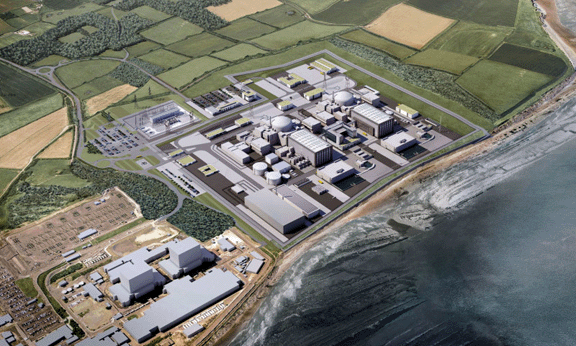 THINK TANK http://tomburke.co.uk/2016/09/15/hinkley-green-light-a-massive-strategic-mistake-says-climate-change-think-tank/ September 15, 2016 by tomburke Following reports today that the Government is about to give the green light to the Hinkley Point C nuclear power station, E3G, a leading climate change think tank said it would be a hugely expensive strategic mistake, using expensive 20th century technology that would soon be obsolete.
E3G Chairman, Tom Burke said: “It is a 20th Century solution to 21st Century problems. Bigger is no longer better. There are faster, cheaper, cleaner and smarter ways to deliver affordable, secure, low carbon electricity to Britain’s consumers.
Nothing about this deal is good for Britain’s hardworking families. They will pay the bill for decades but the jobs will go abroad. It is bad for consumers, bad for the climate and bad for the country.
The Prime Minister is missing a real opportunity to set Britain on course to a more productive and secure future. Instead she has committed us to an expensive and anachronistic energy policy that will leave Britain further behind in a rapidly changing world.”
- E3G sets out below ten reasons why this is a bad deal for British consumers and documents the range of cheaper, smarter, options for low carbon energy security that are better value for money.
HINKLEY POINT : The 10 Mistakes
The Investor Agreement that Greg Clark will sign with EDF is an irrevocable index-linked ‘take or pay’ contract to purchase 35 years’ worth of electricity from EDF at more than twice the current wholesale price. This will cost British consumers £37 billion in subsidy, four times that originally forecast[1]
- This deal binds future governments as well as the current Government. It will prevent Britain’s consumers buying cheaper electricity if it would displace that from EDF.
- It means Britain’s electricity consumers will pay more than £1 billion/year in subsidy to EDF for 35 years.
- The business case for this Agreement has never been subject to informed public scrutiny. The arguments for HPC and the rest of the nuclear programme have never been stress tested.
- The National Audit Office has already raised doubts that it represents value for money in the light of developments, including significant reductions in electricity demand forecasts, since it was first proposed[2].
- The National Infrastructure Commission has identified a package of other measures that could provide affordable, secure, low carbon electricity at lower cost.
- The National Grid has cut its forecast of the need for new centralised generation capacity in Britain by more than 50%, announcing its estimate of growth for decentralised generation was 50 times too low[3]
- EDF’s unions will argue in the French Courts that delaying a Hinkley decision until 2018 would allow for a design review to be completed that would reduce the subsidy needed from £92.50/MWh to £75/MWh[4].
- State Aids clearance for the UK subsidy is under challenge by the Austrian Government and others in the European Court. A further State Aids challenge is likely to the French Government’s re-financing of EDF. If either is successful the deal will fall.
- Hinkley will not produce electricity until 2030. There are cheaper, faster, cleaner and more reliable options available to deliver affordable, secure, low cost electricity to British consumers. These include:
- energy efficiency has reduced electricity demand by 25TWh ( 7% – the same as Hinkley will produce ) since 2010. A McKinsey report for the Government estimates that by 2030 demand could be reduced by a further 23% while reducing consumers bills;
- the National Infrastructure Commission reports that additional interconnectors could supply 2-3 Hinkleys by 2025;
- another National Infrastructure Commission report proposed investment in storage and smart grids that would provide the equivalent of 4 Hinkleys by 2030 and save £8 billion.
- Dong Energy, the world’s largest wind energy company, could replace all Hinkley’s electricity sooner and at lower cost. Offshore wind costs are continuing to fall.
- electricity from solar power is now also cheaper than Hinkley, having fallen by half in the last five years. From almost no solar panels in the UK, a third of a Hinkley has been added since 2010. Half of that was delivered in just 18 month.
- E3G is an independent global think tank, working to accelerate the transition to a low-carbon economy. E3G specializes in climate diplomacy, climate risk, energy policy and climate finance.
- In 2016, E3G was ranked the number one environmental think tank in the UK by the Go To Think Tank Index, second in Europe and sixth in the World.
1 This Month
15 October. Joint Appeal for Nuclear Abolition Day -presentation to the UN on October 15 will be live on UNWebTV
Endorse the Nuclear Abolition Day Appeal
23-25 October – on Zoom – World BEYOND War’s annual global conference

To see nuclear-related stories in greater depth and intensity – go to https://nuclearinformation.wordpress.com
-
Archives
- October 2026 (149)
- September 2026 (339)
- August 2026 (330)
- July 2026 (355)
- June 2026 (287)
- May 2026 (306)
- April 2026 (356)
- March 2026 (251)
- February 2026 (267)
- January 2026 (308)
- December 2025 (358)
- November 2025 (359)
-
Categories
- 1
- 1 NUCLEAR ISSUES
- business and costs
- climate change
- culture and arts
- ENERGY
- environment
- health
- history
- indigenous issues
- Legal
- marketing of nuclear
- media
- opposition to nuclear
- PERSONAL STORIES
- politics
- politics international
- Religion and ethics
- safety
- secrets,lies and civil liberties
- spinbuster
- technology
- Uranium
- wastes
- weapons and war
- Women
- 2 WORLD
- ACTION
- AFRICA
- Atrocities
- AUSTRALIA
- Christina's notes
- Christina's themes
- culture and arts
- Events
- Fuk 2022
- Fuk 2023
- Fukushima 2017
- Fukushima 2018
- fukushima 2019
- Fukushima 2020
- Fukushima 2021
- general
- global warming
- Humour (God we need it)
- Nuclear
- RARE EARTHS
- Reference
- resources – print
- Resources -audiovicual
- Weekly Newsletter
- World
- World Nuclear
- YouTube
-
RSS
Entries RSS
Comments RSS

