Donald Trump’s lying tweets
 Donald Trump wrongly tweets that he ‘never said’ more countries should have nuclear weapons POLITIFACT, By Lauren Carroll Two days after telling CBS that he planned to be “very restrained” on social media going forward, President-elect Donald Trump lashed out at the New York Times on Twitter.
“Wow, the @nytimes is losing thousands of subscribers because of their very poor and highly inaccurate coverage of the ‘Trump phenomena,’” Trump tweeted Nov. 13.
The New York Times communications team responded to say the news organization actually had a surge in digital and print subscriptions after the election.
He also tweeted, wrongly, “The @nytimes sent a letter to their subscribers apologizing for their BAD coverage of me. I wonder if it will change – doubt it?”
He’s referring to a Nov. 13 letter from the news organization’s editor and publisher, in which they thank readers for their loyalty and admit that they underestimated support for Trump. The letter does not include an apology.
Lastly, Trump wrote, “The @nytimes states today that DJT believes ‘more countries should acquire nuclear weapons.’ How dishonest are they. I never said this!”
Here are some of Trump’s key comments about whether more countries should have nuclear weapons……….
Trump accused the New York Times of mispresenting his belief, but the newspaper did not. The reporter portrayed his comments on arming other countries with nuclear weapons as something Trump “has suggested” to further U.S. security interests.
Trump has said he is opposed to nuclear proliferation while also repeatedly saying some countries, namely Japan and South Korea, might be “better off” if they were to develop nuclear weapons, given their proximity to North Korea. He even made such comments to the New York Times.
We rate Trump’s statement False. http://www.politifact.com/truth-o-meter/statements/2016/nov/14/donald-trump/donald-trump-wrongly-tweets-he-never-said-more-cou/
South Africa’s renewable energy boom attacked by nuclear Eskom
America’s nuclear industry lobby seeks cuts to its liability responsibilities in the event of an accident
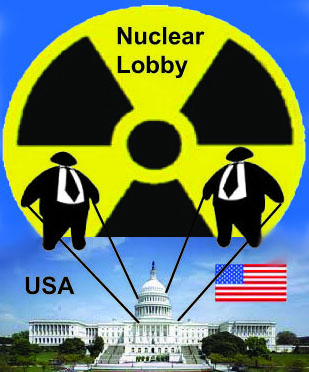 NEI requests DOE minimize US supplier burden for liability risk pool https://dailyenergyinsider.com/featured/2253-nei-requests-doe-minimize-us-supplier-burden-liability-risk-pool/ November 15, 2016 Daily Energy Insider Reports The Nuclear Energy Institute (NEI) recently requested that the U.S. Department of Energy (DOE) provide U.S. nuclear energy suppliers with more certainty regarding their liabilities in a nuclear incident to allow them to better develop a contingency plan. The department is collecting data in developing a liability risk pool for an international treaty on compensating those affected by a nuclear incident.
The Convention of Supplementary Compensation for Nuclear Damage (CSC) was adopted in 1997 and entered into force last year. The CSC establishes a two-tiered approach for compensating victims in the event of a nuclear incident. The first tier is paid by the country in which the incident takes place and is set at a minimum of 300 million “special drawing rights,” a unique form of international money developed by the International Monetary Fund (IMF) based on a weighted average of convertible currencies.
If the first tier is insufficient, the second tier is funded by the CSC signatories.
NEI calculated that the United States would contribute approximately $64.5 million per covered incident if the current parties to the CSC are Argentina, India, Japan, Montenegro, Morocco, Romania, United Arab Emirates and the United States.
NEI said that since the Energy Independence and Security Act of 2007 mandates that U.S. nuclear suppliers reimburse the federal government for any costs it incurs in contributing to the second tier of liability, the CSC would create an undue burden on U.S.-based nuclear suppliers.
The institute also requested that the DOE ensure that the final rule is not overly burdensome from an administrative, record keeping or implementation standpoint.
Secretive meeting for South Africa’s Parliament on nuclear briefing
Media not welcome at nuclear energy briefing http://www.timeslive.co.za/politics/2016/11/15/Media-not-welcome-at-nuclear-energy-briefing Linda Ensor | 15 November, 2016 The Department of Energy’s briefing on the nuclear build programme to Parliament’s energy portfolio committee will be a closed meeting with no media or members of the public present‚ committee chairman Fikile Majola announced on Tuesday. The decision marks a step backwards in Majola’s otherwise forthright push for greater transparency from the department‚ which has been intent on withholding documents on the nuclear procurement programme.
This meeting was also scheduled for Tuesday‚ attracting a strong media presence. Journalists and other members of the public were required to leave the room. Majola said he had obtained the necessary authorisation from parliamentary authorities to close the meeting‚ which would be addressed by the PetroSA board.
At a previous sitting‚ Majola obtained copies of the forensic reports into the Ikhwezi project on the proviso that the committee decided in what manner it dealt with it‚ giving consideration to the need for confidentiality.
The Ikhwezi project was intended to bolster the supply of gas to PetroSA’s gas-to-fuel refinery at Mossel Bay but generated only about 10% of the envisaged volumes.
Donald Trump goes back on his previous statements, attacks media
Donald Trump Conveniently Forgets The Time He Said More Countries Should Have Nukes http://www.huffingtonpost.com.au/entry/donald-trump-nuclear-weapons_us_5828903be4b0c4b63b0d1c7d The president-elect on Sunday railed about the “dishonest” media.The president-elect went on a mini-tirade against The New York Times on Twitter, taking issue with the way the newspaper described his past statements about nuclear proliferation.
In fact, Trump did say he was open to more countries getting nuclear weapons ― in an interview with the very same newspaper back in March.
Nor would it be so bad, Trump has said, if countries like South Korea and Saudi Arabia had nukes, too.
Donald Trump and the road to fascism
We must remember how quickly economic collapse and recession can breed totalitarian movements, especially in countries where privileged segments of the population are used to higher standards of living and special advantages in relation to the rest of the world. Europe and the US, with their long histories of both real and mythological prosperity, may be ticking time bombs. As we enter these next years, those forces aligned with social and economic justice principles must take very seriously the potential for another economic crisis.
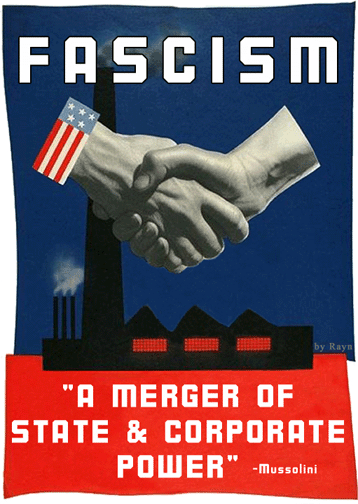 Rising European Fascists Welcome Trump Victory Saturday, 12 November 2016 00:00By Ryan Harvey, Truthout | Report “Today the United States, tomorrow France,” former National Front leader Jean-Marie Le Pen tweeted late Tuesday night, referencing the prophetic quote attributed to Adolph Hitler. This was as Donald Trump’s victory swept through the world’s headlines, exciting many a far-right activist within and outside of the United States.
Unfortunately, Le Pen is no lone Twitter-fascist, but a popular figure whose daughter and fellow far-right leader Marine Le Pen is expected to win the first round of French national elections in April. In the last elections, Le Pen swept large areas of the country in the first round before being defeated by large margins in the second.
But this is the year of Brexit and Donald Trump, and France (and Europe) need not wait until 2017 to anticipate their future. As many have pointed out, the French primaries, only two weeks away, may well determine the outcome in the spring. If Alain Juppe succeeds in clinching the Republican Party’s nomination, he stands to beat Marine Le Pen. Any other scenario opens the gate of possibility for the fascist-right she represents.
France, the target of a number of attacks by Islamic State copycats and a battleground in the humanitarian crisis facing refugees in Europe, is not alone in the predicament of having far-right parties poised to make big gains in fast-approaching elections. Austria, the first EU state to close its borders to refugees, votes December 4 in a highly contested race that saw election results from May — which placed the leftist Alexander Van der Bellen barely in front — invalidated due to fraud. Norbert Hofer, who represents the far-right Freedom Party, lost by a very small margin of just over 30,000 votes and is expected to win next month.
In the Netherlands, holding its next election in March, the far-right Geert Wilders is placed for a possible victory as well, representing the anti-Muslim, anti-EU Party for Freedom. In an echo of Trump’s situation, criminal charges Wilders is facing for hate speech may actually increase his likelihood to win.
“We are witnessing the same uprising on both sides of the Atlantic,” Wilders wrote Wednesday morning in the conspiracy-site-turned-news-blog Breitbart. “The Patriotic Spring is sweeping the Western world.”…….
On the topic of Putin, Trump’s respect for strongmen leaders and his embracing of conspiratorial ideas about who runs the world will likely trickle down to the grassroots. We can expect an alliance with the Le Pens and Hofers of Europe, one that places xenophobic nationalist rhetoric at the center of its policies, as well as a tighter embrace of the Putinsphere across Eastern and now Western Europe………
We can also expect strange approaches to strongmen like Rodrigo Duterte, “the Trump of the East,” who recently appointed Trump’s business partner in the Philippines, Century Properties Group chairman Jose Antonio, as a special envoy to Washington for trade, investment and economic affairs………
We must remember how quickly economic collapse and recession can breed totalitarian movements, especially in countries where privileged segments of the population are used to higher standards of living and special advantages in relation to the rest of the world. Europe and the US, with their long histories of both real and mythological prosperity, may be ticking time bombs. As we enter these next years, those forces aligned with social and economic justice principles must take very seriously the potential for another economic crisis. http://www.truth-out.org/news/item/38345-rising-european-fascists-welcome-trump-victory
India does not regard the “Termination” clause as binding – nuclear deal with Japan

 Termination clause in nuclear deal with Japan not binding
on India, insists govt, First Post, 13 Nov 16 New Delhi: The just-signed historic civil nuclear deal with Japan has a “termination” clause which the government here insists is not binding on India but merely records the “views” of the Japanese side considering its “special sensitivities”.
The government insisted that India has made “no additional commitments” over the similar agreements signed with the US and other countries.
In the Nuclear Cooperation Agreement, signed in the presence of Prime Minister Narendra Modi and his Japanese counterpart Shinzo Abe in Tokyo on Friday, there is a note on ‘Views and Understanding’ wherein the Japanese side has cited India’s September 2008 declaration of unilateral moratorium on atomic tests and said if this commitment is violated, the deal will terminate.
Indian government holds that this is merely recording of the views of the two sides.
“The termination clause is there in other NCAs (nuclear cooperation agreements) we have signed, including with the US (Article 14). However the circumstances triggering a possible termination are never sharply defined. Consideration also has to be given to mitigating factors,” a source here said.
“That note is simply a record by the negotiators of respective views on certain issues. It is not the NCA which is what is binding,” the source said.
The sources added that given Japan’s special sensitivities as the only nation to have suffered a nuclear attack, “it was felt that their views should be recorded in a separate Note. The Note is a record by the negotiators of respective views on certain issues.
“The termination clause is there in other NCAs (nuclear cooperation agreements) we have signed, including with the US (Article 14). However the circumstances triggering a possible termination are never sharply defined. Consideration also has to be given to mitigating factors,” a source here said.
“That note is simply a record by the negotiators of respective views on certain issues. It is not the NCA which is what is binding,” the source said.
The sources added that given Japan’s special sensitivities as the only nation to have suffered a nuclear attack, “it was felt that their views should be recorded in a separate Note. The Note is a record by the negotiators of respective views on certain issues………
Japan has made a major exception by signing the atomic cooperation agreement with India, despite it being non-signatory to the Nuclear Non-Proliferation Treaty (NPT)…….. http://www.firstpost.com/india/termination-clause-in-nuclear-deal-with-japan-not-binding-on-india-insists-govt-3103404.html
Trans Pacific Partnership – just about ready for burial?
 TPP: Trans-Pacific Partnership dead, before Trump even takes office, http://www.theage.com.au/federal-politics/political-news/transpacific-partnership-dead-before-trump-even-takes-office-20161113-gso9kn.htmlThe Age, Peter Martin , 14 Nov 16, Eight years in the making, the giant Trans-Pacific Partnership trade deal between Australia, the US and 10 other regional powers is as good as dead after the Obama administration walked away from its plan to put it before the “lame duck” Congress ahead of Donald Trump’s inauguration as president.
Controversial in Australia because it would allow US-headquartered corporations to sue Australian governments in extraterritorial tribunals and entrench pharmaceutical monopolies and copyright rules, the TPP was the subject of a last-minute plea by Prime Minister Malcolm Turnbull to president-elect Donald Trump in their 15-minute phone conversation on Thursday.
It has been signed by each of the member countries – Australia, the US, Japan, Canada, New Zealand, Malaysia, Brunei, Singapore, Chile, Mexico, Peru and Vietnam – but ratified by none.
Other members including Australia were waiting for a decision from the US because the rules require ratification by members accounting for 85 per cent of the the agreement’s gross domestic product, meaning it can’t come into force without the US as the other members combined have only 43 per cent.
Over the weekend the Senate’s top Democrat Charles Schumer told union leaders the deal would not be ratified. House of Representatives Republican speaker Paul Ryan, who has in the past supported the TPP, said the “votes aren’t there” to pass it.
Mr Trump made opposing the TPP a key part of his campaign, saying America did “not need to enter into another massive international agreement that ties us up and binds us down”. Democrats members of Congress were never keen, opposing by a wide margin President Barack Obama’s negotiating mandate which only passed into law with the support of Republicans.
On Sunday Australia’s trade minister Steven Ciobo questioned whether it would be worthwhile concluding the agreement without the US, even if it was possible.
“In theory, yes,” he told the ABC’s Insiders. “but is there enough merit to look at a trade deal among the 11 of us? It changes the metrics substantially.”
Mr Ciobo will hold discussions about the future of the agreement at the APEC leaders summit in Lima, Peru on Thursday which will be attended by Mr Turnbull on Sunday.
The US decision leaves two Australian parliamentary inquiries in limbo. The joint standing committee on treaties finished hearing evidence just before Mr Trump’s election and has not yet produced a report. The Senate inquiry has yet to call witnesses.
Donald Trump’s bullying personality adds danger to his future role as Commander In Chief
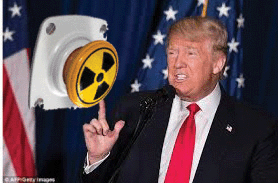 Nuclear weapons: how foreign hotspots could test Trump’s finger on the trigger
From North Korea to Iran to Russia, a president-elect with civilisation-ending weaponry at his fingertips will face an in-tray of potential international crises, Guardian, Julian Borger , 13 Nov 16 On Donald Trump’s first day in office he will be handed the “nuclear biscuit” – a small card with the codes he would need to talk to the Pentagon war room to verify his identity in the event of a national security crisis.
Donald Trump will not last the distance as USA President
“Here’s what’s going to happen, this is why we’re not going to have to suffer through four years of Donald J. Trump, because he has no ideology except the ideology of Donald J. Trump,” Moore said Friday on MSNBC’s “Morning Joe.” “And when you have a narcissist like that, who’s so narcissistic where it’s all about him, he will, maybe unintentionally, break laws. He will break laws because he’s only thinking about what’s best for him.”
When host Mika Brzezinski asked Moore if he were now wishing ill on Trump, Moore replied, “He is ill.”
“He is racist,” Moore said. “He is a misogynist. He is an authoritarian.” ……
Moore participated in a massive anti-Trump protest in Manhattan on Wednesday and has urged relentless resistance.
“We are going to resist, we are going to oppose,” he told MSNBC. “This is going to continue, tonight and the next night and the next night. And all he has to do is start nominating Rudy Giuliani as attorney general, and things like that ― or his Supreme Court. This is going to be a massive resistance. Women are calling for a million woman march on the Inauguration Day, and there is going to be the largest demonstration ever on Inauguration Day.”
Earlier this week in New York, Moore called for demonstrations to continue until Trump is out of office. http://www.huffingtonpost.com/entry/michael-moore-predicts-trump-impeach-resign_us_58261464e4b0c4b63b0c6dee
German Chancellor Angela Merkel will co-operate with President Trump – UNDER CERTAIN CONDITIONS
German Chancellor Angela Merkel Issues CHILLING Warning To Donald Trump, BiPartisan Report , By Sarah MacManus –November 9, 2016 German Chancellor Angela Merkel isn’t going to let up on newly minted President-elect Donald Trump any time soon. The European stateswoman issued a very carefully worded statement to the press on Wednesday, not so subtly hinting that she’d be keeping an eye on the Republican and letting all parties know that her cooperation — and that of Germany — comes with conditions.
German Chancellor Angela Merkel reacts to Donald Trump as elected President (english subtitles)
Trump took a swing at Merkel during his campaign over her refugee policy, criticizing her willingness to accept refugees and immigrants into Germany and stating: “What Merkel did to Germany is a shame, it’s a sad, sad shame.”
Merkel’s even-handed statement of congratulations to the Republican was composed with the utmost precise wording and couched in tones of warning……..
“Please accept my congratulations on your election as President of the United States of America.
“You will assume office at a time in which our countries are jointly facing many different challenges.
“Germany’s ties with the United States of America are deeper than with any country outside of the European Union. Germany and America are bound by common values — democracy, freedom, as well as respect for the rule of law and the dignity of each and every person, regardless of their origin, skin color, creed, gender, sexual orientation, or political views. It is based on these values that I wish to offer close cooperation, both with me personally and between our countries’ governments.
“Partnership with the United States is and will remain a keystone of German foreign policy, especially so that we can tackle the great challenges of our time: striving for economic and social well-being, working to develop far-sighted climate policy, pursuing the fight against terrorism, poverty, hunger, and disease, as well as protecting peace and freedom in the world.
“In the years ahead as president, I wish you a sure hand, every success, and God’s blessing.” http://bipartisanreport.com/2016/11/09/just-in-german-chancellor-angela-merkel-issues-chilling-warning-to-donald-trump/

Nuclear lobby getting a big boost from the British government
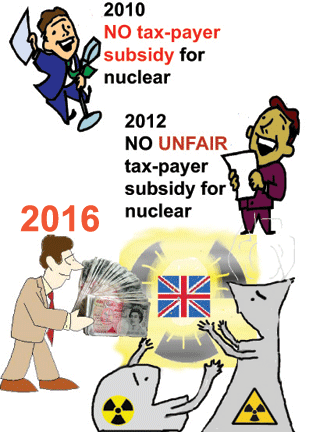 UK launches nuclear innovation program, WNN 07 November 2016 The UK’s Department for Business, Energy and Industrial Strategy (BEIS) has announced its commitment of £20 million ($25 million) for an initial phase of a new nuclear research and innovation program. This covers five major themes: advanced fuels; materials and manufacture; reactor design; advanced recycling; and strategic toolkit.
BEIS said on 3 November: “At Spending Review 2015, government committed to invest in an ambitious nuclear research and development program. This funding forms a part of government’s wider commitment to double the UK’s energy innovation spend, such that by 2021 it will have doubled to over £400 million per year.
“As part of this commitment, over £20 million will be provided to support innovation in the civil nuclear sector across five major areas from 2016-18, building on the recommendations set out by the Nuclear Innovation Research Advisory Board (Nirab).”
This funding includes: £6 million towards maintaining the UK’s leading edge work on advanced nuclear fuels which could provide greater levels of efficiency; £5 million for research that underpins the development, safety and efficiency of the next generation of nuclear reactor designs; £5 million to develop the UK’s capability in materials, advanced manufacturing and modular build for the reactors of the future; £2 million to research fuel recycling processes that may reduce future environmental and financial burdens; and £2 million to continue with the development of a suite of toolkits and underpinning data that will enhance government’s knowledge basis for future decision making in the nuclear sector, up to 2050.
The deadlines for the procurements are, respectively, 16 December 2016 for those on the website of the Official Journal of the European Union, and 18 January 2017 for the Small Business Research Initiative procurement……..
Last November, the government announced plans to invest at least £250 million over the next five years in a nuclear research and development program including a competition to identify the best value small modular reactor (SMR) design for the UK. The first phase of that competition, a call for initial expressions of interest, was launched in March. It has also announced that an SMR Delivery Roadmap will be published later this year.
Nirab chair Sue Ion said the BEIS announcement “acts on the government’s commitment to spend at least £250 million on an ambitious nuclear research and development program over the next five years.” She added: “It’s a significant step forward for the UK in our drive to be a leading nation at the forefront of nuclear research.”
The research into new fuel, advanced manufacturing, reactor design, improved recycling processes and strategic tools aligns with Nirab’s recommendations and will “plug gaps in the UK’s current activity”, she said. “It will begin to equip our universities, national labs and industry with world leading skills and capability and act as a stimulus to national and international collaborative working.”
In October, Rolls-Royce announced it had submitted a paper to BEIS, outlining its plan to develop a fleet of 7 GWe of SMRs with its consortium. Other participants in the UK’s SMR competition include French-owned EDF Energy and its partner China National Nuclear Corporation, Westinghouse and the US developer NuScale Power.
Tom Mundy, managing director for the UK and Europe at NuScale Power, said the company welcomes the government’s “continued commitment to nuclear innovation and interest in the development of small modular reactor technology.” He added: “We look forward to the progression of the government’s competition, which aims to identify the best value SMR design for the UK.”
Industrial strategy
The UK’s Nuclear Industry Association (NIA) today called for the government “to work with industry to ensure the industrial strategy has energy infrastructure front and centre”, in its submission ahead of the Autumn Statement, due on 23 November.
The Autumn Statement is one of the two statements the Treasury makes each year to Parliament upon publication of economic forecasts, the other being the annual Budget……
the NIA has called for four developments.
Firstly, the roadmap for delivery on SMRs, following the Phase 1 competition, “to be released as soon as possible, so industry can capitalise on increasing international interest and for the UK to benefit from the supply chain and intellectual property developed here”.
Secondly, “clarity” following the UK’s decision to leave the European Union, to give investors in key infrastructure developments “the confidence that a stable policy framework will be maintained to deliver vital new projects that promote growth”.
Thirdly, “assurance” that the Levy Control Framework, or successor mechanism, is set for the period beyond the current 2020-21 funding cap, to accommodate Contracts for Difference agreed for further low-carbon energy infrastructure, including new large-scale nuclear power stations at Moorside in Cumbria and Wylfa Newydd in Wales.
These projects belong, respectively, to NuGeneration (NuGen) and Horizon Nuclear Power.
NuGen, a joint venture between Toshiba and Engie, plans to build a nuclear power plant of up to 3.8 GWe gross capacity at Moorside. NuGen will use AP1000 nuclear reactor technology provided by Westinghouse Electric Company, a group company of Toshiba.
Horizon aims to provide at least 5.4 GWe of new capacity across two sites – Wylfa Newydd and Oldbury – by deploying Hitachi-GE UK Advanced Boiling Water Reactors. Established in 2009, Horizon was acquired by Hitachi in November 2012.
Fourthly, “sustained and predictable” funding for decommissioning the nuclear legacy, and maintaining progress made in recent years, while also promoting the country’s advanced supply chain and decommissioning expertise in export markets…..
The government’s strategy “must not stop at Hinkley”, NIA Chief Executive Tom Greatrex said, “but focus on the next line of new build developers, who will need to attract investment to build the new infrastructure we need, as well as providing clarity on the policy direction for an SMR program.” http://www.world-nuclear-news.org/NP-UK-launches-nuclear-innovation-program-07111601.html
Under President Trump there’ll be a fossil fuel fan administration

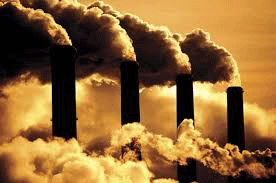 Meet the Fossil Fuel Superfans Tipped to Run Energy and Climate Under Trump Truthout, Friday, 11 November 2016 By Zachary Davies Boren, Joe Sandler Clarke and Emma Howard, Energydesk | Report “…….Trump, an avowed climate change denier and fossil fuel champion, looks set to stack his key energy and environment positions with oil and gas men and free market zealots.
Using documents leaked to Buzzfeed, sources at Politico and beyond, we’ve done a rundown of who’s in line for a top energy and climate job in the US government.
Harold Hamm (Possible Energy Secretary)
Tipped for energy secretary in a Trump administration, oil and gas billionaire Hamm has been showered with praise by the new President-elect, who said with classic hyperbole that Hamm understands energy “better than anybody else”.
As chief exec of Oklahoma-based fracking firm Continental Resources, Hamm would represent the first cabinet appointee directly plucked from the fossil fuel industry since 1977.
For years Trump has been dismissive of man-made climate change, but the particular brand of anti-regulation and anti-renewables stance he deployed in the election was vintage Hamm, who was often referred to as Trump’s ‘energy adviser.’
Hamm, whose firm runs the bulk of the Bakken shale formation in North Dakota, has already called for Trump to scrap “overreaching regulations” in order to ramp up oil production — despite record-breaking output under Obama.
During the campaign, Hamm said Trump didn’t actually “understand” oil issues after the then-candidate suggested local communities should have a say in whether there’s fracking in their area.
Myron Ebell (possible EPA)
Myron Ebell is a highly active climate change denier.
Reports emerged in September that Trump would appoint him to lead the transition at the Environmental Protection Agency.
Ebell is currently head of libertarian think-tank the Competitive Enterprise Institute (CEI), which says of itself: “The CEI’s largest program takes on all the hard energy and climate issues.
“CEI questions global warming alarmism, makes the case for access to affordable energy, and opposes energy-rationing policies, including the Kyoto Protocol, cap-and-trade legislation, and EPA regulation of greenhouse gas emissions. CEI also opposes all government mandates and subsidies for conventional and alternative energy technologies.”
The CEI also leads SafeChemicalPolicy.org, a coalition that lobbies against regulation of the chemicals industry. It promotes the “life enhancing value of chemicals” — even those that scientists claim “significantly increase our risks of cancer, developmental defects, and even obesity”.
If that wasn’t enough, Ebell also runs the Cooler Heads Coalition, a grassroots group that works to “dispel the myths of global warming.” It names the neoconservative American Legislative Exchange Council (ALEC) and the Heartland Institute among its members.
The Heartland Institute has used the words of mass murderers to justify its opposition to climate action and attempted to block climate change teaching in schools.
ALEC, which has repeatedly blocked legislation to tackle climate change, has become so divisive that even oil giants Shell and BP have quit the group.
Sarah Palin (Possible Secretary of Interior) “I would love to have the strength of Sarah Palin in my administration.” That’s what Trump said back in September 2015.
The former Vice Presidential candidate and Alaska Governor is on the shortlist for the next Secretary of the Interior, running the government department responsible for the management of federal land and, crucially, the country’s natural resources.
On announcing her support for the then-candidate Trump, Palin told CNN she would love to run the Department of Energy, seemingly without knowing what the department actually did.
“Energy is my baby,” she said. “Oil, gas, minerals, those things God has dumped on this part of the earth for mankind’s use instead of us relying on unfriendly foreign nations for us to import their resources. If I were head of that, I’d get rid of it.”
The Interior Department has broad ranging responsibilities, from managing America’s national parks to dealing with the land rights of Native Americans, to making decisions about fracking and offshore drilling
The thought of the woman responsible for the “drill baby drill” campaign overseeing who can drill off the coast of Alaska certainly is something.
Forrest Lucas (Possible Secretary of Interior) One of Palin’s rivals for the Interior job is oil industry executive Forrest Lucas.
Lucas, 74, is the co-founder of Lucas Oil and is wealthy enough to have given new Vice President Mike Pence $50,000 while he was running to be Indiana’s governor and spend more than $100million putting his name on an American Football stadium 10 years ago. The Indianapolis Colts now play their home games at the Lucas Oil Stadium.
The oil and gas industry has been fighting furiously against the Obama administration for eight years, on everything from Arctic drilling to the Keystone XL pipeline, so having one of their own heading up the department of interior would be a boon.
As Khalid Pitts, from the Sierra Club, told Politico it would be “open season” on America’s environment if someone like Lucas was given a job.
That said, current secretary Sally Jewell is a former Mobil Oil executive, but she is also known for her conservation work.
Mike McKenna (Energy Department)
Energy lobbyist Mike McKenna is in line to to lead the transition at the Energy Department.
McKenna is the President – and according what is presumably his LinkedIn page also the “Czar” — at lobby firm MWR Strategies, while also working as a specialist for the energy department in the past.
According to the Washington Post, he has lobbied on behalf of the firm owned by the billionaire Koch Brothers, which was listed by Forbes as one of the largest private companies in the US. They are a major funder of climate sceptic think-tanks and scientists as well as efforts to water down environmental regulation at the EU level.
Also among the companies to have been represented by McKenna, named by the Washington Post, are multinational Dow Chemical and energy firm EDF Suez, which owns fracking licences in the UK. http://www.truth-out.org/news/item/38348-meet-the-fossil-fuel-superfans-tipped-to-run-energy-and-climate-under-trump
Big banks will be happy with American election result
Trump Announces Big Gift To Banks Despite His Campaign Rhetoric Against Wall Street http://news.groopspeak.com/breaking-trump-announces-big-gift-to-banks-despite-his-campaign-rhetoric-against-wall-street/, 11 Nov 16
President-elect Trump is announcing on his website that he will immediately dismantle the Dodd-Frank financial regulations put into place shortly after the 2008 crash and signed into law by President Obama. With a Republican Congress backing him up, it’s fair to say that he will get his wish.
Banks are hailing the move as a godsend and see it as less oversight and more profit.
If such a move is implemented, its effects will be far-reaching. It will get rid of legislation that has up until now protected consumers from abusive lending and mortgage practices by banks that caused the financial crisis in the first place – and which it sought to prevent from happening again.
In total, there are 16 major areas of oversight reform that the law put into place that will go away.
“Following the financial crisis, Congress enacted the Dodd-Frank Act, a sprawling and complex piece of legislation that has unleashed hundreds of new rules and several new bureaucratic agencies,” reads the statement. “The proponents of Dodd-Frank promised that it would lift our economy. Yet now, six years later, the American people remain stuck in the slowest, weakest, most tepid recovery since the Great Depression.”
It’s no secret that Republicans have been wanting to undo the massive legislation since the very moment it was implemented. They will now get their chance.
The law took years to write and while it will be almost impossible for them to get rid of it entirely in their first 100 days, there are some things they can do to reverse some of its major provisions from the very get go, padding banks profits almost as soon as the new year begins.
Once Republicans get rid of the “Volcker-rule,” banks will once again be able to make speculative investments that led to the industry’s downfall almost a decade ago.
Another major target – the Consumer Financial Protection Bureau, will almost assuredly go away.
They made news just a few months ago in September when they fined Wells Fargo more than $100 million for the widespread illegal practice of secretly opening unauthorized accounts without the permission of account holders. This protection will no longer exist under a Trump administration.
Elizabeth Warren, known for her tough stance on the big banks, vowed to fight Trump and Republicans on this if they attempted to follow through with it.
“If Trump and the Republican Party try to turn loose the big banks and financial institutions so they can once again gamble with our economy and bring it all crashing down, then we will fight them every step of the way,” she said.
Given that Trump just recently added this to his site, it must mean that he is making this a priority in his administration. He has already stated publicly that repealing Obamacare would be one of the first things he does, so it remains to be seen where this will rank on his to-do list.
Danger of World War III closer, with election of Donald Trump
 WW3 News: Trump Win to Send World to Even Greater Danger of Conflict http://www.techplz.com/alec-baldwin-leave-us-promised-trump-wins-else-leaving/174389/ 12 Nov 16, – Trump is the new president of the United States. The question in everybody’s mind is, will the new leader of the most powerful country in the world bring peace? Or is a new age of political tension upon us?
The whole world awoke to the shocking (for some) news that Donald J. Trump has won the US presidential elections. The Republican candidate shocked the whole world with his victory. Trump is a vocal supporter of Russian President Vladimir Putin; the new president has proclaimed his admiration for the Russian president many times. Trump is by no means a skilful diplomat. He recently criticized his country’s own wars in Iraq and Afghanistan and demanded that US’s own allies share in the defense expense accrued by the US military. Recently, Trump called the issue on climate change a “chinese hoax.”
Will Trump bring about war and destruction to the world? Questions are now asked on when Trump will get the Nuclear launch codes of the US military.
WW3 NEWS WHEN WILL TRUMP GET THE NUCLEAR CODES?
With Trump’s obvious tendency to make enemies in every turn, the obvious question is: How easy is it for President Trump to push the button to launch Nuclear Missiles and jumpstart World War 3? The answer is: pretty simple actually.
According to Bruce Blair, who is a research scholar at Princeton, the US president has the sole authority to authorize the use of nuclear weapons. “The commander-in-chief’s power is pretty clear.” He told Bloomberg. Blair continued to explain that the US president always has a continuous line with his military officials. The US president has the power to authorize a nuclear counterstrike as well.
Kingston Reif of the Arms Control Association recently said that the US president has the “supreme authority” to decide what to do with America’s nuclear weapons.
America currently has 900 nuclear missiles, all of them 30 times more powerful than the bombs dropped in Nagasaki and Hiroshima.
WW3 NEWS: MORE TENSE RELATIONSHIP WITH BEIJING
According to a report by The New York Time, Beijing is exceedingly worried about Trump’s unpredictability. Territorial issues in the South China Sea has made tensions between US and China very tense in the past few years. With a Trump presidency now at hand, will the US – China relationship decline further? And how will the new US president handle his country’s powerful nuclear arsenal? The times are very frightening indeed.
1 This Month
15 October. Joint Appeal for Nuclear Abolition Day -presentation to the UN on October 15 will be live on UNWebTV
Endorse the Nuclear Abolition Day Appeal
23-25 October – on Zoom – World BEYOND War’s annual global conference

To see nuclear-related stories in greater depth and intensity – go to https://nuclearinformation.wordpress.com
-
Archives
- October 2026 (139)
- September 2026 (339)
- August 2026 (330)
- July 2026 (355)
- June 2026 (287)
- May 2026 (306)
- April 2026 (356)
- March 2026 (251)
- February 2026 (267)
- January 2026 (308)
- December 2025 (358)
- November 2025 (359)
-
Categories
- 1
- 1 NUCLEAR ISSUES
- business and costs
- climate change
- culture and arts
- ENERGY
- environment
- health
- history
- indigenous issues
- Legal
- marketing of nuclear
- media
- opposition to nuclear
- PERSONAL STORIES
- politics
- politics international
- Religion and ethics
- safety
- secrets,lies and civil liberties
- spinbuster
- technology
- Uranium
- wastes
- weapons and war
- Women
- 2 WORLD
- ACTION
- AFRICA
- Atrocities
- AUSTRALIA
- Christina's notes
- Christina's themes
- culture and arts
- Events
- Fuk 2022
- Fuk 2023
- Fukushima 2017
- Fukushima 2018
- fukushima 2019
- Fukushima 2020
- Fukushima 2021
- general
- global warming
- Humour (God we need it)
- Nuclear
- RARE EARTHS
- Reference
- resources – print
- Resources -audiovicual
- Weekly Newsletter
- World
- World Nuclear
- YouTube
-
RSS
Entries RSS
Comments RSS

