A nuclear proponent tipped as Trump’s Energy Secretary
 Will Donald Hoffman Be President Trump’s Secretary Of Energy? Forbes, Rod Adams, 11 Nov 16, President-elect Trump announced a major emphasis on infrastructure building and manufacturing growth that is going to require a large increase in our energy consumption.
Though many observers keep referring to a four-year-old tweet to characterize Trump’s view on climate change as a hoax, he has at least two close advisors — Senator Jeff Sessions and Donald Hoffman — that are strong supporters of nuclear energy development.
My reasonably well-founded guess is that Don Hoffman is near the top of a short list of potential candidates to become the Secretary of Energy.
Don mentioned his opportunities to talk with Candidate Trump about nuclear energy’s capacity for abundant, reliable power production without pollution or CO2 emissions in an October article published by EENews…….
Who Is Donald Hoffman?
Hoffman joined Trump’s Leadership Council in March. He is the founder, President and CEO of Excel Services Corporation, a nuclear engineering and consulting firm that Don founded in 1985 …….EXCEL has done business with virtually every U.S. nuclear utility and every nuclear plant and enrichment facility in the United States. The company is also currently working on projects in 21 countries, as well as with the International Atomic Energy Agency and the World Nuclear Association, among other organization. http://www.forbes.com/sites/rodadams/2016/11/10/will-donald-hoffman-be-president-trumps-secretary-of-energy/#60c6dc4a3115
With Trump as USA President Asia’s Nuclear Crisis Expands
Next to North Korea and fearing U.S. abandonment, South Korea and Japan weigh their own options, WSJ, By DAVID FEITH Nov. 11, 2016 Seoul
The nuclear crisis in Northeast Asia was bound to be one of the most dangerous challenges facing the next U.S. president, no matter who won on Tuesday. With Donald Trump’s surprise victory, though, it could metastasize in dramatic ways: If you thought North Korea’s nuclear march was disconcerting, consider that South Korea and Japan may now pursue nuclear programs of their own, raising the risks and stakes of war not only with North Korea but China too…….
It’s possible Mr. Trump will drop his enthusiasm for South Korean and Japanese nuclearization upon entering the Oval Office. His campaign advisers tended to ignore the subject in public statements, likely a reflection of the decades-old bipartisan consensus against nuclear proliferation in Washington. But as with other issues, the approach of President Trump will depend on who he brings into the White House for advice, and whether he listens to them……..
South Korea’s civilian nuclear infrastructure—24 plants providing 30% of the country’s energy—could be used to produce 5,000 bombs worth of fissile material, Mr. Cheong says, dwarfing Pyongyang’s capability. Embracing the necessary technologies, including plutonium reprocessing, could be “the game-changer that will enable South Korea to manage North Korean problems.”………
Several potential candidates in South Korea’s looming presidential election back nuclearization, including former National Assembly floor leader Won Yoo-cheol and Nam Kyung-pil, governor of the country’s most populous province. Mr. Cheong, who acknowledges that “experts and technocrats have tended to be against going nuclear,” says that officials have privately expressed greater interest since Pyongyang’s latest nuclear test in September. Once Pyongyang completes a hydrogen bomb, he says, “many experts will switch their views.”
Then there’s Donald Trump. If he sticks to supporting South Korean and Japanese nuclearization, he might as well hold a bonfire of traditional U.S. nonproliferation dogmas on the White House lawn. http://www.wsj.com/articles/with-trump-asias-nuclear-crisis-expands-1478797800
Trump will put all USA climate action into Limbo
Trump said he will rescind any regulations that unduly burden energy development, including the Clean Power Plan, which, if it survives legal challenges, was to have been the cornerstone of Obama’s climate action legacy and the main policy for realizing the nation’s Paris goals. He also said he would abolish the Waters of the U.S. rule, which the fracking industry in North Dakota has opposed. Trump said he would urge TransCanada to renew its permit application for the Keystone XL pipeline. Within his first 100 days, Trump said he would lift moratoriums on fossil fuel production in federal areas, which could clear the way to new coal leasing in the West as well as coastal oil drilling, not only in the Arctic but also the Atlantic and potentially, the Pacific………
For his energy and environmental policy team, Trump has selected one of the nation’s most prominent climate contrarians, Myron Ebell of the Competitive Enterprise Institute, to head his EPA transition. Ebell worked on policy for the tobacco industry before his years of work opposing environmental regulations and sowing doubt on climate science. Trump is also reported to be considering Harold Hamm, chief executive of fracking industry leader Continental Resources, for energy secretary, and Forrest Lucas, co-founder of oil products company Lucas Oil, for interior secretary……..
the early battle lines will be Trump’s regulatory proposals.

 In Trump, U.S. Puts a Climate Denier in Its Highest Office and All Climate Change Action in Limbo
His anti-regulatory stances, support of unfettered fossil fuel production, and his threat to pull the U.S. out of the Paris agreement, send ripple effects worldwide.BY MARIANNE LAVELLE, INSIDECLIMATE NEWSNOV 9, 2016 Donald Trump’s astonishing victory has turned the world of climate action upside down, setting back U.S. environmental policy and threatening the international drive to cut carbon pollution and slow global warming. Continue reading
Donald Trump’s defence policies may spark a nuclear arms race
President Trump’s defence deals may spark a nuclear arms race https://www.newscientist.com/article/2112461-president-trumps-defence-deals-may-spark-a-nuclear-arms-race/By
“A man you can bait with a tweet is not a man we can trust with nuclear weapons.” The words of his vanquished opponent, Hillary Clinton, are perhaps the biggest anxiety hanging over the shock election of Donald Trump to the US presidency: can he be trusted with the power to launch Armageddon?
Every US president has constant access to a nuclear launch device only he can activate. Born in the Cold War, it is designed for when Russian nuclear missiles are detected making their 30-minute flight to the US, allowing 10-15 minutes to decide to order a counter-strike which would not be countermanded. But it could be used in other scenarios. “There is nothing to prevent a launch for very little reason,” says Paul Ingram of the British American Security Information Council, an arms control think-tank in London.
Would Trump hit the button? He has said he would be “very, very slow on the draw” but has refused to rule out using nukes, asking several times during the campaign, if they are never used, “why do we make them?”
“The very fact that one person, whoever it is, can decide to launch a nuclear strike is very worrying,” says Ingram.
Hair-trigger alert The president’s ability to respond rapidly is to allow the launch of 450 US land-based missiles before they are destroyed in an attack – for which reason they are kept on hair-trigger alert.
One way to reduce the risk of a rash launch would be for President Obama to take US missiles off hair-trigger alert before he leaves, which would be politically delicate to reverse. Or Trump, who wants better relations with Russia, might do it himself.
The use of existing nukes is one thing; proliferation is another. Trump has said he will “renegotiate” last year’s agreement with Iran to limit its uranium enrichment. Arms control experts say we are never likely to get a better deal, so Trump’s plan could see Iran resume its efforts.
And as North Korea approaches nuclear capability, Trump has suggested its neighbours might develop their own nuclear weapons. In April he said that US allies should pay more for the nuclear protection offered by the US umbrella – or defend themselves, “including with nukes”.
Japan and South Korea, under threat from North Korea, are already under pressure to do that. But both are non-nuclear states in the Non-Proliferation Treaty, and have sworn never to develop their own weapons. Their abandonment of that pledge could well be the death-knell of the treaty. While it has failed to disarm the major nuclear powers, it has kept other countries, such as Egypt and Saudi Arabia, from trying to develop the bomb.
Anti-nuclear norms Its failures in disarmament led a large majority of UN members to vote in October to start work on a new treaty that simply bans nuclear weapons for everyone. Existing nuclear nations rejected the idea (apart from North Korea, which voted for it), as, ominously, did Japan and South Korea. Non-nuclear NATO members backed it in the hope of strengthening global anti-nuclear norms.
Those may not last long in the Trump era. He has long called NATO “obsolete” and questions US commitments to Europe. The threat of losing reliable US defence could lead to military build-up in Europe, handing nuclear deterrence to the small UK and French nuclear arsenals, which would then be more likely to go ahead with expensive upgrades.
Thomas Homer-Dixon at the Balsillie School of International Affairs in Waterloo, Canada, sees a more insidious threat. He believes Trump could pick fights abroad and incite attacks on alleged enemies at home to generate a constant “emergency” to bolster his support. Russia’s Vladimir Putin, whom Trump has long admired, uses such tactics.
“The risk of a slide into war which ultimately involves nuclear weapons is very real,” he says. “Trump has an insatiable need to dominate, and he seems incapable of ignoring a slight.” The deadly nuclear winter predicted to follow even a limited nuclear exchange could one day answer the president-elect’s question: if we have these weapons, why don’t we use them?
Mr Trump will soon control America’s nuclear codes
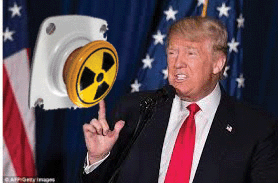 Donald Trump and the nuclear codes Mr Trump will soon control America’s nuclear codes http://www.economist.com/news/briefing/21709999-mr-trump-will-soon-control-americas-nuclear-codes-donald-trump-and-nuclear-codesNov 12th 2016 IN A ritual out of sight of the cameras on Inauguration Day in January, America’s “nuclear briefcase” will change hands and President Donald Trump will receive a card, sometimes known as the “biscuit”. The card, which identifies him as commander-in-chief, has on it the nuclear codes that are used to authenticate an order to launch a nuclear attack. At that point, should he wish, Mr Trump can launch any or all of America’s 2,000 strategic nuclear missiles.
There are no constitutional restraints on his power to do so. Even if all his advisers have counselled against it, as long it is clearly the president giving the command, the order must be carried out. There are no checks and balances in the system. Moreover, once the order is given there is likely to be only a matter of minutes in which it could be rescinded. Once the missiles are flying, they cannot be called back or disarmed. Mr Trump, from what he has said, does not take this responsibility lightly. Indeed, he has often stated that he believes nuclear weapons to represent the greatest threat to humanity and that he will not be trigger-happy, “like some people might think”. But in common with his predecessors, he does not rule out their use.
With little more than ten minutes to take a decision that could kill hundreds of millions of people, even the calmest individual would be under intolerable stress if informed that America was under imminent attack. It is not Mr Trump’s fault that the system, in which the vulnerable land-based missile force is kept on hair-trigger alert, is widely held to be inherently dangerous. Yet no former president, including Barack Obama, has done anything to change it.
Of greater concern would be how Mr Trump might behave in an escalating confrontation if Russia were to rattle its nuclear sabre even more loudly. It is possible that his apparent desire to be buddies with Vladimir Putin might help defuse a dangerous situation. He is, however, notoriously thin-skinned and unable to stop himself responding to any perceived slight with vicious (verbal) attacks of his own. He also revels in braggadocio and is known to be reluctant to take advice. Marco Rubio, a rival for the Republican nomination, questioned whether he had the temperament to be put in charge of the nuclear codes. So did Hillary Clinton. They were right to do so. But it is now Mr Trump, not them, who takes the biscuit.
Donald Trump wants to blow up the global climate effort
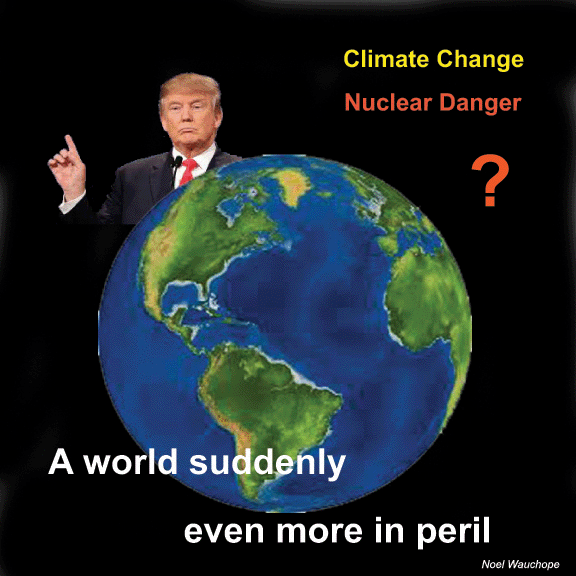 There’s no way around it: Donald Trump looks like a disaster for the planet Vox by Nov 9, 2016 This is happening. Donald Trump is going to be president of the United States.
And there’s no way around it: What he’s planning to do looks like an absolute disaster for the planet (and the people on it). Specifically, all the fragile but important progress the world has made on global warming over the past eight years is now in danger of being blown up.
Trump has been crystal clear about his environmental plans. Much of the media never wanted to bring it up, never wanted to ask about it in debates, never wanted to turn their addled attention away from Hillary Clinton’s email servers to discuss what a Trump presidency might mean for climate change. But the warning signs were there:
- Trump called global warming a Chinese hoax. He couldn’t have been blunter about this. He also tapped Myron Ebell, an avowed climate denier, to head his EPA transition team.
- Trump has said, straight up, he wants to scrap all the major regulations that President Obama painstakingly put in place to reduce US carbon dioxide emissions, including the Clean Power Plan. If Trump wants to rewrite these rules through executive action, he can. Or Republicans in Congress could try to pass a law forbidding the EPA from ever regulating CO2 again.
- Trump has also hinted he wants to downsize the EPA. “What they do is a disgrace,” he has said. He now has the power to rewrite or scale back other regulations on mercury pollution, on ground-level ozone, on coal ash, and more.
- Trump has said he wants to repeal all federal spending on clean energy, including R&D for wind, solar, nuclear power, and electric vehicles. This would require Congress, but it’s not impossible.
- Trump has said he wants to pull the United States out of the Paris climate deal. There’s nothing stopping him here. Technically, the US can’t officially withdraw for four years, but for all practical purposes, the Trump administration could ignore it.
So what happens if Trump gets his way? More air pollution, more carbon emissions. Exactly how much more remains to be seen. There are, after all, plenty of other factors pushing down US emissions that Trump has no control over. Natural gas from fracking would continue to kill coal power. Wind and solar would continue to grow. But it’s nearly impossible to imagine emissions under Trump dropping at the sharp pace necessary to slow global warming. And emissions could even rise, as this analysis from Lux Research suggests.
The world is making cautious progress on global warming. Trump wants to blow that all up.
For the last eight years, the Obama administration has been using every regulatory lever at its disposal to push down US greenhouse gases — aiming for a 28 percent cut below 2005 levels by 2025. Obama has also been trying to coax countries like China to participate in a global climate deal, in which every country would voluntarily pledge to restrain its emissions and meet regularly at the UN to ratchet up ambitions over time.
That plan finally came to fruition last December, when the world agreed to a sweeping climate agreement in Paris. The Paris deal was always delicate, and the current pledges weren’t nearly enough to avoid dangerous global warming, defined as 2°C or more. But the deal was a start. And the hope was that by cooperating and exerting diplomatic pressure on each other, all countries would steadily increase action over time.
Now it’s in peril. If Trump yanks the United States out of the Paris agreement, the deal won’t die, but momentum could wane. One can imagine China and India deciding they don’t need to push nearly as hard on clean energy if the world’s richest and most powerful country doesn’t care. At best, progress would slow. At worst, the entire arrangement could falter, and we set out on a path for 4°C warming or more.
These are decisions that will reverberate for thousands of years and affect hundreds of millions of people. We can’t easily undo the effects of all that extra carbon dioxide we keep putting into the air. Without drastic reductions in emissions (or possibly risky geoengineering), global temperatures will keep rising. The ice caps in Greenland and Antarctica will keep melting. Once that process gets underway, we can’t reverse it. The seas will rise. South Florida will eventually vanish beneath the oceans. Megadroughts will become more likely in the Southwest. For generations and generations.
This is the future of humanity at stake. We’re at risk of departing from the stable climatic conditions that sustained civilization for thousands of years and lurching into the unknown. The world’s poorest countries, in particular, are ill-equipped to handle this disruption. http://www.vox.com/2016/11/9/13571318/donald-trump-disaster-climate
Vietnam rejects nuclear power
Vietnam ditches nuclear power plans, DW, 10 Nov 16
Vietnam has decided to scrap plans to build two nuclear power plants, which would have been the first in southeast Asia. Hydropower and coal are set to remain dominant in the fast-industrializing country. Vietnam’s ruling communist party decided Thursday that two planned plants in the southern region of Ninh Thuan will not feature in the country’s future energy mix, state-controlled media reported.
MP Duong Quang Thanh, chairman of the Electricity Committee in the National Assembly, confirmed that no budget for the plants – which were approved in 2008 with a combined capacity of 4,000 megawatts (MW) – had been included in a long-term energy plan approved by Prime Minister Nguyen Xuan Phuc, the DTI news website reported.
Le Hong Tinh, vice chairman of the National Assembly’s Science, Technology and Environment Committee, said a key reason for the government’s decision was that the price for the plants had doubled to $18 billion (about 16.5 billion euros)…….. http://www.dw.com/en/vietnam-ditches-nuclear-power-plans/a-36338419
In Trump administration, climate denier Sarah Palin tipped to be in charge of climate policy
 Trump Campaign Leaks MAJOR Sarah Palin Announcement, Sit Down For This (DETAILS), http://bipartisanreport.com/2016/11/09/breaking-trump-campaign-leaks-major-sarah-palin-announcement-sit-down-for-this-details/ Nov Palin A By Pearson McKinney –
The only climate-denying world leader – Donald Trump
Donald Trump will be the only climate-denying world leader Mashable, BY ANDREW FREEDMAN, 10 Nov 16 If a Donald J. Trump administration acts on the president-elect’s view that global warming’s a “hoax,” the consequences of the presidential election may echo for generations. When he’s sworn into office in January, Trump becomes the only leader of a major industrialized country to deny the existence of human-caused global warming.
In the lead-up to the election, environmental leaders and climate scientists issued apocalyptic warnings of what a Trump presidency would do to efforts to rein in global warming, given that the Paris Climate Agreement only just went into effect on Nov. 4, and is still fragile. Now, some of these same people are shellshocked, but remain resolved to opposing attempts to slow the pace of emissions cuts, which climate science says is a crucial factor in determining how much the world will warm in the next several decades.
The U.S. and the world can’t afford to stall or slide backwards on climate progress, according to scientific research. Studies show climate change proceeding faster than anticipated, with a narrowing window to act in order to forestall the worst impacts of global warming, such as a catastrophic increase in sea levels.
In fact, a recent U.N. report showed that if we are to have any hope of meeting the Paris Agreement’s goal of limiting global warming to under 2 degrees Celsius, or 3.6 degrees Fahrenheit, below preindustrial levels, emissions cuts need to become more ambitious.
The Obama administration committed to reducing U.S. greenhouse gas emissions by 25 to 28 percent below 2005 levels by 2025, and it’s expected to lay out a decarbonization plan by midcentury during the ongoing U.N. climate talks in Marrakech, Morocco.
During the campaign, Trump made clear he would dismantle those regulations and others.
A Trump White House will have few checks on its power given that Republicans hold both houses of Congress, meaning that there could be significant rollbacks of EPA regulations and climate-related executive orders that could have ramifications beyond a single presidential term.
A slowdown or halt in U.S. emissions cuts would shift the climate math in favor of more severe global warming impacts. Leading environmental activist and journalist Bill McKibben emphasized that issue when reached on Wednesday, telling Mashable that “… The results of this election may eventually be measured in inches or feet of sea level rise.”
He went on to say that the U.S. is “one of the world’s biggest economies, and even just four years of unbridled emission staying in the atmosphere for many hundreds years would make a substantial difference. The climate system doesn’t forget, and it doesn’t forgive.”
Environmental groups unite
Trump’s election may help unify the environmental movement in opposition to the White House, making opposition to new fossil fuel projects, anti-regulatory moves and other potential actions more intense and effective.
“This is an undeniable tragedy, but of course as organizers, our job is try and forge some sort of way ahead,” said Jamie Henn, a spokesman for 350.org, in an email on Wednesday morning.
Henn says the group will push the Obama administration to take fossil fuel projects currently undergoing review off the table, and then focus on flexing its muscles to oppose Trump’s moves…….http://mashable.com/2016/11/09/trump-climate-denier-president/#M.xO4eMvMkqu
France’s nuclear power dependence causing anxiety
 France could face winter power cuts, hit by nuclear dependence, Channel News Asia,
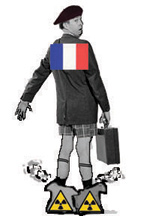
09 Nov 2016 PARIS: France could impose power cuts this winter due to an electricity shortage, an unprecedented step in the wealthy nation which would expose the vulnerabilities of its dependence on nuclear power.
The warning was issued on Tuesday by grid operator RTE, which said power supply had been hit by the closure of around a third of the country’s ageing nuclear reactors for safety checks. The country’s regulator has ordered a review of the strength of crucial steel components after the discovery of manufacturing irregularities.
France relies on nuclear for three-quarters of its power, more than any other country. RTE said the amount of nuclear power available was at a record low for this time of year, around 10,000 megawatts lower than a year ago – equivalent to more than twice the consumption of Paris and Marseille combined……..
GENERIC DESIGN
The discovery last year of weak spots in the steel of the EPR reactor state-backed utility EDF is building in Flamanville in northwest France led nuclear regulator ASN to take a closer look at manufacturing procedures of state-owned reactor builder Areva.
In May, the ASN said the anomalies found in Flamanville had also been discovered in reactors being operated by EDF and ordered safety tests on 18 out of EDF’s 58 reactors.
Unlike other nuclear countries such as the United States and China, which have used different reactor models and suppliers, all French reactors are pressurised water reactors made by the same manufacturer, a forerunner of Areva.
This standardisation allowed France to build reactors relatively quickly and cheaply, but also created the risk that a generic design flaw or manufacturing problem would affect many reactors and incapacitate a large part of the fleet. Green activists have warned of this possible scenario for years………
“The outlook is pessimistic, notably for the first three weeks of December,” said a Paris-based power trader, adding that power outages could easily happen.
PROFIT WARNING
The reactor closures are weighing on the power sales of EDF, which has cut its nuclear production target three times this year. They are also forcing the utility to buy expensive power on the market, further weighing on its profitability.
Ratings agency Moody’s said on Tuesday that EDF was unlikely to benefit from rising power prices offsetting the expected shortfall in volumes.
Last week, EDF issued its second profit warning of the year, lowering its 2016 core earnings forecast to 16-16.3 billion euros from the original 16.3-16.8 billion euros.
The company finally secured approval from the British government in September to go ahead with its 18 billion pound (US$22 billion) project to build two nuclear reactors at Hinkley Point in England………
EDF has faced internal dissent over the project, with many critics saying the company’s balance sheet is already too stretched. EDF needs to borrow money just to pay its dividend, and will have to spend about 50 billion euros (US$55.1 billion) on upgrading its ageing nuclear fleet and several billion more for its planned takeover of the reactor division of Areva http://www.channelnewsasia.com/news/world/france-could-face-winter-power-cuts-hit-by-nuclear-dependence/3272948.html
Japanese government’s underhand scheme to subsidise nuclear power
Ministry devises crafty finance scheme favoring nuclear power http://www.asahi.com/ajw/articles/AJ201611080049.html The Asahi Shimbun, Nov. 8 The industry ministry, the supposed champion of electricity market deregulation, is making a move that runs counter to the principles of reform by giving preferential treatment to nuclear power.
A proposal by the Ministry of Economy, Trade and Industry would force new electricity suppliers that have entered the market in response to its liberalization to shoulder part of the costs of decommissioning the crippled Fukushima No. 1 nuclear power plant.
The plan was submitted to an expert council discussing the issue.
The ministry, which regulates the power industry, has already presented a plan to make such new utilities bear part of the costs of decommissioning aging reactors at other nuclear power plants.
The power market reform, which was expanded this spring to cover retail electricity sales as well, is designed to abolish the regional monopolies of established utilities, thereby encouraging new entries into the market.
It is also aimed at lowering electricity rates by separating the operations of power plants and transmission grids to promote fair competition.
The ministry cannot claim it is working for fair competition if it is now creating rules that force new electricity providers that have nothing to do with any nuclear power plant or the 2011 Fukushima nuclear disaster to pay part of the decommissioning bills.
In its attempt to get new utilities involved in the financing plan, the ministry is targeting the fees they pay to use the power transmission lines operated by established utilities.
The total cost of decommissioning the stricken Fukushima nuclear plant is estimated at several trillion yen.
The ministry has stressed its intention to protect the public from the huge financial burden. It has promised to make Tokyo Electric Power Co., operator of the Fukushima plant, pay for the work by saving necessary funds through streamlining its operations.
But the ministry has proposed a new system to use the money saved from more efficient power grid operations primarily to cover decommissioning costs.
The current rule requires major utilities to lower the charges they impose on smaller power suppliers using their transmission lines when higher efficiency lifts their profits. But the proposed system would exempt the big power companies from the rule when they spend the money saved on decommissioning reactors.
The ministry seems to be trying to convince the public that this approach would not increase the financial burden on consumers because it doesn’t involve price hikes.
But this idea raises some questions that cannot be overlooked.
The costs of decommissioning reactors are by nature expenses related to power generation. But the ministry’s proposal would transfer part of the expenses to the operations of transmission lines.
As a result, new power suppliers using TEPCO’s transmission cables would have to pay higher fees.
Subscribers to such new utilities would also have to shoulder part of the burden. In particular, the envisioned system would be totally unacceptable for consumers who have switched to new power providers to avoid using electricity generated by nuclear plants.
The ministry appears to be targeting an “easy source” of revenue. The charges on using transmission lines are not highly visible to general consumers. The ministry’s plan to use power transmission charges as a source of funds to decommission reactors is a crafty scheme to give preferential treatment to nuclear power. Its aim is to ensure nuclear plants will not lose their cost competitiveness against other electricity sources like thermal power generation.
For many years, both the government and established utilities have been emphasizing that atomic energy is a low-cost source of electricity.
They are grossly irresponsible and insincere if they are trying to impose part of the inevitable cost burden of decommissioning reactors on competitors.
The ministry should rethink the idea from the viewpoint of the basic principles of market deregulation
State-controlled China General Nuclear Power Group (CGN) building floating nuclear reactor
China starts to build its first floating nuclear power reactor for deployment off coast, Times of India, Reuters | Updated: Nov 7, 2016, BEIJING: China has started to build its first floating nuclear power reactor, which it plans to deploy off its coast by the end of the decade.
State-controlled China General Nuclear Power Group (CGN) has begun construction of the ACPR50S reactor, and will acquire the reactor pressure vessel that encloses the reactor core from Dongfang Electric, CGN said in a statement on Friday.
The 200-megawatt reactor will help power offshore facilities in China’s open sea and island reefs, CGN said, adding that offshore energy supply is an issue that China has to overcome in order to become a naval power…….http://timesofindia.indiatimes.com/world/china/China-starts-to-build-its-first-floating-nuclear-power-reactor-for-deployment-off-coast/articleshow/55298242.cms
Analysis of Donald Trump’s Nuclear Policy: Global Implications
Donald Trump’s Nuclear Policy: Global Implications – Analysis , Eurasia Review, 5 Nov 16 “……. the weightiest concern within the US and in the rest of the world is the future of the global nuclear order. What would be the effect on that order if Donald Trump becomes the next US President? The US is the first country to make a nuclear weapon, the first and only country to have used the bomb during the Second World War, the pioneer in efforts to prevent other countries from acquiring nuclear weapons capability, and, above all, the most powerful nuclear-capable country in the world. The pervasive disquiet related to his views and policies on nuclear weapons thus are unpretentious.
President Barack Obama has backed the idea of a nuclear weapons free world, at least in principle. Will Trump endorse the idea of a world rid of nuclear weapons? ……
Will Trump spend more time and energy in nuclear arms control negotiations with Russia? ….
In the perceived march of China towards super power status, will Trump take steps to rope in China for arms control negotiations?…
How will a probable Trump presidency handle the Iranian nuclear question? His campaign has repeatedly condemned the Obama administration’s nuclear deal with Iran….
Much more significant will be a Trump presidency’s policy towards Japan and South Korea. ….. http://www.eurasiareview.com/05112016-donald-trumps-nuclear-policy-global-implications-analysis/
British nuclear lobby now going after government subsidies
 Government could part-fund new UK nuclear plants, NuGen suggests, Telegraph UK, energy editor 5 NOVEMBER 2016
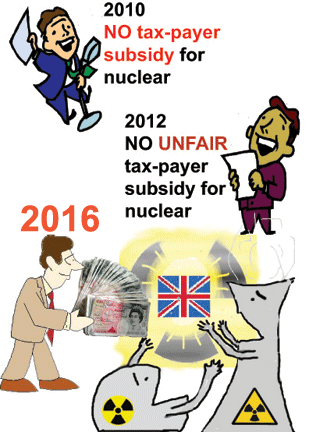
Taxpayers could shoulder the multibillion-pound cost of civil engineering works for new nuclear power plants to make them easier to finance and reduce their impact on energy bills, the company seeking to build reactors in Cumbria has suggested.
Tom Samson, chief executive of NuGen, proposed reviewing how the different elements of new nuclear plants could be “carved up in different way to allow the Government to take a role in some of the enabling infrastructure”.
This could include funding major aspects of construction such as “the civil works”, he told a House of Lords committee.Mr Samson’s company wants to build three Westinghouse reactors at Moorside, near Sellafield in Cumbria, in a 3.8-gigawatt project he said was expected to cost up to £15bn.
But financing presents a major challenge for the project, which is 60pc owned by Japan’s Toshiba and 40pc by France’s Engie, formerly GDF Suez. It has been in talks with potential investors for months about a deal.
These will be levied on consumer energy bills and could cost as much as £30bn.
But the model has been criticised as inefficient and expensive.
Even EDF, which is majority-owned by the French government, struggled to raise enough funds for the construction, raising major questions about how non-state-owned groups like Toshiba could hope to…….
NuGen is already lobbying via the Cumbrian Local Enterprise Partnership for Government assistance in improving the transport infrastructure in the Cumbrian area to help support both decommissioning operations at Sellafield and the proposed construction site at Moorside.
Ministers are reported to have commissioned a study earlier this year to consider alternative funding models, which also suggested the Government could take direct stakes in future projects.
Earlier this year rival developer Horizon warned that the Government needed to come up with a framework that was palatable for private investors, not just state companies like EDF….. http://www.telegraph.co.uk/business/2016/11/05/government-could-part-fund-new-uk-nuclear-plants-nugen-suggests/
Next president will have to grapple with nuclear weapons issues — and possible nuclear crises
 Whose Finger on the Nuclear Button?Election 2016 and playing a game of chicken with nuclear strategy, Common Dreams by Michael T. Klare , 7 Nov 16
Until recently in the post-Cold War world, however, nuclear weapons seemed to drop from sight, and that question along with it. Not any longer. In 2016, the nuclear issue is back big time, thanks both to the rise of Donald Trump (including various unsettling comments he’s made about nuclear weapons) and actual changes in the global nuclear landscape.
With passions running high on both sides in this year’s election and rising fears about Donald Trump’s impulsive nature and Hillary Clinton’s hawkish one, it’s hardly surprising that the “nuclear button” question has surfaced repeatedly throughout the campaign. In one of the more pointed exchanges of the first presidential debate, Hillary Clinton declared that Donald Trump lacked the mental composure for the job. “A man who can be provoked by a tweet,” she commented, “should not have his fingers anywhere near the nuclear codes.” Donald Trump has reciprocated by charging that Clinton is too prone to intervene abroad. “You’re going to end up in World War III over Syria,” he told reporters in Florida last month.
For most election observers, however, the matter of personal character and temperament has dominated discussions of the nuclear issue, with partisans on each side insisting that the other candidate is temperamentally unfit to exercise control over the nuclear codes. There is, however, a more important reason to worry about whose finger will be on that button this time around: at this very moment, for a variety of reasons, the “nuclear threshold” — the point at which some party to a “conventional” (non-nuclear) conflict chooses to employ atomic weapons — seems to be moving dangerously lower.
Not so long ago, it was implausible that a major nuclear power — the United States, Russia, or China — would consider using atomic weapons in any imaginable conflict scenario. No longer. Worse yet, this is likely to be our reality for years to come, which means that the next president will face a world in which a nuclear decision-making point might arrive far sooner than anyone would have thought possible just a year or two ago — with potentially catastrophic consequences for us all.
No less worrisome, the major nuclear powers (and some smaller ones) are all in the process of acquiring new nuclear arms, which could, in theory, push that threshold lower still. These include a variety of cruise missiles and other delivery systems capable of being used in “limited” nuclear wars — atomic conflicts that, in theory at least, could be confined to just a single country or one area of the world (say, Eastern Europe) and so might be even easier for decision-makers to initiate. The next president will have to decide whether the U.S. should actually produce weapons of this type and also what measures should be taken in response to similar decisions by Washington’s likely adversaries.
Lowering the Nuclear Threshold………
The New Nuclear Armaments
Both countries are already in the midst of ambitious and extremely costly efforts to “modernize” their nuclear arsenals. Of all the weapons now being developed, the two generating the most anxiety in terms of that nuclear threshold are a new Russian ground-launched cruise missile (GLCM) and an advanced U.S. air-launched cruise missile (ALCM). Unlike ballistic missiles, which exit the Earth’s atmosphere before returning to strike their targets, such cruise missiles remain within the atmosphere throughout their flight……..
On the American side, the weapon of immediate concern is a new version of the AGM-86B air-launched cruise missile, usually carried by B-52 bombers. Also known as the Long-Range Standoff Weapon (LRSO), it is, like the Iskander-M, expected to be deployed in both nuclear and conventional versions, leaving those on the potential receiving end unsure what might be heading their way. In other words, as with the Iskander-M, the intended target might assume the worst in a crisis, leading to the early use of nuclear weapons. Put another way, such missiles make for twitchy trigger fingers and are likely to lead to a heightened risk of nuclear war, which, once started, might in turn take Washington and Moscow right up the escalatory ladder to a planetary holocaust.
No wonder former Secretary of Defense William J. Perry called on President Obama to cancel the ALCM program in a recent Washington Post op-ed piece. “Because they… come in both nuclear and conventional variants,” he wrote, “cruise missiles are a uniquely destabilizing type of weapon.” And this issue is going to fall directly into the lap of the next president.
The New Nuclear Era
Whoever is elected on November 8th, we are evidently all headed into a world in which Trumpian-style itchy trigger fingers could be the norm. It already looks like both Moscow and Washington will contribute significantly to this development — and they may not be alone. In response to Russian and American moves in the nuclear arena, China is reported to be developing a “hypersonic glide vehicle,” a new type of nuclear warhead better able to evade anti-missile defenses — something that, at a moment of heightened crisis, might make a nuclear first strike seem more attractive to Washington. And don’t forget Pakistan, which is developing its own short-range “tactical” nuclear missiles, increasing the risk of the quick escalation of any future Indo-Pakistani confrontation to a nuclear exchange. (To put such “regional” dangers in perspective, a local nuclear war in South Asia could cause a global nuclear winter and, according to one study, possibly kill a billion people worldwide, thanks to crop failures and the like.)
And don’t forget North Korea, which is now testing a nuclear-armed ICBM, the Musudan, intended to strike the Western United States. That prompted a controversial decision in Washington to deploy THAAD (Terminal High Altitude Area Defense) anti-missile batteries in South Korea (something China bitterly opposes), as well as the consideration of other countermeasures, including undoubtedly scenarios involving first strikes against the North Koreans.
It’s clear that we’re on the threshold of a new nuclear era: a time when the actual use of atomic weapons is being accorded greater plausibility by military and political leaders globally, while war plans are being revised to allow the use of such weapons at an earlier stage in future armed clashes.
As a result, the next president will have to grapple with nuclear weapons issues — and possible nuclear crises — in a way unknown since the Cold War era……..http://www.commondreams.org/views/2016/11/06/whose-finger-nuclear-button
1 This Month
15 October. Joint Appeal for Nuclear Abolition Day -presentation to the UN on October 15 will be live on UNWebTV
Endorse the Nuclear Abolition Day Appeal
23-25 October – on Zoom – World BEYOND War’s annual global conference

To see nuclear-related stories in greater depth and intensity – go to https://nuclearinformation.wordpress.com
-
Archives
- October 2026 (139)
- September 2026 (339)
- August 2026 (330)
- July 2026 (355)
- June 2026 (287)
- May 2026 (306)
- April 2026 (356)
- March 2026 (251)
- February 2026 (267)
- January 2026 (308)
- December 2025 (358)
- November 2025 (359)
-
Categories
- 1
- 1 NUCLEAR ISSUES
- business and costs
- climate change
- culture and arts
- ENERGY
- environment
- health
- history
- indigenous issues
- Legal
- marketing of nuclear
- media
- opposition to nuclear
- PERSONAL STORIES
- politics
- politics international
- Religion and ethics
- safety
- secrets,lies and civil liberties
- spinbuster
- technology
- Uranium
- wastes
- weapons and war
- Women
- 2 WORLD
- ACTION
- AFRICA
- Atrocities
- AUSTRALIA
- Christina's notes
- Christina's themes
- culture and arts
- Events
- Fuk 2022
- Fuk 2023
- Fukushima 2017
- Fukushima 2018
- fukushima 2019
- Fukushima 2020
- Fukushima 2021
- general
- global warming
- Humour (God we need it)
- Nuclear
- RARE EARTHS
- Reference
- resources – print
- Resources -audiovicual
- Weekly Newsletter
- World
- World Nuclear
- YouTube
-
RSS
Entries RSS
Comments RSS

