 The TPP wasn’t killed by Donald Trump – our protests worked https://www.theguardian.com/commentisfree/2016/nov/28/tpp-protests-mass-opposition-worked-trump-presidency We the people can create change by standing together. This is crucial to remember for the next four years, Guardian, Evan Greer, Tom Morello and Evangeline Lilly, 28 Nov 16,
The real story is that an unprecedented, international uprising of people from across the political spectrum took on some of the most powerful institutions in the world, and won.
Sure, Donald Trump – and Bernie Sanders’ – campaign focus on the TPP elevated US awareness about the pact, a wide-reaching international agreement negotiated by the Obama administration. But no single politician killed this deal.
If not for the constant pressure from activists and civil society groups, the TPP would have become law long before the recent US election. But thanks to intense, creative and strategic organizing from the day the text was finalized in 2015, there was never a majority of support for the pact in Congress. That’s why it was never implemented.
The TPP is a massive global deal that was negotiated in secret with hundreds of corporate advisers given special access while the public was locked out. It would have handed multinational corporations like Walmart, AT&T and Monsanto extraordinary new powers over everything from the wages we earn, to the way we use the internet, to the safety of the food we feed our children.
Perhaps most shockingly, the TPP would have allowed corporations to sue governments before tribunals of three corporate lawyers, essentially creating an unaccountable, shadow legal system outside of our traditional courts to punish governments that pass laws that corporations don’t like.
A simple agreement to lower tariffs and other anticompetitive barriers to trade wouldn’t have been so controversial. But big business couldn’t resist the urge to abuse the extreme secrecy surrounding the TPP negotiations to stuff the pact with a wishlist for policies they knew they could never pass through traditional means.
That unchecked greed was the TPP’s demise. What emerged from the closed-door negotiations was more than 5,000 pages of policy so clearly against the public interest that it awakened a firestorm of opposition that swept the globe, and in the end, sent the TPP to its grave.
While negotiations were still under way, tens of thousands of people joined mass protests in Japan, Peru, Australia, New Zealand and other Pacific Rim nations. They pushed back on the TPP’s worst provisions, held their leaders’ feet to the fire and dragged the talks out for years. This early wave of international resistance changed the game: it bought time for activists to organize an effective opposition in the US, which was seen as all-important in the global calculus of the Washington-led deal. If Congress did not ratify the TPP, it would die.
In the meantime, an unlikely alliance was forming. Activists, farmers, labor unions, tech companies, environmentalists, economists, nurses, LGBTQadvocates, libertarians and librarians mounted an intense opposition to the “fast track” legislation that the White House needed to rush the final agreement through Congress. The coalition that formed grew from dozens, to hundreds, to literally thousands of organizations, many working together for the first time, ranging from Black Lives Matter to Doctors Without Borders to the Tea Party.
We marched in the streets. We rallied outside the hotels and resorts that hosted the secret negotiations. Cancer patients protesting about the TPP’s impact on healthcare access engaged in civil disobedience and were arrested. Internet freedom activists mobilized thousands of websites for online protests that bombarded lawmakers with emails and phone calls. Academics picked apart leaked versions of the deal, and coordinated with advocates to launch a campaign to educate the public on its flaws.
Hard-hitting activism and public outcry slowed the TPP down, and as a result, dragged it fully into the spotlight just as the US headed into a contentious election season.
It wasn’t a coincidence that Donald Trump saw the TPP as a useful stump speech talking point. Widespread suffering caused by previous trade deals laid a strong foundation for skepticism, making President Obama’s devotion to the Wall Street-friendly deal, and Hillary Clinton’s previous support for it, a huge liability for the Democratic party. As more and more people learned about what the TPP really meant for them and their families, it became politically toxic, to the point that no major party candidate for president could openly support it.
This was a sign that the TPP was on its deathbed, but with the threat of a last-minute push during the “lame duck” session after the election, we needed to be sure. So we targeted undecided lawmakers with protests and flew inflatable blimps outside their offices. We harnessed the power of music to draw huge crowds across the country to “Rock Against the TPP” concerts and teach-ins, taking our opposition to the TPP into the cultural mainstream. We tuned out the chorus of voices that told us that corporate power would always prevail in the end. And finally, we claimed our victory.
Now more than ever, it’s crucial that Americans understand how the TPP was really defeated. An organized and educated public can take on concentrated wealth and power and win. With four years of new battles ahead of us, this is a story we must commit to memory, and a lesson we must take to heart.
November 30, 2016
Posted by Christina Macpherson |
politics, politics international, USA |
Leave a comment
|
What’s next for SA energy, now that Russian nuclear build is on ice? Expert unpacks the plan , Biz News, Business players and others with interests in nuclear energy are understandably annoyed that the country’s plans are changing, with a nuclear build programme with Russia looking like it is on ice. For Hartmut Winkler, a physics expert at the University of Johannesburg, the new plan has the makings of a good news story for South Africa. He unpacks the details, explaining how energy consumption patterns in the country have changed recently and also how the costs of renewable energy options have been falling. Although the pro-nuclear lobby – which includes Eskom, a state entity that features prominently in state capture allegations – is expected to keep pushing for the Russian option, Winkler reckons the programme is unlikely to go ahead. There is research that indicates that nuclear power might not even be needed by South Africa until at least 2050, which means pushing the build out even further. Winkler is remarkably upbeat about the state of the energy sector. If energy generation is managed properly from here on, South Africa’s energy challenges may not be as bad as we all think, is his message. – Jackie Cameron By Hartmut Winkler* 29 Nov 16 The much awaited updated South African Integrated Resource Plan for electricity has been released for comment.
The document makes far-reaching proposals about the target energy generation mix leading all the way to 2050. In particular, the plan pronounces on the future scale and role of nuclear energy and renewable energy technologies. The appropriateness of these has been debated a great deal in the country in the past few years……
in an updated version of the 2011 plan that was prepared in 2013. It recommended that, in view of these changing conditions, there was no longer a need to kick-start a nuclear build programme immediately. It also recommended that a decision on whether or not to embark on an expensive expansion of the nuclear reactor fleet could be delayed for several years.
But this updated version of the plan was never promulgated. This left the door open for a fiercely pro-nuclear lobby which is in favour of a highly lucrative nuclear expansion programme. This issue has developed into a political hot potato. The central argument is that the push for nuclear goes against economic common sense and that it’s being pursued for the benefit of politically connected individuals.
The nuclear build issue has come to feature prominently as one of the important drivers of what is referred to as “state capture” of some of the country’s large institutions.
The latest version
The draft update of the resources plan advocates the following most likely scenario, referred to as the “base case”.
- Electricity demand between 310 and 355 TWh in 2030 (about 100 TWh lower than envisaged in the 2010-2030 plan) with demand rising to between 390 and 530 TWh in 2050. This is based on projection models developed at the Council for Scientific and Industrial Research.
- The construction of 37.4 GW (1 000 GigaWatts equal 1 TeraWatt) of wind capacity and 17.6 GW of solar photovoltaic capacity between 2020 and 2050.
- The gradual decommissioning of most existing coal power stations by 2050 in line with international carbon emission agreements.
- A substantial increase (35.3 GW) in electricity generation from gas. Due to the high cost of gas it is generally used only as a back up. It would in any case contribute only about 7% of total energy generation.
- The construction of just over 20 GW of nuclear power. But this would only gradually come on line between 2037 and 2050. Given that construction of the plants would take ten years the decision to go ahead with the nuclear build could still be delayed for another decade.
Initial reactions
Unsurprisingly, the nuclear industry and its supporters have reacted very negatively to the new draft. Strong nuclear advocates in the state electricity utility Eskom have gone so far as to defiantly declare that they will invite nuclear construction proposals before the end of the year.
But Eskom’s defiance is unlikely to lead to anything substantial. This is because the state utility is facing both a credibility crisis and its finances are in poor shape.
On the other hand advocates of faster growth in renewables have criticised two fundamental assumptions underpinning the “base case” model.
They argue that the model assumes renewable tariffs slightly higher than achieved in the last allocations made under the renewable energy procurement programme. Only by 2030 do these drop a further 20% for photovoltaics and 9% for wind. But given recent trends and projections there’s a strong likelihood that future renewable energy costs will be lower than that.
The “base case” also assumes a limit to how many solar and wind plants can be constructed annually. But based on past interest and delivery by private renewable power producers far greater annual developments are possible.
Several researchers have shown that by applying lower renewable tariffs and removing annual construction limits renewables can make up a much greater proportion of the energy mix, and that new nuclear might not even be needed in 2050.
Future energy demand
The new energy plan is now subject to public input. It is due to be adopted by government in four months time after improvements and further scenario modelling has been added.
Even after adoption, updates will need to be done regularly, ideally every two years since even current projections could be overestimating future energy demand considerably.
This is particularly true given that energy consumption is declining in most developed countries because of advances in technology and energy saving initiatives.
If the energy sector is managed correctly, the current South African energy crisis may not be as far reaching as is often assumed.
|
|
|
November 30, 2016
Posted by Christina Macpherson |
ENERGY, politics, South Africa |
Leave a comment
 Donald Trump will soon learn the nuclear codes. What will he do with them?, The Age, 27 Nov 16
Tim Johnson “……By all accounts, the nuclear briefings a president-elect receives before inauguration are both complex in detailing procedures for a nuclear launch and awe-inspiring in explaining the physical consequences of selecting a target, launching an attack and girding for the fallout.
“These are the aspects that reportedly left President Kennedy ashen-faced,” said Peter D. Feaver, a security and conflict expert at Duke University, who worked on the National Security Council under the Bill Clinton and George W. Bush administrations.
Those familiar with the nuclear briefings say they demand a sharp focus……..
Mr Trump will learn how a launch order would “send key people to underground bunkers,” Mr Crowley said. “That’s a critical dimension of this. Even for the Strategic Command out in Nebraska, this would send an airborne command up in the air.”
The black satchel operates with a dual key system, and part of the system is for the president to take a card from his pocket to input the correct codes.
“The card itself is critical to begin the process that activates the system,” Mr Panetta said.
While the system is designed with overlapping triggers that ensure that nuclear weapons are not launched by mistake, it is also designed for a president to make a snap decision.
“It’s a very short period of time, measured in minutes,” Mr Feaver said.
After Barack Obama received his nuclear briefings, he laid out a vision of “a world without nuclear weapons.”
“If we believe that the spread of nuclear weapons is inevitable, then in some way we are admitting to ourselves that the use of nuclear weapons is inevitable,” Mr Obama said in Prague in April 2009, promising to make nuclear nonproliferation a top priority.
In theory, no one stands in the way of the commander in chief and a nuclear launch……..
Some voice concern about what they see as Mr Trump’s imprudence.
“He seems to be quite impulsive. He sends off tweets in the middle of the night,” said Ira Helfand, co-president of the International Physicians for the Prevention of Nuclear War, an anti-nuclear advocacy group. “You can’t backtrack a nuclear weapon once it’s been fired.”
During the campaign, Mr Trump offered many points of view, saying limited proliferation was inevitable, nuclear war would be horrific and that the United States should always leave nuclear use as a possibility.
“I don’t think you could predict with confidence where he is going to come down on a question like this,” said Mr Feaver, the Duke University expert……. Whether those proliferation issues are addressed in further briefings for Mr Trump will depend largely on his level of interest, experts said…. http://www.theage.com.au/world/donald-trump-will-soon-learn-the-nuclear-codes-what-will-he-do-with-them-20161126-gsyc1e.html
November 28, 2016
Posted by Christina Macpherson |
politics, USA |
Leave a comment
Swiss reject plan to speed up exit from nuclear energy Herald Courier, Associated Press |BERLIN (AP) , 27 Nov 16, — Swiss voters rejected a plan to accelerate the country’s exit from nuclear energy in a referendum Sunday, turning down an initiative that would have forced their government to shut the last plant in 2029.
The plan promoted by the Green party would have meant closing three of Switzerland’s five nuclear plants next year. Polls ahead of the referendum had shown a tight race, but voters shot down the initiative by 54.2 percent to 45.8 percent.
Under Switzerland’s direct democracy system, proposals need support from both a majority of the country’s cantons (states) and of the national vote to pass. Only six of Switzerland’s 26 states backed the nuclear shutdown plan.
After the Fukushima nuclear disaster in Japan, the Swiss government adopted a gradualist approach toward transitioning the country to renewable energy by 2050.
It said nuclear plants should continue to operate as long as they are deemed safe, but didn’t set a precise timetable. The government said it needs time to switch to other sources such as wind, solar and biomass energy.
If successful, the initiative would have limited the lifespan of nuclear plants to 45 years and meant the closure next year of the Beznau 1, Beznau 2 and Muehleberg reactors. The newest of the plants, in Leibstadt near the German border, started operating in 1984 and would have had to close in 2029.
The nuclear plants currently generate around a third of Switzerland’s electricity.
“We would have liked to win, that’s clear, but 45 percent for ‘yes’ is a good result,” Regula Rytz, the Greens’ chairwoman, told SRF television. Her party isn’t part of Switzerland’s broad coalition government.
“The problems haven’t been resolved with this referendum Sunday,” Rytz said. “We will keep at it on safety, on financial security … and on expanding renewable energies.”….
The referendum result “is a disappointment for all who had hoped for clarity on when the last nuclear power station in Switzerland will go offline,” Rita Schwarzeluehr-Sutter, a deputy German environment minister, said.
Nuclear power is “an outdated model in Switzerland, too,” she said, adding that the country has some of the world’s oldest reactors and “their days are numbered anyway.” http://www.heraldcourier.com/news/swiss-cast-ballots-on-referendum-on-nuclear-energy/article_92960829-a9d6-57a4-9cce-031054b7ab3a.html
November 28, 2016
Posted by Christina Macpherson |
politics, Switzerland |
Leave a comment
Swiss nuclear plants to remain on grid, swissinfo.ch
Swiss voters have thrown out a proposal to close the country’s five nuclear power plants after 45 years in operation. The Green Party initiative was rejected by 54.2% of the vote, according to final results.
Only six of the country’s 26 cantons, mainly in French-speaking Switzerland, came out in favour of the phase out. Despite the defeat, Regula Rytz, president of the Green Party, welcomed Sunday’s result.
“The high number of yes votes confirmed that citizens wanted to opt out of nuclear power in the long run,” she said.
The leftwing Social Democrats said the nuclear era was coming to an end, while the environmental organisation Greenpeace described the result as a “slap on the wrist” of the nuclear power industry.
Confidence
Energy Minister Doris Leuthard said the result was a vote of confidence in the government and its energy strategy. “Voters do not want a hasty shut down of nuclear power plants. A policy change is not feasible from one day to the next,” she told a news conference…….
Supporters of the initiative argued the safety of old reactors, operating since the early 1970s, could no longer be guaranteed. Instead, they called for more energy efficiency and renewable energy resources.
“An orderly phase out creates more safety and protects our country,” according to the campaign slogan of the initiative committee.
If it had been approved, three plants would have had to close as early as next year and Switzerland would have phased out nuclear energy production by 2029. Most of the Swiss nuclear reactors have unlimited operating licences, which are subject to approval by the regulator.
The proposal was backed by an alliance of leftwing parties, trade unions and environmental organisations……..
Energy Strategy
Following the nuclear disaster in Fukushima, the Swiss government in 2011 decided in principle to opt out of nuclear power production by 2034. In its energy policy, the government recommended decommissioning all nuclear reactors and to promote hydroelectric power, renewable energy and combined gas plants.
Last September, parliament approved an energy strategy, ending more than two years of debate. The programme foresees boosting renewable energy resources and outlaws the construction of nuclear power plants. However, it sets no deadline for the existing reactors to be shut down.
Unhappy with the Energy Strategy 2050, the rightwing Swiss People’s Party is challenging the law to a referendum, criticising planned government subsidies for renewable energy resources……
Nuclear votes
The Nov 27 was vote was the seventh nationwide ballot on nuclear power in Switzerland since 1979.
Ballots also took place at cantonal and local levels, notably on the storage of nuclear waste, public stock ownership in nuclear companies or a ban of nuclear power supplies for public utilities.
November 28, 2016
Posted by Christina Macpherson |
politics, Switzerland |
1 Comment
Dana Bash catches Rubio in trap with clip where he said Trump ‘too erratic to have the nuclear codes https://www.rawstory.com/2016/11/dana-bash-catches-rubio-in-trap-with-clip-where-he-said-trump-too-erratic-to-have-the-nuclear-codes/ TOM BOGGIONI 27 NOV 2016 FLorida Senator Marco Rubio (R) gave his full support to Donald Trump on Sunday morning but continued to hedge his bets when it comes to feeling comfortable handing over the nuclear codes to the president-elect.
Appearing on CNN’s State of the Union, host Dana Bash reminded the Florida senator that he once called Trump unfit for the office of the presidency, and warned against “turning over the nuclear codes to an erratic individual.”
“Senator, do you still have those concerns about President-elect Trump?” Bash asked.
“Well, Dana, we had an election,” Rubio replied. “Ultimately the voters chose him both as our nominee and now as our president. The election is over and it’s time to govern. We’ll give him every chance to be successful. That’s what I”m focused on now. At some point elections end and governing needs to begin.”
“Senator, I completely get elections are over and now it is time for governing,” Bash pressed. “But given the fact that it’s time for governing and your criticism was about his abilities to govern, even as far as saying that he shouldn’t have the nuclear codes because he’s too erratic. What will you do as senator, as somebody who actually has the responsibility of check and balance, to make sure that he is governing properly given the concerns that you expressed?”
“The same as I would do with anybody else who is elected.” Rubio replied, side-stepping once again before adding, “I feel comfortable voters have voted him to be the commander-in-chief.” [Video]
November 28, 2016
Posted by Christina Macpherson |
USA elections 2016 |
Leave a comment
NucClear News, 26 Nov 16 New Reactor Notes The Environment Agency is planning to launch a consultation on its preliminary conclusions on the Advanced Boiling Water Reactor design which Horizon Nuclear is proposing to build at Wylfa on Anglesey and Oldbury in Gloucestershire. The consultation will run between 12 December 2016 and 3 March 2017. (1) EA will hold a consultation meeting on 24th January 2017 at the Botanical Gardens, Birmingham. This should give participants an introductory understanding of the reactor design currently being assessed through the GDA. (1)
The second stage of a public consultation into the two EPR reactors planned for Sizewell in Suffolk has been launched.
November 26, 2016
Posted by Christina Macpherson |
politics, UK |
Leave a comment
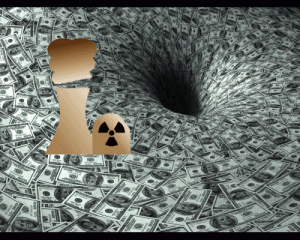 Empty Pockets Leave Indian Nuclear Plants Incomplete https://sputniknews.com/asia/201611231047759881-india-incomplete-nuclear-plants/ ASIA & PACIFIC 23.11.2016 India’s target to rapidly step up nuclear power capacity may be stumbling because many suppliers have not been paid. The Government is now trying to borrow from state-owned companies to complete the projects.
New Delhi : India’s ambitious nuclear power plans are facing the sword of financial uncertainty. The Indian Government has acknowledged that major equipment for two nuclear power projects was delivered on time because the suppliers had not been paid. The projects are being set up by the government-owned Nuclear Power Corporation of India Limited (NPCIL).
“The delay in supplies of major equipment for Kakrapar Atomic Power 3 & 4 (2×700 MW) and Rajasthan Atomic Power 7&8 (2×700 MW) projects by the industries was mainly on account of financial crunch and shortage of skilled manpower,” says Dr. Jitendra Singh, Minister of State for Atomic Energy.
The approved cost of units 7 and 8 of Rajasthan Atomic Power Station is $ 1852 million but the Government has approved about $ 150 million lessOvernmnet has while Indian government has approved USD 1723 million for units 3 and 4 of Kakrapar. NPCIL was scheduled to complete these projects in 2015 but the date has been put off to 2019.
India had changed the Atomic Energy Law this year to allow NPCIL enter into joint ventures with other government entities. “After the changes in the law, India would be able to set up a new nuclear power reactor in every four year,” says Rajiv Nayan, senior research associate, Institute of Defense and Security Analysis.
Sources say that companies like NTPC, Indian Oil Corporation and NALCO have agreed to invest $ 1,500 million each in joint ventures with NPCIL. “India will not get far even after adding this money with the amount available with NPCIL for investment. Costs and financing, therefore, complicate India’s ability to scale up nuclear power through its own means without relying on foreign imports,” writes Anirudh Mohan, Junior Fellow at Observer Research Foundation in a research paper. Currently, India is setting up 6,700-megawatt nuclear power projects across the country with an estimated cost of more than $ 18 billion. Being the sole company authorized to set up nuclear power plants, NPCIL is faced problems in generating funds for these projects.
November 24, 2016
Posted by Christina Macpherson |
business and costs, India, politics |
Leave a comment
 Zuma’s waning power exposed by stalled nuclear plan. Mail and Guardian 24 Nov 2016 Mike Cohen, Paul Vecchiatto Government’s decision to stall plans championed by President Jacob Zuma to build nuclear plants has exposed his waning authority.
News of the delay came on Tuesday when the department of energy said additional atomic power won’t come on stream until 2037 under its “base case” scenario, 14 years later than previously projected. Although Zuma says reactors are key to addressing power constraints in Africa’s most industrialised economy, Finance Minister Pravin Gordhan, economists and ratings agencies warn that South Africa can’t afford them now.
“Essentially the project has been indefinitely postponed and the final decision on nuclear power will only be taken by Zuma’s successor,” said Robert Schrire, a politics professor at the University of Cape Town. “This is a great victory for economic rationality and political expediency and reflects the new political balance of a weakened Zuma administration.”…….
Gordhan’s victory
Gordhan won a victory this month after prosecutors withdrew fraud charges against him for allegedly approving a pension payment to a tax service official, two days before he was due to appear in court. The Democratic Alliance, the main opposition party, alleged that Zuma intended to use the court case as a pretext for firing Gordhan and in the process remove the biggest obstacle to his nuclear ambitions.
The party also says that Zuma may already have signed a secret nuclear power supply deal with Russia and that the programme would be used to benefit his own financial interests and those of his allies. The president and the government deny the allegation……
Energy Minister Tina Joemat-Pettersson told reporters the power blueprint was updated to reflect developments in the energy industry, including changes in technology costs and lower-than-anticipated demand. The draft plan will be finalised next year.
Eskom, which supplies about 90% of the nation’s power, isn’t shelving its nuclear plans yet. The state utility will continue to seek requests for proposals to build new reactors pending the completion of the energy plan…..
The dynamics of power in South Africa are shifting, according to Keith Gottschalk, a political scientist from the University of the Western Cape in Cape Town.
Zuma is “still able to outvote and outmanoeuvre his opponents in the ANC, but the mounting pressure has meant he has not been able to always get his own way all the time,” he said. “He is on the way down like a slow-leaking puncture.” – Bloomberg http://mg.co.za/article/2016-11-24-news-analysis-zumas-waning-power-exposed-by-stalled-nuclear-plan
November 24, 2016
Posted by Christina Macpherson |
politics, South Africa |
Leave a comment
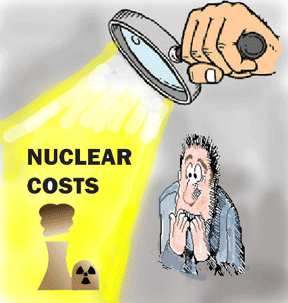
 Government delays nuclear plant plans as economy stagnates, Mail and Guardian, 22 Nov 2016 Mike Cohen, Paul Vecchiatto South Africa delayed plans to build new nuclear power plants over concern about their cost and the waning demand for additional electricity as economic growth stalls.
Under a new timeline, the first nuclear power is expected to come on stream in 2037, with a total 20 385 megawatts of nuclear energy added to the national grid by 2050, according to the “base case” scenario outlined in a presentation about the department of energy’s updated Integrated Resources Plan. The proposal, released in Cape Town on Tuesday, also estimates as additional 37 400 MW of power from wind, 17 600 MW from solar plants, 35 292 MW from gas and 15 000 MW from coal by 2050.
The government previously said it wanted to generate 9 600 MW of energy from as many as eight reactors that should begin operating from 2023 and be completed by 2029. Price estimates had ranged from $37-billion to $100-billion. Although President Jacob Zuma has championed the nuclear programme, the treasury has cautioned that the country may be unable to afford new reactors at a time when the economy is barely growing and the budget deficit needs to be curbed to fend off a junk credit rating.
“Gas and renewables [will] form the biggest chunk of installed capacity by 2050,” the department of energy said in the presentation. “There is significant reduction in installed capacity from coal……..
Power cuts
The energy plan will be refined in March next year and then submitted to Cabinet for final sign-off.
Eskom, the state-owned utility, has said it could use the more than R150-billion it will accumulate in reserves within 10 years to build new reactors. The utility operates Africa’s only nuclear power plant — the 1 800 MW Koeberg facility near Cape Town, which began operating in 1984.
Rosatom, Areva SA, EDF SA, Toshiba’s Westinghouse Electric unit, China Guangdong Nuclear Power Holding Corp and Korea Electric Power Corp previously expressed interest in building new reactors in South Africa…..http://mg.co.za/article/2016-11-22-sa-delays-nuclear-plant-plan-as-economy-stagnates
November 23, 2016
Posted by Christina Macpherson |
politics, South Africa |
Leave a comment

 Vietnam Formally Scraps Plans for First Nuclear Power Plants http://www.voanews.com/a/vietnam-scraps-plans-for-nuclear-power-plants/3607042.html , 22 Nov 16 HANOI — Vietnam’s legislature on Tuesday endorsed the government’s decision to scrap plans to build the country’s first two nuclear power plants.
A statement from the government announcing the endorsement said cheaper renewable energy and power imports were available and that investment should be made in more urgent infrastructure needs.
The National Assembly in 2009 approved plans to build two nuclear power plants with combined capacity of 4,000 megawatts. Construction contracts had been awarded to companies from Russia and Japan.
Construction was initially scheduled to start in 2014 but was delayed several times.
State media have reported that the nuclear power plants were not economically viable because of cheaper sources of power and that the costs of the plants had doubled to $18 billion.
November 23, 2016
Posted by Christina Macpherson |
politics, Vietnam |
Leave a comment
 Inside Exelon’s last-minute push to save its nukes and remake the Illinois power sector
The Illinois legislature has a week to decide on a far-reaching energy reform bill that includes something for everyone to hate, Utility Dive, Peter Maloney@TopFloorPower, 22 Nov 16 fate of two nuclear plants in Illinois is coming down to the wire.
A bill introduced into the Illinois General Assembly this week would provide subsidies Exelon says are necessary to keep its Clinton and Quad City nuclear plants online.
When the legislature failed to pass a previous version of the bill, Exelon said it would close the 1,069-MW Clinton station on June 1, 2017, and the 1,871-MW Quad Cities plant in Cordova on June 1, 2018. At the time, Exelon said the plants had lost a combined $800 million over the past seven years.
Exelon faces a Dec. 1 deadline for notifying the Midcontinent ISO about whether or not it will close Clinton next year.
There is a lot riding on the bill. According to Exelon’s accounting, closing the nuclear facilities would result in the loss of $1.2 billion in economic activity annually.
But the bill, an amendment to SB 2814, goes beyond the fate of two nuclear plants. It is loaded with provisions that touch upon almost every aspect of the state power sector, from funding for utility based energy efficiency measures, community solar programs and microgrids to changes in rate structure such as the imposition of demand charges and the elimination of retail net metering for solar power. The bill also includes a last minute addition of capacity payment add-ons for coal-fired plants in the south of the state.
orking through the complexities of any one of those provisions would be enough of a challenge, but lawmakers are working under a tight deadline.
The bill was taken up in the General Assembly’s veto session, which has a short lifespan of less than a week. The final day of the session is Dec. 1, but it could roll over into a lame duck session that could extend to Jan. 11, 2017.
Exelon, of course, is also facing the Dec. 1 deadline for giving notice to MISO regarding the closure of the Clinton nuclear plant.
The lawmakers’ work could be eased somewhat by the fact that many of the provisions cover familiar ground. The Future Energy Jobs Bill, as it’s called, traces its history back to three bills that were eventually rolled into one. All three failed, but then failed bills were reworked into a single piece of legislation. But that bill, too, failed to make it through the assembly.
That bill was also reworked and revived for the current session and now includes $1 billion in funding for low-income program, a doubling of energy efficiency programs to produce $4 billion in energy savings, fixes for the state’s stalled renewable portfolio standard program, and funding of up to $220 million a year for renewable resources.
The bill was also recast at the last minute after Donald Trump won the presidential election to highlight its job saving or creating aspects. Prior to the election, the bill had assumed that the Clean Power Plan, the environmental regulations that would limit carbon dioxide emissions from coal plants and that is stalled by court challenges, would be put in place and provide an economic rationale for zero emission generation. But Trump has promised to dismantle those regulations.
The Future Energy Jobs Bill made it through the House Energy Committee Wednesday night, but many of the lawmakers who voted to move the bill cast a “yea” vote with the expectation that there would be substantial changes before the bill comes to the floor of the assembly.
The legislature is now faced with a single massive (446 pages) bill laden with provisions – what legislators call a “Christmas tree”– that has something for everyone. It also has something for everyone to dislike. The bill attracted vociferous criticism from a variety of constituents as soon as it landed.
“This is going to be the largest rate hike in U.S. history,” Dave Lundy, head of the BEST Coalition, a business group opposed to the bill, said at a press conference shortly after the bill was introduced.
Lundy argues that the capacity represented by the nuclear plants is not needed. Electricity demand is down 3% in the state, and Illinois generates 41% more power than it consumes, meaning that much of that output is exported out of state……..
Eric Robertson, general counsel of Illinois Industrial Energy Consumers, told the House committee his group opposes the legislation because the FRAP would increase commercial and industrial electric rates by $125 million a year.
SolarCity also opposes the legislation, not necessarily because of the FRAP, but because it would impose demand charges on retail customers and eliminate retail net metering in the state. Elimination of net metering would do away with a revenue stream that provide much of the incentive for rooftop solar, and demand charges would make electricity bills unpredictable, Elizabeth Pearlman, regulatory counsel and director of policy at SolarCity, told the committee.
“If you can’t do the math at the kitchen table, we can’t sell you solar,” she said. She called the bill’s proposed imposition of demand charges on customers’ bills, a “radical” and “unprecedented” change, one that is usually effected by regulatory commissions, not legislatures.
Both Shannon Fulton, president of the Illinois Solar Energy Association, and Amy Heart with The Alliance for Solar Choice cited the dual effect of the demand charge and net metering changes and said they also oppose passage of the bill.
With all the controversy, it seems clear that the Future Energy Jobs bill is still a work in progress and, if it does come to a vote, it will be on a revised version of the legislation.
In the committee meeting, Rita said there are “issues we have to work through,” and pledged that a revised bill would come “back through this committee.” http://www.utilitydive.com/news/inside-exelons-last-minute-push-to-save-its-nukes-and-remake-the-illinois/430692/
November 23, 2016
Posted by Christina Macpherson |
politics, USA |
Leave a comment
 In last minute dash, Obama administration pushes global clean energy initiatives http://www.utilitydive.com/news/in-last-minute-dash-obama-administration-pushes-global-clean-energy-initia/430430/Robert Walton @TeamWetDog
- The Obama administration has announced a broad range of global clean energy initiatives and investments, including financing in India and El Salvador, off-grid grants in Africa and a new report on the market for access to efficient appliances.
- The slate of announcements includes committing $125 million in financing for renewable energy projects through the Overseas Private Investment Corporation.
- The funding is a small drop compared to the $11 billion the United States has invested from 2010-2015 alone in international clean energy finance, according to the Department of Energy.
Dive Insight:
While President-elect Trump’s looming presidency has worried many over the future of the clean energy technology, the Obama administration is not slowing down on global decarbonization goals.
The White House continues its progressive moves on energy efficiency, global clean energy and decarbonization, last week issuing a lengthy overview of new initiatives. Among them:
- A partnership between the U.S. Agency for International Development (USAID), the Department of State and the Department of Energy’s National Renewable Energy Laboratory to identify “a pipeline of clean energy entrepreneurs in developing countries.”
- Providing $4 million in awards to eight household solar firms under the Power Africa Scaling Off Grid Grand Challenge, totaling a $36 million investment to empower entrepreneurs and investors in sub-Saharan Africa.
- Announcing more than $11 million raised for the deployment of efficient off-grid technologies globally through the Efficiency for Access Coalition;
- Launching a partnership to bring more efficient appliances tor rural Indian villages; and
- And supporting the first Solar Decathlon competition in Africa.
-
The USAID-State partnership with the National Laboratories aims to expand the geographic reach of the next annual Industry Growth Forum in April 2017. “This is one of the nation’s premier clean energy investment event to connect early stage companies with capital,” the White House said.So far, companies participating in the NREL Growth Forum have raised over $5 billion in financing.
Last week, the White House also released a report detailing the status of global markets for off-grid energy and the U.S. government’s role in developing those markets. In the past decade, the market has “grown exponentially” to give millions access to basic energy services.
According to the report, worldwide there are over 20 million households powered by solar home systems, and another 6 million are connected to renewables-based mini-grids or small wind turbines.
November 23, 2016
Posted by Christina Macpherson |
politics, renewable, USA |
Leave a comment
 Florida’s Amendment 1 defeat shows why solar won’t be stopped, Trump or no Trump, http://www.utilitydive.com/news/floridas-amendment-1-defeat-shows-why-solar-wont-be-stopped-trump-or-no/430373/14 Nov 16, David Pomerantz, executive director of the Energy and Policy Institute, wants utilities to ‘co-thrive’ with DERs.
Americans who are concerned about climate change are shell-shocked over the election of Donald Trump, who has claimed climate change was a hoax created by China and promised to end federal support for clean energy, neuter the EPA, and kill the Paris agreement.
If Trump follows through on these threats, it will cause irreversible damage. But an election result buried by the chaos of Tuesday night offers a thin silver lining to the dark clouds gathering on the climate horizon: the surprise defeat of a deceptive ballot initiative in Florida called “Amendment 1.”
Florida’s investor-owned electric utilities – Duke Energy, Florida Power & Light (FPL), Gulf Power and Tampa Electric – spent $20 million pushing Amendment 1 and branding it as “pro-solar,” when in fact it would have undermined customer-owned solar power in Florida. Amendment 1’s passage would have paved the way for the utilities to add fees to solar customers’ bills and to cut net metering payments for the extra power they produce. They could have killed the nascent rooftop solar industry in Florida, which already lags behind far smaller states like
Massachusetts and New Jersey.
Amendment 1’s defeat offers a road map for how to keep the clean energy economy growing under a Trump presidency: turn to the states. During the George W. Bush years, wind and solar power grew rapidly, despite federal hostility, thanks to supportive policies in both red and blue states. That’s not surprising, as Americans across the political spectrum, then and now, overwhelmingly support clean energy. A President Trump can’t block that progress, but another obstacle can: electric utilities.
Utilities profit when they build more power plants and transmission lines, which they can only do if people buy more electricity. Distributed solar threatens that outdated business model by offering people the choice of making their own power, so utilities have waged war on rooftop solar, and Amendment 1 revealed their battle plan:
Instead, they advocate for “smart solar” and “solar done right” – code for large solar farms that utilities own, not customers. But it’s a ruse; Duke Energy told Florida regulators that it planned to generate a mere 2.2% of its power from solar energy in 2025, and FPL reports that it will be 1% solar in that year. Duke and FPL are instead investing heavily in gas, as are many other utilities.
Florida voters proved that they wouldn’t be fooled. The utilities’ “pro-solar” message crumbled after the Energy and Policy Institute and the Center for Media and Democracy released an audio recordingconfirming Amendment 1 was a “political jiu-jitsu” campaign designed to trick pro-solar voters. Once the truth was out, support cratered.
Second, utilities try to divide environmentalists from low-income advocates and communities of color, using front groups to argue that rooftop solar is only for the rich, who “shift the costs” to poor people. It’s more deception: a host of studies have shown that the benefits that rooftop solar customers provide to the wider grid outweigh the costs.
Low-income communities and communities of color are refusing to be pawns in the utilities’ game. Black and Latino leaders spoke out against Amendment 1, noting that they want policies that result in more solar for their communities, not less. The NAACP nationally has been a forceful advocate for rooftop solar power, and polls show that communities of color support clean energy at the highest rates of all Americans.
Last, utilities use their financial might to buy political power. In addition to the $20 million that Florida’s utilities spent backing Amendment 1, they spent another $9.3 million on campaign contributions to legislators this cycle. Utilities’ influence peddling will never go away, but the pro-solar movement is learning to counter it via grassroots organizing, as it did effectively in Florida.
If other utilities follow their Florida brethren’s game plan, they too will unite their opponents into broad movements against them, and politically sensitive regulators will take notice. FPL’s war on solar power is already having this effect. Regulators in Hawaii, rightfully skeptical of FPL’s record of blocking solar in Florida, rejected its parent company NextEra’s bid to buy Hawaii’s electric utility. In Texas, where NextEra wants to buy Oncor, regulators are expressing their own concerns.
Nevadans – many still outraged at NV Energy’s hostility toward rooftop solar in the net metering battle there – voted Tuesday to strip the utility of its monopoly status.
These results should send a loud alarm to utilities and their investors that every attack they launch at rooftop solar will boomerang to erode their customers’ trust and weaken their standing with regulators.
There is only one way out of the jam for utilities: they have to adapt their business models and find ways to co-thrive with distributed resources. Some are trying to do that, albeit at the behest of regulators, but most seem intent on wasting time fighting a war they are destined to lose. Customers are demanding solar, the market forces behind solar cannot be stopped, and a Trump presidency will not change those facts.
November 23, 2016
Posted by Christina Macpherson |
decentralised, politics, USA |
Leave a comment
All bets are off: 4 takeaways on what President Trump means for the power sector
The paradigm of decarbonization that’s guided utility sector investments for the past decade is now up in the air, Utility Dive, Gavin Bade@GavinBade, 9 Nov 16, “…… In the coming weeks, much effort will be spent trying to decipher who Trump will appoint and how his team will handle the specifics of energy policy. But given that President Trump will likely come into office with a GOP-controlled Congress and a vacancy to fill on the Supreme Court, there are some broad conclusions for the power sector that we can already draw.
1. The Clean Power Plan — and other air regulations — are in danger
One of the most immediate impacts of Donald Trump’s election is that the Clean Power Plan now appears much more likely to be struck down.
The CPP is the EPA’s first set of federal carbon regulations and seeks to cut CO2 emissions from the power sector 32% by 2032. Though the utility industry is largely on board with the plan, a group of conservative states and fossil fuel interests challenged the rules, saying they constitute an overreach of EPA’s authority.
Those arguments came to a head in September, when the D.C. Circuit Court held an en banc hearing on the regulations. Due to the composition of the court — six Democratic appointees and four from Republicans — legal experts largely expect the rules to be upheld there.
But the Supreme Court could be a different story. No matter who prevails at the D.C. Circuit, the high court is expected to take up the Clean Power Plan next year. The justices have already shown interest in the case, placing an unprecedented judicial hold on compliance until court challenges are concluded.
After Justice Antonin Scalia’s death earlier this year, the Supreme Court has a vacancy, and Republican senators have refused to confirm President Obama’s nominee, Judge Merrick Garland.
If the Supreme Court were to hear the Clean Power Plan case with one seat vacant, energy lawyers told Utility Dive that a 4-4 split would be plausible, which would uphold the D.C. Circuit decision. But if Trump puts another conservative on the court — as he has promised — it could potentially give CPP opponents the five skeptical judges they would need to overturn the Clean Power Plan.
Given that Trump will come into office with a GOP-controlled Senate, that judicial outcome is now much more likely. But even if the Supreme Court upholds the plan, a Trump administration and Republican Congress could still scuttle it by defunding the agency or simply halting implementation work.
And while the Clean Power Plan is the highest-profile EPA air pollution rule at risk in a new Trump presidency, it is not the only one. Fossil fuel interests still bristle at rules like the Mercury and Air Toxics Standards (MATS), which regulates harmful coal power pollution, and the EPA’s new source pollution rules, which govern emissions from new power plants.
Trump has indicated that he wants to overhaul the EPA. With him in the White House, the future of any clean air or water regulation remains uncertain.
2. Renewable energy subsidies could be on the chopping block
EPA regulations are a relatively easy way for Donald Trump to weaken President Obama’s clean energy legacy, since many of them are facing current court challenges or could simply not be enforced.
Renewable energy subsidies would take more of an effort to revoke. At the end of last year, Congress reached a deal to extend supports for wind and solar energy into the early 2020s, with subsidy levels decreasing over time. That tax credit extension is fueling a boom in deployment, with renewables expected to add the vast majority of generating capacity for the remainder of the decade.
That could change quickly. Though Trump hasn’t laid out a policy position on renewable subsidies, wind and solar have been the target of frequent ridicule from the president elect. In one speech designated for energy policy, Trump lambasted solar energy as “very expensive” and accused wind turbines of “killing all the eagles.”
Because the renewable energy supports are already in place, revoking them would take a legislative effort. That’s a heavier lift than in the past, since many Republican officials have renewable energy facilities or manufacturing in their states, boosting support for the industry among conservative lawmakers.
But there’s also appetite in some circles to get rid of renewable energy subsidies altogether. Some fossil fuel and nuclear generators complainthat the production tax credit for wind lets these facilities to bid into the market at lower prices, pushing down electricity prices and preventing their baseload plants from competing.
If Trump’s energy team will listen to clean energy opponents remains to be seen. The president elect has also said he is “for” renewable energy on many occasions, even while criticizing it in the next breath. But whether he opts for a full-frontal attack on wind and solar subsidies or will simply turn his attention to boosting fossil fuels, the future for renewables in a Trump administration does not look as bright as it would under a Clinton administration.
3. Fossil fuels will likely get a boost………If Donald Trump has sent mixed messages about renewables, no one can mistake his support for fossil fuels……
4. The paradigm of decarbonization may shatter….. http://www.utilitydive.com/news/all-bets-are-off-4-takeaways-on-what-president-trump-means-for-the-power-s/430071/
November 23, 2016
Posted by Christina Macpherson |
ENERGY, politics, USA |
Leave a comment




 U.S. Department of Energy



