Energy minister’s advisers reveal why nuclear should be dumped News 24, Dec 07 2016 14:53 Matthew le Cordeur Cape Town – A Ministerial Advisory Council on Energy (Mace) working group report on South Africa’s future energy plan explains that by removing policy adjustments and keeping the plan at a least cost level, the need for nuclear energy falls away.
The report was presented by Mace member Mike Levington on Wednesday, as part of the Department of Energy’s (DoE’s) public consultation workshop for the Integrated Resource Plan (IRP) and Integrated Energy Plan process……….
Energy Minister Tina Joemat-Pettersson and Public Enterprises Minister Lynne Brown have come out in support of nuclear energy as a big part of the eventual IRP, but critics have warned that nuclear energy’s inclusion will be a political decision and not based on scientific fact.
The Mace report recommended that the “annual new-build limits for solar PV and wind should be removed” from the base case assumptions, Levington revealed.
“This unconstrained scenario … re-run with correct solar PV and wind cost assumptions, should form the least-cost base case of IRP 2016,” it explained.
“Step by step constraints or policy adjustments scenarios (for example annual new-build limits for solar PV and wind) should also be financially modelled and the total cost per year of such constrained scenarios compared with the revised least-cost Base Case to assess the cost effectiveness of such interventions,” it said.
The Mace committee said nuclear energy is not a least-cost option in the current 2010 IRP.
“In IRP 2010, nuclear was not the least-cost option,” they said. “It was a policy decision to include nuclear in the plan to cater for uncertainties around the forecasted cost reduction of renewables, as at the time it was unclear whether they would materialise in the magnitude and as quickly as anticipated in the IRP 2010.
“These adjustments led to the model building nuclear under very specific constraints, where the amount of required CO2-neutral electricity could not be supplied entirely by renewables because of these annual new-build limits.”
Looking ahead, it said a “least cost IRP model, free of any artificial constraints and before any policy adjustments, does not include any new nuclear power generators”.
“The optimal least cost mix is one of solar PV, wind and flexible power generators (with relatively low utilisation).”…….. http://www.fin24.com/Economy/energy-ministers-advisers-reveal-why-nuclear-should-be-dumped-20161207
December 12, 2016
Posted by Christina Macpherson |
politics, South Africa |
Leave a comment
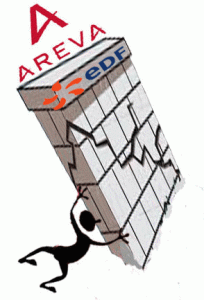 French taxpayers face huge nuclear bill as EDF financial crisis deepens, Ecologist, Paul Brown 8th December 2016
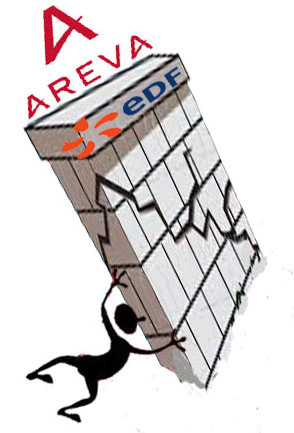
Nuclear giant EDF could be heading towards bankruptcy, writes Paul Brown, as it faces a perfect storm of under-estimated costs for decommissioning, waste disposal and Hinkley C. Meanwhile income from power sales is lagging behind costs, and 17 of its reactors are off-line for safety tests. Yet French and UK governments are turning a blind eye to the looming financial crisis.
The liabilities of Électricité de France (EDF) – the biggest electricity supplier in Europe, with 39 million customers – are increasing so fast that they will soon exceed its assets, according a report by an independent equity research company,
Bankruptcy for EDF seems inevitable – and if such a vast empire in any other line of business seemed to be in such serious financial trouble, there would be near-panic in the workforce and in governments at the subsequent political fall-out.
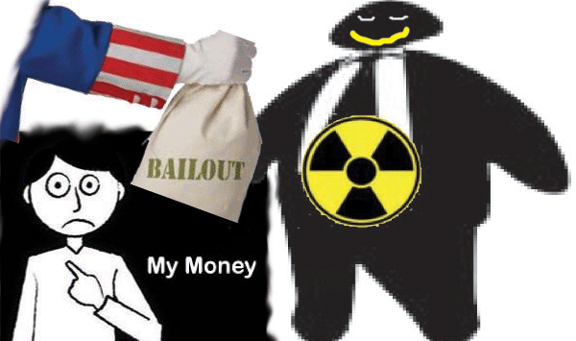
But it seems that the nuclear-dominated EDF group is considered too big to be allowed to fail. So, to keep the lights on in western Europe, the company will have to be bailed out by the taxpayers of France and the UK.
The French government, facing elections next spring, and the British, struggling with the implications of the Brexit vote to leave the European Union, are currently turning a blind eye to the report by AlphaValue that EDF has badly under-reported its potential liabilities.
Ageing nuclear reactors
While EDF is threatening to sue people who say it is technically bankrupt, the evidence is that the cost of producing electricity from its ageing nuclear reactors is greater than the market price.
Coupled with the impossibility of EDF paying the full decommissioning costs of its reactors, it is inevitable that it is the taxpayers in France and the UK who will eventually pick up the bill. However this will not be easy due to the EU’s ‘state aid’ rules, which limit governments’ ability to support ailing companies.
There is also the ongoing thorny problem of disposing of the nuclear waste and spent fuel rods, which are building up in cooling ponds and stores on both sides of the Channel, with no disposal route yet in sight.
A looming problem for EDF, which already admits is has €37 billion of debt, is that 17 of its ageing fleet of nuclear reactors, which provide 70% of France’s electricity, are being retired.
According to AlphaValue, EDF has underestimated the liabilities for decommissioning these reactors by €20 billion. Another €33.5 billion should be added to cost of handling nuclear waste, the report says. Juan Camilo Rodriguez, an equity analyst who is the author of the report, says that a correct adjustment of nuclear provisions would lead to the technical bankruptcy of the company.
In a statement, EDF said it “strongly contests the alleged accounting and financial analyses by the firm AlphaValue carried out at the request of Greenpeace and relating to the situation of EDF”.
It says that its accounts are audited and certified by its statutory auditors, and that the dismantling costs of EDF’s existing nuclear power fleet have also been subject to an audit mandated by the French Ministry of the Environment, Energy and the Sea.
Even with its huge debts, EDF’s problems could be surmounted if the company was making big profits on its electricity sales, but the cost of producing power from its nuclear fleet is frequently greater than the wholesale price.
That creates a second problem – that unless the wholesale price of electricity rises and stays high, the company will make a loss on every kilowatt of electricity it sells. The new rightwing French presidential candidate, François Fillon, promises not to retire French reactors and to keep them going for 60 years. But this cannot be done without more cost.
This is the third problem: vast sums of capital are needed to refurbish EDF’s old nuclear fleet for safety reasons following the 2011 Fukushima nuclear disaster in Japan. …….
Repeated life extensions
Since the sale of UK nuclear plants to EDF in 2008 at a cost £12.5 billion, the company has continued to operate them, and has repeatedly got life extensions to keep them running.
But this cannot go on forever, and they are expected to start closing in the next ten years. Once this happens, the asset value of each station would become a liability, and EDF’s mountain of debt would get bigger.
So far, the French and UK governments, and the company itself, seem to be in denial about this situation. Currently 17 French reactors are shut down for safety checks, following the discovery of faulty safety-critical compenents including large, difficult to replace steel forgings like steam generators.
The company has issued reassuring statements that they will be back to full power after Christmas, however in so doing EDF is assuming that the safety checks will give the reactors a clean bill of health. In fact, there are three other possible outcomes:
- additional potentially time-consuming tests are needed that will create further months of downtime.
- remedial engineering works are required to make the reactors safe. These would probably be costly and time-consuming.
- key components at the heart of the reactors, for example steam generators, need to be replaced altogether. However this would be so costly that, for a nuclear plant already reaching the end of its lifetime, premature closure would be the only viable option.
Perhaps the most likely outcome is that some of the 17 reactors will fall into each of these four categories, creating as yet unquantifiable unbudgeted costs for the company.
Meanwhile, to make up the shortfall from the closed reactors, electricity is being bought from neighbouring countries, including the UK, to keep the lights on in France. The power shortage is temporarily causing an increase in wholesale prices – but one that EDF is unable to fully exploit because so many of its reactors are not generating.
The future remains unpredictable – but as long as there are no actual power cuts, no action is expected from governments. Despite official denials, however, the calculations of many outside the industry suggest that it is only a matter of time before disaster strikes.
The cost of producing electricity from renewables is still falling, while nuclear gets ever more expensive, and massive liabilities loom. Ultimately, the bill will have to be passed on to the taxpayers. http://www.theecologist.org/News/news_analysis/2988433/french_taxpayers_face_huge_nuclear_bill_as_edf_financial_crisis_deepens.html
December 10, 2016
Posted by Christina Macpherson |
business and costs, France, politics |
Leave a comment
 Trump Team’s Asking for Ways to Keep Nuclear Power Alive
 by Mark Chediak and Catherine Traywick, Bloomberg, December 9, 2016
-
Nuclear facing increasing competition from gas, renewables
-
Trump team asked Energy Department for ways to help nuclear
-
President-elect Donald Trump’s advisers are looking at ways in which the U.S. government could help nuclear power generators being forced out of the electricity market by cheaper natural gas and renewable resources.
In a document obtained by Bloomberg, Trump’s transition team asked the Energy Department how it can help keep nuclear reactors “operating as part of the nation’s infrastructure” and what it could do to prevent the shutdown of plants. Advisers also asked the agency whether there were any statutory restrictions in resuming work on Yucca Mountain, a proposed federal depository for nuclear waste in Nevada that was abandoned by the Obama administration.
- The list of questions to the Energy Department offers one of the clearest indications yet of Trump’s potential plans for aiding America’s battered nuclear power generators. Five of the country’s nuclear plants have closed in the past five years, based on Energy Department data, and more are set to shut as cheaper supplies from gas-fired plants, wind and solar squeeze their profits.
Media representatives for the Trump transition and Energy Department didn’t immediately respond to calls and e-mails seeking comment. For more on the questions Trump’s team sent the Energy Department, click here.…….https://www.bloomberg.com/news/articles/2016-12-09/trump-s-team-is-asking-for-ways-u-s-can-keep-nuclear-alive
December 10, 2016
Posted by Christina Macpherson |
politics, USA |
1 Comment
Bulgaria’s NEK settles arbitration damages for shelved Belene nuclear plant http://sofiaglobe.com/2016/12/09/bulgarias-nek-settles-arbitration-damages-for-shelved-belene-nuclear-plant/ Bulgaria’s state-owned electric utility NEK has paid 601.6 million euro in damages to Atomstroyexport, the foreign contracts subsidiary of Russia’s state nuclear corporation Rosatom, Energy Minister Temenouzhka Petkova said on December 9 during question time in Parliament.
The money was transferred into Atomstroyexport’s accounts on December 8, Petkova said.
In a statement, Atomstroyexport confirmed receipt of the funds and was satisfied with the fact that NEK disbursed its commitments in full under the terms of an agreement signed in October, which saw the Russian company drop the daily penalty interest as long as NEK paid the principal owed by December 15.
The accumulated amount of daily penalties would have reached 23.8 million euro by that date. NEK’s agreement with Atomstroyexport also saw the Russian company accept a 20.9 million euro deduction in the original amount of damages ordered by arbitration, following several objections raised by the Bulgarian side to the calculation methodology.
Atomstroyexport was picked to build two 1000MW nuclear reactors at Belene on the Danube River, a project that was shut down by Bulgaria in 2012. The Russian contractor filed for arbitration, asking for 1.2 billion euro in damages for equipment ordered for the nuclear power plant, which NEK never paid for, and won the court action in June, although it was awarded just over half of the amount it claimed.
NEK decided not to appeal the ruling in September after Parliament passed a bill on September 28 that authorised a cash injection from the state Budget to NEK to pay the damages awarded by the tribunal.
The delay in the disbursement was due to the fact that Bulgaria was waiting for the European Commission to rule on whether such a transfer was allowed under the EU’s state aid rules. The Commission gave its approval earlier this week, according to reports in Bulgarian media.
NEK will now take ownership of the equipment manufactured by Atomstroyexport, but uncertainty remains about what the company will do next. Bulgarian officials travelled to Iran earlier this year to discuss a possible sale of the equipment, but there has been no development in the months since then.
Speaking to reporters in Parliament on December 9, Petkova said the Belene assets – the site itself and the equipment from Atomstroyexport – could be spun off into a separate company that would be put up for privatisation.
“If there is [investor] interest, then the [Belene nuclear power plant] project could be carried out on a market basis. If there is no investor interest, we will go in another direction and seek other options,” she said, as quoted by Bulgarian National Radio.
December 10, 2016
Posted by Christina Macpherson |
Bulgaria, business and costs, politics |
Leave a comment
 French taxpayers face huge nuclear bill as EDF financial crisis deepens, Ecologist, Paul Brown 8th December 2016 “………New nuclear stations Even more money is required to finish new nuclear stations EDF is already committed to building. The first, Flamanville in northern France, is five years late and billions over budget. Questions over the quality of the steel in its reactor are still not resolved, and it may never be fully operational.
Add to that the need for €12 billion (or potentially considerably more) capital to complete the two nuclear stations EDF is committed to building at Hinkley Point in southwest England, and it is hard to see where all the money will come from.
To help the cash-strapped company, its ultimate owner, the French state, has already provided €3 billion in extra capital this year, and decided to forego its shareholder dividend. But that is a drop in the ocean.
Mycle Schneider, a Paris-based independent international consultant on energy and nuclear policy, says: “The French company overvalues its nuclear assets, and underestimates how much it will cost to decommission them.
“However, EDF’s biggest problem is the cost of producing power from these ageing power stations. The cost is greater than the wholesale price, so everything they sell is at a loss. It is impossible to see how they can ever make a profit.”
He says that is not the company’s only problem: France has not dealt with the problem of nuclear waste, and has badly underestimated the cost of doing so: “With German electricity prices going down and production increasing in order to export cheap electricity to France, it is impossible to see how EDF can ever compete. It is really staggering that no one is paying any attention to this.”
Even former EDF director Gérard Magnin agrees. He resigned from the board in July as he thought the Hinkley Point project too risky for the company because of its already stretched finances. Now he says that, with the reactors closed for safety checks, the French nuclear industry faces “its worst situation ever”.
The company’s troubles do not stop in France, as EDF also owns the UK nuclear industry. Ironically, it took over 15 reactors in the UK after British Energy went bankrupt in 2002 because the cost of producing the electricity was greater than the wholesale price – exactly the situation being repeated now in France.http://www.theecologist.org/News/news_analysis/2988433/french_taxpayers_face_huge_nuclear_bill_as_edf_financial_crisis_deepens.html
December 9, 2016
Posted by Christina Macpherson |
business and costs, France, politics |
Leave a comment
Plan to go to market for nuclear proposals not open for review http://www.iol.co.za/news/politics/plan-to-go-to-market-for-nuclear-proposals-not-open-for-review-7140535 9 December 2016, Emsie Ferreira Cabinet will not revisit its decision to endorse plans to proceed with a request for proposals to build new nuclear reactors, Presidency Minister Jeff Radebe said on Friday.
Reporting on the fortnightly Cabinet meeting, Radebe told reporters that the issue had not been discussed by Cabinet as it had been decided and ministers had approved the draft Infrastructure Resource Plan for publication.
“On nuclear options, we did not discuss those issues as there are Cabinet decisions on them which we gave on the ninth of December [2015], so there is nothing new on them except that in the last Cabinet we released for public discussion the Integrated Energy Plan, as well as the resource plan,” Radebe said.
He was referring to a decision taken a year ago to proceed to the market with a call for proposals to increase nuclear energy generation.
Initial public submissions on the IRP this week saw experts, including members of Energy Minister Tina Joemat-Pettersson advisory team, challenge the blueprint’s assumptions on the need for South Africa to procure more nuclear energy.
They told public hearings that should artificial constraints on increasing the amount of renewable energy in the power mix be removed, nuclear no longer made sense in a planning model.
The contested base case scenario in the IRP provides for a first new nuclear reactor coming on line in 2037, followed by more that would add a total of 20 gigawatt to the power grid by 2050.
Eskom, which Cabinet recently designated as implementing agency instead of the energy department, plans to proceed with a request for proposals this year still despite the longer timelines for nuclear commissioning introduced in the IR.Matshela Koko, Eskom’s new acting CEO, also said the country could need nuclear much earlier than the scenario set out in the document, putting him at odds with Joemat-Pettersson.
Pressed on this, Radebe said he did not expect Cabinet to discuss their divergence or any aspect of the nuclear drive before a final IRP is brought before it next year.
December 9, 2016
Posted by Christina Macpherson |
politics, South Africa |
Leave a comment
 Does Donald Trump Believe Nuclear War Is Inevitable? The man about to take control of US nukes has a very fatalistic view, Mother Jones, DAVID CORN DEC. 8, 2016 n just seven weeks, a man known for being ill-tempered, thin-skinned, narcissistic, and erratic will take control of the US nuclear arsenal. Donald Trump will have the authority and power to launch any combination of the country’s 4,500 nuclear weapons. At any time and for any reason he deems fit, Trump could destroy a nation and, through miscalculation, the world.
During the presidential campaign, he uttered several troubling statements about nuclear arms. At a Republican primary debate, he botched a question about the nuclear triad—America’s system of sea-, air-, and land-based nuclear weapons—suggesting he did not understand the most basic information about the structure of the US nuclear command. (He babbled, “For me, nuclear is just the power, the devastation is very important to me.”) At other points in the campaign, Trump noted he would support allowing Japan, South Korea, and Saudi Arabia to obtain nuclear weapons and indicated he would be open to using such weapons against ISIS and in other conflicts.
What makes Trump’s loose talk—and ignorance—about nuclear weapons particularly worrisome is that in the past, he has taken a fatalistic approach toward the notion of nuclear war. He has spoken as if he believed such a conflagration was almost inevitable. And now he is about to become one of the few humans on the planet who can decide the fate of the Earth……. http://www.motherjones.com/politics/2016/12/donald-trump-nuclear-war-weapons-inevitable
December 9, 2016
Posted by Christina Macpherson |
politics, USA, weapons and war |
Leave a comment
 Outa says there is no case for nuclear http://www.iol.co.za/business/news/outa-says-there-is-no-case-for-nuclear-7126828 BUSINESS NEWS / 8 December 2016, Emsie Ferreira Cape Town – Civic rights organisation Outa on Thursday said it believed the case for building new nuclear energy reactors had been dismantled after the energy minister’s advisors told public hearings there were cheaper viable options.
“Following input provided by numerous entities at Wednesday’s Integrated Energy and Resource Plan (IEP and IRP) draft documents, Outa believes the rationale for any plans to introduce nuclear energy into South Africa’s electricity grid has been removed,” Outa’s portfolio director Ted Blom said.
He said the first day of hearings on the draft resource and energy blueprints had shown that they contained serious flaws in their assumptions of the prices of different energy technologies and that there was a need to for the IRP base case scenario to use the cheapest options. The base case scenario advanced in the IRP provides for South Africa to add 20 gigawatt of new nuclear energy by 2050 and Eskom has said it would it go to the market with a request for proposals by the end of the year still.
A team of experts that advised Energy Minister Tina Joemat-Pettersson challenged this conclusion and said their input was ignored. Business Day reported that members of the panel of 40 experts told the hearings that the department’s decision to impose artificial constraints on how much renewable energy could be added to the grid, as well as outdated pricing had allowed nuclear into the model. Outa chairman Wayne Duvenhage said the hearings had already yielded valuable input for the final IRP and he did no see how it could support the government and Eskom’s plans for nuclear expansion.
“Personally, I cannot see how the final IRP-2016 document will be able to suggest the inclusion of even one kilowatt of energy being generated through nuclear. If nuclear energy is indeed forced into the system, the DOE’s credibility will come under serious scrutiny.” Outa has called on the department to allow more time for public submissions.
“We remain concerned that the DOE is trying to force the process to be complete by the end of March 2017, which we believe will not be sufficient time,” Blom said.
December 9, 2016
Posted by Christina Macpherson |
civil liberties, politics, South Africa |
Leave a comment
All indications so far point to a bleak future for addressing climate change, or even recognizing it as one of the world’s largest challenges. A number of his cabinet nominees, political appointees and closest advisors are outright climate deniers while others have funded the denial of climate change or are lukewarm on accepting the science.
-
At best, climate action will likely take a backseat to other issues. At worst, there could be an all-out assault on the science, and as important, the funding that makes it possible.
To glean a clearer picture of where Trump’s administration stands and where it may be headed, we’ve created a list of his major cabinet and agency appointees as well as his senior advisors. We’ll continue to update this as appointments are made.
Steve Bannon, Senior Advisor
His views: Since 2012, Bannon has been in charge of Breitbart News, a site that espouses extremist right-wing views on a number of issues, including climate change. Under Bannon’s leadership, Breitbart News has repeatedly referred to climate change as a hoax and denigrated everyone from scientists (“dishonest” and mostly “abject liars”) to the Pope (“a 16-year old trotting out the formulaic bilge”) who has spoken out about the need to rein in carbon pollution.
-
According to James Delingpole, a writer for Breitbart, “one of his pet peeves is the great climate-change con . . . it’s going to be a core part of his administration’s political program.”
Bannon has also framed dealing with climate change and terrorism as an either/or choice (a similar theme has emerged with Trump’s national security picks as well. It’s also a false dichotomy).
What he could do: As senior advisor, Bannon will be in position to influence Trump’s thinking on a wide range of issues, including climate change.
Reince Priebus, Chief of Staff
His views: As chair of the Republican National Committee, Priebus oversaw the creation of the 2016 party platformthat called the widely respected Intergovernmental Panel on Climate Change “a political mechanism, not an unbiased scientific institution.”
During the primaries, Priebus criticized Democratic candidate Martin O’Malley for saying that “the cascading effects” of climate change contributed to the rise of ISIS despite the research directly linking the climate-change fueled Syrian drought to instability in the region.
More recently, Priebus reiterated that Trump “has his default position, which most of it is a bunch of bunk” when it comes to climate science.
What he could do: As chief of staff, Priebus will also have Trump’s ear and advise him on all fronts, including climate change. Traditionally, the chief of staff also acts as a gatekeeper to the president and works with Congress to communicate and enact the president’s agenda.
-
Senator Jeff Sessions, nominee for Attorney General
His views: Sessions (R-Ala.) has repeatedly questioned climate change and voted against climate action. In a 2003 floor speech in opposition to the McCain-Lieberman Climate Stewardship Act, Sessions said, “I believe there are legitimate disputes about the validity and extent of global warming . . . Carbon dioxide does not hurt you. We have to have it in the atmosphere. It is what plants breathe. In fact, the more carbon dioxide that exists, the faster plants grow.”
Sessions repeated an oft-debunked claim that there’s been “almost no increase” in temperatures over the past 19 years during a December 2015 episode of Washington Watch, a podcast put out by the conservative think tank Family Research Council.
-
Sessions also signed a letter to cut U.S. contributions to the United Nations Green Climate Fund, which is designed to help poor countries adapt to climate change. He is also on the Senate Committee on Environment and Public Works where Republicans have attacked the U.S. commitments to the Paris Agreement and the EPA’s implementation of the Clean Power Plan.
What he could do: As attorney general, Sessions would be advising Trump on the legality of various climate rules and treaties, including the Clean Power Plan and the Paris Agreement. Sessions would also be head of the Justice Department, which is currently defending the Clean Power Plan in court. As Attorney General, Sessions could tell federal government to stop arguing the case, though how that would work and what would come after is unclear according to Michael Burger, executive director of Columbia’s Sabin Center for Climate Change Law. Burger said there are a number of states, cities and environmental organizations that could continue the defense.
Rep. Mike Pompeo, nominee for Director of the CIA
His views: Pompeo (R-Kan.) has been an outspoken critic of factoring climate change into national security issues during his tenure in the House of Representatives. In a December 2015 statement, Pompeo said, “For President Obama to suggest that climate change is a bigger threat to the world than terrorism is ignorant, dangerous, and absolutely unbelievable.” The Pentagon doesn’t necessarily support that view nor the idea that climate and terrorism is an either/or issue (more on that below).
Pompeo has referred to the Paris Agreement — a pact forged between nearly 200 countries to voluntarily take steps to reduce their impacts on the climate beginning in 2020 — as a “radical climate change deal” and even used last year’s mass shooting in San Bernardino to claim that President Obama “continues his pursuit of misguided policies, including his radical climate change agenda.”
On C-SPAN in December 2013, Pompeo responded to a question on if he agrees that global warming is a problem by saying “Look, I think the science needs to continue to develop. I’m happy to continue to look at it. There are scientists who think lots of different things about climate change. There’s some who think we’re warming, there’s some who think we’re cooling, there’s some who think that the last 16 years have shown a pretty stable climate environment.”
That statement belies the fact that the world has warmed dramatically, with temperatures increasing about 1°C since the start of the Industrial Revolution. This year will be the hottest on record, marking the third year in a row that’s happened. The 2000s were the warmest decade on record and the 2010s are easily on the path to surpass that mark.
- What he could do: As the CIA’s director, Pompeo would be responsible for how the U.S. approaches national intelligence and security. The CIA shut down its climate program last year, but an agency spokesperson said “it continues to evaluate the national security implications of climate change.” Under Pompeo, it’s likely that resources focused on climate change would be further scaled back or scrapped altogether.
Gov. Nikki Haley, nominee for United Nations ambassador
Her views: South Carolina, where Haley is governor, is one of the states suing the EPA over the Clean Power Plan. She has criticized that plan, saying in a meeting with electric utilities that it “raises the cost of power. That’s what’s going to keep jobs away.”
During her tenure as governor, the state Department of Natural Resources came under fire for burying a report on the impacts of climate change throughout South Carolina for what appear to be political reasons.
What she could do: As the U.S. ambassador to the United Nations, Haley would set the tone for how the U.S. approaches international climate negotiations. Trump has threatened to “cancel” the Paris Agreement. While he can’t cancel it, he can pull the U.S. out of it and Haley would likely play a major role in doing that if Trump decides to move forward.
Lt. General Michael Flynn, National Security Advisor
His views: Similar to Pompeo, Flynn has railed against the idea that climate change should be a national security priority, a stance that would fly in the face of the Pentagon’s risk assessment and planning.
Dealing with climate change and terrorism is not a simple one-or-the-other decision. The two are linked, withnumerous studies showing climate change is tied to conflict and that climate change will only further destabilize the world. The Pentagon itself has described climate change as an “immediate” risk and major threat multiplier, one that could cause crops to fail, spark mass migrations and increase conflict for dwindling water resources (to say nothing of the threat sea level rise poses to U.S. naval bases around the world).
- What he could do: As national security advisor, Flynn will be Trump’s main sounding board and trusted source on security issues. If he downplays the threat of climate change, Flynn could create a huge blind spot for the administration’s security plans.
Betsy DeVos, nominee for Education Secretary
Her views: Of all Trump’s appointees so far, DeVos, an heiress to the Amway fortune and philanthropist, has the most moderate views on climate change (though she’ll likely have little influence in that realm as head of the Department of Education). WindQuest Group, the investment management firm she operates with her husband Dick DeVos, has overseen investments in clean technology.
But that moderation is somewhat tempered. DeVos has donated to the political campaigns of a number of Republican senators and representatives who deny climate change and have voted on an array of bills that would increase offshore oil drilling, end fuel efficiency standards and bar the EPA from regulating greenhouse gases. Of course, that’s a bit of guilt by association as over the past eight years Republicans have been steadfast in their opposition to Obama’s climate and energy policies and any donation to her party would have resulted in votes against meaningful climate action. But given Republicans will soon control the White House, Senate and House, the legislators she’s backed will likely play a role in further gridlocking climate action or actively dismantling it.
What she could do: As education secretary, DeVos would have little direct sway on climate policy as there are no national education standards. But Ann Reid, head of the National Center for Science Education, said DeVos’ interest in providing vouchers and school choice could have an indirect effect on climate education.
“It’s not at all clear these charter schools are held to the same standards as public schools with curricula,” Reid said. “Part of their point is to be creative and teach in new ways. That sounds grand but what if they don’t accept climate change? Are they going to be held to the standards of the state? That’s a big, big change.”
K.T. McFarland, Deputy National Security Advisor
Her views: Like Bannon, Pompeo and Flynn, McFarland views climate change and terrorism as mutually exclusive. McFarland worked in the Nixon, Ford and Reagan administrations on national security and is currently a commentator on Fox News. It’s in the latter position where she’s espoused views that terrorism is a greater threat than climate change. Speaking about President Obama attending the 2015 climate conference in Paris in the wake of the terrorist attacks that killed 130, she told Fox host Neil Cavuto:
-
“Well, because President Obama thinks that climate change is the greatest strategic and geological and existential threat to our future. You know, here we are — and the irony, if it were not so tragic it would be funny — here we have ISIS, which is attacking with suicide vests and Kalashnikovs and potentially chemical weapons in the French water supply. What are we doing? We’re going to fight ISIS. We’re going to have windmills. We’re going to have solar panels. We’re going to show them. It’s just really — all it does is it gives encouragement to the terrorists who feel that they have been selected and chosen by Allah to establish the caliphate and kill everybody who disagrees with them. They now look at this and they are laughing.
“This is a threat and an assault against all western civilization. We will not defeat it with windmills and solar panels.”
What she could do: As deputy national security advisor, McFarland will occupy a similar role to Flynn, and her views on climate change appear to line up with his.
Rep. Tom Price, nominee for Health and Human Services Secretary
His views: The voting pattern of Price (R-Ga.) in the House lines up with his fellow cabinet nominees Pompeo and Sessions. He has voted against having the EPA regulate greenhouse gases and voted no on subsidies for renewable energy as well voting to continue giving subsidies for oil and gas exploration.
Price also signed a pledge created by Americans for Prosperity, a conservative advocacy group funded by the Koch brothers, vowing to oppose climate legislation.
What he could do: As Health and Human Services Secretary, Price would have sway over a number of agencies and centers that do research on climate-related diseases and health issues, including the Centers for Disease Control and National Institutes of Health.
Elaine Chao, nominee for Transportation Secretary
Her views: In a 2009 blog post for the conservative think tank Heritage Foundation, where she was a fellow at the time, Chao derided a proposed cap-and-trade system as a policy that “would drain trillions of dollars out of the private economy and into federal coffers.” While the economics of any cap-and-trade system are worthy of debate, it’s clear something has to be done about climate change and Chao has shown no interest in any alternative. Letting global warming continue unabate could cause trillions in economic losses from drowned coastal cities to decreased agricultural productivity.
Chao was on the board of Bloomberg Philanthropies’ board until January 2015. She chose to step down after the foundation decided to ramp up its “Beyond Coal” campaign. The move came shortly after her husband, Senator Mitch McConnell’s (R-Ky.), won re-election during a campaign where he was attacked for accepting money from “enemies of coal,” a veiled reference to Chao’s board membership at Bloomberg.
-
What she could do: As Transportation Secretary, Chao would be tasked with overseeing a large chunk of Trump’s proposal to spend $1 trillion on infrastructure over the next 10 years. She would also be tasked with building out the electric vehicle charging corridors proposed by the Obama administration earlier this month, a project that is unlikely to fit with Trump’s plans that focus on the private sector.
Steven Mnuchin, nominee for Treasury Secretary
His views: It’s a mystery. Mnuchin has worked at Goldman Sachs, hedge funds and as a financier in Hollywood. Through all that, he’s said nary a word about climate change or energy-related issues.
His political donations also don’t say much about his views. He and his wife donated $5,400 to Trump, the maximum amount allowed under campaign finance law, and $309,600 to the Republican National Committee. That’s not surprising since he was Trump’s campaign finance chair. He also donated $2,000 to Kamala Harris, California’s new Senator who has been outspoken about the need to address climate change (in sharp contrast to Trump).
What he could do: As Treasury Secretary, Mnuchin would essentially help Trump set economic policies for the country. Climate change is expected to cost the U.S. — and the world — trillions if actions aren’t taken. Speaking at the Brookings Institute in 2014, current Treasury Secretary Jack Lew said, “if the fiscal burden from climate change continues to rise, it will create budgetary pressures that will force hard tradeoffs, larger deficits or higher taxes.”
The Treasury has also had to loan $24 billion to the National Flood Insurance Program to cover hurricane damages from Katrina, Rita, Wilma and Sandy, underscoring that planning for a fiscal response to near- and longer-term climate shocks will be a part Mnuchin’s job.
Wilbur Ross, nominee for Commerce Secretary
His views: Ross is a billionaire who made his fortune in buying distressed companies, cutting costs and selling them for a profit. In the past, he’s invested in coal companies and has recently moved into the oil and gas industry.
Beyond those investments, Ross hasn’t said anything about his interest or understanding of climate science.
What he could do: As Commerce Secretary, he would oversee the National Oceanic and Atmospheric Administration’s $189 million climate research budget. One of Trump’s advisors has suggested shifting some of NASA’s climate science responsibilities to NOAA, further expanding the amount of climate work Ross would be in charge of.
Gen. James Mattis, nominee for Defense Secretary
His views: Mattis served in a number of roles in the Marines prior to retiring in 2013. He hasn’t espoused anything publicly, but according to Stephen Cheney, a retired Marine brigadier general, Mattis “gets climate change.”
In 2003, Mattis led the 1st Marine Division during the Iraq invasion. Following the invasion, he told Navy researchersto “unleash us from the tether of fuel.” That indicates an understanding that renewable energy and alternative fuels have an important role to play in military preparedness and operations. The statement lines up with recent Department of Defense goals to reduce the use of petroleum products, increase renewable energy and cut non-combat greenhouse gases 34 percent by 2020.
What he could do: As Defense Secretary, Mattis would be in charge of implementing military strategy around the world (in comparison to Trump’s National Security Advisor, who can only offer advice). Under the Obama administration, climate change has been on the Department of Defense’s radar from how it affects national security to how military installations around the world should prepare for climate impacts, like sea level rise at naval bases, melting permafrost in the Arctic and more extreme rainfall events around the world.
Editor’s note: This story has been updated to correctly note that Kamala Harris is California’s newest Senator, not governor.
December 9, 2016
Posted by Christina Macpherson |
politics, USA |
Leave a comment
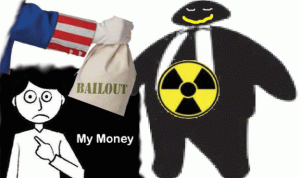 Critics blast Cuomo’s $7.6B subsidy for nuclear plants, WBFO.org, By KAREN DEWITT, 8 Dec 16, A long-term energy plan by the Cuomo administration that includes a nearly $8 billion subsidy to two upstate nuclear power plants is being challenged from both ends of the political spectrum, and a lawsuit has been filed to try to stop the deal.
Gov. Andrew Cuomo’s Public Service Commission plans to convert 50 percent of the state’s power sources to renewable energy over the next decade and a half. A controversial part of that program includes a $7.6 billion state-financed subsidy to a company that now runs two New York nuclear power plants – Nine Mile Point in Oswego and Ginna near Rochester – and is taking over a third plant, FitzPatrick, also in Oswego.
That has angered environmental groups, who filed a lawsuit, saying the PSC “acted improperly when it mandated a massive subsidy to prop up New York’s aging, failing nuclear power plants as part of the State’s Clean Energy Standard.”
Other progressive-leaning groups, including the New York Public Interest Research Group, also object to the deal.
“In some ways, it’s a straight-up ratepayer issue,” said Blair Horner, NYPIRG’s legislative director.
He said the deal will result in $2.3 billion in increased payments for residential utility customers, and even more for businesses. That’s in a state that already has among the highest utility rates in the nation.
“Roughly 800,000 New Yorkers are already having a hard time paying their existing electric bills,” Horner said. “This isn’t going to make it any better.”
Not only left-leaning groups oppose the deal. Fossil fuel companies like Shell and BP have objected, filing complaints with the PSC. Oil and gas companies would have to essentially help subsidize the deal through the price of zero emission tax credits bought and sold in New York…..http://news.wbfo.org/post/critics-blast-cuomos-76b-subsidy-nuclear-plants
December 9, 2016
Posted by Christina Macpherson |
politics, USA |
Leave a comment
Nuclear Deal(s): What Zambia can learn from South Africa, Daily Maverick, 08 DEC 2016 Zambia has just signed four memoranda of understanding with Rosatom, Russia’s state-run nuclear agency, with a view to signing a nuclear deal worth $10-billion. While government has hailed the deal as a way to solve Zambia’s ongoing energy crisis, Zambians should be asking difficult questions – especially given Rosatom’s track record in South Africa. By SIMON ALLISON.
When Zambian President Edgar Lungu addressed Parliament in September, he announced a bold new energy strategy: Zambia is going nuclear…….
Three months later, we now have a better idea of what he was talking about. In a ceremony in Lusaka’s plush Pamodzi Hotel on Tuesday, Zambian government representatives signed a series of Memoranda of Understanding with Rosatom, the Russian state-owned nuclear agency.
The deal, which is not legally binding, sets out a 15-year nuclear co-operation plan, with the eventual goal of constructing a nuclear gigawatt nuclear power plant. In addition, Rosatom will help train Zambian nuclear engineers, develop a nuclear energy regulator, and spearhead nuclear research in the country. Local media estimate the total value of the deal to be $10-billion (that’s nearly half of Zambia’s GDP)……
There’s no doubt that Zambia needs an energy plan……..
But is nuclear really the solution? As Zambia prepares to go down the nuclear road, they could learn a few lessons from down south. Although South Africa has successfully operated a nuclear power station at Koeberg for several decades, a government initiative to build two new nuclear power stations has been mired in controversy, with Rosatom playing a central role in the drama. Based on the South African experience, here are three questions that Zambians should be asking.
1. Does Zambia need nuclear power? There’s no question that Zambia needs power…….. But nuclear power might not be the best solution. It’s not just the inherent dangers associated with nuclear power, although that is a factor; but also the nature of the energy generated. Nuclear power stations produce a steady “base line” supply of energy, which may not be appropriate for Zambia’s needs. Nuclear power can’t be turned on and off in response to supply and demand……
Critics of South Africa’s proposed nuclear deal have highlighted similar issues, as well as pointing out that South Africa – and, by extension, Zambia – might be better placed to take advantage of the decreasing cost of renewable energy.
“The promotion of nuclear energy at the expense of renewables bucks global trends. An industrial nation like Germany is phasing out nuclear power, and has a much higher renewable energy investment than sunny, windy South Africa. Chinese renewables expansion currently exceeds nuclear development by far,” said Hartmut Winkler, physics professor at the University of Johannesburg, writing in the Mail & Guardian.
 2. Can Zambia afford nuclear power?
Nuclear power is expensive. Very expensive. It’s not just the cost of the construction of the nuclear plant itself, although those numbers are eye-watering (especially in an economy as small as Zambia’s, where GDP in 2015 was $21.2-billion). It is also the cost of financing that construction.
With most banks unwilling to take such a massive gamble, financing usually comes from the vendor itself. In South Africa’s case, Rosatom is supposed to fund the construction of the two new nuclear plants, and recoup its costs by selling the electricity generated at an artificially high price. According to the text of a secret agreement uncovered by investigative journalist Lionel Faull, Rosatom will be able to dictate that price at will – leaving South African energy users at the mercy of a foreign corporation.
 3. Will the nuclear deal be corrupt?
Suspicion of corruption immediately attaches itself to any massive infrastructure project, and with good reason – especially in the case of nuclear deals. South Africa appears to be a textbook example of how the massive sums of money at stake can lead both government and corporations astray.
For example, French nuclear company Areva was accused by Sherpa, an anti-corruption NGO, of attempting to bribe high-ranking South African officials by purchasing unprofitable uranium mining assets for an inflated sum, just months before the tender for the nuclear project was announced. Rosatom itself, meanwhile, has been linked with a suspicious lack of transparency, fuelling fears that not all is above board. As Professor Winkler wrote in a separate piece for The Conversation:
“The nuclear debate gained a political dimension when President Jacob Zuma and his Russian counterpart, Vladimir Putin, started to develop an unusually close relationship… The lack of transparency surrounding the process, coupled with a history of corruption in South African mega-projects like the arms deal, has made the whole scheme seem suspicious to the broader public,” he said……. https://www.dailymaverick.co.za/article/2016-12-08-nuclear-deals-what-zambia-can-learn-from-south-africa/#.WEoQptJ97Gg
December 9, 2016
Posted by Christina Macpherson |
AFRICA, politics |
Leave a comment
 E.ON sees limited scope for nuclear claims after ruling -Bernstein, Reuters, Dec 8 E.ON sees limited scope for compensation claims following a court ruling related to Germany’s nuclear exit that paves the way for utilities to try to reclaim money, its chief executive told brokerage Bernstein in an interview.
Germany’s highest court on Tuesday ruled that hastening the shutdown of nuclear plants after Japan’s Fukushima disaster violated some of the property rights of utility companies, allowing them to seek limited damages.
It said that utilities could claim back stranded investments made between December 2010 and March 2011 when the government decided to extend the life of nuclear plants. In 2011, the government’s position changed and it decided to shut down all stations by 2022.
E.ON said earlier this week it had invested several hundred million euros in 2010 in the expectation that the government’s nuclear policy would remain unchanged.
“Of this, a low triple digit million amount was likely incurred in the four month period between December 2010 and March 2011, which should be eligible for compensation,” Bernstein quoted CEO Johannes Teyssen as saying.
Germany’s environment minister Barbara Hendricks said this week the court ruling meant demands by utilities for billions of euros in compensation was off the table……http://www.reuters.com/article/germany-nuclear-e-on-idUSL5N1E31FC
December 9, 2016
Posted by Christina Macpherson |
business and costs, Germany, Legal, politics |
Leave a comment
How far will Trump go to gut U.S. climate policies? http://www.eenews.net/stories/1060046632 Evan Lehmann, E&E News reporter ClimateWire: Monday, December 5, 2016 President-elect Donald Trump would have to undertake a herculean political effort to reverse his administration’s responsibility to reduce greenhouse gases, and he might not be able to count on Republicans in Congress for help.
In promising to rescind the Clean Power Plan, Trump is clipping a regulation off at the stem, but the roots would survive to pester his administration with the threat of lawsuits and the likelihood of future rules governing the release of carbon dioxide at U.S. firms, according to experts.
When the Supreme Court ruled in 2007 that greenhouse gases are an “air pollutant,” it set in motion a series of actions that could now require Trump to convince the courts that global warming is not adversely affecting humans and the Earth — after the same court, the U.S. Court of Appeals for the District of Columbia Circuit, came to the opposite conclusion in 2012.
That effort would occur if Trump’s U.S. EPA tried to reverse the so-called endangerment finding of 2009, a tick-tock in the bureaucratic record that gave rise to a cascade of regulations on greenhouse gases over cars, power plants, natural gas wells and more in the future. The finding is EPA’s trigger to regulate. Continue reading →
December 7, 2016
Posted by Christina Macpherson |
climate change, politics, USA |
Leave a comment
 No one can stop President Trump from using nuclear weapons Chicago Tribune, Alex WellersteinSpecial to The Washington Post, 1 Dec 16,
Sometime in the next few weeks,
Donald Trump will be briefed on the procedures for how to activate the U.S. nuclear arsenal, if he hasn’t already learned about them.
All year, the prospect of giving the real estate and reality TV mogul the power to launch attacks that would kill millions of people was one of the main reasons his opponents argued against electing him. “A man you can bait with a tweet is not a man we can trust with nuclear weapons,” Hillary Clinton said in her speech accepting the Democratic presidential nomination. Republicans who didn’t support Trump — and even some who did, such as Florida Sen. Marco Rubio — also said they didn’t think Trump could be trusted with the launch codes.
Now they’re his. When Trump takes office in January, he will have sole authority over more than 7,000 warheads. There is no failsafe. The whole point of U.S. nuclear weapons control is to make sure that the president — and only the president — can use them whenever he decides to do so. The only sure way to keep President Trump from launching a nuclear attack, under the system we’ve had in place since the early Cold War, would have been to elect someone else.
When the legal framework for nuclear weapons was developed, the fear was about not irrational presidents but trigger-happy generals. The Atomic Energy Act of 1946, passed with President Harry Truman’s signature after nine months of acrimonious congressional hearings, firmly put the power of the atomic bomb in the hands of the president and the civilian components of the executive branch. It was a momentous and controversial law, crafted in the months following the atomic bombings of Hiroshima and Nagasaki, with an eye toward future standoffs with the Soviet Union…….
Eventually, the brass adopted the idea that, when it came to nuclear matters, they were at the president’s beck and call. It was not generals’ responsibility to make the order; it was their responsibility to carry it out.
That the president would be the only person competent to use nuclear weapons was never challenged. Even asking the question would throw the entire system into disarray, as Maj. Harold Hering learned in 1973. Hering was a 21-year Air Force veteran who was decorated for his flying in Vietnam before being sent for training as a nuclear missile squadron commander. He had been taught that officers had an obligation to disobey illegal orders. So when he was told how to launch a nuclear attack, he asked what seemed like a simple question: How could he be sure that an order to launch his missiles was lawful? How could he be sure, for example, that the president wasn’t insane? Instead of an answer, he got the boot: an aborted promotion and an administrative discharge for “failure to demonstrate acceptable qualities of leadership” and for indicating “a defective mental attitude towards his duties.”
The Air Force’s problem, in short, is that once a serviceman starts down the rabbit hole of doubt, he becomes an unreliable second-guesser — and suddenly he is one of the few people who can decide whether nuclear weapons are used.
The procedure for ordering a nuclear attack involves more than one person: The president cannot literally press a button on his desk and start World War III. There is no “nuclear button” at all. Instead, the U.S. nuclear command-and-control system is bureaucratically and technically complex, stretching out to encompass land-based missile silos, submarine-based ballistic and cruise missiles, and weapons capable of being dropped from bombers. The chain of command requires that the president order the secretary of defense to carry out a launch; the secretary serves as the conduit for implementation by the military. There are succession policies in place so that the procedure can be continued in the event of the death or incapacitation of either the president or the secretary of defense — or their designated successors.
Most details of how a nuclear war would be started are classified, because an enemy who knew enough about the system could come up with ways to complicate or defeat it. What is known is that an aide is always following the president, carrying at least one large satchel (often two) known as the “nuclear football,” reportedly containing information about nuclear attack possibilities and how the president could verify his identity, authenticate orders and communicate with the military about implementing them……..
It might be worth resurrecting this debate , if we take seriously the idea that presidents — any of them, much less Trump — should not have the legal authority to conduct arbitrary and unilateral nuclear war. Perhaps now, decades after the end of the Cold War, we are past the moment when we need to entrust that power in a single person. One can imagine a law that would allow the president to use nuclear weapons in the face of imminent danger, the sort of situation in which a matter of minutes or even seconds could make a difference, but would enact formal requirements for outside consensus when more options were on the table. It would not require a full renunciation of the possibility of a first-strike nuclear attack (something the United States has never been willing to make) but might add some reassurances that such decisions would not be made unilaterally.
Congress ceded a considerable amount of power to the presidency in 1946. Seventy years later, maybe it is time lawmakers took some of it back. http://www.chicagotribune.com/news/opinion/commentary/ct-trump-use-nuclear-weapons-20161201-story.html
December 2, 2016
Posted by Christina Macpherson |
politics, USA, weapons and war |
1 Comment
 New trouble for Exelon nuke bailout as Rauner balks, Chicago Business, By STEVE DANIELS , 1 Dec 16, The calendar has turned to December, and a sudden wind has chilled the prospects for Exelon’s nuclear bailout.
The deal Exelon announced yesterday with Gov. Bruce Rauner appears to be teetering today. Rauner’s staff has found problems it didn’t anticipate now that the bill language purporting to carry out the governor’s agreement with the Chicago-based energy company is out.
Among the issues “not agreed to” are “loose cap language” that doesn’t appear to protect business ratepayers the way Rauner envisioned when Exelon announced that businesses would pay no more than 1.3 percent more than the rates they pay today to finance an annual $200 million-plus subsidy to keep open two money-losing nuclear plants Exelon has moved to close, according to a source close to the negotiations.
Rauner also discovered a provision on prevailing wages that he accused archrival House Speaker Michael Madigan of inserting into the bill, this source said.
Madigan’s spokesman, Steve Brown, said the prevailing wage language has been in the legislation for months. “Once again, they’re grasping at straws and they’re not quite getting the grip,” he said.
Rauner’s camp is characterizing the provisions as “poison pills.” But the source said the governor still is committed to the “framework” he negotiated with Exelon.
How this will impact floor votes scheduled for today on what was before now a rapidly moving compromise is unclear.
Crain’s will update with further developments.
The CEO of Illinois’ second largest power generator is fuming over Rauner’s 11th-hour agreement to support Exelon’s nuclear-plant bailout—calling it a “regressive tax on rural America.” ……..http://www.chicagobusiness.com/article/20161201/NEWS11/161209995/exelon-nuclear-bailout-hits-a-snag-as-illinois-gov-bruce-rauner-balks
Illinois Lawmakers and Attorney General Wary Of Nuclear Deal http://northernpublicradio.org/post/illinois-lawmakers-and-attorney-general-wary-nuclear-deal
By BRIAN MACKEY Exelon says it finally has a deal to subsidize nuclear power plants in Clinton and the Quad Cities.
On Wednesday afternoon, after weeks of intense negotiating, ComEd and Exelon put out a news release saying they had a deal thanks to Gov. Bruce Rauner. But the administration didn’t publicly support the bill at a House hearing. And it hasn’t responded to repeated media inquiries about the governor’s stance.
That has some state lawmakers on edge. Linda Chapa LaVia is a Democrat from Aurora and heads the House Energy Committee.
“It has happened in the past where we get to a point where it gets to the governor’s desk, and then we take a wrong direction,” she says. Consumer groups also have reservations about the measure. Susan Satter is with the Illinois Attorney General’s office. Her boss opposed previous versions of the Exelon deal, and Satter says she isn’t ready to weigh in on the latest proposal.
“This is a wildly complicated effort, and we just simply have not had the time to understand how it’s going to work,” Satter said.
Over the decade the plan would be in effect, ComEd says its average residential customers would pay no more than 25 cents a month related to the subsidy.
December 1 is the final day the General Assembly meets this year. Exelon also claims it’s the last chance to keep the Clinton and Quad Cites plants open.
December 2, 2016
Posted by Christina Macpherson |
politics, USA |
Leave a comment