Another month in UK’s failing new nuclear programme nuClear News No.94 April 2017 The ongoing collapse of the Moorside nuclear project has hit the headlines. But the French nuclear industry continues to be mired in scandal as EDF starts pouring nuclear safety critical concrete at Hinkley. And now we learn that the chief executive of Wylfa Newydd developer Horizon Nuclear Power says he needs to raise cash or the Anglesey project will not go-ahead.
Moorside Collapse On 29th March 2017, Westinghouse Electric Company, a subsidiary of Japanese company Toshiba and the largest historic builder of nuclear power plants in the world, filed for Chapter 11 bankruptcy protection in the U.S. Bankruptcy Court in New York. (1)

Toshiba owns 60% of the NuGen consortium which is planning to build 3 AP1000 reactors at Moorside next to Sellafield in Cumbria. Senior figures in the UK nuclear industry told the Financial Times that Westinghouse’s bankruptcy has crystallised doubts about the project. There is now considerable doubt about whether NuGen will be able to find a new source of funding. (2)
As we reported last month the owner of 40% of the NuGen Moorside consortium, French company Engie (33% owned by the French Government) declared last December that it would like to abandon the project. (3) Now the Company has exercised its right under the NuGen consortium agreement to sell all of its shares to Toshiba in the “event of a default”. Toshiba’s decision to place Westinghouse – into bankruptcy protection qualifies as such an event. Toshiba said it would pay around $138.7m for Engie’s stake. Under its agreement with the French utility, it is required to pay at least the amount that Engie invested to acquire the stake. (4)…….
Engie is the seventh international energy utility to give up on UK new nuclear build. Over the past decade, on top of Toshiba, E-on (Wylfa), RWE Npower (Wylfa), Iberdrola (Moorside), SSE (Moorside), and Centrica (Hinkley Point) have all pulled out of developing new nuclear reactors in the UK. (6)
This leaves a very limited field of companies for the UK to approach in its hunt for a new partner for the Moorside scheme. South Korea’s KEPCO remains the most likely suitor, but Reuters reports that the giant utility won’t be rushed. It is one of few utilities remaining with global nuclear ambitions, but despite the fact that the AP1000 reactor has now received approval from the Office for Nuclear Regulation and the Environment Agency, may still want to use its own technology – the APR1400. This would delay the development by a further four to five years No2NuclearPower nuClear news No.94, April 2017 3 whilst the South Korean reactor is put through its Generic Design Assessment by UK Regulators. Greg Clark, the Business Secretary, was in Seoul for talks at the beginning of April, but offered no evidence of concrete progress in the negotiations. (7)
KEPCO would also want to know more about the causes of the problems with two new nuclear projects in the US, involving AP1000 reactor designs which brought Westinghouse to its knees. Were the problems specific to the AP1000 reactor or a classic big project issue of not having done your homework before you start digging? (8)…….
KEPCO is unlikely to be tempted into taking over the troubled Moorside nuclear project without some sort of public financing, says former energy minister and chairman of New Nuclear Watch Europe, Tim Yeo. He says they will also be hesitant to step in and save the development unless it can use its own reactor technology. “I’ve been arguing for some time that we should look at providing during the construction phase some government finance.” Yeo said this would have to be on the basis of repayments beginning as soon as the plant is generating. (10) http://www.no2nuclearpower.org.uk/nuclearnews/NuClearNewsNo94.pdf
April 8, 2017
Posted by Christina Macpherson |
business and costs, politics, politics international, UK |
Leave a comment
 Another month in UK’s failing new nuclear programme nuClear News No.94 April 2017 Who will put up the cash for Wylfa? Hitachi Ltd, the owner of Horizon nuclear, which is proposing to build two Advanced Boiling Water Reactors (ABWRs) with a total capacity of 2.7MW at Wylfa on Anglesey, is set to lose tens of billions of yen this financial year after withdrawing from a uranium enrichment joint venture in the US.
Hitachi is expected to report a 70 billion yen ($620 million) non-operating loss by the time books were closed at the end of March. The deficit is largely attributed to the joint venture GE Hitachi Nuclear Energy Inc. withdrawing from the uranium enrichment project. Hitachi no longer expects any profits from the North Carolina-based company, of which it owns 40% and the rest by General Electric. Hitachi and GE were expecting more nuclear power plants to be built when they launched the joint fuel enrichment business, but orders have been sluggish across the globe, forcing the project to be shelved. Nevertheless, Hitachi says it will be sticking with its nuclear power business and plans to proceed with its project to build Wylfa by ensuring costs are thoroughly managed. (22)
The chief executive of Horizon Nuclear, Duncan Hawthorne, says funding is the key issue to ensure the nuclear plant gets built. Wylfa Newydd would be the “showcase plant” for Horizon and Hitachi and important for the UK and Japanese Governments, which means there is huge resolve to get the project done successfully. But without the private investment and Government support the £14bn project would not happen. He said the deal that was struck for Hinkley Point would not work for Wylfa Newydd due to the fact they are private investors. Hinkley is supported by state backed Chinese and French enterprises. Hitachi are funding the project to the ‘Final Investment Decision’, with around £2.5bn of cash. He said he was very aware of the need to keep the Anglesey community behind the project, showing them what benefits the scheme could bring: “Without community support we can’t do anything.” (23)
Meanwhile Horizon has taken another major step towards delivering The Wylfa Newydd power station with the submission of its application for a nuclear site licence. A site licence is one of the main permissions Horizon will need as it looks to build and operate two ABWRs on Anglesey. Receipt of the application by the Office for Nuclear Regulation (ONR) now triggers a rigorous 19-month programme of assessment and intervention to establish whether Horizon can demonstrate it will be in control of all safety related activities on its site. (24) http://www.no2nuclearpower.org.uk/nuclearnews/NuClearNewsNo94.pdf
April 8, 2017
Posted by Christina Macpherson |
business and costs, politics, UK |
Leave a comment
 FirstEnergy Corp. gets introduction of the nuclear bailout bill it sought, Crains Cleveland Business,
 By
DAN SHINGLER, 7 APR 17,
FirstEnergy Corp. got the legislation it apparently sought introduced to the Ohio Senate in the form of
Senate Bill 128.
And the company probably got the reaction it expected from various consumer and industrial groups — mostly a chorus of boos.
The bill, which has been introduced by Republican Sens. John Eklund of Geauga County and Frank LaRose of Hudson, would give so-called zero emissions credits to FirstEnergy’s nuclear plants near Perry and Toledo.
If the plants are sold, however, the legislation would reduce the credits through a formula based on the sales price and the revenues it generates for FirstEnergy, unless the company sold the plants out of bankruptcy.
Of course, those credits won’t be spun from straw. They will result in an extra charge on the bills of FirstEnergy’s electricity customers. It would reportedly give the plants an extra $300 million per year in revenue — mostly to help them compete with wind- and natural gas-generated electricity — and cost consumers an extra 5% on their electric bills, or about $57 per year per household.
What’s at stake, the company insists, is nothing less than the future of Ohio’s Perry Nuclear Power Plant and Davis-Besse Nuclear Power Station, if not the future of Akron-based FirstEnergy itself. The plants are having difficulty competing with low-cost natural gas and subsidized wind energy that can encroach on nuclear’s turf.
Not surprising, the legislation was applauded by FirstEnergy, which has been lobbying for its introduction in Columbus for months……..Likewise, the International Brotherhood of Electrical Workers, with members working at FirstEnergy’s nuclear plants, supported the legislation………
But from others, the response was negative.
“Senate Bill 128 is nothing more than another attempt by utilities to force customers to pay above-market prices for electricity … FirstEnergy should not be allowed to prop up its business on the backs of Ohio consumers. While manufacturers support nuclear power as part of an all-of-the-above energy portfolio, Senate Bill 128 is a wolf in sheep’s clothing. We will actively work to oppose this misguided bill,” wrote the Ohio Manufacturers’ Association on Thursday, April 6.
Then came angry retirees.
“Deregulation of the market in Ohio is working,” said AARP state director Barbara Sykes. “Ohioans have the ability to buy power from whoever they want, forcing competitive pricing. This legislation unfairly props up businesses, such as FirstEnergy, who have failed to remain competitive by passing the costs of doing business on to consumers. We are firmly opposed to this for all Ohioans, but especially for those age 50-plus who are living on fixed incomes.”
And, finally, the Ohio Consumers’ Counsel in Columbus — which pegged the cost of the proposed bill at $57 per year for 2 million FirstEnergy customers — gave one of the sternest rebukes.
“What needs to stop is the electric utilities’ dependence, since 2000, on government subsidies — $14.7 billion to date — that have been charged to Ohio families and businesses,” wrote OCC public affairs coordinator Molly McGuire. “Under the legislature’s 1999 vision for benefits from power plant deregulation, Ohioans should not pay more than the market price of electricity on their electric bills.”
Such reactions might be an indication of how steep a climb FirstEnergy has ahead of it if it’s to get the legislation passed. So far, the legislation has no sponsor in the House, where some observers predict it will face obstacles, including from free-market Republicans.http://www.crainscleveland.com/article/20170407/NEWS/170409853/firstenergy-corp-gets-the-nuclear-bailout-bill-it-sought
April 8, 2017
Posted by Christina Macpherson |
politics, USA |
Leave a comment
 Another month in UK’s failing new nuclear programme nuClear News No.94 April 2017 EDF Finances A French Parliamentary report from the National Assembly’s Commission for Sustainable Development and Regional Development says the clean-up of French reactors will take longer, be more challenging and cost much more than French nuclear operator EDF anticipates. Whereas Germany has set aside €38 billion to decommission 17 nuclear reactors, and the UK Nuclear Decommissioning Authority estimates that clean-up of UK’s 17 nuclear sites will cost between €109‒250 billion over the next 120 years, France has set aside only €23 billion to decommissioning its 58 reactors. In other words France estimates it will cost €300 million per gigawatt (GW) of generating capacity to decommission a nuclear reactor, Germany estimates €1.4 billion per GW and the UK estimates €2.7 billion per GW.
EDF says it wants to set aside a €23 billion fund to cover decommissioning and waste storage for an estimated €54 billion final bill ‒ and the difference between these two figures will be closed through the appreciating value of its equities, bonds and investments ‒ in other words, ‘discounting’. Unfortunately, recent experience has taught us that markets can go up and down over time ‒ especially the very long-time periods involved in radioactive waste management. But for a company that has huge borrowings and an enormous debt of €37 billion, €23 billion is a large sum of money to find. Any significant change in the cost of decommissioning would have an immediate and disastrous impact on EDFs credit rating ‒ something that the debt-ridden corporation can simply not afford. EDF is already in financial trouble. Along with bailing out collapsing AREVA, EDF also has to bear the huge financial burden of the failing reactor newbuild at Flamanville. It will also have to pay for extending the life of France’s existing nuclear power stations (to 2025), at a cost of €55 billion.
On top of all this the French authority tasked with disposal of all the countries vast and increasing waste burden (Andra) has recently ramped up the estimated cost for the planned national nuclear waste repository at Cigéo, to €25 billion ‒ and EDF must pay for most of Cigéo’s construction. Although €5 billion more than EDF anticipated, it still seems a gross underestimation, and the costs are likely to rise considerably. (21) http://www.no2nuclearpower.org.uk/nuclearnews/NuClearNewsNo94.pdf
April 8, 2017
Posted by Christina Macpherson |
business and costs, decommission reactor, France, politics |
Leave a comment
With Westinghouse Bankruptcy, the Nuclear Energy Story Nearly Over The much touted nuclear renaissance is now over. News Click Prabir Purkayastha 07 Apr 2017 With Westinghouse announcing its bankruptcy, India’s pledge to buy at least 10,000 MW as a part of the India US Nuclear Deal and reiterated by Modi last year, should be given a decent burial. Any agreement with Westinghouse now means that India would be bailing out Westinghouse and the US nuclear industry with Indian peoples’ money.
This also draws to a close all talk about a nuclear renaissance. The three major reactor manufacturers – Toshiba-Westinghouse, GE-Hitachi and Areva, France – are all in major financial difficulties. Only a fool will still believe their promise that the 3rd generation reactors they are developing – none of which have been successfully commissioned as yet – are either safe or cheap.
The Left’s position during the India US 123 Deal was that it neither served India’s strategic interest, nor made sense in energy terms. It also meant abandoning India’s self-reliant nuclear reactor industry for importing costly and unproven US reactors. Though it failed to stop the 123 Agreement in Parliament, the Left successfully led the struggle to modify India’s Nuclear Liability Act, ensuring that nuclear suppliers, like in any other hazardous industry, should be liable for their faulty equipment.
The Fukushima disaster has shown that a nuclear accident can cost up to $200 billion . Even this could be a conservative estimate. The Indian liability law caps operator and suppliers’ liability to just $ 407 million (300 million SDR’s). Though cost of a reactor is in billions of dollars, even this small liability, only a fraction of its cost, was perceived to be too “dangerous” and unacceptable to the US suppliers.
Last year, Modi, announced during one of his US visits that not only would India buy US reactors, a continuation of the assurance given by Shivshankar Menon, the Foreign Secretary under Manmohan Singh (Letter September 10th, 2008 ), but would also assume the liabilities of the US suppliers in case of of a nuclear accident. India offered Mithi Virdi in Gujarat to Westinghouse and Kovvada in Andhra to GE as the two sites. Subsequently on GE’s failure to show any successful contract combined with local resistance in Mithi Virdi, GE’s project was considered cancelled, and its Andhra site offered to Westinghouse.
Fortunately for India, Modi’s assurances have come too late for the US nuclear industry. The much touted nuclear renaissance is now over. In OECD countries, only 7 new reactors are being built with varying degrees of state support. With huge cost and time overruns, the curse of the nuclear industry, all of them are in deep trouble. GE, unsuccessful in selling even one of its so-called advanced design, has virtually pulled out of the nuclear business. After huge and continuing losses, Areva, the French reactor supplier, is being taken over by EdF, the French state-owned energy utility. EdF has already scrapped the new Areva EPR design, with which the Finnish Olkiluoto and French Flamanville plants were being built. This is also the design Areva is trying to sell for the Jaitapur project in Maharashtra.
The major objections of the Left regarding imported reactors have been proven correct. The untried and untested designs have meant numerous changes and difficulties in construction, leading to significant delays and sharp increase in costs. The cost of the two Areva plants of Euro 3 billion each originally, have increased by almost three times .
The Westinghouse story is no different………
In the exchanges between the UPA and the Left during Manmohan Singh’s government, the cost of new nuclear plants from French or US suppliers had come up. The UPA had presented figures for capital cost per KW of $1,500 and the price of power to be Rs. 1.49 paise per unit from imported nuclear plants. The Left had given figures from Olkiluoto and the US, showing that the capital cost would be at least $4,000 per KW and the price of electricity from such plants around Rs. 5 per unit.
The figures from the US and French projects now show that the capital cost per KW for such plants is in the range of $6,000-7,000, and therefore the price per unit of electricity from such plants will not be less than Rs. 8-10 per unit.
Why did the UPA claim such absurdly low figures for nuclear energy? They were either figments of their imagination or took these figures straight from the promotional material of the nuclear suppliers. To claim nuclear energy to be competitive, the nuclear suppliers took a 60-year life of the plant, left out the interest on capital during construction as a component of the cost, and claimed their new designs had much lower capital costs. They then did what are called levellised cost calculations – the cost of electricity over the lifetime of the plant. By this sleight of hand, they reached figures for the cost of nuclear power to be competitive with coal and gas.
Of course, the actual capital costs are much higher than what the nuclear industry was claiming. The regulators and utilities that price the electricity, have also to look at all the cost components including cost of capital, interest on loans, etc., and fix the price that of electricity. What matters to consumers and utilities (distribution companies or state electricity boards) is not the levellised cost of electricity, but the entry cost of nuclear power to the grid. This is what needs to be competitive to other sources. Any such calculations shows that nuclear energy is simply not competitive.
The collapse of Westinghouse, which has either built or licensed its designs to almost half the world’s reactors, shows that the nuclear story is nearly over. The reality is that with the cost of renewables – solar photovoltaics and wind – dropping sharply, the economics are increasingly against nuclear energy. This is apart from danger of catastrophic accidents or danger from long-term storage of radioactive nuclear wastes. It may still sustain itself for some time in countries, where there is a strong indigenous nuclear industry, such as India, China, Korea and Russia. But its days are now clearly numbered. http://www.newsclick.in/westinghouse-bankruptcy-nuclear-energy-story-nearly-over
April 8, 2017
Posted by Christina Macpherson |
business and costs, India, politics, politics international, USA |
Leave a comment
What specifically makes this new plan different from the operations of administrations past is the new autonomy it gives the military from civilian control, not only in terms of congressional oversight but also in terms of presidential direction.
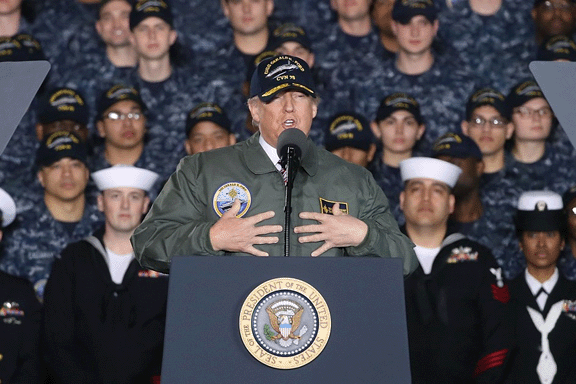
Trump’s dangerous expansion of executive war powers For decades, Congress has relinquished its constitutional role in declaring war. But Trump is taking it to new extremes. Politico, By BONNIE KRISTIAN 04/03/17 With Washington distracted by the health care debate, President Donald Trump has quietly overseen an expansion in the administration’s war-making powers, giving the Department of Defense greater autonomy to conduct military operations independent of the White House.
Already, the Pentagon has used this expanded authority in Yemen, where the U.S. has recently conducted significant air operations against AQAP, an Al Qaeda offshoot. And on Friday, Trump extended the authority to parts of Somalia where the U.S. is targeting Shabab, a terrorist group. In military terms, Yemen and Somalia are now “areas of active hostility,” a bureaucratic way of saying that the U.S. is conducting military operations there, with little input or oversight from either the White House or Congress.
This expanded bombing campaign, though, could be just the tip of the iceberg. In early March, The Guardian reported that the White House is considering a secret Pentagon proposal to designate temporary areas of active hostility in which the military could launch what amounts to six-month wars without congressional approval. Under the proposal, once the president signs off on a temporary battlefield, commanders would be given “the same latitude to launch strikes, raids and campaigns” as they now have in active U.S. warzones like Iraq. Protections for civilians would also be scaled back.
These temporary battlefields, as The Guardian dubbed them, are not exactly new; the Obama administration already applied the label to conflicts in Afghanistan, Iraq, and Syria. But the proposal Trump is considering would expand and formalize that decision, stretching the temporary battlefield designation to cover entire countries in which the United States is technically not at war. Despite the bureaucratic language, Trump’s plan, if implemented, is a flagrant perversion of the Constitution, redoubling the worst excesses of the Obama administration and further undercutting the rule of law.
To understand the recklessness of this proposal, a little history is in order. Though it names the president as “Commander in Chief” of the U.S. military, the Constitution explicitly delegates the power to “declare war” to Congress. The choice of the word “declare” was a careful one, as James Madison’s notes from the Constitutional Convention reveal. Originally written as the power to “make war,” it was amended to communicate that while the executive is permitted “the power to repel sudden attacks” on American soil, it is not allowed to “commence war” independent of the legislature.
George Mason, the “father of the Bill of Rights,” was against “giving the power of war to the Executive, because [it was not] safely to be trusted with it,” Madison records, and Mason supported using “declare” as a means of “clogging rather than facilitating war [and instead] facilitating peace.”…….
With this “temporary battlefields” idea, the White House once again strips Congress of what was left of its responsibility for our military, taking unilateral control of foreign policy for the foreseeable future.
What specifically makes this new plan different from the operations of administrations past is the new autonomy it gives the military from civilian control, not only in terms of congressional oversight but also in terms of presidential direction. In Obama’s scheme, which was already far afield from the constitutional war powers framework, the president and his top national security advisers remained intimately involved in the approval process for U.S. strikes outside of active war zones in Afghanistan, Iraq, and Syria. With the new plan, military commanders would be able to make these decisions independently during 180-day periods. This puts major foreign policy decisions one step further away from congressional influence and civilian control………
this proposal is regression, not reform. It demolishes the last remnants of one our Founders’ most necessary constitutional protections, and it opens the gate to a host of dangerous, imprudent military interventions with no demonstrable connection to U.S. national security interests.
After the last 15-plus years of imprudent executive war-making, what we need is not less oversight of our foreign policy, but more—more open debate about our goals and strategy, more realistic risk analysis, and more careful determination of what political outcomes we can achieve through military force.
Bonnie Kristian is a fellow at Defense Priorities. She is a weekend editor at The Week and a columnist at Rare, and her writing has also appeared at Time Magazine, CNN, Politico, Relevant Magazine, The Hill, and The American Conservative, among other outlets. http://www.politico.com/agenda/story/2017/04/trumps-dangerous-expansion-of-executive-war-powers-000387
April 7, 2017
Posted by Christina Macpherson |
politics, USA, weapons and war |
Leave a comment

 GOP climate resolution deserves wider support APRIL 5, 2017 PHILLY.COM by John C. Dernbach
It has already been a tough year for those who want bipartisan leadership on climate change.
President Trump’s recent executive order is intended to unwind much of the Obama administration’s work on climate change. Trump wants to cut funding by a third for the Environmental Protection Agency (EPA), which has a major role in reducing greenhouse gas emissions, and he appointed Scott Pruitt, who has openly questioned the reality of climate change, to lead EPA.
But even in the face of hostility for climate action from the Republican leadership in Washington, there are signs of positive change within the party.
Seventeen Republican lawmakers – including Pennsylvania Congressmen Ryan Costello, Brian Fitzpatrick, and Patrick Meehan – just introduced the Republican Climate Resolution. It states that it is “a conservative principle to protect, conserve, and be good stewards of our environment.” It also calls for Congress to commit to economically viable solutions to climate change………
This House resolution on climate change is the latest sign that more Republicans are changing their tune on this and other environmental protection issues. Earlier this year, nine Republicans broke with their party on a vote to repeal an Obama-era rule to protect waterways from coal mining runoff. And 11 Republicans voted against a repeal of a rule to reduce greenhouse gas emissions from the oil and gas industry.
It is little wonder that Republicans are increasingly willing to buck special interests on the issue. Lawmakers are seeing more and more climate change-related impacts in their home districts. The economic opportunities provided by climate action are enormous. And their constituents are calling for solutions.
That is certainly the case in Pennsylvania……….
It was a Republican state senator from Delaware County, Ted Erickson, who sponsored the Climate Change Act of 2008, which calls for state impact assessments and a climate change action plan. A Republican chief justice of the state Supreme Court, Ronald Castille, wrote the 2013 opinion upholding the Environmental Rights Amendment of the Pennsylvania Constitution.
The House resolution does not make specific policy recommendations for preventing future climate disruptions. And more signers are needed before the caucus will have the votes necessary to command the respect it needs. But this is real progress.
Costello, Fitzpatrick, and Meehan recognize that everyone has much to gain if we act on climate change, regardless of political affiliation. Let’s hope they convince more of their GOP colleagues to join them. And those of us who live in other districts represented by Republicans can do our part by asking them to join this resolution.
John C. Dernbach is the commonwealth professor of environmental law and sustainability and the director of the Environmental Law and Sustainability Center at Widener University Commonwealth Law School. jcdernbach@widener.edu http://www.philly.com/philly/opinion/commentary/20170405_Commentary__GOP_climate_resolution_deserves_wider_support.html
April 7, 2017
Posted by Christina Macpherson |
climate change, politics, USA |
1 Comment
Britain’s secret Brexit nuke http://www.newindianexpress.com/opinions/2017/apr/06/britains-secret-brexit-nuke-1590353–1.html By Tom Arms 6th April 2017
May’s attempt to link trade and security sets a dangerous precedent for the world. Will she now offer N-protection to Saudi Arabia?
British Prime Minister Theresa May has linked Britain’s nuclear deterrent to Brexit negotiations. And in doing so she has pointed the way for India and other nuclear weapons states to use their irradiated umbrellas to secure their own lucrative trade deals.
Until now it has been accepted that nuclear weapons are the ultimate deterrent, and are to be used only in that capacity. Linking them to trade, as May has done, has added a new and dangerous level to the nuclear playing field.
The link came in the British prime minister’s letter to the European Commission triggering Article 50 of the Lisbon Treaty and the start of Brexit negotiations. In just one letter, she explicitly linked economic concessions with security issues nine times.
Alright, the n-word has yet to be dropped on a public stage, but it is being talked about behind closed Whitehall doors. The whispers have been loud enough for me to hear them and to contact the UK’s Department for Brexit negotiations. I pointedly asked them, “Is the government considering offering a nuclear deterrent—probably incollaboration with the French—to EU countries in return for trade concessions?” The reply was neither a confirmation nor a denial but an email pointing me to the links in May’s Brexit letter and a speech in which the British PM said, “The third … reason I believe we can come to the right agreement is that cooperation between Britain and the EU is needed not just when it comes to trade but when it comes to our security too.”
“Britain and France are Europe’s only two nuclear powers. … Britain’s armed forces are a crucial part of Europe’s collective defence.”
“… After Brexit, Britain wants to be a good friend and neighbour in every way, and that includes defending the safety and security of all of our citizens.”
Quick phone calls to embassies and European ministries of foreign affairs elicited a wall of no comments, until I came to the Poles where a spokesperson said, “Yes that’s right.”
But if the negotiating ploy is successful in Europe, what is to stop the British from offering the same protection to other regions of the world? Does Britain strike a deal with Saudi Arabia and the Gulf states to protect them from Iran? The British have just reopened a permanent naval base in Bahrain. How about East Africa? The Americans lease Diego Garcia but the British still own it. London has great relations with Singapore, an excellent base for an Asian presence.
And what about other nuclear weapon states? What is to stop India, Pakistan, France, Russia, China, and the US from using their nukes to extract trade concessions. It will cost more but the trade deals, or should I say protection money—should more than cover the costs, with a profit—adding a new and dangerous element to the problem of nuclear non-proliferation.
A stronger nuclear Britain willing to flex its muscles fits in nicely with the Trump view of the world. During his campaign, The Donald shocked analysts by floating the cost-cutting proposal that America supply nukes to Japan and Saudi Arabia. And although the US is making more positive noises about the NATO, the initial talk of obsolescence has left Europeans deeply worried.
Beefing up the British nuclear deterrent and tying it closer to Europe would save America money. However, it would also put several more links in the defensive chain that ties the US to the protection of Europe.
Trump may favour such a change, but it is not in the interests of either side of the Atlantic. Two World Wars have proven that. In both, the US adopted a hands-off role at the start. However, the fact is their interests were so intertwined with the European democracies that Washington was eventually forced to intervene to protect its national interests.
It is the growing American isolationism that makes it possible for May to test thendangerous nuclear waters. The EU is worried about losing its American nuclear umbrella. The UK is worried about losing their European market. Britain has nuclear weapons. The EU has markets. There is a clear fit.
Dr Ian Lesser, vice president at the German Marshall Fund, said it is “not incredible” that Britain is considering using its nuclear deterrent as part of the Brexit negotiations. He added, “But it would certainly be controversial.”
Trump’s foreign policy has prompted widespread calls for greater European defence cooperation, including—at the suggestion of the Polish Prime Minister Jaroslaw Kaczynski—a German-funded European nuclear deterrent. This was firmly and immediately rejected by Chancellor Angela Merkel.
April 7, 2017
Posted by Christina Macpherson |
politics, UK |
Leave a comment

 ZUMA’S CABINET RESHUFFLE OPENS DOOR FOR SA NUCLEAR DEAL, EyeWitness News, 1 April 17 Hartmut Winkler is professor of physics, University of Johannesburg.This article first appeared on The Conversation.
South Africa has just witnessed a game-changing Cabinet reshuffle with the firing of five ministers and several deputy ministers. This included the Finance Minister Pravin Gordhan and his second-in-charge Mcebisi Jonas.
The three ministries with the most critical impact on the energy sector have all been affected, significantly increasing the chances of the country opting for a highly controversial nuclear energy programme. Continue reading →
April 3, 2017
Posted by Christina Macpherson |
politics, South Africa |
Leave a comment

 Treasury shoots down nuclear deal allegations http://www.news24.com/SouthAfrica/News/treasury-shoots-down-nuclear-deal-allegations-20170402 Jenna Etheridge, News24 Cape Town – National Treasury on Sunday set the record straight on news that was circulating on social media of a nuclear deal allegedly signed by incoming Finance Minister Malusi Gigaba.
ANC member Sibusisiwe Mngadi had alleged on Facebook earlier on Sunday that “the nuclear deal deadline was last night” and that Gigaba had signed it.
She also alleged that President Jacob Zuma’s nephew Khulubuse Zuma would benefit from nuclear plants being built.
“Khulubuse Zuma is the SA holding company for the Nuclear plants. The next 20yrs Khulubuse Zuma will be making more than 50billion. Congratulations, mission accomplished,” she alleged on the post.
Mngadi listed her occupations as a researcher and part-time lecturer at University of KZN in Pietermaritzburg, and an area manager at Msunduzi Municipality.
Some of her followers asked her for proof to support her claims. She replied that people should do their own digging, alluding only to a “parliament document that was signed yesterday”.
Former ANC MP Vytjie Mentor also entered the fray on her personal Facebook profile page, seeming to support the allegations.
“Gigaba signed the Nuclear Deal Last night. It will be R6 trillion with over-runs. All South Africans are now Officially slaves of the Russians, and thus will be the case for the next 100 years,” Mentor alleged.
National Treasury issued a series of tweets on the matter on Sunday night. “The Minister arrived (on) Friday and has not yet gone beyond boardrooms where he met management and later had a telecon with rating agencies,” the treasury account stated.
“He is formally occupying his office tomorrow and will have a briefing meeting with the outgoing Minister Pravin Gordhan in the morning. There are no documents of deals ready for signature on nuclear. Therefore the reports are misleading and mischievous.”
Gigaba’s spokesperson Mayihlome Tshwete also took to Twitter to say he had signed “not a single thing”, not even to sign off for the printing of his business cards. He said Gigaba had not even received any documents from the Director-General.“Sadly, we must now release a statement to deny fake news, then the story will be about the denial,” he lamented.
In government’s updated Integrated Resource Plan (IRP) 2016, which is still under discussion, it intends to add 20 385MW units of nuclear power to the national grid, Fin24 reported.
This will make up approximately one-third of South Africa’s total generation mix.
On December 20, 2016, Eskom, which has taken over from the Department of Energy as owner and operator of the proposed nuclear build programme, issued a Request for Information (RFI) for the procurement of nuclear energy. Comment is currently open for the Request for Proposal (RFP) until April 28.
The RFP is expected to be issued to the market place by the middle of the year and in 2018 Eskom and the Nuclear Energy Corporation SA (Necsa) will choose their preferred bidders and negotiate and finalise contracts.
April 3, 2017
Posted by Christina Macpherson |
politics, politics international, South Africa |
Leave a comment
 Gordhan said to have spooked Russian connection on nuclear deal http://www.iol.co.za/news/politics/gordhan-said-to-have-spooked-russian-connection-on-nuclear-deal-8459357
2 April 2017 Staff Reporter Johannesburg – Former finance minister Pravin Gordhan said the masses should be worried when top ANC officials admitted that they didn’t know where a decision was made.
Professor Njabulo Ndebele said the country was in a “deep political and moral crisis” characterised by power and greed.
Zuma’s spokesperson Dr Bongani Ngqulunga said the president was not involved “in the planning of the memorial service and in the cancellation thereof. Any impression created that the president cancelled or ordered the cancellation is erroneous and unfortunate.”
Meanwhile, while Gordhan was doing the presentations in London there was a gentleman called Chenkov who kept on asking many questions about South Africa. He wanted to know if the South African government was looking at developing nuclear energy. Gordhan quickly quashed the idea of nuclear and repeatedly confirmed that the South African government would never develop this energy.
Chenkov had no further questions. After the presentation Chenkov called someone and spoke in Russian but whoever he was speaking to was not impressed and angrily dropped the phone.
It is believed that this person immediately called President Jacob Zuma and threatened him that if he did not immediately trigger the process of changing the finance minister and sign the nuclear deal, as commission had already been paid, he would be taught a lesson.
A shaken Zuma immediately called the minister back home. “You obviously know what happened!”
April 3, 2017
Posted by Christina Macpherson |
politics, politics international, Russia, secrets,lies and civil liberties, South Africa |
Leave a comment
Congress should be a voice of caution and restraint. Any marginal benefit of this legislation is outweighed by the risk of giving an impulsive president license to take steps that could undermine a deal that is working, isolate the United States, and put U.S. troops at risk.
Dear Senators: Push Back Against Iran, but Not at the Expense of the
Nuclear Deal, Foreign Policy, BY ANTONY J. BLINKEN, AVRIL HAINES, COLIN  KAHL, JEFF PRESCOTT, JON FINER, PHILIP GORDON, ROBERT MALLEY MARCH 31, 2017 – During our time in government, there were few issues on which it was easier to build a bipartisan consensus in Congress than the need to contend with the range of threats posed by Iran. Congress played a critical role in penalizing Iran for supporting terrorism, providing support to U.S. partners in the region threatened by Iran, and establishing the sanctions regime that, combined with tough diplomacy, led to a deal that prevents Iran from developing or acquiring nuclear weapons. Momentum is again building in Congress to impose additional sanctions on Iran, including with the introduction last week of the Iran’s Destabilizing Activities Act of 2017 by Sen. Bob Corker, the chairman of the Senate Foreign Relations Committee, and Sen. Robert Menendez. The bill has already garnered more than two-dozen cosponsors. Unfortunately, as currently drafted, this bill would do more harm than good.
Thanks in large part to Congress’s support — including some difficult votes — the United States and our partners were able to address the most immediate and consequential threat posed by Iran. Under the Joint Comprehensive Plan of Action (JCPOA), Iran has dismantled much of its nuclear infrastructure: removing two-thirds of the centrifuges it had installed (well over 10,000 centrifuges), shipping out 98 percent of its stockpile of enriched uranium, decommissioning a reactor capable of producing plutonium for a bomb, and putting all of its nuclear facilities under strict international monitoring.
Iran has committed in writing that, pursuant to the Nuclear Non-Proliferation Treaty, it will never seek a nuclear weapon and has put all key elements of its program under close surveillance. Most important of all: The deal is working.
By all accounts — including those of International Atomic Energy Agency, inspectors we have trained, and our own intelligence community — Iran is complying with its commitments. In other words, we were able to eliminate a potential threat to our allies and our nation without firing a shot — and the only price we paid was a relaxation of those international sanctions whose very purpose was to enable us to address the nuclear threat at the negotiating table. Non-nuclear sanctions, on matters like ballistic missiles, terrorism, and human rights violations, remain in place. And Iran essentially paid for the nuclear deal with its own money, which the international community had frozen in banks around the world, to increase pressure on Iranian leaders to make a deal. In short,
President Donald Trump has inherited an Iran policy that leaves us significantly safer than when his predecessor took office. This context is important in evaluating the potential upsides — and downsides — of new legislation to impose additional sanctions on Iran.
Many senators will be tempted to support the Corker-Menendez legislation, which at first glance seems to accomplish a rare feat in Washington these days: bringing together bipartisan support to address a known national-security threat. We share concerns about threats from Iran to the United States and our allies, including the challenges posed by Iran’s ballistic missile program and support for terrorism. But when it comes to an arrangement as complex as the JCPOA, the details matter, and this legislation, in its current form, includes several significant risks that could undermine the nuclear deal.
First, the bill adds new conditions that must be met before Washington can lift sanctions on certain Iranian parties in the future, including sanctions we are already committed to remove if Tehran continues to comply with the nuclear deal……..
Second, the legislation would, most likely, lead the president to designate Iran’s Revolutionary Guards (IRGC) as a terrorist group. …….
Third, by mandating sanctions on any person or entity that “poses a risk of materially contributing” to Iran’s ballistic missile program, the bill introduces a standard that is overly broad and vague. Such a loose definition could potentially be used to impose sanctions in violation of the JCPOA — particularly when in the hands of an administration that is overtly hostile to the deal.
………Congress should not take any steps that our international partners might view as violating a deal that, so far, has fulfilled its goals. Rather than containing Iran, such steps would isolate the United States.
……..Trump promised during his campaign that his “number one priority is to dismantle” the deal. On February 2, then-National Security Advisor Michael Flynn publicly, and vaguely, put Iran “on notice,” followed the next day by Trump declaring on Twitter that Iran was “playing with fire.” Trump’s team has not since publicly outlined any overall approach to Iran policy, engaged openly with Iranian diplomats, or publicly committed to working with our closest allies in keeping the nuclear deal intact. In this uncertain environment, Congress should be a voice of caution and restraint. Any marginal benefit of this legislation is outweighed by the risk of giving an impulsive president license to take steps that could undermine a deal that is working, isolate the United States, and put U.S. troops at risk. http://foreignpolicy.com/2017/03/31/dear-senators-push-back-against-iran-but-not-at-the-expense-of-the-nuclear-deal/
April 1, 2017
Posted by Christina Macpherson |
politics |
Leave a comment
If Congress sends Trump this legislation, our new president will be granted the tools and the greenlight from Congress to unravel the Iran deal and put us back on the path to a war with Iran. Unless Democratic senators stand up against this bill soon, opponents of the Iran nuclear deal may wipe away Obama’s diplomatic legacy with Iran faster than even they thought was possible.
Why Give Trump The Keys To War With Iran? https://www.niacouncil.org/give-trump-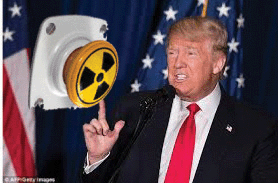
keys-war-iran/ When Trump won the elections, many worried that it could lead to war between the United States and Iran, due to his desire to kill the Iran nuclear deal. Now, thanks to the U.S. Senate, we may be one step closer to this nightmare scenario: The Senate is poised to pass legislation that will place President Trump’s trigger-happy finger on the ignition switch of a deadly conflict with Iran.
Introduced to coincide with the annual American Israel Public Affairs Council (AIPAC) conference that concludes today, the Countering Iran’s Destabilizing Activities Act of 2017 (S. 722) would give Trump new tools to violate the Iran nuclear deal. Perhaps most shockingly, a small group of Senate Democrats have joined Republicans to grant Trump some of the most dangerous authorities that would put the U.S. and Iran back on the path to war. The list of sponsors includes many of the usual suspects ― the consummate Iran hawks who worked to block Obama’s diplomacy with Iran and many of whom have sworn to “rip up” the nuclear deal: Robert Menendez (D-NJ), Bob Corker (R-TN), Marco Rubio (R-FL), Tom Cotton (R-AR), and Ted Cruz (R-TX). But the list of sponsors also includes Ben Cardin (D-MD) ― who opposed the nuclear deal but has said the U.S. should still abide by it ― as well as Bob Casey (D-PA), Richard Blumenthal (D-CT), Michael Bennet (D-CO), Chris Coons (D-DE), and Joe Donnelly (D-IN) who supported the deal.
Yet now these senators are signed onto legislation that requires non-nuclear certifications that would block the president from removing sanctions that are set to expire in later stages of the nuclear agreement. Why would Democratic senators who support the nuclear deal sign on to a measure that would violate the agreement? Because, they have argued, the bill gives the president a case-by-case waiver for the deal-killing provisions. That means that these senators are trusting Donald Trump with new deal-killing authorities and abdicating to him whether the U.S. honors the nuclear deal or “rips it to shreds.”
The bill also enables Trump to re-impose sanctions on Iranian entities that were de-listed pursuant to the accord. And it mandates sanctions that would broadly target any person or entity that ― knowingly or unknowingly ― contributes to Iran’s ballistic missile program, including universities that conduct research and banks that process payments for the government. This would amount to a trickle-down reimplementation of sanctions on much of Iran ― and a violation of the nuclear accord. Finally, the bill would designate the Islamic Revolutionary Guard Corps (IRGC), an elite branch of the Iranian military, as a terrorist group ― a major escalation. The IRGC is a highly problematic organization that has benefitted from years of a sanctions economy at the expense of Iran’s people. It is not unusual for individuals within the IRGC to be sanctioned if they are believed to have connections to Iran’s ballistic missile program. However, designating a foreign military branch as a terrorist organization is an extremely dangerous provocation that Pentagon leaders in multiple administrations have advised against. AIPAC has urged for the IRGC designation for the past decade, yet Barack Obama and even George W. Bush resisted. But now, with Donald Trump in the White House, AIPAC is pressing ahead with its proposal.
If this legislation is passed the U.S. can expect a negative response from Tehran that will undermine moderates in Iran’s upcoming May elections and empower anti-U.S. hardliners. The ranking member of Iran’s Parliament, Alaeddin Boroujerdi, has already signaled that Iranian lawmakers will consider designating the U.S. Army as a terrorist organization in retaliation. It is naïve to assume this exchange will be limited to words. U.S. special forces and IRGC units are currently fighting ISIS on the same front in Mosul. Despite some evidence that IRGC units targeted U.S. troops with IEDs during the height of the Iraq War, there have been no such incidents since U.S. soldiers reentered Iraq in the summer of 2014. In effect, the IRGC and the U.S.-backed coalition have agreed to stay out of each other’s way as they fight a mutual enemy in ISIS. This bill could change that reality by removing any incentive for Iran not to attack U.S. troops in Iraq, forbidding any cooperation with IRGC-backed militias against ISIS, and placing our Iraqi allies in a diplomatic catch-22. It is for this very reason that back in 2007, President Bush’s Pentagon opposed an SDGT designation for the IRGC.
With thousands of AIPAC supporters on Capitol Hill to lobby senators on behalf of the bill, there is a strong chance that this bill could obtain filibuster-proof levels of support. If every Republican supports the bill, and just one more Democrat signs on, AIPAC’s bill will hit 60 votes. If that happens, and Congress sends Trump this legislation, our new president will be granted the tools and the greenlight from Congress to unravel the Iran deal and put us back on the path to a war with Iran. Unless Democratic senators stand up against this bill soon, opponents of the Iran nuclear deal may wipe away Obama’s diplomatic legacy with Iran faster than even they thought was possible. This piece originally appeared in The Huffington Post.
April 1, 2017
Posted by Christina Macpherson |
Iran, politics, politics international, USA |
Leave a comment
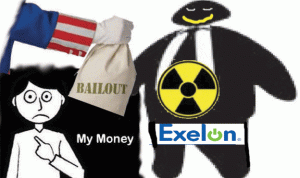 Groups Make Last Ditch Effort To Stop NY Nuclear Plant Bailout, WAMC 1 Apr 17 Midnight Friday is not just the deadline for the New York state budget to be finished. It’s also the date for an $8 billion state bailout of some upstate nuclear power plants to begin. More than 80 local government leaders are making a last ditch effort to stop a plan that they say will cost electric utility ratepayers billions of dollars.
In the summer of 2016, Governor Andrew Cuomo’s Public Service Commission announced that they’d reached a deal to provide nearly $8 billion to help Exelon, which owns two upstate nuclear power plants, buy a third one and keep them all running for another twelve years.
Cuomo announced the deal to cheering plant workers in Oswego, who would all be able to keep their relatively high-paying jobs for another dozen years.
“And keep it producing nuclear power for years and years to come,” Cuomo said, in August of 2016…….
The downside of the deal, say opponents, is that electric rates will go up for many rate payers in vast regions of New York.
More than 80 local government leaders, mainly from municipalities who would also have to pay the higher electric rates, came to the Capitol to ask for a moratorium on the deal, until there’s more time to study the consequences. Carl Chipman, supervisor of the town of Rochester, in Ulster County in the Hudson Valley, says the plan was enacted in a hasty and secretive manner, with no chance for the public to weigh in.
“We urge Governor Cuomo to halt the planned Public Service Commission mandate,” said Chipman, “Until a comprehensive and transparent evaluation of the available alternatives is conducted and made available for public comment.”
Jean Kessner, Syracuse City Councilor At-Large, says her city will be paying part of the estimated $2 billion in additional electric fees to help finance the bail out.
“It is not fair,” Kessner said. “If somebody sent you a bill for something you didn’t buy, you wouldn’t pay it.”
The plan has also angered some environmentalists. The New York Public Interest Research Group is one of the organizations opposed to the bailout. NYPIRG’s Blair Horner says nuclear power is not the best bridge fuel to use in achieving greener energy sources.
“It’s multi billions of dollars the state is going to spend to give to one company to keep Vietnam War-era power plants open for twelve years, and then close them down,” Horner said. “We think the money is better invested in 21st century, renewable and safe technology.”
Governor Cuomo has a different policy for nuclear power plants located downstate. In January, he announced a deal to close the Indian Point nuclear power plant along the Hudson River in Westchester County by 2021……http://wamc.org/post/groups-make-last-ditch-effort-stop-ny-nuclear-plant-bailout
April 1, 2017
Posted by Christina Macpherson |
politics, USA |
Leave a comment
Climate Converts: The Conservatives Who Are Switching Sides on Warming
It’s hardly being noticed, given the current political atmosphere in Washington. But a small yet growing number of Republicans, conservatives, and libertarians are starting to push for action on climate. Yale Environment 360 BY MARC GUNTHER • MARCH 30, 2017 As liberal Democrats and conservative Republicans pull farther apart in the long-running, increasingly polarized debate over climate change, Jerry Taylor is a rare bird — an advocate who has switched sides.
For two decades, as an energy and environment expert with the conservative American Legislative Exchange Council and the libertarian Cato Institute, Taylor challenged the scientific consensus on climate change and argued that decarbonizing the energy sector would impose intolerable costs on the U.S. economy. “I was an enthusiastic and convinced champion of the idea that climate change is an overblown problem,” he says.
Today, as the founder and president of the Niskanen Center, a libertarian think tank, Taylor embraces the scientific consensus on climate change and argues that a carbon tax is “the most efficient and least costly means of achieving greenhouse gas emissions reductions and hedging against climate risk.” He makes the conservative case for carbon pricing in footnoted position papers, on Capitol Hill, and to the media, with unbridled passion. “If you believe in free markets, how are those ends advanced by burning the planet?” he asks.
Taylor has joined a small but growing cohort of Republicans, conservatives, and libertarians who are bucking Republican Party orthodoxy on climate — even as President Trump has moved briskly to roll back the Obama administration’s major climate initiatives. Loosely organized and sometimes called the eco-right, they include GOP stalwarts James Baker and George Shultz and the former treasury secretary Hank Paulson; Ted Halstead of the Climate Leadership Council, a newly formed research and advocacy group that supports a revenue-neutral carbon tax; Eli Lehrer of the R Street Institute, a right-leaning Washington think tank that supports carbon taxes; and Lynn Scarlett, a former Bush administration official and director of the libertarian Reason Foundation who now directs global public policy at The Nature Conservancy. ……..http://e360.yale.edu/features/climate-converts-the-conservatives-who-are-switching-sides-on-climate-change
April 1, 2017
Posted by Christina Macpherson |
climate change, politics, USA |
Leave a comment