I think that sooner or later the white working-class constituency will recognize, and in fact, much of the rural population will come to recognize, that the promises are built on sand. There is nothing there.
Maybe scapegoating, saying, “Well, I’m sorry, I can’t bring your jobs back because these bad people are preventing it.” And the typical scapegoating goes to vulnerable people: immigrants, terrorists, Muslims and elitists, whoever it may be. And that can turn out to be very ugly.
I think that we shouldn’t put aside the possibility that there would be some kind of staged or alleged terrorist act, which can change the country instantly
 Chomsky: If Trump Falters With Supporters, a ‘Staged or Alleged’ Terrorist Attack Could Follow, truth dig, Mar 29, 2017 By Jan Frel / AlterNet It’s March 2017 , and the political process and the media in the U.S. are a depressing mess, on top of an ever-growing pile of issues that are not remotely being addressed, much less resolved by society: inequality, climate change, a global refugee crisis, you name it.
Donald Trump presents a new problem on top of the old familiar ones; a toxic multifront political disaster whose presence in the White House is doing damage to the national psyche on a daily basis. But in the first few months of his presidency it appears he is unwilling or unable to carry out almost any of the campaign promises he made to his base. Repealing Obamacare was supposed to be a cinch—well, that was a total disaster for Trump and the Republican party; the first big legislative rollout of his presidency, and it didn’t even make it to a vote. What about canceling TPP? Trump did do that, right?
In a recent interview with the renowned intellectual and public commentator Noam Chomsky, he told me TPP was dead on arrival regardless of who was elected. What about scrapping NAFTA? Chomsky said he was doubtful Trump would be able to do much there either. What Trump appears to be doing, Chomsky observed, is ramming through the standard GOP wish list: tax cuts, corporate welfare, climate change denial. How would Trump’s voters react to that? What we need to worry about, Chomsky says, is the potential for the Trump administration to capitalize on a “staged or alleged” terrorist attack. The text of our interview follows.
Jan Frel: Do you observe any meaningful signs of the key power factions in Washington aligning against Trump? Noam Chomsky: Well, the so-called Freedom Caucus, which is a Tea Party outgrowth, has been refusing, so far, to go along with the health plan that he has advocated. There are other indications of the Tea Party-style far-right, separating themselves from Trump’s proposals.
On the other hand, if you take a look at what is actually happening in Washington, apart from the rhetoric and what appears in Sean Spicer’s press conferences and so on, the old Republican establishment is pretty much pushing through the kinds of programs that they have always wanted. And now they have a kind of open door that is Trump’s cabinet, which draws from the most reactionary parts of the establishment. It doesn’t have much to do with Trump’s rhetoric. His rhetoric is about helping the working man and so on, but the proposals are savage and damaging to the constituency that thinks that Trump is their spokesperson.
JF: Do you think there will ever be a moment of awakening, or a disconnect for Trump’s supporters of his rhetoric and what he’s been doing in Washington, or can this just keep going?
NC: I think that sooner or later the white working-class constituency will recognize, and in fact, much of the rural population will come to recognize, that the promises are built on sand. There is nothing there.
And then what happens becomes significant. In order to maintain his popularity, the Trump administration will have to try to find some means of rallying the support and changing the discourse from the policies that they are carrying out, which are basically a wrecking ball to something else. Maybe scapegoating, saying, “Well, I’m sorry, I can’t bring your jobs back because these bad people are preventing it.” And the typical scapegoating goes to vulnerable people: immigrants, terrorists, Muslims and elitists, whoever it may be. And that can turn out to be very ugly.
I think that we shouldn’t put aside the possibility that there would be some kind of staged or alleged terrorist act, which can change the country instantly…….http://www.truthdig.com/report/item/chomsky_if_trump_falters_with_supporters_a_staged_terrorist_20170329
March 31, 2017
Posted by Christina Macpherson |
politics, USA |
Leave a comment
Westinghouse wins UK reactor approval from nuclear regulator, Reuters, 30 Mar 17 , By Susanna Twidale and Nina Chestney | LONDON Toshiba’s (6502.T) Westinghouse, which filed for bankruptcy on Wednesday, has won approval for its AP1000 reactor design, Britain’s nuclear regulator said on Thursday.The Office for Nuclear Regulation (ONR) approval is needed before the design can be used at NuGeneration Ltd’s (NuGen) Moorside new nuclear project in north west England, which consists of three AP1000 units.
“The closure of our assessment of the generic design of the AP1000 reactor is a significant step in the process, ensuring the design meets the very high standards of safety we expect,” Richard Savage, ONR’s chief nuclear inspector, said.
“We will now focus our regulatory attention on site specific assessments, and NuGen’s application for a nuclear site license,” he added in a statement.
Westinghouse’s bankruptcy filing has raised questions over whether it will be able to complete capital intensive projects……
Britain ……has struggled to get large projects built, especially nuclear, due to the costs involved.EDF’s (EDF.PA) 18 billion pound ($22.5 billion) Hinkley Point C nuclear project in southwest England got the final go-ahead in 2016 after several years of delay, but only after securing backing from the French government.
NuGen, a joint venture between Toshiba and French utility Engie (ENGIE.PA) has also come under doubt since Japan’s Toshiba said last month it planned to pull out of the construction work at the British plant after posting a $6.3 billion writedown on Westinghouse, which has been hit by billions of dollars in cost overruns at new nuclear plants……http://www.reuters.com/article/us-toshiba-westinghouse-britain-idUSKBN1711E6
March 31, 2017
Posted by Christina Macpherson |
politics, UK |
Leave a comment
 Trump has launched a blitzkrieg in the wars on science and Earth’s climate Skeptical Science 28 March 2017 by dana1981Today, Trump signed executive orders taking aim at America’s climate policies. On the heels of a report finding that the world needs to halve its carbon pollution every decade to avoid dangerous climate change, Trump’s order would instead increase America’s carbon pollution, to the exclusive benefit of the fossil fuel industry.
Trump’s anti-climate executive orders
One part of the executive order tells the EPA to review and revise (weaken) its Clean Power Plan and methane regulations. However, revising these regulations isn’t so simple. It requires proceeding through the same years-long rulemaking process the EPA used to create the rules in the first place. This involves considering the scientific evidence, crafting draft rules, responding to millions of public comments, and defending the new plan in court. Environmental attorneys are confident “this is another deal President Trump won’t be able to close.”
A second part of the executive order tells the EPA to ignore the government’s estimated price on carbon pollution. The Republican Party wants to lower the current estimate, but most evidence indicates the government is dramatically underestimating the cost of carbon pollution. Trump gets around this inconvenient evidence by ordering the EPA to simply deny the existence of those costs.
A third part of the executive order ends a moratorium on new coal leases on public lands before a review is completed to determine if taxpayers are being shortchanged due to the lands being sold too cheaply. Environmental groups are set to immediately challenge this order. Regardless, lifting the moratorium would have little effect on coal production or mining jobs.
EPA administrator Scott Pruitt would undoubtedly be happy to follow Trump’s orders. In his previous job as Oklahoma Attorney General and fossil fuel industry puppet, one of Pruitt’s 14 lawsuits against the EPA was aimed at the Clean Power Plan. However, the Clean Air Act requires the government to cut carbon pollution. Trump and Pruitt may not like it, but the law, scientific evidence, and public opinion fall squarely against them.
Trump’s anti-science budget
A few weeks ago, Donald Trump released his first proposed budget, and it’s also fiercely anti-science and anti-climate………https://www.skepticalscience.com/trump-blitzkrieg-wars-on-science-climate.html
March 31, 2017
Posted by Christina Macpherson |
climate change, politics, USA |
Leave a comment
UK nuclear plans could be hit by Westinghouse financial crisis https://www.theguardian.com/business/2017/mar/28/uk-nuclear-westinghouse-bankruptcy-toshiba-us
Toshiba’s US subsidiary, which has technology in about half world’s reactors, expected to file for bankruptcy protection, Guardian, Adam Vaughan, 29 Mar 17, A financial crisis at a major nuclear energy business is threatening to deal a blow to the UK’s atomic energy programme.
Toshiba’s US nuclear subsidiary Westinghouse Electric is believed to be on the brink of filing in the US for bankruptcy protection from creditors. A UK expert said the collapse would leave a considerable hole in Britain’s new nuclear ambitions as Toshiba is a key player behind plans for a new power station at Moorside in Cumbria.
Westinghouse is a behemoth in the world of nuclear vendors, with its technology in about half the world’s reactors. But it is facing a writedown of billions of dollars over its acquisition of a nuclear construction and services business. In 2015 Toshiba bought CB&I Stone & Webster, the company managing the construction of new reactors Plant Vogtle in Georgia and Virgil C Summer in South Carolina, both of which are over budget and behind schedule.
Westinghouse filing for Chapter 11 protection would potentially limit future losses for its owner Toshiba. The move will also trigger complex negotiations between the Japanese conglomerate, its American unit and creditors, and could embroil the US and Japanese governments, given the scale of the collapse and US government loan guarantees for new reactors.
The US utilities that operate the two nuclear plants are among Westinghouse’s biggest creditors, owed for work that has yet to be completed and potential penalties, sources have said. The bankruptcy filing will allow Westinghouse to renegotiate or break the construction contracts, although the utilities that own the projects would likely seek damages.
Credit rating agency Moody’s said it welcomed the prospect of bankruptcy because it could limit Toshiba’s liabilities.
Anti-nuclear campaigners said the episode showed the world should build renewable energy rather than new nuclear. Doug Parr, policy director at Greenpeace UK, said: “The world is watching the meltdown of a major corporation and questioning the cost of new nuclear. Declaring bankruptcy in the USA might shield Toshiba from Westinghouse’s debt, but as Toshiba’s share price ricochets and its multibillion-dollar losses escalate, the beleaguered nuclear industry is being shaken to the core again.”
Dr Paul Dorfman, a nuclear expert at UCL in London, told the Guardian: “Toshiba has fallen on its sword and this has significant consequences for the UK’s plans for new nuclear. Kepco of South Korea may come and buy into NuGen [the consortium behind the UK’s Moorside plant]. But you can’t necessarily sell off the bad bits of a nuclear corporation and keep the good bits.”
Kecpo last week ruled out buying Westinghouse but said it was in talks to take a stake in NuGen. However, Dorfman said: “While Kepco may wish to buy into NuGen they may find it both legally and financially problematic.”
He added that any unravelling of Nugen as a result of Westinghouse filing for bankruptcy would “leave a considerable hole in UK nuclear plans”.
The AP1000 reactor design of the two US plants is the same as the three planned for the Moorside power station. Within days the UK nuclear regulator is expected to approve a “generic design assessment” for the AP1000, the end of a four-year approval process.
This year Toshiba has twice delayed publishing its financial results for the third quarter of 2016, which will reveal the scale of the impairment it faces with regards to CB&I Stone & Webster. In January, chief executive Satoshi Tsunakawa said that while Toshiba would continue to maintain and operate its existing nuclear plants: “It is unlikely that we will carry out construction work for future nuclear power plant projects, in order to eliminate risk.”
But NuGen has said that while Toshiba may not build Moorside, the Japanese corporation was still committed to developing the Moorside power station. The possibility of a Westinghouse bankruptcy also raises questions over its impact on the Springfields nuclear fuel plant in Lancashire. The company owns the site on a 150-year lease from the UK government’s Nuclear Decommissioning Authority.
In the US, the reactors that Westinghouse is building are due to be completed within the next three years.
March 29, 2017
Posted by Christina Macpherson |
business and costs, politics, UK |
Leave a comment
Stabenow, Peters, Kildee Introduce Resolution Opposing Nuclear Waste Storage Site in Great Lakes Basin https://www.stabenow.senate.gov/news/stabenow-peters-kildee-introduce-resolution-opposing-nuclear-waste-storage-site-in-great-lakes-basin, March 15, 2017 U.S. Senators Debbie Stabenow (D-MI), Gary Peters (D-MI) and Congressman Dan Kildee (MI-05) today introduced resolutions, in both the House and Senate, expressing opposition to construction of a nuclear waste repository less than a mile from Lake Huron in Ontario.

“Canada is facing a critical decision that will impact generations in both our countries,” said Senator Stabenow. “A nuclear waste spill near the Great Lakes could have a devastating impact on our health and environment and threaten our Michigan way of life. Given what is at stake, I urge our Canadian neighbors to make the right choice and shelve plans for this site once and for all.”
“The Canadian proposal to build a permanent nuclear waste repository less than a mile from Lake Huron could cause significant, lasting damage to the Great Lakes and undermine the progress we have made cleaning up the water quality in the Great Lakes Basin,” said Senator Peters. “President Trump and Secretary of State Tillerson should make every effort to prevent the Canadian government from moving forward with this proposal and work to find an alternative solution that does not jeopardize the health of the Great Lakes.”
“Permanently storing nuclear waste less than a mile from Lake Huron just doesn’t make sense and poses a great risk to our Great Lakes,” said Congressman Kildee. “From Detroit to Toronto, a growing number of people – in both the U.S. and Canada – have voiced opposition to this dangerous plan. Surely in the vast land mass that comprises Canada, there must be a better place to permanently store nuclear waste than on the shores of Lake Huron.”
U.S. Senators Amy Klobuchar (D-MN), Kirsten Gillibrand (D-NY), Sherrod Brown (D-OH), Al Franken (D-MN), and Dick Durbin (D-IL) are also original co-sponsors of the Senate resolution. Mike Bishop (MI-08), Debbie Dingell (MI-12), David Joyce (OH-14), Marcy Kaptur (OH-09), Louise Slaughter (NY-25), Mark Pocan (WI-02), David Trott (MI-11), Jackie Walorski (IN-02), Luis Gutiérrez (IL-04), Sander Levin (MI-09), Paul Mitchell (MI-10), Brian Higgins (NY-26), Jan Schakowsky (IL-09), and John Moolenaar (MI-04) are also original co-sponsors of the House resolution.
Over 40 million people in Canada and the United States get their drinking water from the Great Lakes and the highly toxic waste could take tens of thousands of years to decompose to safe levels. Ontario Power Generation is currently seeking approval from the Canadian Ministry of Environment to build a deep geologic repository to permanently store 7 million cubic feet of low- and intermediate-level radioactive waste. The facility would be located less than 1 mile from Lake Huron in Kincardine, Ontario.
The resolution urges the President and Secretary of State to work with their counterparts to prevent a permanent nuclear waste repository from being built within the Great Lakes Basin. It further states that the U.S. and Canada should develop a safe and responsible solution for the long-term storage of nuclear waste.
March 27, 2017
Posted by Christina Macpherson |
politics, USA, wastes |
Leave a comment
 Energy Costs http://www.no2nuclearpower.org.uk/news/energy-costs-25-3-17/ Molly Scott Cato, Green MEP for the South West, has accused the government of failing consumers and the environment over energy policy. The accusation follows new projections from the Department for Business, Energy and Industrial Strategy (BEIS) which estimate that onshore wind and solar will be as cheap or cheaper than gas by 2020 [1]. BEIS now acknowledge an increased role for renewables, particularly due to potential improvements in battery storage. Molly Scott Cato said:
“Having hammered the renewables sector for ideological reasons, the government now discovers that wind and solar are set to become the cheapest ways to generate electricity. Government energy policy supposedly seeks to deliver secure, affordable and low carbon energy. They have failed on all three counts. But in particular we now see that by failing to pursue a transition to renewable energy they have missed the opportunity to provide electricity for the consumer at the lowest cost.”
Green Party 23rd March 2017 read more »
A long-awaited report exploring the complex cost implications of different energy technologies has finally been released, offering a series of recommendations on how government should manage a grid that is transitioning to cleaner sources of power. The report from consultancy Frontier Economics was originally commissioned by former Energy and Climate Change Secretary Ed Davey in response to a wide-ranging debate about whether the government was accounting for the full cost of renewable energy technologies. Business Green 24th March 2017
March 27, 2017
Posted by Christina Macpherson |
ENERGY, politics |
Leave a comment
 Nuclear energy caucus forms in challenging times, The Times Tribune, 26 Mar 17 HARRISBURG — A group of state lawmakers formed the Nuclear Energy Caucus last week as part of an effort to keep nuclear power part of Pennsylvania’s mix of energy sources. Sen. John Yudichak, D-14, Plymouth Twp., ranking Democrat on the Senate Environmental Resources and Energy Committee, is a member of this caucus……..
Pennsylvania has five nuclear plants, making it the second largest state with nuclear capacity, the caucus said.The goal of the caucus is to develop policies that promote nuclear energy as part of Pennsylvania’s energy mix…..
Industry struggling Sen. Ryan Aument, R-36, Lancaster, points out that the nuclear industry nationwide is struggling.
Five nuclear plants have ceased production since 2013 while an additional seven plants have announced plans to close by 2019, said Aument. Given Pennsylvania’s status as a top nuclear power producer, it’s important the caucus promotes the use of nuclear energy, he added.
The caucus arrives at a time when the nuclear industry’s economic problems are an issue in neighboring New York and Ohio. Some nuclear plants have experienced problems selling their electricity on the market at a price that covers the costs of generating it. Competition from cheaper natural gas is a key factor.
New York has approved a surcharge on customers’ electric bills to provide a subsidy to help keep its nuclear plants open. Supporters say the subsidy recognizes that nuclear energy is a renewable power source and doesn’t produce carbon emissions. The subsidy is being challenged in state courts.
Ohio is considering legislation where customers would pay a surcharge to underwrite zero-carbon emissions credits given to nuclear plants.
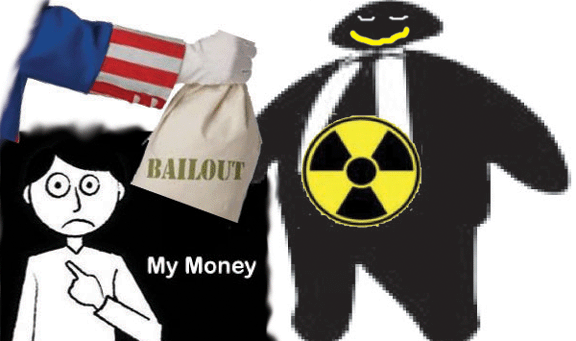
The nuclear industry shouldn’t get a bailout from ratepayers, said activist Eric Epstein, chairman of Three Mile Island Alert.
‘Cannot compete’
“It’s become clear the nuclear industry cannot compete in the market,” he said. “It’s environmental attributes are negligible.”
The storage of high-level radioactive wastes is a major problem with nuclear plants, added Epstein.
Nuclear plant owners recouped investment costs after Pennsylvania enacted an electric deregulation law in 1999, he said.
The new caucus hasn’t discussed any legislation, let alone a subsidy or tax credits for nuclear plants, said Yudichak. http://thetimes-tribune.com/news/nuclear-energy-caucus-forms-in-challenging-times-1.2172406
March 27, 2017
Posted by Christina Macpherson |
politics, USA |
Leave a comment

 Donald Trump’s tweets a distraction from decisions being made at the White House, Sydney Morning Herald, Paul McGeough, 24 Mar 17 Washington: “……… it wasn’t till this week that The Wall Street Journal, the very conservative and very sensible, Murdoch-owned WSJ, snapped – its Wednesday editorial tears into Trump for his false and lying tweets.
Likening the teetotaller commander-in-chief to a desperate alcoholic, it thunders on Trump’s widely-debunked claim that former US president Barack Obama had ordered wire taps on Trump Tower: “The President clings to his assertion like a drunk to an empty gin bottle, rolling out his press spokesman to make more dubious claims.”
The Journal often is accused of covering Trump with kid gloves. But throwing into reverse, the editorial’s author drives over the President again – damning his “seemingly endless stream of exaggerations, evidence-free accusations, implausible denials and other falsehoods”. And then it guns the engine before making another run: “If he doesn’t show more respect for the truth, most Americans may conclude he’s a fake president.”Theories abound on Trump’s obsessive, reckless tweeting – it’s a fight to defend the legitimacy of his presidency; it’s innate – he was groomed since childhood to wage total war on any threat, real or perceived; or it’s all a distraction – creating a crisis to divert attention from other crises and/or from the dire impact of his legislative and executive decisions.
George Lakoff, a cognitive linguist at the University of California at Berkeley, sees a deliberate strategy at work. Analysing Trump’s March 4 wire-tapping tweets, Lakoff lays out four elements on his blog:
Pre-emptive framing: He frames first. He creates a new presidential scandal – Obama’s wire tapping – an accusation without evidence, and with all evidence against it.
March 25, 2017
Posted by Christina Macpherson |
media, politics, USA |
Leave a comment
 FirstEnergy exec calls for ‘urgent’ aid, Toledo Blade, Belcher:
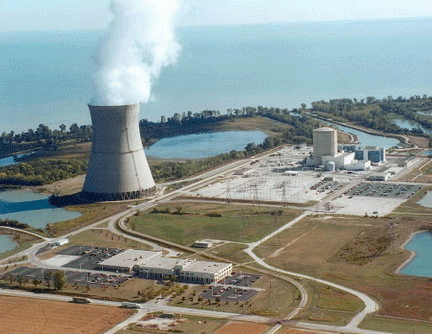
  Davis-Besse’s premature closing is real, ByTom Henry | BLADE STAFF WRITER March 25, 2017 OAK HARBOR, Ohio — Calling warnings of the Davis-Besse nuclear power plant’s premature closure “real” and the need for a bailout “urgent,” FirstEnergy Corp.’s top nuclear official left little doubt Friday that Ottawa County’s largest employer is in trouble.
Sam Belcher, FirstEnergy’s chief nuclear officer, said the utility’s other nuclear plants — the Perry nuclear plant east of Cleveland and the twin-reactor Beaver Valley complex northwest of Pittsburgh — are likewise in danger of premature closing by the summer of 2018 unless a buyer emerges or the utility gets help from legislators in Ohio and Pennsylvania……
“Our plants have been losing money. We’ve continued to operate them at a loss. But, at some point, those economics don’t make sense,” Mr. Belcher told The Blade during an hourlong telephone interview from his corporate office in Akron.
He discussed reasons why FirstEnergy announced just before Christmas it was going to “exit competitive generation.”
“We no longer can be exposed to continually changing market conditions,” Mr. Belcher said.
The utility decided in December to give the situation another 18 months to play out.
Now, three months closer to that self-imposed deadline, nothing meaningful has been done to turn around the situation in Ohio and Pennsylvania, Mr. Belcher said.
“The situation is real. It’s urgent,” Mr. Belcher said. “In the absence of something happening, we’re going to have to make some tough decisions.”……
So now — barring legislation on the federal level — FirstEnergy is studying how New York passed a bill in its state legislature to save the James A. FitzPatrick and Robert Emmett Ginna nuclear plants in upstate New York from premature closings, and how Illinois followed suit with plants in the southern part of that state. It also is tracking bills being considered or expected to be submitted in Connecticut and New Jersey, Mr. Belcher said.
“We’re hopeful something like that could be in the cards in Ohio,” he said.
No bill sponsor has been identified in Ohio, said Jennifer Young, a FirstEnergy spokesman.
But according to a column written by John Funk of The (Cleveland) Plain Dealer, the utility began shopping around a 13-page document to lawmakers in January, outlining a proposal to increase customers’ monthly bills by at least 5 percent in order to raise an extra $300 million a year in perpetuity. The report said the Plain Dealer downloaded a copy before it was removed from the Internet.
Critics such as Dick Munson of the New York-based Environmental Defense Fund claim it is the latest bailout attempt for a corporation that has mismanaged its assets…….
FirstEnergy’s message will likely mirror that which has been promoted on Capitol Hill by the Washington-based Nuclear Energy Institute for Congress.
The NEI argues nuclear plants — to give the nation more diversity in fuel sources, thereby strengthening national security — should receive special consideration in energy markets for what it calls their “unique attributes.”…..
Some emissions occur within the nuclear industry on a cradle-to-grave basis, including the process of mining, milling, and packing uranium into fuel assemblies; spent fuel’s transportation and disposal, and production of vast amounts of concrete and steel used to build plants.
But an NEI analysis shows that only solar and hydroelectric power do better in terms of cradle-to-grave emissions, producing 14 and 15 tons of carbon dioxide per gigawatt hour of electricity generated, respectively, to nuclear’s 17. The footprints of natural gas and coal are exponentially greater, 622 and 1,041 tons of carbon dioxide per gigawatt hour of electricity generated, according to the NEI study. http://www.toledoblade.com/Energy/2017/03/25/FirstEnergy-exec-calls-for-urgent-aid.html
March 25, 2017
Posted by Christina Macpherson |
business and costs, politics, USA |
Leave a comment
 Donald Trump’s administration to review decades-old US aim of world without nuclear weapons, The Independent, Policy review under way as US opposes proposed UN treaty on a global nuclear weapons ban Lizzie Dearden @lizziedearden, 21 Mar 17
Donald Trump’s administration is to review whether the US will keep its policy of nuclear disarmament.
Christopher Ford, the National Security Council’s senior director for weapons of mass destruction and counter-proliferation, said an assessment of US policy will examine whether the aim was “realistic”.
“Like all administrations we’re reviewing policy across the board, and that necessarily includes whether or not the goal of a world without nuclear weapons is in fact a realistic objective, especially in the near to medium term, in the light of current trends in the international security environment,” he told the Carnegie International Nuclear Policy Conference.
“It’s too early to say what the answers will be – looking at things with fresh eyes is not saying we will necessarily end up with different positions.”
Mr Ford said there was a “tension” between the goal of nuclear disarmament and the security requirements of the US and its allies.
He argued that the “headspace” for reducing nuclear arsenals had diminished in the years since the Cold War and cuts by the US and Russia seemed unlikely while other nuclear states continue development.
Mr Trump “will not accept a second place position in the nuclear weapons arena” but is open to broader engagement with Russia on the issue, Mr Ford said. He added that the current “threat environment” had changed substantially from when the review that established America’s current aims took place under Barack Obama in 2010.
The nuclear adviser said the Trump administration would continue American opposition to a “dangerous and misbegotten” proposed treaty to ban nuclear weapons.
UN member states voted overwhelmingly to start negotiations on a “legally binding instrument to prohibit nuclear weapons, leading towards their total elimination” last year.
A conference on the issue will be held in New York starting on 27 March but the treaty was opposed by nuclear powers including the US, Britain, Russia, France and Israel.
Mr Trump has not made any official policy statement on nuclear weapons but has touched on the issue repeatedly in his speeches and tweets.
Questioned about his warm statements towards Vladimir Putin at a press conference in February, the President warned that war between the US and Russia would be a “nuclear holocaust like no other”…….. http://www.independent.co.uk/news/world/americas/us-politics/donald-trump-nuclear-weapons-goal-world-without-reconsider-deproliferation-treaties-white-house-a7641706.html
March 24, 2017
Posted by Christina Macpherson |
politics, USA, weapons and war |
1 Comment
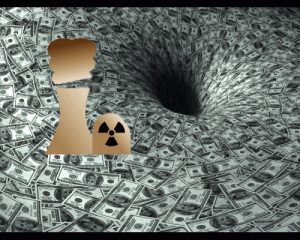
 U.S. Consumers May Be $3.9 Billion ‘Losers’ From Nuclear Aid, Bloomberg by Jonathan Crawford March 23, 2017,
Expanding state aid to money-losing nuclear reactors across the eastern U.S. may leave consumers on the hook for as much as $3.9 billion a year in higher power bills. Nuclear plant owners are seeking subsidies in Ohio, Connecticut, Pennsylvania and New Jersey after Exelon Corp. won state aid for reactors in Illinois and New York last year. Should all 28,000 megawatts of nuclear power across northeast and mid-Atlantic states win subsidies at the same level as New York, ratepayers would face an annual $3.9 billion hike, according to a report by Bloomberg Intelligence Tuesday……
“The losers would be customers and rival plants,” Kit Konolige, a senior analyst for Bloomberg Intelligence in New York, said by phone. “I think there’s a good chance it will pass in Ohio, Pennsylvania and Connecticut.”…..
New York regulators in August approved subsidies totaling about $500 million a year for the R.E. Ginna and Nine Mile Point nuclear plants owned by Exelon, and the James A. FitzPatrick plant it is purchasing from Entergy Corp. Those payouts equal about $17 a megawatt-hour, according to Bloomberg Intelligence…..
Illinois approved annual payouts of about $235 million for 10 years to keep Exelon’s Quad Cities and Clinton reactors open. The prospect of expanding subsidies has caught the eye of federal energy regulators, who plan to explore the impact of payouts on competitive markets…..
After wins in New York and Illinois, Exelon is pushing for aid for its three Pennsylvania reactors and one New Jersey plant, according to Bloomberg Intelligence. FirstEnergy Corp. needs Ohio subsidies to keep its Davis-Besse and Perry reactors open.
“It’s fair to assume that every nuclear plant is going to explore a subsidy,” Konolige said. “They’re going to say if they got in it New York, maybe I can get it in New Jersey.”
The subsidies offered by New York and Illinois are being challenged in court by opponents. A court decision on the New York dispute could come in the second quarter, according to Bloomberg Intelligence. https://www.bloomberg.com/news/articles/2017-03-21/consumers-would-be-3-9-billion-losers-from-nuclear-subsidies
March 24, 2017
Posted by Christina Macpherson |
business and costs, politics, USA |
Leave a comment
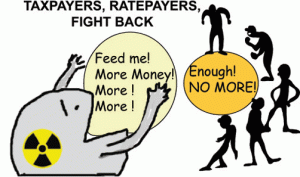 Local leaders join opposition to New York nuclear plant aid http://www.recordonline.com/news/20170321/local-leaders-join-opposition-to-new-york-nuclear-plant-aid, TIMES HERALD, By Associated Press ALBANY, N.Y. (AP) — Nearly 70 locally elected officials in New York are calling on Democratic Gov. Andrew Cuomo to halt a tax subsidy program that would allow three aging nuclear power plants to remain open upstate.
Legislators, town supervisors and councilmembers from more than two dozen counties signed a letter Monday to Cuomo requesting the state pause the program set to begin April 1 and publicly reassess clean energy options. Cuomo has said keeping the plants open would provide reliable energy as New York transitions half its power to renewable sources by 2030.
Some environmental advocates who oppose the program estimate its cost at up to $7.6 billion over 12 years.
The Public Service Commission says the program will cost about $1 billion in the first two years but cannot predict additional costs.
March 24, 2017
Posted by Christina Macpherson |
business and costs, opposition to nuclear, politics, USA |
Leave a comment
Wallace said, “I sense that they have no plans today of walking away from this claim. This is still the president’s belief. Some folks still close to the president, but not on the White House staff said it’s a word I can’t say on family-friendly TV, but the initials are B and S. Another person who spent time with the president this weekend in Florida said it was signs of paranoia and delusion around this idea that he’s so right. Interestingly, he has sought to have people outside the government corroborate this wiretapping claim, which either suggests this observation of paranoia and delusion is in fact operation or extreme ignorance of all the powers at his disposal and all the investigative powers of the federal government.”
These are Republicans close to Trump who claimed that the President Of The United States is paranoid, delusional, and believes that Obama wiretapped him. Wallace’s comments on MSNBC were a statement that the President might be mentally ill.
Before anyone asks, the constitutional standard for the removal of a president contains no discussion of mental fitness. It would be difficult to nearly impossible to remove Trump from office due to mental illness. It would have to be demonstrated that Trump is physically unable to perform the job of president.
The Trump claim that Obama wiretapped him was not some brilliant diversion. Trump’s belief that Obama spied on him is the mark of a paranoid, and mentally ill president.
March 24, 2017
Posted by Christina Macpherson |
politics, psychology - mental health, USA |
Leave a comment
Right Now, Trump Can Start a Nuclear War Without so much as a vote by Congress, our whole planet could be destroyed.Common Dreams, March 19, 2017 by OtherWords by Olivia Alperstein Right now, Donald Trump could start a nuclear war on a whim, and no one could stop him.
Under any circumstances, the prospect of nuclear war is terrifying, the deadly consequences irreversible. Yet with a single order, the president — any president — could effectively declare a nuclear war that would wipe out entire nations, including our own.
More worrying still, our current president has shown an alarming willingness to engage in aggression instead of diplomacy — particularly towards nations like Iran and China, as well as countries whose citizens have now been banned from traveling to the U.S. under an overbroad, dog-whistle executive order.
Trump has almost gleefully exercised his right to threaten nuclear war.
He made boastful remarks about nuclear might throughout his campaign. And just recently, he called for a new push to put America at the “top of the pack” when it comes to nuclear weapons capability (as though we weren’t already).
Going against decades of precedent, not to mention hard-won diplomatic treaties reached with countries like Russia and Iran, Trump has enthusiastically declared that we should expand, not reduce, our nuclear arsenal…………
It’s almost impossible to comprehend millions of people being obliterated from the face of the earth simultaneously, in the blink of an eye. Especially at the whim of just one American who happens to have access to a certain red button.
That’s why Representative Ted Lieu and Senator Ed Markey have introduced legislation prohibiting the sitting president from unilaterally declaring nuclear war without a prior act of Congress. They call it the Restricting First Use of Nuclear Weapons Act of 2017.
“Nuclear war poses the gravest risk to human survival,” Markey warned in a joint statement introducing this legislation. Unfortunately, Trump insists on “maintaining the option of using nuclear weapons first in a conflict.”
“In a crisis with another nuclear-armed country,” the senator went on to explain, “this policy drastically increases the risk of unintended nuclear escalation.” http://www.commondreams.org/views/2017/03/19/right-now-trump-can-start-nuclear-war
March 20, 2017
Posted by Christina Macpherson |
politics, USA, weapons and war |
Leave a comment
Aside from the catastrophic impacts on public health and planetary survival, these Trump-Koch attacks on environmental protection and increased energy efficiency bode ill for a struggling U.S. economy. Germany, China and other global competitors are surging ahead with ecologically sound advanced technologies like high-speed rail, EV autos, PV cells, ultra-efficient wind turbines, solar farms, and highways guaranteed to leave America in the dust.
The “tycoon” President who promised full employment and prosperity is instead bringing an ill wind, darkened sun, and scorched planet.
 Trump’s Budget Assault on the Environment Packs a Wallop, The Progressiveby Harvey Wasserman March 17, 2017
Donald Trump’s first budget makes his antipathy to the environment clear—and his love for fossil fuels and nuclear power even clearer.
In addition to slashing funding to the Environmental Protection Agency, he also announced this week that he wants massive rollbacks in automotive fuel efficiency standards and billions in new investments in nuclear weapons and storage for commercial nuclear waste.
The administration’s budget cuts $2.4 billion from the EPA’s operating funds
—roughly 31 percent—taking the agency’s annual budget from $8.1 billion to $5.7 billion, the smallest since it was formed in 1970. These cuts will cripple regulation of air and water quality, strip oversight of a wide range of land management programs, and loosen restrictions on chemical emissions from industrial facilities.
Much of this money would be shifted directly over to the military, which the Trump Administration wants to bolster with an additional $54 billion over the final Obama allocations…….
llowing through on his campaign promise to reduce the EPA to “little tidbits,” Trump’s budget defunds more than 50 programs. These include infrastructure improvement on Indian reservations, major projects to clean up Puget Sound, Chesapeake Bay and the Great Lakes, a wide range of renewable energy development and energy efficiency programs, numerous climate change research programs, national heritage sites, environmental justice programs, oceanographic research and preservation, and much more. Gina McCarthy, a former EPA official under Obama, described it as “a scorched earth budget that represents an all-out assault on clean air, water and land.”
Some of the immediate opposition has crossed party lines. Ohio’s recently re-elected Republican Senator Rob Portman, a close associate of former President George W. Bush, strongly opposed cuts to the $300 million Great Lakes Restoration Initiative. Bill Becker of the National Association of Clean Air Agencies warned, “if such cuts are realized, many more people will die prematurely and get sick unnecessarily due to air, water and waste pollution.”…….
Meanwhile, Illinois and New York are moving toward massive subsidies for uncompetitive, dangerously dilapidated old nuclear reactors in a marketplace where renewables are coming in far cheaper and creating thousands more jobs. In Ohio and other states, owners of money-losing reactors are advocating for massive handouts to block cheaper, job-creating renewables and efficiency from getting into the marketplace.
Adding insult to injury, Trump wants to add $120 million to the long-dead Yucca Mountain nuclear waste dump. ……
Aside from the catastrophic impacts on public health and planetary survival, these Trump-Koch attacks on environmental protection and increased energy efficiency bode ill for a struggling U.S. economy. Germany, China and other global competitors are surging ahead with ecologically sound advanced technologies like high-speed rail, EV autos, PV cells, ultra-efficient wind turbines, solar farms, and highways guaranteed to leave America in the dust.
The “tycoon” President who promised full employment and prosperity is instead bringing an ill wind, darkened sun, and scorched planet. http://progressive.org/dispatches/trump%E2%80%99s-budget-assault-on-the-environment-packs-a-wallop/
March 17, 2017
Posted by Christina Macpherson |
environment, politics, USA |
Leave a comment