 Eskom: SA has not signed nuclear deal http://northglennews.co.za/106808/eskom-sa-not-signed-nuclear-deal/ The power utility has not received any formal proposals from potential supplier SOUTH Africa has not signed any nuclear deal, Eskom recently said. Responding to last week’s media reports alleging that a nuclear deal has been signed, Eskom reiterated the remarks made by National Treasury that no deal has been signed.
“Eskom expects to issue a full Request for Proposal (RFP) to the open market once the Request for Information (RFI) has been assessed and the relevant approvals have been obtained,” said Eskom Chief Nuclear Officer, Dave Nicholls.
Nicholls said the power utility has not received any formal proposals from potential suppliers and has not signed any power plant procurement agreements.
“Eskom has not undertaken any pre-qualification assessment to date related to the potential respondents to a potential RFP,” he said.
South Africa plans to introduce 9 600 megawatts of nuclear energy to the grid in the next decade.
“The funding model of the project will be determined by the response received from the markets once bidders have responded to the RFP. This will also be done at a pace and scale that government can afford,” said the department.
April 12, 2017
Posted by Christina Macpherson |
politics, South Africa |
Leave a comment

 Generators, business groups line up against Ohio nuclear bill http://www.utilitydive.com/news/generators-business-groups-line-up-against-ohio-nuclear-bill/440178/ Peter Maloney@TopFloorPower
Dive Brief:
- Backers and opponents are squaring off over a bill in Ohio that aims to provide financial support for FirstEnergy’s nuclear plants.
- Opponents include AARP, the Ohio Manufacturers’ Association, the Ohio branch of the American Petroleum Institute, the Alliance for Energy Choice, and the Electric Power Supply Association, a generator trade group. They say the subsidies would only serve to prop up FirstEnergy’s bottom line and oppose undue costs on consumers.
- Backers include the International Brotherhood of Electrical Worker Local 245 and FirstEnergy, who argue the plants are essential for the state’s economy and local tax bases.
- Dive Insight:
Measures to shore up nuclear power plants have been put in place in New York and Illinois and are under consideration in legislatures in Connecticut, Ohio and New Jersey.
And in all instances they have encountered resistance.
Non-nuclear generators say the measures in Illinois and New York will distort the economics of wholesale power markets. PJM Interconnection has also weighed in. In a March filling in federal court, PJM’s independent market monitor said Illinois zero emission credit (ZEC) would violate federal law.
A bill in Ohio, called a zero emission nuclear resource (ZEN) program, would provide emissions credits for FirstEnergy’s three nuclear plants.
- Sen. John Eklund (R), the bill’s sponsor, says the continued operation of those nuclear assets is “critical to the economic health of Ohio, and especially to the communities in which they are located.”
The IBEW takes a similar view, focusing on the livelihood of the 517 union workers at the plants, as well as the “thousands” of union contractors who depend on the plants.
But independent generators groups, such as EPSA, argue that bill would first and foremost improve the bottom line of FirstEnergy and distort price formation in organized markets.
The Ohio Manufacturers’ Association takes a similar line, arguing that the bill would allow FirstEnergy to prop up its business on the backs of Ohio consumers.” The group says it supports nuclear power as part of an all-of-the-above approach but calls the bill, SB 128, a “wolf in sheep’s clothing.”
AARP cites the opposition similar measures have attracted and calls them “scams” because they interfere with the working of wholesale energy markets.
The Federal Energy Regulatory Commission is due to address that market question in a technical conference at the beginning of next month focused on state generation subsidies.
April 12, 2017
Posted by Christina Macpherson |
politics, USA |
Leave a comment
30-year veteran compares EPA chief’s climate denial to lies tobacco executives told Congress Mike Cox retired after three decades at the Environmental Protection Agency on March 31 with a scathing letter for EPA administrator Scott Pruitt.
Team Trump is apparently an open joke to their staff — something even the Reagan and Bush administrations never experienced. Morale has collapsed, Cox notes.
“I have worked under six administrations with political appointees leading EPA from both parties,” Cox wrote on his last day on the job. “This is the first time I remember staff openly dismissing and mocking the environmental policies of an administration and by extension you.”
The 60-year-old Cox, who worked on climate change for EPA’s Region 10, which covers Alaska and the northwest, was especially harsh on Pruitt’s science denial.
Cox called Pruitt’s claim on national TV that CO2 is not a primary contributor to recent global warming “shocking” — and directly compared it to the congressional hearing with the CEOs of the major tobacco companies where “all of the CEOs categorically denied that smoking causes lung cancer.”
What’s the result of this denial? “You will continue to undermine your credibility and integrity with EPA staff, and the majority of the public,” Cox wrote, “if you continue to question this basic science of climate change.”
In the five-page letter, Cox slams the president for the “false and misleading” claim that killing EPA carbon pollution standards will bring back coal jobs.
In a section on “indefensible budget cuts,” Cox slams Pruitt for standing by while the White House gutted the overall EPA budget. These cuts have real consequences for real people, he says.
Cox directly asks Pruitt:
- Why resources for Alaska Native Villages are being reduced when they are presented with some of the most difficult conditions in the country;
- why you would eliminate funds for the protection and restoration of the Puget Sound ecosystem which provides thousands of jobs and revenue for Washington State; and
- why you would reduce funds for a program that retrofits school buses to reduce diesel emission exhaust inhaled by our most vulnerable population — children.
The entire letter from Cox is a must read for anyone who cares about clean air, clean water, and our children’s future.
April 12, 2017
Posted by Christina Macpherson |
politics, USA |
Leave a comment
As noted by the Palmer Report, Trump owns stock in Raytheon, which was reported by Business Insider in 2015.
According to Trump’s financial disclosure reports filed with the FEC in 2015, his stock portfolio includes investments in technology firms, financial institutions and defense firms, including Raytheon.
On Thursday, Trump launched an attack on the al-Shayrat military airfield, used by both Syrian and Russian military forces, hitting it with 59 Tomahawk missiles manufactured by Raytheon. Trump’s attack on Syria was reportedly in response to a deadly gas attack launched by Syrian President Bashar al-Assad against his own people earlier in the week.
While the Tomahawk attack did little damage to the airfield — with the Syrian air force continuing to launch assaults from the same base on Friday — investors, sensing an increasing escalation in tensions between two countries and the possibility of war , pushed Raytheon stock up.
Since taking office, Trump has refused to divulge all of his financial information — including his income taxes — and refused to place his business and financial holdings in a blind trust allowing Trump and his family to move money and investments around as they see fit.
April 10, 2017
Posted by Christina Macpherson |
business and costs, politics, secrets,lies and civil liberties, USA |
Leave a comment
 ‘R1 trillion nuclear deal will guarantee SA junk status’ http://www.iol.co.za/news/politics/r1-trillion-nuclear-deal-will-guarantee-sa-junk-status-8565844 9 April 2017 ANA Reporter Cape Town
 – It is an undeniable fact that South Africa cannot afford, and does not need, government’s planned nuclear energy deal, the Democratic Alliance said on Sunday.
Media reports on Sunday that the nuclear deal was going full-steam ahead were extremely concerning and would essentially guarantee that South Africa would be downgraded by more ratings agencies and make recovering from this status even more difficult, DA spokeswoman Natasha Mazzone said.
Fitch Ratings stated in no uncertain terms on Friday that a key driver behind the decision to downgrade SA’s long-term foreign currency debt and long-term local currency debt to “BB+”, or “junk status”, was that “Eskom has already issued a request for information for nuclear suppliers and is expected to issue a request for proposals for nuclear power stations later this year.
The Treasury under its previous leadership had said that Eskom could not absorb the nuclear programme with its current approved guarantees, so the Treasury will likely have to substantially increase guarantees to Eskom”.
Just days before, S&P Global also downgraded South Africa to sub-investment level – “junk status”. Mazzone said the DA would ask public enterprises portfolio committee chairwoman Dipuo Letsatsi-Dub for an urgent meeting of the committee to ensure that Parliament, as a key oversight body, would fully interrogate all aspects related to the nuclear deal.
“The undeniable fact is that South Africa cannot afford, and does not need, the nuclear deal. Indeed, international ratings agencies agree and this deal has been repeatedly cited as a cause for great concern and a key factor in downgrades not only for Eskom, but the country as a whole.
“These downgrades have already and will continue to have a devastating effect on our economy. Jobs will be lost and the cost of living will increase, which will hurt the poor,” Mazzone said.
Earlier on Sunday, City Press reported that a confidential document reveals that South Africa’s nuclear-build programme kicks off in earnest in June when Eskom issues a formal request for proposals from companies bidding for the estimated R1 trillion contract.
The nuclear deal – for which Russian company Rosatom was widely considered to be the front runner – was, according to senior National Treasury officials, “directly related” to President Jacob Zuma’s axing of finance minister Pravin Gordhan and his deputy Mcebisi Jonas, the newspaper reported.
“It is well known that Gordhan was against the project as he said the country couldn’t afford it.Eskom will be issuing a request for proposals in June and that really is the beginning of procurement. Gordhan had to go because he was going to block it again,” a senior official reportedly said.
The internal Eskom document dated three days before Gordhan and Jonas were axed revealed a tight timeline for the programme that would see four plants built to provide 9600 megawatts of electricity to the country.
After the request for proposals was issued in June, the deadline for bids was September, for evaluation in December. The winning bidder would be decided in March 2018 and the contract signed between December next year and March 2019, City Press reported.
The document also revealed that most of the major nuclear contracts would be implemented through “turnkey” procurement, which Treasury officials were concerned about.
“While Treasury allows for turnkey procurement, we know that it is often used to hide corruption. Companies that are asked to deliver turnkey projects are accountable to themselves. They appoint whoever they like, however they like,” a senior official reportedly said.
Turnkey projects were when a single company was appointed to manage and deliver an entire project. The management company became responsible for appointing all contractors and service providers. This was different from an open tender that was spread over a range of different contractors appointed by the state, City Press reported.
April 10, 2017
Posted by Christina Macpherson |
business and costs, politics, South Africa |
Leave a comment
Donald Trump’s decision to launch airstrikes on a Syrian airfield was hailed by many corporate media and foreign policy establishment types, but in addition to the myriad questions surrounding the motivation and constitutionality of Trump’s unilateral action, the ineffectiveness of the strike is becoming the story. According to multiple reports, flights from the airbase resumed on Friday, a day after the strikes.
Trump, true to form, wore that insecurity on his sleeve, and his Twitter feed:….
Democratic Congressman Ted Lieu (D-CA) pointed out that the strikes did “basically nothing” to prevent Assad from launching attacks on civilians. Lieu is part of a growing number of lawmakers on both sides of the aisle who are questioning the efficacy of the Syria strikes, including one of the most vocal boosters of Trump’s decision, Sen. John McCain (R-AZ).
The criticism sparked an absurd response from current Trump National Security Advisor H.R. McMaster, who was pressed by Fox News Sunday host Chris Wallace over the fact that the airbase resumed operations so quickly:……..
Trump has definitely sent a lot of messages with this strike, including to the Russians prior to the strike, to Congress by not seeking their authorization, and to the corporate media by getting them to look away from the Russia collusion investigation. The faintest of these was to Assad, who scarcely has any more incentive to cease his brutality than he did last week. http://shareblue.com/trump-team-on-the-defensive-amid-dem-criticism-of-syria-strikes/
April 10, 2017
Posted by Christina Macpherson |
politics, USA |
Leave a comment
 Nuclear plant owners expand search for financial rescue, http://www.pennlive.com/news/2017/04/nuclear_plant_owners_expand_se.html By Marc Levy | The Associated Press April 09, 2017 HARRISBURG, Pa. (AP) — The natural gas boom that has hammered coal mines and driven down utility bills is hitting nuclear power plants, sending multi-billion-dollar energy companies in search of a financial rescue in states where competitive electricity markets have compounded the effect.
Fresh off victories in Illinois and New York, the nuclear power industry is now pressing lawmakers in Connecticut, New Jersey, Ohio and Pennsylvania for action. Lobbying efforts are bubbling up into proposals, even as court battles in Illinois and New York crank up over the billions of dollars that ratepayers will otherwise foot in the coming decade to keep nuclear plants open longer.
Perhaps nuclear power’s biggest nemesis is the cheap natural gas flooding the market from the northeast’s Marcellus Shale reservoir, the nation’s most prolific gas field. Meanwhile, electricity consumption hit a wall after the recession, while states have emphasized renewable energies and efficiency.
“You put all of this together and it’s a perfect storm,” said John Keeley, a spokesman for the Nuclear Energy Institute, an industry group.
Opposition to a so-called nuclear bailout is uniting rivals and the natural gas exploration industry. The potential for a hit to utility bills is drawing pushback from the AARP and manufacturers.
Subsidizing nuclear power could chill investment in lower-cost energy sources and erode competitive markets, critics say, and, with natural gas prices expected to stay low for some time, shutting down nuclear plants may have no impact on electricity bills.
For steel companies, paper companies, food processors and pharmaceutical makers whose electric bill might be their biggest expense, “a mil of an increase in a kilowatt hour turns into a lot of money,” said David Kleppinger of the Industrial Energy Consumers of Pennsylvania.
In Pennsylvania, the nation’s No. 2 nuclear power state after Illinois, it could mean propping up five nuclear plants to help feed the sprawling mid-Atlantic power grid that stretches from New Jersey to Illinois.
The owners of the 11 nuclear plants in Connecticut, New Jersey, Ohio and Pennsylvania are no small potatoes: Exelon, PSEG, FirstEnergy and Dominion, among them.
The plant owners’ strategy is similar to that in Illinois and New York: give nuclear power megawatts the kind of preferential treatment and premium payments that are given to renewable energies, such as wind and solar.
The industry’s pitch is part economic, part environmental. A plant shutting down would devastate a local economy, they say. And, nuclear waste and water consumption issues aside, zero-carbon nuclear plants are better suited than natural gas or coal to fight climate change, they say.
The claim to environmental credentials has drawn jeers from nuclear power’s traditional critics.
“When did highly carcinogenic toxic waste become green?” said Eric Epstein, a longtime nuclear power watchdog in Pennsylvania.
The most vulnerable nuclear plants are those with just one unit — such as Exelon’s Three Mile Island in Pennsylvania, where a second unit was destroyed in a partial meltdown in 1979 — or those in need of expensive upgrades, analysts say.
FirstEnergy says it could decide next year to sell or close its three nuclear plants — Davis-Besse and Perry in Ohio and Beaver Valley in Pennsylvania — unless states make them more competitive.
Exelon is warning that it could close Three Mile Island and PSEG says it won’t operate nuclear plants — it owns all or parts of all three in New Jersey and part of Peach Bottom station in Pennsylvania — that are long-term money losers.
Should nuclear power disappear, it can be replaced.
“The question is, at what cost and whether or not you can find other resources that have the same emission characteristics,” said Joe Dominguez, an Exelon executive vice president.
In the mid-Atlantic grid, it likely would be natural gas. Some 190 natural gas power projects comprising roughly 59,000 megawatts are being studied or built, according to PJM Interconnection, the grid operator. That dwarfs the grid’s nuclear capacity.
April 10, 2017
Posted by Christina Macpherson |
business and costs, politics, USA |
Leave a comment
 France’s oldest nuclear plant in Fessenheim to close by 2020 http://www.dw.com/en/frances-oldest-nuclear-plant-in-fessenheim-to-close-by-2020/a-38358239 Amid a whirlwind of controversy, the French government has ordered the closure of the nuclear power plant. But its closure is dependent on the commissioning of a state-of-the-art nuclear plant in Normandy. French Environment Minister Segolene Royal announced on Sunday that the country’s oldest nuclear power plant will close by 2020.
“The decree on the closure of the Fessenheim plant has been signed and published this morning in the official (government) journal,” Royal said in a tweet.
According to the decree, the Fessenheim plant will close once the new reactor being built at Flamanville on the Normandy coast “enters service.”
The plant has been operational since 1977 and sits near Germany’s border with France. The decree marks the partial fulfillment of French President Francois Hollande’s campaign pledge during the 2012 presidential election to close the plant during his term, which ends in May.
The government’s decision comes days after French nuclear plant operator EDF said it would only shutter the Fessenheim plant after receiving compensation for its closure alongside the successful commissioning of the Flamanville plant.
“I would like to pay tribute to the work of Fessenheim employees and services providers who operate our industrial equipment safely and with excellent performance. I assure them of the consideration I shall bring for their future in all circumstances,” said EDF chief executive Jean-Bernard Levy in a statement.
Problematic reactors The Fessenheim plant has been a source of tensions between France and its neighbors Germany and Switzerland. In 2014, one of the plant’s reactors had to be shut down after water was discovered leaking from several places.
According to documents obtained by the “Süddeutsche Zeitung,” the reactor had to be shut down by adding boron to the pressure vessel, an unprecedented procedure in Western Europe, according to experts. The incident allegedly occurred due to jammed control rods.
However, French authorities played down the incident by not divulging the gravity of the situation. An official report from France’s nuclear authority ASN did not contain information on the need to use boron, nor was the incident reported to the International Atomic Energy Agency in that manner.
Despite the incident, France continues to rely on nuclear energy, which covers 75 percent of its energy needs.
April 10, 2017
Posted by Christina Macpherson |
France, politics |
Leave a comment
 Ohio lawmakers weigh bailout for FirstEnergy nuclear plants, by Associated Press April 9, 2017 TOLEDO, Ohio (AP) – A bailout proposed for Ohio’s two nuclear plants would keep alive a big source of jobs and tax money but end up increasing electricity rates for FirstEnergy Corp.’s customers in the state.
It will be up to the legislature and Republican Gov. John Kasich whether to approve what would amount to a huge subsidy for the plants.
While it’s not known how much FirstEnergy’s rates could go up, the increases would be capped at 5 percent.
Exactly how much the plan would generate for the nuclear plants isn’t clear yet because it’s based on a complex formula that involves plant emissions.
Both New York and Illinois recently approved multibillion-dollar subsidies to stop unprofitable nuclear plants from closing prematurely.
Akron-based FirstEnergy says the subsidies are needed to save the Davis-Besse and Perry plants that sit along Lake Erie and make 14 percent of the state’s electricity. The company has said both might be sold even if the subsidies are approved………http://nbc4i.com/2017/04/09/ohio-lawmakers-weigh-bailout-for-firstenergy-nuclear-plants/
April 10, 2017
Posted by Christina Macpherson |
business and costs, politics, USA |
Leave a comment
Experts agree that in limited instances, such as the Syrian missile attack, a president has legal authority provided in the Constitution as commander-in chief.
“Because the air strikes were undertaken by cruise missiles that put virtually no American lives at risk and because the strikes lasted only minutes, the president’s action would seem to be a lawful use of force under the Constitution. Needless to say, if further military actions were to be undertaken, they could rise to the level of requiring congressional authorization.”
 Mark Pocan wrongly claims Donald Trump had no legal authority to launch missile attack on Syria http://www.politifact.com/wisconsin/statements/2017/apr/07/mark-pocan/mark-pocan-wrongly-claims-donald-trump-had-no-lega/ By Tom Kertscher on Friday, April 7th, 2017 The morning after the U.S. cruise missiles assault on a Syrian air base, U.S. Rep. Mark Pocan questioned the legal authority of President Donald Trump to order the attack.
“There is no legal basis for last night’s missile strike against Syrian military assets,” the Madison-area Democrat declared in a statement on April 7, 2017. “Congress must be called back immediately, if President Trump plans to escalate our military involvement. He must send a new Authorization for Use of Military Force (AUMF) to Congress, as I have previously called for.”
The 59-missile assault was launched in retaliation for a chemical weapons attack by the government against Syrian civilians two days earlier. News reports quoted U.S. officials as saying Trump had the right to use force to defend national interests and to protect civilians from atrocities.
Meanwhile, first-term U.S. Rep. Mike Gallagher, R-Green Bay, while praising the “limited strikes,” also said Trump “should seek congressional authorization for any sustained military operation in Syria.”
There’s certainly debate over the extent of a president’s authority to use military force without approval from Congress.
But Pocan went too far in saying there is no legal basis for Trump’s action.
Competing arguments To support Pocan’s claim, his office noted the U.S. Constitution assigns to Congress the power to declare war, and sent us commentary on that provision and the missile attack by the American Civil Liberties Union.
The ACLU reiterated its position that “the decision to use military force requires Congress’ specific, advance authorization.”
Pocan also cited the War Powers Resolution of 1973, which was enacted over a veto by Republican President Richard Nixon. It says “the introduction of United States Armed Forces into hostilities” can be done only “pursuant to a declaration of war, specific statutory authorization, or a national emergency created by attack upon the United States, its territories or possessions, or its armed forces.”
And Harvard law professor Jack Goldsmith, an assistant attorney general under Republican President George W. Bush, argued in 2013 that Democratic President Barack Obama didn’t have unilateral authority to launch attacks against Syria, as was being considered at the time.
Goldsmith said the president’s authority to use force without congressional approval had been extended to protect American persons and property abroad, but that rationale would not have applied to the attacks Obama contemplated (but never carried out).
The Trump administration, meanwhile, also invokes the Constitution (Article 2) in asserting that the president has the power to defend the U.S. national interest.
In this case, that interest is described as “promoting regional stability, which the use of chemical weapons threatens” — which the Trump administration likened to the Obama administration’s justification for using force in Libya in 2011.
Other views
Experts agree that in limited instances, such as the Syrian missile attack, a president has legal authority provided in the Constitution as commander-in chief.
Cameron University history and government professor Lance Janda said he agrees with Pocan’s call for a new congressional authorization for use of force, adding: “We have not declared war on anyone since 1941, and yet we are the most active nation state on the planet when it comes to military action.”
But “having said that,” Janda continued, the Constitution gives the president authority as commander in chief to use force to protect our national interests and War Powers Resolution gives the president “leeway to respond to attacks or other emergencies.”
McGill University professor of international relations Mark Brawley also said the president has authority to use military force in a crisis, but then should notify Congress within 48 hours. The president also should ask Congress for authority to use military force if there will be extended conflict, or for a declaration of war, if the United States will be at war with Syria, he said.
Like the Trump administration, Georgetown University professor Anthony Arend, whose specialties include international relations and constitutional law of U.S. foreign relations, also cited Article 2 of the Constitution and the president’s power as commander-in-chief. He told us:
“While the precise scope of this power is unclear, a strong argument can be made that the president can use force in short military operations — especially where there is minimal risk to American lives — without congressional authorization. Indeed, over the years, Congress has generally acquiesced in such presidential uses of force.
“Because the air strikes were undertaken by cruise missiles that put virtually no American lives at risk and because the strikes lasted only minutes, the president’s action would seem to be a lawful use of force under the Constitution. Needless to say, if further military actions were to be undertaken, they could rise to the level of requiring congressional authorization.”
Added Richard Stoll, an international conflict scholar at Rice University, about the Trump attack: “This is not new.” Stoll said he would advise a president to get congressional approval before taking additional action, but presidents many times have taken a “one-off” action such as the Syrian attack.
Those views correspond to a 2013 fact check of then-U.S. Sen. Joe Lieberman, who said Obama would have had the legal authority to strike Syria without a vote from Congress. PolitiFact National’s rating was True. As our colleagues reported:
- Since the last time Congress declared war, at the beginning of World War II, presidents have generally initiated military activities using their constitutionally granted powers as commander in chief without having an official declaration of war in support of their actions.
- Even under the War Powers Resolution, the president can send in forces without approval from Congress.
- Lower courts have ruled in favor of the White House in the use of force, and the U.S. Supreme Court declined to hear an appeal on that point.
Our rating
Pocan said: “There is no legal basis” for Trump’s “missile strike against Syrian military assets.”
For limited military activities like the missile strike, presidents can send in forces without approval from Congress.
We rate Pocan’s statement False.
April 8, 2017
Posted by Christina Macpherson |
politics, USA |
Leave a comment
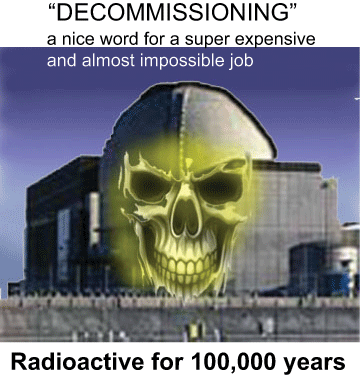
 nuClear News No.94 April 2017 The UK Government has been forced to pay nearly £100m in a settlement with two US companies – Energy Solutions and Bechtel – for mishandling the way it awarded a £6.1bn nuclear decommissioning contract. Ministers have ordered an inquiry headed by the former boss of National Grid to find out why the procurement process was so flawed. Labour said the payout showed “dramatic levels of incompetence”. The Nuclear Decommissioning Authority (NDA) will also terminate the contract it awarded for cleaning up the UK’s old Magnox reactor sites nine years early. The sites include Bradwell, Chapelcross, Hinkley A and Hunterston A. (1)
The High Court ruled last summer that the NDA had “manipulated” and “fudged” the tender process. It meant that the wrong company won the work to decommission 12 UK nuclear sites (10 Magnox sites plus Harwell and Winfrith). The move opens the door for other bidders to attempt to reclaim their bid costs, which could run to an additional £50m. The contract was awarded in 2014 to Cavendish Fluor Partnership, a joint venture between the UK’s Babcock International and Texas-based Fluor. However, the consortium cannot be asked to take on the extra work because that could increase potential compensation claims by companies that wrongly lost out in the tender. Some industry sources have complained that the government plumped for an unrealistically low bid for the work at the outset. Another losing bidder, UK Nuclear Restoration Ltd, which is a consortium of Amec Foster Wheeler, Atkins and Rolls-Royce, said that the settlement “raises serious concerns” about the procurement process and that it has raised the implications of the judgment with the government and the NDA. (2)
Former National Grid chief executive Steve Holliday has been appointed to lead an independent inquiry into what went wrong. The inquiry will look at how the mistakes were made and by who, how the litigation was handled, and the relationship between the NDA and the government departments. Holliday will publish an interim report in October. The government now has the daunting task of starting a new tendering process for the 12 sites, as the deal with Cavendish Fluor Partnership (CFP) will end early, in September 2019 instead of 2028. (3)
Babcock said in a statement the CFP, in which it has a 65% stake, has come to a mutual agreement with the NDA to bring to an end the contract at the end of August 2019, having operated the contract for a full five years. Babcock said it had become apparent that the work that needs to be done is now materially different in volume from that specified in the NDA’s tender, and this puts the contract at risk of a legal challenge. What those material differences are remains a mystery.
The Business Secretary, Greg Clark, said: “It has become clear to the NDA through this consolidation process that there is a significant mismatch between the work that was specified in the contract as tendered in 2012 and awarded in 2014, and the work that actually needs to be done. The scale of the additional work is such that the NDA board considers that it would amount to a material change to the specification on which bidders were invited in 2012 to tender.” (4)
The failure of the contract award process was “inevitable” according to nuclear power expert Dr Paul Dorfman, from University College London’s Energy Institute. “They were set up to fail and have failed because the understanding of costs and complexity to nuclear decommissioning is changing all the time,” he said. “Magnox reactors were thrown up in a rush to give electricity too cheap to meter and create plutonium and there was no thought of how they would be decommissioned. Each Magnox reactor is bespoke so decommissioning each one is different with its own complexities and challenges. The more we learn about dealing with the ‘back end’ of nuclear power, the more we see how complex and costly it is.” (5)
Stop Hinkley Spokesperson Roy Pumfrey said: “Why should anyone believe that this astonishing level of incompetence will suddenly end when we start to build new reactors? Just because Hinkley Point C is not a Magnox reactor doesn’t just suddenly make the industry competent.” (6)
The Daily Telegraph declared today “if we could, we would stop this madness … In committing to new nuclear, we seem to have joined a runaway train, with no hope of getting off. Has not the time finally arrived for a fully fledged rethink of the merits of Britain’s nuclear energy strategy?” (7)
Roy Pumfrey continued: “We agree – it is time to stop this madness. The UK’s nuclear decommissioning costs have increased from £55.8 billion in 2008 to £117.4 billion at the last count. Although EDF is required to set aside funds for decommissioning Hinkley Point C, this is only up to an agreed limit. The taxpayer will be on the hook for the all too predictable shortfall.”
Chris Huhne, former energy secretary for the coalition government, said the remit for the enquiry by Steve Holliday was not broad enough and it needed to look at the total cost of nuclear decommissioning. “It is a complete mess, it’s deeply embarrassing but it’s actually I’m afraid only the latest in a long line of embarrassments,” Huhne told BBC Radio 4. “We’re not even scraping the surface with the problem that this legal case has exposed.” Huhne, who was energy secretary between 2010 and 2012 and left the before the contract was awarded, said the cost of decommissioning the UK’s old nuclear fleet had increased £107bn in the last five years to £161bn. “In terms of industrial strategy this makes every other disaster in the post-war period pale into insignificance.” He said the problem stemmed from how early reactors stations were complex bespoke constructions made without consideration to how they would later be disassembled. “We ordered a whole series of Savile Row suits rather than a bunch of work-a-day Marks & Spencer suits… Every single one of those reactors is different. Even the fuel rods in every single one of those reactors are different – crazy.” (8) Huhne called on the government not to allow subsidies for new reactors. That was the coalition government policy. It should be the policy again but the government seems to be relenting – it’s opening the door to exactly a repetition of the sort of disaster that we see today. (9) http://www.no2nuclearpower.org.uk/nuclearnews/NuClearNewsNo94.pdf
April 8, 2017
Posted by Christina Macpherson |
decommission reactor, politics, UK |
Leave a comment
Hawaii congresswoman says Trump ‘acted recklessly’ with Syria missile strikes https://www.businessinsider.com.au/trump-syria-missile-strikes-reckless-nuclear-tulsi-gabbard-2017-4?r=US&IR=T BRYAN LOGAN APR 7, 2017 Rep. Tulsi Gabbard of Hawaii torched President Donald Trump on Thursday night over his decision to launch a missile strike against airfields in Syria.
Gabbard said Trump “acted recklessly” in authorizing the strikes on Shayrat airfield and nearby military infrastructure controlled by Syrian President Bashar al-Assad. The operation was a response to a chemical weapons attack that killed at least 80 civilians in northwestern Syria earlier this week.
Gabbard said: “It angers and saddens me that President Trump has taken the advice of war hawks and escalated our illegal regime change war to overthrow the Syrian government.” The Democrat congresswoman made similar remarks after returning from a trip to Syria days after Trump’s inauguration.
Gabbard called the strike “short-sighted,” and said it would lead to “more dead civilians, more refugees … and a possible nuclear war between the United States and Russia.”
Her statement represents one of the strongest condemnations of Trump’s strike order, and a departure from a bipartisan group of congressional lawmakers who cautiously applauded the commander-in-chief’s action late Thursday night.
Read Rep. Gabbard’s full statement below:
“It angers and saddens me that President Trump has taken the advice of war hawks and escalated our illegal regime change war to overthrow the Syrian government. This escalation is short-sighted and will lead to more dead civilians, more refugees, the strengthening of al-Qaeda and other terrorists, and a possible nuclear war between the United States and Russia.
This Administration has acted recklessly without care or consideration of the dire consequences of the United States’ attack on Syria without waiting for the collection of evidence from the scene of the chemical poisoning. If President Assad is indeed guilty of this horrible chemical attack on innocent civilians, I will be the first to call for his prosecution and execution by the International Criminal Court. However, because of our attack on Syria, this investigation may now not even be possible. And without such evidence, a successful prosecution will be much harder.”
April 8, 2017
Posted by Christina Macpherson |
politics, USA |
Leave a comment
 Seven Lessons From Trump’s Syria Strike, The Atlantic, DAVID FRUM, 7 APR 17
The attack raises a series of questions about the president’s approach to America’s political processes and institutions. When the Electoral College elevated Donald Trump to the presidency, it conferred on him the awesome life-and-death powers that attend the office. It was inevitable that President Trump would use those powers sooner or later. Now he has. For the effects on the region, I refer you to the powerful piece by The Atlantic’s Andrew Exum. I’m concerned here with the effects on the U.S. political system. Seven seem most immediately relevant.
Trump’s Words Mean Nothing
If there was any one foreign policy position that Donald Trump stressed above all others, it was opposition to the use of force in Syria. Time has helpfully compiled Trump’s tweets on the subject dating back to 2013. For example:
April 8, 2017
Posted by Christina Macpherson |
politics, USA |
Leave a comment
While this might mean huge losses for taxpayers, the real tragedy is that financial entanglement with the project could have been avoided altogether. It’s not clear what the Department of Energy can do now to mitigate the potential for losses. In the end, the Vogtle mishap could be a very expensive way to learn what we should have known all along – the federal government cannot ignore risk when taxpayers’ money is on the lin
 The High Cost of Ignoring Risk https://www.usnews.com/opinion/economic-intelligence/articles/2017-04-06/westinghouse-bankruptcy-shows-cost-of-energy-department-ignoring-risk
The bankruptcy of a company in the midst of building two nuclear reactors could leave taxpayers on the hook. By Ryan Alexander |April 6, 2017, Last week, Westinghouse Electric Co. announced that it will be filing for bankruptcy. Westinghouse, a subdivision of Toshiba Corporation, is in the process of building two AP1000 nuclear reactors for a power plant known as Plant Vogtle in Georgia. In fact, Westinghouse is bankrupt largely because of Vogtle. The project is a mess, and thanks to the $8.3 billion worth of loan-guarantees federal taxpayers have put into the project, courtesy of the Department of Energy, we are the ones who are going to take the hit if the whole things goes belly up.
In 2008, when the project originally applied for a federally backed loan guarantee, it was estimated that the two reactors under construction would begin commercial operation in April 2016 and 2017, respectively, and cost $14.3 billion. Instead of being completed this month, the project is less than halfway done, more than 39 months behind schedule, and at least $3.3 billion over budget. Now this.
The Title XVII program at the Energy Department provides broad authority for it to guarantee loans for early commercial use of advanced technologies if there is a “reasonable” prospect of repayment by the borrower. Loan guarantees are like cosigning a loan. The government (taxpayers) are on the hook for repayment of the loans if the borrower defaults. Building a nuclear reactor – two nuclear reactors – is expensive and risky.
The amount of risk represented by a particular loan guarantee is measured in the project’s “
subsidy cost.” The higher the risk, the higher the cost that gets assigned to the guarantee. You would think a loan guarantee for a nuclear power plant – the riskiest project of all – would be assessed a pretty high price. It should have been. But the Energy Department guaranteed at least $6.5 billion of the $8.3 billion total
at a cost of $0. That is, it recorded
no potential liabilities for its guarantee of more than $6 billion in loans for the construction of two nuclear power plants.
What is even more maddening is that the inexplicable decision to pretend like there was no risk in the Vogtle project was made knowing that for years the project has been beset by problems. From mispoured cement in one of the reactor’s foundation to poorly constructed reactor parts, the project began hitting snag after snag. Deadlines were missed and costs mounted. The three major credit ratings agencies eventually downgraded the creditworthiness of all of the project partners. If taxpayers end up forking over billions of dollars to pay off Westinghouse’s loans, we can’t say we didn’t see it coming.
While this might mean huge losses for taxpayers, the real tragedy is that financial entanglement with the project could have been avoided altogether. It’s not clear what the Department of Energy can do now to mitigate the potential for losses. In the end, the Vogtle mishap could be a very expensive way to learn what we should have known all along – the federal government cannot ignore risk when taxpayers’ money is on the line.
April 8, 2017
Posted by Christina Macpherson |
business and costs, politics, USA |
Leave a comment
And yet that appears to be precisely what we’re seeing with New York Gov. Andrew Cuomo, a potential 2020 challenger to Trump who until recently had a strong record advocating for the planet.
Most notably, Cuomo as governor banned fracking statewide, which was a huge win for the movement and also recently closed Indian Point nuclear power plant, a move that may have saved the lives of millions of people.
But the goodwill from those arguably heroic acts has evaporated because of another Cuomo directive that’s causing problems nationwide, but has barely made headlines outside New York.
Last year, Cuomo quietly ordered New York’s Public Service Commission—which regulates energy companies in the state—to slip subsidies into electric bills for all New Yorkers to prop up three aging, unsafe, unprofitable nuclear power plants.
He’s not calling it a tax, but it is and one that will bring in an estimated $7.6 billion over the next 12 years for Exelon, the $34 billion Fortune 100 corporation that operates the plants.
As if handing more than $7.6 billion to a nuclear energy company isn’t outrageous enough, he did it in the name of his otherwise commendable “Clean Energy Standard,” which calls for 50 percent of New York State’s energy to be renewable by 2030, and the reduction of carbon dioxide emissions and other heat-trapping pollutants by 40 percent from 1990 levels.
Unfortunately, the idea to make ratepayers—some of whom have opted into renewable programs for which they’re already paying a premium—subsidize nuclear power plants has spread to other states, with proposals now pending in Ohio, Connecticut, Pennsylvania and New Jersey.
Meanwhile, Illinois, where Exelon is located, had repeatedly fought off a similar program. After Cuomo authorized New York’s bailout, however, they approved ratepayer-funded nuclear subsidies in late 2016 to keep two plants there open.
All total, consumers can be on the hook for $3.9 billion in higher bills as a result of these subsidies, according to a Bloomberg analysis.
Cuomo’s decision, and the resulting ramifications nationwide, is a hard blow and environmentalists won’t soon forget it—especially if, as early signs seem to indicate, he runs for the White House in 2020.
After four years of Trump, what this country will need is a president who is both consistent and creative when it comes to the environment. We’ve seen neither of those qualities from Cuomo.
Cuomo has an environmental record with some serious achievements, but if he’s looking to be the next president, he needs to take such bold action again, not support corporate welfare.
There is still time for Cuomo to make this right. Just as he directed New York’s Public Service Commission to include the surcharge tax in the Clean Energy Standard, he can direct them to remove it and build a better, more ambitious plan that relies on energy efficiency and renewables and moves away from nuclear power.
The people and the planet deserve nothing less.
April 8, 2017
Posted by Christina Macpherson |
politics, USA |
Leave a comment


 ‘R1 trillion nuclear deal will guarantee SA junk status’ http://www.iol.co.za/news/politics/r1-trillion-nuclear-deal-will-guarantee-sa-junk-status-8565844 9 April 2017 ANA Reporter Cape Town – It is an undeniable fact that South Africa cannot afford, and does not need, government’s planned nuclear energy deal, the Democratic Alliance said on Sunday.