Brexit bill prompts Anglesey nuclear power plant concerns, BBC, 7 February 2017 Plans to build a nuclear plant on Anglesey will face big challenges if the UK leaves a European nuclear cooperation institution due to Brexit, according to an expert.
Prof Dr Glyn O Phillips said leaving Euratom would make it difficult to get staff for projects like Wylfa Newydd.
The UK will leave the body if the bill to trigger Article 50 to start the process of leaving the EU is approved……
Prof Phillips, winner of international science awards, said that withdrawal from Euratom “will be destructive to any nuclear work in the UK” as European resources have been centralised at Cern in Geneva, Switzerland.
“They are trying to build a centre now in Manchester, to bring some kind of training but, in the end, all our researchers go back and forth to Cern,” he said in an interview BBC Cymru Fyw.
“If that link is cut and we can’t keep the connection, then I can’t see how we could ever produce the workforce that is vital to maintain the new power stations that they are talking about.”
He said training is “crucially important” to staff the next generation of plants, and that doing so is dependent on “working with other people”.
Inside the Arms Control Association 1 February 2017 We bring to the attention of GR readers this important text by Daryl G. Kimball, Executive Director of The Arms Control Association
With the inauguration of Donald J. Trump—with his confrontational style, disdain for expert advice, and penchant for Twitter-based policy making—several key foreign policy and nuclear security challenges have become more daunting.
As commander-in-chief, Mr. Trump now has the authority to decide whether to use nuclear weapons in a crisis, despite entering the White House with no discernable strategy for managing today’s nuclear challenges.
“The United States must greatly strengthen and expand its nuclear capability until such time as the world comes to its senses regarding nukes.” When questioned on this the next day in an MSNBC interview, he responded “Let it be an arms race. We will outmatch them…and outlast them all.”
In the coming weeks and months, there will be policy reviews on nuclear weapons strategy and force requirements; missile defense; and options to deal with Iran and North Korea. This week, Roll Call reported that a blue-ribbon Pentagon advisory panel has urged the Trump administration to consider making the U.S. arsenal more capable of “tailored nuclear options for limited use.”What does this mean?
Among other things, hard-won nonproliferation and arms control successes secured under past Republican and Democratic administrations will be reconsidered and are at risk.
The U.S. nuclear testing moratorium, the policy against new types of nuclear weapons, the landmark 2015 Iran nuclear deal, and key U.S.-Russian nuclear arms reduction treaties cannot be taken for granted. The danger of possible confrontations over with China in the South China Sea, Iran in the Persian Gulf, North Korea, and even Russia in Europe are even higher.
Our team is working with urgency and determination to defend past gains, strengthen ties with coalition partners, exploit opportunities for progress, and raise public awareness in ways that hold our elected leaders to one of their most important responsibilities: preventing proliferation and avoiding nuclear catastrophe.
If you find our efforts important, please become a member or help us with a special donation at this critical time. We can’t do this without our members and supporters.
Last week, Trump’s chief strategist Steve Bannon, who’s been called many things including a white supremacist, a misogynist and an anti-Semite, was give a permanent seat on the National Security Council. Experienced military and intelligence leaders were immediately outranked. Of course, there has been protest by lawmakers and the public over this appointment. Some claim this action is illegal. But like many of Trump executive orders and actions post Election Day and then post Inauguration Days, mass protests and outrage are getting fused into a whirling plethora of alleged corruption. Asawin Suebsaeng with Daily Beastwrites:
It’s a habit that will likely continue into his time in the executive branch. The New York Times reported that last week’s avalanche of Trump of executiveorders was primarily hatched by Bannon and his team, and doubled as an effort “at disorienting the ‘enemy.’”
What may be of more concern, is learning about Bannon’s dangerous obsession with war. The problem right now is that America seems to be Bannon’s “enemy” he wishes to disorient. Countless Americans remain scared, confused and on edge. Besides wanting to disorient, Bannon wants to destroy. Here is a quote by Bannon from 2013 that has been circulating social media for several months, but is all to real right now.
“Lenin wanted to destroy the state, and that’s my goal, too. I want to bring everything crashing down, and destroy all of today’s establishment.” —Steve Bannon
There are some who are not surprised with Bannon’s aggression. Julia Jones, Bannon’s former friend and longtime Hollywood writing partner told Daily Beast that she recalls often seeing him “lovingly talk about” and “excitedly flip through” two of his favorite books, Sun Tzu’s The Art of War, about ancient Chinese text on military strategy. She added Bannon owned many books on war and battle. Jones, who calls herself a “Bernie Sanders liberal” ended her friendship with Bannon after observing his participation in Trumps presidential campaign and said it absolutely “disgusted” her.
Steve is a strong militarist, he’s in love with war—it’s almost poetry to him,” Jones told The Daily Beast in an interview last year, well before Trump won the election and Bannon landed his new job. “He’s studied it down through the ages, from Greece, through Rome… every battle, every war… Never back down, never apologize, never show weakness… He lives in a world where it’s always high noon at the O.K. Corral.”
The Daily Beast writer relays a quote from another former Bannon colleague, who has asked to remain anonymous.
“He constantly used military terms, used military terms to describe people who worked for him… like, ‘grunts,’” one former Breitbart staffer recalled. “He always spoke in terms of aggression. It was always on-the-attack, double down… macho stuff. Steve has an obsession with testosterone.”
Separately, here is a video via Democracy Now! with Amy Goodman discussing Stephen K. Bannon just last week. You can read the transcript if full on YouTube.
If there ever was a time to seek impeachment of a president, it is here and now. Let’s hope all of the Democrats step up — before it’s too late.
House GOP Quietly Shields Lawmakers Records from Ethics Probes, Fiscal Times, By Eric Pianin January 9, 2017 The new rule states that records created, generated or received by the congressional office of a House member “are exclusively the personal property of the individual member” and that the member “has control over such records,” according to a report by OpenSecrets.org.
While the rule change might seem relatively benign on the surface, it has severe and troubling implications for future ethical oversight and investigations of members of Congress as the Republicans fully take charge of Congress and the White House.
Sheila Krumholz, executive director of the Center for Responsive Politics, said Monday that the rules change “is not good” and threatens to erode ethical oversight in government further. She said it leads to a situation where “There’s no cop on the beat – that we’ve lost a critical element of independent oversight” over government records and members’ activities.
“Why on earth would Congress now create barriers to investigation and subpoenas of a member’s spending records?” she added. “This only benefits the incumbent politicians who passed this rule and those who would flout it, not the system and certainly not the public.
Related: Conflicts of Interest With Trump’s Businesses Are Already Occurring ………
For sure, there will be a need for heightened vigilance of Congress and the incoming Trump administration in the coming years, as congressional Republicans continue to try to soften ethical oversight rules and Trump and his wealthy cabinet members seek to navigate past media and public watchdog concerns about potential conflicts of interest.
Chaka Fattah (D-PA) was convicted on 23 counts of racketeering, fraud and other corruption charges last year. He was sentenced to 10 years in prison on December 12.
Rep. Duncan Hunter (R-CA) has been under a review by the Office of Congressional Ethics for the past year for allegations that he siphoned off tens of thousands of dollars of campaign fund for personal use, including his children’s private school tuition and lunches, trips to Disney Land and SeaWorld, jewelry and sporting goods. The San Diego Union-Tribune, which has been aggressively covering the case, reported last week that Hunter used campaign funds to pay for $600 of airline fees to fly a pet rabbit.
by Alexander Reed Kelly
Feb 2, 2017 In an interview with acTVism, investigative journalist Jeremy Scahill discussed the connection between President Trump’s Cabinet picks and the military-industrial complex.
Scahill also addressed the history of anti-war movements and Germany’s role in the United States’ “war on terror.” He examined the significance of the Ramstein Air Base in Germany, and questioned the legality of its activities.
Jeremy Scahill on the Military Industrial Complex, Donald Trump, Ramstein & Anti-War Movements
Trump Is Foolish to Ignore the Flourishing Renewable Energy Sector http://www.truth-out.org/opinion/item/39306-trump-is-foolish-to-ignore-the-flourishing-renewable-energy-sectorSunday, February 05, 2017By Linda Pentz Gunter, Truthout | Op-Ed President Donald Trump claims to be focused on providing “jobs for all Americans,” but — in another example of his reliance on “alternative facts” — he has emphasized the fossil-fuel sector as the likeliest site to create those jobs. He is clearly not paying attention to the recently released figures from the US Department of Energy (DOE) that show soaring jobs growth in the US renewable energy sector.
Indeed, as Tomás Carbonell of Environmental Defense Fund wrote in December 2016, the clean energy sector “currently supports hundreds of thousands of manufacturing and construction jobs around the country, and employs far more people than the coal or oil and gas industries.”
Solar, already far outpacing fossil fuels and nuclear energy, jumped from 300,192 US jobs in 2015 to 373,807 in 2016. The industry anticipates further such growth in 2017. The wind energy sector, while smaller in actual job numbers at 101,738, nevertheless experienced even faster growth than solar, increasing by 32 percent over 2015 numbers.
According to the International Renewable Energy Agency’s 2016 Annual Review of Renewable Energy and Jobs, employment in the US solar industry “grew 12 times as fast as overall job creation in the US economy, and surpassed those in oil and gas extraction (187,200) or coal mining (67,929).”
The United States has been steadily increasing its investment in renewable energy, according to figures in the 2016 World Nuclear Industry Status Report, which compares the nuclear and renewable energy sectors in terms of growth, installed capacity, electricity generation and general trends. However, the US — while second in the world with $44.1 billion invested in renewable energy development in 2015 — still lags far behind China, which invested $102.9 billion that same year.
The US electricity sector is likely to see further shifts in employment as the country’s aging and perpetually more dangerous nuclear fleet continues to close in a declining industry that currently employs around 68,000. However, fears that a nuclear shutdown would boost fossil fuel use have proven unfounded. Nebraska and California have announced they will replace their shuttered or imminently closing nuclear plants with solar power, wind power and energy efficiency.
In New York, after announcing the planned shutdown of the Indian Point nuclear power plant by 2021, Gov. Andrew Cuomo released plans to build the nation’s largest offshore wind energy project off the Long Island coast.
Frustratingly, Cuomo also announced a $7.6 billion state subsidy to prop up three upstate nuclear power plants. One, the James A. FitzPatrick Nuclear Power Plant, is the same design as those that melted down in Japan. Even its owner, Entergy, which is selling the reactor to Exelon, wanted to close it. The state handout will make every nuclear job at the three plants — FitzPatrick, Nine Mile Point and Ginna — worth around $300,000 a year. Re-directing this money into the renewables sector would have created more, longer-term and safer jobs for the economically depressed region.
Globally, wind and solar are on a dramatic upward trajectory, while nuclear energy has been fundamentally flat lining since the start of the 21st century. A reduction, and eventual elimination of fossil fuel use is, of course, essential if the planet is to survive.
Sustainable new US jobs will not be created by building pipelines, sending working people back down collapsing coal mines or sending workers out to incendiary offshore oil rigs. If the Trump administration were serious about job growth, it would focus on renewable energy investment rather than make hollow promises to revive mining in declining communities where coal was once king.
Government urged to guarantee Moorside nuclear funding, ITV.com, 3 Feb 17The Government is being urged to step in and guarantee funding for a new nuclear power station after Japanese giant Toshiba said it was reviewing its investment in overseas nuclear projects.
The GMB union said ministers should take urgent action to secure the development at Moorside in Cumbria.
France’s Next President May Face $3 Billion Nuclear Hangover, Bloomberg by Francois De BeaupuyFebruary 4, 2017,
Not enough left in the kitty to bail out both EDF and Areva
Sale of assets from phone company to Renault may be considered
Whoever succeeds Francois Hollande as France’s president may find one of their first tasks in office will be selling off some of the nation’s prized assets to prop up the state’s nuclear industry.
That’s because the government is as much as 3 billion euros ($3.2 billion) short of the 7.5 billion euros it has said it needs this year to fix the financial problems of Areva SA and Electricite de France SA, said two government officials with direct knowledge of the matter. Hollande will try to find an answer before he leaves office in June, one of the people said. If he can’t, his successor must decide how to plug the gap, said the other person.
France is preparing to rescue its nuclear industry after EDF was weakened by falling European power prices and Areva lost billions on a long-delayed project in Finland. The president must either increase the national debt or weigh politically sensitive privatizations of holdings in anything from automakers such as Renault SA to the former phone monopoly — a tall order with the first round of presidential elections just three months away…….
While the government has enough in its privatization account for the 3 billion-euro stimulus it plans for EDF this quarter, it remains almost 3 billion euros short of the 4.5 billion euros it wants to help its near-bankrupt reactor maker, Areva, complete its restructuring and meet debt repayments this year, said the officials. Areva shareholders on Friday voted in favor of a 5 billion-euro state-backed bailout, which includes 500 million euros from Japanese investors………https://www.bloomberg.com/news/articles/2017-02-03/france-s-next-president-said-to-face-3-billion-nuclear-hangover
Robert Reich: Why Putting Steve Bannon on the National Security Council Is So Terrifying, In These Times, 30 Jan 17 The dangers of “America First.”BY ROBERT REICH Donald Trump has reorganized the National Security Council – elevating his chief political strategist Steve Bannon, and demoting the Director of National Intelligence and the Chairman of the Joint Chiefs of Staff.
Bannon will join the NSC’s principals committee, the top inter-agency group advising the President on national security.
Meanwhile, the Director of National Intelligence and the Chairman of the Joint Chiefs of Staff will now attend meetings only when “issues pertaining to their responsibilities and expertise are to be discussed,” according to the presidential memorandum issued Saturday.
Political strategists have never before participated in National Security Council principals meetings because the NSC is supposed to give presidents nonpartisan, factual advice.
But forget facts. Forget analysis. This is the Trump administration.
And what does Bannon have to bring to the table?
In case you forgot, before joining Donald Trump’s inner circle Bannon headed Breitbart News, a far-right media outlet that has promoted conspiracy theories and is a platform for the alt-right movement, which espouses white nationalism.
This is truly scary.
Former National Security Adviser Susan Rice calls the move “stone cold crazy.” Former Defense Secretary Robert Gates, who also served under George W. Bush, says the demotions are a “big mistake.”
Republican Sen. John McCain, chairman of the Armed Services Committee, told CBS News, “I am worried about the National Security Council. … The appointment of Mr. Bannon is a radical departure from any National Security Council in history.” McCain added that the “one person who is indispensable would be the chairman of the Joint Chiefs of Staff, in my view.”
Here’s the big worry: Trump is unhinged and ignorant. Bannon is nuts and malicious. If not supervised by the Joint Chiefs of Staff, their decisions could endanger the world…….
Not incidentally, “America First” was the name of the pro-Nazi group led by Charles Lindbergh that bitterly fought FDR before U.S. entry into World War II to keep America neutral between Churchill’s Britain and Hitler’s Reich.
Trump’s and Bannon’s version of “America First” is no less dangerous. It is alienating America from the rest of the world, destroying our nation’s moral authority abroad, and risking everything we love about our country.
Government urged to seek new investors to save Moorside project after concerns key partner will leave consortium, Guardian, Adam Vaughan, 3 Feb 17, Plans for a new nuclear power station in Cumbria are likely to be scrapped after a key backer pulled out, creating a major hole in the government’s nuclear strategy.
Two industry sources close to the process said Toshiba had privately decided to quit the consortium behind the planned Moorside plant, echoing sources who told Reuters and the Wall Street Journal that the Japanese company was withdrawing from new nuclear projects in the UK.
Toshiba said last month it was reviewing all its nuclear business abroad after suffering a multibillion-dollar writedown on its US business. It has promised to provide more details about its intentions when it publishes results on 14 February.
The French energy firm Engie, which is Toshiba’s partner in the NuGen consortium, has long been seen as wanting to get out of the project. Its chief executive said last year the future did not lie in nuclear power……..
“Any potential investor in that project is going to need to have very direct reassurance from the government; even if they are just starting an exploratory period, they are welcomed,” said Tim Yeo, the chairman of the pro-nuclear group New Nuclear Watch Europe.
The former Conservative MP said ministers should even consider taking a direct stake in the Moorside plant. Such an interventionist approach would have been anathema in recent years but appears more credible after recent leaks revealed the government was considering taking a stake in another new nuclear plant, at Wylfa in Wales……..
Moorside, near Sellafield, is a key part of the government’s hopes for a new fleet of power stations to fill the UK’s energy gap in the next decade as coal plants and ageing atomic plants close.
With Toshiba fast sinking due to failed nuclear projects, and other members of the Nugen consortium getting cold feet, the project is facing collapse. The only alternatives are a Korean rescue – or making British taxpayers pick up the bill upfront.
The financial fog swirling around the Moorside new-build project in West Cumbria continues to thicken by the day.
The development consortium NuGen must inadvertently have added to the gloom with its recently published statement that:
“NuGen’s shareholders [Toshiba and Engie] are committed to the development of the Moorside project.”
Folks with longish memories will recall an identical statement (though with names changed) coming just a few short weeks before the widely predicted departure from NuGen of Scottish & Southern Energy (SSE) in 2011 and in 2013 when Spain’s Iberdrola also pulled out of the project.
Whether the current consortium partners of Toshiba and Engie will survive NuGen’s kiss of death message remains to be seen, but the omens are not good for NuGen or those who support the development.
For Engie itself, on record last December as “trying to abandon its nuclear projects in Turkey and Great Britain” in order to concentrate on decentralized energy and renewables, is the odds-on favourite to be next through NuGen’s seemingly ever revolving doors.
Is Toshiba’s AP1000 reactor finished?
Toshiba, dubbed as “ailing” by the Japanese media and still suffering the aftershocks of an accounting scandal in 2015 that rocked the corporate world, now has to contend with its wayward and wholly owned subsidiary Westinghouse purchased from British Nuclear Fuels (BNFL) in 2006 and which has now landed its parent with a multi billion dollar loss on reactor building projects.
Selling Westinghouse, or lowering its equity stake in the reactor business is an option currently being considered by Toshiba, as is selling off some profitable Westinghouse segments such as its nuclear fuel business which includes the Springfields site in Lancashire.
With Westinghouse and its AP1000 modular reactors selected for Moorside by NuGen in 2014, the turmoil surrounding the reactor builder is set to further undermine the future prospects for the West Cumbrian development.
Toshiba’s decision on the “corrective measures” it intends to take to sort out its corporate mess will not be published until mid-February, but it is widely reported by the international media that the Corporation will cease taking orders related to the building of nuclear power stations in a move that would effectively mark its withdrawal from the nuclear construction business.
Though it will continue work on the two twin-reactor AP1000 nuclear plants under construction in the United States, Toshiba is reported to be reviewing its investment in Moorside. There is no doubt that Moorside’s future currently hangs precariously in the balance, its survival dependent on whether or not Toshiba pulls the plug on any further involvement in overseas developments.
Should that be the case, NuGen faces the game-changer not only of losing its main consortium shareholder and its Westinghouse subsidiary (with Engie to follow?) but having to find one or more new partners prepared to nail their colours to a failing new build renaissance on a greenfield site acknowledged as being less than optimum for new-build construction and ridiculously remote from where its output of electricity is needed.
Korea’s KEPCO to the rescue?
One such potential partner whose interest in Moorside has been quietly simmering on the back-boiler for the last few years is South Korea’s Korea Electric Power Corp (KEPCO).
In terms of involvement in Moorside, the company appears to have just two options, the first being to take over some of Toshiba’s stake in the development and thereby help finance the project. Such a move however must surely bite the dust if Toshiba does decide in mid-February that it no longer wants any part of Moorside.
The second and only remaing option is for KEPCO to take on the development itself with or without other partners and ditching the US AP1000 reactors in favour of using its own reactor technology such as its Advanced Power Reactor APR1400 – the first of which, Shin Kori 3 in Ulsan, went on line in South Korea only last year having taken eight years to build.
In turning NuGen’s original plan completely on its head, the adoption of KEPCO’s APR1400 at Moorside would automatically put back NuGen’s current but overly-optimistic projection of a Moorside construction start around 2021 by several years as the South Korean reactor undergoes its Generic Design Assessment by the UK’s Regulators. Such a delay may seem a small price to pay by NuGen whose pet project, without the APR1400, would be facing oblivion.
Yet given its recent history, others may take a different view of KEPCO, which is part-owned by the South Korean government.
For like Toshiba, KEPCO is itself still emerging from a major scandal that surfaced in 2012 involving bribery, corruption and faked safety tests for critical nuclear plant equipment which resulted in a prolonged shut-down of a number of nuclear power stations and the jailing of power engineers and parts suppliers.
Or make the taxpayer finance the project upfront?
Without ‘friends like this’, and in the absence of any change of mind by Toshiba, it is difficult to see how else Moorside might be financed in the future, unless the UK Government itself rides to the rescue with taxpayers money.
The suggestion, floated by NuGen to a House of Lords committee just two months ago that some of what it described as non-nuclear elements of the project – the local transport infrastructure and the offshore cooling systems – might qualify for Government support.
After a decade of posturing over its West Cumbrian project, that the private consortium now feels the need for taxpayer support for Moorside underscores the extent of NuGen’s financial woes and highlights the unattractive face of new nuclear build to would-be global investors.
Picking the UK taxpayer pocket to support a technology past its sell-by date wholly undermines the Government’s erstwhile promise that the full costs of developing, constructing and operating new-build reactors would be borne by the developer and is not likely to go unchallenged.
Right on cue however is the GMB union’s view announced today that “the sensible thing is for the Government to step in and guarantee the funding, this will keep Moorside on track and push down the price we will all have to pay for the electricity it will produce.”
In truth, the ulterior motive behind the Union’s support for Moorside as a means of ‘keeping the lights on’ is the rank fear that, without the development – and with Sellafield’s commercial operations soon to end, the decades of West Cumbria’s unhealthy domination by the nuclear industry will be a thing of the past.
Not just Toshiba – the global nuclear industry is in crisis everywhere, Ecologist, Jim Green 3rd February 2017 “…….The number of reactors under construction is slowly dropping. Using WNA figures, 71 reactors were under construction in January 2014 compared to 60 in January 2017. According to WNISR figures, the number is down from 67 to 55 over the same period. Again, that trend seems near-certain to continue because of a sharp drop in reactor construction starts: 50 from 2007-2011 compared to 31 from 2012-2016. Last year, there were just three construction starts.
Hollow, pyrrhic victories
Most of the nuclear industry’s wins in 2016 may turn out to be hollow and pyrrhic.
The decision to go ahead with two EPR reactors at Hinkley Point in the UK may be a blessing or a curse for the industry. Other EPR projects face mounting problems – long delays; spectacular cost increases; ongoing inquiries into the integrity of EPR pressure vessels; and in the case of the EPR under construction in Finland, litigation.
EDF faces additional problems as a result of Brexit, the UK’s impending withdrawal from the European Union, which will, significantly, include withdrawal from the Euratom treaty. The post-referendum fall in the value of Sterling will cut its income, while costs will remain roughly level; EDF’s ability to import skilled workers to build the reactors is also in doubt. And the Euratom exit creates a host of additional uncertainties.
And even if construction at Hinkley Point goes to plan and to budget, the obscene subsidies will turn the British public against nuclear power for decades to come. Eight of the UK’s 15 power reactors are scheduled to be shut down over the next decade, and it’s unlikely that new reactors will keep pace with closures.
Toshiba’s problems, meanwhile, are adding significant doubt to the future of the Moorside nuclear project next to the notorious Sellafield site in Cumbria, where the company is meant to be building three Westinghouse AP1000 units.
Last August, Russia announced plans for 11 new reactors but there is no likelihood that all will be built and every likelihood that few if any will be built. Already there is some backsliding from the August 2016 announcement.
In a November 2016 referendum, voters in Switzerlandrejected a proposal to impose time limits on the operation of the country’s five power reactors. Nonetheless, pre-Fukushima plans for new reactors have been abandoned. Switzerland is tracking towards a nuclear phase-out by attrition. One of its five reactors is to be closed in 2019, and the others will likely all be closed by the end of the 2020s (or by 2034 according to Nuclear Energy Insider) … much the same outcome as that envisaged in the defeated referendum proposal.
The nuclear industry in Sweden certainly had some wins in 2016, but they may not amount to much. There is no longer an end-date for nuclear energy in Sweden other than a non-binding aspiration to exit the industry by mid-century and a (contradictory) aspiration to be 100% renewable-energy powered by 2040; existing reactors can be replaced with new ones (at the same sites); and a nuclear capacity tax will be abolished.
But there are no plans for new reactors and no likelihood of any in the foreseeable future. Keeping existing reactors operating is proving quite a challenge. One reactor closed in 2015 (leaving Sweden with nine), and three more closures are scheduled by the end of 2020.
‘South Africa formally launches new build programme’, Nuclear Engineering Internationalreported in December 2016. But in fact, plans to build new reactors have been deferred – the latest projection is 1.4 GW of new nuclear capacity by 2037 followed by more later – and plans for new reactors may be scrapped altogether once President Jacob Zuma is ousted.
Corruption has undermined South Africa’s nuclear new-build program and developments in a widespread kick-back and bribery corruption scandal in Brazil’s nuclear program was one of the biggest stories of 2016. Corruption has claimed numerous scalps – not least Othon Luiz Pinheiro da Silva, considered the father of Brazil’s nuclear program, who was sentenced to 43 years in prison in August 2016. The partially-built Angra-3 reactor remains frozen due to the corruption scandal and a lack of funding.
Belgium: 10-year extensions for two of Belgium’s seven reactors were approved in late-2015. But all reactors are still scheduled to closed by the end of 2025. There has been ongoing controversy over the safety of Belgium’s reactors – in particular Doel-3 and Tihange-2 – including strenuous efforts by politicians and the public in neighboring countries to force the closure of the reactors.
USA: The nuclear industry had a couple of wins last year, convincing state legislatures in New York and Illinois to stump up billions to keep ageing reactors operating. However the number of operable reactors has decreased from 104 to 99 in recent years and the pattern of slow decline is certain to continue – 44 out of the 99 reactors have been operating for 40 years or more.
Misery
In some other important nuclear countries, there were no victories for the nuclear industry last year, pyrrhic or otherwise … just misery.
France: The French nuclear industry is in its “worst situation ever”, former EDF director Gérard Magnin said last November. Just one reactor is under construction – the Flamanville EPR that is many years behind schedule and three times over-budget.
EDF will need to spend around €100 billion (US$107 billion) upgrading its fleet of 58 reactors by 2030, the country’s state audit office has said, to meet new safety requirements and to extend the lives of the units beyond 40 years.
In 2015, concerns about the integrity of some EPR pressure vessels were revealed, prompting investigations that are still ongoing. Last year, the scandal was magnified when the French Nuclear Safety Authority (ASN) announced that at least 400 of the 10,000 quality documents reviewed by Areva contained anomalies, affecting a range of reactor components in many countries.
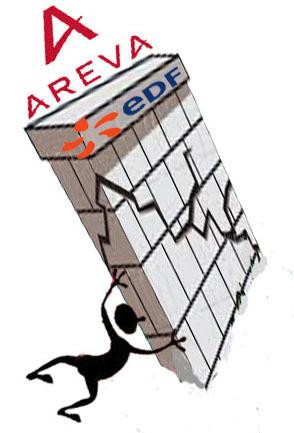
Both Areva and EDF are financially stressed, to put it mildly – hence a taxpayer-funded bailout agreed last year. A government-led rescue of Areva and the wider nuclear industry may cost the state as much as €10-billion, Reuters reported in January 2017, and in addition to its “dire financial state, Areva is beset by technical, regulatory and legal problems.”
French finance authorities raided the offices of EDF in July 2016 as part of a probe into EDF’s disclosure of information to the market regarding domestic nuclear maintenance costs as well as planned reactors in the UK.
Last year, former Areva chief executive Anne Lauvergeon was placed under formal investigation for the “publication of inaccurate accounts” and the “spreading of false information” in relation to the acquisition of a number of African uranium mines.
Japan: Only two of the country’s 42 ‘operable’ reactors are actually operating. The future of Japan’s nuclear program remains a guessing game, but projections are being steadily reduced. According to the OECD’s Nuclear Energy Agency and the IAEA, installed capacity of 42.4 GW in 2014 could fall to as little as 7.6 GW by 2035 “as reactors are permanently shut down owing to a range of factors including location near active faults, technology, age and local political resistance.”
Another reactor was permanently shut down in 2016 (Ikata-1) in addition to five shut-downs in 2015 and the six Fukushima Daiichi reactors shut down in the aftermath of the March 2011 disaster. Japan also decided last year to permanently shut down the troubled Monju fast breeder reactor. For all the rhetoric about Generation IV fast reactors, and the US$100+ billion invested worldwide, only five such reactors are operating worldwide (three of them experimental) and only one is under construction (in India).
Late last year, Japan’s Ministry of Economy, Trade and Industry revised the estimated cost of decommissioning the Fukushima Daiichi nuclear plant, and compensating victims of the disaster, to around US$187 bnillion (€175 bn). The latest estimate is four times greater than estimates provided in 2011/12. Indirect costs (e.g. fuel imports, adverse impacts on agriculture and fishing, etc.) are likely to exceed the direct clean-up and compensation costs.
India has 22 operable reactors (6.2 GW capacity) and five under construction. In early 2015, India claimed to have resolved one of the major obstacles to foreign investment by announcing measures to circumvent a liability law which does not completely absolve suppliers of responsibility for accidents. But that hasn’t led to any construction starts; indeed the last construction start was in 2011.
Newcomer countries: The WNA claims that “over 45 countries are actively considering embarking upon nuclear power programmes.” Codswallop. Only two newcomer countries are actually building reactors – Belarus and the United Arab Emirates. Numerous potential newcomers have deferred or abandoned nuclear plans over the past two years, including Chile, Indonesia, Vietnam and Lithuania (which operated reactors until 2009).
Newcomers will be few and far between. Moreover, some countries – including Germany, Belgium, and Taiwan – are deliberately phasing out nuclear power, while nuclear power faces attritional phase-outs in some other countries (e.g. Switzerland).
The July 2016 World Nuclear Industry Status Report noted that over the past two decades, only two countries started power reactors for the first time (Romania in 1996 and Iran in 2011) while two countries closed theirs (Kazakhstan and Lithuania).
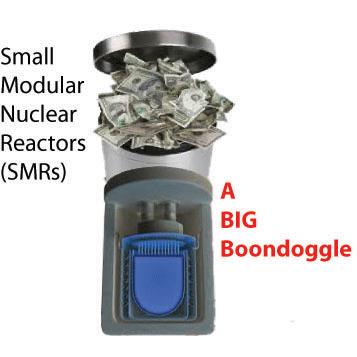
Small Modular Reactors NuClearNewsNo92 February 2017 Scotland Engineering giant Rolls-Royce is teaming up with a host of rivals including Amec Foster Wheeler and Arup and nuclear specialist Nuvia to develop mini-nuclear reactors. Rolls Royce believes the so-called next generation technology could support as many as 40,000 jobs if the industry flourishes. The consortium is entering a £250m competition started last March by the Government, which wants to find the best SMR design for civil use. It is hoped the technology will be more cost-effective than conventional plants. (1) The companies believe SMRs will strengthen the UK’s energy security by reducing reliance on foreign gas imports and smoothing out the impact of ‘intermittent generation’ technologies.
In November 2015, the British government announced plans to invest at least £250 million over the next five years in a nuclear research and development program including a competition to identify the best value SMR design for the UK. Rolls-Royce submitted a paper to the Department of Business, Energy and Industrial Strategy, outlining its plan to develop a fleet of 7 GWe of SMRs with its partners. Other participants in the UK’s SMR competition include French-owned EDF Energy and its Chinese partner CNNC, Westinghouse and US developer NuScale Power. (2)
In the US NuScale has formally completed its design submission to the Nuclear Regulatory Commission. The 12,000-page application will now undergo a lengthy review by the NRC, which must approve the design before construction can begin. (3)
According to City AM the Government’s work on SMRs appears to have slowed down, and many companies were expecting mention of plans in the industrial strategy published in January, but there was nothing specific. (4)
NuClearNewsNo92 February 2017Scotland and Hinkley A report, called ‘Scotland’s Wind’ (1), by Dr David Toke – Reader in Energy Politics at Aberdeen University and published by the Scottish Greens shows that UK, electricity consumers are set to pay around £16 a year for 35 years to subsidise Hinkley Point C. If Scottish consumers could go it alone their £16 levy could fund almost twice as much power from onshore and offshore wind farms.
The report says:
“If Scottish consumer s money was spent on supporting renewable energy rather than paying for their share of Hinkley Point C … then, even on conservative calculations, nearly double the amount of electricity would be generated from wind power as from Hinkley C”.
The costs of onshore windfarms and also offshore windfarms even on current prices need much less support from consumer surcharges to generate an equivalent amount of electricity compared to HPC. Wind power costs are falling rapidly, with some especially low prices being reported in Denmark and The Netherlands. Under such a programme organised by the Scottish Government the cheapest onshore windfarms could start generating in 2020 and offshore windfarms organised under a new, Danish-style framework, could be online in 2026.
The Scottish Government s own preference for renewable energy over nuclear power lends support to the suggestion that the Scottish Government should be able to use Scottish consumers money to pay for new renewable energy rather than new nuclear power. Moreover the best value for money for Scottish consumers in terms of generating non-fossil fuels is likely to come from the Scottish Government having powers to fund its own renewable energy programme from Scottish consumer bills. This is because the Scottish Government will be able to decide on what contract length to offer wind developers, for example offering to pay guaranteed prices for 20 years rather than 15 years as done by the Westminster Government now with renewable energy. Also, the Scottish Government will be able to organise a much more effective offshore windfarm programme than is being done by the Westminster Government. The Westminster Government’s methods are increasing the costs of offshore wind by leaving too much uncertainty to be dealt with by developers. The Scottish Government could organise a much cheaper offshore wind programme on the lines done by the Danish Energy Agency. This is likely to lead to lower costs and less confrontation in the courts over planning issues than is the case with the current offshore windfarm programme. (2)
Swiss to vote on government’s anti-nuclear energy strategy, The Local, 2 Feb 17, The Swiss people will go to the polls on May 21st to decide whether the government’s ‘energy strategy 2050’ should go ahead.
The policy, which will instigate a gradual withdrawal from nuclear power in favour of renewable resources, is opposed by the right-wing Swiss People’s Party (SVP) which in October launched a campaign to gather enough signatures to force a referendum on the matter.
On Tuesday the government confirmed that the SVP had gathered 68,390 valid signatures, well over the necessary threshold of 50,000, reported news agencies.
Consequently, in May the Swiss people will get the chance to have their say on the government’s energy plans.
The Energy Strategy 2050 was devised following the Fukushima nuclear disaster in 2011 and is spearheaded by energy minister and current Swiss President Doris Leuthard.
Under the plans no new nuclear power plants will be built in Switzerland and the five that do exist – including the world’s oldest operating reactor, Beznau I – will be decommissioned at the end of their technically safe operating life.











 nuclear-news