Trump’s associates and USA conservatives to wage war on environmentalists
Conservatives predict ‘real war’ with environmentalists http://www.eenews.net/stories/1060050477 Amanda Reilly, E&E News reporter Greenwire: Thursday, February 23, 2017 People who question the science of climate change today told conservative activists they were looking forward to using their bigger platform during the Trump administration to roll back U.S. EPA regulations on greenhouse gas emissions.
At the annual Conservative Political Action Conference, a panel of prominent global warming skeptics said one of their top targets was the Obama administration’s 2009 endangerment finding, the basis for EPA’s greenhouse gas regulations.
“It’s going to be a real war with environmentalists, no question about that,” said Steve Milloy, who says he served on President Trump’s EPA transition but was not listed on the administration’s official landing team for the agency. “There’s going to be a lot of litigation. But we’re going to move EPA in the right direction.”
Milloy said “nothing’s made me prouder than the fact that Donald Trump is now president” because Republicans as a whole had been lukewarm in their support of climate skeptics prior to Trump, who once called climate change a Chinese hoax.
The Energy & Environment Legal Institute sponsored the panel this morning in one of the side ballrooms at CPAC, happening outside Washington. Appearing on the panel with Milloy were James Delingpole and Tony Heller. All three have questioned whether human-caused climate change is occurring.
Delingpole, an executive editor at the Breitbart News Network, likened environmentalism to a religion and recycling advocates to a “cult.” The environmental movement, he told the conservative audience, was full of “control freaks” looking for a scientific justification “to tax us, to regulate us, to control our lives.”
Heller, who also goes by the pseudonym Steven Goddard, accused the government of faking statistics to make people believe in “absurd” and “fake news” climate change.
He claimed that conservatives who don’t believe in climate change have been treated like women who were accused of being witches in the 1600s. “Right now, conservatives get blamed for every bad weather event and for climate change, right. It’s our fault,” he said. “But hundreds of years ago, it was witches who were blamed for it.”
‘Scumbags’
The treatment of people who don’t believe in man-made warming is about to change during the Trump administration, Delingpole said. “The people who portray people like us as selfish, greedy, nature-hating scumbags — no. They are the scumbags. We are the good guys,” Delingpole said. “Thank goodness, thanks to Donald Trump, the tide’s turned, and we are about to witness that.”
Along with questioning federal climate change science, panelists also said they were skeptical of EPA research on everything from air pollution to pesticides. Milloy, who led a crusade against EPA’s risk assessment of secondhand smoke, said he hoped the Trump administration would completely end scientific research at the agency, accusing it of paying for “the science it wants.”
An agency “can’t be responsible for producing science and then regulating” based on that science, Milloy said.Being selected to EPA’s transition team was “a dream come true after fighting EPA for 25 years,” he said.
Conservatives are starting to see the fruits of the advice of that transition team, beginning with the confirmation of former Oklahoma Attorney General Scott Pruitt as EPA administrator, he said.
Under the Trump administration, Milloy said, warming skeptics would get to participate in debates over killing President Obama’s key climate policies, including the endangerment finding, which the Supreme Court upheld in 2014.
“The endangerment finding needs to be repealed,” he said. “If it’s not, then President Trump is going to be forced to issue his own climate policy.”
John Walke, clean air director at the Natural Resources Defense Council, slammed the panel in a series of tweets.
“This is alt-reality, folks,” he said.
Twitter: @apeterka Email: areilly@eenews.net
South Africa’s Minister of Finance silent about nuclear energy
 Why Gordhan’s silence on nuclear was golden’ The Minister effectively signaled that there is no need to react to exaggerated energy crisis talk coming from the pro-nuclear lobby’ Business Day, 24 FEBRUARY 2017 – 08:50 AM HARTMUT WINKLER South Africa’s Minister of Finance, Pravin Gordhan said very little about the energy sector in his recent budget speech. The word “energy” came up only once compared with 2016, when it was used five times. Even more notable is that he didn’t mention nuclear energy – a source of major contention – at all.
The explicit statements relating to energy were restricted to an increase in the fuel levy and affirmation that the independent power producer programme would continue with the development of further renewable and gas power generation.
This avoidance might at first glance seem odd given the heated controversies around power shortages as well as the government’s plans to invest in unaffordable nuclear power plants.
But there’s a great deal to take heart from. By downplaying the energy sector in his speech, the Minister effectively signaled that there is no need to react to exaggerated energy crisis talk coming from the pro-nuclear lobby. Instead, he is showing faith in the existing modest medium term energy budget, and an unwillingness to be diverted onto a reckless financial course…….
The significance of the Minister’s silence
Gordhan’s budget signalled that he is intent on standing firm against any political pressure by refusing to significantly deviate from the National Treasury’s long term expenditure plan.
Contrary to what his detractors would have hoped for, he did not make appreciably higher allocations to the nuclear sector. Instead he:
– Committed to the continuation of the independent power producer driven renewable energy programme. This has been opposed by the pro-nuclear Eskom;…….
Gordhan went on to say: “By acting now to stabilise debt … future generations will not pay … 20 or 30 years from now.”
This affirms the frequently stated view that the decision to embark on a massive nuclear build could only be financed through astronomical loans that will severely burden the nation for decades.
Gordhan has stood firm. But one question remains: will his stand lead to his dismissal and replacement with a stooge leading inevitably to a crash of the country’s currency, open warfare inside the ruling party and public protest? https://www.businesslive.co.za/rdm/politics/2017-02-24-why-gordhans-silence-on-nuclear-was-golden/
Britain’s conservatives want new nuclear power stations in Scotland
Tories back plans for new nuclear power plants in Scotland, The Scotsman, SCOTT MACNAB 23 February 2017 The creation of two new nuclear power plants in Scotland has been backed by the Scottish Conservatives. They would be housed on the site of the current plants at Torness in East Lothian and Hunterston in Ayrshire which are coming to the end of their lifespans. Both have already had their operational lives extended – with the backing of the anti-nuclear SNP government – because they are seen as essential to keeping the country’s energy mix. Tory leader Ruth Davidson is also backing a target to ensure 50 per cent of Scotland’s energy comes from renewables by 2030 and a drive towards greater use of electric cars in proposals set out in a major new policy paper on the environment yesterday. The plans came under fire from opposition parties who dismissed the Tories’ “green” credentials.
….The Tory government at Westminster has already unveiled plans to rebuild the Hinkley Point nuclear power station in Somerset, which will be led by French operator EDF, with new nuclear projects in the pipeline…..the plans were dismissed by Greens environment spokesman Mark Ruskell. He said: “The Tories have no environmental credentials. Actions always speak louder than words, and the actions of their UK government have set back the creation of jobs in Scotland’s renewables industry. As they flap about, trying to shed their nasty image, people will recognise greenwash when they see it.” Liberal Democrat Liam McArthur accused the Tories at Westminster of “sweeping cuts” in renewables. “The Tories are about as eco-friendly as a dustbin fire,” Mr McArthur said… http://www.scotsman.com/news/politics/tories-back-plans-for-new-nuclear-power-plants-in-scotland-1-4374207
Fight building in Connecticut against subsidies for nuclear power
 Connecticut girds for nuclear power debate as critics line up against Millstone support bill Independent generators say allowing the Dominion plant to bid into renewable energy solicitations would undermine competition. Utility Dive, 23 Feb 17 The bill to provide support for Connecticut’s sole nuclear power plant has yet to be drafted, but the opposition is already lining up.
Connecticut legislators are picking up where they left off last year and drafting a bill that would essentially make nuclear power a Class Irenewable resource, making it eligible to participate in state solicitations for renewable energy resources.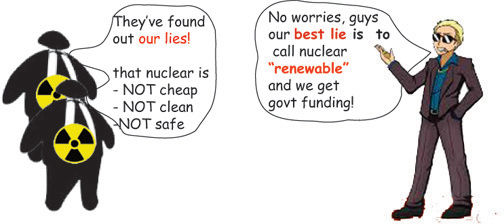
The nuclear plant is not named – indeed, the legislation is not even drafted – but there is only one nuclear plant in Connecticut, Dominion Energy’s 2,110 MW Millstone plant in Waterford.
Dominion has not been as vocal as other nuclear operators such as Exelon, which has for years said that it would have to close at least two of its nuclear plants in Illinois if it did not get some form of financial relief……
Nuclear subsidies and their discontents
As some have analysts have predicted, Illinois and New York’s success with ZECs has emboldened other states to follow suit.
In 2016, the Connecticut Senate passed SB 344, which would have allowed nuclear plants to bid into state RFPs as a renewable resource, but the bill did not make it through the state’s House of Representatives.
Legislators in the state are now drafting a bill, SB 106, that would take up those same issues again.
In its Feb. 7 testimony filed with Connecticut’s General Assembly, the Electric Power Supply Association, a trade group for independent generators, used SB 344 as the basis of its comments on the assumption that the bill will provide the “framework” for the new SB 106.
SB 344 would have expanded the definition of “renewable” so that nuclear power could bid into the state’s clean energy solicitation and be eligible to be awarded a 10-year power purchase agreement……..http://www.utilitydive.com/news/connecticut-girds-for-nuclear-power-debate-as-critics-line-up-against-mills/436685/
Fear of terrorists smuggling nuclear weapons in marijuana – why the Mexico wall is needed, says GOP lawmaker
GOP lawmaker calls for Trump’s border wall, warns nuclear weapons may be hidden in marijuana Arizona Republican Rep. Trent Franks told CNN he worries about terrorists using bales of marijuana to smuggle nukes, salon.com Arizona Republican Rep. Trent Franks defended President Donald Trump’s proposed border wall by claiming it could prevent a nuclear weapon from being smuggled into the United States concealed in a bale of marijuana……..
In 2014, he said that the militant group ISIS had operations running in Ciudad Juarez, a claim that a senior U.S. law enforcement official said had no basis in reality. As his website notes, he also raised the specter of Hezbollah smuggling marijuana nukes into the U.S. back in 2012……http://www.salon.com/2017/02/23/gop-lawmaker-calls-for-trumps-border-wall-warns-nuclear-weapons-may-be-hidden-in-marijuana/
New Mexico bill stalled – would have classed nuclear power as “renewable”
Bill to label nuclear energy as renewable stalls A bill aimed at classifying nuclear power as a renewable energy source in New Mexico stalled Thursday afternoon in committee on a tie vote.
House Bill 406, sponsored by Rep. Cathrynn Brown, R-Carlsbad, would have amended the state’s Renewable Energy Act, which requires energy companies provide a certain amount of electricity from renewable sources…. New Mexico Political Report 24 Feb 17
Nuclear Is Renewable Energy? http://krwg.org/post/nuclear-renewable-energy
By CVNM •Santa Fe, N.M. 24 Feb 17 – Today, the House Energy, Environment and Natural Resources Committee debated Nuclear Energy as Renewable Energy (HB 406, Brown). The bill was tabled on a tied vote. CVNM Legislative Director Ben Shelton and CVNM Education Fund Western New Mexico Program Director Talia Boyd released the following statements:
“Nuclear energy is part of the problem, not the solution. Proposing to classify nuclear as renewable energy – as Governor Martinez did her in energy plan – disrespects the sacrifice Indigenous communities in western New Mexico have already made and continue to make with their health from the impacts of uranium mining,” says Ben Shelton, CVNM Legislative Director. “In addition, adding nuclear energy to the Renewable Energy Portfolio standard neutralizes its job creating potential because of nuclear assets already held by New Mexico’s two largest electric utilities – something our leaders should not consider a possibility.”
“My community in Gallup and Church Rock have witnessed our health, culture, families, and land be desecrated and sacrificed for uranium – an industry that many in our communities do not want, as demonstrated by a ban on uranium mining passed by the Navajo Nation in 2005,” says Talia Boyd, CVNM Education Fund Western New Mexico Organizer and member of the Diné Nation.
“Communities that have been living with the impacts of poor energy policy need to be at the table shaping our energy future by putting hardworking New Mexicans first with clean, renewable energy jobs, like wind and solar.”
Nuclear station restart at Oi, Japan, approved – but local consent is needed

 Local consent needed despite OK to restart Oi nuclear plant, Asahi Shimbun February 23, 2017 The Nuclear Regulation Authority on Feb. 22 published a draft safety inspection report saying measures taken at the Nos. 3 and 4 reactors of Kansai Electric Power Co.’s Oi nuclear power plant in Fukui Prefecture meet the new stricter anti-disaster standards.
In 2014, however, the Fukui District Court ordered the operator to keep the two reactors offline, raising serious questions about their safety.
Some 160,000 people in Fukui, Kyoto and Shiga prefectures reside within 30 kilometers from the plant. It is also questionable whether local residents can be evacuated quickly and smoothly if a serious accident occurs at the plant.
In a recent Asahi Shimbun survey, 57 percent of the respondents expressed their opposition to the restart of offline nuclear reactors, nearly double the number of those who supported the idea.
Come next month, six years will have passed since the catastrophic accident broke out at the Fukushima No. 1 nuclear power plant. Many Japanese remain unconvinced of the safety of nuclear reactors.
Kansai Electric Power is hoping to bring the two reactors back on line as early as this summer. But we find it difficult to support the plan.
There are multiple faults around the Oi plant. The biggest worry cited in the district court ruling was the possibility that a stronger earthquake than assumed could seriously damage the reactors or the spent fuel pool.
The electric utility has since appealed the ruling. But the company has also raised the estimated maximum ground acceleration that could occur in an earthquake at the location.
The utility will spend 122 billion yen ($1.07 billion) on measures to enhance the safety of the plant.
But Kunihiko Shimazaki, a seismologist and former acting chairman of the NRA, has warned against the plan. Using observation data about the powerful earthquakes that hit areas around Kumamoto Prefecture in April last year, he has argued that the utility’s calculation method may have underestimated the biggest potential shaking of a quake at the location.
After reviewing the data, the NRA dismissed Shimazaki’s argument, with Chairman Shunichi Tanaka calling it “groundless.”
But the scientist’s warning has deepened anxiety among local residents.
The spent fuel pools at Kansai Electric Power’s three nuclear power plants including Oi are almost filled to the brim.
The utility says it will build an interim storage facility outside Fukui Prefecture around 2030 so that used fuel rods can be removed from the pools.
But the company has yet to map out a specific and workable plan to build such a facility…….http://www.asahi.com/ajw/articles/AJ201702230032.html
President Donald Trump’s control of U.S. nuclear forces is no longer a laughing matter.
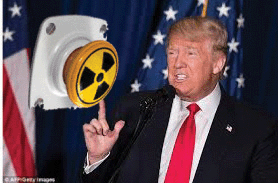 The Trump Nuclear Threat, It’s time to worry about Donald Trump’s control of U.S. nuclear forces. US News, By Louis René Beres | Feb. 21, 2017,
China stalls in its push for nuclear power
 China Nuclear Push Stalled by Next-Generation Reactors, Bloomberg, by Stephen Stapczynski and Aibing Guo, February 21, 2017,
-
Aims to approve eight new nuclear reactor projects this year
-
CGN’s Taishan units see further delay in commercial operations
China’s decision to approve its first new nuclear reactors in two years may need to wait for its success starting up the world’s first next-generation units.
Plans to green-light eight reactors this year in the world’s fastest-growing nuclear market, announced last week, could depend on whether it’s able to complete some of the world’s most-advanced facilities, including Westinghouse Electric Co.’s AP1000 and Areva SA’s EPR. The first such reactors may come online as early as the first half, followed by new approvals, according to Karl Liu, an analyst at BOC International Holdings Ltd. in Hong Kong.
“There are indications that Chinese policy makers want to wait for the AP1000s and EPRs under construction to come online and see how they do operationally before approving new projects,” said M.V. Ramana, a professor at the University of British Columbia. “I am not entirely sure that this plan will actually translate into reality.”
China is seeking to be the first country to bring online either an AP1000 or EPR, so-called generation III+ reactors, which have suffered costly delays in the U.S. and Europe. The world’s second-biggest economy, and largest energy consumer, is aiming to boost its nuclear power capacity and develop its own next-generation technology for export.
Construction delays for third-generation units are among reasons the Chinese government approved no new reactors last year, according to BOC’s Liu.
“The country wants to wait until the first AP1000 reactor successfully starts commercial operations before approving reactors using the same or similar technologies,” he said. …….
Originally designed to be cheaper and safer than earlier technology, growing complexity and new safety requirements of third-generation reactors are among cost issues that contributed to Westinghouse’s parent company Toshiba Corp. taking a multi-billion dollar writedown this year and Areva seeking a government bailout.
Oversupply
China’s power-generation overcapacity is another possible risk to new approvals, according to Ramana at the University of British Columbia. The country began showing signs of a glut as early as 2013, and hit a high in 2015, according to IHS Markit…….https://www.bloomberg.com/news/articles/2017-02-20/china-nuclear-ambitions-seen-stalled-by-next-generation-reactors
Florida Senate bill to promote solar energy, and repeal nuclear fees
 Pro-consumer Florida energy bills would expand solar, repeal nuclear fees http://protectingyourpocket.blog.mypalmbeachpost.com/2017/02/21/pro-consumer-florida-energy-bills-would-expand-solar-repeal-nuclear-fees/
Growing concern over Trump’s mental condition
Their letter prompted another, from Dr Allen Frances, professor emeritus of psychiatry and behavioural sciences at Duke University Medical College, who happens to be the expert psychiatrist who defined narcissistic personality disorder.
He rebuked the authors, arguing that to claim that Trump is mentally ill is an insult to those who truly are. But he also had this to say – Trump may be a “world-class narcissist”.
But the debate has taken off. Another psychologist weighed in last month, telling US News and World Report that Trump displays a malignant narcissism, characterised by grandiosity, sadism and anti-social behaviour.
 Americans take an anxious journey to the centre of Donald Trump’s mind, The Age,Paul McGeough, 20 Feb 17 Washington: Flip references by reporters – mine included – to Donald Trump not taking his meds have been criticised as offensive to the mentally ill. But Trump’s unhinged behaviour, as in his erratic press conference on Thursday, ensures that the President’s mental state is the stuff of debate.
Rick Wilson, a Republican Party strategist and Trump critic, saw the Thursday press conference as a turning point – instead of a divide between left and right, the split he sees in America is between those who saw the spectacle as a “success” and those who are “terrified” for the future of the country.
“[His press conference] could have been evidence in a mental competency hearing,” he told The Washington Post. “It was really pretty disturbing and terrifying to watch this guy and think: ‘What happens when the stakes are higher?’”
On Saturday, The New York Times‘ conservative columnist David Brooks wrote in similar language about the press conference: “President Trump’s mental state is like a train that long ago left freewheeling and iconoclastic, has raced through indulgent, chaotic and unnerving, and is now careening past unhinged, unmoored and unglued.”
It’s not just the commentariat in the “fake press”, on which Trump has upped the ante, denouncing them as “the enemy of the American people”. Mental health professionals are weighing in.
In a letter to the editor of The New York Times last week, 35 psychiatrists, psychologists and social workers acknowledged they were in breach of professional rules against evaluating public figures, but to remain silent, they wrote, denied journalists and members of Congress the value of their expertise at this critical time.
Here’s their diagnosis: “Mr. Trump’s speech and actions demonstrate an inability to tolerate views different from his own, leading to rage reactions. His words and behaviour suggest a profound inability to empathise. Individuals with these traits distort reality to suit their psychological state, attacking facts and those who convey them (journalists, scientists).
“In a powerful leader, these attacks are likely to increase, as his personal myth of greatness appears to be confirmed. We believe that the grave emotional instability indicated by Mr Trump’s speech and actions makes him incapable of serving safely as president.”
Their letter prompted another, from Dr Allen Frances, professor emeritus of psychiatry and behavioural sciences at Duke University Medical College, who happens to be the expert psychiatrist who defined narcissistic personality disorder.
He rebuked the authors, arguing that to claim that Trump is mentally ill is an insult to those who truly are. But he also had this to say – Trump may be a “world-class narcissist”.
But the debate has taken off. Another psychologist weighed in last month, telling US News and World Report that Trump displays a malignant narcissism, characterised by grandiosity, sadism and anti-social behaviour.
Trump biographer Michael D’Antonio observes: “He lives inside his head, where he runs the same continuous loop of conflict with people he turns into enemies for the purposes of his psychodrama.”
The press conference was Trump unleashed. As though he couldn’t help himself, he seized the lectern at the end of a first chaotic month that had prompted this assessment from General Tony Thomas, head of the military’s Special Operations Command: “Our government continues to be in unbelievable turmoil. I hope they sort it out soon, because we’re a nation at war.”
In casting aside the usual filters and talking heads such as Sean Spicer and Kellyanne Conway, Trump signalled an attempted reset. After weeks of leaks, he is determined to rewrite the agenda – he was doing it again at a Boeing factory in South Carolina on Friday and at a campaign-style rally in Florida on Saturday.
Instead of being confronted by pesky, fake journalists, Trump was hungry for the adoring fans who turned out to both events, described by presidential historian Timothy Naftali as “an attempt to inject some adrenaline into his administration and shake a perception of loserdom“.
At the Florida bash, Trump basked in the glow of a 9000-strong crowd, forgetting his plummeting polls as he re-ran a string of well-worn campaign promises and whacked the media again before reaching his crescendo.
After serial exaggerations and misrepresentations of all that his administration has achieved, or not, he declared: “It’s a new day in America – this will be change for the ages, change like never before.”
But back in the real world, White House deputy press secretary Sarah Huckabee Sanders was probably earning a presidential rebuke by acknowledging Trump’s frustration with media reporting, as she explained the Florida gig was likely to be the first to put Trump out front more often.
“There’s definitely frustration that the media makes up stories and reports things that aren’t true,” she told the Post. The Florida rally, she said, was an attempt “for the President to speak directly to the American people and not have his message filtered through a biased media.”………
As he basked in the limelight at Boeing on Friday, Associated Press dropped an exclusive – an internal administration document outlining a plan for the National Guard to be drafted to round up undocumented migrants. Despite its conformity with all that Trump said in the election campaign, the White House claimed it had been discarded.
Also on Friday, Trump hit a new low in opinion polls – confirming his standing as the least popular new president in American history, Gallup found that just 38 per cent of Americans approve his performance, against 56 per cent who disapprove.
Amidst a constant sense of crisis, two emerging patterns work against Trump – the Republican establishment figures who might save his administration are increasingly reluctant to work for him and he is being hemmed in by the checks and balances of the American democratic process.
Also working against him is the toxic brew he has concocted in the White House – factions divided by ideology and new hires defeated by their youth and inexperience.
After the debacle of appointing a national security adviser who proved incapable of surviving in the job for a month, Trump is desperately seeking for a replacement…….
Trump and those around him are paranoid about loyalty. In the last week, the State Department sacked six senior career staffers who were deemed suspect. And faction wars continue with gusto…….. http://www.theage.com.au/world/americans-take-an-anxious-journey-to-the-centre-of-donald-trumps-mind-20170219-gugc6j.html
Top science adviser warns on the change in culture in the Trump era
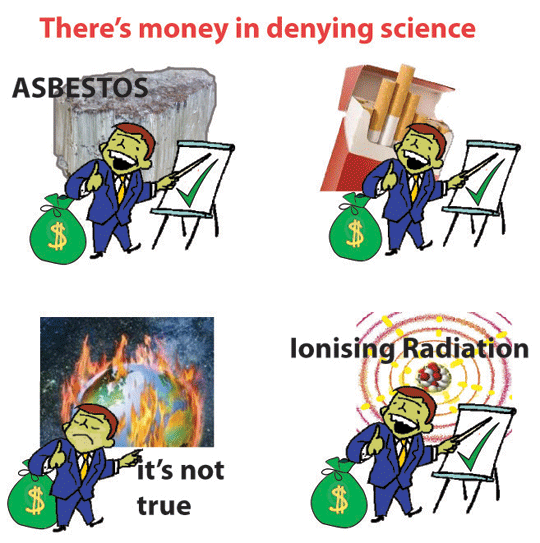 Obama’s top science adviser’s guide to navigating the Trump era John Holdren: “We can be in for a major shift in the culture around science.” Vox News, Feb 18, 2017 BOSTON — If there’s a subtext to this year’s meeting of the American Association for the Advancement of Science, the largest gathering of scientists of the year, it’s anxiety for the future.
John Holdren, the top science adviser to President Barack Obama who spoke Friday at the conference, summed it up like this:
“I’m worried — based on early indications — that we can be in for a major shift in the culture around science and technology and its eminence in government. We appear to have a president now that resists facts that do not comport to his preferences. And that bodes ill on the Obama Administration’s emphases on scientific integrity, transparency, and public access.”
Trump has yet to select people for several top science jobs in the administration — such as NASA administrator, director of the CDC, and director of the NIH.
One of the names floated for Trump’s science adviser is Will Happer, a former Princeton physics professor who recently told ProPublica the science on global warming was “very, very shaky.”……
Scientists are becoming more politically engaged in the Trump era, and it shows here at AAAS. Later in the day, Harvard science historian Naomi Oreskes got a standing ovation after speaking on how scientists can — and should — be “sentinels” for the public, and shouldn’t fear a loss of credibility for getting more politically engaged……http://www.vox.com/science-and-health/2017/2/18/14653234/holdren-aaas-science-trump
US nuclear industry looks to Trump to change nuclear regulation rules
 Trump and U.S. Nuclear Power Find Common Ground in Jobs Push, Bloomberg by Jonathan Crawford February 8, 2017,
 -
Early signs suggest Trump is eager to keep reactors open
-
Obama gave a higher priority to wind and solar power: NEI
Nuclear power providers, battered by low prices and competition from cheap natural gas, say they can help President Donald Trump fulfill a campaign promise to put more people to work.
Trump will throw more support behind nuclear power than the Obama administration, which gave a higher priority to wind and solar power, Maria Korsnick, president and chief executive officer of the Nuclear Energy Institute, said in an interview Tuesday at Bloomberg headquarters in New York. The industry’s goal of expanding the number of U.S. nuclear reactors dovetails into Trump’s campaign promise to add jobs and boost investment in infrastructure.
Profits for U.S. nuclear operators are falling with the collapse of wholesale power prices amid a boom in gas production and rising supplies of renewables. Five nuclear plants will close by 2025, bringing the total number of retirements to 10 since 2009 when the shale boom was just getting underway. ………
Korsnick said. “The previous administration was a bit more in love with renewables.”
Early indications suggest that Trump may be supportive of nuclear power and receptive to the concerns of the industry. In a document obtained by Bloomberg, Trump’s transition team asked the Energy Department how it can help keep nuclear reactors “operating as part of the nation’s infrastructure” and what it could do to prevent the shutdown of plants.
Regulatory Support
The administration can help at the Federal Energy Regulatory Commission, which oversees wholesale U.S. power markets. …….Korsnick is pushing for more states to follow New York and Illinois, which approved measures to prevent the premature closing of money-losing nuclear plants.
In December, Illinois approved annual payouts of about $235 million for 10 years to keep Exelon Corp.’s Quad Cities and Clinton reactors open. In August, New York regulators approved subsidies totaling about $500 million a year for the R.E. Ginna and Nine Mile Point nuclear plants owned by Exelon, and the James A. FitzPatrick plant it is purchasing from Entergy Corp.
“FERC can value what nuclear brings,” Korsnick said. “They can value it in the same way that some of the states have valued it.”……..https://www.bloomberg.com/news/articles/2017-02-07/trump-and-u-s-nuclear-power-find-common-ground-in-jobs-push
Trump’s attitude to science is like Stalin’s , says Australia’s Chief Scientist
Australia’s chief scientist compares Trump to Stalin over climate censorship
 Alan Finkel warns that forcing EPA data to undergo political review before publication will ‘cause long-term harm’, Guardian, Gareth Hutchens, 7 Feb 17, Australia’s chief scientist has slammed Donald Trump’s attempt to censor environmental data, saying the US president’s behaviour was comparable to the manipulation of science by the Soviet Union.
Speaking at a scientific roundtable in Canberra on Monday, Alan Finkel warned science was “literally under attack” in the United States and urged his colleagues to keep giving “frank and fearless” advice despite the political opposition.
“The Trump administration has mandated that scientific data published by the United States Environmental Protection Agency from last week going forward has to undergo review by political appointees before that data can be published on the EPA website or elsewhere,” he said.
“It defies logic. It will almost certainly cause long-term harm. It’s reminiscent of the censorship exerted by political officers in the old Soviet Union.
“Every military commander there had a political officer second-guessing his decisions.”
Last month Trump’s administration mandated that any studies or data from scientists at the EPA undergo review by political appointeesbefore they can be released to the public.
The communications director for Trump’s transition team at the EPA, Doug Ericksen, said the review also extended to content on the federal agency’s website, including details of scientific evidence showing the Earth’s climate was warming and human-induced carbon emissions were to blame.
Finkel compared the Trump administration’s attempt to censor science to the behaviour of Soviet dictator Josef Stalin.
“Soviet agricultural science was held back for decades because of the ideology of Trofim Lysenko, who was a proponent of Lamarckism,” he said……..https://www.theguardian.com/science/2017/feb/06/australias-chief-scientist-compares-trump-to-stalin-over-climate-censorship
Taking a longer view of a nuclear North Korea
 Should we really be so afraid of a nuclear North Korea? https://theconversation.com/should-we-really-be-so-afraid-of-a-nuclear-north-korea-71855 The Conversation, Markus Bell, Anthropologist and Lecturer in Korean and Japanese studies, University of Sheffield , Postdoctoral Scholar, Korean Studies Institute, University of Southern California February 6, 2017 The common thinking is that North Korea’s nuclear programme poses a threat to global peace and diverts economic resources from an impoverished population. North Korean leaders are depicted in the Western media as a cabal of madmen who won’t be satisfied until Washington, Seoul, or some other enemy city is turned into a “sea of fire”.
Successive US governments have used a range of carrots and sticks to entice or pressure the North Korean leadership to give up its nuclear programme. The North’s missile launches and nuclear tests in 2016 make plain that these efforts have failed; in short, the West has to accept that it is now a nuclear power and focus instead on limiting the risks a nuclear North Korea presents.
But it also pays to consider what sounds like a perverse question: could a North Korean bomb actually benefit both the country’s people and the world at large?
First, a reality check: the North Korean nuclear programme is less a madcap scheme than a clear and deliberate strategy. Its leaders have closely watched what’s happened to other countries that have backed away from nuclear arsenals, and two in particular: Ukraine and Libya.
Ukraine gave up its massive Soviet-era nuclear arsenal in 1994 when it signed the Budapest Memorandum with Russia, the US and the UK, on whose terms it traded nuclear weapons for a formal reassurance to respect its sovereignty; 20 years later, Moscow invaded and annexed the Crimean peninsula, and a pro-Russian insurgency in the east is still rumbling. As for Libya, Muammar Gaddafi renounced his weapons of mass destruction programme as part of an opening to the West only to be forcibly removed from power by the same countries some eight years later.
Along with the Iraq War, these spectacles taught the North Korean regime that it’s hard for a relatively small, isolated country to survive without the military hardware to guarantee it. Pyongyang has duly shown great diplomatic skill in drawing out nuclear negotiations, buying itself both time and financial aid as its programme moves forward.
In 2016 alone, it tested two nuclear weapons, sent a satellite into orbit, and made advances in both submarine launched ballistic missiles (SLBM) and intercontinental ballistic missile (ICBM) technology. In his New Year’s address at the start of 2017, Kim Jong-un emphasised that the country’s nuclear forces are central to its self-defence capability: “We will defend peace and security of our state at all costs and by our own efforts, and make a positive contribution to safeguarding global peace and stability.”
The long view
A nuclear North Korea obviously worries the international community for several reasons. Kim might in theory actually use nuclear weapons on his enemies, a threat he periodically makes. His country’s admission into the “nuclear club” might spark a regional arms race. It could share or sell technologies of mass destruction to hostile states. And then there’s the danger of a full-blown nuclear accident with all the attendant regional repercussions.
These risks aren’t trivial, but they should be viewed with some perspective. For starters, a nuclear attack from Pyongyang appears highly unlikely. The government is fully aware that it would incur an overwhelmingly destructive military response from the US and South Korea. It’s also worth remembering that while the programme has been underway for 25 years, there is still no sign of a regional nuclear arms race.
As for proliferation or accidents, these demand not isolation but co-operation and communication. Keeping Pyongyang cut off from the world will not help; if its nuclear facilities are to be kept safe and their products not used to bring in illicit foreign revenue, they must be properly monitored rather than kept hidden.
Meanwhile, a nuclear North Korea might well see fit to downsize its enormous and costly conventional military forces, which are among the world’s largest. As it transitions away from what it calls a “Military First” policy to something more deterrent-centric, it makes sense to encourage it to reduce its conventional military forces. (Better still, if it did, heavily-armed South Korea might follow suit.)
With a smaller conventional military to maintain, Pyongyang might be able to channel scarce state funds away from defence and towards raising the standard of living for ordinary North Koreans. This point is in line with its stated strategy of growing the economy and developing the nuclear deterrent in parallel, a policy known as the Byungjin line, and with Kim’s mooted five-year economic plan. His plans demand dramatic shifts in North Korean state policy, which could destabilise the regime. The calculation is that the security provided by nuclear capabilities would offset the shock of sudden domestic change.
Most paradoxically of all, North Korea’s nuclear “arrival” might make for a positive turn in inter-Korean relations. International efforts to eliminate North Korea’s nuclear programme isolated the country, in turn greatly undermining the chances of a rapprochement with the South, whose efforts to defrost relations have lately come to nothing. The pace of the North’s nuclear development meant that the now-impeached President Park’s policy of reconciliation – “Trustpolitik” – was doomed before it began.
As far as Pyongyang is concerned, its militaristic strategy has worked: It has kept the Kim government internally stable, the population dependent on the government, and the country’s enemies at bay. Accepting the country’s nuclear status, rather than trying to head it off with sanctions and threats, could bring it back to the diplomatic bargaining table.
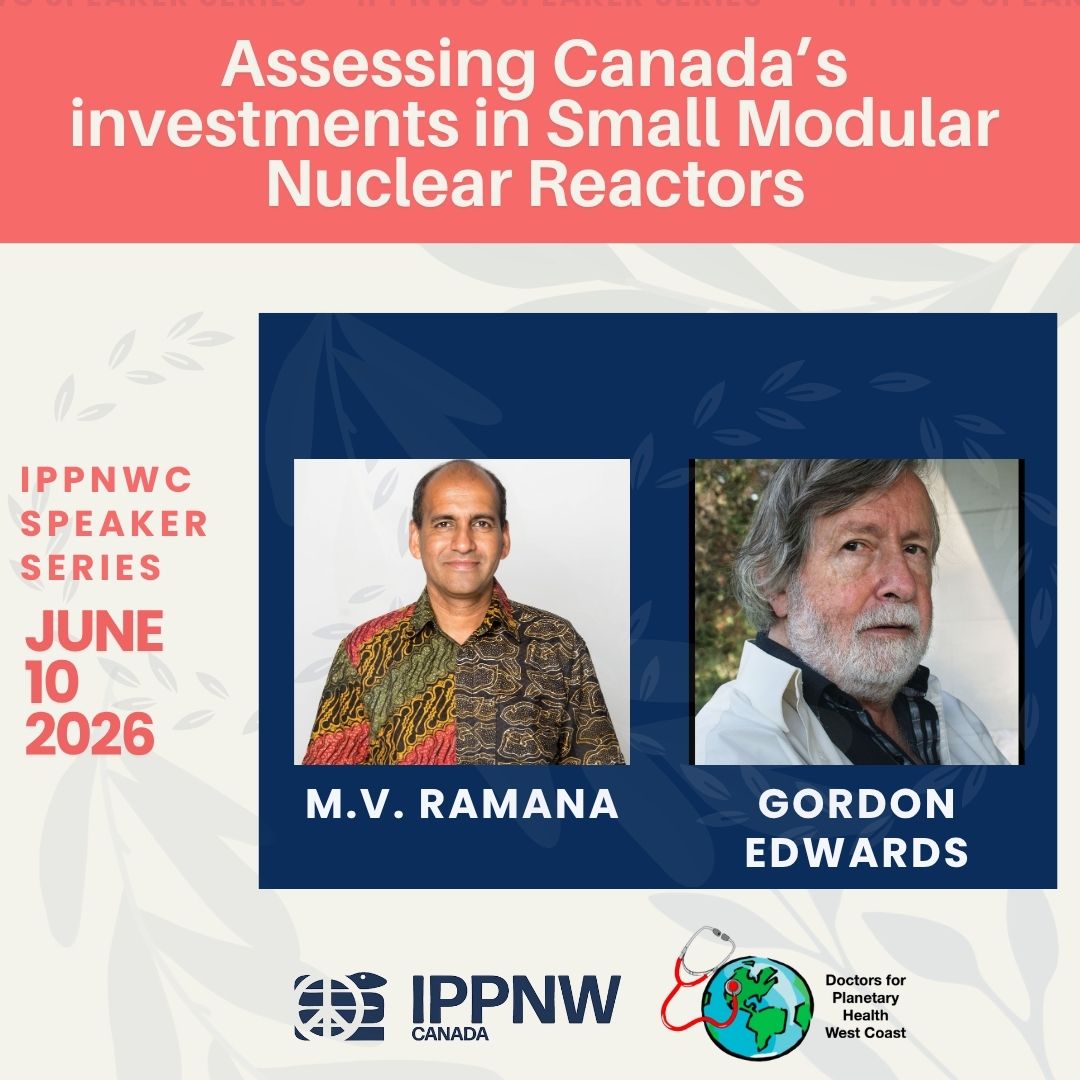
1 This Month
10 June – Assessing Canada’s Investments in Small Modular Nuclear Reactors – https://zoom.us/meeting/register/IiqHA5feRhaEBycOLNTJlA#/registration


Cuba Is Not a Failed State – It Is a Besieged State
PETITION: “Global Appeal to Endorse Palestinian Right of Return of Refugees”
To see nuclear-related stories in greater depth and intensity – go to https://nuclearinformation.wordpress.com
-
Archives
- June 2026 (89)
- May 2026 (306)
- April 2026 (356)
- March 2026 (251)
- February 2026 (268)
- January 2026 (308)
- December 2025 (358)
- November 2025 (359)
- October 2025 (376)
- September 2025 (257)
- August 2025 (319)
- July 2025 (230)
-
Categories
- 1
- 1 NUCLEAR ISSUES
- business and costs
- climate change
- culture and arts
- ENERGY
- environment
- health
- history
- indigenous issues
- Legal
- marketing of nuclear
- media
- opposition to nuclear
- PERSONAL STORIES
- politics
- politics international
- Religion and ethics
- safety
- secrets,lies and civil liberties
- spinbuster
- technology
- Uranium
- wastes
- weapons and war
- Women
- 2 WORLD
- ACTION
- AFRICA
- Atrocities
- AUSTRALIA
- Christina's notes
- Christina's themes
- culture and arts
- Events
- Fuk 2022
- Fuk 2023
- Fukushima 2017
- Fukushima 2018
- fukushima 2019
- Fukushima 2020
- Fukushima 2021
- general
- global warming
- Humour (God we need it)
- Nuclear
- RARE EARTHS
- Reference
- resources – print
- Resources -audiovicual
- Weekly Newsletter
- World
- World Nuclear
- YouTube
-
RSS
Entries RSS
Comments RSS
 nuclear-news