 Trump Again Attacks Media as White House Bars NYT, CNN & BBC from Gaggle
  https://www.democracynow.org/2017/2/27/headlines/trump_again_attacks_media_as_white_house_bars_nyt_cnn_bbc_from_gaggle
President Trump again escalated his self-declared war on the media, while speaking at CPAC, the Conservative Political Action Conference, on Friday.
President Donald Trump: “A few days ago, I called the fake news the enemy of the people. And they are. They are the enemy of the people, because they have no sources. They just make them up when there are none.”
That’s Trump, speaking the same day the White House took the unprecedented act of barring The New York Times, CNN, Politico, the Los Angeles Times, the BBC and several other news organizations from an off-camera briefing known as a gaggle. Several right-wing news outlets were allowed to attend, including Breitbart, The Washington Times and One America News Network.
March 1, 2017
Posted by Christina Macpherson |
media, politics, USA |
2 Comments
NY Times rips into Trump: ‘An inept White House led by a celebrity apprentice’http://thehill.com/blogs/blog-briefing-room/news/320231-ny-times-rips-into-trump-an-inept-white-house-led-by-a BY NIKITA VLADIMIROV – 02/18/17 The New York Times on Saturday published a blistering assessment of President Trump’s performance, blasting him for a lack of meaningful accomplishments.
“It’s with a whiff of desperation that President Trump insists these days that he’s the chief executive Washington needs, the decisive dealmaker who, as he said during the campaign, ‘alone can fix it,’ ” The Times wrote in its editorial.
“What America has seen so far is an inept White House led by a celebrity apprentice.”
The newspaper’s editorial board argued that Trump’s executive orders are not achievements and that the president has not yet been able to spearhead any meaningful reform effort.
The editorial board claimed that Trump’s adviser Steve Bannon writes his script while Reince Priebus, the White House chief of staff, “crashes meetings to which he has not been invited.”
“The White House is a toxic mix of ideology, inexperience and rivalries; insiders say tantrums are nearly as common as the spelling errors in the press office’s news releases,” the Times said.
“If there is any upside here, it is that the administration’s ineptitude has so far spared the nation from a wholesale dismantling of major laws, including the Affordable Care Act, though he may yet kill the law through malign neglect.”
The Times also criticized the president for planning to partially dismantle top government agencies, including the Environmental Protection Agency, which employs a vast team of specialists and experts.
“Indeed, unless Mr. Trump can bring some semblance of order to his official household and governing style, the only element of his famous campaign pledge that may prove accurate is the ‘alone’ part,” the newspaper concluded.
March 1, 2017
Posted by Christina Macpherson |
media, politics, USA |
Leave a comment

 UK nuclear power stations ‘could be forced to close’ after Brexit Leaving Euratom treaty will shut down nuclear industry if international safety agreements are not made in time, MPs told, Guardian, Adam Vaughan, 1 Mar 17, Nuclear power stations would be forced to shut down if a new measures are not in place when Britain quits a European atomic power treaty in 2019, an expert has warned.
Rupert Cowen, a senior nuclear energy lawyer at Prospect Law, told MPs on Tuesday that leaving the Euratom treaty as the government has promised could see trade in nuclear fuel grind to a halt.
The UK government has said it will exit Euratom when article 50 is triggered. The treaty promotes cooperation and research into nuclear power, and uniform safety standards.
“Unlike other arrangements, if we don’t get this right, business stops. There will be no trade. If we can’t arrive at safeguards and other principles that allow compliance [with international nuclear standards] to be demonstrated, no nuclear trade will be able to continue.”
Asked by the chair of the Commons business, energy and industrial strategy select committee if that would see reactors switching off, he said: “Ultimately, when their fuels runs out, yes.” Cowen said that in his view there was no legal requirement for the UK to leave Euratom because of Brexit: “It’s a political issue, not a legal issue.”
The UK nuclear industry would be crippled if new nuclear cooperation deals are not agreed within two years, a former government adviser told the committee.
“There is a plethora of international agreements that would have to be struck that almost mirror those in place with Euratom, before we moved not just material but intellectual property, services, anything in the nuclear sector. We would be crippled without other things in place,” said Dame Sue Ion, chair of the Nuclear Innovation and Research Advisory Board, which was established by the government in 2013.
She said movement of the industry’s “best intellectual talent” was made easier by the UK’s membership of Euratom…….
Over the weekend, the GMB union called on ministers to reconsider their “foolhardy rush” to leave the treaty, claiming it could endanger the “UK’s entire nuclear future”…….
Norman also promised a decision was due soon on the next stage of a delayed multimillion-pound government competition for mini nuclear reactors, known as small modular reactors. “I love the projects and ideas but I want to be shown the value,” he told the peers. https://www.theguardian.com/business/2017/feb/28/british-nuclear-power-stations-could-be-forced-to-close-after-brexit
March 1, 2017
Posted by Christina Macpherson |
politics, UK |
Leave a comment
 Energy Department issues scathing evaluation of nuclear project WP, By Steven Mufson February 28
 The Energy Department has delivered a blunt assessment of the work done by one of the world’s biggest companies in the nuclear business: “Unsatisfactory.”
For a decade, CB&I Areva MOX Services has been under contract with the Energy Department’s National Nuclear Security Administration to design, build and operate a facility near the Savannah River in Aiken, S.C.
Yet the project — designed to convert weapons-grade plutonium and uranium into a mixed oxide fuel for commercial nuclear power plants — has been running far beyond budget and way behind schedule. Estimates now put the price tag at $17 billion.
On Dec. 5, the NNSA completed a scathing evaluation that branded several of the company’s claims about the state of the project “misleading” and “inaccurate.” The agency said CB&I Areva’s claims that the project is 70 percent complete “are patently false.” A separate September 2016 Energy Department report said construction was only 28 percent complete……
CB&I Areva is a venture created as a combination of Chicago Iron & Steel and the French nuclear giant Areva. The company did not return calls for comment……
One of the project’s sharpest critics Tom Clements, director of the public interest group Savannah River Site Watch, obtained the December NNSA assessment through a Freedom of Information Act request. He called the evaluation “devastating.”
“I have never seen an asessment like that. It all but calls them liars,” he said……
the Obama administration continued to say the MOX plant at Savannah River wasn’t practical. What started as a $620 million project in 1999 with a 2006 starting date has become a $17 billion project still decades away from a start state. By some estimates, it would require a $1 billion a year appropriation, which the Obama administration said was unlikely at best…..
The assessment said that while the contractor boasted of “zero order non-compliance,” in fact the NNSA found evidence of non-compliance.
Overall, the NNSA awarded nothing from the $2.7 million available for a bonus payment to the contractors. It said, “there continued to be a lack of transparency and openness in external communications with key project stakeholders by the contractor including continued release of misleading and inaccurate project information.” https://www.washingtonpost.com/business/economy/energy-department-issues-scathing-evaluation-of-nuclear-project/2017/02/28/8af4d11a-fd2c-11e6-99b4-9e613afeb09f_story.html?utm_term=.4b6e8e136ee6
March 1, 2017
Posted by Christina Macpherson |
politics, technology, USA |
Leave a comment

 LOOKING FOR MR. NUCLEAR, The amaBhungane Centre for Investigative Journalism , 28 Feb 17 Senti Thobejane, President Jacob Zuma’s former point man on South Africa’s proposed R1 trillion nuclear deal, appears to have gone to ground since his sudden departure as energy adviser in late 2015.
Back then he was riding high.
He was not only advisor to Minister of Energy Tina Joemat-Pettersson, but had outlasted her two predecessors, Dipuo Peters and Ben Martins, reportedly because of his status as Zuma’s personal go-to-guy on the nuclear project.
- Watch the video explainer here
One senior Department Of Energy (DoE) official told amaBhungane that he was known in the Department of Energy as “Mr Nuclear”.
Then, on September 15, 2015, Business Day reported that Thobejane had been fired. There was never any explanation or comment from Joemat-Pettersson or the DoE; he simply dropped out of sight.
Not long afterwards, amaBhungane received a tipoff from a highly placed source who had worked with Thobejane at the DoE.
According to the source, Thobejane had been fired after his behaviour in the murky discussions around a nuclear deal had riled senior officials, including the president.
The claim was potentially defamatory and based on insider gossip that was almost impossible to verify.
It went something like this:
Thobejane had travelled to Russia at the same time as Zuma’s mysterious “medical visit” in August 2014.
During that trip an understanding was reached with unidentified Russians which, claimed the source, included the payment of some kind of commission……….http://amabhungane.co.za/article/2017-02-22-exclusive-looking-for-mr-nuclear.
March 1, 2017
Posted by Christina Macpherson |
politics, South Africa |
Leave a comment

 Thousands of Scott Pruitt’s Emails Just Hit the Internet. Here Are the Wildest, Scariest Bits. http://www.motherjones.com/environment/2017/02/new-epa-head-scott-pruitts-emails-reveal-close-ties-fossil-fuel-interests
The new EPA chief had a “very cozy” relationship with fossil fuel.
OLIVER MILMAN AND DOMINIC RUSHEFEB. 22, 2017 This story was originally published by the Guardian and is reproduced here as part of theClimate Desk collaboration.
The close relationship between Scott Pruitt, the new administrator of the Environmental Protection Agency, and fossil fuel interests including the billionaire Koch brothers has been highlighted in more than 7,500 emails and other records released by the Oklahoma attorney general’s office on Wednesday.
The documents show that Pruitt, while Oklahoma attorney general, acted in close concert with oil and gas companies to challenge environmental regulations, even putting his letterhead to a complaint filed by one firm, Devon Energy. This practice was first revealed in 2014, but it now appears that it occurred more than once.
The emails also show that American Fuel and Petrochemical Manufacturers, an oil and gas lobby group, provided Pruitt’s office with template language to oppose ozone limits and the renewable fuel standard program in 2013. AFPM encouraged Oklahoma to challenge the rules, noting: “This argument is more credible coming from a state.” Later that year, Pruitt did file opposition to both of these regulations.
The letters also show the cozy relationship between Pruitt and the American Legislative Exchange Council (Alec), the influential US lobbying network of Republican politicians and big businesses, and other lobby groups sponsored by the Koch brothers, the billionaire energy investors who have spent decades fighting against environmental regulation.
Alec has consistently challenged the science on climate change and fought against tougher environmental regulation. Companies including Google, Ford and Enterprise Rent-a-Car have quit Alec in protest of its climate change activities.
The emails contain correspondence between Pruitt’s executive assistant and Amy Anderson, Alec director and Oklahoma membership contact, about Pruitt’s appearance at a May 2013 Alec board meeting in Oklahoma City.
That meeting attracted more protesters than attendees, with 600 firefighters, teachers, environmentalists and church leaders carrying signs reading “ALEC is Not OK” and chanting: “Backroom deals are Alec’s game / Sweetheart deals for corporate gain.”
Pruitt addressed a workshop entitled “Embracing American Energy Opportunities: From Wellheads to Pipelines”.
The emails state that Pruitt spoke “on state primacy in oil and gas regulation and the EPA’s sue & settle modus operandi”. The lunch meeting was sponsored by Koch Industries, a major Alec sponsor.
Pruitt was congratulated for his work on pushing back against the EPA by another Koch-backed pressure group.
“Thank you to your respective bosses and all they are doing to push back against President Obama’s EPA and its axis with liberal environmental groups to increase energy costs for Oklahomans and American families across the states,” said one email sent to Pruitt and an Oklahoma congressman in August 2013 by Matt Ball, an executive at Americans for Prosperity, a nonprofit group also funded in part by the Kochs. “You both work for true champions of freedom and liberty!” the note said.
Last week, an Oklahoma judge ordered that emails from a January 2015 open records request be released by Tuesday. A further batch of emails is due to be turned over next week. The Center for Media and Democracy, which has made nine separate open records requests for Pruitt’s emails, said it will attempt to obtain all of the sought-after communications without exceptions.
Pruitt was confirmed as EPA administrator on Friday. Democrats had sought to delay the Senate vote until the emails were released but were unsuccessful.
“The emails show a very cozy relationship between Pruitt’s office and particularly Devon Energy, as well as other coal, oil and gas companies,” said Nick Surgey, research director at the Center for Media and Democracy.
“Pruitt is the world’s top environmental regulator now and these emails raise serious conflict of interest concerns. He has very close ties to fossil fuel firms and has shown himself to be generally opposed to the rules the EPA has to protect the environment.”
Pruitt’s appointment as EPA chief has been vigorously opposed by environmental groups, Democrats and even some EPA staff as antithetical to the agency’s mission. More than 700 former EPA employees wrote to senators to urge them to vote against Pruitt, while some current staff in Chicago took part in protests against him. This effort did little to budge the mathematics of the Senate, with only one Republican, Susan Collins of Maine, voting against Pruitt.
Following the confirmation, the EPA put out a press release listing those that “cheer” Pruitt’s appointment. They include Republican representatives and lobbyists for mining, farming and grazing, who were quoted in the EPA’s own release calling the agency “rogue” and “one of the most vilified agencies in the ‘swamp’ of overreaching government”.
The former Oklahoma attorney general, a Republican, has described himself as a “leading advocate against the EPA’s activist agenda” and sued the regulator 14 times over pollution regulations relating to mercury, smog, methane and sulfur dioxide. Fossil fuel companies or lobbyists, a frequent source of Pruitt’s past donations, joined with him in 13 of these cases against the EPA.
A staunch opponent of what he sees as federal overreach, Pruitt said following his appointment that “citizens don’t trust the EPA is honest” with its scientific work, particularly around climate change. Pruitt has said he accepts the planet is warming but has questioned the degree of human influence over this, despite the volumes of scientific literature on the impact of greenhouse gases.
In his first speech at EPA headquarters in Washington on Tuesday, Pruitt praised career employees and promised to “listen, learn and lead”. He said regulators such as the EPA “ought to make things regular. Regulators exist to give certainty to those that they regulate.”
He added: “I believe that we as a nation can be both pro-energy and -jobs, and pro-environment. We don’t have to choose between the two.”
John O’Grady, an EPA environmental scientist and head of a union that represents 9,000 agency staff, said that Pruitt came across “very professionally and conciliatory, he didn’t come out heavy handed”.
But O’Grady said that many staff are nervously waiting for the administration’s agenda to unfold, with Donald Trump expected to sign executive orders that aim to do away with the EPA’s effort to reduce greenhouse gases and regulate America’s expanse of waterways.
“Mr Pruitt isn’t a proponent of addressing climate change or of a strong EPA, so it won’t surprise me when they start to whittle away at what we do as an agency,” O’Grady told the Guardian. “I’m wondering when the hammer is going to fall.”
March 1, 2017
Posted by Christina Macpherson |
environment, politics, USA |
Leave a comment
 New York’s nuclear subsidies contradict economic principles Credits to keep nuclear generation online will not lower emissions, argues the R Street Institute’s Devin Hartman, Utility Dive, 28 Feb 17 In New York State’s massive zero-emission credits (ZECs) program kicks off in April, it will begin a 12-year process of unloading $7 billion in subsidies on unprofitable nuclear plants. Astoundingly, this staggering price tag will yield minimal, if any, immediate climate benefit. Indeed, after factoring in the damage ZECs will do to competitive electricity markets, the plan may actually undermine the long-term goal of reducing greenhouse gas emissions.
The main reason ZECs are unlikely to yield incremental emissions reductions is New York’s participation in the Regional Greenhouse Gas Initiative (RGGI), a regional carbon dioxide emissions trading program. Imposing new policies under a binding emissions-trading program will affect the market price of allowances without changing emissions levels. Should RGGI remain binding, subsidizing nuclear will merely avoid emissions reductions elsewhere…….
The underlying market failure is that pollution is underpriced, not that clean energy is overpriced. Unsurprisingly, economists overwhelmingly prefer emissions pricing (e.g., tax) as the means to address pollution.
As a mirror image of taxes, subsidies can, in theory, provide incentives to reduce emissions, but in practice, they often encourage economically inefficient and environmentally unsound decisions. The ability of nuclear generators to displace emissions from fossil plants varies dramatically by time and location. ……
For example, nuclear generation in wind-heavy areas with transmission constraints generally reduce emissions less than in locales with high coal generation. Emissions pricing accounts for this by building pollution costs into dynamic, sub-regional supply curves. Subsidies do not, resulting in inaccurate compensation for nuclear or other low-emissions resources.
Subsidies are grossly inferior in application, as well as in design. Markets pick different, lower-cost winners than governments……….
Unlike emissions pricing, subsidies create a public financial burden and encourage poor economic behavior from recipients. Production subsidies like ZECs lower the effective costs of operating a power plant. This encourages owners to offer into electricity markets below their true cost, which can artificially suppress market-clearing prices and distort market signals for resource investment……..
Subsidies also encourage poor political behavior. They establish entrenched interests that contribute to an ongoing cycle of subsidization. An examination of bailout policy history reveals that “early bailouts set a stage that makes subsequent requests for assistance more difficult to resist.” This underscores the challenge of using nuclear subsidies as a transitional policy to efficient emissions pricing. Ignoring the political economy of subsidies obscures the complete economic picture.
The economist Frédéric Bastiat once remarked that “the bad economist confines himself to the visible effect; the good economist takes into account both the effect that can be seen and those effects that must be foreseen.”
Beyond the visible price tag, the foreseen effects of ZECs will severely undermine the health of competitive wholesale electricity markets administered by the New York Independent System Operator (NYISO). Investors in competitive markets make decisions based on forward price expectations. Healthy price formation requires quality market design and minimal political interference. New York’s nuclear subsidies unexpectedly retain massive blocks of electric capacity that has already disrupted forward prices. This renders once-profitable investments uneconomic overnight, upends investor confidence and deters or requires a risk premium for new investment……
If New Yorkers truly care about reducing emissions and providing a model for the world, they should remain committed to emissions pricing and embrace competitive electricity markets. http://www.utilitydive.com/news/new-yorks-nuclear-subsidies-contradict-economic-principles/436978/
March 1, 2017
Posted by Christina Macpherson |
business and costs, politics, USA |
Leave a comment
 FG’s guidance on licensing process for nuclear power plants set – D-G NNRA , Vanguard, FEBRUARY 28, 2017 Abuja – The Nigerian Nuclear Regulatory Authority (NNRA) said it was reviewing the Nuclear Safety, Security and Safeguards (NSSS) Bill regulations to accommodate the operation of Nuclear Power Programme (NPP) in the country. Prof. Lawrence Dim, the Director-General of the authority said this on Tuesday in an interview in Abuja.
Dim said that the NSSS Bill formed the basis for science and nuclear energy operations in the country and was undergoing a revision by relevant stakeholders to ensure that it was exclusive. “The Nuclear Safety, Security and Safeguards bill is the act that will guide the operation of nuclear science, technology, and nuclear energy practice in Nigeria. “It is very important that it is passed because it is the basis for any operation in Nigeria. If it is not passed, anything we are doing in that sector is null and void. “This bill has been with us from the last national assembly and it went through the lower house but could not get the concurrence of the upper house………
One of the most important provisions of the NSSS bill is that no person shall site, construct, commission, operate or decommission a nuclear installation without a license issued by the NNRA.
The bill also recommends that an operator shall be exclusively liable for injury to any person and property upon proof that the damage was caused by a nuclear or radiological incident.
March 1, 2017
Posted by Christina Macpherson |
Nigeria, politics |
Leave a comment
Meanwhile, OPG continues to tell MPPs and other decision makers that nuclear power is our lowest cost option for keeping the lights on and that it is simply not possible to import low-cost power from Quebec. Both of these claims are false.
According to Hydro Quebec’s CEO, Eric Martel, Quebec has 3,000 megawatts of surplus power available for export. Furthermore, according to Mr. Martel, Hydro Quebec is more than willing to sign long-term fixed-price export contracts.
Hydro Quebec has power available to export for at least 99% of the hours in a year. It can further increase the power it has for export by improving energy efficiency in Quebec and continuing to develop its significant low-cost wind power potential.
Our public utility and the nuclear lobby should stop spreading “alternative facts.” We need an honest discussion based on transparent information about whether keeping the 46-year-old Pickering Station running and re-building the 30-year-old Darlington Station makes sense.
And instead of playing shell games designed to hide the rising cost of nuclear power, our government should be looking at grabbing some real cost savings – by making a deal with Quebec.
Please send an email to Premier Wynne premier@ontario.ca or call her at 416 325 1941. Tell her you want to see Ontario secure some real cost savings by making a long-term deal with Quebec to permit the closing of the Pickering Nuclear Station in 2018 when its licence expires.
You can also contact your MPP and tell them you want to see real savings. You can find your MPPs contact info here. If you don’t know your electoral district, click here.
March 1, 2017
Posted by Christina Macpherson |
business and costs, Canada, politics |
Leave a comment
Trump to Seek $54 Billion Increase in Military Spending | 27 Feb 2017 | President Trump put both political parties on notice Monday that he intends to slash spending on many of the federal government’s most politically sensitive programs – relating to education, the environment, science and poverty – to protect the economic security of retirees and to shift billions more to the armed forces.
The proposal to increase military spending by 54 billion and cut nonmilitary programs by the same amount was unveiled by White House officials as they prepared the president’s plans for next year’s federal budget. Aides to the president said final decisions about Medicare and Social Security would not be made until later in the year, when he announces his full budget. But Sean Spicer, his spokesman, cited Mr. Trump’s campaign commitments about protecting those programs and vowed that “he’s going to keep his word to the American people.”
March 1, 2017
Posted by Christina Macpherson |
politics, USA |
Leave a comment
Did Putin help elect Trump to restore $500 billion Exxon oil deal killed by sanctions
Follow the money: Will Trump repay Putin by ending Russian sanctions and killing the Paris climate deal? Think Progess, Joe Romm , 28 Feb 17, “……. our democracy and our children have a new axis to worry about: Putin, Trump, and ExxonMobil, whose CEO Rex Tillerson — an extreme Russophile and long-time director of a US-Russian oil company — is Trump’s puzzling choice for Secretary of State.
I say “puzzling” because the long-serving Exxon employee (from age 23!) has no qualifications to be secretary of state — other than a history negotiating major oil deals with countries like Putin’s Russia, which in any sane world would actually disqualify him or at least force a recusal from all State Department dealings with Russia.
But that puzzle disappears if we follow the famous dictum from the Watergate era for uncovering a tangled web of covert campaign acts: “Follow the money.” And perhaps another puzzle is also solved: Why did Putin take such a “fearful risk,” as Frum put it, to “mount a clandestine espionage and disinformation campaign on behalf” of Trump and against Clinton, “when Putin had every reason to expect that he probably would end up facing a President Clinton,” and a tremendous backlash.
You can certainly make a plausible case, as U.S. intelligence agencies do in their bombshell new report, that Putin had plenty of motivation to interfere. He wanted to undermine the legitimacy of U.S. elections and a Clinton Presidency, he blamed Secretary Clinton for “inciting mass protests against his regime,” and he was angry with the U.S. for the Panama Papers leaks.
Those leaks showed a $2 billion trail of offshore accounts and deals that traced back to Putin and his cabal of kleptocrats, who, among other things, were getting rich “trading shares in Rosneft,” Russia’s state-owned (i.e. Putin run) oil monopoly.
But a half trillion dollars to line their pockets and prop up the Russian economy offers a much more tangible motivation for team Putin to get Trump elected. And it was Tillerson who had made the $500 billion oil dealwith Putin that got blocked by sanctions.
Blocking the deal did not just “put Exxon at risk,” as the Wall Street Journal reported in 2014. MSNBC’s Rachel Maddow explained last month the biggest oil deal in history was “expected to change the historical trajectory of Russia.”
The top priority for Putin and the kleptocrats who benefit from his rule is enriching the Kremlin’s coffers and their own, which have been hurt by the sanctions. And Trump’s election already appears to have delivered $11 billion to the Kremlin through sale of a 19.5 percent stake in Rosneft, “confounding expectations that the Kremlin’s standoff with the West would scare off major investors,” as Fortune has reported in a must-read piece.
Kleptocracy — and interfering with our election — pays…….
Indeed, if Trump and Tillerson instead end the sanctions that are blocking the Exxon-Rossneft deal, it is going to look suspiciously like a half trillion dollar quid pro quo for Putin’s help getting elected.
And if Trump and Tillerson work together to kill the Paris climate deal, the last best chance to save Americans from catastrophic climate change—and aridiculously good deal for the U.S.— that will look like they are putting Putin’s interests and Exxon’s profits above America’s national interest and the health and well-being of our children. It bears repeating that ExxonMobil’s future is inextricably tied to their stalled oil deal with Putin — and their future drilling plans would benefit from continued global warming and melting of polar ice…….. https://thinkprogress.org/putin-helped-trump-exxon-oil-deal-sanctions-6f169c4a4cd0#.hxgqiytyu
March 1, 2017
Posted by Christina Macpherson |
politics, politics international, Russia, USA |
Leave a comment
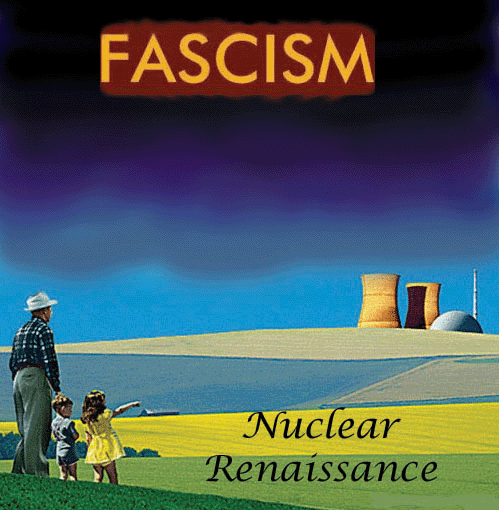
Is Nuclear Experimentation Fascism? Wake Up World, 22nd January 2014 By Ethan Indigo Smith Contributing Writer for Wake Up World Definition of Fascism: “Any program for setting up a centralized autocratic national regime with severely nationalistic policies, exercising regimentation of industry, commerce, and finance, rigid censorship and forcible suppression of opposition.” ~ New Collegiate Dictionary based on Webster’s New International Dictionary second edition, copyright 1956.

….The United States was formerly one of the few anti-institutional, anti-oligarchical nations in the world, but we have succumbed to the oligarchical corporaculture that has been pushed for the last couple of hundred years, whether fused by labels like the divine rite of kings or by corporate personhood. The United States used to push for individual rights, but now we yield to violent fascism just like the rest of the intolerant world. Hell, we were once so anti-fascist and anti-oligarchy that it used to be illegal to do business in more than one American state, now the police and political system seems to only serve and protect business interests. But at what cost?
Imagine if this culture of anti-fascism were still the case, perhaps none of us would ever question our water supply, hijacked for a nuke plant or polluted by a petroleum conglomerate.
Learning from History
Recent events at Fukushima have highlighted the uncontainable dangers of nuclear experimentation. If one examines trends, there are bound to be more accidents, spills and ‘unprecedented events’ within the nuclear industry.
The first nuclear power generation experiment began at Oak Ridge in 1948, and first massive one began in the Soviet city of Obninsk in 1954. In the 65 years that followed, there have been numerous known meltdowns at nuclear facilities around the world, as well as environmental, human and political destruction at other sites that did not (by luck only) experience full meltdown.
Hanford, USA, 1943 – 1987……. Bikini Atoll, Northern Pacific Ocean, 1946……Windscale Fire, UK, 1957……. Santa Susana, USA, 1959…. Three Mile Island, USA, 1979……. Chernobyl, Ukraine, 1986…….Rocky Flats Plant, USA 1987…… Fukushima Daiichi, Japan 2011….
Who is next?
The list goes on. And while this is a short summary of some of the nuclear industry’s worst failings – both environmental and political – what it does not take into account that there are now over four hundred nuclear power generation experiments in operation worldwide, and more being built, each one representing another potential disaster. Now factor in the endless radioactive pollution and dumped material (buried and sunken near you) involved in the process even when things go ‘right’ (by nuclear industry standards) and you get a clearer view of the impact of nuclear experimentation.
Under the terms of current policy, the US Federal Government simply incurs the financial costs and burden of dealing with nuclear ‘events’…. and by the ‘Federal Government’ I mean the U.S. taxpayer.
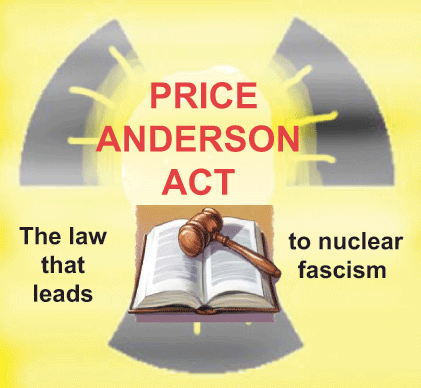
Regimentation of IndustryToday, the United States of America is fascist. So is China, Japan, Russia, France, England, Japan and every single nuclear nation. Australia is de facto fascist, being a major extractor of uranium for the nuclear fuel chain. The United States of America is fascist by way of one single act: The Price Anderson Nuclear Industries Indemnity Act. There are many more acts and laws that strengthen nuclear fascism in the United States, but The Price Anderson Act seals the deal. Its main purpose is to indemnify the nuclear industry against liability claims arising from nuclear incidents. And other countries have their own nuclear deals which also guarantee that those who profit from the nuclear industry are not held accountable for their work.
 The Price Anderson Act illustrates the U.S.A.’s fascist trail, and that nuclear experiment cleared the way for it in the first place. The Act makes it so that nuclear power generation experiments can operate at all, otherwise no insurance corporation would insure them. The insurance companies that deal with nuclear experimentation only do so because the Act limits their responsibility in the event of an accident, such as the Fukushima meltdown. If there is an accident that costs more than the capped amount, insurance companies pay out up to and including their cap, and communities and governments foot the bill for the remaining clean up costs. Put simply…. they profit, you pay. Not to mention the non-financial costs of human and planetary health.
The Price Anderson Act endorses fascism in the United States, and in the bigger picture, nuclear experimentation guarantees fascism no matter what nation is doing the experimenting – whether Israel, China, Iran or the U.S. or Japan. The nuclear power industry could not survive without placing all the risk on the shoulders of taxpayers. And by doing so, the Price Anderson Act enables nuclear oligarchical fascists to make a fortune by endangering everyone and everything on the planet.
Even if nuclear facilities operated to their original design specifications rather than running components on extended operation (by years) and over-crammed fuel pools, as is the case today, the industry is still unworkable. But today, most if not all nuclear power generation experiments in the U.S.A. have fuel pools loaded with waste material beyond original design specifications, but the nuclear industry and its regulators seem content continuing down this path — and waiting for our grandchildren to figure out what to do with the mess they leave behind.
Censorship and Suppression of Opposition
 Further fascism is evident through nuclear experimentation in the sense that it is a militaristic invention, put to use by engineering corporations that are linked with government entities, which also own news and information corporations. The GE/NBC corporation is the starkest, but not the only, example of this in the U.S.A. Being both the subject and reporter of news on the Fukushima Daiichi nuclear disaster, the GE/NBC corporation has placed itself in a clear conflict of interest. As the subsidiary of the failed nuclear reactor’s parent company, can you trust NBC News not to ‘spin’ glossy tales or omit details relating to the situation at Fukushima? Particularly details that might implicate GE in the chain of failings that caused the meltdown?
But news corporations are not the only parties able to censor or suppress information; government institutions have also closed ranks following the Fukushima disaster. As a prime example, the United States EPA (the supposed Environmental Protection Agency) went as far as disabling public access to radiation monitors in the wake of the Fukushima meltdown. Do they really believe what we can’t see won’t hurt us? Or is the EPA, as part of the US government, trying to avoid adverse political fallout?
Furthermore, the Fukushima disaster has led to a practical elimination of free speech and free reporting of information from within Japan. Japanese Prime Minister Shinzo Abe’s Designated Secrets Bill was arguably written for and because of the Fukushima disaster after authorities failed to manage the radioactive leaks and news spread around the globe. Since it could not contain the nuclear contamination, the Japanese government instead decided to contain information about it, creating laws that enable punishment of individuals for leaking or reporting information about their disastrous failure. Despite drawing criticism and protest at home and around the world, the Japanese parliament has since passed the law under which people convicted of leaking classified information will face 5 to 10 years in prison.
Clearly nuclear experimentation does not co-exist alongside freedom of speech or transparent access to information. It can only exist in a fascist state, which suppresses information and opposition.
Severely Nationalistic Policies
The only part of the definition of fascism that nuclear experimentation does not technically fit is that nuclear experimentation operates on an international level, not just a nationalistic one. However it seems even nuclear disaster rings opportunity bells for nationalistic governments.
As reported by Bloomberg in 2013, “Japan will receive international help with the cleanup at the Fukushima atomic station once it joins an existing treaty that defines liability for accidents at nuclear plants, U.S. Energy Secretary Ernest Moniz said.” This means that the United States’ “offer” of assistance is conditional upon Japan signing onto an international convention known as the Convention on Supplementary Compensation for Nuclear Damage, designed only to protect US nuclear interests from liability in the event of an accident. The U.S. Government has lobbied for the international adoption of the convention for many years, and now it seems it has Japan over a barrell. Surely this political opportunism qualifies as ‘severely nationalistic’ behaviour. Yet it in the United States, it seems we can barely distinguish this kind of fascism from the actions of true democratic government.
We are so confused in the United States that we call our country ‘America’, ignoring the unity of our ‘United States’. We are so confused that we equate freedom with liberty, but in actuality, freedom allows fascism. It allows people to punch you in the face without consequence or destroy ecosystems via oligarchical energy systems requiring destructive, extraction, refinement and use. We are so confused we think we can declare wars on other countries in the name of peace. We are so confused we think that digging up nuclear resources is different than digging up petroleum resources, but both nuclear and petrol fuels destroy human life, destroy ecosystems…. and destroy liberty.
Liberty is the oppositional factor against fascism and its facsimiles. Liberty is the quality individuals have to control their own actions. Liberty promotes the rights of individuals, whereas freedom allows oligarchical energy institutions to punch you in the face through The Price Anderson Act and the Convention on Supplementary Compensation for Nuclear Damage…. and all the other reinforcements that build up institutions at the expense of individuals, allowing them to make uncapped fortunes without liability for their actions. https://wakeup-world.com/2014/01/22/is-nuclear-experimentation-fascism/
February 27, 2017
Posted by Christina Macpherson |
2 WORLD, politics |
Leave a comment
 Yeo: Treasury needs to pour billions into nuclear projects , Telegraph UK Jillian Ambrose 25 FEBRUARY 2017 The Treasury is facing calls to pour billions of pounds into a string of troubled new nuclear projects which threaten the UK’s energy supplies.
Tim Yeo, a former environment minister and energy committee chairman, is warning that the only way the Government can avert a crisis for the country’s nuclear programme is to take a direct financial stake in the projects.
Ministers should also actively encourage investment from nuclear companies in China, South Korea and Russia where the the industry is relatively insulated from the challenges faced by European companies thanks to strong state backing, he said.
Ministers are wary of involving the foreign powers in its energy security plans and have steadfastly resisted taking on the financial risk involved in nuclear construction.
In a letter to Business Secretary Greg Clark, the Tory grandee says there is a real danger that the pipeline of nuclear projects will fail to come on stream before 2030 unless Government agrees to intervene. Mr Yeo said the existing support regime, which guarantees a fixed price for each megawatt of power produced, does not go far enough to help investors who face billions in construction costs before the nuclear plant begins producing power……
February 27, 2017
Posted by Christina Macpherson |
politics, UK |
Leave a comment
Indebtedness, a stumbling block to Nigeria’s nuclear sector progress- NNRA DG http://tribuneonlineng.com/indebtedness-stumbling-block-nigerias-nuclear-sector-progress-nnra-dg/ February 26, 2017 Ademola Adegbite – Abuja THE Nigerian Nuclear Regulatory Authority (NNRA) has appealed to the Federal Government to ensure the payment of its indebtedness to the International Atomic Energy Agency (IAEA), lamenting that the debt has been a stumbling block to the progress of nuclear sector in Nigeria.
The Director-General/Chief Executive Officer (DG/CEO) of the authority, Professor Lawrence Dim, who made this appeal in a signed statement made available to the Nigerian Tribune in Abuja, on Sunday, further urged the government to ensure that Nigeria paid up all her access contribution fees to the IAEA to enable the NNRA made meaningful contributions in the society.
He also implored the government to improve the funding of the NNRA, as nuclear power programme required long term commitment, pointing out that the authority has lived up to its mandate by continuously ensuring the protection of life, health, as well as property and the environment.
Professor Dim observed that there was the need for the institutionalisation of the Nuclear Safety Security and Safeguards Bill through an act of the National Assembly in order to domesticate the nation’s international obligations.
The DG, who admitted that there was inadequate information on the beneficial uses of ionizing radiation, said these were parts of recommendations after the 4th National Workshop organised by the NNRA in Abuja for Editors and Correspondents.
According to him, government at all levels should ensure that all facilities that ought to be under regulatory control of the NNRA are indeed regulated by the NNRA. Not all the facilities that should be under regulatory control of the NNRA are indeed regulated by the Authority.
“There is generally a low level of awareness with respect to the nuclear sector. The Nuclear Safety, Security and Safeguards Document (Bill) is yet to be passed into law by the National Assembly. There should be more information dissemination on the nuclear sector in order to enlighten the public.
“Government should embark on an intensive manpower development to achieve the critical mass of professionals for the development of the nuclear sector. The NNRA should collaborate with the relevant agencies on grassroots sensitization”, he added.
Other Management Staff present at the workshop included Director, Radiological Safety, Professor T. C. Akpa; Director, Authorization and Enforcement, Dr. Yau Idris; as well as Deputy Director, Nuclear Safety, Physical Security and Safeguards , Dr. Nasiru Bello and the Head of Information and Protocol Unit, Mrs. Ekaette Ebong Bassey.
February 27, 2017
Posted by Christina Macpherson |
Nigeria, politics |
Leave a comment
 In West Texas, spent fuel storage seeks a foothold, Edward Klump, E&E News reporter , Energywire: Friday, February 24, 2017 Waste Control Specialists LLC operates a facility licensed to dispose of low-level radioactive waste in Andrews County, Texas. The company is in the process of seeking a license for an interim storage facility for spent nuclear fuel. …….
The fight is over the fate of spent fuel — often referred to in the WCS debate as high-level radioactive waste — from U.S. nuclear reactor sites. It’s tangled up in conversations about energy and the economy, ethnicity and income, politicians and regulators, transportation and water resources.
The debate likely won’t end soon. Leaders and influential voices in Andrews County have been lining up to support WCS. Many critics, on the other hand, want high-level waste to stay at existing sites until a better solution emerges. Continue reading →
February 25, 2017
Posted by Christina Macpherson |
politics, USA, wastes |
Leave a comment















 nuclear-news
