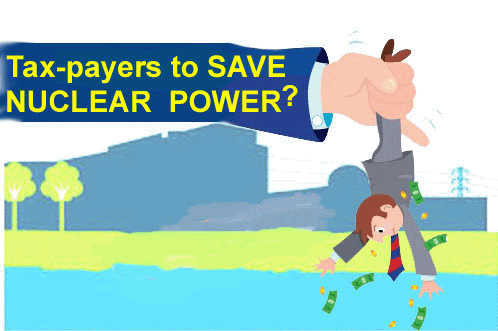
Nuclear plant to cost consumers ‘billions more’ News 24 24 June 17 London – A highly-controversial UK government deal for the new Hinkley Point nuclear power plant will cost British energy consumers billions more pounds than forecast, the country’s National Audit Office said on Friday.
“The Department for Business, Energy and Industrial Strategy’s deal for Hinkley Point C has locked consumers into a risky and expensive project with uncertain strategic and economic benefits,” the NAO said in a report.
Under the project, UK energy users will have sums added to their bills for a period of 35 years.
The NAO said the combined cost of such payments is set to surge to $38bn.
“Delays have pushed back the nuclear power plant’s construction, and the expected cost of top-up payments under the Hinkley Point C’s contract… has increased $38bn,” the report said……
The contract for a French-Chinese consortium to build Britain’s first nuclear plant in a generation was signed in September after a string of controversies threatened to scupper the huge deal.
China’s involvement
The British government had delayed agreement over concerns about China’s involvement, while there were also questions about how the French state-owned power giant EDF would fund the construction of Hinkley Point.
But Britain finally gave the go-ahead last September for the complex, which is expected to provide seven percent of the country’s power needs. Beijing’s state-run China General Nuclear Corporation is set to finance £6bn of the cost of the Hinkley Point plant, with French state-owned power giant EDF providing the remaining £12bn.
Critics have focused on an electricity price guarantee to be paid to EDF of £92.5 for every megawatt hour of power produced by Hinkley for the next 35 years, rising with inflation, despite falling energy prices…….http://www.news24.com/World/News/nuclear-plant-to-cost-consumers-billions-more-20170624
June 26, 2017
Posted by Christina Macpherson |
business and costs, politics, UK |
Leave a comment
Green Party 23rd June 2017,Lucas: “Consumers and taxpayers are going to be ripped off by this absurd
project” Caroline Lucas, the co-leader of the Green Party, has responded to
a report by the National Audit Office on Hinkley Power Station.
The report says that the Department for Business, Energy and Industrial Strategy’s
deal for Hinkley Point C has locked consumers into a ‘risky and expensive
project’ with uncertain strategic and economic benefits. The multibillion
pound project at Hinkley is currently supported by both Labour and the
Coservatives, but opposition to the plans is expected to grow as the costs
soar.
Caroline Lucas, co-leader of the Green Party, said: “The National
Audit Office’s damning report confirms what many of us have been saying
for a long time: the Hinkley deal is overpriced and risky. Not only are
consumers and taxpayers going to be ripped off by this absurd project but
it will also divert resources away from building the clean energy
infrastructure we need, and threaten our climate change targets because of
the snail’s pace at which it will be built.
“The fight against Hinkley isn’t over – and we will be joining campaigners in continuing to
highlight the major shortcomings of this project. This is a crossroads for
Britain – and the signing of this deal has seen us swerve down the wrong
path. By reversing this decision we can put the resources needed into
building a decentralized energy system where Britain puts to use its most
abundant resources: the sun, sea and wind.”
https://www.greenparty.org.uk/news/2017/06/23/caroline-lucas-nao-report-on-hinkley-is-damning/
June 26, 2017
Posted by Christina Macpherson |
politics, UK |
Leave a comment
Masculinity and the Environment: A Double-edged Sword, Trump, populist masculinity, and the Paris Agreement., The Good Men Project ,June 23, 2017 by Joseph Gelfer , Trump’s decision to pull out of the Paris Agreement, with its disastrous consequences for our collective future, has been met with dismay by politicians and citizens from around the world. Of course, this decision comes as no surprise, not just because of his previous signaling on the matter, but because resistance to environmental concerns is a key value of the type of populist masculinity that underpins his presidency.
The connection between Trump-like masculinity and its perception of the environment is well known. A 2011 study in the journal Global Environmental Change shows that “conservative white males are significantly more likely than are other Americans to endorse denialist views.” The cast of populist masculinity celebrities that support Trump has also been keen to embody this view. For example, Alex Jones’ publication Infowars ran numerous articles such as Globalist Cucks Triggered After Trump Puts America Before Paris Agreement. The masculinity element is not just implicit here, but explicit, with the use of the emasculating term “cuck” and the fact that the article was illustrated with a picture of Trump giving a hand gesture indicating that someone has a tiny penis. Breitbart and other publications that platform populist masculinity views ran similar articles. Elsewhere, the likes of Paul Joseph Watson and Milo Yiannopoulos have thrown their weight behind Trump on this issue, as well as Mike Cernovich, who upped the muscular ante by asking, “How do these people know so much about climate change? These people can’t even lift, bro!”
While there is a danger of blaming everything on masculinity and being distracted from bigger geo-political culprits, it is fair to say that masculinity has a damaging effect on the environment. It’s not just Trump and the populist masculinity celebrities. More generally, stereotypical masculine values work against sustainability, whether it be violence, domination and exploitation of people and natural resources, or even connecting lifestyle choices such as eating less meat with being unmanly. But it doesn’t have to be that way.
Stereotypical Masculinity for the Environment
There are also men in the public eye who look stereotypically masculine but who are working towards a more sustainable future. Soon after the withdrawal from the Paris Agreement, the exemplar of muscularity Arnold Schwarzenegger made an appeal to Trump to think again, using the logic not of tree-huggers, but job-creators. While Schwarzenegger may not have been an ideal governor for California, he did at least do his bit for standing up for the environment, and he did it with a certain masculine clout such as his famous facebook post, “I don’t give a **** if we agree about climate change.”
In a similar way, we can point to Elon Musk who stepped down from Trump’s advisory councils after the Paris announcement. Musk makes his money in some of the most stereotypically masculine things on the planet: sleek cars and phallic rockets. Yet at the same time it is arguable that between championing electric cars at Tesla, green energy at SolarCity and ultimately interplanetary existence with SpaceX, Musk is doing more for our sustainability as a species than any other business person alive.
We can look at Leonardo DiCaprio whose playboy lifestyle, complete with a penchant for supermodels, is the epitome of a certain type of stereotypical masculinity. But his environmental activism over the years has turned countless people on to this issue, and far outweighs the private-jet-hypocrisy snipes gleefully made by populist masculinists such as Paul Joseph Watson. And there are countless other men, both in the public eye and in private life, who may look in some ways like standard masculine climate change deniers, but whose values and behavior say something altogether different.
Both Remedy and Poison…..
ecofeminism should [not] be discarded, rather complemented. In short, the environment needs to be turned into a “men’s issue.” Conservatives do not have a monopoly when it comes to masculinity and the environment. The binary between women tending towards environmental protection and men tending towards environmental destruction is false, in exactly the same way as the binary between femininity and masculinity is false.
The message needs to be clear: healthy masculinity requires a healthy environment. This does not even necessitate moving outside of the frame of stereotypical masculinity. Ensuring a healthy environment is logical as it secures existential survival; it means the environment must be protected and requires strength. Men need to champion this issue as if their lives and those of their families depended on it: because they do.https://goodmenproject.com/featured-content/masculinity-and-the-environment-a-double-edged-sword-wcz/
June 26, 2017
Posted by Christina Macpherson |
2 WORLD, psychology and culture |
Leave a comment
 Britain’s Brexit plan will plunge its nuclear power plants, cancer
treatment centres and leading research facilities into chaos within two
years, according to a secret government assessment.
Times 26th June 2017, The UK plans to pull out of Euratom, Europe’s nuclear body, at the same time as it leaves the EU
in 2019. A bill to replace European safeguards with a British system of
oversight was published in last week’s Queen’s Speech.
However, experts say that this would not match the regime provided by the EU body, meaning that
plants, research facilities and hospitals may be unable to import
radioactive material after Brexit. Officials from the Department for
Business, Enterprise and Industrial Strategy have warned that it will take
seven years to replace the current set of agreements, The Times has been
told.
The delay would partly be caused by the fact that work on new
international treaties, for example with the US and Japan, cannot start
until new inspections standards are approved. Ministers have suggested
that, as with financial regulations, there could be a transition period
after Brexit to allow a new regime to be put in place, but experts say that
the complexity of the task is still not sufficiently realised.
The Nuclear Industry Association (NIA) will today step up calls for David Davis, the
Brexit secretary, to consider asking for Britain to remain an associate
member of Euratom instead. That option will worry some Tory MPs, because
some lawyers believe that it would require oversight by the European Court
of Justice or even for Britain to continue to take part in elections to the
European parliament. Tom Greatrex, the NIA chief executive, said the plans
did not “come anywhere close” to matching the scale of the problem.
https://www.thetimes.co.uk/edition/news/experts-warn-of-chaotic-fallout-from-post-brexit-nuclear-plan-mh8prkkdv
June 26, 2017
Posted by Christina Macpherson |
politics, politics international, UK |
Leave a comment
 Zuma: The Nuclear Deal Is Still Happening, Folks He says nuclear power stations will eventually bring the country profits once they are built. Huff Post, Amil Umraw, Politics Reporter 23/06/2017 South Africa’s controversial nuclear build programme is still very much on the cards.
In his responses to parliamentary questions on Thursday, President Jacob Zuma said government still intends to pursue the acquisition of nuclear power stations at a “pace and scale” that the country can afford…..
He denied that the deal is going to push the agenda of any country, especially Russia.
However, Energy Minister Mmamoloko Kubayi reportedly told a delegation at a nuclear conference in Moscow on Wednesday that the deal would be awarded to the “most experienced people who have a track record”.
Kubayi reportedly met Russian Energy minister Alexander Novak and Rosatom head Alexei Likhachev during her visit. Rosatom is a Russian state company believed to be the strongest contender for the award of the nuclear contract.
The nuclear build programme was dealt a blow by the Cape Town High Court after Earthlife Africa and the Southern Africa Faith-Communities’ Environmental Institute successfully challenged the way in which the state determined the country’s nuclear power needs. The plan would have seen South Africa purchasing 9 600 megawatts of extra nuclear power.
The programme is expected to cost the country around R1 trillion.http://www.huffingtonpost.co.za/2017/06/22/zuma-the-nuclear-deal-is-still-happening-folks_a_22580816/
June 24, 2017
Posted by Christina Macpherson |
politics, South Africa |
Leave a comment
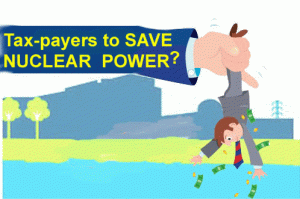 FT 23rd June 2017, NAO said the government should have at least considered sharing the construction risk at Hinkley to lower the cost for consumers. This conclusion will add to debate in Whitehall over whether the government should contribute to financing other planned nuclear plants, including one planned by Hitachi of Japan at Wylfa in Anglesey.
Talks have been held between the UK and Japanese governments about making Wylfa a public-private partnership, according to people briefed on the matter. This would reduce costs for consumers compared with Hinkley but expose taxpayers to more risk. https://www.ft.com/content/8a6a7f5a-574b-11e7-80b6-9bfa4c1f83d2
June 24, 2017
Posted by Christina Macpherson |
politics, UK |
Leave a comment

 Perry says no decision made on interim nuclear waste storage in Nevada, Las Vegas Review Journal June 21, 2017 WASHINGTON — Energy Secretary Rick Perry clarified a previous statement on interim nuclear waste storage, telling a Senate subcommittee Wednesday that no decisions have been made on temporary sites for spent fuel in Texas, New Mexico or Nevada.
Private companies in New Mexico and Texas have submitted applications to the Nuclear Regulatory Commission to store nuclear waste on an interim basis.
Perry created a firestorm Tuesday when he suggested to the House Appropriations subcommittee on energy that the Nevada National Security Site could store waste temporarily.
The suggestion brought an avalanche of criticism from Nevada Gov. Brian Sandoval and members of the state’s congressional delegation who called the proposal ill-conceived and likely illegal because of restrictions involving the former nuclear test site northwest of Las Vegas.
Before the Senate Appropriations subcommittee on energy, Perry clarified the statement to note that no decision has been made on interim storage and that any such plan would require coordination with Congress.
“I think it is appropriate to say, there are no plans at this particular time for interim storage in New Mexico, Nevada or Texas or any other site,” Perry said…..https://mail.google.com/mail/u/0/#inbox/15cd262afeb49316?compose=15cd3e0979cb83a3
June 23, 2017
Posted by Christina Macpherson |
politics, USA, wastes |
Leave a comment
 Perry repeats desire to store nuclear waste in Nevada; state officials respond, News 4 , by Tony Garcia, LAS VEGAS (KSNV News3LV) —
Nevada’s state and national elected officials reacted swiftly Tuesday after Energy Secretary Rick Perry said he wants to build interim nuclear waste facilities at the Nevada National Security Site and called constructing a long-term repository at Yucca Mountain a “moral obligation.”
“Today’s comments by Secretary Perry suggesting he would consider storage of high-level nuclear waste at the Nevada National Security Site come as a complete blindside, and I view this as a total disregard and failure to honor the historical process,” Nevada Gov. Brian Sandoval said in a statement.
“The idea of storing high-level nuclear waste at the National Security Site is ill-conceived, irresponsible, and likely illegal. This is a prime example of federal overreach, and Nevada will pursue every legal option at our disposal.”
Sandoval added that he has asked Nevada Attorney General Adam Laxalt to review the proposal and identify legal avenues to stop it.
“Let me be clear – no part of Nevada will be home to the world’s most toxic waste and we will fight every effort that puts our citizens at risk,” Sandoval said.
“Secretary Perry’s comments today are irresponsible, reckless, and show a blatant disregard for the state of Nevada,” U.S. Sen. Dean Heller (R) said in a statement. “As I have repeatedly told the Secretary, Nevada will not serve as our nation’s nuclear waste dump. The only viable solution to our country’s nuclear waste problem is one that is rooted in consent, and Nevada has said ‘no.’….
“I am appalled to see how tone-deaf this administration is in refusing to listen to the collective voice of an entire state,” said U.S. Rep. Jacky Rosen. “The only moral obligation we have is to keep Nevadans safe from nuclear waste. If Secretary Perry thinks that he alone can restart Yucca Mountain with the flip of a switch, he is mistaken. Since the 1980s, Nevada has voiced its opposition to Yucca Mountain based on legitimate safety concerns.
“Today’s comments by Secretary Perry are wrong and dangerous. Reviving Yucca Mountain as a nuclear waste dump would place Nevada and communities around the country in harm’s way by green-lighting daily regular shipments of high-level nuclear waste by train or by truck for over 50 years.” http://mynews4.com/news/local/sandoval-and-other-officials-respond-to-perrys-desire-to-store-nuclear-waste-in-nevada
June 23, 2017
Posted by Christina Macpherson |
politics, USA, wastes |
Leave a comment
 ZUMA ‘HAS NO KNOWLEDGE’ OF HIS FAMILY BENEFITING FROM NUCLEAR PROGRAMME http://ewn.co.za/2017/06/22/zuma-has-no-knowledge-of-his-family-benefiting-from-nuclear-programme, President Jacob Zuma said the government will pursue a nuclear power project at a pace and scale that the country can afford. Rahima Essop CAPE TOWN – President Jacob Zuma has told the National Assembly he has no knowledge of his family benefitting from South Africa’s proposed nuclear build programme.
He was responding to a question by Democratic Alliance leader Mmusi Maimane, who asked him directly, whether he or any of his family members have received payments related to the project.
Zuma was asked questions about state capture, the recession and his government’s nuclear power ambitions.
The president was terse in his response to Maimane’s frank question about the possibility of corruption in the proposed nuclear build programme.
Zuma said the government would pursue a nuclear power project at a pace and scale that the country could afford.
He also reaffirmed the state’s position that nuclear is a clean and reliable form of energy.
Earlier this year, the Western Cape High Court dealt a legal blow to government’s plans when it found certain agreements related to the project were unconstitutional and unlawful.
June 23, 2017
Posted by Christina Macpherson |
politics, South Africa |
Leave a comment
South Africa committed to nuclear power expansion, process to be open – Zuma, http://www.reuters.com/article/safrica-politics-nuclear-idUSJ8N1H5007
South Africa is committed to an “open, transparent” process to build new nuclear power plants and the government planned to go through with its plans for nuclear expansion, President Jacob Zuma told parliament on Thursday.
South Africa is planning to build 9,600 megawatts (MW) of nuclear capacity, a project that could be one of the world’s biggest nuclear contracts in decades.
But Energy Minister Mmamoloko Kubayi said on Wednesday in Moscow that the plans will be reviewed as the country is in a recession. (Reporting by Wendell Roelf; Writing by Ed Stoddard; Editing by James Macharia)
June 23, 2017
Posted by Christina Macpherson |
politics, South Africa |
Leave a comment
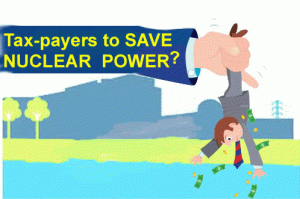 House advances legislation to provide nuclear production tax credit access to non-profits, Daily Energy Insider, June 22, 2017 The U.S. House of Representatives advanced legislation Tuesday that would expand access to the nuclear production tax credit (PTC) to nonprofits and eliminate the 2020 deadline for the credits.
The bill, introduced by Rep. Tom Rice (R-SC), would amend the Energy Policy Act of 2005, through which the PTC was established.
Under current law, ratepayers to for-profit partners can receive savings from the credit, while ratepayers to nonprofit partners do not. The bill would allow non-profit partners to utilize the credit. The current law also requires that nuclear facilities must enter service by the end of 2020 in order to qualify for the credit, a stipulation the bill would eliminate……..
Four new nuclear power units are currently under construction in South Carolina and Georgia. For each project, one partner is a non-profit entity.
Sen. Tim Scott (R-SC) introduced companion legislation in the Senate. https://dailyenergyinsider.com/news/6025-house-advances-legislation-provide-nuclear-production-tax-credit-access-non-profits/
June 23, 2017
Posted by Christina Macpherson |
politics, USA |
Leave a comment
 India’s inward nuclear turn, ECONOMIC TIMES, JUN 22, 2017, By Brahma Chellaney Just as Japan’s Diet has ratified the civil nuclear agreement with New Delhi, India has decided to build 10 nuclear power reactors of indigenous design in what is the largest such construction decision in the world since the 2011 Fukushima nuclear disaster. India’s turn to a “fully home-grown initiative“ reflects the continuing problems in implementing the 2005 Indo-US nuclear deal.
India, duped by its own hype over the nuclear deal, had announced plans to import Western reactors costing tens of billions of dollars. The Indian plans helped to motivate Toshiba to acquire Westinghouse a takeover that ultimately proved a huge blunder, plunging Toshiba into a grave financial crisis.
Japan, a top nuclear-equipment supplier, signed a separate nuclear agreement with India only last year after other supplier-nations had already concluded such accords. The recent Japanese parliamentary approval removes a critical missing link in commercialising the IndoUS deal. It, however, has come when Westinghouse, GE Hitachi and Areva which dominate the international reactor export business are in a dire financial state, with their futures hanging in balance.
Having invested considerable political capital in the vaunted Indo-US deal, India today confronts an embarrassing situation: the nuclear power promise is fading globally before New Delhi has signed a single reactor contract as part of that deal.To save face, India, with one of the world’s oldest nuclear energy programmes, has embarked on a major expansion of domestically designed power reactors.
That the decision to construct 10 reactors of 700 megawatts capacity each is monumental is underscored by the fact that the total size of these units surpasses the current installed nucleargenerating capacity in the country . India has 22 nuclear power reactors in operation, with capacity of 6,780 MWe but producing 6,219 MWe. To be clear, the 10 reactors will be in addition to seven others already under construction, with a combined capacity of 5,300 MWe.
June 23, 2017
Posted by Christina Macpherson |
India, politics |
Leave a comment
 House passes nuclear energy tax bill http://thehill.com/policy/energy-environment/338653-house-passes-nuclear-energy-tax-bill, BY DEVIN HENRY – 06/20/17 The House quickly passed a bill extending a nuclear energy tax credit on Tuesday.
The bill, bipartisan legislation from Reps. Tom Rice (R-S.C.), Earl Blumenauer (D-Ore.) and others, would increase the number of utilities that can qualify for the tax credit and remove construction deadlines for facilities that use it.
The House passed the bill, which would cost $16 million over 10 years, on a voice vote.
The legislation lifts a requirement that nuclear facilities be placed into service by the end of 2020 in order to receive the 1.8-cent-per-kilowatt-hour tax credit.
It would also allow government-owned utilities and nonprofit electric co-ops to receive the credit and give them the power to transfer credits to other partners on the facilities, such as the projects’ designers.
The bill is especially important for the states of Georgia and South Carolina, the only two states where new nuclear power plants are under construction.
“Without this legislation, the nuclear power industry may cease to exist as we know it in this country, which is exactly why passing this bill now is more important than ever,” Rice said.
“We need to give these plants the certainty of these tax credits, just as Congress intended.”
Only one member spoke out against the bill on Tuesday. Rep. Lloyd Doggett (D-Texas) criticized the measure as a reward for the nuclear sector, which he said has a “record of miserable failures” when it comes to getting more reactor projects up and running.
“Instead of today’s measure, our focus should be on safe, healthy forms of energy instead of an industry that costs too much and poses too much danger to humans,” he said.
The nuclear energy sector supported the bill, with five industry groups telling lawmakers in a letter last week that the bill supports the “strategic national imperative” of supporting nuclear power projects.
June 21, 2017
Posted by Christina Macpherson |
politics, USA |
Leave a comment
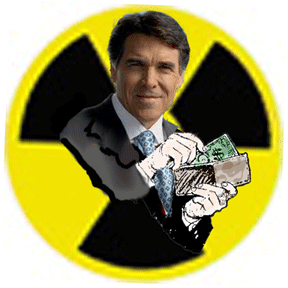
 Nuclear power on the ‘front burner,’ says Energy Secretary Rick Perry
- Nuclear power as “a very important part” of the White House’s energy strategy, Department of Energy Secretary Rick Perry said Monday.
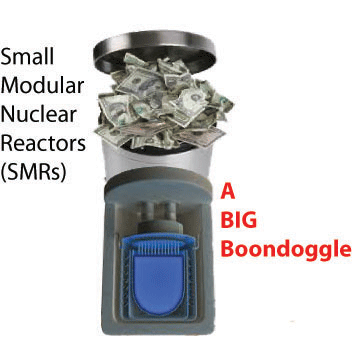
- Projects such as small modular reactors are on the front burner, he said. CNBC,
Monday, 19 Jun 2017 The Trump administration sees nuclear power as “a very important part” of an all-of-the-above energy strategy, Department of 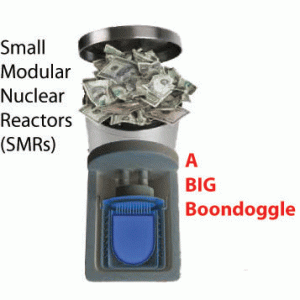 Energy Secretary Rick Perry said Monday.
“Bringing our nuclear energy industry back, small modular reactors for instance, that’s on the front burner so to speak,” he told CNBC’s “Squawk Box” on the sidelines of the SelectUSA Investment Summit, which promotes investment in the U.S.
Perry’s comment offers some insight into the administration’s spending priorities as it seeks to slash funding for Energy’s research and development programs by 54 percent from 2016 levels. Offices that would see deep cuts — unless Congress intervenes — include those responsible for promoting energy efficiency and extending the life of nuclear power plants.
June 21, 2017
Posted by Christina Macpherson |
politics, USA |
1 Comment
Jun.20,2017 , Changed energy policy prioritizes public safety, in line with South Korea’s turn from developing to developed country
“Permanently shutting down operations at Kori-1 is the beginning of a journey toward a nuclear-free country; it is the turning point toward a safe country. I will soon be preparing a roadmap for the nuclear power phase-out that can set South Koreans’ hearts at ease,” President Moon Jae-in said on June 19. With anxiety increasing around the world about the safety of nuclear power following the nuclear accident in Fukushima, Japan, Moon has become the first South Korean president to declare a nuclear power phase-out, signaling a major change in the country’s energy policy.
“Since South Korea has to import the majority of its energy, nuclear power was the energy policy chosen when we were still a developing country, but now it’s time to change that,” said Moon during an address delivered at a ceremony marking the permanent shutdown of Kori-1. The ceremony took place at the Kori Nuclear Power Headquarters of Korea Hydro & Nuclear Power (KHNP), located in Gijang County, Busan.
Moon’s declaration of the goal of making South Korea nuclear-free signifies his willingness to turn the country’s current energy policy paradigm on its head. It affirms a transition from the energy policy of developing countries, which prioritize cheap power and efficiency, to that of developed countries, which place a premium on the environment and on the people’s right to life.
The key message offered by Moon is “public safety.” While mentioning the earthquake that struck Gyeongju in Sep. 2016, Moon emphasized that South Korea is no longer safe from earthquakes. Citing the fact that 3.82 million people live within a 30 km radius of the Kori plant, he argued that a nuclear accident in South Korea could be even more horrific than what happened at Fukushima
“The world today is moving irreversibly toward phasing out nuclear power. This is something we have to start now on behalf of our descendants, who will live in this country for millennia to come,” Moon said, making clear that it was impossible to return to the energy policy of the past.
Moon’s address also marks the point when he begins to specifically implement the pledges he made as a presidential candidate. He had promised to scrap all plans for building new nuclear reactors, to immediately shut down reactors whose operational life cycle has ended, to suspend construction on Shin Kori-5 and Shin Kori-6, and to shut down Wolseong-1. “It’s as if the people of Busan [who live close to the Kori nuclear plant] have to live with this bomb by their beds that could go off at any time,” Moon said, after watching the nuclear disaster film “Pandora” at the end of last year. “We shouldn’t be asking whether or not to open up Pandora’s box [nuclear power]; we should be getting rid of the box altogether.”“The reason we haven’t been able to phase out nuclear power is not because of a lack of researchers but because of a lack of government will. The fact that the new government has not only shut down the Kori-1 nuclear reactor but also announced a new energy policy and declared its intention to phase out nuclear power in this address is very significant,” said Yun Sun-jin, a professor at the Graduate School of Environmental Studies at Seoul National University.“The next stage is to draw up a detailed roadmap for the nuclear power phase-out. Developed countries are reducing their consumption of electricity. A superficial comparison should be avoided since their industrial structures are different from ours, but in the future, we too should be able to move in the direction of the efficient consumption of energy,” Yun added.By Jung Yu-gyung and Lee Jung-ae, staff reporters
June 21, 2017
Posted by Christina Macpherson |
politics, South Korea |
Leave a comment