If We Don’t Act Now, Fascism Will Be on Our Doorstep, Says Yale Historian Timothy Snyder warns: History gives us a bunch of cases where democratic republics became authoritarian regimes. By Steven Rosenfeld / AlterNetMarch 13, 2017How close is President Donald Trump to following the path blazed by last century’s tyrants? Could American democracy be replaced with totalitarian rule? There’s enough resemblance that Yale historian Timothy Snyder, who studies fascist and communist regime change and totalitarian rule, has written a book warning about the threat and offering lessons for resistance and survival. The author of On Tyranny: Twenty Lessons from the Twentieth Century talked to AlterNet’s Steven Rosenfeld.
“……..the book does describe what is going on now.
The year figure is there because we have to recognize that things move fast. Nazi Germany took about a year. Hungary took about two and a half years. Poland got rid of the top-level judiciary within a year. It’s a rough historical guess, but the point is because there is an outside limit, you therefore have to act now. You have to get started early. It’s just very practical advice. It’s the meta-advice of the past: That things slip out of reach for you, psychologically very quickly, and then legally almost as quickly. It’s hard for people to act when they feel other people won’t act. It’s hard for people to act when they feel like they have to break the law to do so. So it is important to get out in front before people face those psychological and legal barriers…..
I think that the people who inhabit the White House inhabit a different ideological world in which they would like for the United States not to be the constitutional system that it now is……
Democracy only has substance if there’s the rule of law. ……
The second thing about ‘post-truth is pre-fascism’ is I’m trying to get people’s attention, because that is actually how fascism works. Fascism says, disregard the evidence of your senses, disregard observation, embolden deeds that can’t be proven, don’t have faith in god but have faith in leaders, take part in collective myth of an organic national unity, and so forth. Fascism was precisely about setting the whole Enlightenment aside and then selling what sort of myths emerged……..
in terms of what might happen next, or what people could look out for, some kind of event that the government claims is a terrorist incident, would be something to be prepared for. That’s why it’s one of the lessons in the book…….
it is much easier to have a dramatic negative event, than have a dramatic positive event. That is one of the reasons I am concerned about the Reichstag fire scenario. The other reason is that we are being mentally prepared for it by all the talk about terrorism and by the Muslim ban. Very often when leaders repeat things over and over they are preparing you for when that meme actually emerges in reality…..
the German Jews then, and people now, don’t understand how quick their neighbors will change; don’t understand how quickly society can change………
German Jews were not aware of, or Germans were not aware of, was how new media can quickly change conversations. In that way, it’s not exactly the same, but radio at that time often ended up being a channel for propaganda. There are parallels with the internet now, where there were hopes that it would be [primarily] enlightening. But in fact, it turns out that with presidential tweets, or with bots, or isolated habits of viewing, it isn’t necessarily enlightening. It’s the opposite. A lot of us were blindsided by the internet in much the same way that people could be blindsided by radio in the 1930s……..
most of the time authoritarianism depends on some kind of cycle involving a popular consent of some form. …….
Are you in favor of the end of the American way of democracy and fair play?’ Because that’s what’s really at stake…….
The Big Winner in Donald Trump’s Decision to Fire Preet Bharara Might Be Rupert Murdoch, My Mag, By Gabriel Sherman, 12 Mar 17, Throughout his six-decade career working on three continents, Rupert Murdoch has used his media properties to advance the prospects of politicians whose policies help his business interests. Whether it was Margaret Thatcher’s union-busting in the 1980s or Rudy Giuliani’s campaign to put Fox News on Time Warner’s cable system in the 1990s, Murdoch went all-out for leaders who allowed him to protect and expand his corporate empire.
Since Election Day, Murdoch, now the executive chairman of Fox News, has personally nudged the network in a more pro-Trump direction, sources tell me. That effort included anointing Trump-friendly Tucker Carlson as the successor to Megyn Kelly as host in the 9 p.m. slot. Fox News staffers are also grumbling that segments now have to fit a “pro-Trump narrative,” one insider told me. Trump seems to be returning the goodwill: He asked Murdoch to submit names for FCC commissioner and tweeted praise for Fox News. He’s even taken policy ideas from the network. Now Murdoch may be poised to reap a much bigger win from a Trump administration action.
That’s because on Saturday Trump oversaw the firing of Preet Bharara, the U.S attorney for the Southern District of Manhattan, whose office is in the middle of a high-profile federal investigation of Fox News. The probe, according to sources, is looking at a number of potential crimes, including whether Fox News executives broke laws by allegedly obtaining journalists’ phone records or committed mail and wire fraud by hiding financial settlements paid to women who accused Roger Ailes of sexual harassment. …….
Given that Fox News is Murdoch’s most profitable division, the prospect of indictments is a serious problem. …..
Thae Yong-ho, who recently compared Kim to the Roman emperor Nero, said North Korea is headed down a dangerous path as it seeks recognition as a nuclear weapons state like “India or Pakistan,” Voice of America reported Tuesday.
“The Kim Jong Un regime will never give up nuclear weapons,” Thae said.
The high-profile defector added North Korea could “fall apart” if the regime decides to conduct a major nuclear test at its Punggye-ri nuclear site, where Pyongyang conducts tests of weapons of mass destruction.
Recent satellite images show tunnel digging continues at the site, which lies below the 800-meter Mount Mantap.
According to 38 North, the activity indicates North Korea may be prepared to conduct additional underground nuclear tests.
Thae said Tuesday the site is located on a road that connects Pyongyang to Hamgyong Province, and that “roads and railways that go up north pass by the nuclear test site.” “If a large explosion takes place and the area becomes contaminated with radiation while Pyongyang loses control of the border region of North Hamgyong Province, mass defections could take place,” Thae said.
A nuclear failure in a “small country like North Korea” could lead to disaster, the defector said, adding China and the international community must be aware of the danger.
Thae also said Kim Jong Un is trying to achieve parity with South Korea’s relatively more powerful military with his nuclear weapons program.
In an annual ranking of militaries around the world, South Korea troops ranked the 11th most powerful in 2016, while North Korea’s military strength ranked 25th in the survey by website Global Firepower.
Legislation intended to give the Millstone nuclear plant access to power markets has been broadened to increase Connecticut’s portfolio of renewable energy sources.
The measure, released Monday by the legislature’s energy and technology committee, gives the state new authority to include nuclear energy in the portfolio of other zero- or low-carbon emission sources of power…….
A group of power producers criticized the legislation as “bad for residents and bad for business.”
“It would provide Millstone a huge corporate payout funded by raising utility bills for businesses and residents,” said the group, which includes Calpine Corp., Dynegy, NRG Energy and the Electric Power Supply Association.
As other states subsidize nuclear energy, the Connecticut proposal is touted by Dominion as a measure that provides no subsidy but gives it the ability to compete with other sources of energy.
In Ky. coal country, a potential embrace of nuclear power, WMC Action News, Wednesday, March 15th 2017, By ADAM BEAM Associated PressFRANKFORT, Ky. (AP) – Donald Trump promised to bring back coal jobs, but even the country’s third-largest coal producer appears to be hedging its bets on a comeback. Kentucky is on the cusp of doing what was once unthinkable: opening the door to nuclear power. The Republican-controlled state legislature is close to lifting its decades-long moratorium on nuclear energy in a state that has been culturally and economically dominated by coal……..
But Kentucky has been burned by the nuclear industry in the past. In the 1960s, seeking to lure the emerging nuclear energy industry into the state, Kentucky set up a place to store toxic waste. From 1963 to 1977, more than 800 corporations dumped 4.7 million cubic feet of radioactive waste at the site, but no nuclear reactor was ever built. The Maxey Flats site is closed, but its contaminated soil, surface water and groundwater resulted in an expensive state and federal cleanup.
“This is the Faustian bargain we engage in. We get cheap energy, but we saddle future generations with millennia responsibility of being mature enough to properly manage waste we are generating,” said Tom Fitzgerald, executive director of the Kentucky Resources Council, which has opposed lifting the moratorium.
Even if the ban is lifted, a nuclear power plant could still take more than 10 years to develop given the rigorous permitting process. And construction would be expensive, which would threaten to drive up electricity rates to pay for it. That is of particular concern to the state’s manufacturing sector, which uses large amounts of electricity in their production processes.
Cabinet reaffirms goal of phasing out nuclear power by 2025 http://focustaiwan.tw/news/ast/201703110010.aspx2017/03/11 Taipei, March 11 (CNA) (By Yu Hsiao-han and Lee Hsin-Yin)
ENDITEM/AW/ Cabinet spokesman Hsu Kuo-yung (徐國勇) reiterated on Saturday that the government’s goal of phasing out nuclear power in Taiwan by 2025 remains unchanged, as protesters held anti-nuclear power rallies around the country.
Hsu said the government will brief the public about its plans later this month, including ways to increase the amount of electricity generated from renewable sources nationwide to 20 percent by 2025.
Other issues such as handling nuclear waste, upgrading to more efficient thermal power plants and steps to decommission the country’s three active nuclear power plants will also be addressed, added state-run utility Taiwan Power Co. (Taipower) in a statement.
Hsu made the remarks as demonstrations were held in Taipei, Kaohsiung and Taitung against the continued use of nuclear power in Taiwan on the sixth anniversary of an earthquake and tsunami in Japan that resulted in a nuclear incident that forced the evacuation of tens of thousands of people from the region around the Fukushima Daiichi Nuclear Power Plant.
The protesters demanded that the government move faster on its pledge to create a “nuclear power free homeland,” including the announcement of more concrete plans and a timetable.
In addition, the problem of air pollution should also be included as part of anti-nuclear policy as it has become a pressing health issue, said one of the rally organizers, the National Nuclear Abolition Action Platform.
The Atomic Energy Council said it will complete its review by June of Taipower’s plan to phase out the No. 1 nuclear Power plant.
The council is also demanding Taipower too put forth its plans to decommission the second and third nuclear plower plants by 2018 and 2021, respectively.
‘Trump lies all the time’: Bernie Sanders indicts president’s assault on democracy
How Bernie Sanders is Making President Trump’s Life a Living Hell
Exclusive: the former presidential candidate suggested that Donald Trump’s false claims serve a purpose – to push the United States toward authoritarianism, Guardian, Ed Pilkington , 10 Mar 17, Bernie Sanders has launched a withering attack on Donald Trump, accusing him of being a pathological liar who is driving America towards authoritarianism.In an interview with the Guardian, the independent senator from Vermont, who waged a spirited campaign for the Democratic presidential nomination in 2016, gave a bleak appraisal of the new White House and its intentions.
He warned that Trump’s most contentious outbursts against the media, judiciary and other pillars of American public life amounted to a conscious assault on democracy.
“Trump lies all of the time and I think that is not an accident, there is a reason for that. He lies in order to undermine the foundations of American democracy.”…..
he reserved his most excoriating language for what he believes are the president’s authoritarian tendencies.
He charged Trump with devising a conscious strategy of lies denigrating key public institutions, from the mainstream media to judges and even the electoral process itself, so that he could present himself as the sole savior of the nation. The aim was to put out the message that “the only person in America who stands for the American people, the only person in America who is telling the truth, the only person in America who gets it right is the president of the United States, Donald Trump”.
Trump’s fragile relationship with the truth has been one of the distinguishing features of his fledgling administration……
While the media spotlight remains firmly on Trump and the daily bombardment of his Twitter feed, quietly and largely unmarked, Sanders, the self-styled democratic socialist senator, is spearheading a nationwide resistance to the new administration. The Brooklyn-born politician is working in tandem with, though at arm’s length from, former senior advisers in his presidential campaign to rouse for a second time the vast army of young people who flocked to his cause in 2016.
He said that despite what he sees as the virulent threat of Trump, he finds comfort in the evidence that the resistance is already in full swing. “You are seeing a very active progressive movement. Our Revolution – a group which came out of my campaign – other groups, the spontaneous Women’s March, that’s all an indication of the willingness of the American people to fight back for democracy.”……https://www.theguardian.com/us-news/2017/mar/10/bernie-sanders-donald-trump-lies-democracy
NEW EPA boss says carbon dioxide not primary cause of climate change By New Scientist staff and Press Association, SHORT SHARP SCIENCE, 9 March 2017 The new chief of the US Environmental Protection Agency has said he does not believe that carbon dioxide is a primary contributor to global warming……..
Pruitt’s view is at odds with mainstream climate science, including NASA and the National Oceanic and Atmospheric Administration.
The planet’s average surface temperature has risen by about 2 degrees F since the late 19th century, “a change driven largely by increased carbon dioxide and other human-made emissions into the atmosphere”, the agencies said in a joint statement.
Environmental groups seized on Pruitt’s comments as evidence he is unfit for the office he holds.
“The arsonist is now in charge of the fire department, and he seems happy to let the climate crisis burn out of control,” said Sierra Club executive director Michael Brune.
Pruitt “is spewing corporate polluter talking points rather than fulfilling the EPA’s mission of protecting our air, our water, and our communities,” Brune said, noting that the EPA has a legal responsibility to address carbon pollution.
Senator Brian Schatz (Democrat, Hawaii) said the comments underscore that Pruitt is a “climate denier” and insisted politicians will stand up to him. “Anyone who denies over a century’s worth of established science and basic facts is unqualified to be the administrator of the EPA,” Schatz said in a statement.
Pruitt previously served as Oklahoma attorney general, where he rose to prominence as a leader in co-ordinated efforts by Republican attorneys general to challenge former president Barack Obama’s regulatory agenda.
John McDonnell’s vow to end nuclear power and weapons in first 100 days of a Labour government Laura Hughes, political correspondent Telegraph UK9 MARCH 2017
John McDonnell, the shadow chancellor, has promised that Labour would bring an end to nuclear power and nuclear weapons in the first 100 days of a Labour government.
In footage uncovered by The Telegraph, Mr McDonnell said that he wanted to build on the early success of Gordon Brown, who mapped his first days in power shortly after becoming prime minister.
The shadow chancellor also said that Labour would introduce a wealth tax and a land tax, renationalise the railways and pull out of Afghanistan.
Speaking at a Labour meeting in July 2012, Mr McDonnell said: “From the Left now […] we should now be mapping out not in manifesto form but in a manual form the first 100 days of a Labour government going into power.
This climate lawsuit could change everything. No wonder the Trump administration doesn’t want it going to trial, WP, By Chelsea HarveyMarch 9A groundbreaking climate lawsuit, brought against the federal government by 21 children, has been hailed by environmentalists as a bold new strategy to press for climate action in the United States. But the Trump administration, which has pledged to undo Barack Obama’s climate regulations, is doing its best to make sure the case doesn’t get far.
The Trump administration this week filed a motion to overturn a ruling by a federal judge back in November that cleared the lawsuit for trial — and filed a separate motion to delay trial preparation until that appeal is considered.
The lawsuit — the first of its kind — argues the federal government has violated the constitutional right of the 21 plaintiffs to a healthy climate system.
Environmental groups say the case — if it’s successful — could force even a reluctant government to reduce greenhouse gas emissions and take other measures to counter warming.
“It would be huge,” said Pat Gallagher, legal director at the Sierra Club, who is not involved in the case. “It would upend climate litigation, climate law, as we know it.”
The landmark lawsuit was originally filed during the Obama administration. The 21 plaintiffs, now between the ages of 9 and 20, claim the federal government has consistently engaged in activity that promotes fossil fuel production and greenhouse gas emissions, thereby worsening climate change. They argue this violates their constitutional right to life, liberty and property, as well the public trust doctrine, while holds that the government is responsible for the preservation of certain vital resources — in this case, a healthy climate system — for public use.
While legal experts are uncertain as to the lawsuit’s likelihood of success, few have disputed its pioneering nature. Similar cases have been brought on the state level, but this is the first against the federal government in the United States. And in November, the case cleared a major early hurdle when U.S. District Judge Ann Aiken denied motions filed by the Obama administration, as well as the fossil fuel industry, to have the lawsuit dismissed, ordering that it should proceed to trial.
The move allowed the case to join the ranks of climate lawsuits filed in other nations, which could upend the way environmental advocacy is conducted around the world. Just last year, a court in the Netherlands ordered the Dutch government to cut carbon emissions by a quarter within five years. Similar climate-related suits have been brought and won in Austria, Pakistan and South Africa.
Shortly after President Trump’s inauguration, the plaintiffs submitted a request that the Department of Justice preserve all documents that could be relevant to the lawsuit, including information on climate change, energy and emissions, and cease any destruction of such documents that may otherwise occur during the presidential transition. The request came just days after reports began to surface of climate information disappearing from White House and certain federal agency websites.
Democrats renew attack on new nuclear cruise missile, Defense News, By: Aaron Mehta, 8 Mar 17 WASHINGTON — Hours after top Pentagon officials traveled to the Hill to defend the need for a new nuclear-capable cruise missile, a group of nine Democratic Senators has introduced legislation to slow the development of the system, known as the Long Range Standoff Weapon, or LRSO.
The bill, headlined by Sen. Ed Markey of Massachusetts and announced Wednesday, would cap funding for the LRSO and its associated warhead at 2017 levels until the Trump administration submits its Nuclear Posture Review (NPR) to Congress. “If the United States wants other countries to reduce their nuclear arsenals and restrain their nuclear war plans, we must take the lead,” Markey said in a statement. “Instead of wasting billions of dollars on this dangerous new nuclear weapon that will do nothing to keep our nation safe, we should preserve America’s resources and pursue a global ban on nuclear cruise missiles.”
Capping the LRSO spending at 2017 levels would restrict the Pentagon to spending $95.6 million for the weapon itself, and hold the Department of Energy’s National Nuclear Security Administration to $220.2 million for the life-extension program on the W-80-4 warhead. Such levels likely mean a log-term delay for the development of the weapon, which is in its early stages of design and development.
The LRSO program aims to replace the air-launched cruise missile (ALCM) program with 1,000 to 1,100 cruise missiles that represent the Air Force’s standoff nuclear delivery capability. The ALCM is set to expire around 2030. The non-proliferation community has pushed against the LRSO, arguing it is an inherently destabilizing weapon, as any nation the U.S. could threaten with conventional cruise missiles could mistake those weapons as nuclear and escalate accordingly. ……
Joining Markey in backing the bill are Sens. Dianne Feinstein, D-Calif.; Jeff Merkley, D-Ore.; Ron Wyden, D-Ore.; Patrick Leahy, D-Vt.; Al Franken, D-Minn.; Bernie Sanders, I-Vt.; Chris Van Hollen, D-Md.; and Sherrod Brown, D-Ohio. While Sanders is technically an independent, he caucuses with the Democratic Party and waged a hard-fought war for the Democratic nomination during the last presidential election.
Bill Lifting Kentucky Nuclear Moratorium Picks Up Steam, WUKY
ByJOSH JAMES • MAR 7, 2017 Kentucky is close to lifting a decades-old moratorium on nuclear waste storage in the state. While Senate Bill 11 also clears a path for the construction of nuclear power plants, a reactor in the commonwealth would still be a long way off……..
even if the bill finally wins approval, Kentuckians aren’t likely to see cooling towers on the horizon any time soon.
“Lifting the moratorium is not going to bring nuclear to Kentucky,” Tom FitzGerald with the Kentucky Resources Council says. “There will have to be a number of fundamental changes in the economics of nuclear power,……..
Typically an opponent of nuclear, FitzGerald is taking a neutral stance on the bill, praising new provisions requiring nuclear proposals to more fully account for the costs of operation, waste storage, and decommission.
Unlike current laws mandating nuclear facilities arrange a permanent means of disposal, SB11 would only require them to offer a plan for safe storage to be reviewed by the Nuclear Regulatory Commission. The Senate-approved measure passed a House committee Tuesday and now heads to the full chamber.
In addition to increasing the national debt, such a program will require cutting every sector of the civilian side of the budget — housing, transportation, environmental protection, biomedical research, education and health care. For many years, caps on these programs have continued to weaken them. The current proposal will essentially bankrupt the federal contribution to the civilian side of the economy.
The longer-term effects on the national economy are often obscured but will be even more devastating…..
Efforts to communicate to voters the role of weapons contractors in distorting national security policy are getting underway, following the lead of the European-based “Don’t Bank on the Bomb” campaign. Last spring, the Cambridge City Council voted unanimously to request that the Cambridge pension funds divest from stocks in companies involved in the manufacture of nuclear weapons. Subsequently, the US Conference of Mayors passed a supporting resolution. These are small but important first steps in focusing attention on these corporate drivers of dangerous and costly nuclear weapons policies
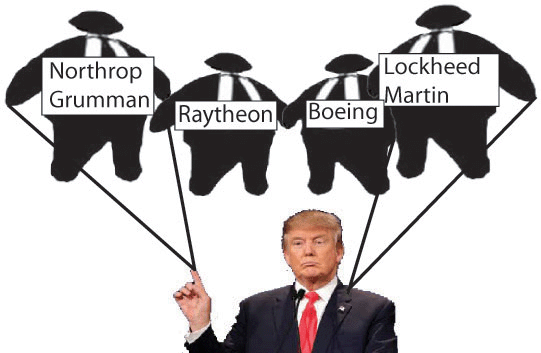
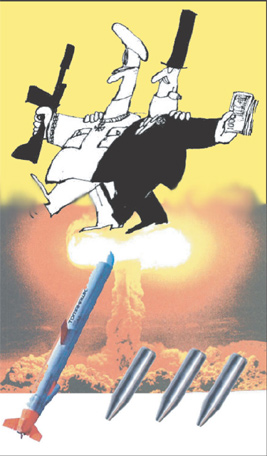
Trump Is Bankrupting Our Nation to Enrich the War Profiteers, March 06, 2017By Jonathan King and Richard Krushnic, Truthout | News AnalysisPresident Trump’s calls for a military buildup are opening the fiscal floodgates for congressional hawks and defense industry contractors. On January 27, Trump signed an executive order setting in motion a “great rebuilding of the Armed Forces” that will include new ships, planes and weapons and the “modernization” of the US nuclear arsenal. Presently, more than half of this year’s congressional budget — some $610 billion of our income tax dollars — is allocated to Pentagon accounts, including overseas military operations and nuclear weapons.
Though the details were scarce, we can expect the Trump order to align with the proposals of Sen. John McCain, chair of the Armed Services Committee. As reported in Politico, Senator McCain is now calling for large increases in this already bloated budget, to $640 billion for fiscal year 2018 — $54 billion above the current budget projections. Adding in the $60 billion projected spending for Iraq, Afghanistan, Syria and other interventions could bring total Pentagon spending next year to more than $900 billion. The primary beneficiaries of such a buildup will be the large corporations that dominate weapons contracting.
This is likely to be more than 60 percent of the total congressional discretionary budget. For comparison, the National Institutes of Health budget, which funds biomedical research on all the diseases that afflict tens of millions of Americans, is about $33 billion, less than 3 percent of the congressional budget. By fiscal year 2022, defense appropriations would reach $800 billion.
Trump’s tweets calling to limit the costs on the deeply troubled and over-budget F-35 Joint Strike Fighter have led to some optimism regarding his Pentagon spending plans. But mildly limiting the excessive profits to Lockheed Martin and their subcontractors, by tens or even hundreds of millions, is a very small effect when overall spending is increased by hundreds of billions.
Excessive Pentagon Spending Undermines the Civilian Economy
In addition to increasing the national debt, such a program will require cutting every sector of the civilian side of the budget — housing, transportation, environmental protection, biomedical research, education and health care. For many years, caps on these programs have continued to weaken them. The current proposal will essentially bankrupt the federal contribution to the civilian side of the economy.
The longer-term effects on the national economy are often obscured but will be even more devastating. Weapons don’t house us, don’t clothe us, don’t help us get to work and don’t cure our diseases. Thus, in the long run, they drain resources away from productive investments, deeply undercutting the overall health of the economy………
Former US Secretary of Defense William J. Perry, who served from 1994-1996, argues, “We are facing nuclear dangers today that are in fact more likely to erupt into a nuclear conflict than during the Cold War.” He notes that the new US nuclear weapons modernization program and Russia’s modernization program — along with confrontations in Eastern Europe and the Middle East — have begun a new nuclear arms race more dangerous than the Cold War. He sees “an imperative to stop this damn nuclear race before it gets underway again, not just for the cost but for the danger it puts all of us in.”
Efforts to communicate to voters the role of weapons contractors in distorting national security policy are getting underway, following the lead of the European-based “Don’t Bank on the Bomb” campaign. Last spring, the Cambridge City Council voted unanimously to request that the Cambridge pension funds divest from stocks in companies involved in the manufacture of nuclear weapons. Subsequently, the US Conference of Mayors passed a supporting resolution. These are small but important first steps in focusing attention on these corporate drivers of dangerous and costly nuclear weapons policies.http://www.truth-out.org/news/item/39712-trump-is-bankrupting-our-nation-to-enrich-the-war-profiteers
Lockheed Martin Used Pentagon Dollars to Lobby Congress for Nuclear Weapons Funding One of the uses of the billions of dollars from these contracts is to recycle them back into lobbying the government to push for additional conventional and nuclear weapons spending, as reported by William Hartung and Stephen Miles. Of course, in addition, these funds are used to support a general environment of fear and insecurity, through contributions supporting hawkish think tanks.
“……..Corporations that contract with the Department of Defense (DOD) for nuclear weapons complex work do not report revenues and profits from this work separately from their other military work, although they do break up government work from civilian work, and sometimes break up military work from other government work. Hence, it is not possible to determine profits made from nuclear weapons complex work from the annual reports and Securities and Exchange Commission (SEC) filings of large military corporations. However, it is possible to estimate, and to demonstrate how a significant amount of military R&D and production not recorded as nuclear weapons work is in fact partially nuclear weapons work. The nuclear weapons work financed by the US Department of Energy (DOE) is (not surprisingly) carried out in a semi-secret insiders club that insulates it from public knowledge and oversight. The first contracts for the upgrading of the nuclear weapons triads have already been awarded — one to Northrop Grumman — for a new generation of long-range bomber. But the public remains in the dark as to how many tens of billions of their tax dollars will be spent on the project.
From 2012-2014, according to Lockheed Martin’s 2014 annual report, the company realized an average of $46 billion a year in revenue, with an average of $3.2 billion in profits — 7 percent of revenue, and a 76 percent return on $4.2 billion of investor equity. The annual report informs us that 59 percent of 2014 revenue came from the Pentagon. We know from other sources that $1.4 billion a year is coming from the DOE for operation of the Sandia nuclear weapons lab, and we are estimating that an additional $600 million a year is coming for DOE nuclear weapons complex work. Information in the annual report indicates that around $6.1 billion came from foreign military sales. This adds up to around $35 billion of military revenue, or 75.3 percent of total 2014 revenue. The single biggest revenue earner in recent years is the F-35 jet fighter, bringing in $8.2 billion, 17 percent of total corporation revenue, in 2014. (William Hartung’s recent report describes additional aspects of Lockheed Martin’s military business, and his book Prophets of War: Lockheed Martin and the Making of the Military Industrial Complex provides extensive background).
The only references to Lockheed Martin’s nuclear weapons complex work in its 2014 annual report is a sentence noting provision of infrastructure and site support to the DOE’s Hanford complex, and a phrase noting continuing work on the Trident missile. The words “nuclear weapons” never appear in the report.
Lockheed Martin’s Nuclear Weapons Operations
In spite of the lack of mention in the annual report, Lockheed Martin is a partner with Bechtel ATK, SOC LLC and subcontractor Booz Allen Hamilton in Consolidated Nuclear Security LLC (CNS), in running the DOE Pantex Plant and the Y-12 Complex. Pantex does nuclear weapons life extension, dismantlement, development, testing and fabrication of high explosive nuclear warhead components. Y-12 stores and processes uranium, and fabricates uranium weapons components.
Lockheed Martin produced the Trident strategic nuclear missile for the 14 US Ohio-class nuclear submarines and for the four British Vanguard-class submarines. The 24 Tridents on each Ohio-class submarine each carry either eight or 12 warheads, all of them 20 to 50 times more powerful than the bombs dropped on Hiroshima and Nagasaki. Each warhead is capable of killing most of the people in any one of the world’s largest cities — either immediately or later, from radiation, burns, other injuries, starvation and disease. Lockheed MArtin is not producing new Trident missiles now, but it maintains and modifies them. Previously, Lockheed Martin and its subcontractors received $65 million for each of the 651 Trident missiles, in addition to the $35 billion in earlier development costs.
The other primary strategic nuclear weapon delivery vehicle is Boeing’s land-based Minuteman III strategic missile, also with many warheads per missile. About 450 of them are in silos in Colorado and northern plains states. Lockheed Martin produced and continues to produce key systems for the Minuteman III, and plays a large role in maintaining them. It was awarded a $452 million contract for this work in 2014.
Lockheed’s Sandia Subsidiary
Regarding the Pentagon’s nuclear weapons upgrades planned for the next decade; particularly important is the role of Sandia National Laboratories (SNL). Outside of Albuquerque, New Mexico, this DOE lab’s 10,600 employees make 95 percent of the roughly 6,500 non-nuclear components of all seven US nuclear warhead types. Components arm, fuse, fire, generate neutrons to start nuclear reactions, prevent unauthorized firing, preserve the aging nuclear weapons stockpile and mate the weapons to the missiles, planes and ships that deliver them to targets. Sandia Corporation LLC, wholly owned by Lockheed Martin, operates Sandia. The DOE is spending at least $1.4 billion a year on Sandia nuclear weapons work. The secret Lockheed Martin nuclear warhead assembly plant uncovered in Sunnyvale in 2010 is an extension of Lockheed Martin’s Sandia operations. Again, none of this received any mention or revenue numbers in Lockheed Martin’s 2014 annual report.
Lockheed Martin Used Pentagon Dollars to Lobby Congress for Nuclear Weapons Funding
One of the uses of the billions of dollars from these contracts is to recycle them back into lobbying the government to push for additional conventional and nuclear weapons spending, as reported by William Hartung and Stephen Miles. Of course, in addition, these funds are used to support a general environment of fear and insecurity, through contributions supporting hawkish think tanks. Technically, the federal government does not allow military contracting firms to use awarded funds to lobby Congress. Lobbying funds must come from other parts of the companies’ businesses. In reality, this is a non-functional restriction, since profits from various business segments are fungible; that is, once they are profits, they are intermingled, so in reality, the firms can use the profits from military contracts to lobby Congress. But Lockheed Martin went ahead and spent military contract funds from 2008-2012 as part of the contract expenditures. It didn’t even bother to book the lobbying expenditures as expenditures of profits. In 2015, the US Department of Justice required Lockheed Martin’s Sandia subsidiary to repay $4.9 million of a Sandia contract award to the Pentagon that the firm had spent under the contract for lobbying of Congressman the DOE secretary and the secretary’s family and friends………http://www.truth-out.org/news/item/39712-trump-is-bankrupting-our-nation-to-enrich-the-war-profiteers
Decision-makers skip N.Y. nuclear bailout hearing, Democrat and Chronicle, 7 Mar 17 Jon Campbell , @JonCampbellGAN ALBANY – A state-approved bailout of three upstate nuclear power plants was the focus of a legislative hearing Monday, but New York’s top energy officials declined to attend.
The state Assembly held a hearing Monday on the state’s “zero-emissions credit” plan, which kicks in on April 1 and will require ratepayers across the state to pay several billion dollars over 12 years to keep open the three aging plants, including the R.E. Ginna Nuclear Power Plant near Rochester.
The hearing, however, was absent the key decision-makers in Gov. Andrew Cuomo’s administration who were behind the initiative. The state Public Service Commission, which approved the measure last August, declined to testify in person, citing scheduling conflicts and a late invitation to attend. The state Energy Research Development Authority also declined……
Differing views
Without Cuomo’s administration participating Monday, lawmakers instead heard from private critics and supporters of the plan, including Exelon’s representatives. It began around 10 a.m.Monday and continued into the afternoon.
Blair Horner, legislative director of the New York Public Interest Research Group, urged lawmakers to pass legislation pausing the nuclear subsidy before it takes effect April 1.
NYPIRG and other critics of the plan estimate it will cost ratepayers $7.6 billion over 12 years, though the actual cost will depend largely on the cost of wholesale power.
“I think you hit that pause button, because once these things go on sale, it’s tough to un-ring that bell,” Horner said.
James Vaughn, senior manager at Exelon’s Nine Mile Point plant in Oswego County, spoke in support of the plan, urging lawmakers to be driven by “facts not fear.”
He said the plan is not about “lining our pockets with money,” but keeping the plants profitable so they can stay open and producing clean power.


 | March 14, 2017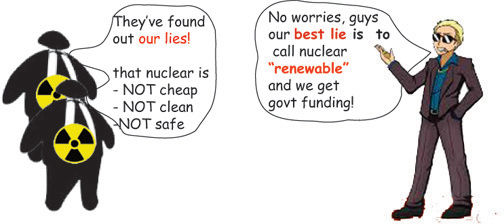









 nuclear-news