Point Lepreau nuclear power plant gets 5-year licence renewal, Commission says it’s satisfied plant will protect environment, safety and security By Viola Pruss, CBC News Jun 16, 2017 Point Lepreau’s nuclear power reactor is good to go for another five years.
The Canadian Nuclear Safety Commission announced its decision this week to renew the NB Power nuclear generating station’s operating licence until June 30, 2022.
The current licence runs out on June 30 of this year.
In a summary report, the commission said it found NB Power, “in carrying on that activity, will make adequate provision for the protection of the environment, the health and safety of person and the maintenance of national security,” as well as follow international obligations.
Lack of transparency
The commission said it considered a number of issues and submissions related to NB Power’s qualifications to receive an extended licence, including an environmental assessment and emergency plans in the event of a nuclear emergency.
An environmental assessment found that “adequate measures are in place to protect the environment and human health.”
However, the commission noted a lack of transparency and public availability of emergency planning documents, and directed the utility to disclose them……..
Indigenous land
In making its decision, the commission also considered information presented at two public hearings in January and May, including submissions from members of several Indigenous groups.They told the commission the plant was built on traditional and ancestral territories, and the facility “adversely affected their Aboriginal and treaty rights.”
While the commission recognized that Indigenous groups were not consulted when the plant was built, it “acknowledges the current efforts and commitments made by NB Power in relation to Aboriginal engagement,” the report said…….
Disaster-proof
A good portion of the first public hearing in January 2017 also focused on Point Lepreau’s ability to withstand a significant earthquake and other potential risks, including dam failures, shipping disasters, plane wrecks and meteor strikes……http://www.cbc.ca/news/canada/new-brunswick/point-lepreau-nuclear-power-licence-renewal-commission-safety-nb-1.4164700
June 19, 2017
Posted by Christina Macpherson |
Canada, politics |
Leave a comment

 Dave Toke’s Blog 15th June 2017, The French Government’s announcement that it will legislate for a carbon floor price of 30 euros per MWh marks a dramatic turn in EU energy markets which will now be shifted to favour nuclear power above renewables. This is because just over half of nuclear power generated in the EU come from reactors in France, whereas less than 10 per cent of EU renewable energy production comes from France.
The fact that nuclear power is being given special privileges undermines the policy credibility of the Green Energy
Minister Nichals Hulot who has just been appointed by President Macron.
Given that three-quarters of electricity in France comes from nuclear power, and very little from fossil fuels, this measure is a thinly disguised extra incentive for nuclear power, an incentive that the large bulk of renewable generation in the EU will not be able to receive.
Only the UK has a carbon floor price, which is around 17 per cent lower than the proposed French one. A case in point is Germany, which generates a third of the wind power in the EU. German electricity wholesale power prices are
relatively low – much lower than in the case of the UK for example, and there are fears that some windfarms will no longer be economic after their feed-in tariff contracts end after 2020. But they would be likely to stay online of they had access to the carbon floor price being set in France.
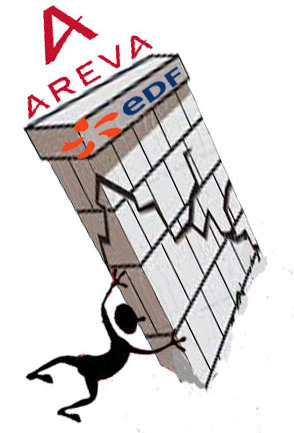
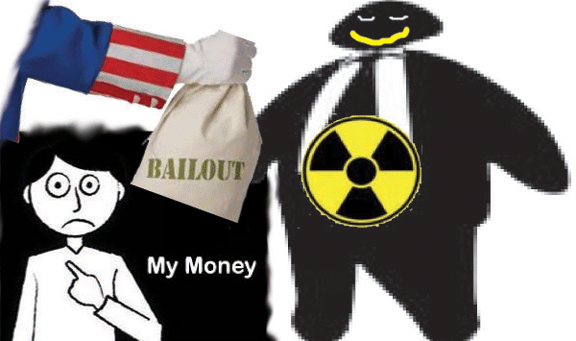
There is no carbon floor price in Germany. Macron seems, in energy at least, to be continuing ‘business as usual’ in letting EDF run the French state. The French Government has effectively ploughed several billions into bankrupt nuclear generators AREVA and also injected money to EDF through a ‘share flotation’ (EDF is 85 per cent owned by the French Government) that seems associated with building Hinkley C power station.
http://realfeed-intariffs.blogspot.co.uk/2017/06/france-to-tilt-eu-energy-market-towards.html
June 19, 2017
Posted by Christina Macpherson |
France, politics |
Leave a comment
 Bill to expedite Yucca Mountain licensing clears 1st hurdle, Martin Review-Journal Washington Bureau, June 15, 2017 WASHINGTON — A bill to expedite the licensing and development of Yucca Mountain nuclear waste site in Nevada was passed by a subcommittee Thursday, clearing the first hurdle for legislation expected to be taken up in the House this year.
The House Energy and Commerce subcommittee on environment approved the Nuclear Waste Policy Amendments Act on a voice vote. The bill now goes to the full committee for approval…..
Rep. Dina Titus, D-Nev., who is not on the committee, attended the hearing and spoke on the House floor later to denounce the bill as one that ignores serious challenges from Nevada, which has denied the federal government water rights to develop the site.
Titus said the bill “usurps the state’s water rights, one of our strongest legal defenses against the repository.”
During the hearing, the ranking Democrat on the panel, Rep. Paul Tonko, D-N.Y., agreed. He said the bill as written would “essentially override the state of Nevada’s objection over its water rights.”
Tonko said that would also draw opposition from lawmakers in other Western states, where water rights have been a long source of contention…..
The House bill mirrors the Trump administration call for a restart of licensing for Yucca Mountain. The president included $120 million in his budget blueprint for fiscal year 2018, which begins Oct. 1.
The Department of Energy first sought an application for a license with the Nuclear Regulatory Commission to develop and operate Yucca Mountain in 2008. The DOE tried to withdraw the application in 2010 and President Barack Obama defunded the program in 2012.
More than $15 billion has been spent studying the site and preparing for the licensing procedure, which includes adjudication of legal challenges.
200 challenges
Nevada has filed more than 200 challenges, mostly citing safety over groundwater and transportation issues.
Titus on Thursday handed lawmakers a state-produced research paper that showed moving nuclear waste to Yucca Mountain would cross through 329 congressional districts nationwide by rail or highway.
Yucca Mountain licensing also faces legal challenges in U.S. circuit courts.
Nevada Gov. Brian Sandoval this week reiterated his pledge that the state would oppose the Yucca Mountain project.
“The state of Nevada will continue to fight and defeat this dangerous project at every opportunity and in any venue,” Sandoval said in a statement……https://www.reviewjournal.com/news/politics-and-government/nevada/bill-to-expedite-yucca-mountain-licensing-clears-1st-hurdle/
June 19, 2017
Posted by Christina Macpherson |
politics, USA, wastes |
Leave a comment
 Donor Lobbying for Nuclear-Plant Tax Credits Brags of Dinners With Trump, Bloomberg, by Bill Allison
and John McCormick June 14, 2017,
-
Developer earlier gave millions to Democratic committees
-
GOP senators called tax-credit allocation ‘very troubling’
-
After Franklin L. Haney made his first million-dollar contribution to a super-PAC, his dream of owning a nuclear power plant took a big step forward.
That gift went to a group to help re-elect President Barack Obama in 2012. Haney followed up with two more million-dollar donations in 2012 and 2014, both of which went to a committee run by former aides of then-Senate Majority Leader Harry Reid.
- Between the first million and the third million, U.S. officials cleared Haney’s company to eventually receive as much as $2 billion in tax credits for owners of nuclear plants that use advanced technology. Federal documents obtained by Bloomberg News show that the approvals came despite two complications: First, the plant in question depends on 40-year-old technology. Second, Haney didn’t own it.
Haney ultimately purchased the unfinished, decades-old nuclear plant in northern Alabama at auction last November. Now, he has what may be an even bigger challenge — getting the mothballed plant into working order and finding customers for its power. That will require billions of dollars and some serious political help: For one thing, the tax credits he qualified for are set to expire in 2021, well before his facility could split its first atom.
While lobbying to extend the credits, Haney made a familiar political move: He gave a fourth million-dollar donation, this one to the inaugural fund of President Donald Trump…..
- During meetings, he mentions that he has dined at least a dozen times with Trump since the election, said the people, who asked not to be named because Haney made the comments in private settings. Haney, who didn’t respond to multiple requests for comment, is a member of Mar-a-Lago, Trump’s private club in Florida. The White House referred questions to the U.S. Department of Energy and the National Security Council, neither of which responded to requests for comment.
- Gaining Trump’s support could be invaluable to Haney’s nuclear ambitions. Over the next 18 months, Trump will have the authority to appoint five of the nine board members who oversee the Tennessee Valley Authority, the government-owned utility that supplies power to 9 million customers in seven states, including Alabama. TVA represents the most likely customer for Bellefonte’s electricity, and Haney said in bid documents that he wants to sell power to the utility. But there’s a problem: TVA has already decided it doesn’t need Bellefonte……
- Haney began trying to get into the nuclear-power industry, at an unfinished site in the Alabama countryside. The Bellefonte plant includes two partially built nuclear reactors, cooling towers and other facilities on 1,400 acres. TVA began construction in 1974 — then abandoned it in 1988. Today, one of the units is about 55 percent complete, and the other is about 35 percent finished.
Haney’s 15-year quest to own the plant reached a climax in November, when he won Bellefonte in an auction, bidding $111 million. The only other bidder planned to sell the plant’s parts as scrap in India or elsewhere. Haney has two years to close the sale, which is conditional on his acquiring federal regulatory approvals and commitments for financing.
‘White Elephant’
In the meantime, Haney has been lobbying officials on legislation that would extend the tax credit allocations that he’d already won for Bellefonte, federal lobbying disclosures show. But even if he wins an extension, many industry experts say they doubt Bellefonte can be profitable. Competition from low-cost natural gas and renewable energy sources has created difficult market conditions for nuclear plants nationwide. At least five have been retired in the past five years…….https://www.bloomberg.com/politics/articles/2017-06-14/million-dollar-donor-touts-dinners-with-trump-in-nuclear-quest
June 16, 2017
Posted by Christina Macpherson |
politics, USA |
Leave a comment
Nevada moves to dismiss lawsuit that could restart Yucca Mountain licensing http://mynews4.com/news/local/nevada-files-motion-to-dismiss-lawsuit-that-could-restart-yucca-mountain-licensing by Matthew Seeman, CARSON CITY, Nev. (News 4 & Fox 11) — The state of Nevada has filed a motion to dismiss a lawsuit that aims to restart licensing for the Yucca Mountain nuclear waste site.
Gov. Brian Sandoval’s office released a statement announcing the motion, saying in a statement the suit, filed by Texas, would “undercut Nevada’s opposition” to Yucca.
The Fifth Circuit Court of Appeals previously granted Nevada’s motion to intervene as a party in the lawsuit.
The governor’s office says the motion to dismiss, filed June 12, “is the first of several legal challenges” state officials, including Attorney General Adam Laxalt, plan to bring forward.
“Yucca Mountain would come at the direct expense of the health and safety of Nevadans and this petition would diminish Nevada’s ability to make its case against this ill-conceived project,” Sandoval said in a statement regarding Texas’s lawsuit.
The suit would require the Nuclear Regulator Commission to start and finish licensing proceedings for the Yucca site within a one-year time frame.
The motion filed by Nevada argues that Texas missed the 180-day window to bring civil action over the federal law that created Yucca in the 1980s.
The Silver State also argues that federal courts cannot force the White House to require a certain level of funding from Congress for the licensing process.
President Donald Trump has asked for $120 million in his 2018 budget to restart licensing at Yucca Mountain, a move that Sandoval, Laxalt and almost all members of Nevada’s Congressional delegation oppose.
June 16, 2017
Posted by Christina Macpherson |
politics, USA |
Leave a comment
 House panel votes to extend tax credit for nuclear power, The Hill, BY NAOMI JAGODA – 06/15/17, The House Ways and Means Committee on Thursday approved a bipartisan bill that would lift a deadline for the nuclear power production tax credit.
The panel passed the bill by voice vote.
The legislation would lift a requirement that nuclear facilities be placed in service by 2020 to be eligible for the credit. It would also allow public and nonprofit entities to transfer credits to other partners on the facilities, such as the projects’ designers.
The bill, which was introduced by Reps. Earl Blumenauer (D-Ore.) and Tom Rice (R-S.C.), is of particular importance in South Carolina and Georgia, where new nuclear power plants are being constructed.
“We need to give these plants the certainty of the tax credits as Congress originally intended…..http://thehill.com/policy/finance/337967-house-panel-votes-to-extend-tax-credit-for-nuclear-power
June 16, 2017
Posted by Christina Macpherson |
politics, USA |
Leave a comment
Bevin signs measure lifting nuclear moratorium. , Lexington Herald Leader, BY DAVID ZOELLER, 15 June 17 Gov. Matt Bevin came to Paducah Wednesday to sign the “Robert J. Leeper Act” lifting Kentucky’s 33-year-old moratorium on nuclear power plant construction.
June 16, 2017
Posted by Christina Macpherson |
politics, USA |
Leave a comment
France to close some nuclear reactors, says ecology minister Hulot, Reuters, 13 June 17, French environment and energy minister Nicolas Hulot said on Monday that the government plans to close some nuclear reactors of state-controlled utility EDF (
EDF.PA) to reduce nuclear’s share of the country’s power mix.
He gave no indication of timing.
Hulot told reporters at the G7 environment summit in the Italian city of Bologna that it was too early to give numbers about France’s aim to reduce the share of nuclear in its power generation to 50 percent from the current 75 percent.
“We are going to close some nuclear reactors and it won’t be just a symbolic move,” he said.
EDF shares, which were down 0.8 percent before Hulot’s comments, immediately fell further to stand 2.2 percent lower.
Asked about the possibility of introducing a carbon tax, Hulot said “France already has a carbon tax which we increase every year. At an EU level we want to increase the threshold,” he said……https://www.reuters.com/article/us-edf-nuclear-idUSKBN1931AD
June 14, 2017
Posted by Christina Macpherson |
France, politics |
Leave a comment
 11 June 17, Alternatives Economiques, [Machine Translation] Who decides on the energy policy of France,especially for electricity? The president of EDF, the minister of ecological and solidarity transition, in charge of energy, or the tenant of Bercy? Perpetual question that sends a lot of ink and weakens EDF, torn between conflicting interests.
It is time for the government to address the problems ofthe 83% -owned state, which is currently heavily indebted and whose financial situation is worrying.
On 6 April, EDF presented a strategic plan for its future investments as part of its Board of Directors’ plan of multiannual energy programming (PPE) 1 published at the end of October. On April 21, Ségolène Royal wrote to Jean-Bernard Levy, CEO of the EDF group, asking him to review his copy because “the actions foreseen by EDF do not make it possible to respect the objectives of diversification of electricity production set in the PPE “.
Among the points raised by the former minister, the absence of measures or means to prepare the closure of nuclear power plants, such as Fessenheim or coal.
Stopping a power station is not very complicated. Nuclear power stations are shut down regularly in France for maintenance or incidents. On the other hand, preparing the retraining of employees, developing new activities at the level of employment areas, organizing training courses for new trades … all this takes time.
EDF’s strategic plan, silent on these aspects, reveals the company’s will: to drag things out as much as possible. Moreover, it is rumored that EDF would have established a plan to reduce the share of nuclear energy to 50% in the energy mix by 2050 and not 2025 as foreseen in the energy transition law. EDF, but is not in any case in a hurry to revise its
strategic plan transmitted to the State. Why can not the state, which guarantees the implementation of the objectives of the Energy Transition Act, be heard?
For that, it would have to speak with one voice. And that is far from the case. For the shareholder state also has its interests in the matter. According to the Court of Auditors, it received a total of 11.3 billion euros of dividends between 2011 and 2016, an amount that the sages of the rue Cambon consider as exorbitant compared to the usual practices.
This financial interest has up to now pushed the State to support the nuclear sector and to defend the prolongation of the lifetime of power stations already depreciated, according to a short-term vision, which hampers investment in renewable energy energy savings.
But now, things are complicated for EDF, with a drop in its turnover and its production of electricity of nuclear origin. Moreover, very heavy investments are emerging: 55 billion euros in 10 years for the large fairing (upgrading of nuclear reactors), 15 to 20 billion euros for the two British EPRs of Hinkley Point, etc. https://www.alternatives-economiques.fr/anne-bringault/energie-edf-va-t-reviser-plan-strategique/00079236
June 12, 2017
Posted by Christina Macpherson |
business and costs, France, politics |
Leave a comment
 Bailout of 2 Ohio nuclear plants stalling at Statehouse http://www.news5cleveland.com/news/local-news/cleveland-metro/bailout-of-2-ohio-nuclear-plants-stalling-at-statehouse, Associated Press, Jun 10, 2017 CLEVELAND – A proposed bailout for Ohio’s two nuclear power plants that would lead to rate increases for FirstEnergy customers appears to be stalled in the Legislature.
One state legislative committee considering the idea suspended testimony last month amid vocal protests against the plan while another committee held its fourth hearing this week without taking a vote.
Much of the written testimony submitted to lawmakers opposes a plan that could lead to $300 million a year in new charges for FirstEnergy customers, The Plain Dealer (
http://bit.ly/2sboxIU) has reported.
CLEVELAND –
FirstEnergy’s average residential customer would pay about $5 more per month while businesses and factories would see much larger increases if the Legislature approves the bailout.
The Akron-based utility says subsidies are needed to save the Davis-Besse and Perry plants, which sit along Lake Erie and produce 14 percent of the state’s electricity. The company has said the plants might be sold even if subsidies are approved.
The plants are vital tax generators for rural towns near the plants, providing millions of dollars for school districts and local governments. The Benton-Carroll-Salem school district east of Toledo could lose $8 million a year if Davis-Besse closed.
Like many U.S. nuclear plants, Davis-Besse and Perry are aging, are costly to operate and maintain, and face stiff competition from utilities producing power with cheap natural gas.
Some nuclear plants have already closed. Power companies have said they will shut down other plants if they don’t get help. New York and Illinois recently approved multibillion-dollar subsidies to stop unprofitable nuclear plants from closing.
Ohio’s full Senate may not vote on the proposal until fall, said Public Utilities Committee Chairman Bill Beagle, a Tipp City Republican.
And there may not be a vote in the Ohio House.
House Utilities Chairman Bill Seitz, a Cincinnati Republican, said in May that he would not hold more hearings.
“I am not sensing a keen desire on the part of the House members to vote on this, and doubt that we will have more hearings in the near future unless something cataclysmic should happen,” Seitz said.
June 12, 2017
Posted by Christina Macpherson |
politics, USA |
Leave a comment
 Politics Homes 9th June 2017, The Nuclear Industry Association (NIA) has called on the next Government, whatever its formation, to return to business as quickly as possible, and resolve the key Euratom question for the nuclear sector to ensure a Brexit cliff edge for the industry is avoided.
Brexit is a key challenge for the nuclear sector and resolving the Euratom issue should be an immediate priority for incoming Ministers. The NIA recently launched a paper, setting out the priority areas for the negotiations with the European Commission to support the UK Government, should it decide to withdraw from Euratom as part of the Brexit process. https://www.politicshome.com/news/uk/energy/nuclear-power/press-release/nuclear-industry-association/86549/nuclear-industry
June 12, 2017
Posted by Christina Macpherson |
politics, UK |
Leave a comment

 With $8.6 billion spent, fate of South Carolina nuclear reactors still unknown, Post and Courier, By Andrew Brown abrown@postandcourier.com Jun 11, 2017 COLUMBIA — If two of the Palmetto State’s largest utilities pull the plug on their nuclear power plant expansion, around half of all South Carolinians could be on the hook for $8.6 billion to pay for a project that might never produce a single kilowatt of electricity.
It’s possible that bankruptcy proceeds, corporate payments and sales of the nuclear reactor components would help defray some of the costs to ratepayers if work stops on the V.C. Summer Nuclear Station in Fairfield County.
It’s just as possible the partnering utilities — publicly operated Santee Cooper and investor-owned South Carolina Electric & Gas — could decide as early as this month to continue work on the two new reactors, which have been plagued with cost overruns, construction delays and the bankruptcy of the project’s lead contractor.
In the end, the power companies can lean on their customers to recover the costs of the nuclear reactors no matter what they decide. For SCE&G, a 2007 law passed by South Carolina lawmakers allows the Cayce-based utility to collect a 10 percent profit for investors, even if the V.C. Summer project is scrapped.
“We are stuck to a great degree. The public is in a very bad position here,” said Lynn Teague, vice president of the League of Women Voters of South Carolina, who has followed the project. “It’s a rotten situation for the ratepayers.”
SCE&G and Santee Cooper already have sunk $8.6 billion into the project — more than half of the expected $14 billion needed to finish the reactors. The new power sources would serve around 1.6 million homes and businesses across South Carolina’s 46 counties.
The utilities have already collected nearly $2 billion from electric customers since the project received approval in 2008, but all of that money has gone to covering finance costs and not to the concrete, steel and manpower used to build the reactors.
The average residential electric bill for a SCE&G customer has risen by $324 a year to pay for the ambitious energy project that was pitched as part of a new carbon-free age of nuclear power in the United States.
The power companies said they could announce by June 26 whether they would stop work all together or continue construction on one or both of the reactors.
The biggest threat to the project is Westinghouse, the primary contractor at the project north of Columbia in Jenkinsville. Westinghouse filed for bankruptcy protection at the end of March.
Officials with SCE&G and Santee Cooper say they are closely monitoring Westinghouse’s bankruptcy proceedings, where both are creditors to the failing company. ……
SCE&G is all but guaranteed to get the project covered by its electric customers because of legislation passed by the General Assembly at the request of the utility industry in 2007.
That law, known as the Base Rate Review Act, allowed SCE&G to start collecting money for construction costs while work was being completed instead of after the fact. SCE&G said that would save $1 billion for what started out as a $9.8 billion project that was scheduled to open in 2016.
But the law also helped shift almost all of the risk for the endeavor off SCE&G’s parent and its shareholders and onto the electricity customers.
The only way that SCE&G will eat any of costs of the project now is if state regulators find the utility failed to, as law says, “anticipate or avoid the allegedly imprudent costs” based on the information available at the time. …….. http://www.postandcourier.com/business/with-billion-spent-fate-of-south-carolina-nuclear-reactors-still/article_b5ea0a00-4d1a-11e7-9e76-fb2e0630d446.html
June 12, 2017
Posted by Christina Macpherson |
business and costs, politics, USA |
Leave a comment
The Constitutional Court had earlier found that the 145 euro/gram tax on reactor refueling was illegal, obliging the government to pay a 6 billion euro ($6.8 billion) refund to the utilities EON, RWE and EnBW.
“The finance minister will assess the ruling and implement it, but first we should wait for that assessment and then Finance Minister Wolfgang Schaeuble will make his proposals,” Merkel said. “I don’t think our main targets will be at risk.” (Reporting by Thomas Escritt; Editing by Madeline Chambers)
June 10, 2017
Posted by Christina Macpherson |
Germany, Legal, politics |
Leave a comment

 Japan Minister Denies Government Considering New Nuclear Plants https://www.usnews.com/news/world/articles/2017-06-08/japan-to-consider-building-new-nuclear-plants-nikkei TOKYO (Reuters) 8 June 17 – Japan’s trade minister on Friday denied a media report and said the government is not considering building new nuclear plants or replacing existing reactors.
The Nikkei business daily reported earlier that Japan’s trade ministry would launch a panel as early as this month to revise the country’s energy plan and consider building new nuclear plants or replacing existing plants in the future.
The government will keep its current plan, set up in 2014, to reduce its reliance on nuclear energy, according to the Nikkei report, but also says that keeping nuclear power at a minimal share of the overall energy mix would require the construction of new reactors.
“At this point, we are not thinking of new construction or replacement at all,” Trade Minister Hiroshige Seko told reporters, dismissing the report as groundless.
Seko said the government is discussing the schedule for the revision of its basic energy plan, normally done every three to four years. No details for consideration have been set, he said.
If the government called for a policy that included building new reactors, such a move would face strong public resistance following Japan’s 2011 Fukushima nuclear disaster, the world’s worst nuclear calamity since Chernobyl in 1986.
A target by the industry ministry for nuclear to provide about a fifth of the country’s electricity in 2030 provoked widespread criticism when it was finalised in 2015.
(Reporting by Ami Miyazaki; Writing by Osamu Tsukimori; Editing by Tom Hogue)
June 10, 2017
Posted by Christina Macpherson |
Japan, politics |
Leave a comment
Greens would ditch Hinkley Point C – an expert view on the manifestos and recycling
https://www.theguardian.com/environment/2017/jun/07/general-election-public-service-manifesto-pledges-environment Damian Carrington ,8 June 17
Conservatives
New support for fracking to extract shale and coal seam gas is the most striking pledge from the Conservatives, with the easing of planning rules, a new dedicated regulator and more of any future tax revenues going directly to communities hosting shale gas sites. Wind power remains ruled out in England, but offshore wind farms are supported. The energy efficiency of all fuel-poor homes would be upgraded to meet energy performance certificate (EPC) band C criteria by 2030. There is no environment section in the manifesto and the UK’s air pollution crisis gets a single sentence: “We will take action against poor air quality in urban areas.” A free vote on repealing the ban on fox hunting with dogs is promised.
Labour
Four million homes would be insulated to cut emissions, improve health and lower bills. Fracking would be banned but new nuclear power stations and renewable energy, including tidal lagoons, are supported. On air pollution, a new Clean Air Act is promised, but without any detail. The controversial badger cull, intended to curb TB in cattle, would end and bees and other pollinators would be protected by a ban on neonicotinoid pesticides. Labour would “set guiding targets for plastic bottle deposit schemes”, aimed at cutting the 7bn single-use bottles sold in the UK each year.
Liberal Democrats
Higher, cheaper, sleeker: wind turbines of the future – in pictures
Greens
Nine million homes would receive energy efficiency upgrades, bringing two million people out of fuel poverty. Fracking would be banned and the planned Hinkley Point C nuclear power station in Somerset cancelled, while public funds would be divested from the fossil fuel industry. A new government-owned investment body would finance the transition to a zero-carbon economy. The Greens would “end the monopoly of the big six [energy companies] by building democratic, locally owned alternatives”, which would get priority access to the national grid. Plastic waste would be tackled with the introduction of a bottle deposit scheme and free public water dispensers.
June 10, 2017
Posted by Christina Macpherson |
politics, UK |
Leave a comment