Industry giants including NuScale, Rolls-Royce, Hitachi and Westinghouse have been summoned by ministers in a bid to reignite interest in the project. They have been asked to present their plans in meetings over the next few weeks.
Small modular reactors (SMRs) are a fraction of the size and cost of major nuclear power stations such as EDF’s controversial Hinkley Point C project. The Government signalled a key role for the technology in efforts to secure the energy supply and meet climate change targets two years ago.
An apparent lack of action since then has drawn criticism and raised industry concerns that the project has fallen by the wayside amid the political instability of Brexit and the general election.
In May, a House of Lords report branded the Government’s failure to publish the results of a competition for development funding as “particularly alarming”.
Companies considering investments in the technology had hoped that ministers would indicate which proposals they would support months ago, but they received no communication, fuelling the speculation that SMRs were being quietly abandoned. Renewed government interest in the technology is a boost to the nuclear industry. Rolls hopes to adapt technology developed to power Royal Navy submarines, for instance.
It has said developing SMRs for civil use will cost £1.2bn, with the first installation expected to require a further £1.7bn. Costs are forecast to fall as more mini reactors are built. Modular design allows the systems to be built in “blocks” in factories then assembled on-site. An SMR is expected to require a site about a tenth of the size of a conventional nuclear power station and generate between 200 megawatts and 450 megawatts of power.
Hinkley Point C, currently under construction in Somerset, is set to generate 3.2 gigawatts. Cost projections on the project have soared from £6bn in 2013 to £20bn, and the first new power is not expected to be generated until at least 2025.
Last month, the National Audit Office (NAO) hit out at Hinkley Point, saying taxpayers could face a final bill of as much as £50bn, because the wholesale market price for electricity is falling steadily while nuclear power construction remains expensive and high-risk. Under a 2013 deal between the Government and EDF, Hinkley is guaranteed to earn £92.50 for every megawatt-hour (MWh) of energy produced through a combination of wholesale market prices and a levy on consumer energy bills. At the time, the Government said this would require top-up payments totalling £6bn from consumers’ energy bills to meet the “strike price”, but falling market prices have widened the forecast gap every year since then.
The NAO criticised the Government’s nuclear plans, saying ministers had “committed electricity consumers and taxpayers to a high cost and risky deal in a changing energy marketplace. Time will tell whether the deal represents value for money”.
Plans for another nuclear plant at Moorside in Cumbria are also in doubt after Westinghouse, the US nuclear reactor developer which is owned by Japan’s Toshiba, filed for Chapter 11 bankruptcy amid spiralling losses brought about by cost over-runs and project delays.
Toshiba is currently a 60pc shareholder in the consortium to develop the 3.8 gigawatt plant at the Moorside site.
Moving to a new backer could push development of the plant back years with regulatory delays and costs likely to go up.
A spokesman for the Department of Business, Energy and Industry Strategy said of the small reactor plans: “We are currently considering next steps for the SMR programme and we will communicate these in due course.”
Success for SMRs could hinge on developing production lines and export businesses that would increase scale and bring costs down further in the years ahead
Tony Roulstone of the Cambridge Nuclear Energy Centre, a former senior Rolls engineer, recently told The Engineer magazine: “The cost of building nuclear plants is related to their complexity and the work you have to do on site to build them, and nothing the industry has tried has worked. So it’s time to try something else.
“The manufacturing approach works in every other industry. Nuclear is the only industry in which production engineering is not used.”
Mr Roulstone added: “It’s only by getting into a factory environment and building these things over and over again that you learn how to bring the cost down.”
When George Osborne, the then chancellor, announced £250m of taxpayer funding for development of the technology in 2015, he said the cash would be allocated by 2020.
Mr Osborne, whose time as chancellor came to an abrupt end last year, added that the money would help to “revive the UK’s nuclear expertise and position the UK as a global leader in innovative nuclear technologies”.
Utility drops rate hike plans for failed nuclear project, By SEANNA ADCOX New Jersey Herald : Aug. 11, 2017 COLUMBIA, S.C. (AP) — Millions of customers who have been footing the bill for years for a now-abandoned nuclear power project may get a temporary reprieve from rising bills, as South Carolina’s state-owned utility dropped plans Friday for two consecutive rate hikes.
Santee Cooper’s board canceled the approval process for average increases of 3.5 percent in 2018 and 3.9 percent in 2019. A vote on the requested hikes had been set for December.
They would have been the utility’s sixth and seventh hikes since 2009 for the now-abandoned expansion of V.C. Summer Nuclear Station north of Columbia. Santee Cooper and South Carolina Electric & Gas decided July 31 to halt construction on two new reactors they’d already jointly spent $10 billion to build, much of that paid by customers.
“Conditions have changed materially since the rate process began,” said Santee Cooper board Chairman Leighton Lord.
But the cancellation doesn’t necessarily mean rates won’t eventually rise for the more than 2 million customers served by Santee Cooper, which provides power directly and through local electric cooperatives. The board directed the utility’s staff to come back in October with a new financial plan.
“Santee Cooper will still need to cover costs related to our load, other system improvements and environmental compliance,” said Santee Cooper CEO Lonnie Carter. “We will tighten our belts and continue to look for ways we can be more efficient to make up the balance.”
Carter said the state-owned utility would have had to raise rates by 41 percent to continue with the project.
Friday’s unanimous vote comes amid a backlash from the public and lawmakers.
The scuttled nuclear project already accounts for 18 percent of SCE&G’s residential electricity bills and more than 8 percent of Santee Cooper’s. SCE&G is seeking permission from the Public Service Commission to recoup an additional $5 billion over 60 years. Those regulators approved all nine of SCE&G’s rate hike requests since 2009. Legislators have publicly warned commissioners they may be fired.
Three of those commissioners are up for re-election early next year by the Legislature. Seven people, including the incumbents, filed for the three slots by Friday’s noon deadline. The commission has no authority over the state-owned utility…….http://www.njherald.com/article/20170811/AP/308119851#
Trump administration silent on demise of nuclear project it once called ‘massively important’, Post and CourierBy Thad Moore and EmmaDumain tmoore@postandcourier.comeduman@postandcourier.com, Aug 12, 2017 The day after two South Carolina power companies decided to bail out on two partially built nuclear reactors, state regulators asked the project’s top executives what it would take to restart construction.
Kevin Marsh, CEO of South Carolina Electric & Gas parent SCANA Corp., answered with a must: The federal government would need to step in to cover the spiraling costs, he said, and guarantee that ratepayers wouldn’t foot the bill for a project with an uncertain price tag.
Nearly two weeks later, support from D.C. doesn’t appear to be forthcoming.
President Donald Trump and Energy Secretary Rick Perry, who have both advocated pro-nuclear positions, haven’t addressed the project’s demise publicly. And one of the two utilities that were building the reactors at the V.C. Summer Nuclear Station near Columbia says it hasn’t heard from the administration since giving it the news.
Santee Cooper, the state-run power utility that owns 45 percent of the project, says it told the White House it was ditching the reactors but hadn’t heard anything since. SCE&G, which owns the other 55 percent, declined to answer questions about its communications with the administration.
Over time, his mental health seemed to decline. He threw more and bigger public tantrums; lied more often and less artfully. The media, also in decline and knowing a ratings magnet when it saw one, turned a blind eye.
In 2016, the precariousness of Trump’s mental health was clear to all with eyes to see, but like extras in a remake of “The Emperor’s New Clothes,” reporters averted their glances. The day after the election, they were all in a state of shock, like staff at an asylum who woke one morning to find that the patient who thought he was Napoleon had just been named emperor of France. Once he took office, many publications began keeping running tallies of his lies. But all take a more cautious approach to questions of their origins in his deeply troubled psyche. To date, no major network, newspaper or magazine has run an in-depth analysis of Trump’s mental health
My meeting with Donald Trump: A damaged, pathetic personality — whose obvious impairment has only gotten worseI didn’t get his endorsement when I ran for governor — but the severely troubled man I met has only gotten worse, Salon.com. BILL CURRY 12 Aug 17, In 1994, I visited the home of Donald Trump. He was a Democrat then, of sorts, and I was the party’s nominee for governor of Connecticut. He’d taken an interest in our state owing to his keen desire to lodge a casino in Bridgeport, an idea I found economically and morally dubious. I had scant hope of enlisting him, but made the trip anyway, thinking that if I convinced him I might win, he’d be less apt to bankroll my opponent.
I arrived at Trump Tower in early evening, accompanied by my finance chair and an old friend and colleague. Stepping off the elevator into his apartment, we were met by a display of sterile, vulgar ostentation: all gold, silver, brass, marble; nothing soft, welcoming or warm. Trump soon appeared and we began to converse, but not really. In campaigns, we candidates do most of the talking; because we like to, and because people ask us lots of questions. Not this time. Not by a long shot.
Trump talked very rapidly and virtually nonstop for nearly an hour; not of my campaign or even of politics, but only of himself, and almost always in the third person. He’d given himself a nickname: “the Trumpster,” as in “everybody wants to know what the Trumpster’s gonna do,” a claim he made more than once.
He mostly told stories. Some were about his business deals; others about trips he’d taken or things he owned. All were unrelated to the alleged point of our meeting, and to one another. That he seldom even attempted segues made each tale seem more disconnected from reality than the last. It was funny at first, then pathetic, and finally deeply unsettling.
On the drive home, we all burst out laughing, then grew quiet. What the hell just happened? My first theory, that Trump was high on cocaine, didn’t feel quite right, but he was clearly emotionally impaired: in constant need of approbation; lacking impulse control, self-awareness or awareness of others. We’d heard tales of his monumental vanity, but were still shocked by the sad spectacle of him.
That visit colored all my later impressions of Trump. Over time, his mental health seemed to decline. He threw more and bigger public tantrums; lied more often and less artfully. The media, also in decline and knowing a ratings magnet when it saw one, turned a blind eye. Sensing impunity, Trump revived the racist ‘birther’ lie. In 2011, he told the “Today” show’s Meredith Vieira he had unearthed some dark secrets:
Vieira: You have people now down there searching, I mean in Hawaii?
Trump: Absolutely. And they cannot believe what they’re finding
As Trump recycled old lies, Vieira had a queasy look but no apparent knowledge of the facts. Of course, there weren’t any. Trump had no proof of Obama being born in Kenya. (Since there is none.) It’s highly doubtful he had any researchers in Hawaii. (It was only after Vieira asked him that he claimed he did.) Later, when Trump’s story crumbled, he followed a rule taught by his mentor, Roy Cohn, infamous architect of McCarthyism: Admit nothing. To Trump, a lie is worth a thousand pictures.
By 2016, the private Trump was on permanent public display, raging over mere slights, seeing plots in every ill turn of events and, as always, stunningly self-absorbed. He was called a racist, a sexist and a bully. But his mental health issues were euphemized as problems of “temperament.” He lied ceaselessly, reflexively and clumsily, but his lies were called merely “unproven” or, later, “false.” The New York Times called the birther story a lie only after Trump grudgingly retracted it. Not till he was safe in office claiming that millions of phantom immigrants cast votes for Clinton did the paper of record use the word “lie” in reference to a tale Trump was still telling.
In 2016, the precariousness of Trump’s mental health was clear to all with eyes to see, but like extras in a remake of “The Emperor’s New Clothes,” reporters averted their glances. The day after the election, they were all in a state of shock, like staff at an asylum who woke one morning to find that the patient who thought he was Napoleon had just been named emperor of France. Once he took office, many publications began keeping running tallies of his lies. But all take a more cautious approach to questions of their origins in his deeply troubled psyche. To date, no major network, newspaper or magazine has run an in-depth analysis of Trump’s mental health……http://www.salon.com/2017/08/12/my-meeting-with-donald-trump-a-damaged-pathetic-personality-whose-obvious-impairment-has-only-gotten-worse/.
Independent 11th Aug 2017,The Government has been accused of undermining its own efforts to tackle
climate change after new research revealed it is investing twice as much in
fossil fuel projects overseas as it is in renewables.
The U.S. Nuclear Industry’s Last Hope Seeks Help From Trump, Bloomberg , By Ari Natter and Mark Chediak
August 12, 2017,
Cost of delayed Georgia nuclear project may be $25 billion
Energy Secretary Perry turned down Scana’s bid for bailout
President Donald Trump has vowed to revive America’s dying nuclear industry. Backers of a troubled Georgia nuclear project want him to prove it.
They have asked the administration to come to the aid of a project to build two reactors to the Southern Co.’s Vogtle power plant, according to people familiar with the talks. That could include increasing or speeding up disbursements of $8.3 billion in federal loan guarantees to the companies behind the nuclear plant, the people said. They asked not to be identified discussing ongoing negotiations.
A Georgia public service regulator was in Washington to make a case for the project, the last nuclear plant under construction in the U.S., and Southern has hosted congressional staff members at the construction site. The company also wants Congress to extend tax breaks for nuclear power….
With Southern set to tell regulators in Georgia by the end of this month whether it plans to continue with construction plans for the plant, federal support could be crucial. Last week, Southern said it estimated its portion of the cost to complete the reactors was at least $11.5 billion, excluding $1.7 billion in guaranteed payments from Toshiba. Given Southern’s 46 percent stake in the project, that would put the total cost of building the two reactors at $25 billion……
After Energy Secretary Rick Perry turned down a request for $3 billion in aid for Scana Corp.’s nuclear plant in South Carolina, it’s not clear how much the federal government will help. Scana abandoned its V.C. Summer nuclear projects last month after it concluded the two reactors would end up costing it more than $20 billion to build.
Paul Keating: North Korea could collapse if it gives up nuclear weapons, SMH, James Massola,
Fergus Hunter, 12 Aug 17, Former Australian Prime Minister Paul Keating has warned that North Korea will never abandon its nuclear weapon program and that this new reality will have to be addressed in the same way as the west sought to contain the former Soviet Union.
The former prime minister, one of Australia’s most-respected foreign policy thinkers and a strong advocate for a more independent foreign policy, has disagreed strongly with the language and approach being taken the US President Donald Trump towards the rogue state…….
Mr Keating said his criticism could be extended to Australia’s pledge to enter any potential conflict between the US and North Korea. He also disagreed with former prime ministers Kevin Rudd and Tony Abbott that Australia should pursue a missile defence system against North Korea’s intercontinental ballistic missiles.
His comments about the growing tensions on the Korean peninsula come on the same day that Prime Minister Malcolm Turnbull declared Australia would assist America if it was attacked by North Korea……..
Mr Keating decided to speak publicly after being contacted by Fairfax Media and his views will be expanded in a major essay for a new magazine, Australian Foreign Affairs, to be published in October.
“I have long believed, especially after the unprovoked Western attack on Iraq and the ransacking of the Gaddafi regime in Libya, that North Korea would not desist from the full development of its nuclear weapons program, despite threats and sanctions from the West and even from China,” he said
“I said in April, we should regard North Korea as a full and capable nuclear weapons state – a state that would, in future, need to be contained, in the way the Soviet Union was contained during the Cold War. Developments since April have only confirmed my view.”
Trump Has Been Thinking About Nuclear War for Decades. Here’s Why That’s Scary. He seems to think it’s inevitable. Mother Jones, DAVID CORN AUG. 11, 2017 “……In a 1984 interview with the Washington Post, Trump, then merely a 38-year-old celebrity developer, shared his fantasies: He was hoping to build the “greatest hotel in the world” and construct the world’s “tallest” building in New York City—and one day become the United States’ chief negotiator with the Soviet Union for nuclear weapons. In between boasts of how rich and famous he was, Trump declared that he could negotiate a great nuclear arms deal with Moscow and said he wanted to head the US arms negotiating squad. “He says he has never acted on his nuclear concern,” the newspaper reported. “But he says that his good friend Roy Cohn, the flamboyant Republican lawyer, has told him this interview is a perfect time to start.”
Comparing crafting an arms accord with cooking up a real estate deal, Trump insisted he had innate talent for this mission. “Some people have an ability to negotiate,” he said. “It’s an art you’re basically born with. You either have it or you don’t.” Trump claimed he would know exactly what to demand of the Russians—though that would have to remain a secret for the time being. He was undaunted by his lack of experience in the technical field of nuclear weaponry: “It would take an hour-and-a-half to learn everything there is to learn about missiles…I think I know most of it anyway. …….
he continued to think and talk about nuclear weapons—often voicing a fatalistic approach, as if he believed nuclear conflagration was unavoidable. During a 1990 interview with Playboy, Trump was asked to describe his “longer-term views of the future.” Trump answered, “I think of the future, but I refuse to paint it. Anything can happen. But I often think of nuclear war.”…….
Trump pushed on with his notion that nuclear annihilation could be on the horizon:……..
It’s clear: Trump has been fretting about nuclear destruction for many years. But for all his concern, he seemingly has not done much to educate himself on the weighty subject. During the presidential campaign, he uttered several troubling comments about nuclear arms. At a Republican primary debate, he botched a question about the nuclear triad—a sign he did not understand the most basic information about the structure of the US nuclear command. As a candidate, Trump noted that he would support allowing Japan, South Korea, and Saudi Arabia to obtain nuclear weapons—that is, he was advocating nuclear proliferation—and that he would be open to using the ultimate weapons against ISIS and in other conflicts. He asserted that when it came to national security, he had “a very good brain.”
These days, his cavalier talk of “fire and fury” in response to Kim Jong-un’s reckless remarks about Pyongyang’s nuclear weapons show that Trump doesn’t bother to consider the difficult and vexing nuances of nuclear diplomacy. (Attack North Korea, and North Korea could well destroy Seoul with or without nuclear weapons.) Since the days of the Cold War, Trump has repeatedly signaled that he fears that nuclear war may be inescapable but that he also believes nuclear policy is an easy matter to master. At least for him. Each of these notions is frightening. Together, they can be terrifying. http://www.motherjones.com/politics/2017/08/trump-has-been-thinking-about-nuclear-war-for-decades-heres-why-thats-scary/
By Manuela Tobias on Thursday, August 10th, 2017 President Donald Trump’s threats against North Korea and tweets about the United States’ powerful nuclear arsenal have raised the specter — however small — of nuclear war.
But some members of Congress argue that the current process by which the president can order a nuclear strike is illegal.
“Our view is the current nuclear launch approval process is unconstitutional,” U.S. Rep. Ted Lieu, D-Calif, said on CNN on Aug. 8, 2017. Lieu has filed a proposal to require congressional approval before the president could launch a first nuclear strike.
“Right now one person can launch thousands of nuclear weapons, and that’s the president. No one can stop him. Under the law, the secretary of defense has to follow his order. There’s no judicial oversight, no congressional oversight,” Lieu said.
Lieu, a colonel in the Air Force reserves, is generally correct about the president’s power to initiate a nuclear strike. The constitutionality, however, is a more complex question. We won’t rate Lieu’s claims on the Truth-O-Meter, but we did think it was important to provide context to his statement and the law.
Nuclear launch process
The current nuclear launch approval process was enshrined after the atomic bombings of Hiroshima and Nagasaki in Japan to end World War II. President Harry Truman signed the Atomic Energy Act of 1946 to give the president full responsibility over the nation’s nuclear arsenal.
(As an aside, Lieu’s argument wouldn’t apply in cases when Congress formally declares war, since the president has a longstanding right as commander-in-chief to decide how to wage war.)
So the current nuclear launch approval process doesn’t include the same checks and balances as other executive branch decisions. The launch process allows the president to use nuclear weapons with a single verbal order. Some experts believethe president doesn’t need to consult with the defense secretary. The president’s order cannot be overridden.
Unconstitutional?
The U.S. Supreme Court has never weighed in on the question of whether the current nuclear launch approval process is legal. Not surprisingly, we heard mixed opinions from legal scholars.
The Constitution allows the president to use significant military force without congressional approval if it’s in self-defense. But would it be constitutional for the president to respond to a conventional bombing with a nuclear strike? What about a state-sponsored act of terror?
These questions have no definitive answer.
The murkiness is due in some part to the framers not foreseeing the capability for mass destruction that nuclear weapons guarantee, said Samuel Issacharoff, a constitutional law professor at New York University. But, he said, the narrow design of a founding document doesn’t necessarily make a president’s unilateral military action — nuclear or non-nuclear — unconstitutional.
“The best one can say is that the constitutional scheme may be poorly designed
for modern circumstances,” he said.
War Powers Resolution The discussion gets even more complicated if the president considers a pre-emptive strike rather than a retaliatory strike.
The Constitution does give Congress the authority to declare war, which it hasn’t done since World War II. But presidents before Trump — and including Trump with his April airstrikes in Syria — have initiated war or war actions without express congressional permission.
In 1973, Congress passed the War Powers Resolution requiring that in the absence of a war declaration by Congress, the president report to Congress within 48 hours of introducing armed forces into hostilities and remove forces within 60 days if Congress does not approve.
A simple reading, then, could give Trump a 48-hour window of unilateral power.
But the War Powers Resolution hasn’t stopped longer military interventions. President Bill Clinton sent U.S. troops into the former Yugoslav republic of Kosovo in 1999, and they remained in place despite the failure to receive congressional authorization.
The Korean War
There’s a final wrinkle to all of this: Some experts say that Trump could circumvent the need for Congress to declare war against North Korea, because the United States is already at war with North Korea.
The Korean War (1950-3) ended with an armistice, but the two parties never signed the peace treaty scheduled in Geneva in 1954 formally ending the war.
“In the absence of some new legal instrument that makes fighting the war improper, you can say that the president has whatever authority he had before,” said Saikrishna Prakash, a law professor at the University of Virginia.
But there’s a caveat to that, too. Congress approved funding to fight the Korean War, but never formally declared war. That was done by the United Nations.
EPA fines collected against polluters dropped 60% under Trump, report says, By Miranda Green, CNN August 10, 2017 Washington (CNN) The amount of money the Environmental Protection Agency is penalizing polluters they’ve sued for breaching federal regulations has plummeted by 60% under President Donald Trump, a report released Thursday has found.
Between January and July, fines resulting from settlements have been significantly lighter on polluters’ pocketbooks on average compared to previous administrations in the same time period, according to a report released by the Environmental Integrity Project, an environmental watchdog nonprofit group.
EIP found that between Trump’s first day in office through the end of July, the Department of Justice collected a total of $12 million in civil penalties from companies sued for breaking pollution control laws. During President Barack Obama’s first seven months, his administration collected $36 million in penalties. President George W. Bush’s administration collected $30 million and President Bill Clinton collected $25 million, according to EIP’s analysis, which is not adjusted for inflation…….http://edition.cnn.com/2017/08/10/politics/epa-lawsuits-dip/index.html
Nuclear Engineering International 10th Aug 2017, One of the conclusions of my most recent article on China was that many ofthe negative factors which have affected nuclear programmes elsewhere in
the world are now also crucial there.
The last year has confirmed that this was a reasonable judgement. Despite five new reactors starting up in 2016,
to bring the number in operation to 36, with combined generating capacity
of 32.6GWe, it is clear that the programme has continued to slow sharply.
The most obvious sign is the lack of approvals for new construction.
Although there are 21 units under construction, representing 23.1GWe, there
have now been no new approvals for 18 months. Other signs of trouble are
the uncertainties about the type of reactor to be utilised in the future,
the position of the power market in China, the structure of the industry
with its large state owned enterprises (SOEs), the degree of support from
top state planners and public opposition to nuclear plans.
There are a few possible explanations for the slowdown in approvals. Delays in imported
Generation III reactor designs (the Westinghouse AP1000 and Areva EPR) have
no doubt concerned regulators. Problems with the AP1000 projects at Sanmen
and Haiyang are more serious, as this reactor was destined for most of
China’s future reactor sites. Now hot testing is complete the first
Sanmen unit may go into operation before the end of 2017, but this will not
bring forward a flood of new approvals.
The Chinese have suffered a severe dent in their confidence about the AP1000, not helped by Westinghouse’s
bankruptcy. The authorities will want to see clear evidence of successful
operation before authorising more units. If they do, the first will be at
the existing two sites, but there are several others that have been ready
to go for several years now. http://www.neimagazine.com/opinion/opinionnuclear-in-china-why-the-slowdown-5896525/
With ‘fire and fury,’ Trump revives fears about his possession of nuclear codes, SF Gate, Marc Fisher and Jenna Johnson, The Washington Post, August 9, 2017
As with most things Trump, the furor over the “fire and fury” has divided the nation in two – those who believe the president is a loose launchpad, impulsively blurting whatever flits through his mind, and those who believe his inflammatory talk is a wily combination of politically savvy instincts and a gut-driven populism that simply aims to please.
When President Donald Trump went off script Tuesday to deliver a startling threat to North Korea – “They will be met with fire and fury like the world has never seen” – it was as if the nation relived the most lurid themes of the 2016 campaign in one chilling moment.
Last fall, Hillary Clinton’s campaign used as one of its final weapons a TV ad featuring a longtime nuclear missile launch officer who warned against voting for Trump: “I prayed that call would never come. Self-control may be all that keeps these missiles from firing.”
Then, quick-fire, a series of clips of Trump on the stump: “I would bomb the s— out of them.” “I want to be unpredictable.” “I love war.” The thought of Donald Trump with nuclear weapons scares me to death,” Bruce Blair, the retired launch officer, says in the ad. “It should scare everyone.”
It very nearly did: Voters made clear last fall that they trusted Clinton vastly more than Trump on the use of nuclear weapons – by 57 percent to 31 percent in a Fox News poll in October, for example.
But Trump voters often said that their reasons for supporting him outweighed their sense that he could be dangerously impulsive – and they repeatedly expressed confidence that the national security apparatus would keep him in check…….
August 10, 2017 (Mainichi Japan) MITO, Japan (Kyodo)— Ibaraki Gov. Masaru Hashimoto said Thursday he will not consent to restarting the sole reactor at the Tokai No. 2 nuclear power plant in Tokaimura, which went offline in March 2011 just as a nuclear disaster unfolded in neighboring Fukushima Prefecture.
Hashimoto’s pledge, coming on the day his campaigning for a seventh term as governor officially got under way, goes further than his previous stance on the issue, in which he had set conditions for a restart.
“I will not approve a restart,” Hashimoto said at an event marking the start of his official campaign for the Aug. 27 gubernatorial election. “I will steer in the direction of not accepting nuclear power,” he told his supporters….. https://mainichi.jp/english/articles/20170810/p2g/00m/0dm/075000c
Donald Trump’s nuclear fixation – from the 1980s to now, BBC, Anthony ZurcherNorth America reporter 10 August 2017 “…….The president’s recent nuclear sabre-rattling shouldn’t be viewed as an isolated incident, however. Mr Trump has displayed a keen interest in the utility of atomic weapons for decades…..
his thoughts on atomic weaponry reflect a certain strain of Cold War arms-race enthusiasm and diplomatic brinkmanship.
Last December President-elect Trump emphasised that the US had to “greatly strengthen and expand” its nuclear weaponry and would “outmatch” any adversaries.In August MSNBC’s Joe Scarborough reported that candidate Trump had asked his foreign policy advisors several times why the US couldn’t use its nuclear weapons – a claim the Trump campaign denied.
The report, however, followed on the heels of an April 2016 town hall forum exchange between Mr Trump and MSNBC’s Chris Matthews, who asked him why he had refused to categorically rule out the use of nuclear weapons.
“Would there be a time when it could be used?” Trump replied. “Possibly. Possibly.”
When pressed on the risks of openly talking of using nuclear weapons, Mr Trump said: “Then why are we making them? Why do we make them?”(The US no longer makes new nuclear warheads. It maintains its current arsenal.)
He repeated that he is not going to take any of his “cards off the table”.
Digging back further, in 1990 Mr Trump gave an interview with Playboy Magazine in which the topic of atomic weaponry came up.
“I’ve always thought about the issue of nuclear war; it’s a very important element in my thought process,” Mr Trump said. He called it the “ultimate catastrophe” and compared it to an illness no one wants to talk about it.
“I believe the greatest of all stupidities is people’s believing it will never happen,” he continued, “because everybody knows how destructive it will be, so nobody uses weapons. What [expletive].”
In 1984 – at the height of the Cold War – Mr Trump even told a Washington Post interviewer he wanted to be put in charge of US-Russia nuclear arms negotiations.”It would take an hour-and-a-half to learn everything there is to learn about missiles,” Mr Trump said. “I think I know most of it anyway.”
Around the time of this interview a computer game called Balance of Power, which simulated the Cold War struggle between the US and Soviet Unions, became a surprise hit.
Players could sabotage, scheme and sabre-rattle up to the brink of nuclear war. The trick was you were never quite sure how close you could get before the missiles started flying. Escalation could lead to inadvertent annihilation.
And if it did, this was the message, displayed in white letters on a black screen: “You have ignited an accidental nuclear war. And no, there is no animated display of a mushroom cloud with parts of bodies flying through the air. We do not reward failure.”
If Mr Trump’s past comments are any guide, he appears to be making the calculus that the US nuclear arsenal is ineffective if adversaries don’t believe the nation is willing to pull the trigger. It’s all part of the “unpredictability” strategy he repeatedly touted during his presidential campaign (and plugged again in a recent tweet).Mr Trump – and his Defence Secretary Jim Mattis – have spoken of how the US will prevail in any military confrontation with North Korea. Largely left unmentioned amid the bluster, however, is the danger that an extended standoff could spin out of control and the high cost in human lives – in civilian lives on both sides of the Korean demilitarised zone and for US military personnel – that any such conflict would entail.
How Congress Is Cementing Trump’s Anti-Climate Orders into Law These efforts are mostly flying under the radar, but they could short-circuit lawsuits and make it harder to restore environmental protections. Inside Climate News, Marianne Lavelle 31 JULY 17,
How NRDC will fight Trump’s attack on our environment.
President Donald Trump marvels at his own velocity when he boasts about dismantling the Obama climate legacy. “I have been moving at record pace to cancel these regulations and to eliminate the barriers to domestic energy production, like never before,” he said at a recent White House event.
But while Trump focuses on speed, his allies in Congress appear increasingly concerned about the durability of the president’s fossil fuel directives.
In recent weeks, they have advanced a handful of legislative measures that echo and extend various presidential orders meant to boost coal, oil and gas production and set aside consideration of climate change.
These moves may seem redundant, but they could provide bulletproof armor during future challenges to Trump’s agenda.
“They are … covering their bases by trying to legislate the rolling back of these safeguards because the process to repeal, undo or rewrite a regulation is as lengthy as the public process that helped establish the standard in the first place,” explained Melinda Pierce, chief lobbyist for the Sierra Club. “And, of course, any attempt to roll back environmental or public health standards can and will be challenged in court.”
“The Trump administration is attacking every environmental and health protection we have,” said Sara Jordan, legislative representative for the League of Conservation Voters. “If these legislative proposals get passed, it will make it that much harder for the next administration to restore environmental protections.”
That’s why Congressional Republicans are racing to write his instructions into law.
“We need to put the legislative stamp of approval on what the Trump administration is doing,” said Rep. Evan Jenkins (R-W.Va.) during a recent debate on the House floor.
The House already has voted to fast-track Trump’s withdrawal of a clean water rule and to streamline future environmental reviews over cross-border pipelines like Keystone XL. Now, GOP members are pushing forward legislation to bolster Trump’s revival of federal coal leasing, and to bar government regulatory agencies from considering the future damages caused by greenhouse gas pollution.
‘A Very Slippery Slope to Government by Fiat’
The courts have already started chipping away at the Trump administration’s edicts. A federal appeals court ruled July 3 that the Environmental Protection Agency (EPA) cannot simply suspend an Obama-era rule on methane emissions from oil and gas facilities. And a federal judge ruled last month that the Army Corps of Engineers had moved too hastily to permit the Dakota Access pipeline project, without considering environmental justice impacts on the Standing Rock Sioux tribe.
Environmental groups, states, and tribes have planned or filed lawsuits over virtually every aspect of the Trump energy agenda. “We’re going to meet them in court, we’re going to sue them, and we’re going to prevail,” Mitchell Bernard, chief counsel for the Natural Resources Defense Council (NRDC), said in a video the environmental group produced.
But Congress could short-circuit that litigation strategy with measures like the provision passed by the House last week allowing withdrawal of Obama’s “Waters of the U.S.” rule without public notice, comment or any of the other requirements that apply to federal departments and agencies. The Trump administration already has begun rescinding the rule, which was written to protect wetlands from dredge and fill material and created new permitting and reporting requirements that the oil, gas and coal industry abhor. The rider that the GOP tucked into an $800 billion budget bill would hurry the repeal and reduce possibilities for legal challenge……….
These Efforts Are Flying Under the Public Radar
Most of the legislative proposals shoring up the Trump energy agenda originate in the House, and their fate is unclear in the Senate, which already has rejected an effort to undo Obama-era methane regulations by legislative fiat, and where appropriators are less tolerant of budget riders.
Still, Senate negotiators may feel pressured to go along with some provisions to pass budget legislation that would keep the government up and running after the fiscal year ends on Sept. 30.
Senate supporters of the Trump energy agenda already have introduced their own version of the “Ozone Standards Implementation Act” that the House passed on July 18. That bill would help EPA Administrator Scott Pruitt delay implementation of the Obama administration’s standards regulating smog emissions for a year. The House-passed legislation would give states until 2025 to comply with the revised standards and would change long-standing law to allow the EPA to revise the standards every 10 years instead of every five.
Both the NRDC and a coalition of environmental, health and labor groups have published online running tallies of budget provisions that affect regulations, but they lament that the Congressional efforts to cement the Trump agenda have not received attention while the health care repeal effort and Russia investigations crowd out media coverage.


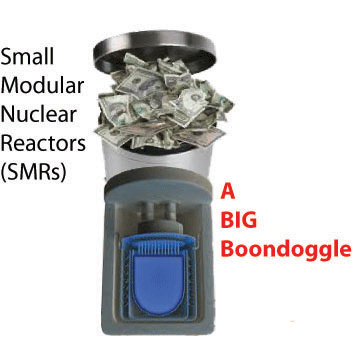 Small modular reactors (SMRs) are a fraction of the size and cost of major nuclear power stations such as EDF’s controversial Hinkley Point C project. The Government signalled a key role for the technology in efforts to secure the energy supply and meet climate change targets two years ago.
 Hinkley Point C, currently under construction in Somerset, is set to generate 3.2 gigawatts. Cost projections on the project have soared from £6bn in 2013 to £20bn, and the first new power is not expected to be generated until at least 2025.
 Toshiba is currently a 60pc shareholder in the consortium to develop the 3.8 gigawatt plant at the Moorside site.