 Can any South African Nuclear Energy Procurement ever Succeed? Daily Maverick, DIRK DE VOS, 05 MAY 2017
 Should the whole nuclear energy procurement process start up again, the few nuclear vendors that still remain should ask themselves: is it really worth the bother?
As most of us know, the recent Cape High Court decision in favour of the applicants, Earthlife Africa Johannesburg (ELA-JHB) and the Southern African Faith Communities’ Environment Institute (SAFCEI), to set aside nuclear procurement agreements was an utter thumping.
All South Africans owe a debt of gratitude especially since both NGO’s operate under significant financial constraints (donations can be made here) and for some, this was a replay of the David and Goliath story in the book of Samuel. Malcolm Gladwell’s take on that story is worth retelling…….
We are yet to see whether the new Minister of Energy will appeal the decision but it is hard to see how a “rematch” in any higher court will result in a different outcome.
Briefly, the court’s decision did two things. It set aside the previous Minister of Energy’s decision to proceed with the procurement of nuclear energy due to a number of flagrant departures from section 34 of the Electricity Regulation Act (ERA), which governs how such determinations should be made. It also set aside the Russian Nuclear Agreement as it should have – and did not – receive Parliamentary approval as required by section 231(2) of the Constitution. This agreement purported to create a number of obligations and liabilities for South Africa (including taking on all liabilities for a nuclear accident). The Constitution requires that these types of agreements with substantive impacts be approved by parliament. More basic framework co-operation agreements with the USA and South Korea – which, being of a more technical, administrative nature, did not require parliamentary approval – were also set aside on the basis that they were not tabled in parliament within a reasonable time, as required by section 231(3) of the Constitution.
 The most striking thing about the judgment is not the decision itself, but just how underhand, dishonest and profoundly inept the government has been in the whole affair. In a sense, they were worse off than Goliath – it was almost a process of self-sabotage. “Oh well”, says the nuclear lobby and in particular, NECSA – which by the way has just secured 85% of the total budget of R787 million allocated to nuclear by the Department of Energy for the next financial year, “the court decision said nothing about the wisdom of procuring nuclear energy as such and South Africa should just start the nuclear procurement process from scratch”. That is true. The court’s decision was mostly about procedural matters, but it raises an important question: could procuring nuclear power ever be done legitimately in a way that satisfies the Constitution and the rule of law? It’s an important question because the answer should guide whether anyone, especially taxpayer-funded entities, should bother even trying.
The answer is no and this is why. The Constitution was not drafted to prevent South Africa from procuring nuclear power, but, given the state of the nuclear energy sector in 2017, it makes it extremely difficult, if not impossible. It is perhaps this very reality that has driven the underhandedness that we have seen.
The problem, at its core, is that the nuclear energy sector is selling a crap product. One could go on forever about why nuclear energy is a problem, but here are the main points:
Nuclear is very different from any other energy options
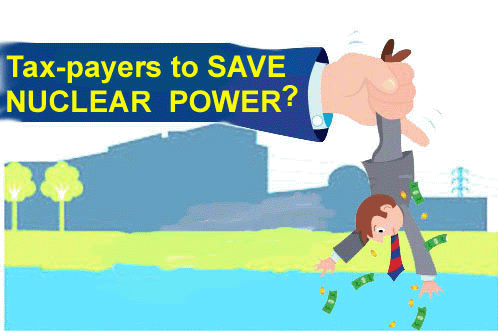
There are no nuclear vendors that are not state-owned. Without state ownership, the nuclear sector would not exist. That means procuring nuclear requires first the state-to-state type agreements whether in terms of section 231(2) or (3) of the Constitution annulled by the Cape High Court. Further, simply having nuclear energy, let alone procuring new nuclear, requires a whole separate and expensive regulatory system, participation in international bodies like the International Atomic Energy Agency, and funding a separate entity like Necsa. Nuclear energy costs South Africa nearly R800 million per year – a cost not typically included in the price of nuclear energy. Nuclear’s safety issues cannot be solved technologically; its safe operation requires constant vigilance from highly trained experts. Enormous decommissioning costs and the storing of spent fuel have not been resolved. Despite efforts to delink civilian nuclear from nuclear weapons proliferation, the risk remains. No other energy option needs any of this.
Nuclear is in decline everywhere……..
Nuclear is very expensive and therefore has to be very big……. A scan through existing nuclear power projects in those parts of the world where independently-obtained information is possible, makes for sobering reading – including projects developed or sponsored by Rosatom. One consequence of the record of nuclear is that credit rating agencies hate them and shred the credit rating of any country that gets serious about procuring nuclear. Current estimates are that nuclear power is now twice as expensive – on a per kWh basis – as renewables, while renewables continue to fall in price.
There are other problems. Eskom is in a terrible state and that is a long-term problem that will have to be resolved in one way or another – probably through another taxpayer-funded bail-out or some type of privatisation…….
Any project with anything like a trillion-rand budget is simply not going to slip through and any hurdle not cleared is fatal for a nuclear procurement programme. The process requires a large amount of transparency and this is the nub of the problem for any nuclear deal……https://www.dailymaverick.co.za/article/2017-05-05-op-ed-can-any-south-african-nuclear-energy-procurement-ever-succeed/#.WQ0akUWGPGh
May 6, 2017
Posted by Christina Macpherson |
politics, South Africa |
Leave a comment

 French presidential favorite pins reactor closures to renewables growth, Nuclear Energy Insider, May 3, 2017 The election of Emmanuel Macron as French President would see nuclear decommissioning activity surge in the next decade but shutdown dates will depend on measures to accelerate wind and solar development. The French presidential elections reach a climax on May 7 when centrist candidate Emmanuel Macron faces far right candidate Marine Le Pen in the final round of voting. Macron is the favorite to win the election– polling at around 59% of the vote on May 1– and the election result will have a profound impact on the future of EDF’s French nuclear fleet.
While a surprise Le Pen victory would likely see a reversal of France’s reactor closure plans, a Macron win would usher in a surge in decommissioning activity in the coming decade. Macron has set out bullish renewable energy objectives and pledged to retain laws introduced in 2015 which aim to cut the share of nuclear power from 75% to 50% by 2025.
However, Macron has not set out a firm position on this nuclear target and market analysts have highlighted the challenge of shutting down an estimated 25 GW of nuclear power capacity over such a short timeframe while maintaining grid stability.
“The lack of a firm position on this issue may be because Mr Macron is well aware that the 2025 target is highly ambitious,” Jefferies analysts Ahmed Farman and Oliver Salvesen said in a research note April 24.
The 50% target may instead be reached between 2030 and 2033, a Macron adviser told Bloomberg in a report published April 26. The 50% objective could be reached sooner if ASN, the French nuclear safety authority, imposes tough conditions to extend reactor lifespans from 40 to 50 years, the adviser told Bloomberg.
Some 34 of EDF’s 58 reactors will soon reach 40 years of operations and the ASN will publish its safety report on the proposed lifespan extensions in around 2018.
Macron has said he would decide on the future of these plants following the ASN’s report.
Green bond
Macron’s pledge to reduce the share of nuclear power to 50% is based on a rapid expansion of wind and solar power. Macron has pledged to double wind and solar capacity and close all of France’s coal-fired power stations by the end of his five-year term in 2022.
Macron’s renewables pledge will require an acceleration in the approval process for renewable energy projects. France’s wind and solar development has been hampered by regulatory and administrative hurdles and Macron has pledged to simplify the authorization process.
Jefferies analysts Farman and Salvesen estimate the closure of 25 GW of nuclear power capacity in the coming eight years would require around 75 GW of new renewable energy capacity.
“That looks quite challenging given that in the last 10 years only 18 GW of wind and solar was installed in France,” the analysts said in their note.
A key advantage for developers going forward is the falling cost of wind and solar power. Technology improvements and improved installation practices have driven wind and solar costs towards wholesale market prices, removing the need for state subsidies in some countries.
Shutdown begins
Macron also supports the current government’s pledge to close two 900 MW reactors at Fessenheim when EDF brings online its 1.65 MW EPR at Flamanville, currently expected by the end of 2018. The EPR project is several years behind schedule but on March 15 EDF said it had begun system performance testing in line with its latest construction timetable announced in September 2015.
“The next milestone will involve fuel loading and then start-up at the end of the fourth quarter of 2018,” the company said……….. http://analysis.nuclearenergyinsider.com/french-presidential-favorite-pins-reactor-closures-renewables-growth?utm_campaign=NEI+03MAY17+Newsletter+B&utm_medium=email&utm_source=Eloqua&elqTrackId=fa70d686bf254ce4b69dc41f31b9c383&elq=acbe9ff6fdea4
May 6, 2017
Posted by Christina Macpherson |
France, politics |
1 Comment
New regs for Monday: Nuclear, relocation, pesticides, The Hill, BY TIM DEVANEY – 05/05/17 Monday’s edition of the Federal Register contains new rules for nuclear facilities, relocation expenses for federal employees and a review of various pesticides.
Here’s what is happening:
Nuclear: The Nuclear Regulatory Commission (NRC) is considering new procedures for decommissioning nuclear power reactors. As part of the rulemaking process, the commission is publishing a preliminary draft regulatory analysisof the decommissioning rule.
The NRC hopes the new rules will make the decommissioning process more efficient.
The public has until June 13 to comment on the analysis….http://thehill.com/regulation/332074-new-regs-for-monday-nuclear-relocation-pesticides
May 6, 2017
Posted by Christina Macpherson |
politics, USA |
Leave a comment
 Pentagon to lease privately owned Trump Tower apartment for nuclear ‘football’: letter, Reuters, By Mark Hosenball and Phil Stewart |5 MAY 17 WASHINGTON
The U.S. Defense Department is finalizing a lease on a privately owned apartment in New York’s Trump Tower for the White House Military Office to use for supporting President Donald Trump without providing any benefit to Trump or his organization, according to a Pentagon letter seen by Reuters.
The Military Office carries and safeguards the “football,” the device that contains the top secret launch codes the president needs to order a nuclear attack, as well as providing him secure communications wherever he is.
The White House, Secret Service, and Defense Department had no comment on whether similar arrangements have been made at other properties Trump frequents – Mar-a-Lago in Palm Beach, Florida and the Trump National Golf Club in Bedminster, New Jersey, where Trump is spending this weekend.
n a letter to Representative Jackie Speier, a Democrat on the House Armed Services and intelligence committees, Defense Department official James MacStravic, said the apartment is “privately owned and … lease negotiations have been with the owner’s representatives only.”
MacStravic, who wrote that he was “temporarily performing the duties of the Under Secretary of Defense for Acquisition, Technology, and Logistics,” said any acquisition of leased space with “an annual rental in excess of $1 million must first be approved by my office.”
He “approved this action” after consulting with the White House Military Office and other officials, he said.
Officials declined to reveal the cost of the lease or identify the owners of the apartment…….http://www.reuters.com/article/us-usa-pentagon-trumptower-idUSKBN1812B5
May 6, 2017
Posted by Christina Macpherson |
politics, USA |
Leave a comment

 Congress Gears Up For Showdown Over Billions In Nuclear Tax Credits, Daily Caller ANDREW FOLLETT Energy and Science Reporter 5 May 17 Congress did not include a provision extending tax credits for nuclear power in the $1.1 trillion spending bill intended to keep the government funded through September.
The lack of nuclear energy tax credits threaten the viability of two nuclear reactors being built in Georgia and South Carolina.
“The extension of the tax credit for advanced nuclear energy production is absolutely imperative to nuclear new build at Vogtle and VC Summer – and next-up U.S. nuclear projects, including SMRs, currently in the queue,” David Blee, executive director of the U.S. Nuclear Infrastructure Council (NIC), told The Daily Caller News Foundation. “Its urgency is even more so given challenges emanating from the Westinghouse Chapter 11 filing.”
Georgia and South Carolina lawmakers strongly supported extending the tax credit. Supporters claim congressional leadership is delaying the issue until lawmakers take up tax reform later this year.
Westinghouse’s March bankruptcy filing will likely delay the construction of the Vogtle and VC Summer reactors. South Carolina’s two Republican senators, Tom Scott and Lindsey Graham, were shocked when the federal tax credit was left out and have already introduced legislation extending the tax credit to 2025.
The Obama administration gave the developers of the Vogtle reactor in Georgia a $8.3 billion loan guarantee. Nuclear power supporters say taxpayers may be at risk of losing money if the Vogtle project falters.
Industry representatives think Scott’s legislation could save the Vogtle and VC Summer reactors……
“I’m not going to sit on the sidelines and watch the nuclear industry be destroyed,” Graham told Politico Wednesday. “For three years, we’ve been trying to get these tax credits extended…The reactors that are being built are very much at risk.”…http://dailycaller.com/2017/05/05/congress-gears-up-for-showdown-over-billions-in-nuclear-tax-credits/
May 6, 2017
Posted by Christina Macpherson |
politics, USA |
Leave a comment
 French Presidential Election: Nationalism Meets Environmentalism From International Environment Reporter Bloomberg, By Rick Mitchell, 5 May 17 “………..While the campaign commitment documents of both candidates set out environmental and energy policies, independent candidate Macron—a former Rothschild banker who was minister of economy, industry and the digital economy in outgoing President Francois Hollande’s Socialist government when the country hosted global climate talks in 2015—offers more detail than does National Front candidate Le Pen…….
May 5, 2017
Posted by Christina Macpherson |
France, politics |
Leave a comment
Americans have placed vast military power at the discretion of this mind, a presidential discretion that is largely immune to restraint by the Madisonian system of institutional checks and balances. So, it is up to the public to quarantine this presidency by insistently communicating to its elected representatives a steady, rational fear of this man whose combination of impulsivity and credulity render him uniquely unfit to take the nation into a military conflict.
 Trump has a dangerous disability, https://www.washingtonpost.com/opinions/trump-has-a-dangerous-disability/2017/05/03/56ca6118-2f6b-11e7-9534-00e4656c22aa_story.html?utm_term=.97e4e52a988c By George F. Will May 3 It is urgent for Americans to think and speak clearly about President Trump’s inability to do either. This seems to be not a mere disinclination but a disability. It is not merely the result of intellectual sloth but of an untrained mind bereft of information and married to stratospheric self-confidence.
In February, acknowledging Black History Month, Trump said that “Frederick Douglass is an example of somebody who’s done an amazing job and is getting recognized more and more, I notice.” Because Trump is syntactically challenged, it was possible and tempting to see this not as a historical howler about a man who died 122 years ago, but as just another of Trump’s verbal fender benders, this one involving verb tenses.
Now, however, he has instructed us that Andrew Jackson was angry about the Civil War that began 16 years after Jackson’s death. Having, let us fancifully imagine, considered and found unconvincing William Seward’s 1858 judgment that the approaching Civil War was “an irrepressible conflict,” Trump says:
“People don’t realize, you know, the Civil War, if you think about it, why? People don’t ask that question, but why was there the Civil War? Why could that one not have been worked out?”
[When is it okay to say the president might be nuts?]
Library shelves groan beneath the weight of books asking questions about that war’s origins, so who, one wonders, are these “people” who don’t ask the questions that Trump evidently thinks have occurred to him uniquely? Presumably they are not the astute “lot of,” or at least “some,” people Trump referred to when speaking about his February address to a joint session of Congress: “A lot of people have said that, some people said it was the single best speech ever made in that chamber.” Which demotes Winston Churchill, among many others.
What is most alarming (and mortifying to the University of Pennsylvania, from which he graduated) is not that Trump has entered his eighth decade unscathed by even elementary knowledge about the nation’s history. As this column has said before, the problem isn’t that he does not know this or that, or that he does not know that he does not know this or that. Rather, the dangerous thing is that he does not know what it is to know something.
The United States is rightly worried that a strange and callow leader controls North Korea’s nuclear arsenal. North Korea should reciprocate this worry. Yes, a 70-year-old can be callow if he speaks as sophomorically as Trump did when explaining his solution to Middle Eastern terrorism: “I would bomb the s— out of them. . . . I’d blow up the pipes, I’d blow up the refineries, I’d blow up every single inch, there would be nothing left.”
As a candidate, Trump did not know what the nuclear triad is. Asked about it, he said: “We have to be extremely vigilant and extremely careful when it comes to nuclear. Nuclear changes the whole ballgame.” Invited to elaborate, he said: “I think — I think, for me, nuclear is just the power, the devastation is very important to me.” Someone Trump deemed fit to be a spokesman for him appeared on television to put a tasty dressing on her employer’s word salad: “What good does it do to have a good nuclear triad if you’re afraid to use it?” To which a retired Army colonel appearing on the same program replied with amazed asperity: “The point of the nuclear triad is to be afraid to use the damn thing.”
[Trump has been sued. Here’s why the Justice Department shouldn’t represent him.]
As president-elect, Trump did not know the pedigree and importance of the one-China policy. About such things he can be, if he is willing to be, tutored. It is, however, too late to rectify this defect: He lacks what T.S. Eliot called a sense “not only of the pastness of the past, but of its presence.” His fathomless lack of interest in America’s path to the present and his limitless gullibility leave him susceptible to being blown about by gusts of factoids that cling like lint to a disorderly mind.
Americans have placed vast military power at the discretion of this mind, a presidential discretion that is largely immune to restraint by the Madisonian system of institutional checks and balances. So, it is up to the public to quarantine this presidency by insistently communicating to its elected representatives a steady, rational fear of this man whose combination of impulsivity and credulity render him uniquely unfit to take the nation into a military conflict.
May 5, 2017
Posted by Christina Macpherson |
politics, USA |
Leave a comment
 Stephen King: Trump’s nuclear ability ‘worse than any horror story I ever wrote’, The Hill, BY BRANDON CARTER – 05/03/17 Author Stephen King slammed President Trump on Wednesday, saying Trump’s tweets show that “he’s an almost textbook case of personality disorder.” King also signaled fear over Trump’s ability to launch a nuclear attack.
“That this guy has his finger on the nuclear trigger is worse than any horror story I ever wrote,” King said…..King’s comments come as lawmakers are pushing a bill that would deny Trump the authority to launch a first strike with a nuclear weapon without congressional approval. http://thehill.com/blogs/in-the-know/in-the-know/331865-stephen-king-trumps-nuclear-ability-worse-than-any-horror-story
May 5, 2017
Posted by Christina Macpherson |
politics, USA, weapons and war |
Leave a comment
 With Renewables Surging, Nuclear And Petroleum Battle Over Subsidies, Forbes, Jeff McMahon , 4 May 17 If the petroleum industry continues to fight subsidies for nuclear power, the nuclear industry will go after petroleum-industry tax breaks, the president of the Nuclear Energy Institute said Tuesday.
“They might say, oh don’t subsidize this, but let me tell you, you open up the books and you might not call it a subsidy but I tell you there’s a lot of tax breaks that the American Petroleum Institute gets,” said Maria Korsnick, president and CEO of NEI, the leading nuclear industry lobbying group.
“If in fact that’s the playing field that we’re going to be set with, then you’re going to hear more about comparisons of subsidies vs. tax breaks in order to get all the information, if you will, out on the table.”The American Petroleum Institute, the largest lobbying group for oil and gas companies like ExxonMobile and Chevron, has lobbied against legislative efforts in several states to save aging nuclear plants that are struggling to compete against cheap natural gas and, in some places, cheap renewable energy.
In Ohio, for example API Ohio Executive Director Chris Zeigler sent a message to state legislators:
“Abundant natural gas has provided Ohio consumers with reliable and affordable energy and created countless jobs throughout the state without government subsidies,” Zeigler said. “Instead of subsidizing nuclear power companies, we should let the markets work to protect consumers.”
API accused the nuclear industry of misleading consumers about the consequences of closing nuclear plants, arguing that natural gas would continue to lower emissions even if two Ohio plants close.
The nuclear industry has won support in New York and Illinois, with Exelon and Entergy benefitting. Lest those victories set a trend, the oil industry is raising objections in Ohio, Pennsylvania, and Connecticut…..https://www.forbes.com/sites/jeffmcmahon/2017/05/04/with-renewables-surging-nuclear-and-petroleum-battle-over-subsidies/#27185f7d4b15
May 5, 2017
Posted by Christina Macpherson |
business and costs, politics, USA |
Leave a comment

 One man is stoking fear over Iran’s presidential election — and the nuclear deal 5/4/2017 CNBC, May 3, 2017 – Supporters of Iranian cleric and presidential candidate Ebrahim Raisi vawe Iranian flags during Raisi’s electoral rally prior to presidential elections in Tehran, Iran on April 29, 2017.
The likely successor to Iran’s supreme leader has entered the country’s presidential election, and that’s throwing a lot into question.
Many still expect President Hassan Rouhani to win another term when Iranians go to the polls on May 19. But the emergence of Ebrahim Raisi as the conservative favorite has tightened the race and raised concerns about oil, a historic nuclear deal, and the fragile reopening of the Iranian market.
Raisi was an unknown until he rose to prominence last year when Ayatollah Ali Khamenei named him the custodian of an important Shiite shrine. The move sparked speculation that Raisi is in line to succeed the 77-year old supreme leader.
A hardline victory this month would put conservatives on a collision course with a combative Trump administration, endangering the 2015 agreement that put limits on Iran’s nuclear program in exchange for sanctions relief.
Hanging in the balance is Iran’s oil production, which has grown by roughly a million barrels a day since sanctions were lifted. So too are investment plans by energy giants to develop the country’s massive oil and gas reserves, and billions in aircraft sales by companies including Boeing.
More broadly, the election represents a choice between joining the global economy under Rouhani — who spearheaded the nuclear deal — and the so-called ‘resistance economy’ championed by hardliners, which is designed to protect politically connected domestic businesses.
Khamenei has not publicly backed Raisi, but generals from the influential Islamic Revolutionary Guard Corps paid the candidate an official visit, cementing the view that he is the ayatollah’s choice.
Raisi could backfire on hardliners……..
The election will depend on the economy and whether voters feel the benefits of the nuclear deal have trickled down to them, in Eurasia Group’s view.
Rouhani has restored a sense of security by preventing hyperinflation and shortages, but unemployment remains high, particularly among young people.
Following the nuclear deal, oil is flowing more freely, but there is a sense that Rouhani’s promise of prosperity has not come to pass.
‘He’s not being hit on the nuclear deal,’ Vatanka said. ‘He’s being hit on how he oversold it.’https://www.mojahedin.org/newsen/54741?c=twitter
May 5, 2017
Posted by Christina Macpherson |
Iran, politics |
Leave a comment
New energy minister departs from nuclear script, Times Live, Linda Ensor | 02 May, 2017 Energy minister Mmamoloko Kubayi has committed her department to public participation and transparency around the nuclear procurement programme. In her first public comments since taking office‚ the minister told members of parliament’s energy portfolio committee that she did not have any problems with a call for public participation in last week’s Western Cape High Court judgment.
Judge Lee Bozalek declared that the determinations gazetted by former energy minister Tina Joemat-Pettersson were unconstitutional and unlawful because the National Energy Regulator of SA had not followed legal prescripts around public participation.
These determinations were the basis on which Eskom has proceeded with its request for information for the procurement of 9‚600MW of nuclear energy.
However‚ while supporting the need for public participation‚ the minister said she was concerned about the status of the determinations. It might be necessary to seek a declaratory order from the court or appeal the judgment……http://www.timeslive.co.za/politics/2017/05/02/New-energy-minister-departs-from-nuclear-script
May 3, 2017
Posted by Christina Macpherson |
politics, South Africa |
Leave a comment
Call it what you want. There is an explanation for his behavior. https://twoifbycharmwordpress.wordpress.com/
Throughout the 2016 presidential campaign, we have seen numerous examples of Donald Trump’s behavior fitting neatly into the blueprint presented in this blog. The “black heart” and “lack of empathy” Mr. Khan so eloquently spoke of falls within the framework of a dangerous personality disorder according to experts. Some call it Narcissistic Personality Disorder, while other experts describe this behavior as sociopathic, or psychopathic.
The purpose of the original posting below (link to WordPress article dated 07.14.16 is posted here) is to call attention to an apparent mental health issue relating to Trump. It is to provoke thought and incite a broad discussion around Donald Trump’s apparent dangerous personality disorder, and to provide a reliable and consistent profile of Trump’s behavior.
Based on Harvard psychiatrist Dr. Martha Stout’s highly-touted book, The Sociopath Next Door, Trump seems to fit the bill of a sociopath, and that is why I speculated that he is a sociopath in the original posting. A reasonable person must admit that Trump’s behavior does align with the description in her introductory chapter (YouTube link is here).
Many experts believe Trump is a narcissist. In fact, a retired psychotherapist, with over 40 years of experience, wrote a comment about my article, stating that he believes everything I wrote about him in the posting is “precise and true,” though he believes Trump “fits into the diagnosis of narcissistic personality disorder, one of the most severe I and most other psychotherapists I have talked to, and who have written about it, have ever seen.”
Call it what you want to. diagnosis is for the experts. My thesis below is simply that “Trained in sociopathy or not, I can state one certainty: If there is a debate about whether a person is a narcissist or a sociopath (or any of the related personality disorders), there is much cause for alarm if you are within that person’s sphere of influence. The stakes are even higher if the questioned individual is in contention to lead the free world.”
With or without agreement to the posting’s proposition, if you believe this discussion should be had on a broader level, I kindly ask you to chime in, and to share it. I believe it gives a strong perspective, in real-life terms, on what the world is observing in Donald Trump’s campaign and behavior. It also provides an education that could help everyday people gain perspective and healing when they are affected by someone with a personality disorder, such as sociopathy.
Thank you for reading this post, your comments. This article has now been read in 30 countries worldwide, and several experts have chimed in favorably towards the thesis.
Note: Please leave your comments at the original posting: link to WordPress article dated 07.14.16 is posted here so it will be combined with the broader discussion. This posting may be updated or replaced from time-to-time.
May 3, 2017
Posted by Christina Macpherson |
politics, psychology - mental health, USA |
Leave a comment
Potential Challenges The ‘first of a kind’ build cost for any commercial SMR would be comparable to that of a conventional large reactor and would therefore need Government support. Cost savings for manufacture will typically only be realised after 10 or more reactors have been built, which is likely to be bigger that the UK market for SMRs. SMRs have the potential to both increase and decrease the proliferation risk depending upon the type of SMR produced.
We are disappointed that the Government launched a competition for SMRs and has not kept to its stated timetable. This has had a negative effect on the nuclear sector in the UK and if the Government does not act soon the necessary high level of industrial interest will not be maintained. It is particularly alarming that the results of Phase One of the competition, which does not involve the selection of an SMR design, have yet to be announced by the Government.
May 3, 2017
Posted by Christina Macpherson |
politics, technology, UK |
Leave a comment
Nuclear industry warns UK must avoid ‘cliff edge’ over Brexit, Leaving Euratom treaty without new deals would have dramatic impact on Hinkley Point C and other stations, says NIA, Guardian, Adam Vaughan, 3 May 17, The UK nuclear industry has issued its strongest warning yet to ministers on the problems it faces if the government is unable to strike new international atomic power deals during Brexit talks.
Failure to put in place alternative arrangements to replace the existing European nuclear treaty, Euratom, which the UK is quitting as part of the article 50 process, would have a “dramatic impact” on Hinkley Point C and other new power stations around the country, the industry said.
Ministers must avoid a “cliff edge” when the UK exits Euratom or face “major disruption to business across the whole nuclear fuel cycle”, the Nuclear Industry Association will warn the government on Wednesday.
The stark briefing to officials, seen by the Guardian, comes just a day after MPs said the continued operations of the UK nuclear industry were at risk from exiting the Euratom treaty. A Lords committee on Tuesday also said the UK risked losing access to markets and skills when leaving Euratom.
Tom Greatrex, the chief executive of the NIA, said: “We’ve had today two select committee reports that have both touched on this. The industry has been and is clear to government we are ready to do what we can – but it needs the government to get on with this and engage now, regardless of all the other issues they have to deal with.”
Theresa May’s decision to call a general election had made matters worse, he added, because it had squeezed the time available to establish alternatives to the treaty.
Euratom was first signed in 1957 by Belgium, France, Germany, Italy, Luxembourg and the Netherlands, and covers nuclear power station inspections, trade of materials and research.
The UK’s departure will mean the government needs to agree a new inspections regime with the International Atomic Energy Agency to replace Euratom inspectors.
“If the UK has not replaced the Euratom safeguards regime with its own system by the time it left Euratom, normal business could be disrupted right across the nuclear industry,” the NIA paper said. Falling back on World Trade Organisation standards would risk putting the UK in breach of its obligations in international nuclear law, the organisation added.
Nuclear cooperation agreements (NCAs) would also need to be put in place with key nuclear countries outside the EU, including the US, Japan and Australia, because the UK’s agreements with those governments are currently based on its membership of Euratom……https://www.theguardian.com/business/2017/may/02/nuclear-industry-uk-brexit-euratom-hinkley-point-c-nia
May 3, 2017
Posted by Christina Macpherson |
politics, politics international, UK |
Leave a comment
 Politicians clash over impact of Brexit on nuclear plans. North West Evening Mail, 2 May 2017 SOUTH Cumbria politicians have clashed over claims that the impact of Brexit could damage Britain’s nuclear future.
The business, energy and industrial strategy committee of MPs raised concerns of a long-term risk the UK could become a “rule taker”, unable to influence the European rules and standards.
The committee urged ministers to find transitional arrangements to keep Britain in the agency until a new plan could be hammered out.
Barrow and Furness’ sitting MP, John Woodcock, has criticised plans to leave nuclear research agency Euratom, with potential delays in finding an alternative threatening power supplies and inhibiting nuclear trade and research…….http://www.nwemail.co.uk/Politicians-clash-over-impact-of-Brexit-on-nuclear-plans-2b350329-bcc1-4e10-8fda-144b34c41de6-ds
May 3, 2017
Posted by Christina Macpherson |
politics, UK |
Leave a comment













 nuclear-news