For America’s Environmental Protection Agency (EPA), “climate” is now a dirty, or rather, nonexistent, word.
 EPA’s climate change website reappears, missing the word ‘climate’, Mashable, BY ANDREW FREEDMAN, On April 28, the Environmental Protection Agency (EPA) abruptly took down its long-standing treasure trove of online climate change resources, and put up a message stating that they were being updated to reflect the new priorities of the Trump administration.
To that end, on Friday, a group that monitors federal websites for changes in climate change content reported that the some of the climate websites taken down in April have returned to the EPA’s site, with all references to climate change removed.
According to the Environmental Data and Governance Initiative’s website monitoring group (EDGI), an EPA website that previously offered climate and energy resources for state, local, and tribal governments has been stripped of its references and links to climate science and policy. Prior to April 28, the site had contained programs and tools to assist these government entities in becoming more energy efficient, using more renewable energy, and developing climate change policies.
“Large portions of climate resources that were formerly found on the previous website have not been returned, and thus have ultimately been removed from the current EPA website,” the EDGI web monitoring group stated.
he EPA’s voluminous climate change website had previously been maintained under both Republican and Democratic administrations dating back at least to the first Bush administration, and it had served as a valuable tool for teachers and students, researchers, and government officials looking for data and advice on climate resilience efforts.
Since becoming EPA administrator, Scott Pruitt has pursued an aggressive agenda of dismantling the Obama administration’s climate change regulations, culminating in his action on Oct. 10 to withdraw the Clean Power Plan, which would limit greenhouse gas emissions from power plants.
Pruitt has said he doesn’t believe that science shows greenhouse gases from burning fossil fuels are the main cause of global warming, even though scientific evidence demonstrates exactly that link.
Pruitt instead wants to hold televised “red team, blue team” debates between climate scientists and deniers to contest the merits of mainstream climate science research. …… http://mashable.com/2017/10/20/epa-climate-website-missing-climate-change-references/#yfrYCTm9CPqM
What if White House officials really did have to physically stop President Donald Trump from starting a nuclear war?

Matt Lauer to John Brennan: Will Military Leaders ‘Lock’ Trump ‘in A Room’ to Stop Nuclear War? https://www.mediaite.com/tv/matt-lauer-to-john-brennan-will-military-leaders-lock-trump-in-a-room-to-stop-nuclear-war/, by Caleb Ecarma October 19th, 2017
As talks of military confrontation between the US and North Korea continue to escalate, Today Show host Matt Lauer raised an incredible question: What if White House officials really did have to physically stop President Donald Trump from starting a nuclear war?
As ridiculous as the idea may seem, there have been reports circulating in which WH aides suggest that Chief of Staff John Kelly and Secretary of Defense James Mattis may have formulated a plot to physically apprehend Trump before he reaches the nuclear football.
These reports inspired Lauer to ask Brennan the following:
“I feel weird asking you this, but you’ve read the same stories I’ve read. You know the key players around the president in Mattis, Mcmaster and John Kelly. Stories are going around out there that if the president inches closer to some kind of a nuclear confrontation with North Korea, that those guys are going to do something. They’re going to lock him in a room. They’re going to tackle him. You’re smiling. But these are the stories that are out there. And they will prevent him from carrying out any action that would cause that. Is that all nonsense?”
Despite the preposterous, slapstick image that Lauer’s question conjures up — Kelly or Mattis leaping like an NFL safety at Trump while he’s mid-nuclear launch — the always professional Brennan calmly clarified that the president alone has “unilateral authority” on military action. The former CIA director said Mattis’ options for protest include trying to talk the president out of it or tendering his resignation — the possibility of tackling Trump was not a listed option, though.
When asked whether or not he would follow unethical orders from his authorities, Brennan said that in certain cases — such as a command to bring back waterboarding — he would choose getting fired over following directives.
As for the Mattis, Kelly, and H.R. McMaster, Brennan commended all of them, saying, “They’re patriots… They understand the gravity of this situation, and I don’t think Trump does.”
U.S. House to vote on non-nuclear Iran sanctions next week
Patricia Zengerle WASHINGTON (Reuters) 21 Oct 17, – The U.S. House of Representatives will vote next week on new sanctions on Iran’s ballistic missile program and on Lebanon’s Iran-backed Hezbollah militia, senior House Republicans said on Friday, seeking to take a tough line against Iran without immediately moving to undermine the international nuclear deal.
President Donald Trump defied both allies and adversaries on Oct. 13 by refusing to certify that Iran is complying with an international agreement on its nuclear program, and threatened that he might ultimately terminate the accord.
That threw the fate of the agreement between Iran, the United States and other world powers into the hands of Congress, by opening a 60-day window in which Congress could reimpose, or
“snap back,” sanctions on Iran’s nuclear program that were lifted under the agreement.
However, many of Trump’s fellow Republicans – who all opposed the deal reached under former Democratic President Barack Obama – have said they see no immediate need to do so.
Congressional aides said that, for now, House lawmakers are focusing on clamping down on Iran in other ways such as the missile and Hezbollah sanctions……https://www.reuters.com/article/us-iran-nuclear-congress/u-s-house-to-vote-on-non-nuclear-iran-sanctions-next-week-idUSKBN1CP2A7
South Korea still to phase out nuclear power: commission voted to complete present construction
 Proposed resumption of nuclear reactors to delay Moon’s new energy policy http://english.yonhapnews.co.kr/national/2017/10/20/0301000000AEN20171020004651315.html SEOUL, Oct. 20 (Yonhap) — President Moon Jae-in was forced to push back the start of his new nuclear-free energy policy Friday after a public debate commission recommended resuming the construction of two unfinished nuclear reactors he earlier promised to scrap.
The resumption of the construction, however, may have limited effect on the president’s energy policy, which seeks to ultimately build a nuclear energy-free nation.
The commission said 59.5 percent of 471 citizens and experts who took part in the debate voted in favor of completing the Shin Kori-5 and Shin Kori-6 reactors, while 40.5 percent sided with the president to remove the unfinished reactors for good.
The presidential office Cheong Wa Dae said it respects the commission’s recommendation, adding it will soon take necessary measures to resume the construction of the two nuclear reactors.
Such a swift response from Cheong Wa Dae comes after the president earlier said he would respect the outcome of the debate, noting it would mark the start of what he called “deliberative democracy.”
“The process of reaching a social consensus requires a lot of time and money. But I believe it is a valuable process, considering the social cost we must bear when such decisions are made unilaterally,” the president said earlier.
Scrapping the two new nuclear reactors was a key election pledge of Moon.
Despite the inevitable delay in the start of Moon’s new energy policy, the outcome of the monthslong debate on the fate of the two new nuclear reactors will likely have little or no effect on the president’s ongoing plan to build a nation free of nuclear energy.
The president has noted his new energy policy did not seek to immediately shut down nuclear reactors that are currently in operation, but to do so when they run out their natural designed lifespan, a process he said would take at least four decades, considering the 40-year lifespan of the reactors recently built.
The Shin Kori reactors will also operate for at least 40 years following their completion, which is expected to take a few more years.
Before it was disrupted in July, the Korea Hydro & Nuclear Power Co. said the construction of the two reactors was 28.8 percent complete. Work on them began in 2016.
Officials at the presidential office Cheong Wa Dae insisted the president’s new energy policy was launched the day he took office in May, saying the policy also relied on not building any more nuclear reactors.
The public debate commission also hinted that its recommendation on the fate of the Shin Kori reactors may have been influenced by economic reasons, noting 53.2 percent of those who took part in the process voted in favor of reducing nuclear energy while 35.5 percent said the number of nuclear reactors should be maintained at the current level.
Only 9.7 percent said the number of nuclear reactors should increase, the commission said.
The government earlier said scrapping the construction of the Shin Kori reactors may cost more than US$2 billion for the payment of damages to developers and builders.
The president also remains firm on building a nuclear energy-free nation, the Cheong Wa Dae officials said.
“Up until now, the lives and safety of the people have been put in the backseat when establishing and implementing energy policies, while environmental considerations have also been overlooked,” Moon said earlier.
“To build a safe Republic of Korea and keep pace with the global trend, we … have to implement a great shift in our national energy policy that will reduce nuclear and coal-fired power plants, and implement and increase (the use of) clean, safe future energy.”
Defense Nuclear Facilities Safety Board – (nuisance to the nuclear industry) to be got rid of?
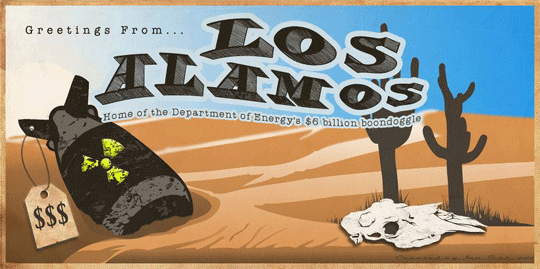 Efforts underway to remove ‘redundant’ nuclear safety board, Santa fe – New Mexican , By Rebecca Moss | The New Mexican, Oct 19, 2017
North Koreans support Kim Jong un’s bellicose policies
North Koreans undaunted by the prospect of nuclear war http://www.euronews.com/2017/10/19/north-koreans-undaunted-by-the-prospect-of-nuclear-war, By Robert Hackwill,
President Donald Trump’s bellicose rhetoric on North Korea appears to have had the effect of stiffening people’s resolve, with some North Koreans even believing they could survive nuclear conflict.
In this newly nuclear nation there seems to be more bikes on the road than cars. For decades they’ve had a military-first policy; that’s what we’re going to see. We are very quickly learning that President Trump’s rhetoric is having a profound effect. Officials here, talking to us about President Trump, the Vice Foreign Minister warning that he believes this region is on the brink of war, and if that is the case, then we are standing here on the front line,” reports NBC’s Kier Simmons.
“This is the border, the demilitarised zone between the north and South Korea. President Trump is expected to visit South Korea next month. I asked a Lieutenant-Colonel who is based here ‘What do you think about President Trump?’ He said to me, very plainly, that he believes the president is mentally ill. I spoke to another North Korean official who’s the father of a young son, and I said to him, ‘Aren’t you frightened by the prospect of war?’ And you know what he said to me? He said that all his life he has felt as if his existence is threatened by the United States, and he said that he thinks that North Korea and the North Koreans could even survive a nuclear war.”
NBC News poll shows that three quarters of Americans fear that Trump is leading them into war
Three-quarters of Americans think Trump is going to lead them into war http://www.independent.co.uk/news/world/americas/us-politics/trump-war-poll-americans-think-president-lead-conflict-a8009401.html
Unlike the President, most Americans don’t think diplomacy is a waste of time, Andrew Buncombe New York ,@AndrewBuncombe
U.S. threats of war with North Korea are ‘dangerous and short-sighted’ – Hillary Clinton
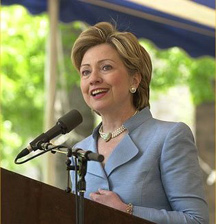 Hillary Clinton says US threats of war with North Korea are ‘dangerous and short-sighted’, Express UK, 19 Oct 17, HILLARY Clinton has declared that “cavalier” threats to start war on the Korean peninsula were “dangerous and short-sighted”, urging the United States to get all parties to the negotiating table.
Mrs Clinton told the World Knowledge Forum in the South Korean capital of Seoul: “There is no need for us to be bellicose and aggressive (over North Korea).”
Tension between Pyongyang and Washington has soared following a series of weapons tests by North Korea and a string of increasingly bellicose exchanges between US President Donald Trump and North Korean leader Kim Jong Un.
Mrs Clinton said, without mentioning Mr Trump by name: “Picking fights with Kim Jong Un puts a smile on his face.”
Ms Clinton also indirectly referred to Trump’s social media comments on North Korea, saying, “The insults on Twitter have benefited North Korea, I don’t think they’ve benefited the United States”…….. http://www.express.co.uk/news/world/868114/Hillary-Clinton-US-threats-of-war-North-Korea-dangerous-short-sighted
Dubious future for Armenia’s aging nuclear power station
The Uncertain Fate of Armenia’s Nuclear Power Plant, The Armenian Weekly, By on October 20, 2017 YEREVAN (A.W.)—The fate of the 41-year-old Armenian Nuclear Power Plant (ANPP), commonly known as Metsamor, is up for debate yet again as reports have emerged questioning whether the Armenian government will abandon plans for renewal or replacement altogether.
Metsamor, which is the only nuclear energy plant in the South Caucasus and one of the five remaining Soviet nuclear reactors of its kind, provides energy to 40% of Armenian consumers. Despite its critical role in Armenia’s modern energy economy, its aging design and proximity to earthquake-prone areas make it among the most dangerous nuclear plants in the world.
Built in 1976, the plant was shut down in 1989 by Soviet officials, following the devastating Spitak Earthquake. However, the economic difficulty and energy scarcity in Armenia after the collapse of the USSR in 1991, motivated the new Armenian government to relaunch the second of the plant’s two units.
Since then, the reactor’s operations have been a contentious issue both domestically and internationally. The issue was even addressed in an impending EU-Armenia trade agreement, where a 350-page, publicly-released draft text stipulated the reactor should be closed and replaced (though practical measures in enforcing this were notably vague)………https://armenianweekly.com/2017/10/20/uncertain-fate-armenias-nuclear-power-plant/
Trump administration set to unravel protection rules on ionising radiation?

EPA Says Higher Radiation Levels Pose ‘No Harmful Health Effect’, Bloomberg, By Ari Natter,
- Trump administration guidelines may be prelude to easier rules
“The position taken could readily unravel all radiation protection rules.” https://www.bloomberg.com/news/articles/2017-10-16/epa-says-higher-radiation-levels-pose-no-harmful-health-effect
FACT CHECK: Did Hillary Clinton Tell FBI’s Mueller to Deliver Uranium to Russians in 2009? ‘Secret Tarmac Meeting’?
 Did Hillary Clinton Tell FBI’s Mueller to Deliver Uranium to Russians in 2009 ‘Secret Tarmac Meeting’? Snopes, 19 October 17,
Hyperpartisan web sites mischaracterized a State Department cable alerting the U.S. Embassy in Russia of a transfer of criminal evidence obtained in a sting operation.
CLAIM: Then-Secretary of State Clinton ordered then-FBI Director Robert Mueller to deliver highly enriched uranium to the Russians in a secret plane-side meeting in 2009.
WHAT’S FALSE: There was nothing nefarious in the transfer of the ten-gram sample, which was done at the request of Russian law enforcement and with the consent of the government of Georgia, whose agents had participated in its confiscation.
ORIGIN: In May and June 2017, a number of hyperpartisan news and opinion web sites published articles reporting that former Federal Bureau of Investigation director Robert Mueller, who in mid-May was named special counsel in the Justice Department’s investigation into alleged ties between the Trump presidential campaign and Russian officials, was himself enmeshed in “secret dealings” with Russia related to his 2009 delivery of a sample of highly enriched uranium (HEU) to Moscow ordered by Hillary Clinton.
The conspiracy web site Intellihub noted that the transfer was revealed in a WikiLeaks release of a classified State Department cable:
Former Secretary of State Hillary Clinton facilitated the transfer a highly enriched uranium (HEU) previously confiscated by the U.S. Department of Energy (DOE) during a 2006 “nuclear smuggling sting operation involving one Russian national and several Georgian accomplices,” a newly leaked classified cable shows.
So-called “background” information was provided in the cable which gave vague details on a 2006 nuclear smuggling sting operation in which the U.S. government took possession of some HEU previously owned by the Russians.
The secret “action request,” dated Aug. 17, 2009, was sent out by Secretary of State Clinton and was addressed to the United States Ambassador to Georgia Embassy Tbilisi, the Russian Embassy, and Ambassador John Beyrle. It proposed that FBI Director Robert Mueller be the one that personally conduct the transfer a 10-gram sample of HEU to Russian law enforcement sources during a secret “plane-side” meeting on a “tarmac” in the early fall of 2009.
The WikiLeaks release was announced via Twitter on 18 May, the day after Mueller was appointed special counsel:
……….Intellihub characterized the plane-side transfer of uranium “shocking” and “rather reminisce [sic] of the infamous [then-Attorney General] Loretta Lynch/Bill Clinton meeting which occurred on a Phoenix, Arizona, tarmac back in June of 2016” (which meeting was cited by former FBI Director James Comey as the reason he concluded the Department of Justice wasn’t capable of an independent investigation into Hillary Clinton’s e-mail issues at the State Department).
Read in its entirety, however, the cable itself reveals nothing questionable or nefarious about the transfer of evidence between Mueller and a similarly placed Russian law enforcement official in Moscow. It merely asked the U.S. Embassy in Moscow to inform the Russian government that the transfer, which was postponed from an earlier date, would take place on 21 September 2009.
Moreover, it provided a complete explanation of why the transfer was taking place:…….
The 2006 sting operation was widely reported after the fact by U.S. newspapers, including the Washington Post:
Republic of Georgia authorities, aided by the CIA, set up a sting operation last summer that led to the arrest of Russian man who tried to sell a small amount of nuclear-bomb grade uranium in a plastic bag in his jacket pocket, U.S. and Georgian officials said.
The operation, which neither government has publicized, represents one of the most serious cases of smuggling of nuclear material in recent years, according to analysts and officials.
Despite partisan attempts to make it appear conspiratorial, the transfer of the sample of confiscated uranium was simply an instance of cooperative law enforcement between three countries: the U.S., Georgia, and Russia. The Russia government requested a sample of the uranium for forensic testing, the Georgian government signed off on it, and the U.S. government carried out the delivery.
The total amount of HEU confiscated in the sting was 3.5 ounces (about 100 grams). The amount Mueller delivered to the Russians was ten grams (the weight of four U.S. pennies). https://www.snopes.com/hillary-clinton-robert-mueller-uranium/
UK Labour warns that nuclear safety laws post Brexit could damage Britain’s democracy

 Energy Voice 17th Oct 2017, Labour has threatened to vote against nuclear industry contingency measures post-Brexit, claiming they give ministers a blank cheque to make “controversial policy decisions”. Shadow business secretary Rebecca Long Bailey said the Nuclear Safeguards Bill contained so-called Henry VIII powers which would enable the Government to pass laws with less scrutiny in the Commons.
She told MPs: “The job of a legislature is to legislate: the Bill before us as it stands is efectively a blank cheque handing that job over to ministers. “And I hope that the Minister can respond today with an iron-clad guarantee that the Government will not use those powers in that way but the ultimate guarantee will be to change the face of this Bill
itself.
“Safeguards are vital for our nuclear industry, but they are needed for our parliamentary democracy as well.” Speaking during the Bill’s second reading, Ms Long Bailey received cheers from the Government benches as she said there needed to be a nuclear safeguarding regime for the UK after it leaves the EU “should all else fail”.
But she said: “Let me add a caveat to that: we will need to see evidence of substantial amendment of the procedure set out here in this Bill, and evidence that the Government is really thinking about the best post-Brexit Euratom formulation before we can wholeheartedly commit at report stage and third reading to the passage of this Bill.”
https://www.energyvoice.com/otherenergy/nuclear/153420/uk-needs-nuclear-safeguarding-regime-post-brexit-labour-says/
South Africa’s President Zuma now has a new (Nuclear) Energy Minister: David Mahlobo praises nuclear energy
 New Energy Minister Mahlobo’s first words on his nuclear vision for SA, Fin 24, Matthew le Cordeur , Cape Town – Incoming Energy Minister David Mahlobo on Thursday highlighted his vision for South Africa’s nuclear energy future, following the approval for Eskom to develop 4GW of new power stations near Koeberg last week.
Mahlobo is the third energy minister this year. Tina Joemat-Pettersson was axed in March after the nuclear programme was halted following a court ruling. Her successor, Mmamoloko Kubayi, was this week redeployed to the communications ministry, with speculation that President Jacob Zuma was not happy with her progress in restarting the nuclear procurement programme.
Critics and opposition parties have warned that Mahlobo’s appointment could be an attempt by Zuma to push through the nuclear deal, as the president’s leadership position hangs in the balance ahead of the ANC’s elective conference in December.
4GW of new nuclear next to Koeberg
His appointment comes as the Department of Environmental Affairs (DEA) last week authorised its Final Environmental Impact Report for the power station at Duynefontein, giving Eskom permission to develop a new nuclear plant next to the existing Koeberg power station.
Koeberg, based outside Cape Town, is Africa’s only nuclear power station and contributes 6%, or 1.8GW, to South Africa’s power grid.
Citing the outdated 2010 Integrated Resource Plan (IRP), which states that South Africa requires 9.6GW of nuclear energy before 2030, Mahlobo said the latest development forms part of a “policy decision to pursue nuclear energy as a baseload energy form to mitigate our carbon footprint”………..
Zuma’s nuclear minister?
Allegations that Mahlobo’s appointment is a desperate bid by Zuma to get the nuclear new build programme off the ground hinge on revelation that he accompanied Zuma (with Deputy International Relations Minister Nomaindia Mfeketo) on a state visit to Russia in 2014, where he met with Putin at his residence in Novo-Ogariovo. No aides, advisers or wives went along, creating a veil of secrecy.
It has been widely speculated that Zuma and Putin struck a deal on nuclear cooperation at this meeting, but no evidence has ever emerged to confirm this. Rosatom, Zuma and the Department of Energy have consistently denied such a deal.
Democratic Alliance energy spokesperson Gordon Mackay said South Africans should be deeply concerned. “This is the state securitisation of the energy department. It started under Kubayi and will be completed under Mahlobo.” http://www.fin24.com/Economy/new-energy-minister-mahlobos-first-words-on-his-nuclear-vision-for-sa-20171019
Politifact rates Nikki Haley Mostly False on her claim that Congress had no input on Iran nuclear deal

 Haley wrongly says Congress had no input on Iran nuclear deal, Politifact, By Allison Colburn Defending President Donald Trump’s decision to decertify the Iran nuclear deal, United Nations ambassador Nikki Haley said Congress now has a voice on the issue that it didn’t have in the past.
Trump’s decision allows Congress to potentially kill the agreement or tack on new conditions………
Here, we are fact-checking Haley’s claim that Congress was “never allowed” to debate or discuss the agreement.
Much of the responsibility for U.S. foreign policy falls under the authority of the executive branch. Congress does play a significant role, however, in foreign trade and commerce, immigration, foreign aid, the defense budget and any declarations of war. The Senate authorizes treaties and confirms the president’s cabinet nominees.
To avoid needing Senate approval for an agreement with a foreign power, the president can simply avoid calling the agreement a treaty. The Obama administration said the Iran deal was neither a treaty nor an executive agreement. Instead, the State Department said in a letter that the deal “reflects political commitments” between the seven nations involved.
When the president negotiates a deal that is not deemed a treaty, Congress — if it wants a say on the deal — must convince the president to give the legislative branch the power to approve or block the final deal.
That’s exactly what Congress did when it passed the Iran Nuclear Agreement Review Act of 2015, a bill that had bipartisan support and allowed Congress the right to review any agreement reached in the negotiations. Obama initially threatened to veto the bill but did not.
Senators considered a separate, and ultimately unsuccessful, measure that would have given them the the power to block the agreement through a resolution of disapproval. A procedural vote on the resolution fell short of the 60 votes needed to override a Democratic filibuster.
Despite the resolution’s failure, by passing the Iran Nuclear Agreement Review Act, Congress was able to have some authority and say in the final agreement.
Sen. Bob Corker, R-Tenn., who spearheaded the bill, has touted the legislation for taking “power back from the president” and forcing the executive office to be transparent………
Haley said Congress was never allowed to debate or discuss the Iran nuclear agreement while Obama was in office.
Though Congress had to fight for the right to disapprove of the deal, the passage of the Iran Nuclear Agreement Review Act of 2015 allowed Congress to not only vote on the deal but to also hold public hearings and debate. The Senate ultimately did not have the votes to block the deal, but the act included a requirement for the president to frequently monitor Iran’s progress in meeting the agreement’s conditions.
So Congress did have input, even if Obama initially tried to avoid it.
We rate this claim Mostly False. http://www.politifact.com/truth-o-meter/statements/2017/oct/19/nikki-haley/haley-wrongly-says-congress-had-no-input-iran-nucl/
Authorities always knew that nuclear fallout shelters would not work
 Nuclear Fallout Shelters Were Never Going to Work, History // OCTOBER 16, 2017 “…….[IN 1961] the federal government was devising a way for 50 million Americans to survive a nuclear war by scurrying to the nearest basement. The National Fallout Shelter Survey and Marking Program had begun……….
With North Korea’s intercontinental ballistic missiles, or ICBMs, pointed west and President Trump’s atomic sabre-rattling, fears of nuclear war have crept slowly back into the public consciousness. If the headlines rekindle some of the old unease about air-raid sirens and mushroom clouds, they’re also an occasion to consider a singular relic of the period that, oddly enough, never left us—the fallout-shelter sign.
Dented and faded now, the Kennedy-era signs still cling to the sides of buildings across the country. “They’re an enduring symbol of the Cold War,” says popular-culture historian Bill Geerhart, who since 1999 has maintained CONELRAD.com, a meticulous chronicling of the duck-and-cover era. “They outlasted everything, including the Berlin Wall. They’re tangible artifacts of that era.” And though their original purpose has vanished, the signs still have much to say. They are the products of an ill-conceived program, designed to appease a population with little faith in that program even working.
Kennedy was privately skeptical about the value of a public shelter program……. While fallout shelters would do nothing to safeguard people from an actual bomb, they would, in the words of JFK’s civil-defense chief Steuart L. Pittman, give “our presently unprotected population some form of protection.”……..
In fact, the untenability of the shelters was public knowledge before they had even opened. A November 1961 story on the front page of The Washington Post bemoaned that most of the designated shelters would be little more than “cold, unpleasant cellar space, with bad ventilation and even worse sanitation.”
Conditions were a serious problem, but location was a bigger one. Two-thirds of the fallout shelters in the U.S. were in “risk areas”—neighborhoods so close to strike targets that they’d likely never survive an attack in the first place. In New York, for example, most of the government shelters could be found in Manhattan and Brooklyn—despite the fact that a 20-megaton hydrogen bomb detonated over Midtown would leave a crater 20 stories deep and drive a firestorm all the way to the center of Long Island. Even out there, Life magazine said, occupants of a fallout shelter “might be barbequed.”……..
Anyone who read the newspapers understood not just that an inbound ICBM would leave them only 15 minutes, if that long, to get to a fallout shelter—but also that few structures in the city would survive a strike anyway. …….
Looking back on the civil-defense program in 1976, The New York Times observed: “the only reminders of fallout shelters [now] are the yellow-and-black signs placed outside buildings.”
That’s where thousands remain to this day—eerie reminders of a tense past that, as recent headlines remind us, feels unwantedly familiar. “They couldn’t have come up with a more ominous symbol,” reflected Eric Green, keeper of the Civil Defense Museum website, whose personal collection of fallout-shelter artifacts includes over 140 signs. “That’s the most ominous looking sign—the black and yellow and those triangles. It looked like exactly what it meant: This is the end.” http://www.history.com/news/nuclear-fallout-shelters-were-never-going-to-work
-
Archives
- October 2026 (112)
- September 2026 (339)
- August 2026 (330)
- July 2026 (355)
- June 2026 (287)
- May 2026 (306)
- April 2026 (356)
- March 2026 (251)
- February 2026 (267)
- January 2026 (308)
- December 2025 (358)
- November 2025 (359)
-
Categories
- 1
- 1 NUCLEAR ISSUES
- business and costs
- climate change
- culture and arts
- ENERGY
- environment
- health
- history
- indigenous issues
- Legal
- marketing of nuclear
- media
- opposition to nuclear
- PERSONAL STORIES
- politics
- politics international
- Religion and ethics
- safety
- secrets,lies and civil liberties
- spinbuster
- technology
- Uranium
- wastes
- weapons and war
- Women
- 2 WORLD
- ACTION
- AFRICA
- Atrocities
- AUSTRALIA
- Christina's notes
- Christina's themes
- culture and arts
- Events
- Fuk 2022
- Fuk 2023
- Fukushima 2017
- Fukushima 2018
- fukushima 2019
- Fukushima 2020
- Fukushima 2021
- general
- global warming
- Humour (God we need it)
- Nuclear
- RARE EARTHS
- Reference
- resources – print
- Resources -audiovicual
- Weekly Newsletter
- World
- World Nuclear
- YouTube
-
RSS
Entries RSS
Comments RSS

