Democrats push bill to stop a Trump pre-emptive strike on North Korea
Conyers-Markey legislation has two Republican backers in House
President’s threat to ‘totally destroy’ North Korea fuelled nuclear war fears, Guardian, Julian Borger 27 Oct 17, Congressional Democrats have introduced legislation aimed at preventing Donald Trump from launching a pre-emptive attack on North Korea, as concerns grew about the administration’s failure to explore talks with Pyongyang.
The new legislation prohibiting an attack on North Korea without congressional authority was launched by Democrats John Conyers in the House and Ed Markey in the Senate. It has two Republicans among the 61 backers in the House, but at present no formal Republican backing in the Senate.
“As a veteran of the Korean war, I am ashamed that our commander-in-chief is conducting himself in a reckless manner that endangers our troops stationed in South Korea and our regional allies,” Conyers said.
“President Trump’s provocative and escalatory rhetoric, with threats to unleash ‘fire and fury’ and ‘totally destroy’ North Korea, cannot be allowed to turn into reality,” Senator Markey said. “As long as President Trump has a Twitter account, we must ensure that he cannot start a war or launch a nuclear first strike without the explicit authorization of Congress.”
The bill’s supporters acknowledge that it will not pass without attracting more Republican support, but they argue that it helps focus attention on the unlimited authority of a US president to order the use of nuclear weapons, many of which can be launched within a few minutes. No official has the power to stop or even delay the launch.
Senator Dianne Feinstein, speaking at a conference organised by the Ploughshares Fund, an non-proliferation advocacy group said she once asked a former head of US Strategic Command if he would carry out a launch order even if he knew it was a catastrophically bad decision. “He looked me straight in the eye and said: Yes,” Senator Feinstein recalled……..
Ted Lieu, the Democratic congressman who co-authored the bill in January to limit the president’s power to launch a first strike said the best recruiter for Republican support was Trump’s behaviour.
Non-partisan analysis reveals the cost of energy secretary Rick Perry’s proposal to give handouts to some of the country’s oldest and dirtiest power plants, Guardian, Oliver Milman, 27 Oct 17, A Trump administration plan to subsidize coal and nuclear energy would cost US taxpayers about $10.6bn a year and prop up some of the oldest and dirtiest power plants in the country, a new analysis has found.
The Department of Energy has proposed that coal and nuclear plants be compensated not only for the electricity they produce but also for the reliability they provide to the grid. The new rule would provide payments to facilities that store fuel on-site for 90 days or more because they are “indispensable for our economic and national security”.
Rick Perry, the energy secretary, said the subsidies were needed to avoid power outages “in times of supply stress such as recent natural disasters”.
The plan would provide a lifeline to many ageing coal and nuclear plants that would otherwise go out of business, primarily due to the abundance of cheap natural gas and the plummeting cost of renewables.
The Department of Energy noted 531 coal-generating units were retired between 2002 and 2016, while eight nuclear reactors have announced retirement plans in the past year.
Donald Trump has vowed to arrest this decline and end the “war” on mining communities by repealing various environmental regulations put in place during the Obama administration.
Perry’s pro-coal market intervention would cost taxpayers as much as $10.6bn a year over the next decade, according to a joint analysis by the non-partisan groups Climate Policy Initiative and Energy Innovation. Just a handful of companies, operating about 90 plants on the eastern seaboard and the midwest, would benefit from the subsidies, the report found.
“The irony of putting costs on consumers for resources that are no longer competitive is really striking,” said Brendan Pierpoint, energy finance consultant at Climate Policy Initiative. “It would serve to keep a lot of uneconomic plants in the market that currently can’t compete with the changing dynamics of cheap gas and the falling cost of renewables.”
The Trump administration has raised concerns that the growth of intermittent wind and solar energy could undermine the so-called “baseload” power provided by coal and nuclear, pointing to power outages during the Polar Vortex cold wave that swept over North America in 2014.
However, recent studies of the grid have found that it has not been weakened by the loss of coal and nuclear plants and is barely affected by power outages. Also, coal-fired plants are not immune to natural disasters, with facilities going offline during the Polar Vortex and Hurricane Harvey, which hit Texas this year.
An unlikely alliance of renewable energy advocates and the American Petroleum Institute has complained that Perry’s plan tips the scales in favor of a failing coal industry and has vowed to fight the proposal. The rule would also jar with the supposed free market principles of an administration that has attacked subsidies for wind and solar, as well as intervention in healthcare insurance markets.
“Perry’s obsession with propping up these expensive, dirty facilities will cost Americans real money,” said Mary Anne Hitt, a campaigner at the Sierra Club.
“These ageing coal plants are making Americans sick, and now Secretary Perry wants to force us to pay tens of billions of dollars to Wall Street to keep them running, so they can continue polluting our air and water.”
Perry’s plan has to be approved by the Federal Energy Regulatory Commission (FERC), which is housed within the Department of Energy but is an independent agency. Two of FERC’s three commissioners were appointed by Trump, with one,Neil Chatterjee, already voicing support for subsidizing coal and nuclear. Perry has asked for a ruling on his request by 27 November.
The aggressively pro-fossil fuels stance of the Trump administration has been advanced elsewhere this week, with the House of Representatives approving a budget plan that would open the way for oil drilling in a vast Arctic wildlife refuge in Alaska.
Meanwhile, the interior department has released a plan to sweep away the regulatory “burdens” that slow down or prevent mining and drilling on public lands.
The disclosure came at a hearing of the Commons Public Accounts Committee looking at the huge cost of building Hinkley Point power station which critics see as uneconomic and not properly costed.
It was raised in a paper submitted to the committee by Professor Andy Stirling, Fellow of the Academy of Social Sciences, and Dr Phil Johnstone, from the Science Policy Research Unit, Sussex University, which questioned whether the Ministry of Defence is being subsidized by the civil nuclear industry.
Their paper pointed out this is never publicly discussed but added: “If a UK withdrawal from civil nuclear power on grounds of uncompetitive economics were to leave these shared costs borne entirely on the military side, then UK military nuclear infrastructures would be significantly more expensive.
“If civil nuclear commitments are being maintained (despite adverse economics) in order to help cover these shared costs, then it is this that amounts to a cross-subsidy.”
The point was taken up by Meg Hillier, chair of the PAC, last week. She questioned Stephen Lovegrove, former Permanent Secretary, Department for Energy and Climate Change, on the issue.
“Mr Lovegrove, there has been an argument put forward by Sussex University that Hinkley is a great opportunity to maintain our nuclear skills base. With your hat on at the Ministry of Defence, are you having discussions with the business Department about this?”
Lovegrove replied: “We are, yes. In my last year at DECC, I was in regular discussion with Jon Thompson, former Permanent Secretary at the MOD, to say that as a nation we are going into a fairly intense period of nuclear activity … We are building the new SSBNs (nuclear armed nuclear submarines) and completing the Astutes … We are completing the build of the nuclear submarines which carry conventional weaponry. We have at some point to renew the warheads, so there is very definitely an opportunity here for the nation to grasp in terms of building up its nuclear skills.
“I do not think that that is going to happen by accident; it is going to require concerted Government action to make it happen. We are speaking to colleagues at BEIS ( Business, Energy and Industrial Strategy) fairly repeatedly about it, and have a number of forums in which we are doing that.”
The Sussex University paper also pointed out that private industry was making the link. Their paper said: “Rolls Royce acknowledged for the first time in a major public statement, that there also exists a deep interlinkage between British civil and military nuclear industrial capabilities … stating that “expansion of a nuclear-capable skilled workforce through a civil nuclear UK programme would relieve the Ministry of Defence of the burden of developing and retaining skills and capability. This would free up valuable resources for other investments.”
He was speaking ahead of his medium-term Budget speech, which did not mention nuclear power plans.
A new integrated resource plan on energy would provide more clarity, he said.
Proposals for a nuclear building project have been debated with a new urgency since weekend reports that President Jacob Zuma had recently met a Russian delegation.
Both the Presidency and the Russian embassy in Pretoria have denied that there was such a meeting, at which Zuma was said to have come under pressure to start implementing the nuclear power project with Russia.
Zuma’s cabinet reshuffle last week included the appointment of David Mahlobo as energy minister.
Mahlobo was reported to have travelled to Russia with convicts Gayton McKenzie and Kenny Kunene to facilitate a R5-billion nuclear deal with Russian company Rosgeo. Mahlobo was state security minister at the time of the trip.
Allegations that the energy sector has been captured go beyond the nuclear project. PetroSA is also being investigated.
The move will restart work on the two reactors that was frozen after President Moon Jae-in came to power in May on a ticket calling for scaling back nuclear power. It comes after results of a survey unveiled last week found a majority of South Koreans actually backed the projects.
The world’s fifth-biggest nuclear energy user currently runs 24 nuclear reactors, generating a third of the country’s total electricity needs.
“Construction work (for the two new nuclear reactors) will begin immediately after midnight,” Paik Un-gyu, Minister of Trade, Industry and Energy, told a news briefing in the capital.
But in a bid to press on with Moon’s commitment to boost use of natural gas and renewable sources in the nation’s energy mix, the ministry said Seoul will also cancel all plans to construct a further six nuclear reactors. The number of nuclear reactors operating in South Korea will be cut to a net 14 by 2038 it said.
The ministry said it will use alternative fuels such as solar and wind power to replace the six nuclear reactors with a projected combined capacity of 8.8 gigawatts (GW).
Additionally, the Asia’s fourth-largest economy will not allow extending the lifespan of 14 aging nuclear power stations, totaling 12.5 GW of capacity, the statement said.
The energy ministry said it will reflect changes in the country’s long-term energy mix plan, which is expected to be finalised in November.
Reporting by Jane Chung; Additional reporting by Christine Kim; Editing by Kenneth Maxwell
South Korea’s experiment in deliberative democracy will impact President Moon Jae-in’s nuclear phase-out policy. The Diplomat, By Se Young Jang, October 26, 2017……….The current controversy over the Shin Kori is only the beginning of South Korea’s long journey toward achieving a social consensus on its energy policy. The country is still divided on how to plan and prepare for its energy future. Some experts warn that Moon’s nuclear phase-out policy could lead to the sharp rise of electricity bills, a potential energy shortage, and the downturn of South Korea’s nuclear export capacity. They also point out that increasing the share of LNG in South Korea’s energy mix would create another problem, while renewable energy technology is still in a rudimentary stage. In contrast, supporters for Moon’s phase-out policy assert that safety and environmental concerns should be given first priority, rather than economic gains, and argue that less dangerous LNG could be used as a bridge energy source until renewables become more competitive. Even though nuclear safety measures would be sufficiently advanced, critics argue that the impact of any nuclear accident caused by human mistakes or misjudgment would be far more critical than accidents involving other sources of electricity generation.
On the one hand, the key schism here has been created by the lack of transparency in planning and implementing nuclear energy policy, which has been heavily dominated by key stakeholders including the central government, KHNP, nuclear academia, and business for several decades. The cover-up of a station blackout incident at the Kori nuclear power plant and the falsification of safety documents for nuclear power plant components are only a few examples among many. Although the knowledge and opinion of experts on nuclear technology should be respected in any case, it is notable that today’s conflicts on South Korea’s nuclear energy future are deeply rooted in the public’s growing distrust of the expert community, which failed to assure the public of their expertise in successfully preventing and controlling a potential nuclear accident…….
The deliberative polling with regard to the resumption of construction on the Shin Kori 5 and 6 reactors had its own limits, such as insufficient time assigned for deliberation and a lack of consideration for the voices of local residents around the plant. Despite these limits, this experiment in deliberative democracy is expected to serve as an important precedent for the new administration’s work on peacefully resolving or managing conflicts over other highly divisive issues, like the storage of spent nuclear fuel. Both pro- and anti-nuclear energy advocates, in addition to the Moon administration, now face a new task: how to effectively inform and persuade the public in this era of deliberative democracy. Politics is an art of persuasion, after all.
Business Green 25th Oct 2017, The government’s “outdated” ban on developing new onshore wind farms on
mainland Britain is blocking access to the cheapest available form of new
electricity generation, and having a negative impacts on bills, climate
change targets, and businesses.
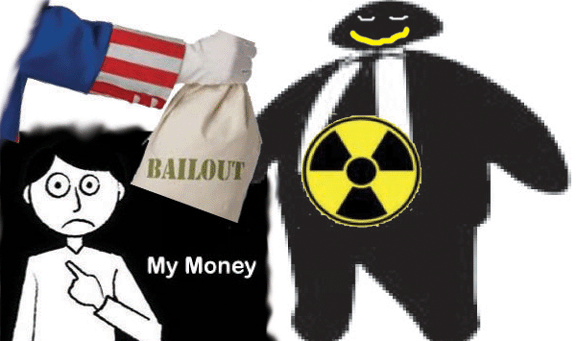
“NO BAILOUT!” BACKLASH BUILDS: 10,000+ COMMENTS AGAINST NUCLEAR, COAL HANDOUTS TO BE DELIVERED TO FERC https://www.nirs.org/press/no-bailout-backlash-builds-10000-comments-nuclear-coal-handouts-delivered-ferc/Signers Oppose Crowding Out Renewables With “Old, Unsafe and Dying” Energy WASHINGTON, D.C.///October 11, 2017///More than 10,000 comments were submitted today for the record at the Federal Energy Regulatory Commission (FERC) in opposition to Trump Administration plans for the Commission to enact massive bailouts of the coal and nuclear industry at the expense of renewable energy and with the added downside of higher bills for consumers. The comments were delivered at 9 a.m. shortly after an 8:45 a.m. protest organized by the Nuclear Information and Resource Service (NIRS) outside the main entrance of FERC at 888 First St NE, Washington, D.C.
NIRS noted that the stakes for wind, solar, and the pocketbooks of U.S. ratepayers is very high. A November 2016 report by NIRS concluded that a federal bailout for nuclear alone could add up to $280 billion by 2030. When a major nuclear reactor project in South Carolina failed this year, ratepayers were left holding the bag for $9 billion or more—even though they will never see a single electron of electricity for their steep investment.
NIRS Executive Director Tim Judson said: “Survey after survey shows that Americans want more clean and safe renewable energy and there is very little support for perpetuating the old, unsafe and dying coal and nuclear industries. To artificially prop up these dirty energy industries and then to force consumers to pay the bill to enrich these already astonishingly profitable companies would have to rank as one of the most anti-environment and anti-consumer steps of the last 50 years.”
Most of the 10,000 individuals’ public comments to FERC submitted by NIRS read as follows:
“Call off your plans to promote coal and nuclear power, and commit to a transition to 100% clean, efficient, renewable energy. Nuclear and coal are two of the dirtiest, most polluting, dangerous, and uneconomical energy sources in the world.”
“If you really want to revive our economy, create jobs, revitalize local communities, and boost small businesses—then clean energy is the only way to go. Our green energy economy can keep the lights on and create millions more jobs than dirty energy could ever provide. Solar and wind are already creating twice as many jobs as coal and nuclear combined—that is ten times as many for the amount of energy generated, and at lower cost.”
“Renewable energy is now providing more electricity than nuclear power. Wind and solar are growing by leaps and bounds, are already cheaper than coal and nuclear, and will soon be the cheapest sources of power available.”
Last winter, and to the delight of utility executives, a bipartisan majority in the Illinois State Legislature offered them a generous gift they had long sought: a $16.4 billion bailout to keep a pair of nuclear plants in operation.
The executives had lobbied hard for this, warning of the loss of 4,200 jobs and carbon-free electricity if the money-losing Clinton and Quad Cities nuclear plants closed. The two plants, owned by Chicago-based Exelon Corporation, were in jeopardy of closing because they were losing a combined $100 million a year due to the increasing availability of cheap natural gas and renewables.
With less than an hour remaining in the legislative session, the state legislature passed the Future Energy Jobs Act, a multi-billion-dollar bailout that provides taxpayer subsidies to keep the nuclear plants operating for at least another 10 years. The cost of power for Chicago-area ratepayers has increased 16 percent since May due to higher capacity charges coupled with the nuclear subsidies. Power rates will go up at least an additional 5 percent next May based on capacity charges that have already been set. For consumers in a typical suburban Chicago household, the increases will boost their annual electricity bill by at least $140.
The ripple effects from the bailout may well lead to future increases on top of the new surcharges. Subsidizing the two nuclear plants has the unintended consequence of potentially harming the owners of unsubsidized, competing power plants. The PJM Interconnection, an organization that sets the rules for wholesale power markets, is contemplating changes that would compensate the owners of natural gas and coal plants. Simply put, households and businesses in Illinois could be paying twice to keep the same nuclear plants open.
What has yet to be determined is how much electricity bills will rise as a result of the bailout. They’re already on the upswing due to earlier changes PJM made to reward nuclear plant operators and owners of other “base-load” plants that run most of the time for their reliability during periods of intense heat or cold.
And the same basic story applies at a broader level. Nuclear subsidies are expected to raise the electricity bills of New Yorkers by $7.6 billion over 12 years, thanks to the bailout of three nuclear plants in upstate New York. The New York State Legislature approved the bailout on a promise to save 2,600 jobs. The Exelon Corporation stands to benefit the most from the bailout. The company owns two of the plants and, since the bailout last year, purchased a third plant. Other states considering bailouts of nuclear plants are Ohio, Pennsylvania, New Jersey, and Connecticut.
Now, on top of that, Energy Secretary Rick Perry recently called on the Federal Energy Regulatory Commission to come up with a new pricing system to reward power plants that help ensure reliability by storing months’ worth of fuel on site. This is an attempt to help financially-distressed coal and nuclear plants nationwide.
There was a time not too long ago when market competition, one of the most basic cost-control methods, was a driving force in the electricity market, and everyone benefitted from it. History clearly shows that market competition lowers costs, boosts performance, and spurs innovation. In the end, consumers get reliable power at competitive prices.
What we don’t need, and can’t afford, is another round of misguided nuclear bailouts that saddle households and businesses with higher electricity bills. If greater use were made of low-carbon natural gas and renewables, and if more failing nuclear plants were closed, the country and economy would be better off. As it is now, in a quest to shield some utilities from the marketplace, more nuclear plants will receive taxpayer subsidies, the growth of more competitive power, along with more jobs, may be slowed. And millions more will be wasted to perpetuate a cycle that not only abuses consumers but promotes what is at best a dubious energy policy.
Mark J. Perry (@Mark_J_Perry) is a contributor to the Washington Examiner’s Beltway Confidential blog. He is a scholar at the American Enterprise Institute and a professor of economics and finance at the University of Michigan’s Flint campus.
In what has been interpreted by some as an attack on Donald Trump, actor makes remarks in a speech at the White House, Guardian, 24 Oct 17, The actor Leonardo DiCaprio has said he thinks that those who don’t believe in climate change should not hold public office.
Speaking at the White House ahead of a screening of his new documentary, Before the Flood, DiCaprio said such rejection indicated an inability to engage with the rational world.
“If you don’t believe in climate change, you don’t believe in facts, and science, and empirical truths,” he said.
“And, in my humble opinion, [you] should not be allowed to hold public office.”
The words were interpreted as a slight against presidential candidate Donald Trump, who has frequently tweeted his scepticism – despite denying he had made such claims in last week’s presidential debate……Before the Flood premiered in September at the Toronto film festival, where DiCaprio told the audience: “We cannot afford, at this critical moment in time, to have leaders in office that do not believe in the modern science of climate change.” https://www.theguardian.com/film/2016/oct/04/leonardo-dicaprio-climate-change-donald-trump-before-the-flood-documentary
New Zealand’s Jacinda Ardern signs coalition deal, names Winston Peters Deputy PM, ABC News 24 Oct 17, New Zealand’s incoming Government is hoping to make the nation greener by planting 100 million trees each year, ensuring the electricity grid runs entirely from renewable energy, and spending more money on cycle ways and rail transport.
Key points:
Incoming prime minister Jacinda Ardern signs coalition deal with NZ First and the Greens Party
Ms Ardern says the country aims to generate 100 per cent of its electricity from renewable sources by 2035
She also plans to raise the minimum wage by 27 per cent
Prime minister-elect Jacinda Ardern and NZ First Leader Winston Peters — who will serve as deputy prime minster and foreign affairs minister in the new Government — signed the coalition agreement on Tuesday and outlined their priorities……
Ardern aiming for 100 per cent renewable energy
Ms Ardern’s plan is for New Zealand to reduce its net greenhouse gas emissions to zero by the year 2050.
Some of the targets will require only incremental changes.
New Zealand already generates about 85 per cent of its electricity from renewable sources including hydroelectric, geothermal and wind.
Ms Ardern plans to increase that to 100 per cent by 2035, in part by investigating whether solar panels can be used atop schools.
She said the country would need to double the amount of trees it plants each year, a goal she said was “absolutely achievable” by using land that was marginal for farming animals.
Ex-energy regulators denounce Trump bid to boost coal, By MATTHEW DALY, WASHINGTON (AP), 24 Oct 17 — Eight former federal energy regulators — including five former commission chairs — oppose a Trump administration plan to bolster nuclear and coal-fired power plants, arguing it would raise prices and disrupt electricity markets.The former officials, who served under presidents from both parties, call the plan “a significant step backward.”
The plan by Energy Secretary Rick Perry would reward nuclear and coal-fired power plants for adding reliability to the nation’s power grid. Perry says the plan is needed to help prevent widespread outages such as those caused by Hurricanes Harvey, Irma and Mari
The plan aims to reverse a steady tide of retirements of coal and nuclear plants, which have lost market share as natural gas and renewable energy flourish. President Donald Trump has vowed to revive the struggling coal industry and expressed strong support for nuclear power, while casting a skeptical eye toward renewable energy such as wind and solar power.
The Federal Energy Regulatory Commission is considering the plan and could decide by mid-December.
A letter signed by eight former energy commission members said “subsidizing resources” such as coal and nuclear plants “so they do not retire would fundamentally distort markets … and inevitably raise prices to customers.”
The plan could backfire as investors lose confidence in energy markets, the former officials said. “This loss of faith in markets would thereby undermine reliability,” they wrote.
The letter was signed by officials who served under every president since Ronald Reagan, including former FERC chairs Elizabeth Moler, James Hoecker, Pat Wood III, Joseph Kelliher and Jon Wellinghoff. Moler, Hoecker and Wellinghoff are Democrats, while Wood and Kelliher are Republicans.
The American Public Power Association also urged FERC to reject the plan, saying in a statement Monday it would “impose significant costs on customers without any justification.”…..https://www.apnews.com/9c2b530d60bd4b8fac4630ab05c0c614
Designs for ‘mini’ nuclear power plants proposed by Rolls-Royce led group set to be given go-ahead, Telegraph Alan Tovey 22 OCTOBER 2017
An important report assessing the viability of new “mini” nuclear power plants for the UK to be published this week is expected to give the green light to develop designs proposed by a British consortium led by Rolls-Royce.
The Department for Business, Energy and Industrial Strategy (BEIS) is set to issue a study which formally ends a competition between different types of low-carbon power generation to assess which should be supported.
Industry sources say a concurrent Techno-Economic Assessment for the government by EY concludes that designs for small nuclear reactors (SMRs) from the Rolls consortium are the more likely to succeed.
Trump Plan for Coal, Nuclear Power Draws Fire From Environmental, Oil Groups
Critics from factions often at odds are calling Trump administration’s proposal a bailout for struggling power plants, By Timothy Puko Oct. 22, 2017 WASHINGTON—A Trump administration proposal aimed at shoring up coal-fired and nuclear power plants across the nation has generated opposition from an array of energy and consumer interests, including some who are often at odds on energy policy.