U.S. Senator Ed Markey points out the absurdity of John Bolton’s suggesting the “Libya model” for negotiating with North Korea
 The $100 billion dollar man Senator Ed Markey wants to slash nuclear weapons spending and get the US back to the negotiating table with North Korea By Linda Pentz Gunter
28 May – deadline day for Hitachi over whether or not to proceed with UK Horizon nuclear power plant
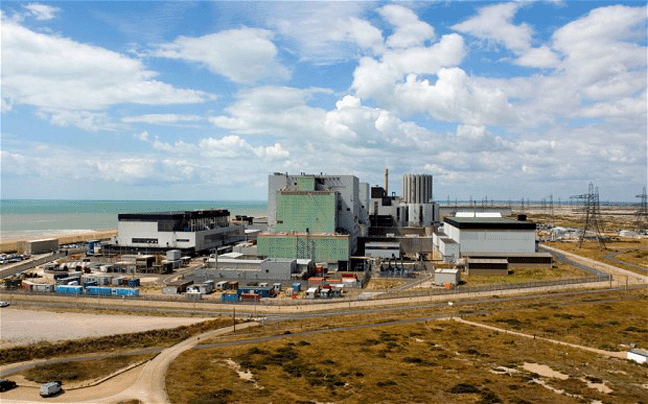 Deadline day for Japan’s Hitachi over Wales £15bn Horizon nuclear plant Sunday Times, 27 May 18 The fate of a £15bn-plus nuclear power station is set to be decided this week — and with it the future of Britain’s atomic renaissance.
The Japanese industrial giant Hitachi is due to decide tomorrow whether to proceed with Horizon, a twin-reactor plant on Anglesey, north Wales.
Hitachi’s decision has huge implications for industrial collaboration between Britain and Japan and the country’s nuclear power industry. The project hinges on winning financial support from Westminster.
This weekend, ministers are expected to set out their offer to Hitachi in a letter ahead of the crucial meeting. The proposal is expected to include UK taxpayers taking a direct stake in the plant, alongside Hitachi and the Japanese state, as well as guaranteeing loans.
In return, Westminster wants Hitachi…(subscribers only) https://www.thetimes.co.uk/article/deadline-day-for-japans-hitachi-over-wales-15bn-horizon-nuclear-plant-mdxhnj9x8
Jordan drops plans for large nuclear reactors, will try small ones from Russia
 Jordan Settles for Smaller Russian Nuclear Reactor by 2022 May 27th, 2018 via SyndiGate.info
Pennsylvania nuclear lobby hoping for nuclear industry salvation via Tax-payer funding

 Nuclear plants hope not to close, The Daily Item, By John Finnerty CNHI Harrisburg reporter, May 26, 2018, HARRISBURG — New Jersey Gov. Phil Murphy signed into law this week a $300 million Zero Emissions Certificate program intended to prop up the state’s nuclear power plants.
Britains big future nuclear power plans hang on government subsidising Hitachi

 UK nuclear plans ‘risk collapse if Hitachi talks fail’https://www.theguardian.com/environment/2018/may/25/new-uk-nuclear-power-plants-hinge-on-deal-between-hitachi-and-government– Adam Vaughan
Japanese group believed to be demanding direct financial support with consumers making up the difference.
Britain’s hopes for a number of new nuclear power stations could collapse if the government and the Japanese conglomerate Hitachi fail to make a breakthrough on talks for a plant in Wales, a top nuclear lobbyist has warned.
Hiroaki Nakanishi, the firm’s chairman, met Theresa May earlier this month, to press the prime minister for financial support for two reactors at Wylfa on the island of Anglesey.
The company’s board is understood be meeting on Monday to decide whether it can proceed with the UK’s subsequent offer, believed to include a multibillion-pound loan.
Tim Yeo, chairman of the industry-backed group New Nuclear Watch Europe, said the outcome of the negotiations had huge consequences for other international firms hoping to build reactors in Britain.
“If Hitachi walk away from Wylfa that probably spells the end of new nuclear in the UK,” he said.
The 3GW plant at Wylfa by the Hitachi subsidiary Horizon Nuclear Power would be the UK’s second new nuclear power station after EDF Energy’s Hinkley Point C, under construction in Somerset.
More are planned: EDF wants to build at Sizewell on the Suffolk coast, South Korea’s Kepco at Moorside in Cumbria and China’s CGN at Bradwell in Essex, with EDF’s help.
Hitachi wants to build abroad because of a moribund home market,
while the UK government sees nuclear as an important source of low-carbon power.
Despite the protracted discussions between the two parties, London appears to still be committed to making the economics of nuclear work.
“I sense there’s still a lot of political will to make new nuclear happen from government, and backbenchers seem to want it in their areas,” a Whitehall source said.
An industry source said the deal would work if the government offered some form of financial support directly, while energy bill payers footed the rest through a subsidy known as a contract for difference.
That would mean Hitachi receiving a guaranteed price of power, likely to be around £80 a megawatt hour, lower than Hinkley’s £92.50 but still nearly twice the wholesale cost of electricity.
The Department for Business, Energy and Industrial Strategy (BEIS) is understood to be enthusiastically backing the project, while the Treasury, which would have to see an equity contribution or loan for the construction period on government books, is more sceptical.
Paul Dorfman at the Energy Institute at University College London said: “This would mean the hardworking UK taxpayer and energy consumer, who are labouring under ramping austerity, are being asked to stump up for an extraordinarily expensive nuclear plant just at the time that renewable costs are plummeting.”
Japanese media have reported the UK government’s loan for the project could be as much as £13bn, and put the total cost of the plant at more than £20bn, even more than Hinkley Point C. The details are understood to have been leaked by the Japanese government, not Hitachi, and the UK government has said it “does not recognise” the reports.
Greenpeace said the UK was wrongly pursuing a “dinosaur” technology and should focus on renewables, batteries and interconnectors to other countries.
Kate Blagojevic, the group’s head of energy, said: “It’s unacceptable the Japanese public are hearing about this before the British public, if what we’re hearing is true that over £13bn of British taxpayer money is going to a Japanese company to build a plant in Wales.
“It’s pretty outrageous the government hasn’t been upfront about what they’re proposing and why.”
A spokesperson for BEIS said: “These discussions are commercially sensitive and we have no further details at this time.”
A Horizon spokesperson said: “It’s no secret we’re in discussions with the UK and Japanese governments, and have been for some time, over support for our project. With these discussions still ongoing it is too early to comment on the specifics of what a future deal may look like.
“We’re confident, given the strategic importance of our project to both nations, we’ll reach a successful conclusion to these discussions in the near future.”
Solar and Wind Subsidies are a Clear Success. The Coal and Nuclear Industries Just Aren’t Ready to Admit it.
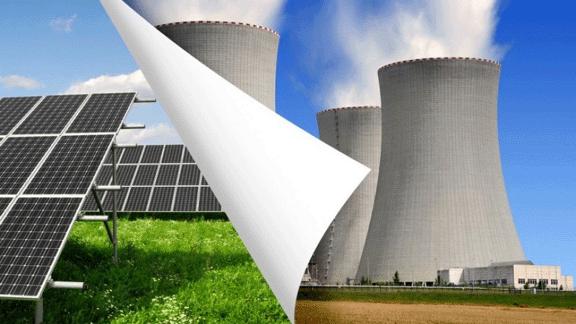
https://www.ewg.org/news-and-analysis/2018/05/solar-and-wind-subsidies-are-clear-success-coal-and-nuclear-industries#.Wwh8jTSFPGg By Grant Smith, Senior Energy Policy Advisor 25 May 18
German government to compensate utilities over the phaseout of nuclear power
Germany To Compensate RWE & Vattenfall Over Nuclear Phase-Out, Clean Technica, 25 May 18 The German Government has passed a bill that gives the country the legal right to proceed with its phase-out of nuclear power but will open the door to companies like Vattenfall and RWE to receive compensation for their investment into nuclear power plants.
Following the 2011 Fukushima nuclear disaster in Japan, Germany made the unprecedented decision to close down all its nuclear power plants — the oldest eight power plants were closed immediately, while the remaining nine are scheduled to be turned off by 2022.
“A decision has been taken to shut down eight plants before the end of this year and they definitely won’t be reactivated. And the remaining nine will be shut down by the end of the decade,” Juergen Becker, deputy environment minister at the time, told Reuters. “Japan has shown that even if there is a minuscule occurrence, the residual risk is too high to justify the continuation of nuclear power (…) It is better to go for other energy services in a civilized country.”
In response, German utility RWE and Swedish power company Vattenfall sued the German government, arguing that they were due financial compensation for investing in a technology that, at the time, the German government was supporting, and that in suddenly reversing direction, the companies would suffer significant financial losses.
In December of 2016, the German Federal Constitutional Court confirmed that the government’s decision to phase-out nuclear power was “essentially constitutional.” This week, the German Federal Government approved a bill which implemented the findings of the Court, giving the country the right to proceed with its phase-out but also allowing utilities to seek “adequate financial compensation for so-called frustrated investments they made in nuclear power plants between 28 October 2010 and 16 March 2011.”
“The bill passed today ensures that the accelerated phasing out of nuclear power plants, which was initiated in 2011, will be continued consistently and in accordance with the provisions of the Basic Law,” said Federal Environment Minister Svenja Schulze. “Each nuclear power plant will retain its current statutory cut-off date by 31 December 2022 at the latest of nuclear energy in Germany.” …….. https://cleantechnica.com/2018/05/25/germany-to-compensate-rwe-vattenfall-over-nuclear-phase-out/
UK short of funds for its £51bn nuclear defence programme
Nuclear defence programme to cost £51bn over next decade National Audit Office predicts total spending and warns of £2.9bn shortfall, Ft.com Peggy Hollinger, Industry Editor
The cost of building and maintaining the UK’s nuclear defence programme will add up to £50.8bn over the next 10 years, the UK’s public spending watchdog has said. The National Audit Office predicted a £2.9bn shortfall on the programme in that period, assuming the Ministry of Defence delivers the cost-cutting it has promised. The assessment is the first time the NAO has looked at the cost of the entire network of programmes, equipment and people needed for the UK’s nuclear deterrent between 2018 and 2028. As well as itemising completion of the current Astute submarines, the report looks at the costs of building the new Dreadnought class that will eventually replace the four Vanguard nuclear-armed boats from the early 2030s. The report showed that the top four suppliers — Rolls-Royce, BAE Systems, Babcock International and AWE Management — have won 97 per cent of contracts for nuclear defence………..https://www.ft.com/content/08d19194-5d0e-11e8-ad91-e01af256df68
USA Congress rejects move to limit new low-yield nuclear weapon.
House rejects limit on new nuclear warhead, Defense News , , 24 May 18, WASHINGTON — The U.S. House on Wednesday shot down a proposed limit on the Trump administration’s pursuit of a low-yield nuclear weapon.
Trump’s reckless propping up of the nuclear industry pleases its big lobbyists
 Trump has Plenty of Accomplices in his Reckless Energy Policies http://progressive.org/dispatches/trump-has-plenty-of-accomplices-in-his-reckless-energy-polic/, by Harvey Wasserman, May 24, 2018
Some 360,000 Americans now work in the solar industry, more than in nukes and coal combined. In fact, more Americans are now working in California’s solar industry than are digging coal nationwide. And the U.S. wind business now employs more than 100,000 people.
But President Donald Trump wants to change that. He has already slammed the solar industry’s growth by slapping a 30 percent tariff on imported Chinese panels, slowing installations nationwide.
He’s also contemplating using an obscure Korean War-era “emergency” ordinance that would let the government bail out money-losing coal and nuclear plants at the expense of renewables.
The idea was presented to Trump while he dined with a lobbyist from the infamous Akron-based FirstEnergy, whose bad business decisions have hung it with four crumbling, money-losing nuclear power reactors and some eighty obsolete coal burners.
More than half the nation’s ninety-nine licensed commercial reactors are now losing money. FirstEnergy’s Davis-Besse, near Toledo, Ohio; Perry, east of Cleveland, Ohio, and Beaver Valley 1 & 2, outside Pittsburgh, Pennsylvania, are bleeding radioactive red ink. One might expect “free market” corporate executives to cut their losses and let competition determine how our energy will be generated.
But FirstEnergy CEO Chuck Jones (annual salary: $8.7 million) has begged Ohio’s legislature and regulators to slap consumers with billions in higher electric rates. So far he’s failed, which is why he sent his lobbyist to dine with Trump.
Already, governments are doing what they can to prop up the nuclear power and fossil-fuel industries and damage the cause of renewable power.
Three nuclear reactors in Illinois have been granted a $200 million annual handout for the next decade. Pennsylvania and Connecticut may soon get soaked with massive rate hikes to keep reactors running there.
The New Jersey legislature has just approved spending $430 million over the next decade to run three more uneconomical reactors there, two at Salem and one at Hope Creek. Activists including actor Alec Baldwin have urged that state’s new Democratic governor to veto that proposal.
Throughout the United States, owners of even those few reactors that are still making money are poised to scam their way into compliant legislatures to see how much they can grab.
But the biggest nuke scam of all has been rammed through state regulatory agencies by New York’s “liberal” Governor Andrew Cuomo. Cuomo backs the 2021 shutdown of two decrepit reactors at Indian Point, saying they are too close to Manhattan to be considered safe.
But Cuomo wants ratepayers statewide to cough up a staggering $7.6 billion for four upstate reactors whose owners had them slated for decommissioning. To the astonishment of economists, ecologists, business and ratepayer groups, Cuomo’s hand-picked regulators approved the rip-off last year.
Nuclear opponents have gone to court to stop it. They argue that while less than four thousand jobs are tied to the reactors, many thousands more would be created by replacement wind and solar projects.
FirstEnergy’s scam is even more brazen. According to the Nuclear Energy Institute, the average reactor generally employs between four hundred and seven hundred workers. Some workers stay on long after shutdown to deal with issues of decommissioning and waste management.
But along with bailing out its four dying nukes, FirstEnergy wants a staggering $8 billion per year in above-market ratepayer fees for some 80 coal burners.
Rightwing think tanks like Heritage have joined financial and business groups in warning such rate hikes could decimate the area’s economy.
Meanwhile, a bitterly disputed “set-back” law has stopped some $4.2 billion in proposed wind projects along Ohio’s “north coast,” which is flat, windy, well-wired and full of farmers desperate for the projects to begin. But repeal has stalled, with tens of thousands of jobs and billions in income hanging in limbo.
They’ll all disappear if Trump and Energy Secretary Rick Perry approve FirstEnergy’s “emergency” bailout.
Last September, the Trump Administration approved another $3.7 billion in federal loans, on top $8.3 billion approved in the past, to sustain a scandal-ridden nuclear project in Vogtle, Georgia.
More recently, on May 10, Congress passed a new attempt to open the proposed Yucca Mountain waste dump. The plan to store some 70,000 tons of high-level commercial radwaste in an earthquake-riddled dormant volcano is overwhelmingly opposed by Nevadans and had long since been written off. But the measure was approved by a vote of 206 to 179, with ninety-four Democrats and eighty-five Republicans voting against. It now heads to the Senate.
As all of this plays out, tens of thousands of jobs hang in the balance. The nation’s entrenched fossil-nuclear corporate elites are more focused on propping up the industries of the past than embracing the technologies of the future.
Harvey Wasserman’s radio shows appear at prn.fm and KPFK-Pacifica, 90.7FM, Los Angeles. His America at the Brink of Rebirth: The Life & Death Spiral of US History from Deganawidah to the Donald will soon be published at Solartopia.org.
Ontario NDP only party speaking out against nuclear waste bunker near Lake Huron
Global News, The Canadian Press 24 May 18, TORONTO — Of the three main parties vying for office in Ontario’s spring election, only the NDP has spoken out against building a $2.4-billion nuclear waste bunker near Lake Huron.
Trump’s lawyer Cohen opens doors for Alabama nuclear developer Haney
By Kyle Whitmire kwhitmire@al.com “……Franklin Haney is a very rich man, and his money is hard at work in Alabama, in Washington, D.C., and maybe even the Middle East. The Chattanooga developer’s campaign cash has given him access to politicians from city council members to presidents of the United States.
And now, according to the Wall Street Journal, he has the help of President Donald Trump’s personal lawyer and political fixer, Michael Cohen, with designs on bringing online a nuclear power plant in northeast Alabama.
Two years ago, when I first wrote about Haney’s dream to buy a half-finished nuclear power plant in north Alabama and bring it online, I didn’t take his plans seriously for a couple of reasons.
Even if Haney could convince TVA to sell him the Bellefonte plant, even he — a billionaire — probably couldn’t afford to finish it, could he? Haney’s own projection was that the project would cost about $13 billion to complete. By most accounts, including Haney’s company’s website, he is worth less than that.
And even if he managed to finish it, there was no way the federal government would allow him to turn the thing on, would they?
The logistics and regulation of nuclear power make it nearly impossible to stop a project and then restart it again, which was a big reason the TVA never finished the job.
I wasn’t alone in that assessment.
Stephen Smith, the executive director of the Southern Alliance for Clean Energy, said then that Haney’s plans for Bellefonte were delusional.
“The first concrete was poured in 1974,” he said. “That reactor is approaching 50 years old. Do you think the Nuclear Regulatory Commission is going give a license for a reactor that has been sitting around for 50 years?”
But Haney didn’t give up.
Once a door-to-door Bible salesman, Haney became a self-made billionaire through working as the government’s landlord. He acquires and develops property, which he leases to local, state and federal agencies.
And he makes connections first with political donations. He’s donated to Democrats and Republicans. Bill Clinton and Barack Obama have benefited from his largess, as have Republicans, including Alabama Gov. Bob Riley………
TVA agreed to sell the power plant to Haney, but he still had those two hurdles left — regulation and capital.
Enter Donald Trump.
After the president’s victory in 2016, Haney donated $1 million to Trump’s inaugural fund, and last summer Bloomberg reported that Haney had bragged about dining with Trump about a dozen times during the president’s first six months in office. Haney could have had those opportunities because he’s a member of Trump’s club, Mar-a-Lago.
And it turns out, the Wall Street Journal reports, Haney had another connection, too. He is a client of Michael Cohen, Trump’s personal lawyer and political fixer, who appears to have turned his proximity to the president into a lucrative business opportunity.
According to the Journal, Haney hired Cohen to help him solicit investments for the Bellefonte project, and in April, the two met in Miami with Sheikh Ahmed bin Jassim bin Mohammed al-Thani, the minister of economy and commerce of Qatar and the vice chairman of the Qatar Investment Authority.
Previously, Cohen had solicited $1 million from Qatar for access to the Trump administration, the Washington Post reported last month. The Qatar government declined that solicitation.
It’s unclear whether the meeting was fruitful for Haney, but what is clear is that the law might not allow significant foreign investment in the Bellefonte project. Under the Atomic Energy Act, the NRC may not issue licenses for projects owned or controlled by a foreign entity.
But laws change, especially when men with money need them fixed, and if the Trump administration has shown anything, it’s that it cares little about regulations, environmental protections and foreign influence in domestic affairs.
Haney’s hurdles are still high. They are still there. But his money is working harder than ever to tear them down.
And anyone who cares about the safety of northeast Alabama should take him very seriously. https://www.al.com/opinion/index.ssf/2018/05/cohen_opens_doors_for_alabama.html
Many years before massive nuclear power station could be built at Bradwell, UK
 Maldon Standard 23rd May 2018 , THE site of the new nuclear power station at Bradwell is staggering in
size. Measuring the length of six football pitches, it sits on land near to
the existing station, now being decommissioned. The Standard was given
exclusive access to see how work was progressing at Bradwell B. EDF Energy
and the China General Nuclear Power Group have been carrying out early site
investigations into the site since December. Since then, the company has
been drilling and digging sampling holes and testing the soil. While work
is underway, the project is still very much in the beginning stage. Once
all groundwork is complete proposals for what the new power station could
look like will be drawn up. Then, a huge public consultation will be held,
alongside a generic design assessment, environmental assessment, and
nuclear site licence being sought. In short, we are many years away from
any station being built.
http://www.maldonandburnhamstandard.co.uk/news/16242529.Digging_deep__A_look_into_the_site_for_a_new_nuclear_power_station_in_Bradwell/
Huge corporate subsidy to be given by New Jersey Governor to nuclear industry
New Jersey Governor Plans to Sign Nuclear Bailout Bill, Bloomberg, By Elise Young and Brian Eckhouse
-
Bill seen costing customers more than $300 million a year
-
Exelon, Public Service Enterprise Group own reactors in state
-
New Jersey Governor Phil Murphy plans to sign a bill requiring utility customers to spend more than $300 million a year to rescue struggling nuclear power plants run by Exelon Corp. and Public Service Enterprise Group Inc., according to a person familiar with the matter.
The legislation, approved in April by the state’s Democratic legislature, aims to keep the state’s three nuclear plants operating, after owners warned the facilities were no longer economic amid lower power prices.
Murphy, a Democrat who was sworn-in in January, has not said publicly if he supports the measure, which some environmentalists oppose. A schedule released by his office Tuesday said he planned to sign “energy bills” at 11 a.m. Wednesday.
…….. Exelon and PSEG didn’t immediately comment. A spokesman for the Electric Power Supply Association, which represents independent power producers and has opposed subsidies for coal and nuclear plants, called the move “disconcerting.”“If news reports are true that Governor Murphy will sign the nuclear bailout legislation without seeking amendments, it is a sad day for New Jersey consumers and the future of competition in the state,” John Shelk, president of the Washington-based association, said in an email.
- ……. The Sierra Club is one of several environmental groups that have criticized the plan, calling it the “biggest corporate subsidy in state history.”https://www.bloomberg.com/news/articles/2018-05-22/new-jersey-governor-is-said-to-plan-to-sign-nuclear-bailout-bill
Call to White House to oppose Saudi Arabia’s threat to acquire nuclear weapons
 White House Should State Opposition to Saudi Threat to Acquire Nuclear Weapons http://www.ipsnews.net/2018/05/white-house-state-opposition-saudi-threat-acquire-nuclear-weapons/
-
Archives
- October 2026 (104)
- September 2026 (339)
- August 2026 (330)
- July 2026 (355)
- June 2026 (287)
- May 2026 (306)
- April 2026 (356)
- March 2026 (251)
- February 2026 (267)
- January 2026 (308)
- December 2025 (358)
- November 2025 (359)
-
Categories
- 1
- 1 NUCLEAR ISSUES
- business and costs
- climate change
- culture and arts
- ENERGY
- environment
- health
- history
- indigenous issues
- Legal
- marketing of nuclear
- media
- opposition to nuclear
- PERSONAL STORIES
- politics
- politics international
- Religion and ethics
- safety
- secrets,lies and civil liberties
- spinbuster
- technology
- Uranium
- wastes
- weapons and war
- Women
- 2 WORLD
- ACTION
- AFRICA
- Atrocities
- AUSTRALIA
- Christina's notes
- Christina's themes
- culture and arts
- Events
- Fuk 2022
- Fuk 2023
- Fukushima 2017
- Fukushima 2018
- fukushima 2019
- Fukushima 2020
- Fukushima 2021
- general
- global warming
- Humour (God we need it)
- Nuclear
- RARE EARTHS
- Reference
- resources – print
- Resources -audiovicual
- Weekly Newsletter
- World
- World Nuclear
- YouTube
-
RSS
Entries RSS
Comments RSS

