“A Space Force is not an aspiration unique to the Trump administration, of course,” she continued on the Beyond Nuclear International website of the Takoma Park, Maryland group, “but it feels worse in his reckless hands.”
Why do democracies elect sociopaths?
Ken commented on Nuclear news to 24 June 18
The Mass Psychology of Fascism by Wilhelm Reich. It is what is happening. He wrote it in 1933, and most of the book tries to answer the question why democracies continually elect psychopaths to rule them. I think you would really like it.
Here’s a free link to the PDF: http://www.wilhelmreichtrust.org/mass_psychology_of_fascism.pdf
You know Trump is a narcissist– a malignant narcissist. Every psychopath is also a narcissist and it’s clear that Trump is also a psychopath. You probably knew that too.
The question is, how did a malignant narcissist psychopath become president– not just president but a horrific monster who is intentionally destroying the protections that have made Americans and America save from the predations of the worst corporations and his fellow billionaire psychopaths? And what should we do about it.
It’s a long story. Before civilization, humans evolved, over at least seven million years, to live in small hunter-gather bands where they were bottom-up beings– empathic, kind, cooperative, sharing, interdependent, living with bottom-up connection consciousness– awareness of how decisions and actions affected all the people around them– and the natural ecosystems they depended upon. Anyone who tried to take more than their share of the bands resources would be seen as insane, or would banished or killed. for example, one expert on psychopaths told me that in the far north, a psychopath living amongst the indigenous peoples would be put on an chunk of ice and pushed off into the ocean to float away.
The creeping opening of vulnerability to the depredations of narcissists and psychopaths started with the onset of civilization, when food surpluses and possession of domesticated animals led to the creation of police and soldiers to protect them. That led to hierarchy, centralization, authoritarianism and domination. Narcissists and psychopaths began to flourish because there was no band of people to stop them.
Most of history (as opposed to prehistory)has been, until the past 3040 years, the top-down history of generals and rulers, i.e., despots, monarchs and worse. Civilization, while bringing some wonderful good advances came with a high price– slavery, serfdom, feudalism, privatization of the commons and brutal exploitation of the people at the bottom.
The narcissistic, top-down ideas of privatization and exploitation have been framed and celebrated by the right as aspects of “liberty” and individualism, as described by Ayn Rand. These narcissistic behaviors have become values that are supported and encouraged by religious and political leaders
Today, some businesses actually seek out psychopaths as employees. That gives them increasing access to wealth and power. Trump is a born-on-third-base child of wealth. These people are, I believe more at risk for developing the characteristics of psychopaths– particularly callousness, hard-heartedness, absence of empathy, propensity towards lying and disrespecting laws and morals. Of course, Donald Trump fits this profile perfectly.
His massive scale child abuse is a clear sign of his having all the signs– callousness, hard-heartedness, absence of empathy, propensity towards lying and disrespecting laws and morals. Worse, his deranged behavior is contagious, as evidenced by the many supporters and flunkies who defend this depraved policy. Even worse, ripping away children from their loving parents will permanently traumatize them and make them, the victims more at risk of becoming narcissists and psychopaths themselves. We have to take serious, aggressive action.
I’ve written many articles, in my article series, Psychopaths, Sociopaths and Narcissists, on the challenge narcissists and psychopaths present to a decent society. Trump and his enablers have made my message even more urgent. We need to develop a science and culture that reject the “values,” really, pathological behaviors and thinking, as the vile, evil things they are. People who engage in such behaviors, people with strong narcissistic and psychopathic tendencies and characteristics should be identified, just as sexual predators are. This is not bigotry, not separating out any particular religion, race, or culture. This is what is done with sexual predators and carriers of highly contagious diseases.
We need to deal with the reality that these people are dangerous, malignant, destructive people. At one level, they are predators who take life savings from innocent victims who love them. But they are also the same people who gave us the multi-trillion dollar economic collapse of 2008, and the people who profit from war and drugs– addictive and pharmaceutical.
These are the people who set examples of the worse kind, so we see massive increases in hate, bigotry, intolerance and discrimination. We need to identify them and protect the whole, healthy people who are not narcissists and psychopaths. This should be a conversation that is on the table. It will not be easy. There are billionaire narcissists and psychopaths who will fight it and they will fight dirty, attacking the messengers, attacking the idea. But we’ve gone far too long without doing this necessary work.
https://www.opednews.com/articles/How
From Paul Street article on Trump
“There have been many tyranny tests under the monstrous orange-tinted white nationalist Twitter clown Donald Trump. Where to begin:
+ The opening day trip to CIA headquarters, where he half-jokingly rambled about the US going back to Iraq to “get the oil”?
+ The repeated attempts to repeal even Obama’s inadequate health insurance measure and thereby remove tens of millions of U.S. citizens from health coverage?
+ The insane claim to have won the popular vote but for the votes of illegal immigrants?
+ The idiotic call for a southern border wall combined with the asinine call for Mexico to “pay for it”?
+ The noxious description of Mexican and other Central American immigrants and asylum-seekers as rapists and murderers?
+ The praise and dog-whistling cover he offered to murderous fascist racists in Charlottesville in the summer of 2017?
+ The giant tax cut that the racist real estate mogul trailblazed for the already obscenely super-opulent Few last Christmas season – a socioeconomic atrocity in a nation where the top 10thof the upper 1 percent already owned as much wealth as the bottom 90 percent?
+ The advance pardon that the Tangerine Satan offered to the sickening racist and nativist tent-camp murderer Sheriff Joe Arpaio in Arizona last year?
+ The racist shaming of federal judges who happen not to rule his way?
+ The repeated transparent attempts to place himself above the rule of law?
+ The open assault on basic environmental protections and the eco-exterminist determination to advance the extraction and burning of every last fossil fuel in U.S. reach?
+ The clear and transparent affection he shows for blood-drenched authoritarians the world over?
+ The snap approvals of the planet-cooking Dakota Access and Keystone XL pipelines?
+ The open embrace of Saudi Arabia’s practically genocidal war on Yemen?
+ The repeated ugly embrace of the National Rifle Association after yet another and then another mass shooting that amounts to homeland terrorism sponsored by the proto-fascistic and white supremacist gun lobby?
+ The open advance of prison privatization and mass incarceration combined with clear disinterest in curbing the ongoing epidemic of racist police shootings?
That’s just a short list.
What would it take to send millions of U.S.-Americans into the streets to confront the total evil of “their” government in the age of Trump? How about this: “Dragging young children kicking and crying and screaming from their parents, separating those children from their parents indefinitely, locking those children up in cages (‘dog kennels’) like animals, and subjecting them to the predators of the American police state”? Would that be enough? Could that do the trick?”
Draft revision of Japan’s Basic Energy Plan does not call for new nuclear power reactors.
 Japan’s nuclear energy policy at crossroads , Japan News June 23, 2018, By Koichi Kuranuki / Yomiuri Shimbun Senior Writer The Economy, Trade and Industry Ministry has compiled a draft revision of the nation’s Basic Energy Plan. The revised plan will serve as the new guidelines for long-term energy policies. In the plan, nuclear power is defined as “an important mainstay energy source,” but the plan does not specifically call for construction of new and additional nuclear power reactors.
If the situation is left as it is, Japan will move slowly toward zero nuclear energy over the long term. How can the people’s understanding of nuclear power deepen? Japan’s nuclear power policy is at a crossroads.
Mainstay energy source
The draft revision of the Basic Energy Plan presented on May 16 laid out a policy aiming to make solar power and other renewable energy the nation’s key energy sources. At the same time, it also listed technical issues such as fluctuations in energy output according to weather conditions and time of day……..
Growing costs
However, major power companies have to overcome high hurdles to independently build new plants or replace current reactors with new ones.
The total cost of Hitachi, Ltd.’s nuclear power business in Britain has ballooned to more than ¥3 trillion with two reactors. The project is likely to receive financial support from the British government, but negotiations are still under way for the prices of electricity the government guarantees to purchase, and no final conclusion has been reached.
The cost of building the Nos. 6 and 7 reactors at Tokyo Electric Power Company Holdings, Inc.’s Kashiwazaki-Kariwa nuclear power plant in Niigata Prefecture, which began operating in the 1990s, was about ¥400 billion per reactor. TEPCO was a blue chip company before its nuclear accident in 2011, and it was able to procure low-interest funding. Its interest burden for the construction funds of the reactors was only ¥10 billion in total.
However, the situation has changed completely since the nuclear accident. Nuclear safety standards have been ramped up worldwide, and construction costs have soared. TEPCO has spent a total of ¥700 billion on safety measures for the Nos. 6 and 7 reactors at the Kashiwazaki-Kariwa plant.
Even if companies build new plants at tremendous cost, a good return on the investment seems unlikely, and it is difficult to procure funds.
……. Public resistance…….. Many residents in Niigata Prefecture are opposed to nuclear power. A local resident related to the electric power industry who supported Hanazumi said, “I feel that possible votes for him are sure to decrease if constituents see [Hanazumi as being linked to] the activities of electric power companies.”…… Not only those living in the vicinity of nuclear power plants, but Japanese citizens in general have negative views on nuclear power generation…….http://the-japan-news.com/news/article/0004518947
Decision to keep Pickering Nuclear Station going does not make financial sense
Clean Air Alliance 21st June 2018, Today Ontario Premier-Designate Doug Ford failed to seize his opportunity
to lower Ontario’s electricity costs by $1.1 billion per year by
directing Ontario Power Generation (OPG) to close the Pickering Nuclear
Station in August when its licence expires.
On the contrary, Mr. Ford announced that he will allow the 4th oldest nuclear station in North
America to continue to operate in the middle of the GTA until 2024. Mr.
Ford’s decision does not make financial sense for Ontario’s electricity
consumers. The annual savings from closing the Pickering Nuclear Station
would be 183 times greater than the savings from firing Mayo Schmidt, the
CEO of Hydro One. According to the Canadian Manufacturers & Exporters
association, the Pickering Nuclear Station’s performance is
“persistently abysmal…by any objective standard.”
http://www.cleanairalliance.org/ford-fails-to-seize-opportunity-to-lower-ontarios-electricity-costs-by-1-1-billion-per-year/
Trump administration getting ready for nuclear war in space
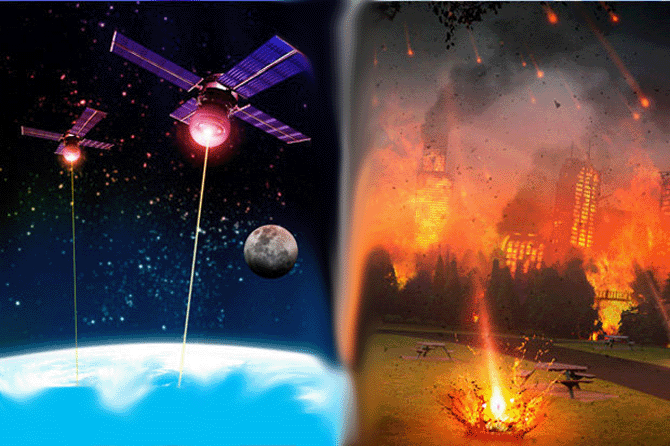
Star Wars Redux: Trump’s Space Force, Counter Punch
 If Donald Trump gets his way on formation of a Space Force, the heavens would become a war zone. Inevitably, there would be military conflict in space.
The Outer Space Treaty of 1967 which designates space as the global commons to be used for peaceful purposes—and of which Russia and China, as well as the United States, are parties—and the years of work facilitating the treaty since would be wasted.
If the U.S. goes up into space with weapons, Russia and China, and then India and Pakistan and other countries, will follow.
Moreover space weaponry, as I have detailed through the years in my writings and TV programs, would be nuclear-powered—as Reagan’s Star Wars scheme was to be with nuclear reactors and plutonium systems on orbiting battle platforms providing the power for hypervelocity guns, particle beams and laser weapons.
This is what would be above our heads.
Amid the many horrible things being done by the Trump administration, this would be the most terribly destructive. “It is not enough to merely have an American presence in space, we must have American dominance in space,” Trump said at a meeting of the National Space Council this week.
“Very importantly, I’m hereby directing the Department of Defense and Pentagon,” he went on Monday, “to immediately begin the process necessary to establish a Space Force as the sixth branch of the armed forces; that is a big statement. We are going to have the Air Force and we are going to have the Space Force, separate but equal, it is going to be something.”
The notion of the U.S. moving into space with weaponry isn’t new…………..
With the Trump administration, there is more than non-support of the PAROS treaty but now a drive by the U.S. to weaponize space.
It could be seen—and read about—coming.
Star wars returns – Free speech tv. 1 of 3
“Under Trump, GOP to Give Space Weapons Close Look,” was the headline of an article in 2016 in Washington-based Roll Call. It said “Trump’s thinking on missile defense and military space programs have gotten next to no attention, as compared to the president-elect’s other defense proposals….But experts expect such programs to account for a significant share of what is likely to be a defense budget boost, potentially amounting to $500 billion or more in the coming decade.”
Intense support for the plan was anticipated from the GOP-dominated Congress. Roll Call mentionedthat Representative Trent Franks, a member of the House Armed Services Committee and an Arizona Republican, “said the GOP’s newly strengthened hand in Washington means a big payday is coming for programs aimed at developing weapons that can be deployed in space.”
In a speech in March at the U.S. Marine Corps Air Station near San Diego, Trump declared: “My new national strategy for space recognizes that space is a war-fighting domain, just like the land, air, and sea. We may even have a Space Force—develop another one, Space Force. We have the Air Force; we’ll have the Space Force.”
Bruce Gagnon, coordinator of the Global Network Against Weapons and Nuclear Power in Space, notes that Trump cannot establish a Space Force on his own—that Congressional authorization and approval is needed. And last year, Gagnon points out, an attempt to establish what was called a Space Corps within the Air Force passed in the House but “stalled in the Senate.”
“Thus at this point it is only a suggestion,” said Gagnon of the Maine-based Global Network.
“I think though,” Gagnon went on, “his proposal indicates that the aerospace industry has taken full control of the White House and we can be sure that Trump will use all his ‘Twitter powers’ to push this hard in the coming months.”
Meanwhile, relates Gagnon, there is the “steadily mounting” U.S. “fiscal crisis…Some years ago one aerospace industry publication editorialized that they needed a ‘dedicated funding source’ to pay for space plans and indicated that it had come up with it—the entitlement programs. That means the industry is now working to destroy Social Security, Medicare, Medicaid and what little is left of the welfare program. You want to help stop Star Wars and Trump’s new Space Force. Fight for Social Security and social progress in America. Trump and the aerospace industry can’t have it both ways—it’s going to be social progress or war in space.”
As Robert Anderson of New Mexico, a board member of the Global Network, puts it: “There is no money for water in Flint, Michigan or a power grid in Puerto Rico, but there is money to wage war in space.”
Or as another Global Network director, J. Narayana Rao of India, comments: “President Donald Trump has formally inaugurated weaponization of space in announcing that the U.S. should establish a Space Force which will lead to an arms race in outer space.”
Russian officials are protesting the Trump Space Force plan, “Militarization of space is a way to disaster,”Viktor Bondarev, the head of the Russian Federation Council’s Defense and Security Committee, told the RIA news agency the day after the announcement. This Space Force would be operating in “forbidden skies.” He said Moscow is ready to “strongly retaliate” if the US violates the Outer Space Treaty by putting weapons of mass destruction in space.
And opposition among legislators in Washington has begun. “Thankfully the president cannot do it without Congress because now is NOT the time to rip the Air Force apart,” tweeted Senator Bill Nelson of Florida.
“Space as a warfighting domain is the latest obscenity in a long list of vile actions by a vile administration,” writes Linda Pentz Gunter, who specializes in international nuclear issues for the organization Beyond Nuclear, this week. “Space is for wonder. It’s where we live. We are a small dot in the midst of enormity, floating in a dark vastness about which we know a surprising amount, and yet with so much more still mysteriously unknown.”
To save the world, we don’t need Trump’s charisma: we need co-operative bureaucratic processes
Charisma in the nuclear age is a bitch. A century ago, the great German sociologist Max Weber showed that modern political authority has two varieties: charismatic and bureaucratic. Charismatic authority is based on personality and is disruptive; bureaucratic authority is based on rules and promises continuity.
 Charisma in the nuclear age https://thebulletin.org/charisma-nuclear-age11926, SHARON SQUASSONI Sharon Squassoni is research professor at the Institute for International Science and Technology Policy, Elliott School of International Affairs, at the George Washington University.
From his speech patterns to his body language, President Donald Trump exudes charisma. Perhaps to the despair of more stalwart democratic leaders, he acts instinctively rather than methodically. His approach to the historic Singapore summit with North Korean leader Kim Jong Un was, he told the press, to size up Kim in the first few minutes and ascertain whether a deal was possible.
And so it was. On the heels of a testy G-7 summit and months of name-calling between Trump and Kim, observers may be grateful that the summit went so well. The two leaders smiled, shook hands, and posed for the cameras. They shared a meal and signed a single page of vague goals that may or may not be realized. And while President Trump personally assured US citizens on Twitter that they could all sleep more safely on Tuesday evening because of the summit, there are many miles to go before anyone sleeps.
Charisma in the nuclear age is a bitch. A century ago, the great German sociologist Max Weber showed that modern political authority has two varieties: charismatic and bureaucratic. Charismatic authority is based on personality and is disruptive; bureaucratic authority is based on rules and promises continuity. Does this sound like two presidential candidates in the 2016 US election? We know who won.
Disruption has its virtues, and while Donald Trump’s campaign statements illustrated his limited understanding of the North Korean nuclear crisis, they also showed he was fearless in his embrace of unorthodox approaches to solving the problem. He called Kim Jong-un a “maniac,” but said—more than a year ago—that he was willing to negotiate with him. Candidate Trump believed China had “total control” over North Korea and could make Kim “disappear.” Ignoring decades of historical context, he flirted with taking troops out of South Korea and Japan and suggested he could support Japan’s development of nuclear weapons in response to North Korea.
As president, Trump’s approach to North Korea’s nuclear weapons has ricocheted from a strategy of isolation and maximum pressure designed to topple Chairman Kim to speculation about beachfront condos replacing missile test launch sites. Expert heads are spinning.
While Trump has focused on his personal relationship with Kim (bad or good), bureaucrats have been left to tidy up the messy details, like guessing which targets might be within range of Kim’s nuclear-tipped missiles, ensuring that missile alerts don’t falsely terrify ordinary people in Hawaii, and musing about whether a deterrence relationship with North Korea is even possible. (They concluded it wasn’t, in part because Kim continued to burnish his brutal dictator brand with firing squads and nerve agent assassination for those deemed a threat or an annoyance to him. Not to mention the long list of human rights violations he has inflicted on his people.).
Trump’s charismatic and chaotic brand of leadership may have helped jump-start talks about North Korea’s nuclear program, but it is inherently dangerous. Eight months ago, the world worried that the personal animosity could cause Trump and Kim to stumble into war; today, the world worries that Trump’s new-found admiration of Kim could lead to the ruin of post-war alliances that have helped to stabilize Northeast Asia. Japan has largely been sidelined, and South Korea was blindsided by Trump’s casual reference during the summit to the end of war-games. Exactly how that US concession will play out is still unclear. Both allies will likely try to make the best out of a bad situation.
The only hope for successful denuclearization will require Trump and Kim to step back and let their worker bees establish a methodical process by which commitments on both sides can be assessed. The only way to make real progress is to establish baselines, identify weapons of mass destruction capabilities, eliminate or somehow repurpose them, and put in place monitoring to ensure those capabilities are not reconstituted.
This is unsexy and uncharismatic work—exactly the kind of thing that we pay disinterested bureaucrats to accomplish. Hopefully, experts with decades of experience—experts therefore unlikely to be fooled by North Korean disinformation—can be put to the task. A few have recently left the State Department; only one seasoned expert on North Korea, Ambassador Sung Kim, was on the US delegation in Singapore.
Unfortunately, Trump has little appreciation for the nuts and bolts of governing, and his administration has devoted considerable attention to stripping away government capabilities. With luck, Secretary of State Mike Pompeo may be able to find experts who are willing to work on this enormous task. He should look beyond the intelligence community. He needs real diplomats, too.
One small but curious element of the Singapore joint statement was a reference to this as a “first historic summit.” President Trump told the press that he and Kim might meet many times, even at the White House or in Pyongyang. For the sake of democracy and global security, we don’t need more summits. It’s time instead to let US government experts do what they do best—careful, cautious negotiation and implementation that produce lasting, verifiable results.
France’s Minister Hulot slams Nuclear power and the pro nuclear push by EDF

Le Monde 21st June 2018 [Machine Translation] Nuclear: Hulot puts pressure on EDF. In an interview on Franceinfo, the Minister of the ecological and solidarity transition considered that the French group was in a “drift” because of its too much attachment to the nuclear power.
While France is in the middle of a discussion on its energetic roadmap, Nicolas Hulot did not mince his words, Thursday on Franceinfo . “One of the reasons why EDF is in trouble is that, in particular, the nuclear industry, sorry  to say , takes us into a drift,” said the Minister of ecological transition and solidarity. Mr. Hulot has been criticizing nuclear power in good standing.
“It is clear that the cost of energy made with nuclear power is increasing because we have not
necessarily provisioned a number of things, at the same time that the cost of renewable energy is falling” stressed the minister. EDF’s financial situation remains difficult: the group suffers from low electricity prices on the market, losing tens of thousands of customers a month and has suffered from the shutdowns of many nuclear plants in recent years.
Contacted, the EDF group did not wish to react to the Minister’s statements.
https://www.lemonde.fr/economie/article/2018/06/21/nucleaire-hulot-met-la-pression-sur-edf_5318946_3234.html
Senator Heller Successfully Keeps Yucca Mountain out of Defense Bill Approved by the U.S. Senate
 June 18, 2018 The U.S. Senate today passed its annual defense authorization bill with three key provisions championed by U.S. Senator Dean Heller (R-NV) to support Nevada’s disabled veterans and veterans struggling with mental illness and to remove the $30 million to store defense nuclear waste at Yucca Mountain that was included in the version approved by the U.S. House of Representatives. The legislation, formally named the John S. McCain National Defense Authorization Act (NDAA) for Fiscal Year 2019, increases funding for training across all service branches and authorizes a 2.6 percent pay raise for troops – the largest increase in nine years for U.S. service members. Moving forward, both chambers will need to convene a joint conference committee in which representatives, who are appointed by leadership in the U.S. House of Representatives and U.S. Senate, reconcile the two versions of the defense bill and must produce a final report.
Heller worked with the U.S. Senate Armed Services Committee and the U.S. Senate Appropriations Committee to keep funding and an authorization of funding to revive Yucca Mountain out of the U.S. Senate’s version of the NDAA. Earlier this year, Heller urged U.S. Senate Armed Services Committee Chairman John McCain (R-AZ) to honor the will of the U.S. Senate appropriators and to exclude any language that authorizes funding for Yucca Mountain in the NDAA. Heller’s letter to Chairman McCain can be found HERE.
“Congress has an obligation to support our men and women in uniform, and that’s why I welcome the U.S. Senate’s passage of legislation that will give Nevada’s service members the largest pay raise in nearly a decade, provide our military with the resources it needs to keep America safe, and support Nevada’s 300,000 veterans. I’m proud that this legislation includes my provisions to support Nevada’s disabled veterans and help our veterans who may be struggling with mental illness and having difficulty finding work,” said Heller. “Furthermore, unlike the U.S. House of Representatives-passed version of the bill that contains $30 million to revive Yucca Mountain, I’m pleased I was able to work with Chairman McCain and U.S. Senate appropriators to successfully ensure that our bill did not include a single dollar authorized for Yucca Mountain. So once again, while the U.S. House of Representatives charges forward with shipping nuclear waste to Nevada, I kill their efforts in the U.S. Senate. While this is progress, we still have more work to do to stop the U.S. House of Representatives from turning Nevada into a nuclear waste dump. I remain committed to doing everything that I can to make sure that Yucca Mountain remains dead.”…….https://www.heller.senate.gov/public/index.cfm/pressreleases?ID=89EE1BBB-BB73-42D9-A192-038B549AADC4
A political problem for US Republicans – conservatives hate Trump’s coal and nuclear bailout
 Lots of conservatives hate Trump’s coal and nuclear bailout — that’s a big political problem, The Hill, BY SILVIO MARCACCI, — 06/19/18 Conservative opposition to EPA Administrator Scott Pruitt has dominated headlines — losing stalwarts like Sen. Jim Inhofe (R-Okla.) and Laura Ingraham stings. However, the Trump administration’s bigger political problem among conservatives could be its controversial proposal to spend billions on a coal and nuclear bailout.
After all, President Trump can simply fire Pruitt: problem solved. But enacting his bailout policy would roil U.S. power markets while alienating a growing number of conservatives and costing consumers billions during his re-election campaign — much tougher mistakes to fix.
It’s no surprise environmental groups and clean energy groups are fightingTrump’s bailout — it would keep coal, the dirtiest available electricity source, on life support. What’s shocking here is the withering fire his bailout proposal drew from conservative media outlets, conservative analysts, and even Trump’s conservative appointees.
“This has no intellectual basis by anybody beyond the third grade,” said Peter Van Doren of the Cato Institute. “If you can find anyone who’s market-oriented or says they’re conservative and supports this, they should turn in their badge.”
Conservatives are opposing the bailout’s economic impacts, which could cost U.S. consumers at least $11.8 billion annually according to Energy Innovation’s analysis, or up to $34 billion per year, according to theNuclear Information and Resource Service.
Trump’s bailout would hike consumer bills by guaranteeing payments to coal and nuclear plants that have either been shutting down or are in danger of closing because they cost more to run than renewable energy or natural gas, instead of letting utilities make their own decisions. Americans for Prosperity weighed in on that point via Twitter.
Those bailout billions would be unevenly distributed: In regional U.S. power markets, just five companies own the majority of uneconomic plants, and they’d get the overwhelming majority of federal subsidies.
”Mandating that grid operators buy more expensive coal and nuclear power would raise consumer prices and could reduce natural gas production that has been a boon to many states,” wrote the Wall Street Journal editorial board.
Hiking power costs for businesses and consumers could inflict a grievous political injury. These billions in higher electricity costs would hit consumer pocketbooks in battleground states (Iowa, Pennsylvania, Ohio, Wisconsin, Michigan, Virginia) located within the affected U.S. power markets.
“It is a ridiculously bad idea. Its consequences will be bad for Trump and, in the long run, bad for coal as well,” wrote the Washington Examiner editorial board. “This unprecedented government interference in energy markets will harm the economy under Trump’s watch.”……..
Proposing policies that risk wide-ranging lawsuits is problematic for any president, but this administration has shown it doesn’t care about those typical concerns. But when even conservative groups and conservative media outlets agree with their liberal counterparts, Trump has a bigger problem — and a potential re-election wedge issue — on his hands.
Silvio Marcacci is communications director at Energy Innovation, a nonpartisan clean energy and climate policy firm.http://thehill.com/opinion/energy-environment/393038-lots-of-conservatives-hate-trumps-coal-and-nuclear-bailout-thats-a
Turkey’s President says Turkey will build its own nuclear power station
Turkey to build third nuclear power plant: Erdoğan
ANKARA Turkey‘s president said June 18 that the country will build a third nuclear power plant.
During a live question-and-answer social media broadcast with Turkish youths, President Recep Tayyip Erdoğan said Turkey would build its own nuclear power plant after the Akkuyu nuclear power plant, to be built by Russia…….http://www.hurriyetdailynews.com/turkey-to-build-third-nuclear-power-plant-erdogan-133468
Most Americans doubt that the Trump summit will result in North Korea giving up nuclear weapons
Poll: Majority skeptical North Korea will give up nuclear weapons as a result of Trump summit http://thehill.com/policy/international/392677-poll-majority-skeptical-north-korea-will-give-up-nuclear-weapons-as-a, BY LUIS SANCHEZ – 06/17/18
Most Americans in a new poll are skeptical that President Trump’s meeting with Kim Jong Un will lead North Korea to give up its nuclear weapons.
Fifty-three percent said that it’s unlikely last week’s Singapore summit will lead North Korea to give up its nuclear weapons, a new ABC News/Washington Post poll found.
Although most Americans remain skeptical following the summit, the historic meeting apparently did improve people’s expectations about denuclearization.
The number of Americans who see denuclearization as likely has increased from 30 percent to 41 percent, the poll found.
The summit, which ended with a vague joint accord stating a commitment to “denuclearize” the Korean Peninsula, has left many unsure of what will happen next.
FIFTY-FIVE PERCENT OF PEOPLE IN THE NEW POLL SAID THAT IT WAS TOO EARLY TO TELL WHETHER OR NOT THE SUMMIT CAN BE CALLED A SUCCESS FOR THE U.S.
LESS THAN ONE-THIRD, 29 PERCENT, SAID THE SUMMIT WAS A SUCCESS FOR NORTH KOREA AND ONLY 21 PERCENT SAID THE SAME ABOUT THE U.S.
FORTY-TWO PERCENT ALSO SAID WAR IS NOW LESS LIKELY IN THE LONG TERM, WHILE 39 PERCENT SAID THAT THE SUMMIT MADE NO DIFFERENCE TO THE LIKELIHOOD OF WAR.
THE POLL SURVEYED 495 ADULTS FROM JUNE 13-15. IT HAS A SAMPLING ERROR OF 5.5 PERCENTAGE POINTS.
South Korean nuclear reactor to be shut down early. Plans for new reactors cancelled
 Korea Times 15th June 2018 , The Korea Hydro & Nuclear Power (KHNP) said Friday its board has decided to shut down the Wolsong-1 nuclear reactor in Gyeongju, North Gyeongsang Province, before the end of its lifespan and scrap all plans for building
four new reactors across the country.
“According to the government’s energy policy shift, we have reviewed operational plans of Wolsong reactors several times and concluded keeping the Wolsong-1 operating under strengthened safety regulations would not be economical,” KHNP CEO Chung
Jae-hoon said in a press conference in Seoul.
“Also, the plans for building new reactors of Cheonji-1,2 and Daejin-1,2 would be terminated in order to eradicate uncertainties in the KHNP’s management and restore smooth relations with local residents.”
https://www.koreatimes.co.kr/www/tech/2018/06/325_250740.html
UK govt providing $billions for Wylfa nuclear power project, but Hitachi still scrambling for more money from Japan and USA

Nikkei Asian Review 16th June 2018 , Hitachi continues to search for ways to share the burdens of building a British nuclear power plant and now is sounding out the Development Bank of Japan and several Japanese power companies about taking stakes in the
project, a high hurdle as many are still struggling with the heavy financial fallout from the 2011 meltdown at Fukushima.
The cost projection for the project on the Welsh island of Anglesey has ballooned to 3 trillion yen ($27.1 billion). To keep it commercially viable, the British government pledged on June 4 to arrange the entire 2 trillion yen in necessary loans, twice its original offer. In addition, 900 billion yen is to be invested in the Hitachi subsidiary responsible for developing and building the plant, with 300 billion yen coming from a consortium of Japanese companies and the Japanese government.
The DBJ is considering an investment as a government-affiliated financial institution. Chubu Electric Power, Tokyo Electric Power Co. Holdings, Kansai Electric Power, Chugoku Electric Power and Hokuriku Electric Power are some of the utilities being approached
about taking small stakes in the project, as well as Japan Atomic Power. Hitachi is also asking the utilities for technical support.
Japan Atomic Power already plans to support such aspects as operation and maintenance of the U.K. plant with U.S. energy provider Exelon. Tepco and Chubu Electric both operate in Japan boiling water reactors, the same type that will bebbuilt on Anglesey. But winning participation from these companies will not be an easy task. Tepco must raise 16 trillion yen of the 22 trillion yen needed to decommission the Fukushima Dai-ichi nuclear plant and compensate victims of the meltdown. The company has said it will improve profitability to do so, but such efforts are still in the preliminary stages.
https://asia.nikkei.com/Business/Business-Deals/Hitachi-seeks-Japanese-partners-in-building-27bn-UK-nuclear-plant
Resounding “No” to nuclear waste dump, from Czech rural community
JAROMĚŘICE NAD ROKYTNOU VOTES AGAINST NUCLEAR WASTER STORAGE SITE http://www.radio.cz/en/section/news/jaromerice-nad-rokytnou-votes-against-nuclear-waster-storage-site Ruth Fraňková17-06-2018
The inhabitants of Jaroměřice nad Rokytnou, a village in the Vysočina region between Bohemia and Moravia, voted overwhelmingly against the construction of a nuclear waste storage site on their land in a referendum on Saturday.
Jaroměřice nad Rokytnou is one of nine Czech locations being considered by experts for the purposes of a nuclear waste store. About 45 percent of the village’s inhabitants took part in the vote, which makes the referendum valid.
Genkai nuclear power station restart sparks protest
 Japan Today 16th June 2018 , A nuclear reactor at a trouble-hit complex in southwestern Japan restarted
operations Saturday for the first time in more than six and a half years
amid lingering safety concerns. The No. 4 unit at the Genkai plant in Saga
Prefecture is the fourth reactor of operator Kyushu Electric Power Co’s to
go back online and the ninth nationwide under stricter safety rules
implemented after the Fukushima crisis in 2011. The utility aims to
generate and supply electricity from Wednesday and start commercial
operations in mid-July. The restart sparked local protests, with around 100
people gathering in front of the plant.
https://japantoday.com/category/national/trouble-hit-nuclear-reactor-in-southwestern-japan-resumes-operations
Govt plan to reuse radioactive soil for agriculture meets opposition
BNA 14th June 2018 Japan’s plan to reuse soil contaminated with radiation from the
Fukushima-Daiichi nuclear power plant accident for agriculture is sparking
something of its own nuclear reaction. Residents and other critics don’t
want any part of it.
https://www.bna.com/blowback-japanese-plan-n73014476527/
-
Archives
- October 2026 (104)
- September 2026 (339)
- August 2026 (330)
- July 2026 (355)
- June 2026 (287)
- May 2026 (306)
- April 2026 (356)
- March 2026 (251)
- February 2026 (267)
- January 2026 (308)
- December 2025 (358)
- November 2025 (359)
-
Categories
- 1
- 1 NUCLEAR ISSUES
- business and costs
- climate change
- culture and arts
- ENERGY
- environment
- health
- history
- indigenous issues
- Legal
- marketing of nuclear
- media
- opposition to nuclear
- PERSONAL STORIES
- politics
- politics international
- Religion and ethics
- safety
- secrets,lies and civil liberties
- spinbuster
- technology
- Uranium
- wastes
- weapons and war
- Women
- 2 WORLD
- ACTION
- AFRICA
- Atrocities
- AUSTRALIA
- Christina's notes
- Christina's themes
- culture and arts
- Events
- Fuk 2022
- Fuk 2023
- Fukushima 2017
- Fukushima 2018
- fukushima 2019
- Fukushima 2020
- Fukushima 2021
- general
- global warming
- Humour (God we need it)
- Nuclear
- RARE EARTHS
- Reference
- resources – print
- Resources -audiovicual
- Weekly Newsletter
- World
- World Nuclear
- YouTube
-
RSS
Entries RSS
Comments RSS

