Paris Normandie 17th March 2018, [Machine Translation]“They are not ready. “Monday morning, at the end of acommittee of health, safety and working conditions of the plant, trade unionists of the CGT are circumspect. EDF agents have just visited the future Local Crisis Center (CCL), one of the “post-Fukushima” equipment whose vocation is to ensure the management of crises.
“They’re supposed to be up and running in two weeks, but we’re far from it …” After seven
years of delay and a construction cost that has tripled to reach 10.5
billion euros, the commissioning of the EPR, this new generation nuclear
reactor under construction in Flamanville, is scheduled for May 2019. The
goal is to be able to load the fuel into the tank in December.
But the context remains tense for this site which accumulated the setbacks: the
problems recently discovered on the tank lid – which will have to be
changed before 2024 when it is normally every 20 or 30 years – or on the
secondary circuit welds leave an uncertainty about the authorization that
could give – or not – the ASN, the “policeman” nuclear.
PeterBanks Blog 17th March 2018,It has been a busy time lately. BANNG has attended a number of meetings and
Prof. Andy Blowers has been involved as an expert in the Geological Disposal Facility (GDF) consultation process. And on top of that the weather has thrown a wobbly which has potential implications on the decisions for energy policies.
There have been two important meetings. One concerned the Government’s consultation on reviewing the siting criteria
for new nuclear power stations. For all of us concerned about the Government’s headlong rush towards more ridiculous nuclear development it is vital to respond to this consultation.
Clearly the Government is attempting to extend the time period allocated for selecting potential new nuclear sites. The sites included in the previous consultation on the siting criteria in 2008 should have had power stations generating by 2025 and even Hinkley Point C (HPC) has only a remote chance of being up and running by then.
BANNG also had an important strategic meeting with the Nuclear New Build departments of the Office for Nuclear Regulation (ONR) and the Environment Agency (EA). This event was co-chaired by BANNG’s Andy Blowers and the EA’s Simon Barlow. The meeting was attended by senior representatives from the EA and ONR and 6 from BANNG. Andy Blowers once again was also able to represent Colchester Borough Council. http://banksyboy.blogspot.co.uk/2018/03/the-other-beast-from-east.html
GOP governor hopeful says his rivals are tainted by nuclear cash, BY JAMIE SELF, jself@thestate.com, March 15, 2018
A Republican running for governor says his rivals have something he lacks: a tie to the utilities responsible for a failed multi billion-dollar effort to build two nuclear reactors in Fairfield County.
Greenville real-estate lender John Warren is calling on his rivals to return campaign contributions they have received from the utilities, Cayce-based SCANA and officials tied to state-owned Santee Cooper.
“Their judgment is clouded by special interests, but I have a plan to address the V.C. Summer crisis that starts with cleaning house,” said Warren on Tuesday in a statement.
Warren’s main targets in the attack are Republican Catherine Templeton, who has received $15,000 in contributions from board members of Santee Cooper, and S.C. Gov. Henry McMaster, who received at least $115,000 in contributions from SCANA, its employees and leaders before the utility’s announcement last July that it was abandoning efforts to build two nuclear reactors at its V.C. Summer Nuclear Station.
After that announcement, McMaster became a vocal critic of SCANA, saying its customers either should get the two nuclear reactors they were promised or their money back. The governor also has called for the sale of Santee Cooper, SCANA’s junior partner in the deal, and forced the release of a damning report about the nuclear project.
……. Templeton has received at least $15,000 in campaign donations from Santee Cooper board members and their families, including $3,500 from former Santee Cooper board chairman Leighton Lord……On Day 1 as governor, Warren says he will fire the entire Santee Cooper board and push legislation to stop utilities involved in the nuclear project from continuing to charge their customers for it. He also says he would call for a forensic audit and valuation of Santee Cooper, push for the preservation of the two unfinished V.C. Summer reactors and encourage the sale of equipment on the site. Reporter Avery G. Wilks contributed.; Jamie Self: 803-771-8658, @jamiemself http://www.thestate.com/news/politics-government/article204896769.html
An independent government agency saved Americans from a massive de facto tax hike.
Energy Secretary Rick Perry had proposed a multibillion-dollar bailout of failing coal and nuclear power plants. He wanted to give these plants taxpayer-funded subsidies to keep them afloat. Luckily, the Federal Energy Regulatory Commission (FERC) made the right call and quashed the plan.
Sec. Perry’s proposal — commonly called the notice of proposed rulemaking, or NOPR — would have granted government subsidies to any power plants capable of storing 90 days’ worth of fuel supply on-site. The only electricity generators that fit this description are coal and nuclear plants. Natural gas and renewables plants don’t store their fuels on site.
The secretary’s goal was to keep nearly bankrupt coal and nuclear plants operating, so they can produce electricity in case natural disasters or cyberattacks disrupt America’s energy grid.
Fears of an electricity shortage are overblown — the power grid is already resilient. According to Sec. Perry’s own department, America’s energy grid reliability is “adequate today despite the retirement of 11 percent of the generating capacity available in 2002.”
Natural gas plants, in particular, are dependable. A recent Brattle Group study found natural gas “relatively advantageous” compared to other energy sources in terms of power grid reliability. It’s relatively easy for these plants to ramp up or slow down electricity generation in response to changing demand or emergency situations.
A DOE report released in August concluded as much. It did not find that the closure of failing coal and nuclear plants would lead to electricity shortages — even though Sec. Perry hoped for such a conclusion to justify a coal and nuclear bailout.
Extending a financial lifeline to failing coal and nuclear plants wouldn’t have been cheap. Sec. Perry’s bailout would have cost taxpayers $10.6 billion a year.
These subsidies would have helped just a handful of lucky corporations. Ninety percent of NOPR funds dedicated to nuclear energy would have been divvied up between five or fewer companies.
Regular Americans oppose this crony capitalism. Seventy-seven percent of voters in Pennsylvania, where lawmakers are trying to bail out nuclear company Exelon, agree that regulators shouldn’t offer special treatment to specific corporations.
Sec. Perry tried to strangle free-market innovation by picking winners and losers. Such cronyism would thwart the continued rise of natural gas, which is now abundant thanks to the advent of hydraulic fracturing and other drilling technologies. In 2016, America generated more electricity from natural gas than from coal for the first time.
That’s good news for the environment. Replacing coal with natural gas has helped reduced greenhouse emissions to levels not seen since 1988. It has also resulted in lower electricity prices for consumers.
The proposed coal and nuclear bailout was a terrible deal for taxpayers. FERC should be commended for refusing to funnel billions of our hard-earned dollars to prop up dying industries.
David Williams is president of the Taxpayers Protection Alliance.
Dave Toke’s Blog 14th March 2018, How Labour can really put the wind up the Tories. Labour is well placed to
embarrass the Tories by attacking the Government’s war on the onshore
wind industry in the UK.
Despite onshore wind now being the cheapest widely
available electricity source the Government is actively sabotaging the
industry by refusing to allow long term contracts to be issued to wind
developers. Meanwhile large subsidies are being offered to gas, coal and
nuclear power stations.
Under the last Labour Government incentives were
given to build up a large increase in onshore wind power, which now
supplies around a tenth of UK’s electricity supply, with offshore wind
and solar farms now supplying around another ten per cent of UK
electricity.
But right wing English Tory pressure has prevented any move
towards enabling long term contracts to be issued so that new windfarms can
be financed. Meanwhile the UK risks becoming increasingly dependent on
supplies of gas from places like Russia and Qatar.
The Labour frontbench is beginning to realise that young people in particular want to see green
energy being given a chance, and, for example, John McDonnell has recently
attacked the Tories for failing to doing anything to revive support for the
feed-in tariff scheme that helped people install solar panels on their
roofs.
But attention ought also to be turned to promoting onshore
windfarms. Doing so would embarrass the Government and also sow division
inside the Tory ranks. More practically, it would offer hope to people who
are working in the industry that they might have a future.
Places like Grimsby are benefitting from offshore wind projects which are still being
built, but onshore wind factories are being closed down, the latest being
the Glasgow based Gaia Wind. The Minister of State for Energy, Claire
Perry, has, in recent months, been making some encouraging noises about
providing some ‘contracts for differences’, but appears to lack the
required political clout to do much that changes anything, especially to
overcome the vocal hostility of the climate-and-wind sceptical group of
Tory MPs. http://realfeed-intariffs.blogspot.co.uk/2018/03/how-labour-can-really-put-wind-up-tories.html
As President Donald Trump steps up efforts to engage North Korea in nuclear disarmament talks, the State Department is in the most turmoil since the president’s inauguration.
The latest upheaval came Tuesday with the sudden firing of Secretary of State Rex Tillerson, who was dismissed with few details provided by the White House. Trump picked CIA Director Mike Pompeo to be the next secretary of state.
The moves followed Trump’s abrupt announcement last week of a yet-to-be-arranged meeting with North Korean leader Kim Jong Un.
But the prospects for any diplomatic breakthrough are clouded by senior State Department vacancies, including a permanent U.S. ambassador to South Korea. The Trump administration has also yet to fill other positions critical to any talks with North Korea, including a permanent undersecretary for arms control and international security affairs, as well as a permanent assistant secretary for East Asian and Pacific Affairs.
Dozens of other key diplomatic jobs remain unfilled, including ambassadors to key U.S. allies such as Germany, Australia and Saudi Arabia.
More than two dozen ambassador posts are waiting for nominations to be put forward; nominees for more than a dozen others are waiting for confirmation.
The vacancies have strained ties with key U.S. allies. On Tuesday, Germany’s Deputy Foreign Minister Michael Roth tweeted that Tillerson’s firing won’t help.
“The dismissal of Rex #Tillerson does not make anything better,” Roth said in a tweet.
Tillerson’s departure also adds to ongoing uncertainty about Trump’s promised reorganization of the State Department. Last fall, the senior official charged with overseeing that effort stepped down after less than four months on the job amid widespread criticism from current and former American diplomats.
Rumors about friction between Trump and Tillerson began circulating last year. In October, NBC News reported that Tillerson called the president a “moron,” something Tillerson never directly denied. Tillerson continued to insist his relationship with the president was solid and brushed off rumors of strain between them.
His departure is just the latest in a high-velocity revolving door that has dogged the Trump administration. Last week chief White House economic advisor Gary Cohn resigned after a heated dispute over Trump’s announcement of steep steel and aluminum tariffs, a move Cohn opposed.
Blair Horner: Fukushima Anniversary And NY’s Subsidies Of Nuclear Power, WAMC, ByBLAIR HORNER • MAR 12, 2018 “……..The power plants in Fukushima are of the same design as some in New York State, which are located on Lake Ontario. While no one would expect the same scenario to occur, those plants have been the focus of state policies in recent years.
The plants, built in the 1960s, have exceeded their expected useful lifetimes. Generally, plants of that design and era are expected to be used for roughly 40 or so years. Yet those plants continue to operate under a deal negotiated largely outside of public view.
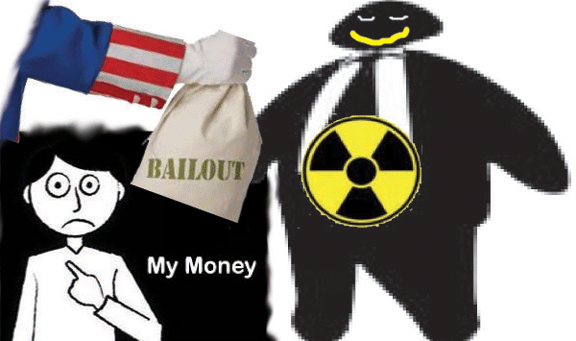
In the summer of 2016, negotiators from the Cuomo Administration and the plant owners agreed to a multi-billion dollar bailout of the plants – which were slated for closure. At that time, the state did not reveal the estimated costs, but subsequent analyses estimated that the costs could run anywhere from $2.9 billion to $7.6 billion over a 12-year period. The negotiation contained no new safety requirements for the plants, just a guarantee that virtually all New Yorkers would be required to pay to make the nuke plants profitable – whether they received power from the plants or not – to keep them open.
The safety records of the plants came under new scrutiny in a report issued last week by the Alliance for a Green Economy, an upstate New York nuclear watchdog organization. The report analyzed recent inspection reports and Nuclear Regulatory Commission (NRC) documents and identified three issues of concern:
The group identified regulatory violations without penalties: 18 violations of Nuclear Regulatory Commission regulations were reported between March 2017 and February 2018 for the four Upstate reactors, but no penalties or fines were assessed.
The group identified examples of weakened regulations at the request of nuclear operators. For example, at the request of one of the plant’s owners, the National Regulatory Commission changed the requirement for what constitutes an “unusual event” regarding Lake Ontario flooding. As we all know, there had been extensive flooding last year in the Lake Ontario area.
Lastly, the group identified missed deadlines for fixing known safety and maintenance issues: one plant near Oswego does not have a containment vessel likely to be able to contain the pressure and radiation released by a meltdown and installation of a required vent has been delayed; the plant’s owner is behind schedule for fixing numerous maintenance issues.
New York State should learn the lessons of the dangers of relying on nuclear power and follow the path set by California: move to shut down these aging facilities, and instead move toward greater reliance on solar, wind and geothermal power.
Those power generators have been starved of adequate support since so much of the state’s wealth is tied up in propping up the Lake Ontario plants. New York energy efficiency programs are anemic and lag far behind neighboring states and currently solar only generates about 1 percent of the power for the state. Instead of mandating that New Yorkers subsidize aging, inefficient, 20th century nuclear plants, that money should be redirected to 21st century conservation and renewable energy programs. Blair Horner is executive director of the New York Public Interest Research Group.http://wamc.org/post/blair-horner-fukushima-anniversary-and-ny-s-subsidies-nuclear-power
In anearly morning tweet, President Trump fired Secretary of State Rex Tillerson and announced that Mike Pompeo, CIA director and unofficial third Koch brother, would be taking over. In other words, a guy who believes climate change is merely an “engineering problem” is being replaced by someone who probably doesn’t think it’s even real.
Pompeo’s environmental record is pretty damning:
In a 2013 interview with C-SPAN’s Washington Journal, he argued that there’s considerable debate within the scientific community about the causes of global warming. There isn’t.
Since 2009, he has accepted more than a million dollars from the oil and gas industry while campaigning for Congress.
He was the largest recipient of Koch Industries campaign money in 2010. And soon afterward, as a newly elected Kansas representative, he hired a former Koch lawyer to be his chief of staff.
It looks like the Koch brothers, who’ve played a huge part in galvanizing the Republican Party against climate change, have Pompeo exactly where they want him.
And why is it important for our secretary of state to understand the basics of climate change? For one, climate change poses a “growing geopolitical threat” to national security — a threat that Pompeo appears quite unequipped to tackle.
What the president and his supporters really mean, of course, is that experts have not shown the proper deference to people who do not understand anything about the world around them. The president seems to believe that no one shows him the proper deference.
Trump and the new Know-Nothings who support him are exploiting this for short-term political gain, but in the longer run, these policies will hurt the very people who voted for Trump in the first place.
Trump is delivering what he promised: A government with no experts, Washington Post, By Tom NicholsMarch 8 Tom Nichols is a professor at the Naval War College and the Harvard Extension School and the author of “The Death of Expertise.”
President Trump kept an important campaign promise this week. Not the one about tariffs — that was incidental — but the one where he vowed to give his supporters the satisfaction of seeing him ignore experts.
The president has plunged ahead with his plans to reverse 70 years of U.S. policy, against the advice of his secretaries of defense and state. His top economic adviser, Gary Cohn — who was unfazed by Trump’s equivocation about Nazis but has found his personal red line on trade policy, apparently — also advised against the tariffs and has now walked out in defeat.
None of this really has very much to do with actual policy. By the time Trump announced the details of the steel and aluminum tariffs on Thursday, his facile public statements about how trade wars are easy to win had already made it clear that he has no actual grasp of what a trade war is, or what it could mean for the United States to start one.
But like so many Trump positions (the wall, the Muslim ban, gun control) the actual content of the policy is irrelevant. His presidential campaign, at its core, operated on a simple premise of social revenge, a notion that only Donald Trump could get even with the shadowy experts who run (and ruin) the lives of ordinary Americans. He vowed to push the eggheads out of the way — not because they are wrong, but because they are eggheads, and nobody likes eggheads……….
Since taking office, however, intelligent people in the administration have been trying to pad the sharp corners around the West Wing in an attempt to prevent these campaign promises from becoming ill-advised realities that could harm both the country and the administration. So with the chaotic point the White House has now reached, the president’s supporters are finally going to get what they want: Their rallying cry all along has been to let Trump be Trump and to ignore people who actually know what they’re doing. ………..
They [the pro Trump expert advocates] are smart enough to know that this campaign against expertise is a sham. They are leading the charge now not only because it is profitable, but also perhaps because they hope that when all this is over, the Jacobins will come for them last.
What the president and his supporters really mean, of course, is that experts have not shown the proper deference to people who do not understand anything about the world around them. The president seems to believe that no one shows him the proper deference. But others have a point, at least about workers who have been hurt by globalization. Experts do lack a certain empathy when it comes to these issues. We tend to be the people who, when asked a question by someone who’s just lost their job, point to low unemployment rates — as though that matters to a recently jobless person. We might be right, but it rankles nonetheless.
This is why the attack on experts appeals both to Trump and his voters: It scratches a deep itch of resentment that has nothing to do with intelligent policy and everything to do with feeling ignored by the people who have to make things work every day.
In the same way that the president fulminates at being told that his ideas might be flawed or wrong, a fair number of Americans now bristle when told that they have to do anything they don’t like: vaccinate their children, eat a healthy diet, put down their phones while driving. None of this is really about steel imports or fortified borders or Muslim travelers; it is about regaining a sense of empowerment.
The world is a complex place. It frightens people to think how much of their daily life is in the hands of their fellow citizens. This has been true since the beginning of the 20th century, and life in the 21st century is not going to get any less dizzying or complicated. Trump and the new Know-Nothings who support him are exploiting this for short-term political gain, but in the longer run, these policies will hurt the very people who voted for Trump in the first place.
Gary Cohn could probably explain all this to the president, if he were still around.
Abe celebrates Fukushima highway http://www.the-japan-news.com/news/article/0004295825, March 10, 2018 Fukushima (Jiji Press)— Prime Minister Shinzo Abe attended on Saturday the opening ceremony of a section of a highway in Fukushima Prefecture being promoted as a state project to support reconstruction from the March 2011 disaster.
Referring to the targeted completion of the Soma-Fukushima highway in fiscal 2020, when the Tokyo Olympic and Paralympic Games will be held, Abe said, “I hope people from around the world will use this highway and experience a reconstructed Fukushima.”
Of the 45-kilometer Soma-Fukushima highway, a 17-kilometer section linking the Fukushima cities of Soma and Date opened on Saturday
N-power project junked due to Fukushima disaster Gujarat CM. Energy World
The project was proposed to be set up at Mithivirdi village in Bhavnagar district, said Energy Minister Saurabh Patel. March 09, 2018, Gandhinagar: Gujarat Chief Minister Vijay Rupani today told the Assembly the proposal to set up a nuclear power plant in Bhavnagar district has been scrapped owing to a movement by panic-stricken locals following the 2011 Fukushima nuclear accident in Japan.
The project was proposed to be set up at Mithivirdi village in Bhavnagar district, said Energy Minister Saurabh Patel.
He was speaking during a debate on the issue during Question Hour of the Assembly which is having its budget session.
Taking part in the debate, Rupani said though the state government had signed an MoU with Nuclear Power Corporation of India (NPCIL) in 2007, the project was eventually scrapped by the PSU after villagers raised apprehensions about their safety in the wake of radioactive “leak” from the Fukushima nuclear plant following a tsunami.
Rupani was replying to a question by Imran Khedawala (Congress) about the status of the proposed 6,000 MW nuclear power plant, for which the state had signed agreements with NPCIL in 2007 during the Vibrant Gujarat Summit.
“This project has been scrapped permanently by NPCIL. During the UPA rule, then Prime Minister Manmohan Singh had signed a nuclear deal with the USA. After that, a total of six nuclear plants were planned across the country and this plant in Bhavnagar was one of them,” he said.
White House: Nuclear power dominates ‘energy dominance’, Washington Examiner, by John Siciliano |
The White House says President Trump’s biggest achievements in his energy dominance agenda are all about nuclear energy.
The White House Office of Science and Technology Policy underscored the president’s achievements Wednesday in a report that highlights a number of scientific advancements made under Trump’s watch.
The biggest energy achievements were on nuclear power, not coal, oil, or natural gas, which are typically promoted as key parts of the administration’s energy dominance agenda.
The report linked Trump’s recently released nuclear policy review, which has much to do with nuclear weapons, with moving the country closer to energy dominance. Trump issued a directive in June ordering his administration to look for ways to expand nuclear power domestically.
“The White House is leading the nuclear policy review, which includes a focus on restoring U.S. nuclear [research and development] capabilities and enabling innovation in the development and deployment of new reactors,” the new report read.
It also pointed out that on Nov. 13, Energy Secretary Rick Perry authorized national lab contractors to strike agreements with the private sector on nuclear technology licensing to help commercialize new reactors.
“The authorization adds a new and powerful technology transfer tool to help unleash American energy innovation by removing barriers for businesses and other entities interested in working with DOE’s National Laboratories,” the report said.
It also pointed out that Trump reopened a program that had been dormant for 23 years, which will boost nuclear power research and development.
“For the first time in 23 years, the U.S. Department of Energy has resumed operations at the Transient Reactor Test Facility,” the White House said. “TREAT is a crucial part of the nation’s nuclear [research and development] infrastructure, and provides the capability to test nuclear reactor fuels and materials under extreme conditions. Such testing can help to improve safety and performance of the current and future nuclear reactor fleet.”
S.C. House cuts customers’ bills over failed nuke project, Aiken Standard. By MEG KINNARD Associated Press, 7 Mar 18,
COLUMBIA — South Carolina lawmakers on Wednesday nearly unanimously advanced a measure aimed at cutting utility bills in the wake of a nuclear construction project failure that’s already cost ratepayers billions.
Now the measure, approved on a 107-1 vote, goes back to the state’s Senate for consideration. That chamber has yet to agree to previous House measures that included cutting customers’ payments for the shuttered project.
Since convening two months ago, state lawmakers have tussled over what to do about the failed project at the V.C. Summer Nuclear Station, a $9 billion reactor construction effort that collapsed last summer. Co-owners SCANA Corp. and Santee Cooper, South Carolina’s public utility, abandoned the project July 31 following the bankruptcy of lead contractor Westinghouse.
State and federal investigations into possible wrongdoing by SCANA are ongoing. Multiple lawsuits alleged company executives knew the project was doomed but kept that information from ratepayers, whom they continued to charge a collective $37 million per month to fund the project.
House and Senate panels quickly convened to examine the debacle, with House lawmakers producing a package of half-a-dozen bills. The proposals included bills cutting rates for customers of SCANA subsidiary South Carolina Electric & Gas by 18 percent – the amount they’ve been paying toward the project – and allowing refunds of what customers have already paid, if regulators conclude there had been “poor management” by SCE&G.
Both chambers put the nuclear mess at the top of their “to do lists” for this year’s session, with some in leadership saying they feared little would get accomplished until the state’s angry ratepayers had some sort of resolution. But debate has lagged in the Senate, where lawmakers have discussed issues related to the failure but also engaged in lengthy debates on other topics, including the recent placement of chicken farms.
Business Report 5th March 2018,The Department of Environmental Affairs recently granted an environmental
permit for a new 4000-megawatt nuclear plant, close to the continent’s
only existing nuclear site, at Koeberg in the Western Cape.
This is despite former finance minister Malusi Gigaba recently stating that construction of
a new plant was unaffordable. Greenpeace Africa has vowed to protest the
construction of the new nuclear plant, saying it would infringe on the
environmental rights of present and future citizens of the country.









 nuclear-news