Editorial. Restarting Tokai No. 2 nuclear plant would be a huge mistake
http://www.asahi.com/ajw/articles/AJ201807050026.html July 5, 2018
The Nuclear Regulation Authority has concluded that the Tokai No. 2 nuclear power plant in Ibaraki Prefecture, operated by Japan Atomic Power Co., meets improved safety standards for a restart.
The watchdog body’s decision effectively paves the way for bringing the idled facility back online.
But a slew of questions and concerns cast serious doubt on the wisdom of restarting this aging nuclear plant located at the northern tip of the Tokyo metropolitan area, given that it is approaching the end of its 40-year operational lifespan.
There is a compelling case against bringing the plant back on stream unless these concerns are properly addressed.
The first major question is how the project can be squared with the rules for reducing the risk of accidents at aging nuclear facilities.
The 40-year lifespan for nuclear reactors is an important rule to reduce the risk of accidents involving aging reactors that was introduced in the aftermath of the disaster at the Fukushima No. 1 nuclear power plant in 2011.
Although a reactor’s operational life can be extended by up to 20 years if approved by the NRA, the government, at the time of the revision to the law, said it would be granted only in exceptional cases.
Despite this caveat, Kansai Electric Power Co.’s applications for extensions for its three aging reactors all got the green light.
The NRA has yet to approve the requested extension of the Tokai No. 2 plant’s operational life. But it is obvious that the nuclear watchdog’s approval will cause further erosion of the rule. It will also undermine the regulatory regime to limit the lifespan of nuclear facilities per se.
Local communities have also raised objections to restarting the Tokai No. 2 plant. Some 960,000 people live within 30 kilometers of the plant, more than in any other 30-km emergency planning zone.
The local governments within the zone are struggling to develop legally required emergency evacuation plans to prepare for major accidents.
This spring, an agreement was reached between Japan Atomic Power and five municipalities around the plant, including Mito, that commits the operator to seek approval from local authorities within the 30-km zone before restarting the plant.
Winning support from the local communities for the plant reactivation plan is undoubtedly a colossal challenge, given strong anxiety about the facility’s safety among local residents. The gloomy situation was brought home by the Mito municipal assembly’s adoption of a written opinion opposing the plan.
But Japan Atomic Power is determined to carry through the plan as its survival depends on the plant continuing operation.
The company was set up simply to produce and sell electricity by using atomic energy. Its nuclear reactors are all currently offline, which has placed the entity in serious financial difficulty.
Since the company is unable to raise on its own funds to implement the necessary safety measures at the Tokai No. 2 plant, which are estimated to exceed 170 billion yen ($1.54 billion), Tokyo Electric Power Co. (TEPCO) and Tohoku Electric Power Co., which are both shareholders and customers of the company, will provide financial support.
But TEPCO has been put under effective state control to deal with the costly consequences of the Fukushima disaster.
It is highly doubtful that the utility, which is kept alive with massive tax-financed support, is qualified to take over the financial risk of the business of another company in trouble.
TEPCO claims the Tokai No. 2 plant is promising as a source of low-cost and stable power supply, although it has not offered convincing grounds for the claim.
Some members of the NRA have voiced skepticism about this view.
TEPCO and the Ministry of Economy, Trade and Industry, which supervises the power industry, have a responsibility to offer specific and detailed explanations about related issues to win broad public support for the plan to reactivate the Tokai No. 2 nuclear plant.
A hard look at the grim situation surrounding the plant leaves little doubt that restarting it does not make sense.
Japan Atomic Power and the major electric utilities that own it should undertake a fundamental review of the management of the nuclear power company without delaying efforts to tackle the problems besetting the operator of the Tokai No. 2 plant.
Japan’s new Basic Energy Plan favours nuclear energy, but also commits to solar and wind power
Nuclear reactor restarts likely as Cabinet OKs new energy plan http://www.asahi.com/ajw/articles/AJ201807030061.html, By SHINICHI SEKINE/ Staff Writer, July 3, 2018
A new wave of nuclear reactor restarts became more likely as the government approved the new Basic Energy Plan on July 3, confirming that nuclear power will remain a key component of Japan’s energy strategy.
But by rubber-stamping the plan, the government also strengthened its commitment to giving renewables such as solar and wind power a major role in energy generation.
The latest Basic Energy Plan, which charts the nation’s mid- and long-term energy policy, marks the fifth in a series that is required by law to be reviewed about every three years.
The second plan to be revised under the administration of Prime Minister Shinzo Abe stated for the first time that the country will strive to make renewable energy a major power source, although it noted fluctuations in output due to weather conditions.
Renewables can become a viable source of a stable power supply when they are combined with rechargeable batteries and hydrogen, according to the plan.
The plan also maintained the reliance on coal-fired thermal power as a base-load energy source despite high emissions of carbon dioxide.
The Abe administration decided to promote nuclear energy when it revised the plan in 2014, reversing the policy of the previous government led by the then-Democratic Party of Japan, which pledged to phase out nuclear power by 2039 in the face of mounting public concern over the safety of nuclear power following the 2011 Fukushima nuclear disaster.
Under the latest plan, the ratio of nuclear energy, renewables and coal thermal power in the nation’s overall energy as of fiscal 2030 will remain at 20-22 percent, 22-24 percent and 26 percent, respectively, in line with the government’s target set three years ago.
Experts say about 30 reactors need to be reactivated to achieve the 20-22 percent target, but only nine have gone back on line so far after they cleared the more stringent reactor regulations that took effect after the Fukushima accident.
The plan did not touch on the need for building a new nuclear plant in light of the widespread public opinion against nuclear energy. The last Basic Energy Plan did not mention the subject, either.
The latest plan re-endorsed using the nuclear fuel cycle, in which plutonium extracted from spent nuclear fuel at nuclear plants is used to generate power.
But the plan, noting calls from the United States, said that Japan “will make efforts to cut the stockpile of plutonium.”
Japan holds a total of 47 tons of plutonium, equivalent to 6,000 Nagasaki-type atomic bombs, a source of criticism from the United States and other countries.
The country has failed to reduce its plutonium stockpile due to little progress in the nuclear fuel cycle over decades.
The project to operate the Monju prototype fast-breeder reactor in Fukui Prefecture, the core part of the nuclear fuel cycle, rarely worked over 20 years due to numerous glitches. The government finally decided to pull the plug on it in 2016.
Burning a mixed oxide form of plutonium and uranium has not spread among conventional nuclear reactors, although it was considered a way to reduce the plutonium stockpile.
In its attempts to export nuclear plants, the country has hit major problems wherever it has pitched them.
But the government will maintain the export policy as a key component of the administration’s strategy for expanding the Japanese economy.
According to the Basic Energy Plan, “Japan is determined to make a positive contribution to enhancing the safety of nuclear energy and the peaceful use of nuclear energy” through exports of nuclear plants.
French engineering group to help Saudi Arabia towards nuclear power
 World Nuclear News 4th July 2018 , French engineering group Assystem is to conduct site characterisation and
impact studies for Saudi Arabia’s first nuclear power plant under a
contract from the King Abdullah City for Atomic and Renewable Energy
(KA-CARE). The contract was awarded recently following an international
call for tenders launched by KA-CARE. Assystem said the services to be
provided under the contract include site characterisation studies –
including geological and seismic analyses – as well as studies on the
impact of a nuclear power plant on the environment, demographics and on
electricity grids. These services will be provided over an 18-month period.
http://www.world-nuclear-news.org/NN-Assystem-to-assess-potential-Saudi-sites-0407185.html
Coal, nuclear moves solve problems that don’t exist
https://www.chron.com/business/energy/article/Administration-s-action-on-coal-and-nuclear-13048108.php By Don Santa
Natural gas pipelines can be targeted by cyberattacks. So can electric grids. And power plants. And hospitals, city governments, banks, entertainment companies, and virtually anything else that exists in the digital age.
Like most of those entities, pipeline companies have taken aggressive steps to better shield their infrastructure from hackers, isolate critical systems, and beef up physical security. Recent allegations by some that the natural gas industry is increasingly vulnerable to cyberattack are unsubstantiated and not based on any factual evidence.
A recent incident affecting a third-party service provider, used for scheduling and nominations by some pipeline operators, demonstrates how the industry’s preparedness protects consumers. After an attack in March halted data exchanges from the company, the operators that used their services to facilitate gas deliveries and billing sprang into action. There was no impact on natural gas deliveries and gas never stopped moving through pipelines as a result of this incident.
Natural gas pipeline companies have a long standing track record of reliable service, and are dedicated to meeting the highest industry and federal standards for safety, security and resilience, ensuring the flow of natural gas. This is par for the course in an industry where the number of threats are increasing, but advances in security and system resilience have made inflicting any real damage increasingly difficult.
Compared to cyberattacks that shut down entire electric grids in the Ukraine and a ransomware virus that hobbled services in Atlanta for days, the natural gas industry has avoided any attacks causing a halt in services. Preparedness is key, and the industry has demonstrated its commitment through participation in programs like the Downstream Natural Gas Information Sharing and Analysis Center, as well as real-world training exercises like the NERC GridEx. There is still work to be done, but we are on the right track.
Despite this progress, a recently leaked “pre-decisional” memo from the U.S. Department of Energy and the National Security Council argues that natural gas cybersecurity threats are proof that aging coal and nuclear power plants need to be propped up through unprecedented and legally-questionable use of federal national security powers.
This represents a solution to a problem that does not exist. If the Energy Department acts, consumers will be saddled with as much as $11.8 billion to pay for the uneconomic coal and nuclear plants.
That might be justifiable if these facilities increased the reliability of the grid. But they don’t. That’s why three previousattempts to find legal justification to subsidize these plants have failed. That’s also why PJM, the non-profit electric grid operator for the region that has seen most coal and nuclear retirements, dismissed the proposal as “damaging to markets and therefore costly to consumers.”
UAE further delays launch of first nuclear reactor
5 July 18 Emirates Nuclear Energy Corporation now says first reactor to come online in late 2019 or early 2020, The United Arab Emirates said Wednesday that its first nuclear reactor would come online in late 2019 or early 2020, further delaying the launch of the Arab World’s first atomic power station….https://www.arabianbusiness.com/energy/400041-uae-further-delays-launch-of-first-nuclear-reactor
The UK’s Hitachi nuclear bailout- a classic case of crony capitalism

Morning Star 29th June 2018 , ENVIRONMENT Secretary Michael Gove promised earlier this month to crack
down on “crony capitalism.” At the same time his cabinet colleague
Energy Secretary Greg Clark was offering a £5 billion bailout to Japanese
nuclear firm Hitachi.
It looks like a classic crony capitalist deal. Gove
argued: “Crony capitalists have rigged the system in their favour and
against the rest of us.” A classic crony capitalist deal is where a big
firm uses its power and lobbying to squeeze a contract from the government
that is good for the capitalists but bad for us.
The Hitachi bailout looks like such a rigged deal. Hitachi Europe chief executive Sir Stephen
Gommersall isn’t an expert in nuclear power or engineering. He is the
former British ambassador to Japan. Gommersall was hired right out of the
Foreign Office to help open doors for Hitachi. Tim Stone sits on the board
of Horizon Nuclear Power, Hitachi’s British nuclear arm. Stone, a former
KPMG consultant, was chief adviser to the energy secretary from 2008-13,
helping shape both Labour and Tory-Lib Dem governments’ nuclear energy
policy. Before that Stone advised the government on many PFI deals,
including famously bad-value ones.
https://morningstaronline.co.uk/article/nuclear-powered-crony-capitalism
75 industry, government, and military dignitaries applaud Trump’s nuclear bailout plan
 Government, military officials in favor of Trump’s nuclear bailout plan http://www.toledoblade.com/local/2018/07/01/Government-military-officials-in-favor-of-Trump-s-nuclear-bailout-plan.html, By | BLADE STAFF WRITER
A broad coalition of 75 industry, government, and military dignitaries — a quarter of whom are retired admirals or vice admirals — has come out in support of President Trump’s plan to bail out the nation’s struggling nuclear plants, agreeing that more premature closures pose a national security threat.
“We urge you to continue to take concrete steps to ensure the national security attributes of U.S. nuclear power plants are properly recognized by policymakers and are valued in U.S. electricity markets,” according to the letter, which was addressed to U.S. Energy Secretary Rick Perry and dated last week.
The letter could help stave off the planned closures of FirstEnergy Solutions’ Davis-Besse nuclear plant east of Toledo, its Perry nuclear plant east of Cleveland, and its twin-reactor nuclear complex west of Pittsburgh.
FES has announced it will close Davis-Besse by May 31, 2020, unless a buyer or bailout emerges. The other three nuclear plants are to be closed by the end of 2021.
FES and FirstEnergy Nuclear Operating Co., both subsidiaries of Akron-based FirstEnergy Corp., are in bankruptcy proceedings because those plants — as well as several coal-fired power plants — have become unprofitable during the era of record-low natural gas prices and growth in the renewable energy sector. FirstEnergy has said it wants out of electricity generation, and that what’s left of the corporation will be focused on transmission.
The high-profile letter in support of saving nuclear plants is being circulated by the Nuclear Energy Institute, the nuclear industry’s lobbying arm on Capitol Hill.
Besides admirals and vice admirals, the signatories include former U.S. Secretary of State George Shultz and former U.S. senators Byron Dorgan (D., N.D.), Judd Gregg (R., N.H.), Trent Lott (R., Miss.), Jim Talent (R. Mo.), and John Warner (R., Va.).
Also signing the letter was former New Jersey Gov. and former U.S. Environmental Protection Agency Administrator Christine Todd Whitman as well as many former industry executives, such as Daniel Akerson, General Motors’ chairman and chief executive officer from 2010 to 2014; Thomas Christopher, former AREVA chief executive officer; Charles Pryor, retired Westinghouse Electric Co. and URENCO USA chairman, and Jeffrey Wadsworth, former Battelle Memorial Institute president and chief executive officer.
In addition, the letter is signed by three former U.S. Nuclear Regulatory Commission chairmen, Nils Diaz, Dale Klein, and Richard Meserve; as well as some former NRC commissioners, and several former directors of national laboratories.
The Trump Administration plan to bail out struggling nuclear and coal-fired power plants came two months after FirstEnergy Solutions filed what many experts view as a historic and potentially landmark petition for relief under Chapter 11 bankruptcy laws.
The bankruptcy filing has drawn national attention because FirstEnergy is one of America’s largest utilities. It appealed to Mr. Perry for help in late March when it filed for bankruptcy.
Those nuclear plants — in addition to numerous coal-fired power plants under FirstEnergy — represent a huge chunk of electricity for the regional electric grid that Pennsylvania-based PJM Interconnection operates in 13 states, including Ohio. That grid, which serves 65 million people, is the nation’s largest.
Mr. Perry is being asked to exercise emergency authority under a pair of federal laws typically reserved for wars or natural disasters.
According to The Associated Press, such a move is “unprecedented intervention into U.S. energy markets.”
PJM has said the planned shuttering of those plants pose “no immediate threat to system reliability,” and warned of higher prices, as have many others.
The Office of the Ohio Consumers’ Counsel, one of several parties that opposes such an emergency order, has called FirstEnergy’s request “extraordinary,” as well as “fundamentally unjust and unreasonable for Ohio consumers,” adding Ohioans will be subject to “paying subsidies and above-market prices for electricity” if a bailout is granted.
Also objecting have been attorneys general from nine states and the District of Columbia, calling the company’s justification “legally flawed” and “a grave abuse of the Federal Power Act,” a section of which provides for relief during national emergencies.
The Chicago-based Environmental Law & Policy Center — which called upon the NRC to investigate the utility’s decommissioning trust fund days before FES filed for bankruptcy protection — also has filed a 96-page petition in opposition, which it prepared with the New York-based Environmental Defense Fund, the Ohio Environmental Council, and Ohio Citizen Action.
The NRC found no shortfall during its last audit of the trust fund, completed in March, 2017.
The ELPC is one of several groups that have labeled Mr. Trump’s directive as an act of socialism, saying it goes against free market supply-and-demand principles. Those opposed include the American Petroleum Institute, which represents the industry benefiting most from expanded production of natural gas.
The United States is now the world’s largest producer of natural gas. Industry executives and government officials said at a conference in Washington last week that the country could expand its shale gas output another 60 percent in the coming decades.
The administration’s position is that America cannot become overly reliant on natural gas, renewable energy, and other sources of electricity that are now being sold at much cheaper prices. Natural gas in particular has made great inroads in the market because of how prices have fallen dramatically over the past decade once the modern era of fracking shale began.
Contact Tom Henry at thenry@theblade.com, 419-724-6079, or via Twitter @ecowriterohio.
Federal and tribal officials support proposed amendments to the Radiation Exposure Compensation Act

 Officials seek support for radiation exposure compensation amendments https://www.daily-times.com/story/news/local/navajo-nation/2018/06/30/officials-seek-support-radiation-exposure-compensation-amendments/740239002/,
Horizon Nuclear Power’s Wylfa Newydd plans formally approved.
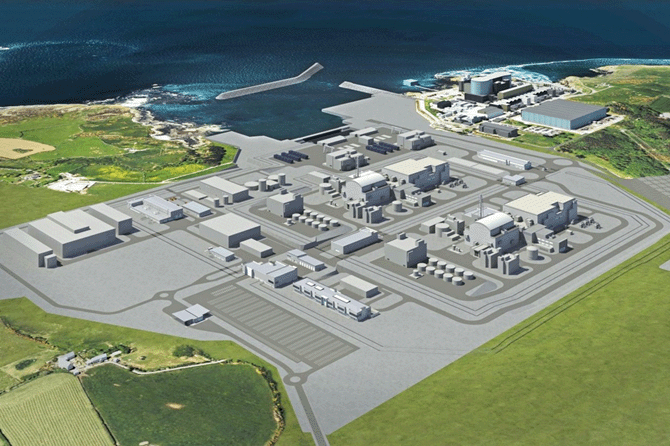 Energy Live News 29th June 2018 ,Horizon Nuclear Power’s Wylfa Newydd plans formally approved. Four key
environmental permits will now enter the assessment stage. Horizon Nuclear
Power has had its plans to build the proposed Wylfa Newydd nuclear power
station in Wales formally approved by the Planning Inspectorate. The
Development Consent Order process now formally begins with the
pre-examination phase, which is where members of the public can become an
‘interested party’. An Examining Authority is also appointed at this
stage and interested parties will be invited to attend a preliminary
meeting. Four other key environmental permits will now also enter the
assessment stage, which will be delivered by Natural Resources Wales.
https://www.energylivenews.com/2018/06/29/horizon-nuclear-powers-wylfa-newydd-plans-formally-approved/
UK Public Accounting for Costs of the Defence Nuclear Enterprise – seriously underscrutinised
Parliament 19th June 2018 Neglected Large-Scale Value for Money Issues in Public Accounting for Costs
of the Defence Nuclear Enterprise :Written evidence a review of issues that
are of direct relevance to the core topic of the National Audit Office
(NAO) report of 2018 concerning ‘the Defence Nuclear Enterprise’
(henceforth ‘NAO Report’). The material summarized here supplements and
updates evidence published by the PAC Inquiry of October 2017. The authors
believe on grounds of many years of research at the Science Policy Research
Unit at the University of Sussex that the matters documented here raise
large-scale, long-run value for money issues of pressing national
importance, which remain seriously neglected in work to date either by the
NAO, the PAC or any other official bodies – and which are therefore
gravely under-scrutinized by Parliament or wider UK policy debates
In South Africa, there’s confusion about the new government’s policy on matters nuclear
Nuclear energy: Ramaphosa’s mixed messages https://www.news24.com/Analysis/nuclear-energy-ramaphosas-mixed-messages-20180629 Ellen Davies and Saliem Fakir
December 2017 marked the beginning of significant political changes in South Africa. Former President Jacob Zuma was replaced by Cyril Ramaphosa as president of the African National Congress (ANC). On 14 February 2018, Zuma stepped down as president of the Republic of South Africa (RSA), almost one year short of completing his second and final term. He was replaced by the newly elected president of the ANC, Cyril Ramaphosa.
This has brought about significant changes in South Africa. However, what this means for Government’s nuclear energy ambitions is not yet clear. While the Zuma administration remained unwaveringly committed to the Nuclear Energy New Build Programme in its full 9.6GW glory, mixed messages about the future of nuclear energy have emerged from President Ramaphosa and his newly appointed Minister of Energy, Jeff Radebe.
Given this uncertainty, as well as the country’s questionable track record with pursuing nuclear energy procurement under the Zuma administration, those opposed to the nuclear new build programme are left in limbo.
Will government continue to pursue nuclear energy despite its prohibitively high costs; the lack of energy demand to justify a build on this scale; the fact that we don’t have the money to finance it; and the continued resistance from many constituencies throughout South Africa? If it does, will the procurement process be more open and transparent than it was under the Zuma administration and will government engage with and listen to the concerns of its people?
These are critical questions because the energy choices we make now will have significant impacts not only on our energy security and economic performance today but also in the future.
It is in this spirit that the World Wide Fund for Nature (WWF) undertook two studies to explore the future of nuclear energy in South Africa. The purpose of these studies is two-fold. First, it seeks to understand what we can learn from the decisions made and strategies pursued to push nuclear energy under the Zuma administration. Second, it seeks to highlight the potential points of intervention available to those seeking to oppose nuclear energy deployment, or at the very least ensure accountability in the procurement thereof.
The first study, South Africa’s nuclear new-build programme: Who are the players and what are the potential strategies for pushing the nuclear new-build programme, maps the most vocal constituencies in the nuclear energy debate and their reasons for either opposing or supporting the new build programme. What it reveals is that across the board, irrespective of ideological positions or technology preferences, South Africans are opposed to the nuclear programme. The reasons given by these commentators include, the prohibitively high costs involved, the lack of energy demand to justify the programme, the lack of finance to fund such a programme, the secrecy associated with nuclear procurement and the potential for corruption, among others.
The study also unpacks some of the lessons we can learn from government’s strategy to push the nuclear programme under the previous administration. Importantly, it unpacks the Earthlife Africa and Southern African Faith Communities’ Environment Institute (SAFCEI) legal challenge, which saw the Western Cape High Court declare Government’s Intergovernmental Agreement with Russia unlawful and what those opposed to nuclear energy can learn from this process. It attempts to understand what, given the High Court decision, are the strategies available to Government if it is to continue to pursue nuclear energy in South Africa.
The second study, South Africa’s nuclear new-build programme: The domestic requirements for nuclear energy procurement and public finance implications, provides insight into the various legislative requirements for large infrastructure builds in South Africa.
What it reveals is that SA has a robust legislative framework in place to ensure that due process is followed in large infrastructure procurement. In particular, Treasury’s various procurement rules impose a number of checks and balances to prevent cost overruns and delays and to ensure transparency and accountability. These are critical to understand, not only in the context of nuclear energy, but for any infrastructure build we might seek to undertake.
The second report also shows unequivocally that SA cannot afford to pursue the nuclear new build programme. Using very conservative cost estimates, it shows not only that the fiscus can neither finance the programme nor provide the guarantees necessary to seek financial support elsewhere.
Given this, and as we move into a new period in SA’s democracy, it is critical we entrench inclusive and accountable decision making from the get go. This requires that we ensure that government engages with and listens to all stakeholders when making important decisions about our energy future.
Going into this new period, we can draw on two fundamental lessons from our past. The first is that everyone has the power to make a difference. Against all odds, Earthlife Africa and SAFCEI, were able to change the course of our energy future. The second is that in order to exercise this power we need to be informed. The energy space is unnecessarily complicated. It is time for those working in this space, to move away from the technical language that excludes participation by most South Africans and start driving Energy Democracy in its truest form.
– Ellen Davies is the Project Manager of Extractives Industry at the World Wide Fund for NatureSaliem Fakir is the Head of the Policy & Futures Unit at the World Wide Fund for Nature South Africa.
This article first appeared on The Journalist.
U.S. Energy Secretary Rick Perrys claim: bailing out coal and nuclear industries so important that the cost doesn’t matter
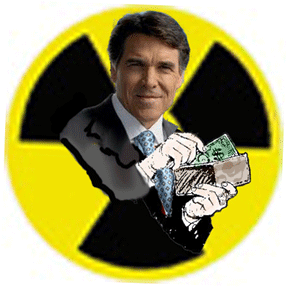 Reuters 28th June 2018 , U.S. Energy Secretary Rick Perry said on Thursday that bailing out
struggling coal and nuclear power plants is as important to national
security as keeping the military strong, and that the cost to Americans
should not be an issue.
https://uk.reuters.com/article/us-gas-conference-perry-grid/nuclear-coal-bailout-worth-any-cost-to-keep-america-free-u-s-energy-chief-idUKKBN1JO2J
Radiation from USA’s nuclear bomb tests went far and wide – now compensation is needed
Cold War Weapons Testing Made People Sick. Now, More Mountain West Residents Could Be Compensated http://boisestatepublicradio.org/post/cold-war-weapons-testing-made-people-sick-now-more-mountain-west-residents-could-be-compensated#stream/0 By RAE ELLEN BICHELL • JUN 28, 2018
Nuclear testing during the Cold War sent radioactive fallout far away from the actual test sites. Politicians are moving to expand who can be compensated by the government for getting sick after exposure to that fallout.
The tests mostly happened in Nevada but winds sent radioactive materials far and wide. Idaho Sen. Mike Crapo said one detonation in 1952 was particularly memorable to his constituents.
“Idahoans that I’ve spoken to in Emmett and elsewhere have shared their memories of waking to find their pastures and orchards covered with a fine grey-white dust that seemingly appeared out of nowhere. It looked like frost, yet it was not cold to touch,” Crapo said in a Senate Committee on the Judiciary hearing Wednesday.
In 1990 Congress created a program to compensate people who became seriously ill after radiation exposure.
According to the Department of Justice, since the programstarted more than $2 billion has been given in compensation. People like miners who worked directly with radioactive materials can get $100,000, people who were on site during nuclear tests get $75,000 and people who lived downwind of a major test site in Nevada get $50,000. So-called “downwinders” have to have lived in certain counties within Utah, Nevada and Arizona at the time of testing to be considered eligible.
“Unfortunately, the science at the time failed to recognize that radioactive fallout is not restricted by state lines,” said Crapo.
According to the National Cancer Institute, some of that fallout landed on fields across the country and especially in the Mountain West. It was consumed by animals like cows and eventually made it into milk cartons. Because of that, people who were milk-drinking children at the time are considered to have a higher risk of thyroid cancer.
Senators, including Crapo, have sponsored a bill that would expand the group of eligible “downwinders” to people who lived in parts of Idaho, Colorado, Montana, New Mexico and Guam at the time that tests were conducted.
The bill would also establish a grant program for further research into the health impacts of uranium mining and would extend the deadline for filing claims from 2022 to the late 2030s.
This story was produced by the Mountain West News Bureau, a collaboration between Wyoming Public Media, Boise State Public Radio in Idaho, Yellowstone Public Radio in Montana, KUER in Salt Lake City and KRCC and KUNC in Colorado.
Socialism is the Trump govt’s policy when it comes to coal and nuclear
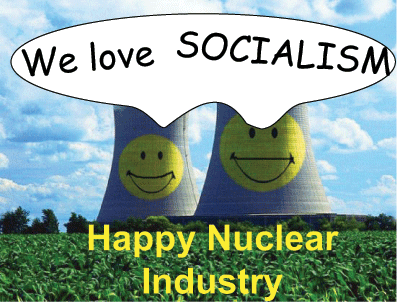 Trump administration wants welfare for coal and nuclear power, https://www.denverpost.com/2018/06/29/trump-administration-wants-welfare-for-coal-and-nuclear-power/ By TOM RIBE | Writers on the Range
The Trump administration just sent a tsunami through America’s electrical energy world when a leaked memo revealed that it had a new plan to shovel millions of dollars to the coal and nuclear power industries.
The memo, leaked to Bloomberg News and written by a member of Trump’s National Security Council, said that the nation faced a “grid emergency” because so many coal and nuclear power plants had shut down. The memo argued that the government could simply order private utility companies to buy high-cost electric power, because “national security” concerns mandated using “fuel-secure” sources to protect national security.
The memo claimed that “resources that have a secure, on-site fuel supply, including nuclear and coal fired power plants … are essential to support the nation’s defense facilities and critical energy infrastructure.” And it added that “due largely to regulatory and economic factors, too many of these fuel-secure facilities have retired prematurely.”
Prematurely? There is no shortage of electric power generation in the United States. The historic shift in this country toward cleaner, renewable energy is driven by national and international energy markets, not by tax breaks or government regulations. Countries around the world are investing in cheaper solar and wind power to address climate change and air pollution. One might think that free-market conservatives would be delighted to see competitive markets providing abundant, low-cost electricity from diverse sources to American consumers — all without interference from government. But apparently this case is different.
As for any threats to our national security, Vermont Law School professor Peter A. Bradford has pointed out: “We have no military crisis and no threats to our system reliability or resilience that require this drastic and expensive governmental intervention. The facts are being fixed around the desired end result.”
A political explanation seems like the real reason behind the administration’s determination to prop up coal. Trump’s staff has found a way to fulfill his campaign promise to rescue the dying coal industry, whose production has dropped 38 percent in the last decade. Robert Murray, CEO of Murray Energy, who gave Trump $300,000 for his inauguration, presented Energy Secretary Rick Perry with an “action plan” last March that included ending pollution controls on coal plants and stopping the rapid shift toward wind and solar energy.
Perry tried to direct federal subsidies to coal, only to be blocked last September by the Federal Energy Regulatory Commission. The leaked National Security Council memo noted that the Trump administration could use laws, such as the Federal Power Act and the Defense Production Act, to force utilities to buy high-cost power from coal and nuclear plants, though neither act has been used for these purposes before.
The memo also stated that natural gas is vulnerable to “cyber attacks” that make its supply unreliable, though record supplies of natural gas exist throughout the country. What the memo ignores is the reality that wind and solar, which make up about a quarter of power generation in this country, are abundant resources — nowhere near scarce.
Ever since horizontal drilling — fracking — transformed the oil and gas industry, this country has been producing large amounts of natural gas. Prices have dropped dramatically, and many coal-burning plants have converted to natural gas. Natural gas, however, is also a potent contributor to global climate change, and the continued flaring of methane during gas production is a significant, largely uncalculated source of pollution.
The Nuclear Information and Resource Service, a nonprofit that supports nuclear-free renewable energy, estimates that the coal and nuclear plant subsidies proposed in the memo could cost consumers up to $35 billion per year. Tim Judson, the group’s executive director, said, “Betting on old, increasingly uneconomical nuclear and coal power plants as a national security strategy is like gold-plating a Studebaker and calling it a tank. It could destroy the booming renewable energy industry, which is already employing more Americans than coal and nuclear combined.”
At a Senate hearing on June 11, Washington Democratic Sen. Maria Cantwell characterized the proposal as nothing more than “political payback” for the coal industry, and members of the Federal Energy Regulatory Commission who testified agreed that there is no “grid emergency.” Citing market interference, even the American Petroleum Institute testified against subsidizing coal and nuclear power.
Trump, who apparently developed his ideas on energy policy back in the 1970s, has shown little interest in any of the major changes to America’s energy picture since then. His effort to turn back the clock to fulfill his campaign promises to coal miners and repay political contributions could throw tens of thousands of people out of work, forfeit America’s leadership in energy technology, and worsen global warming.
America’s environmental and energy future depends upon a vigorous public pushback against this wrongheaded move.
Britain’s Planning Inspectorate has accepted Hitachi unit Horizon’s application for the Wylfa nuclear power station in Wales
Reuters 29th June 2018 , Britain’s Planning Inspectorate has accepted Hitachi unit Horizon’s
application for the Wylfa nuclear power station in Wales, it said, one of
several new plants aimed at replacing the UK’s ageing fleet of atomic
reactors and coal plants. “We have considered very carefully the
application submitted by Horizon Nuclear Power and decided that it meets
the required tests set out in the legislation to be accepted for
examination,” Sarah Richards, chief executive of the Planning
Inspectorate, said in a statement. “Of course, this does not mean that
consent will be given for the project to go ahead – acceptance of the
application simply means that the Examining Authority can begin to make
arrangements for the formal examination of the application,” she added.
https://uk.reuters.com/article/uk-britain-nuclear-horizon/uk-inspectorate-accepts-hitachi-units-planning-bid-for-wylfa-nuclear-plant-idUKKBN1JP0VV?rpc=401&
-
Archives
- October 2026 (104)
- September 2026 (339)
- August 2026 (330)
- July 2026 (355)
- June 2026 (287)
- May 2026 (306)
- April 2026 (356)
- March 2026 (251)
- February 2026 (267)
- January 2026 (308)
- December 2025 (358)
- November 2025 (359)
-
Categories
- 1
- 1 NUCLEAR ISSUES
- business and costs
- climate change
- culture and arts
- ENERGY
- environment
- health
- history
- indigenous issues
- Legal
- marketing of nuclear
- media
- opposition to nuclear
- PERSONAL STORIES
- politics
- politics international
- Religion and ethics
- safety
- secrets,lies and civil liberties
- spinbuster
- technology
- Uranium
- wastes
- weapons and war
- Women
- 2 WORLD
- ACTION
- AFRICA
- Atrocities
- AUSTRALIA
- Christina's notes
- Christina's themes
- culture and arts
- Events
- Fuk 2022
- Fuk 2023
- Fukushima 2017
- Fukushima 2018
- fukushima 2019
- Fukushima 2020
- Fukushima 2021
- general
- global warming
- Humour (God we need it)
- Nuclear
- RARE EARTHS
- Reference
- resources – print
- Resources -audiovicual
- Weekly Newsletter
- World
- World Nuclear
- YouTube
-
RSS
Entries RSS
Comments RSS

