U.S. to probe whether imports are threat to national security
Tariffs on imports ‘would drive up the price of uranium’
The Trump administration’s decision to consider tariffs on uranium imports may raise the cost of fuel for nuclear reactors and undermine a separate initiative to shore up struggling electricity generators.
The Commerce Department said Wednesday it will probe whether uranium imports “threaten to impair” national security. U.S. miners Energy Fuels Inc. and Ur-Energy Inc., which requested the probe in January, want 25 percent of the domestic market reserved for U.S. producers. Domestic companies supply less than 5 percent of U.S. consumption and would need about three years to ramp up production to meet that target.
The prospect of trade barriers comes after President Donald Trump last month ordered his energy secretary to take action to extend the life of money-losing coal and nuclear power plants that face competition from cheap natural gas and renewable energy. Those efforts may be hindered as the prospect of tariffs threatens to deal another blow to financially strapped reactor operators……..https://www.bloomberg.com/news/articles/2018-07-19/uranium-tariffs-threaten-nuclear-plants-trump-is-trying-to-save
The analysis, by Massachussetts-based research firm The Brattle Group, looked at the costs associated with keeping the U.S. coal and nuclear fleets operating as is for the next two years.
“Arresting the retirement of uneconomic generating assets in the current market environment will likely prove quite costly,” the report reads.
The study was commissioned by groups including American Petroleum Institute, Advanced Energy Economy and American Wind Energy Association, after the leak of a memorandum from the Department of Energy calling for the White House to use national security powers to save coal and nuclear plants.
Energy Secretary Rick Perry has been championing such actions since last year, arguing the shutdowns theater the stability of the nation’s power grid.
“Further, bailouts of coal and nuclear plants around the country could raise costs on American consumers and fundamentally hurt the administration’s goal of American energy dominance throughout the world,” said Todd Snitchler, market development director at the American Petroleum Institute.
https://www.nippon.com/en/features/h00238/ [2018.07.19] Seven years on from the Fukushima Daiichi disaster, nine reactors are operational in Japan as of July 2018. Unlike the Fukushima Daiichi reactors, all of these are pressurized water reactors and they are based in western Japan.
On March 11, 2011, there were 54 nuclear reactors in operation in Japan supplying approximately 30% of the country’s electric power. However, the Great East Japan Earthquake and subsequent devastating tsunami that brought disaster to the Fukushima Daiichi Nuclear Power Station transformed attitudes and nuclear energy usage nationwide.
In July 2013, the Japanese government established new regulatory standards for nuclear power plants. To withstand earthquakes and tsunami, new stricter safety regulations must be met, involving huge costs to implement necessary safety countermeasures. Additionally, in municipalities where plants are located, whether operations are allowed to resume has become an election point for local politicians, and residents continue to file injunctions against bringing plants online again. Even if the hugely expensive safety countermeasures are implemented, numerous hurdles remain to be overcome.
As of July 12, 2018, there are five plants with a total of nine reactors that have met the new standards: Ōi and Takahama (Kansai Electric Power Company), Genkai and Sendai (Kyūshū Electric Power Company), and Ikata (Shikoku Electric Power Company). Meanwhile, it has been decided that 19 reactors will be decommissioned.
The nine reactors that have resumed operations are based in western Japan. All of them are pressurized water reactors, thereby differing from the Fukushima Daiichi plant operated by Tokyo Electric Power Company (TEPCO), where the accident occurred. When it comes to nuclear plants that have the same boiling water reactor system as Fukushima Daiichi, reactors 6 and 7 of Kashiwazaki-Kariwa (TEPCO) have passed the new standards review and Tōkai Daini (Japan Atomic Power Company) is now at the final stage awaiting official approval. However, as they are the same types of reactors as Fukushima Daiichi and memories of the huge earthquake are still strong in people’s minds in eastern Japan, it is difficult to gain approval from local residents and municipalities. No plans have been set for restarting them
NORTHAMPTON — On the steps of City Hall, U.S. Rep. James McGovern became the first voting member of Congress to officially pledge his support for the abolition of nuclear weapons across the world.
On Saturday afternoon, candidates running for the state Legislature joined the congressman in calling on the United States government to sign, ratify and implement the 2017 International Treaty on the Prohibition of Nuclear Weapons. The United Nations adopted the treaty last July and so far 59 countries have signed it. U.S. Rep. Eleanor Holmes Norton of Washington, D.C., also signed the pledge in May, but she does not have voting power in the House.
“This treaty to put an end to nuclear weapons once and for all was not started by the great powers, but by grassroots organizations and the leadership of small and medium-sized nations,” McGovern said before a crowd of 70. “I believe it takes hard work, hard organizing, to get people and nations to recognize that nuclear weapons remain one of the greatest threats to all humankind, to the environment, to the planet — and they must be eliminated.”
The Resistance Center for Peace and Justice, formerly the American Friends Service Committee of Western Massachusetts, partnered with NuclearBan.US, a national campaign founded by
Northampton residents Vicki Elson and Dr. Timmon Wallis, to host an event that saw numerous prospective lawmakers voice their support for the dismantling of the country’s nuclear arsenal. Both groups are official partners of the International Campaign to Abolish Nuclear Weapons, which won the 2017 Nobel Peace Prize for its work on the treaty.
The treaty prohibits signatories from the development, testing, producing, manufacturing, transferring, possessing, stockpiling, using or threatening to use nuclear weapons under international law.
Since the treaty was adopted last year, 59 countries have signed it and 11 parliaments have ratified it, according to Wallis. The United States has not signed it, nor has any other nation that possesses nuclear weapons.
Grassroots effort
In order for the treaty to go into effect, 50 countries have to ratify it, which Wallis said he expects to happen at the end of next year. In September, there will be another signing ceremony at the United Nations in New York, where he expects nine countries to sign on.
Local statehouse office-seekers who signed the ICAN Candidate Pledge for a Nuclear Weapons Free Future included Chelsea Kline, Jo Comerford and Steven Connor for state Senate; Marie McCourt, Eric Nakajima, Lindsay Sabadosa and Mindy Domb for the Hampshire House seat; Natalie Blais, Jonathan Edwards, Casey Pease, Christine Doktor, Kate Albright-Hanna and Nathaniel Waring for the 1st Franklin District seat; Tanya Neslusan for the Hampden House seat; Amaad Rivera for the Hampden Senate seat; and Jamie Guerin for state treasurer.
“It’s precisely because our national leadership is failing us that we need a grassroots movement to change things,” McGovern said. “If we are going to abolish nuclear weapons, it’s going to have to be a worldwide grassroots movement.”
The world cannot count on the leadership of President Donald Trump or President Vladimir Putin of Russia, he said, so change must come from regular people around the globe. McGovern said taking the pledge was an easy decision to make and he credited the event organizers for focusing his attention on the need to take action against the threat of nuclear weapons.
“Being in Washington right now is like drinking water from a fire hose, and there are a thousand horrible things happening all the time,” McGovern said. “But if nuclear weapons were ever used, that may be the end of the Earth. This is an incredibly important issue and I am very proud of this movement.”
Lining up support
Elson and Wallis said they are currently working with mayors from Northampton, Easthampton and Holyoke for their cities to become treaty-compliant. As part of their work for NuclearBan.US, they urge people to hold accountable the 26 companies known to help make nuclear weapons, many of which are based in the U.S., by boycotting and divesting from these companies.
With President Trump reversing course on a lot of former President Barack Obama’s efforts at disarmament, Wallis said the campaign faces an uphill battle.
“Of course, the U.S. government is putting pressure on all these countries not to sign and not to ratify, so that is part of what we are up against,” Wallis said.
Elson said, “The citizens are rising up, that is what we are all about.
“The treaty is the tool we can use to solve this problem once and for all,” she said. “Then we won’t be worried about this leader or that leader, or this country or that country. If these weapons don’t exist we would be a whole lot safer, and then we can go on to solve other problems.”
Takoma Park, Md., and Berkeley, Calif., are the first two cities in the nation to declare themselves treaty-compliant through the efforts of NuclearBan.US. In western Massachusetts, the Northampton Quaker Meeting, Broadside Books, Elements Spa, Arcadia Herbs, and Paradise Copy are now treaty-aligned.
NuclearBan.US has a goal of gaining the support of individuals, faith organizations, schools, towns, and cities to demand the attention of the U.S. government.
“Now is the time that we must come together to demand nuclear weapons be abolished, and fortunately we have the tool to do so,” Lydia Wood of NuclearBan.US said. “Now that we have this tool, it is up to us to make it successful … It is unacceptable to make money off the most destructive and potentially apocalyptic weapon ever created. We can make it politically unacceptable by publicly shaming and stigmatizing the companies making billions off of these weapons.”
Government advisers have told ministers to back only a single new nuclear power station after Hinkley Point C in the next few years, because renewable energy sources could prove a safer investment.
The National Infrastructure Commission (NIC) said the government should cool down plans for a nuclear new build programme that envisage as many as six plants being built.
The commission, launched by George Osborne in 2015, said that a decade ago it would have been unthinkable that renewables could be affordable and play a major role in electricity generation. But the sector had undergone a “quiet revolution” as costs fell, it said.
Sir John Armitt, the NIC’s chairman, said: “They [the government] say full speed. We’re suggesting it’s not necessary to rush ahead with nuclear. Because during the next 10 years we should get a lot more certainty about just how far we can rely on renewables.”
He argued that wind and solar could deliver the same generating capacity as nuclear for the same price, and would be a better choice because there was less risk. “One thing we’ve all learnt is these big nuclear programmes can be pretty challenging, quite risky – they will be to some degree on the government’s balance sheet,” he said.
“I don’t think anybody’s pretending you can take forward a new nuclear power station without some form of government underwriting or support. Whereas the amount required to subsidise renewables is continually coming down.”
Renewables were a “golden opportunity” to make the UK greener and make energy affordable, he added.
Armitt said he was agnostic about whether the next power station was the one Hitachi wanted to build in Wales, or one EDF Energy hoped to build in Suffolk. The government is in the process of negotiating a deal with Hitachi to enable the project at Wylfa on Anglesey to go ahead.
But the NIC’s report was unequivocal. It said: “Government should not agree support for more than one nuclear power station beyond Hinkley Point C before 2025.”
Armitt said: “By that point we should be in better position on storage technology and presumably [will] continue to see a drop in price on renewables.”
The NIC said that by 2030 a minimum of 50% of power should come from renewables, up from about 30% today.
New figures released by energy analytics firm EnAppSys show renewables have already overtaken nuclear for electricity generation. Wind, solar and biomass power stations supplied 28.1% of power across April, May and June, with nuclear at 22.5%, the third quarter in a row that renewables have outstripped nuclear.
But Armitt said he was hopeful that, as an independent adviser to ministers, his recommendations would fall on receptive ears. “We’ve seen how long it took to negotiate Hinkley – does the government really want to have to keep going through those sort of negotiations?” he said.
Separate research commissioned by the NIC and published on Tuesday found that nuclear and renewables could meet climate targets for comparable costs.
Aurora Energy Research concluded that, regardless of which technology was pursued, the power sector would have to reach zero emissions by 2050 to hit legally binding carbon goals.
In a statement, EDF Energy said it believed “in having as much renewable power as practically possible and is making major investments in renewables. However, having too much of one energy type creates risks to security of supply and increases costs.”
London Economic 4th July 2018 After weeks of discussions over the risks of investing in large-scale
energy projects, the British government proposed to become an equal
investment partner in the new Wylfa Newydd nuclear plant. Under a
tripartite financing structure, London is going to take a £16 billion
stake in the plant, signalling that it has learned its lessons from past
failures. Both in Wales and further east in Europe, a public stake plays a
critical role in facilitating large-scale, low carbon energy projects.
Any discussion of the planned Wylfa Newydd project is obliged to give a cursory
nod to Hinkley Point C, the first and only nuclear power station to be
built in the UK since 1995. When complete, Hinkley Point will produce the
most expensive electricity compared to all power stations bar none.
Globally.
The irony is that this is largely due not to the installation
costs (admittedly somewhat higher than competition) but to its financing
model. The House of Commons Committee of Public Accounts frets that with
“estimated costs to the consumer having risen five-fold” since the
project’s go-ahead, the deal struck on Hinkley Point locks Brits into
footing the bill for the government’s lack of nous when negotiating the
‘strike price’ for electricity produced at the facility. https://www.thelondoneconomic.com/opinion/splitting-the-financial-atom-how-public-backing-produces-cheaper-nuclear-power/04/07/
EPA’s new leader lobbied for Colorado uranium company on Bears Ears . Scott Pruitt resigned on Thursday https://durangoherald.com/articles/230585 By Mark Harden As Originally Reported by Colorado Politics, July 6, 2018
The man who will replace Scott Pruitt at the helm of the U.S. Environmental Protection Agency – at least temporarily – is a former lobbyist who represented a Colorado uranium company.
Andrew Wheeler was narrowly confirmed by the Senate as EPA’s deputy administrator in April despite opposition from environmentalists and most Senate Democrats. He will step in as acting administrator on Monday following Thursday’s resignation of Pruitt in the face of a storm of controversy over his conduct in office.
Wheeler, 53, could serve as acting administrator for more than a year without further Senate action.
As NPR’s Rebecca Hersher noted in a March report, Wheeler “has spent much of his career working for less oversight from the agency” he will now lead.
Between 2009 and this year, Wheeler was a consultant and lobbyist, often representing large energy companies.
Wheeler has worked as a registered lobbyist for, among others, a major uranium mining company – Energy Fuels Resources Inc. – based in Colorado. Last year, the company lobbied to shrink Bears Ears National Monument.
Colorado Public Radio’s Stephanie Wolf reported last December that the Lakewood-based company – also known as Energy Fuels Inc. – “owns a conventional uranium processing mill and a mine just outside the original boundaries of Bears Ears,” and that the company wrote a letter to the U.S. Department of the Interior, which runs Bears Ears, “expressing concerns that operations might be disrupted or limited by the monument’s original boundaries.”
Fortune magazine says that “while working as a lobbyist, Wheeler worked, along with Interior Secretary Ryan Zinke, to open part of Utah’s Bears Ears National Monument for uranium mining.”
Bears Ears was established in late 2016 by then-President Barack Obama near the end of his term in office. Its original size was 1.35 million acres.
The May 25, 2017, letter to the Interior Department from Mark Chalmers, Energy Fuels’ chief operating officer, says:
“We are concerned that the presence of a new national monument literally adjacent to the privately-owned land acquired specifically for constructing and operating a uranium and vanadium processing facility could affect existing and future mill operations.”
The Washington Post reported last December that:
“Energy Fuels Resources did not just weigh in on national monuments through public-comment letters. It hired a team of lobbyists at (law firm) Faegre Baker Daniels – led by Andrew Wheeler … – to work on the matter and other federal policies affecting the company. It paid the firm $30,000 between Jan. 1 and Sept. 30, according to federal lobbying records, for work on this and other priorities. The company’s vice president of operations, William Paul Goranson, joined Wheeler and two other lobbyists, including former congresswoman Mary Bono (R-Calif.), to discuss Bears Ears in a July 17 (2017) meeting with two top Zinke advisers.
President Donald Trump, whose administration has been promoting expansion of nuclear energy as a means to produce electricity, last December reduced the size of Bears Ears monument by 85 percent. At the time, Chalmers issued a statement saying the company has “no intention of mining or exploring anywhere within the originally designated (Bears Ears monument).”
Wheeler also has represented Xcel Energy, Colorado’s largest power utility, which has invested heavily in renewable energy.
J Truman’s earliest memory is of sitting as a child on his father’s knee in Enterprise, Utah, transfixed by a show in the sky from nuclear-bomb testing in nearby Nevada, including watching pink-gray fallout clouds pass overhead.
“My parents died from cancer,” he says, blaming those radioactive clouds. So Truman, director of Downwinders, Inc., has fought since the 1970s for compensation for victims. A bill by Sen. Orrin Hatch and the late Rep, Wayne Owens in 1990, and expanded in 2000, gave money to victims in 10 southern Utah counties.
Now Truman hails new legislation that proposes finally offering payments to victims in all of Utah — and neighboring states. And payments under the plan would grow from $50,000 for downwind cancer victims to the same $150,000 paid to Nevada Test Site workers. People who received the lower payment could apply to get the additional $100,000.
“Salt Lake County was hit just as hard by fallout” from some nuclear tests as areas in southern Utah that have long qualified for compensation, Truman says. “So was the Uinta Basin,” according to federal fallout studies ordered by the earlier bills.
“We need justice. Not ‘just us.’ There must be equal justice for all exposed and sickened,” Truman says. He adds that the $50,000 offered to some through earlier bills “doesn’t even cover the first round of chemo.”
Sen. Mike Crapo, R-Idaho, and Rep. Ben Lujan, D-N.M., are sponsoring the new legislation — mostly to help victims in their states that had been excluded. No Utah members of Congress have signed on as co-sponsors so far.
Similar bills have been introduced for the past eight years with no action, but Crapo managed finally to win a hearing last monthin the Senate Judiciary Committee. “This hearing has been a long time in coming,” Crapo said there.
The senator complains that 20 of the 25 U.S. counties hardest hit by radioactive Iodine-131 were in Idaho and Montana, where residents received no compensation.
His bill would now cover victims of cancers tied to radiation in all of Utah, Idaho, Montana, Colorado, New Mexico, Arizona, Nevada and Guam (because of Pacific ocean nuclear tests).
Crapo said he’s talked to many Idaho farmers who awoke after a 1952 nuclear test to “find their pastures and orchards covered with a fine white dust. It seemingly appeared out of nowhere. It looked like frost. But it was not cold to touch.” It was fallout, and he said no one warned farmers about its dangers.
Crapo complained that the government has long known, because of studies in Utah, about unexplained clusters of cancer downwind of nuclear tests. “That was 40 years ago. However, there are still a number of those affected who are still waiting for the government to do the right thing and make them eligible for compensation.”
Eltona Henderson, with Idaho Downwinders, testified that her native rural Gem County, Idaho, has been devastated by cancer that she blames on the nuclear tests — and has collected the names of 1,060 cancer victims from there. “Some entire families have been wiped out by cancer, where there was no cancer before the 1950s.”
She added, “It seems that because of the nuclear testing, our ‘Valley of Plenty’ is now ’The Valley of Death…. I have 38 people in my family that have had cancer, 14 have died from the disease,“ adding most did not have lifestyles that otherwise would have increased their likelihood for cancer.
Earlier bills also never compensated victims downwind of the nation’s first Trinity atomic bomb test in New Mexico, which developed the bombs dropped on Japan at the end of World War
II. Tina Cordova of the Tularosa Basin Downwinders protested that omission at the hearing.
“The radioactive fallout settled on everything. On the soil, in the water, in the air, on the plants, and on the skin of every living thing,” she said. “The New Mexico Downwinders are the collateral damage that resulted from the development and testing of the first atomic bomb.”
Hatch and Owens in earlier decades said a major problem of passing compensation bills was their cost, and Truman said it is also an ongoing problem with new legislation.
Justice Department data show that more than $1 billion has been paid to 21,649 downwiders through the years, “and that’s just covering some rural counties. If bigger urban areas were added, that number could really take off,” Truman said.
When compensation is added in that was paid to workers at the Nevada Test Site and at uranium mines and mills, the U.S. government has paid $2.26 billion in radiation compensation.
Studies have said radiation from nuclear tests hit virtually every county in the nation to some extent.
Sen. Tom Udall, D-N.M., whose father, former Interior Secretary Stuart Udall, started early lawsuits seeking downwinder compensation in Utah, said paying some but not other victims is a grave injustice. “We must do everything we can now to make sure the many unwilling Cold War victims and their families are compensated.”
Sen. Cory Booker, D-N.J., said the new legislation “is about confronting the dark corners of our country and working to bring on the light,” and is about “making sure we do right by people who were wronged when our nation was building up and testing its nuclear arsenal.”
DieterHelm 12th June 2018 Dieter Helm: If the government decides to invest in further nuclear power
station projects, it should obviously try to do so at minimum cost. The
Secretary of State, Greg Clark, has suggested that one option might be to
develop a Regulated Asset Base (RAB) model. Is this concept fit for the
nuclear purposes? How does it compare with the other two options currently
under consideration – direct investment and financial guarantees, and the
Hinkley-style CfD approach. (No assumption is made here as to whether
nuclear projects should be proceeded with: it is about the best means, not
the end).
The RAB approach is in a first best world probably inferior to
the direct procurement route, but the latter is ruled out by the Treasury
imposed constraints. The RAB model is a second best, but much better than
the Hinkley style contract.
None of these approaches leads to the conclusion that nuclear is either necessary or desirable to meet the twin
objectives of security of supply and decarbonisation, though it would
contribute to both. No smart contracting and regulating framework can magic
away the deep challenges that nuclear faces, notably: the possibility that
in the next 60 years much cheaper new low carbon technologies may become
available, possibly including new nuclear ones too; the very large upfront
and sunk costs; the risk and the safety regulation; and the challenges of
getting rid of the waste. It is for society to decide whether it wants new
nuclear or not. The market cannot decide. If that decision is to proceed,
the RAB model is both plausible and preferable to the Hinkley model.
Les Echos 4th July 2018, EDF anticipates “a few months” of delay on the site of the nuclear reactor
Norman, because of the problems of welding announced in April. The weld
problems of the Flamanville EPR announced in April will have an “impact” on
the date of commissioning of the nuclear reactor under construction, said Wednesday EDF. Until then, the electrician only mentioned a possible
“additional” delay.
“What we do know is that there will be an impact on the
project schedule. On the other hand, it is much too early to characterize
it, “said Bertrand Michoud, the site’s development director, reviewing
welding problems at a local information committee gathering industrialists,
the safety authority. (ASN), local elected representatives, unions and
associations, next to Flamanville (Manche). “The order of magnitude is a
few months,”
Nevada’s office of Nuclear Projects has called on David Wright to recuse himself from any further proceedings involving the proposed Yucca Mountain nuclear waste dump.
Wright is a member of the Nuclear Regulatory Commission. But Bob Halstead, executive director of the Governor’s Agency for Nuclear Projects, says he’s biased.
“Your participation in the Yucca Mountain licensing process would violate Nevada’s due process right to a neutral and unbiased decision-maker,” Halstead wrote in his formal request for Wright’s removal.
He cited Wright’s participation as an adviser to South Carolina as a member of that state’s Public Service Commission and support for the move by the National Association of Regulatory Utility Commissioners to force the Department of Energy to continue with the licensing process, which DoE shut down after the budget for licensing was cut by the Obama administration.
Halstead pointed to Wright’s “frequent and long-standing expressions of opinion that a repository at Yucca Mountain is necessary and will be safe, your criticism of Nevada for daring to oppose the Yucca Mountain repository and your formation of and active participation in at least one organization whose sole focus was the advancement and completion of the Yucca Mountain repository.” …….https://www.nevadaappeal.com/news/government/nevada-wants-official-removed-from-yucca-mountain-process/
Nuclear plant pushes for state assistance, Ledger Enquirer The Associated Press July 06, 2018 WATERFORD, CONN.
Owners of a Connecticut nuclear plant say the facility faces closure unless the state reverses course and fully considers the plant’s benefits to the environment and regional grid in an upcoming electricity auction.
The Day reports that Dominion Energy is urging state regulators to give the Millstone Power Station an “at risk” of closing distinction in an electricity auction. Dominion Energy claims rising expenses and competition from natural gas have weakened the plant.
“At risk” facilities have an advantage because they’re evaluated on their price as well as environmental benefits and grid reliability.
The Department of Energy and Environmental Protection says facilities won’t be considered for their risk status until 2023.
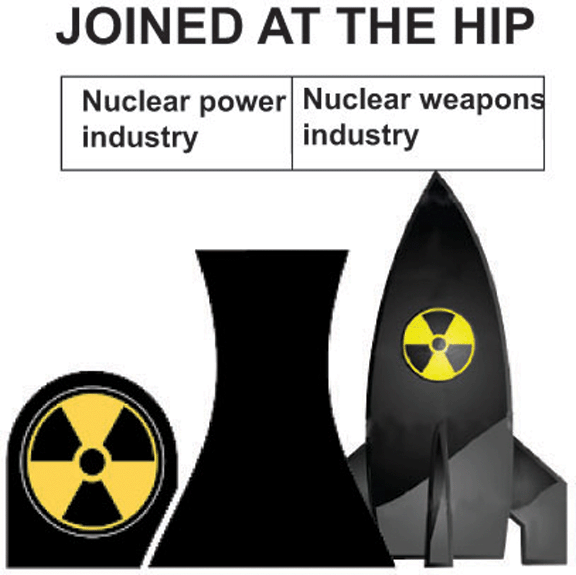
This loss of nuclear competence is being cited by nuclear and national security experts in both the U.S. and in Europe’s nuclear weapons states as a threat to their military nuclear programs. The White House cited this nuclear nexus in a May memo instructing Rick Perry, the Secretary of Energy, to force utilities to buy power from unprofitable nuclear and coal plants. The memo states that the “entire US nuclear enterprise” including nuclear weapons and naval propulsion, “depends on a robust civilian nuclear industry.”
A Double First in China for Advanced Nuclear Reactors, https://spectrum.ieee.org/energywise/energy/nuclear/a-double-first-in-china-for-advanced-nuclear-reactorsBy Peter Fairley 5 July 18 Call it the world’s slowest photo finish. After several decades of engineering, construction flaws and delays, and cost overruns — a troubled birth that cost their developers dearly — the most advanced commercial reactor designs from Europe and the United States just delivered their first megawatt-hours of electricity within one day of each other. But their benefits — including safety advances such as the AP1000’s passive cooling and the EPR’s airplane crash-proof shell — may offer too little, too late to secure future projects.
Both projects are coming online years behind schedule, and they are still at least several months away from full commercial operation. But the real problem for the AP1000 and the EPR are the designs’ unfinished Western debuts.
The AP1000 is designed to passively cool itself during an accidental shutdown, theoretically avoiding accidents like the one at Japan’s Fukushima Daiichi. But AP1000 developer Westinghouse declared bankruptcy last year due to construction troubles, particularly at dual-reactor plants for utilities in Georgia and South Carolina. The latter abandoned their pair of partially built AP1000s after investing US $9 billion. The Georgia plant, initiated in 2012, is projected to be completed five years late in 2022 and at a cost of $25 billion — $11 billion more than budgeted.
Delays for the EPR, whose dual-layered concrete shield protects against airplane strikes, contributed to the breakup of Paris-based nuclear giant Areva in 2015. And the first EPR projects in France and Finland remain troubled under French utility Electricité de France (EDF), which absorbed Areva’s reactor business, Fromatome. The Finnish plant, started in 2005 and expected to take four years, is currently slated for startup next year, and deadlines continue to come and go. In June, Finnish utility Teollisuuden Voima Oyj announced that startup had slid another four months to September 2019.
The troubled EPR and AP1000 projects show that U.S. and European firms have lost competence in nuclear construction and management. ”It’s no coincidence that two of the four AP1000s in the U.S. were abandoned, and that the EPRs that started much earlier than Taishan’s in Finland and France are still under construction,” says nuclear energy consultant Mycle Schneider, principal author of the annual World Nuclear Industry Status Report. “The Chinese have a very large workforce that they move from one project to another, so their skills are actually getting better, whereas European and North American companies haven’t completed reactors in decades,” says Schneider.
This loss of nuclear competence is being cited by nuclear and national security experts in both the U.S. and in Europe’s nuclear weapons states as a threat to their military nuclear programs. The White House cited this nuclear nexus in a May memo instructing Rick Perry, the Secretary of Energy, to force utilities to buy power from unprofitable nuclear and coal plants. The memo states that the “entire US nuclear enterprise” including nuclear weapons and naval propulsion, “depends on a robust civilian nuclear industry.”
A letter sent to Perry last month by 75 former U.S. military, industrial and academic leaders adds to the nexus argument, citing a statement from the Trump Administration’s 2018 Nuclear Posture Review about the United States’ inability to produce enriched uranium for nuclear weapons. “Re-establishing this capability will be far easier and more economical with a strong, thriving civil nuclear sector,” write the signatories.
Heavy dependence on China, meanwhile, puts the global nuclear industry in a vulnerable position. Total nuclear generation declined last year if one takes out China, notes Schneider. And he says a Chinese nuclear growth gap is coming since it hasn’t started building a new reactor in 18 months.
For more than a decade, the AP1000 has been the presumed successor to China’s mainstay reactors, which employ a 1970s-era French design. Areva’s EPR was a fallback option. The Chinese government may now wait to see how the first reactors actually operate before it approves a new wave of reactor construction.
All the while, nuclear is falling further behind renewable solar and wind power. As Schneider notes, the 3.3 GW of new nuclear capacity connected to the grid worldwide in 2017 (including three in China and a fourth in Pakistan built by Chinese firms) pales in comparison to the 53 GW of solar power installed in China alone.
The UK government has been forced to take a multibillion-pound nuclear cleanup contract back into public ownership, after a botched tender to the private sector landed the taxpayer with a £122m bill.
The government will take over the decommissioning of Britain’s 12 Magnox sites, including the former nuclear power stations at Dungeness in Kent and Hinkley Point in Somerset.
The move is a response to the fallout from the Nuclear Decommissioning Authority (NDA) awarding a 14-year deal to the international consortium Cavendish Fluor Partnership in 2014.
Last year the government settled with two US companies that lost out on the £6.2bn contract and brought a legal challenge over the tender process.
Ministers terminated the contract early, leading to speculation over whether it would be put out to tender again to the private sector or brought back into public hands.
David Peattie, the NDA’s chief executive, told staff he understood they had faced uncertainty in recent months, as he confirmed that the private company Magnox Ltd would become a subsidiary of the NDA on 1 September. He said the change would result in “more efficient decommissioning”.
A source close to the process said: “The reason that this has been done is to remove some of the commercial complications and the large fees paid to contractors. This will ensure more money is spent directly on cleaning up these sites.”
Unions said they wanted talks with the new management regime for assurances over pay and terms.
Peter McIntosh, the Unite union’s acting national officer for energy, said: “This decision is long overdue. The 2014 contract should not have been awarded to any organisation.”
He added: “We need to ensure the taxpayer gets value for money through the transfer of the business and it is not paid for at the expense of the workforce.”
Whitehall’s spending watchdog, the Public Accounts Committee (PAC), has strongly criticised the NDA and the Department for Business, Energy and Industrial Strategy over the handling and oversight of the nuclear cleanup contract, one of the government’s biggest ever.
A review of the failings that led to the bungled process, written by the former National Grid boss Steve Holliday, is due to be published later this year.
Bringing the Magnox work back into the public sector means that about 85% of Britain’s nuclear cleanup work is in public hands, after the NDA’s takeover of the Sellafield storage and reprocessing site in 2016.
The PAC last week announced an inquiry into the NDA’s work at Sellafield, which is forecast to be £913m over budget and faces potential delays.
Magnox Ltd looks after 10 former Magnox power stations and two nuclear research sites.
Plans for a controversial multibillion-dollar U.S. nuclear research reactor are coming together at lightning speed—much too fast, say some nuclear policy experts. With a push from Congress, the Department of Energy (DOE) has begun designing the Versatile Fast Neutron Source, which would be the first DOE-built reactor since the 1970s. It would generate high-energy neutrons for testing materials and fuels for so-called fast reactors. But U.S. utilities have no plans to deploy such reactors, which some nuclear proliferation analysts say pose a risk because they use plutonium, the stuff of atomic bombs.
Researchers are divided on whether the reactor, which would likely be built at Idaho National Laboratory (INL) near Idaho Falls, is badly needed or a boondoggle. “Definitely, there is a lack of capability in the U.S. and a shortage of such facilities worldwide,” says Massimiliano Fratoni, a nuclear engineer at the University of California, Berkeley. But Frank von Hippel, a nuclear physicist at Princeton University, says, “It’s a pork-barrel project.”
The reactor does enjoy extraordinary congressional support. In March, Congress gave the project $35 million for this year, although DOE only requested $10 million. The House of Representatives and the Senate have passed separate bills that call for completing the facility by 2025, with the House bill authorizing DOE to spend $2 billion. Von Hippel speculates that the cost could end up reaching $10 billion.