Campaign begins for Fukushima governor race with reconstruction in focus, Oct. 12 FUKUSHIMA
Official campaigning started Thursday for the gubernatorial election in Fukushima Prefecture, with the incumbent governor’s policies on reconstruction work following the 2011 earthquake and nuclear disaster seen as a main issue.
In the governor election which will be held on Oct 28, incumbent Masao Uchibori, 54, is challenged by three candidates — Jun Kanayama, a 78-year-old self-employed worker, Sho Takahashi, a 30-year-old IT company owner, and Kazushi Machida, a 42-year-old prefectural chairman of the Japanese Communist Party.
Although all of the four candidates are running as independents, Uchibori, currently in his first term, gets support from the ruling and opposition parties except for the communist party.
The eastern Japan prefecture is still on the road to recovery from the nuclear meltdown at Fukushima Daiichi power plant, which was crippled by the earthquake-tsunami on March 11, 2011.
“Taking the important missions of the prefecture’s reconstruction and revitalization into consideration, I’ll challenge,” said Uchibori in Fukushima city after filing his candidacy.
Kanayama said he seeks a prefectural administration which “children can be proud of,” while Takahashi appealed for assistance for start-up businesses. Machida called for the complete abolition of all nuclear power plants in Japan.
Belgium’s creaky nuclear reactors raise risk of winter power outages, DW, 10 Oct 18
Belgium is slowly phasing out its aging nuclear energy infrastructure. But looming winter weather, limited renewable options and a poorly connected electricity network have left the country at risk of blackouts.
The Doel 3 nuclear reactor, near the Belgian port of Antwerp, was built in the early 1980s with a design life of four decades. Next week, that creaking reactor will be the only one in Belgium still working — a major blow to the energy security of a country that derives more than half of its electricity from nuclear power.
Belgium’s grid operator Elia said in a statement last week that 700-900 Megawatts (MW) of additional electricity capacity will be needed this winter — down from a previous estimate of about 1,600 MW — if the country is to meet its electricity needs and avoid blackouts.
In addition to managing US nuclear labs, AECOM does billions in business building overseas military bases and maintaining Air Force drones.
By Darwin BondGrahamThe Oakland City Council is considering increasing an existing contract by $420,600 for a total of $1.25 million to repair the 23rd Avenue Bridge, but the modified contract is with AECOM, an engineering company that has been involved in designing and manufacturing nuclear weapons components, and in the past, helped manage a desert test site where nuclear weapons experiments were conducted.
Oakland has an anti-nuclear ordinance that usually bars companies involved in designing and building nukes from doing business with the city. But city staffers are recommending that the council waive the prohibition for AECOM due to the fact that the company, and its URS subsidiary, have been involved with the 23rd Avenue Bridge project since 2003 and finding another firm to do the technical work would be difficult.
The original $229,400 contract form 2003 for design and engineering services was signed when URS was independent from AECOM and before URS was a prime contractor with the U.S. Department of Energy, which oversees the nation’s nuclear weapons programs. But in 2005, URS became part of a consortium of companies that took over management of the Los Alamos National Laboratory, where most of the U.S. military’s nuclear weapons are designed and some weapons parts are manufactured. The next year, URS took over management of the Lawrence Livermore National Laboratory, the nation’s second nuclear weapons design and testing lab.
AECOM bought URS in 2014 and as a result became a partner in the nuclear labs’ management company. Three months ago, the federal government selected a new team to manage the Los Alamos lab, dropping AECOM as one of the firms involved there. But AECOM is still part of the Livermore Lab group.
Prior to this, AECOM helped manage the Nevada National Security Site where nuclear weapons are tested in “subcritical” experiments that don’t result in fission or fusion explosions.
In 2012, Oakland’s City Council increased the contract with URS to work on the 23rd Avenue Bridge to $829,400. But according to the city, “several unforeseen conditions and needed re-design work” require that the contract be increased again to $1.25 million. The funds are mainly state and federal transportation grant dollars.
Morning Star 6th Oct 2018, Alan Simpson: If there are seminal moments in politics, Jeremy Corbyn’s speech at the 2018 Labour conference will go down as one of them.
This was when the planet took centre stage. From the Kerala floods to the Saddleworth moorland fires and from California to Scandinavia, 2018 has been a roller coaster of extreme weather events.
This is the shape of things to come, but it took Corbyn to make “one-planet economics” the centrepiece of tomorrow’s politics. This couldn’t have come at a better moment. The Conservatives are tearing themselves apart, with their crazies loving every moment. We need a better plan.
It was into this maelstrom that Corbyn pitched his leader’s speech — a bold vision, promising that
Labour’s “programme of investment and transformation, to achieve a 60
per cent reduction in emissions by 2030, will create over 400,000 skilled
jobs.” Pretty unequivocal stuff. But that is just the start. Shadow
chancellor John McDonnell was no less uncompromising. The next government
will have to deliver carbon reductions of 15 per cent per year. To do so,
Britain will need a much more circular economics — not one that makes do
with less but one that certainly wastes and pollutes less.
And as Corbyn stressed, it is in “green jobs” that tomorrow’s transformative
economics will be rooted. For most people, a more circular economy would
deliver real improvements in their quality of life — from the air we
breathe, the food we eat, the homes we live in to the jobs and skills the
country needs.
This will come not just in the accelerated shift into
renewable energy but in using less energy in the first place. Tackling the
scandal of “cold homes” will save lives as well as cutting carbon.
Clean transport systems offer the same opportunities. These are a world
away from the triple absurdity of the GMB trade union sharing a platform
with the Taxpayers Alliance at the Tory Party conference in support of
fracking.
The radiation regulation is supported by Steven Milloy, a Trump transition team member for the EPA who is known for challenging widely accepted ideas about manmade climate change and the health risks of tobacco. He has been promoting Calabrese’s theory of healthy radiation on his blog.
the EPA proposal on radiation and other health threats represents voices “generally dismissed by the great bulk of scientists.”
“The individual risk will likely be low, but not the cumulative social risk,
Turning to scientific outliers, EPA says a little radiation may be healthy, WIVN.com, By:CBS/AP Oct 07, 2018 The Trump administration is quietly moving to weaken U.S. radiation regulations, turning to scientific outliers who argue that a bit of radiation damage is actually good for you — like a little bit of sunlight.
The government’s current, decades-old guidance says that any exposure to harmful radiation is a cancer risk. And critics say the proposed change could lead to higher levels of exposure for workers at nuclear installations and oil and gas drilling sites, medical workers doing X-rays and CT scans, people living next to Superfund sites and any members of the public who one day might find themselves exposed to a radiation release.
The Trump administration already has targeted a range of other regulations on toxins and pollutants, including coal power plant emissions and car exhaust, that it sees as costly and burdensome for businesses. Supporters of the EPA’s new proposal argue the government’s current no-tolerance rule for radiation damage forces unnecessary spending for handling exposure in accidents, at nuclear plants, in medical centers and at other sites.
“This would have a positive effect on human health as well as save billions and billions and billions of dollars,” said Edward Calabrese, a toxicologist at the University of Massachusetts who is to be the lead witness at a congressional hearing Wednesday on EPA’s proposal. “The regulatory agencies are kind of a cult, but they don’t know they’re part of a cult.”
Calabrese, who made those remarks in a 2016 interview with a California nonprofit, was quoted by EPA in its announcement of the proposed rule in April. He declined repeated requests for an interview with The Associated Press. The EPA declined to make an official with its radiation-protection program available……….
As recently as this March, the EPA’s online guidelines for radiation effects advised: “Current science suggests there is some cancer risk from any exposure to radiation.”
“Even exposures below 100 millisieverts” – an amount roughly equivalent to 25 chest X-rays or about 14 CT chest scans – “slightly increase the risk of getting cancer in the future,” the agency’s guidance said.
But that online guidance – separate from the rule-change proposal – was edited in July to add a section emphasizing the low individual odds of cancer: “According to radiation safety experts, radiation exposures of …100 millisieverts usually result in no harmful health effects, because radiation below these levels is a minor contributor to our overall cancer risk,” the revised policy says.
Calabrese and his supporters argue that smaller exposures of cell-damaging radiation and other carcinogens can serve as stressors that activate the body’s repair mechanisms and can make people healthier. They compare it to physical exercise or sunlight.
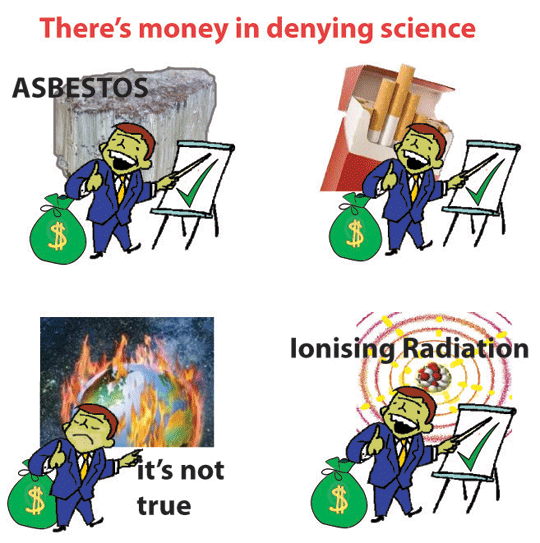
Mainstream scientific consensus on radiation is based on deceptive science, says Calabrese, who argued in a 2014 essay for “righting the past deceptions and correcting the ongoing errors in environmental regulation.”……..
The radiation regulation is supported by Steven Milloy, a Trump transition team member for the EPA who is known for challenging widely accepted ideas about manmade climate change and the health risks of tobacco. He has been promoting Calabrese’s theory of healthy radiation on his blog.
But Jan Beyea, a physicist whose work includes research with the National Academies of Science on the 2011 Fukushima nuclear power plant accident, said the EPA proposal on radiation and other health threats represents voices “generally dismissed by the great bulk of scientists.”
The EPA proposal would lead to “increases in chemical and radiation exposures in the workplace, home and outdoor environment, including the vicinity of Superfund sites,” Beyea wrote.
At the level the EPA website talks about, any one person’s risk of cancer from radiation exposure is perhaps 1 percent, Beyea said.
“The individual risk will likely be low, but not the cumulative social risk,” Beyea said.
“If they even look at that – no, no, no,” said Terrie Barrie, a resident of Craig, Colorado, and an advocate for her husband and other workers at the now-closed Rocky Flats nuclear-weapons plant, where the U.S. government is compensating certain cancer victims regardless of their history of exposure.
“There’s no reason not to protect people as much as possible,” said Barrie.
U.S. agencies for decades have followed a policy that there is no threshold of radiation exposure that is risk-free.
The National Council on Radiation Protection and Measurements reaffirmed that principle this year after a review of 29 public health studies on cancer rates among people exposed to low-dose radiation, via the U.S. atomic bombing of Japan in World War II, leak-prone Soviet nuclear installations, medical treatments and other sources.
Twenty of the 29 studies directly support the principle that even low-dose exposures cause a significant increase in cancer rates, said Roy Shore, chief of research at the Radiation Effects Research Foundation, a joint project of the United States and Japan. Scientists found most of the other studies were inconclusive and decided one was flawed.
None supported the theory there is some safe threshold for radiation, said Shore, who chaired the review. If there were a threshold that it’s safe to go below, “those who profess that would have to come up with some data,” Shore said in an interview.
“Certainly the evidence did not point that way,” he said……..
Public Enquiry 6th Oct 2018 Dr Keith Barnham goes through some of the terminal problems at the Hinkley
C nuclear power station site
– ‘Radioactive mud’ test have been for gamma radiation, not alpha which shows up plutonium
– Economics of nuclear no longer viable
– Bridgwater Bay tidal lagoon would produce an equivalent amount of electricity
– France and China are not building any more nuclear power but have industries which are looking to expand anywhere guillible enough to take them
– Tory government have put the brakes on renewable energy to artificially prop up the dying nuclear industry
– this is a project the nuclear industry want, but nobody else does. Activists call for halt to ‘nuclear mud’ dumping off Wales. Campaigners say sediment has not been tested properly and may do ‘irreversible harm’ Among those backing
the objectors is the Emeritus Prof Keith Barnham, a distinguished research fellow in the physics department at Imperial College London, who argues it is possible that large amounts of uranium and dangerous levels of plutonium could have reached the mud when cooling water from the decommissioned Hinkley Point A was discharged. https://www.youtube.com/watch?v=fL5mnD6HrzA&feature=youtu.be
CAN SMALL DOSES OF RADIATION HARM YOU? THE EPA ISN’T CONVINCED. A new rule might open the door for regulation rollbacks on radiation and harmful chemicals. Pacific Standard EMMA SARAPPO OCT 3, 2018
On Tuesday, the Associated Press reported that the Trump administration was quietly seeking to roll back the Environmental Protection Agency’s regulations on radiation exposure. The story took a closer look at a rule the EPA proposed back in April called “Strengthening Transparency in Regulatory Science.” When it was released, most coveragefocused on the proposal’s potential limitation of what studies the EPA could and could not use in decision-making—it essentially demanded the EPA not use any studies based on data that isn’t publicly available.
Ironically, the transparency rule is hiding another agenda. Paragraphs scattered throughout the document make it clear that the proposed rule is meant to re-evaluate the science behind “the dose response data and models that underlie what we are calling ‘pivotal regulatory science.'” That jargon means the EPA wants to challenge the assumptions that underlie its current guidelines on toxic exposure.
“The so-called transparency rule is an insidious dodge,” said Rush D. Holt, a former congressman and current president of the American Association for the Advancement of Science, before a Senate subcommittee on October 3rd. “It apparently is about reducing regulation.” And though the actual rule is vague, comments in the press release and a July update to the EPA guidelines on radiation exposure make it seem that nuclear regulation is on the chopping block.
Currently, the nuclear industry, the EPA, and other groups operate on the assumption that there is no safe dose of radiation, no matter how small. This is based on the “linear no-threshold” model (LNT). The LNT model is based on studies of people exposed to high and medium doses of radiation, including survivors of Hiroshima, Chernobyl, and Fukushima. That data shows that the higher the dose of radiation you receive, the more severe the consequences—in other words, that the response to doses is linear. The more radiation, the more health effects.
Because it’s much harder to accurately measure small doses of radiation in large populations over long periods of time, there isn’t much data available on the lower end. Still, most scientists agree that the relationship stays the same for small amounts of ionizing radiation: Small doses increase the aggregate risk of cancer by a relatedly small amount. LNT’s prevalence pushes regulatory agencies, professional associations, and medical fields to keep radiation doses “as low as reasonably achievable” in all people, especially considering some groups (children, especially) are more vulnerable to radiation than others.
……..in a larger public-health sense, LNT is cautious and prudent. Just because there isn’t documented proof of harm at very low doses doesn’t mean harm isn’t being done, and an inaccurate model means that it’s also possible that LNT sometimes underestimates cancer risks from low doses. In the absence of more definitive data, multiple groups and studies—the National Academy of Sciences, the International Commission on Radiological Protection, and more—have recommended holding fast to regulations that keep radiation exposure as low as possible, at least until a new model is robustly tested and accepted.
Others go even further and argue that small doses of radiation are good for you. Edward Calabrese, a professor at the University of Massachusetts, is quoted in the April EPA press release—he was glad the agency was “recognizing the widespread occurrence of non-linear dose responses,” and he appeared in the October 3rd Senate hearing on the rule.
Calabrese is a major critic of the LNT model. He is famous for championing “hormesis”—the idea that small amounts of radiation are beneficial, or “hormetic,” ………
Although Calabrese focused on more mainstream criticisms of LNT before the Senate, his hormesis work is controversial. In 2010, Kristin Shrader-Frechette used Calabrese’s work as a case study of “special-interest science.” Shrader-Frechette compares Calabrese and others to the Queen of Hearts in Lewis Carroll’s Through the Looking Glass. “Just as the Queen claimed she could believe six impossible things before breakfast, SIS proponents often use scientific concepts/methods in ways that are ‘impossible,'” she wrote. She points out that Calabrese’s CV shows significant research funding from Atlantic Richfield Oil (ARCO), Dow Chemical, ExxonMobil, Proctor and Gamble, and R.J. Reynolds Tobacco. And despite Calabrese’s nearly 20 years of advocacy for the theory, even friendly reviews indicate radiation hormesis needs further scientific support.
……the rule promises to give special consideration to studies exploring “various threshold models across the exposure range” and pledges to “evaluate the appropriateness” of using the LNT model. If it’s approved, the EPA’s accepted scientific standard for acceptable radiation doses could change from “as low as reasonably achievable” to a standard that identifies no effect or positive effects from low doses. That could lead to the repeal of strict regulations on radiation containment, which the EPA might deem unnecessary. https://psmag.com/news/can-small-doses-of-radiation-harm-you-the-epa-isnt-convinced
Make nuclear waste site Ottawa Valley election issue: coalition https://www.insideottawavalley.com/news-story/8948934-make-nuclear-waste-site-ottawa-valley-election-issue-coalition/ NEWS Oct 05, 2018 by John Carter Arnprior Chronicle-Guide A group of concerned citizens is making a concerted effort to make the proposed nuclear waste disposal at Chalk River an election issue throughout Renfrew County, especially those municipalities along the Ottawa River.The informal alliance that also includes Ottawa Riverkeeper, the Coalition Against Nuclear Dumps on the Ottawa River and two cottagers groups, has sent a lengthy letter to each municipal candidate, spelling out “major concerns” about the plan. The groups stress they’re not advocating the closure of Chalk River nuclear laboratories but want changes to proposals on how and where radioactive nuclear waste is to be disposed.
It asks candidates to support efforts to petition the federal government to move the proposed radioactive nuclear disposal site “much farther away” from the Ottawa River and to use more-secure containment methods.
“Your constituents are very worried that large amounts of radioactive waste could contaminate the Ottawa River if these plans are not changed,” says the letter. That would affect the drinking water of millions of people.
The letter points out the contract includes the requirement to “seek the fastest, most cost-effective means” to dispose of all the radioactive waste that has been accumulating at Chalk River and other federal nuclear sites. The contract also includes decommissioning and entombing the nuclear reactor at Rolphton, which the coalition calls inappropriate.
The letter says the proposed 27-acre containment “mound” will contain up to one million cubic metres of radioactive nuclear waste, including materials transported in from other Canadian decommissioned nuclear sites. It is to be covered over by a combination of sand, stone, gravel and topsoil that could reach about 25 metres high.
The coalition is particularly concerned because the location is directly over an active earthquake zone, above porous and fractured rock, and less than a kilometre from the Ottawa River. It is beside a small lake that drains directly into the Ottawa River through a small creek, the letter points out.
The letter says the danger is exacerbated if the mound is left uncovered for more than 50 years, as planned. Furthermore, “climate change brings unpredictable, catastrophic weather that could cause permanent radioactive contamination of the Ottawa River,” the letter adds.
It suggests retired Atomic Energy of Canada Ltd. (AECL) senior nuclear scientists have raised serious concerns about the proposal. It quotes Dr. J.R. Walker as saying it “employs inadequate technology and is problematically located” and “does not meet regulatory requirements with respect to the health and safety of persons and the protection of the environment.”
The letter urges candidates, if elected, to introduce resolutions questioning the process and opposing the waste proposals as they currently stand, as well as the importation of nuclear waste to Chalk River from other locations “as more than 135 municipalities in Ontario and Quebec have already done.”
What does the UK’s nuclear future look like?,By Chris MasonPolitical correspondent, BBC News, 5 October 2018
Six months out from Brexit, how are those involved with the UK’s nuclear sector viewing the prospect?
The area around the Sellafield nuclear plant in Cumbria is the heartland of the UK’s nuclear industry…….. The word that sums up what everyone told us is “uncertainty”, but a particular kind of uncertainty, grounded in the history of this industry.
Months after Calder Hall opened, the Euratom Treaty established the European Atomic Energy Community. The UK did not formally join straight away but did have a relationship with it.
Euratom oversees nuclear research, sets the rules on where nuclear material is and how it is moved around. It knows, for instance, exactly how much spent uranium is in a storage pond at Sellafield.
But the government has decided leaving the European Union means leaving Euratom, and that is likely to mean potentially huge changes to the way nuclear businesses operate.
Mr Coughlan fears losing out on nuclear decommissioning orders from elsewhere in Europe, especially from Germany and Sweden.
“Once we are out, and no longer part of Euratom, it means we will not be able to participate in those markets,” he says. “The negotiations have been pretty disastrous for the UK,” says Sue Ferns, deputy general secretary of the Prospect trade union, who adds that current “uncertainty” over Brexit negotiations is damaging.
It’s that word again.
So, given such concern, why is the UK leaving Euratom?
After all, former government adviser Dominic Cummings, a leading advocate of Brexit, has described ministers as “morons” for advocating withdrawal from the organisation.
The House of Lords also tried to force the government to keep the UK in Euratom.
The crux of the government’s opposition is the way Euratom itself is overseen by the European Court of Justice (ECJ). The prime minister insists this cannot happen – the UK cannot be subject to the decisions of a foreign court.
The government argues a central driving motivation for Leave voters was the desire to, as the slogan put it, “take back control”, meaning there can be no role for the ECJ.
Instead, ministers say, they will reach alternative arrangements with the EU, and have speeded up arriving at nuclear co-operation agreements with other countries worldwide.
But what do those who work for Euratom have to say about this big change?
Dame Sue Ion, who chairs Euratom’s Science and Technology Committee, says the UK has a lot of world-class expertise and creating new post-Brexit arrangements has meant a huge extra burden of unnecessary work.
She feels that ministers must “keep their foot on the gas pedal” to ensure international nuclear co-operation agreements after Brexit are as broad-based as possible.
The government has set out its plans for the nuclear sector in the event of no deal with the EU. A law has already been passed so that the Office for Nuclear Regulation in the UK, which already exists, could oversee “domestic safeguards” instead of Euratom. New agreements have also been signed with the International Atomic Energy Agency to replace the existing agreements between it, Euratom and the UK.
We understand bringing jobs to the state has been the governor’s chief priority and achievement, and it is one economic benefit of the project. But utility customers should only have to pay for their electric power, not a jobs program without end or limits on how much is spent.
The project, the nation’s only nuclear plant construction still ongoing, is already a year overdue, nowhere near finished and $1 billion overbudget. final cost is expected to reach near $27 billion, more than twice the original $13 billion price tag. Last year’s bankruptcy filing of the project’s lead contractor, Westinghouse, set the deadline back even further.
Yet late last year, the Georgia Public Service Commission fended off pressure from ratepayers and anti-nuclear advocates and voted to back Georgia Power’s request to continue the work.
But now, after years of seemingly exhaustive support for an enterprise with no limits, some are finally fed up enough to say no.
The most recent and crucial rebellion came recently from one of the project’s partner utilities. Oglethorpe Power threatened to pull out of the reactor construction if some effort wasn’t made to ease its financial commitment. Oglethorpe is one of three smaller electric membership corporations that serve as junior partners in the project along with Georgia Power and its parent, the Southern Company.
But though Georgia Power is a for-profit with shareholders to help shoulder the costs, smaller EMCs don’t have that flexibility and must make their customers bear the funding burden.
Oglethorpe balked at reaffirming its partnership and argued its case to lawmakers for relief. They seemed to find sympathetic ears, with 20 legislators, including Hall County Sen. Butch Miller and other influential leaders, urging the partners to consider a cap on the project’s costs before more losses are passed on to consumers.
The new deal doesn’t exactly do that, but it does to ensure that further cost overruns will be shared more equitably among Georgia Power and the owners of the project — Georgia Power, Oglethorpe Power, the Municipal Electric Authority of Georgia and Dalton Utilities. Specifically Georgia Power must take on a greater portion of future deficits.
Yet even with a somewhat more reasonable deal for the owners, it could still leave ratepayers on the hook for the extra costs as the project wobbles toward the finish line.
“We’re very concerned about today’s announcement because it’s clear the Plant Vogtle nuclear project is in serious trouble if this much arm twisting is necessary to keep all four partners at the table,” Stephen Smith, executive director of Southern Alliance for Clean Energy said in an emailed statement.
Liz Coyle, executive director of consumer advocate Georgia Watch, said it “appears the owners have decided to plow ahead with a project that holds continued uncertainty and certainly clear risk of major cost increases and very little, if any true protections for Georgia’s electric customers.”
It’s worth noting that in addition to those who see the reactor construction as an endless money pit, others object over the viability and safety of nuclear power as a long-term solution to ease off carbon-based fuels.
Defenders of the Vogtle reactors argue that the jobs it creates in that part of the state justify its support. Among them is Gov. Nathan Deal, who urged Oglethorpe to stay with construction plans “before walking away from 7,000 Georgia jobs.”
We understand bringing jobs to the state has been the governor’s chief priority and achievement, and it is one economic benefit of the project. But utility customers should only have to pay for their electric power, not a jobs program without end or limits on how much is spent.
Oglethorpe’s resistance to continuing without some guarantees was timely and needed, but it’s only the first step. The only way to ensure customers won’t have to keep paying more is if legislators insist on the cost caps they suggested. Perhaps that would accomplish what the Public Service Commission has thus far been unwilling or unable to do to rein in cost overruns.
Remember, that five-member board voted unanimously last year to allow the utilities to keep charging customers for its boondoggle. It fits the profile of a state agency that over the years has seldom met a rate hike it wouldn’t rubber-stamp for utilities, many of which provide campaign donations to its members.
Yet Georgians do get a say in how this plays out. There’s a statewide election in less than a month and two PSC seats are on the ballot. Perhaps if commissioners got a message from voters making it clear they’re tired of footing the bill, the board wouldn’t be as eager to keep signing off on this and other costly ventures.
Customers of Georgia Power and its partner EMCs already have paid more than their fair share to get the reactors on line. Even if the plant is finished and begins turning out electrical power, it will take years to recoup what has been invested. It’s time to unplug ratepayers from the burden and let the big corporation’s shareholders take that responsibility.
Even the strongest advocates for nuclear power as a replacement for carbon-based energy have to understand there isn’t an endless supply of construction money in the pockets of Georgia utility consumers.
Akkuyu nuclear plant construction site holds Open Doors Day MERSİN, 7 Oct 18 The AkkuyuNuclear Power Plant, whose construction was launched in April in a groundbreaking ceremony, opened its doors on Oct. 6 for the first time.
…..President Recep Tayyip Erdoğan and his Russian counterpart VladimirPutin launched the construction of the Akkuyu plant at a ceremony in Ankara in early April.
…….“In 2023, we will put the first unit into operation and Turkey will thereby join those countries that use nuclear energy … On the anniversary of our republic, we will crown this work with success,” Erdoğan said.
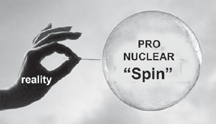
A week or so earlier, a pro-nuclear lobby group, New Nuclear Watch Institute, which masquerades as a think tank, issued a tendentiously inaccurate 34 page report, arguing that new nuclear is essential to meet carbon emission reduction targets. It was reported in The Guardian
In response I wrote this unpublished letter, below, correcting certain factual mistakes:
Here we go again! Your energy editor’s on line article (“Abandoning nuclear power plans ‘would push up carbon emissions,” 26 Sept) reports lobby group the New Nuclear Watch Institute as claiming nuclear power is both low carbon and its alternatives “ will raise the cost of electricity.
All the robust evidence demonstrates the opposite in both cases. Just over a year ago you published a letter from me challenging the low or even zero carbon claims of nuclear ( “Beware nuclear industry’s fake news on being emissions free,”17 Sept 2017;www.theguardian.com/environment/2017/sep/17/beware-nuclear-industrys-fake-news-on-being-emissions-free)
In my letter from a year ago, I pointed out I had challenged this nuclear low carbon myth in your columns 12 years earlier. (“There is nothing green about Blair’s nuclear dream, “ 20 October 2005<https://www.theguardian.com/politics/2005/oct/20/greenpolitics.world.
I said in my letter a year ago “It is about time this dangerous falsehood was confined to the dustbin of history.”
Sadly it seems, like Freddy, it seems it is going to be resurrected each mellow autumn!
Here are some of the more egregiously challengeable extracts from the report……..
The bill reinforces the administration’s efforts to revitalize the U.S. nuclear industry. GreenTech Media
JULIA PYPEROCTOBER 01, 2018“…….On Friday, President Trump signed the Nuclear Energy Innovation Capabilities Act (NEICA), which passed earlier last month with bipartisan support. The bill is expected to speed up the development of advanced reactors in the U.S. by eliminating several of the financial and technological barriers standing in the way of nuclear innovation…….
NEICA was designed to foster collaboration between the public and private sectors, building on relationships formed under the Department of Energy’s Gateway for Accelerated Innovation in Nuclear program. To help offset upfront costs, the bill calls for a cost-share grant program to cover a portion of the licensing fees charged by the U.S. Nuclear Regulatory Commission during its new technology review process.
It also directs the DOE to facilitate the siting of advanced reactor research demonstration facilities through partnerships with private industry.
On the technical side, the legislation requires DOE to develop a fast test reactor, or fast neutron source, used for testing advanced reactor fuels and materials. The U.S. doesn’t currently have this capability.
In addition, DOE must expand its high-performance computing expertise by focusing on the modeling and simulation of advanced nuclear reactors. “The national labs, universities and private sector will help develop new software and tools for developers to use to speed up their research on fission and fusion reactors, in addition to space applications,” according to the DOE announcement.
Nuclear power advocates pushed for several of these reforms in a recent policy paper.
Energy Secretary Rick Perry now has 180 days to provide Congress with a report assessing the ability to host and operate experimental advanced nuclear reactors at the national labs or other DOE sites. He must also submit two 10-year budget plans for nuclear R&D.
The renewed focus on advanced nuclear technology builds on the Trump administration’s support for traditional nuclear power plants. Last fall, Secretary Rick Perry introduced a planto shore up power plants with 90 days of fuel on site — something only nuclear and coal plants can provide. But that proposal was ultimately rejected by the Federal Energy Regulatory Commission.
In June, the White House issued a new order for Secretary Perry to stem the loss of existing nuclear and coal power resources. A leaked memo revealed the administration is working on a new plan to offer guaranteed profits for nuclear and coal plants, leveraging emergency authorities.
Hornepayne, Ont., municipal election to become debate on nuclear waste, Community one of three in northwestern Ontario to consider hosting nuclear waste Jeff Walters · CBC NewsOct 04, 2018 Voters in the small northwestern Ontario town of Hornepayne will have more to consider at the ballot box than tax rates and economic growth.
The township of 1,000 located between Highways 11 and 17 is in the running to host a nuclear waste repository. It’s one of three in northwestern Ontario, the others being Manitouwadge and Ignace.
Aison Morrison organized a walk this summer to demonstrate against hosting the toxic waste and is now running for town council.
The thought of having a burial area near her family camp, about 20 kilometres from town, caused Morrison to become more vocal in her opposition…….Nearly all of the communities in northwestern Ontario who have shown an interest in hosting the facility, including those no longer in the process, had fallen on hard economic times. Many had lost their primary industry, be it a sawmill or mine.
Morrison said she fears the Nuclear Waste Management Organization (NWMO) will use its counts of ‘engagements’ as a sign the community supports the site – which she believes the silent majority does not.
Ken Fraser, who is also running for Hornepayne town council, believes the major motivator for the site is financial.
He said the community has received about $1.3 million in funding from the NWMO, and continues to get about $300,000 annually which supports community events, including Canada Day celebrations and the local fish derby…….Morris and Fraser both hope a victory at the ballot box will mean they can change the current direction of how council feels about hosting nuclear waste. https://www.cbc.ca/news/canada/thunder-bay/hornepayne-nuclear-waste-2018-election-1.4849106
The municipal election is October 22.
Fraser said the population of the town, just under 1,000 people, should not be ‘bought’ at any cost.
“And over an eight year period, that’s what it comes out to, 49 cents. So, they divided a town, they’ve actually, you have family fighting, friends fighting friends for 49 cents a day.”







 Months after Calder Hall opened, the Euratom Treaty established the European Atomic Energy Community. The UK did not formally join straight away but did have a relationship with it.