Wales national assembly to debate motion to stop the dumping of mud from Hinkley nuclear station
 Welsh leaders urged to halt ‘nuclear mud’ dumping off Cardiff, Sediment from Hinkley Point C construction site is being disposed of at Cardiff Grounds, Guardian, Steven Morris @stevenmorris20– 2 Oct 2018 Pressure is increasing on the Labour-led Welsh government to halt the dumping of “nuclear mud” in the sea close to Cardiff after a campaign by an eclectic group of scientists, surfers and a pop star.
New Jersey’s electrical utilities lobbying for nuclear subsidies
 UTILITIES SUBMIT PROPOSALS FOR NUCLEAR SUBSIDIES, NJ Spotlight TOM JOHNSON | OCTOBER 3, 2018
While some residential customers may end up paying $30 more annually, large energy users may see their bills rise by $1 million a year.
It will be months before the state decides whether customers need to subsidize nuclear power, but New Jersey’s four electric utilities are already proposing how they will recover those costs.
In filings with the Board of Public Utilities, each of the utilities submitted tariffs disclosing how they will recoup the cost of buying Zero Emission Certificates (ZECs), the potential $300 million annual subsidy aimed at propping up the state’s supply of nuclear power.
The proposals are the latest in a series of filings that could boost bills to customers by billions of dollars if approved by the regulatory agency, most stemming from two bills signed into law this spring that will transform energy policy in New Jersey.
PSEG threatened to shut down units in South Jersey
The most contentious bill involved proposed subsidies to avert the closing of the three remaining nuclear power plants in New Jersey. Without financial incentives, Public Service Enterprise Group threatened to shut down the units it operates in South Jersey……
Is it a done deal?
“It gives the appearance of being a fait accompli,’’ said Doug O’Malley, director of Environment New Jersey, part of a coalition that opposed the nuclear bill. “The ZEC tariffs give the appearance that it is a done deal.’’
The board must still approve the tariffs, as well as any application by a nuclear-plant owner for the subsidy.
The proposed surcharge is established by the bill signed by Gov. Phil Murphy, but the tariffs submitted to the BPU vary on how much customers will pay depending on what customer class they’re in……..
Stefanie Brand: ‘It all adds up’
“The numbers appear small, but in fact they are quite large,’’ said Steve Goldenberg, an attorney representing large energy users. When you multiply the change by a whole lot of kilowatt hours, you derive a very large number.’’
The annual costs for some large energy users will exceed $1 million, Goldenberg said. “The lowest I’ve heard is $300,000.’’
Others worry the potential subsidies, when added to other costs that are pending before the BPU, or recently approved, will be a huge hit to ratepayers.
“It all adds up,’’ said Stefanie Brand, director of the Division of Rate Counsel. PSE&G has more than $10 billion in proposed rate increases pending before the BPU, if a recent $1.9 billion gas modernization program is included, Brand said.
Those cases include $2.5 billion to improve the resilience of its electric and gas distribution system; a $4 billion clean-energy initiative filed last Friday, and the proposed nuclear subsidy.
“The fact is there is no way to spend $10 billion and not have it be very expensive to ratepayers,’’ Brand said…….https://www.njspotlight.com/stories/18/10/02/utilities-submit-proposals-for-nuclear-subsidies/
Nuclear power advocate nominated to Federal Energy Regulatory Commission
Key Backer of Trump’s Coal and Nuclear Bailout Effort Is Nominated to FERC https://www.greentechmedia.com/articles/read/key-backer-of-trumps-coal-and-nuclear-bailout-effort-is-nominated-to-ferc#gs.gyTRPcM
 Bernard McNamee could soon sit on the commission that unanimously rejected a DOE coal and nuclear bailout plan he has championed.
Environmental groups were quick to decry McNamee’s choice to replace outgoing Commissioner Ron Powelson, a Republican who nonetheless voted last year with the rest of the commission to deny Energy Secretary Rick Perry’s proposal for FERC to use its authority to create out-of-market payments for coal and nuclear power plants.
McNamee, by contrast, worked on this proposal as DOE’s deputy general counsel for energy policy and defended it in a Senate hearing this year as head of DOE’s Office of Policy. He has also defended the department’s ongoing efforts to demand out-of-market payments for coal and nuclear power plants, using federal laws intended to keep critical infrastructure running in times of national emergency.
These efforts have been roundly decried by environmental groups, state and federal regulators including many former FERC commissioners, consumer advocates, and the natural gas, solar, wind and energy efficiency industries. They’ve also been undermined by data from mid-Atlantic grid operator PJM, which has reported no threats to grid reliability from the impending closures of several coal and nuclear plants in its territory .
These power plants belong to FirstEnergy, the utility that in March asked DOE to use its emergency power to prop up its now-bankrupt generation unit. DOE’s plan was also influenced by Perry’s association with coal company CEO and owner Robert Murray, an outspoken financial supporter of Donald Trump’s presidential campaign, whose company sells much of its coal to FirstEnergy’s plants.
DOE hasn’t made its plans public — they were revealed via a leak of a supporting document in June — which makes it difficult to assess how they would affect energy markets. But forcing utilities to buy power from the power plants likely to be supported could raise costs for U.S. consumers by billions of dollars per year. Preliminary estimates range from the American Coalition for Clean Coal Electricity’s projection of about $4 billion per year, to The Brattle Group’s estimate of between $9.7 billion and $17.2 billion per year.
Unlike Powelson, who previously served as a utility executive and Pennsylvania utility regulator before being appointed to FERC, McNamee is an attorney who’s worked for the attorneys general of Texas and Virginia and for Senator Ted Cruz (R-Texas), as well as for anti-regulation think tanks.
His nomination, first floated as a possibility by Politico in August, has largely been seen as the Trump administration’s efforts to get a reliable pro-coal and nuclear vote on FERC.
“The selection is not at all unanticipated, as Powelson’s departure was widely seen as opportunity for the White House to more closely align FERC with its own policies,” Jason Johns, a partner at the law firm Stoel Rives, wrote in a Wednesday email. “It is my belief that Powelson’s opposition to certain policy efforts came as a surprise to the White House, particularly the White House’s efforts to subsidize coal and nuclear facilities. I’m confident the White House is looking to address those surprises with this choice.”
John Moore, director of the Natural Resources Defense Council’s Sustainable FERC Project, noted that “McNamee’s past writings and career track record suggest that he would seek every opportunity possible to support fossil fuels. […] He should be prepared to answer some very hard questions about his previous comments and positions, and how they would affect FERC independence” during his Senate confirmation hearings.
Mary Anne Hitt, senior director of Sierra Club’s Beyond Coal campaign, called McNamee “a political plant for Energy Secretary Rick Perry and Donald Trump. Collectively, they are trying to use FERC to manipulate America’s electricity markets to bail out dirty and expensive coal plants that are heading toward retirement, while locking in a fossil fuel future for communities across the country.”
New Jersey preparing to bail out uneconomic nuclear power plants
NJ BPU set to move ahead with nuclear subsidy application process, By Daniel J. Munoz, NJBIZ October 4, 2018 The state’s public utilities board is set to begin the process for determining which nuclear power plants should receive ratepayer subsidies to stay afloat.
Known as the zero emissions certificate (ZEC) program, $300 million of subsidies would be paid through an additional surcharge on ratepayers bills, and nuclear power plant operators can apply for a piece of the pie.
The ZEC program was enacted with Gov. Phil Murphy’s signing of Senate Bill 2313 in May.
Thursday evening in Hackensack, the board will hold the first of three public sessions to gather testimony on how it will structure the application process. The board will hold additional hearings in Atlantic City on Oct. 10 and in New Brunswick on Oct. 11.
The BPU is scheduled to unveil the program recipients in April……….
The state’s largest utility, Public Service Enterprise Group, threatened to shut down its South Jersey Salem and Hope Creek nuclear power, if it did not receive the subsidies.
PSEG argued that the plants were losing money and could not stay afloat without the ZEC subsidies.
On Aug. 29, the BPU sent out a letter regarding the ZEC program’s implementation to the state’s largest electric companies: PSEG, Jersey Central Power & Light Co., Rockland Electric Co. and Atlantic City Electric Co. The letter was also sent to the New Jersey Rate Counsel and Butler Power & Light.
But the ZEC program has fallen under disapproval by New Jersey’s environmental activists.
Jeff Tittel, president of the environmental advocacy group the New Jersey Sierra Club, said the program is a subsidy to PSEG and other nuclear plant operators at the expense of ratepayers.
“We need to pass legislation that supports renewable energy like feasible solar and wind projects. Instead, they went ahead with this package that is nothing but greencover for the largest subsidy in state history,” Tittel said in a statement. http://www.njbiz.com/article/20181004/NJBIZ01/181009914/nj-bpu-set-to-move-ahead-with-nuclear-subsidy-application-process
Small Modular Nuclear Reactors – their developers demand $billions from UK tax-payers
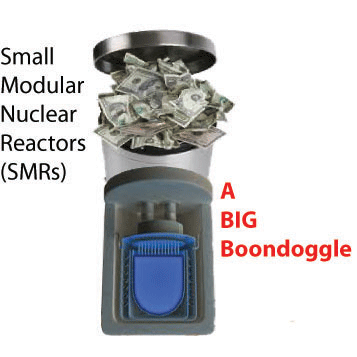 Energy firms demand billions from UK taxpayer for mini reactors Ministers under pressure to fund new generation of small-scale nuclear power stations,Guardian, Adam Vaughan Energy correspondent @adamvaughan_uk, 1 Oct 2018 Backers of mini nuclear power stations have asked for billions of pounds of taxpayers’ money to build their first UK projects, according to an official document.
Advocates for small modular reactors (SMRs) argue they are more affordable and less risky than conventional large-scale nuclear plants, and therefore able to compete with the falling costs of windfarms and solar power.
But the nuclear industry’s claims that the mini plants would be a cheap  option for producing low-carbon power appear to be undermined by the significant sums it has been asking of ministers.
Some firms have been calling for as much as £3.6bn to fund construction costs, according to a government-commissioned report, released under freedom of information rules. Companies also wanted up to £480m of public money to help steer their reactor designs through the regulatory approval process, which is a cost usually paid by nuclear companies.
Ten companies hoping to build the plants requested direct government funding, according to the briefing paper by the Expert Finance Working Group on Small Reactors. While the report named the companies involved in the mini nuclear projects, it did not specify who was asking for
David Lowry, a nuclear policy consultant who obtained the document, said: “SMRs are either old, discredited designs repackaged when companies see governments prepared to throw taxpayers’ subsidies to support them, or are exotic new technologies, with decades of research needed before they reach commercial maturity.”
The working group that drafted the report, and was appointed by the Department for Business, Energy and Industrial Strategy (BEIS), urged the government in August to put in place a framework to help bring the smaller plants to market.
The government has already offered £44m of funding for research and development of one group of SMRs, which typically have a capacity of less than a tenth of the Hinkley Point C nuclear plant being built in Somerset, or enough power for 600,000 homes.
Mini nuclear power stations are unlikely to supply clean energy to Britain’s homes and businesses any time soon. Of more than 30 British, US and Chinese companies that have expressed an interest in building one in the UK, the majority told the working group that their power stations would be ready to deployed in the 2030s.
The companies include UK firms such as Rolls-Royce, Sheffield Forgemasters and Atkins, along with China’s CNNC, US companies NuScale and Westinghouse, and France’s EDF Energy.
The working group found the firms’ cost estimates “varied significantly”, to the degree that some of the companies clearly had a “lack of understanding” of how British nuclear regulation works.
It also noted that some of the companies proposed using “non-standard fuels” rather than the conventional uranium used by today’s nuclear plants, which “may add cost to business models” because of new facilities to produce and later manage the spent fuel.
The firms told the group that the four main barriers they faced were finding and confirming sites, the cost of regulatory approval for their designs, a lack of state funding and unclear policy.
The government is expected to make announcements soon regarding the siting regime and regulatory approvals for SMRs, sources told the Guardian…….. https://www.theguardian.com/environment/2018/sep/30/energy-firms-demand-billions-from-uk-taxpayer-for-mini-reactors
Countering the media’s very unfair attacks on Britain’s Labour leader, Jeremy Corbyn
UpFront – Hans Blix backs Corbyn’s call to scrap UK’s Trident
As the media attacks Labour’s nuclear position, there’s one video we all need to watch https://www.thecanary.co/trending/2018/09/28/as-the-media-attacks-labours-nuclear-position-theres-one-video-we-all-need-to-watch/ SEPTEMBER 28TH, 2018 Labour’s position on nuclear weapons has hit the headlines this week, after Piers Morgan and shadow chancellor John McDonnell clashed on air. But one video from 2016 exposes the attacks from the right-wing media for the smears they are.
Keeping Trident
On 24 September, shadow chancellor John McDonnell confirmed that a Labour government would keep the UK’s nuclear arsenal. He said, however, that as prime minister Jeremy Corbyn would only use it in consultation with the cabinet, parliament, and the “wider community”.
Right-wing attacks
In spite of the comments, the right-wing media attacked McDonnell’s statement as too soft. The Sun, for example, said that McDonnell “sparked ridicule” for suggesting that a Corbyn-led government would only launch a nuclear strike after “ask[ing] for the British public’s permission”.
A favourite weapon
Indeed, Corbyn’s former opposition to renewing the UK’s nuclear arsenal, known as Trident, has been one of the right’s favourite weapons with which to attack him. Some right-wing media outlets have called him “loony left” for his life-long commitment to nuclear disarmament.
And some from the Blairite wing of his own party have also piled on the abuse. In 2015, then Labour MP John Woodcock, for instance, called Corbyn’s position on Trident “childish” and “dangerously naïve”.
Expert view
But a scarcely viewed video on YouTube shows that the anti-Trident position is actually supported by one of the world’s leading experts on nuclear weapons. In a 2016 interview on Al-Jazeera with Mehdi Hasan, former UN weapons inspector Hans Blix backed Corbyn’s call to scrap Trident.
Asked by Hasan whether he supports the scrapping of Trident, he replied:
Yes, I think it’s a tremendous cost, and I do not see that it really, perceptively adds to British security
Blix is a Swedish diplomat and served as minister of foreign affairs in the Ola Ullsten administration in the 1970s. He became famous for his role as a senior UN weapons inspector in the run-up to the invasion of Iraq. He has also served as head of the International Atomic Energy Agency.
“Sentimental status-seeking”
And for Blix, it’s apparently the pro-Trident people who are being childish and naïve. He said that holding on to Trident is “more a question of sentimental status-seeking”. He added that the UK will keep its permanent seat at the UN Security Council regardless of whether it holds on to nuclear weapons. Interestingly, Blix also says that he does not “see any enthusiasm in Washington for Trident, either.”
The hard-hitting video makes nonsense of the right’s endless fear-mongering, and provides a welcome antidote to the attacks on the Labour leadership.
Fortunately, shadow peace minister Fabian Hamilton is reportedly drawing up a nuclear disarmament proposal for the shadow cabinet’s consideration. And it would be well served to heed Blix’s advice.
Britain’s Moorside nuclear power project on the rocks?
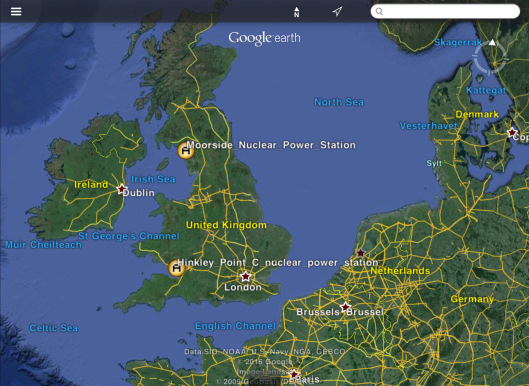 Moorside on the rocks? NucClear News October 18
Plans for a new nuclear power station in Cumbria are on the verge of collapsing after the Toshiba-owned company – NuGen – laid off 60% of its workforce and embarked on a final effort to sell the project. Toshiba was due to sell the NuGen consortium to South Korean state-owned firm Kecpo in early 2018, as the Japanese firm exits international nuclear projects and looks to recoup some of the £400m it has spent on the Moorside plant.
But Kepco has been delaying a final decision, due in part to the UK government signalling a new approach to financing nuclear power stations. That has forced NuGen to cut 60 of its 100-strong workforce after a six-week consultation with staff. (1)
Unions said the project’s problems showed the need for the government to take a stake in Moorside. Justin Bowden, the GMB national secretary, said: “The looming collapse of this vital energy project has been depressingly predictable for months.” The GMB wants the NDA to be scrapped as it currently exists and a Nuclear Development Agency created to make sure Moorside and the accompanying creation of thousands of new jobs and apprenticeships, goes ahead. (2) The skeleton NuGen team is now focused on clinching a deal with Kepco by the end of the year before Toshiba writes the unit off entirely at the end of March 2019. Success will hinge on whether Kepco buys into a new financing approach for nuclear power plants that the government is exploring, known as the regulated asset base (RAB) model. Officials think it could deliver the government’s nuclear ambitions more cheaply for consumers than alternatives.
The RAB approach involves a regulator – in the case of nuclear power stations most likely to be Ofgem – setting a fixed sum for the costs of the scheme, and a fixed return for the project’s backers. Those returns would be funded by energy bill payers. But the model is likely to be ditched if Jeremy Corbyn comes to power. Alan Whitehead, the shadow energy minister, said: “Using customers’ bills to make a bet that construction of such large and complex projects will not overrun in terms of cost or time is a reckless act.” (3)
The Chief Executive of NuGen said he will “fight tooth and nail” to salvage the £15 billion Moorside nuclear power station in an impassioned speech to industry leaders gathered in Cumbria. He says he is fully behind using the RAB model. (4)
The FT reported that Toshiba had entered talks with Canadian asset manager Brookfield over the potential sale of NuGen. Brookfield bought Westinghouse from Toshiba for $4.6bn in January after the US nuclear business filed for Chapter 11 bankruptcy protection in 2017. (5) But the claims were later rubbished by Toshiba. It added that it was still considering the sale of NuGen to Kepco. (6)
Later NuGen admitted that there are no firm plans to save Moorside. (7)
Workington Labour MP, Sue Hayman, co-chair of the All Party Parliamentary Group on Nuclear Energy, wrote to the Secretary of State for Business, Greg Clark MP, at the end of July, when NuGen announced it was consulting on job losses, calling on him to guarantee Government support for the project and 20,000 future Cumbrian jobs. Mr Clark said in June that he “will consider direct Government investment” in the proposed Wylfa nuclear power station in Wales, but he has refused to make any similar commitment to Cumbria. In a response to Sue’s letter, energy minister Richard Harrington MP said: “The Secretary of State and I understand the potential importance of the Moorside project to the local area. However (…) the proposed sale of NuGen is principally a commercial matter for Toshiba and it would not be appropriate for me to comment on those ongoing negotiations.” Sue Hayman said: “This Tory government could not care less about the Cumbrian economy, the Moorside project, or the 20,000 future jobs it will bring.” (8)
but he has refused to make any similar commitment to Cumbria. In a response to Sue’s letter, energy minister Richard Harrington MP said: “The Secretary of State and I understand the potential importance of the Moorside project to the local area. However (…) the proposed sale of NuGen is principally a commercial matter for Toshiba and it would not be appropriate for me to comment on those ongoing negotiations.” Sue Hayman said: “This Tory government could not care less about the Cumbrian economy, the Moorside project, or the 20,000 future jobs it will bring.” (8) http://www.no2nuclearpower.org.uk/wp/wp-content/uploads/2018/09/NuClearNewsNo111.pdf
UK Labour has a credible energy plan, unlike the floundering Tory government
 Dave Toke’s Blog 27th Sept 2018 Labour’s low cost and practical proposals for expansion of onshore and offshore wind, solar power, energy conservation and increases in renewable heat are the surest sign yet that they are the competent choice for Government.
Their proposals need some elaboration in places and some work on detail, but seem to be in a different dimension compared to the Tory Government who seem increasingly certain to be heading for self-destruction on the anvil of Brexit.
Rebecca Long-Bailey is aiming for 85 per cent of electricity to come from low carbon power by 2030. This is an easily
achievable target, and will be done at low cost if simultaneously Labour cancels the disaster-in-waiting project at Wylfa, and some way can be found to avoid Hinkley C being built.
As I indicated in a recent post, there’s already enough offshore wind in the pipeline to ensure well over 50 per
cent of electricity coming from renewables by 2025.
http://realfeed-intariffs.blogspot.com/2018/09/labours-green-energy-plans-are-surest.html
Update on UK’s Bradwell nuclear project: it may not go ahead
 Bradwell Update, NuClear News October 18
China’s leading nuclear energy company CGN says it would consider pulling back from control of the Bradwell nuclear plant to appease political sensitivities.
Under a 2016 agreement, CGN would have a 66.5% stake in Bradwell and EDF would have the remainder when it starts generating electricity in the late 2020s or ealry 2030s. However, CGN’s chief executive Zheng Dongshan told the Financial Times (FT) CGN would be willing to consider “not being the majority operator. We understand the political and local sensitivities”. (1)
Should the Bradwell project proceed, it would be the first Hualong HPR1000-type reactor. The Office for Nuclear Regulation is currently assessing the reactor design but a final decision on the Generioc Design Assessment is expected to take at least three years. (2)
BANNG’s Andy Blowers says the project may be doomed anyway as the site is totally unsuitable and is widely opposed by communities all around the Blackwater Estuary. The Chinese withdrawal, should it come, would reflect widespread concerns about the security issues surrounding their investment into a highly sensitive part of the UK’s national infrastructure. Recent manoeuvres off the disputed, Chinese-built, artificial islands in the South China Sea have increased tensions in the area and provoked warnings of Chinese investment withdrawal from the UK. It is possible that the Bradwell project could be an early victim of deteriorating relations between the two countries. In any event the project was already looking doubtful. It is facing considerable challenges in delivering vast quantities of cooling water by pipeline and the need to avoid polluting the Marine Conservation Zone which gives protection to the Colchester Native Oyster and other marine life. Most of the site is vulnerable to flooding and it will be a heroic feat to demonstrate that highly radioactive spent fuel can be safely and securely stored on the site until the end of the next century. (3)
The Blackwater, Crouch, Roach and Colne Estuaries were designated as a Marine Conservation Zone in 2013. As part of the designation native oysters have been legally protected indeed there is the Essex Native Oyster Restoration Initiative to further the aims of the MCZ designation. The MCZ designation is a major change in the site status since Bradwell was selected in 2011 as a potential site for power generation by the Government. Despite the new MCZ status CGN and EDF Energy still confirm their belief that Bradwell is a good site for nuclear development. If you take into account this and all the other environmental protections that run along the proposed site you would have thought it would be the last place to build a nuclear power station! http://www.no2nuclearpower.org.uk/wp/wp-content/uploads/2018/09/NuClearNewsNo111.pdf
France not facing up to nuclear problems, as High Commissioner for Atomic Energy leaves the position?
position of High Commissioner for Atomic Energy will be vacant. This is not
surprising. The government has known since May that Yves Bréchet would not continue beyond the end of his term.
that the current political power is not facing up to nuclear
issues, both civilian and military. The High Commissioner, for example, has
a controlling role in the management of plutonium stocks.
http://huet.blog.lemonde.fr/2018/09/27/alerte-rouge-le-nucleaire-na-plus-de-haut-commissaire/
UK’s Sizewell C nuclear power project – a figment of the imagination
 NuClear News, October 18 Sizewell C – a figment of the imagination In an interview with The Times in April EDF Energy’s UK chief executive, Simone Rossi, said that rapid progress was needed on the development of Hinkley Point C because promised cost savings would not materialise if there was a significant delay between work on the two. (1)
UK Labour government would aim to to treble the UK’s current solar capacity
Solar Power Portal 26th Sept 2018 A Labour government would look to treble the UK’s current solar capacity
and create more than 400,000 green jobs by 2030. Those were the key facts
from this week’s Labour Party conference which comprised speeches from
some of the opposition party’s central figures. Yesterday the party’s
shadow business, energy and industrial energy secretary Rebecca Long-Bailey
said that Labour had been working with an “expert team” of energy
professionals, engineers and academics to assess how the country could meet
such a target. A near trebling of the UK’s solar capacity would equate to
around 39GW of operational solar in the UK, enough, according to
Long-Bailey, to power seven million homes. Leonie Greene, director of
advocacy at the Solar Trade Association, stressed that expanding wind and
solar capacity should be an economically-driven decision that crosses party
political lines. “The government estimates that around £180 billion
needs to be invested in the electricity sector alone to 2030, so enabling
the lowest cost technologies which do not need public subsidy and which do
not contribute to climate change – namely solar and onshore wind – would be
very good news for consumers.”
https://www.solarpowerportal.co.uk/news/corbyns_labour_government_would_treble_uk_solar_capacity_create_400000_gree
Poor region of Japan is now very dependent on Rokkasho nuclear recycling project
 Japan vows to cut its nuclear hoard but neighbours fear the opposite, By Motoko Rich, 25 Sept 2018 New York Times, “………Pulling the plug would also deprive one of Japan’s poorest regions of an economic lifeline. Over the years, the central government has awarded nearly $3 billion in incentives to the prefecture, where political leaders reliably support Japan’s governing party.
Even inoperative, the plant employs more than 1 in 10 residents in Rokkasho and accounts for more than half the town’s tax revenues.
“It is now indispensable for Rokkasho,” said Kenji Kudo, the fourth generation to run his family’s clothing distribution company, which sells uniforms and protective gear to the plant.
As demand from local squid fishermen disappeared, he added, the plant “rescued our business.” The town has also received more than $555 million in government subsidies for hosting the facility, including funding for a 680-seat concert hall, an international school with just eight students and a new pool and gym complex that opened last year.
There are small reminders that the munificence comes with some risk.
A screen in the lobby of the concert hall reports the radiation level at 32 places around the prefecture, and a sign at a local nursing home warns residents not to use the baths “in case of nuclear disaster.”
Kaoru Sasaki, director of the nursing home, said she doubts the plant will ever operate given concerns about nuclear power around the country. “But we don’t talk about that among friends here,” she said. “It is so important to the community.”
The plant itself is sprawled across nearly 1,000 acres of farmland, surrounded by fields of solar panels and wind turbines.
Some 6,000 workers are installing steel nets to protect it against tornadoes and digging ditches for pipes to carry water from a swamp into its cooling towers. Inside a large control room, workers in turquoise jumpsuits mill about computer consoles, monitoring dormant machinery.
The final piece of the plant to come online will be a facility, now under construction, that will take a mix of plutonium and uranium and turn that into fuel. But no one knows what would happen if the government could not persuade communities to reopen and upgrade more reactors to use this type of fuel.
“Our only plan right now is that we want to start reprocessing in 2021,” said Koji Kosugi, general manager for international cooperation and nonproliferation at Japan Nuclear Fuel.
“But we do not yet know how it will be consumed. This is something that has to be worked out with the utilities and the Japanese government.”
One of the reasons Japan is so wedded to recycling may be that it does not want to confront the politically toxic question of what to do with its nuclear waste, much of which is being stored temporarily in cooling pools on the sites of its nuclear power plants.
Thomas M. Countryman, an Obama administration official who is now chairman of the nonpartisan Arms Control Association in Washington, said the Rokkasho plant is “in a sense a delaying tactic in order to put off the most difficult decision that any country has to face.”
One option, said Tatsujiro Suzuki, a nuclear scientist at Nagasaki University, is to turn Rokkasho itself into a nuclear waste storage facility.
Nuclear plants across Japan have sent waste that cannot be recycled to Rokkasho — steel drums full of ash, contaminated filters, steel pipes and protective clothing.
Huge concrete boxes holding the drums are lined up in vast dugouts on the grounds of the plant, and canisters holding highly radioactive waste are stacked nine deep in a cavernous underground room where only their bright orange lids poke out of the floor.
The government promised that the waste would only be stored here temporarily but never came up with a permanent plan. In Rokkasho, residents are still waiting for the recycling plant.
“If the government had asked the village to only accept waste in the first place,” said the mayor, Mamoru Toda, “I don’t think the village would have accepted it.” https://www.sbs.com.au/news/japan-vows-to-cut-its-nuclear-hoard-but-neighbours-fear-the-opposite
Kenya postpones its nuclear power plans
Kenya now pushes nuclear power plant plan to 2036, https://www.businessdailyafrica.com/economy/Kenya-now-pushes-nuclear-power-plant-plan-to-2036/3946234-4777866-b05oauz/index.html, By PATRICK ALUSHULA, SEPTEMBER 25, 2018 Kenya was already hunting for a partner to produce nuclear power by 202.
Kenya has postponed its plan to build Sh968 billion nuclear power plant by nine years to 2036 in favour renewable energy projects and coal plant.
Updated power development plan prepared by the Ministry of Energy and covering the period 2017 to 2037, now show that the earliest the country can build the nuclear plant is 2036 and not 2027 as initially planned.
In the revised plan, the first unit is expected to be completed in 2036, followed by another in 2037, making it the last project in the ministry’s 20-year plan for power generation expansion.
“All energy sources were considered in the system expansion planning. However, it is noteworthy that nuclear was not brought on board in both optimised and fixed MTP cases,” reads the updated plan shared by the Ministry.
ADVERTISEMENT
In addition to the delay, the plan size has been scaled down. Initially, Kenya was to construct two nuclear power plants, each with a capacity of 1,000 megawatts (MW) at a total cost of $4.05 billion (Sh405 billion) per plant.
However, the new plan is to have each plant with a capacity of 600MW at a cost of $4.84 billion (Sh484) billion.
The Ministry did not explain why the cost had gone up despite cutting the capacity of each unit by 40 per cent.
Kenya was already hunting for a partner to produce nuclear power by 2022 to help match-up rising demand and diversify from hydropower and geothermal.
It joins South Africa South Africa, which in August cancelled plans to add 9,600 MW of nuclear power by 2030 and will instead aim to add more capacity in natural gas, wind and other energy sources.
Japan’s Environment Ministry forced to change its forecast in order to make the nuclear industry look better
|
Ministry retracts estimate of ratio of nuclear power in fiscal 2050,THE ASAHI SHIMBUN, September 24, 2018
The Environment Ministry was forced to retract its trial calculation that the ratio of nuclear power generation to Japan’s total electricity generation will be less than 10 percent in fiscal 2050.
The ministry made the retraction in February in response to backlash from the Ministry of Economy, Trade and Industry, which is supervising the electric power industry, several sources of the two ministries said. At the time, the economy ministry was proceeding with a revision of the government’s basic energy plan. It apparently feared that the trial calculation could influence discussions on the future ratio of nuclear power generation, the sources added. “We didn’t put pressure (on the Environment Ministry),” an economy ministry official said. However, an Environment Ministry official said, “We couldn’t help but retract (the original trial calculation).” After the retraction, the contents of the basic energy plan were decided as had been worked out by the economy ministry and were approved in a Cabinet meeting in July. The Abe administration regards nuclear power generation as “an important baseload electric source” and is promoting the restarts of nuclear reactors. Under the policy, the economy ministry has apparently adopted a stance of concealing data that is inconvenient for the administration. The Asahi Shimbun obtained the trial calculation, which was shown to the economy ministry by the Environment Ministry. According to the estimate, the ratio of nuclear power generation to Japan’s total electricity generation will be 21 percent in fiscal 2030 in accordance with the Abe administration’s policies. The ratio will decrease to 11 to 12 percent in fiscal 2040 and to 7 to 9 percent in fiscal 2050. In addition, the ratio of renewable energies will increase to 57 to 66 percent in fiscal 2040 and further to 72 to 80 percent in fiscal 2050. The Environment Ministry compiled the trial calculation by setting up a team with Mitsubishi Research Institute Inc. and experts to examine measures to reduce greenhouse gases. In the trial calculation, the team assumed that renewable energies will be introduced as much as possible. The Asahi Shimbun obtained the trial calculation, which was shown to the economy ministry by the Environment Ministry. According to the estimate, the ratio of nuclear power generation to Japan’s total electricity generation will be 21 percent in fiscal 2030 in accordance with the Abe administration’s policies. The ratio will decrease to 11 to 12 percent in fiscal 2040 and to 7 to 9 percent in fiscal 2050. In addition, the ratio of renewable energies will increase to 57 to 66 percent in fiscal 2040 and further to 72 to 80 percent in fiscal 2050. The Environment Ministry compiled the trial calculation by setting up a team with Mitsubishi Research Institute Inc. and experts to examine measures to reduce greenhouse gases……….http://www.asahi.com/ajw/articles/AJ201809240032.html |
|
-
Archives
- October 2026 (104)
- September 2026 (339)
- August 2026 (330)
- July 2026 (355)
- June 2026 (287)
- May 2026 (306)
- April 2026 (356)
- March 2026 (251)
- February 2026 (267)
- January 2026 (308)
- December 2025 (358)
- November 2025 (359)
-
Categories
- 1
- 1 NUCLEAR ISSUES
- business and costs
- climate change
- culture and arts
- ENERGY
- environment
- health
- history
- indigenous issues
- Legal
- marketing of nuclear
- media
- opposition to nuclear
- PERSONAL STORIES
- politics
- politics international
- Religion and ethics
- safety
- secrets,lies and civil liberties
- spinbuster
- technology
- Uranium
- wastes
- weapons and war
- Women
- 2 WORLD
- ACTION
- AFRICA
- Atrocities
- AUSTRALIA
- Christina's notes
- Christina's themes
- culture and arts
- Events
- Fuk 2022
- Fuk 2023
- Fukushima 2017
- Fukushima 2018
- fukushima 2019
- Fukushima 2020
- Fukushima 2021
- general
- global warming
- Humour (God we need it)
- Nuclear
- RARE EARTHS
- Reference
- resources – print
- Resources -audiovicual
- Weekly Newsletter
- World
- World Nuclear
- YouTube
-
RSS
Entries RSS
Comments RSS

