UK’s ageing nuclear power stations are likely to close early
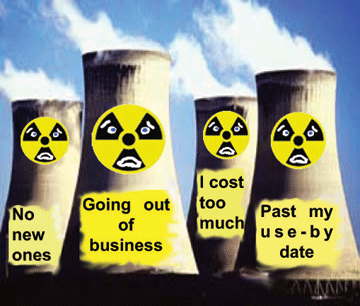
After 12% drop in generation, experts say existing nuclear plants are likely to close early Britain’s nuclear power stations recorded a 12% decline in their contributions to the country’s energy system over the past month, as outages raised concerns over how long the ageing plants will be able to keep operating.
Prospects for new nuclear projects have commanded headlines and government attention in recent weeks, with Hitachi and Toshiba scrapping their plans for major new plants.
But the fate of the existing plants, which usually provide about a fifth of the UK’s electricity supplies, has been pulled into focus by outages due to safety checks and engineering works running over schedule. Nuclear outages also push up carbon emissions because any capacity shortfall will typically be replaced by fossil fuel power stations
Seven of the power stations use an advanced gas reactor (AGR) design, the oldest of which is 43 years old and the youngest 30 years .
Most were built with a lifetime of about 35 years in mind. All are due to be closed in the 2020s after owner EDF Energy extended their lives, but there are now fears that ageing infrastructure may reduce their output or even lead them to shut early.
Iain Staffell, lecturer in sustainable energy at Imperial College, which compiled the nuclear output data, said: “Just as Toshiba and Hitachi have pulled out of building new reactors, we have one third of the existing nuclear capacity unavailable either for maintenance or because their maximum power has been reduced as they get older.
“Many of our reactors were built in the late 70s, and like your typical 40-year-old they aren’t in peak physical condition any more.”……… https://www.theguardian.com/environment/2019/feb/03/fate-of-uks-nuclear-power-stations-in-doubt-over-ageing-infrastructure
Czech industry minister: nuclear reactor tender not realistic in 2019
PRAGUE, Feb 3 (Reuters) – The Czech Republic is unlikely to be ready to hold a tender to build new nuclear reactors this year, given the financing structure has still not been decided, Industry Minister Marta Novakova said on Sunday.
The government and electricity producer CEZ, which is 70 percent owned by the state, have been locked in a debate over how to finance the construction of new nuclear units……..
Builders for nuclear power plants from countries including Russia, China and the United States are all set to vie for the Czech deal. (Reporting by Robert Muller; Editing by Susan Fenton) https://www.reuters.com/article/czech-uclear/czech-industry-minister-nuclear-reactor-tender-not-realistic-in-2019-idUSL5N1ZY0AN
U.S. Sen. Elizabeth Warren introduces Bill to outlaw first strike use of nuclear weapons
US Sen. Warren: Ban US first strike nuclear weapons option https://www.sfgate.com/news/article/US-Sen-Warren-Ban-US-first-strike-nuclear-13585408.php February 3, 2019 BOSTON (AP) — U.S. Sen. Elizabeth Warren wants to make sure the United States never uses nuclear weapons first.
The Massachusetts Democrat has introduced a bill with Democratic U.S. Rep. Adam Smith of Washington that would make it the official policy of the United States not to use nuclear weapons first.
The lawmakers say the United States currently retains the option to be the first to use nuclear weapons in a conflict, even in response to a non-nuclear attack.
They said banning the use of nuclear weapons for first-strike purposes would “reduce the chances of a nuclear miscalculation.”
Fellow Massachusetts Democratic U.S. Sen. Edward Markey and U.S. Rep. Ted Lieu, a California Democrat, have also sponsored a bill that would bar the president from launching a nuclear first strike without congressional approval.
FirstEnergy nuclear bailout would be crony capitalism at its worst
 Should legislators help save Ohio nuclear plants? NO: FirstEnergy bailout would be crony capitalism at its worst Columbus Dispatch, 4 Feb 19, Crony capitalism is never acceptable and should be always met with public outrage. But more-covert pay-to-play schemes that affect Ohio’s long-term economic health are particularly egregious. Take for instance the campaign-contributions scheme from FirstEnergy Solutions over the past year. While transactions to more than a dozen of Ohio policymakers may seem normal to the average voter, recent activity in Columbus reveals a much more calculated operation that seemly puts FirstEnergy’s nuclear agenda ahead of Ohio’s future.
In April 2018, FirstEnergy Solutions filed for bankruptcy in the wake of massive financial problems arising from the company’s competitive power-generation fleet. The company announced it would shut down its Ohio nuclear plants over a three-year period because continued operation wasn’t profitable. FirstEnergy had been unsuccessfully pursuing bailouts from the Public Utilities Commission of Ohio since 2014 and seeking a nuclear subsidy in the legislature since 2016 without success.
So it scrambled desperately for a lifeline, hatching a plan to offer sizable campaign donations to candidates hoping to gather up political allies to support its demand for $300 million a year to keep its plants operational.
What did FirstEnergy cough up for its legislative lifeline? For starters, the company gave $172,000 in total to Ohio House candidates, many of whom had no legislative or energy-industry experience. It also donated $565,000 to the Republican Governors Association, an amount more than five times what the company gave to Governor Mike DeWine’s Democratic counterpart.
We can clearly see the pay, but what exactly was the play? Conveniently, on the first day of the new General Assembly a standing committee on power generation was established, setting the stage to justify passage of a nuclear bailout and help out FirstEnergy. Additionally, FirstEnergy recently announced a debt-restructuring agreement with its creditors. Not coincidentally, this surprise development came on the tails of securing state-lawmaker support to bail out FirstEnergy.
This situation is pay-to-play politicking at its worst, flying in the face of the new administration’s promises to be the most innovative administration in Ohio’s history. Part of an innovation agenda should include rejecting political favoritism toward uncompetitive and less technologically advanced nuclear power plants. Ohioans need to know that FirstEnergy’s attempt to influence a bailout for its failing nuclear plants isn’t just bad ethics. It’s also awful public policy.
Incidentally, natural gas is fueling jobs and consumer cost savings across America. This is especially true in Ohio, …………https://www.dispatch.com/opinion/20190203/column-should-legislators-help-save-ohio-nuclear-plants-no-firstenergy-bailout-would-be-crony-capitalism-at-its-worst
Is Vogtle nuclear station expansion now further behind schedule? Report is delayed?
 Proposed deal would delay report on Georgia nuclear plant The News and Observer, THE ASSOCIATED PRESS, FEBRUARY 02, 2019 ATLANTA
Georgia utility regulators are being asked to delay a Georgia Power report showing whether the Plant Vogtle nuclear expansion has fallen further behind schedule.
Additional construction delays would increase the project’s costs — and that could lead to higher power bills for many Georgians, The Atlanta Journal-Constitution reported.
Some consumer and environmental groups are objecting to any delay in updates.
“The company and the project do not deserve this break in scrutiny at this critical time,” Sara Barczak, a director for the Southern Alliance for Clean Energy, wrote in an emailed statement to the Journal-Constitution.
“The ratepayers do not deserve this extended period of a lack of protection and transparency as their exposure potentially increases by more than a billion dollars,” Barczak said.
The delay also means the company won’t make its latest disclosure while the state legislature is in session, said Liz Coyle, the executive director of Georgia Watch.
“There is a lack of transparency in what is happening with schedule and budget at a time when the legislature could take some action,” Coyle said.
Georgia Power denied the move is an intentional effort to avoid the legislative session……….https://www.newsobserver.com/news/business/article225448705.html
IAEA urges Japan to slow the Fukushima wastes clean-up – delay release to Pacific till after Olympic Games

IAEA urges Japan to take ample time in Fukushima cleanup https://phys.org/news/2019-01-iaea-urges-japan-ample-fukushima.html January 31, 2019 by Mari Yamaguchi The International Atomic Energy Agency urged Japan on Thursday to spend ample time in developing a decommissioning plan for the tsunami-damaged Fukushima nuclear power plant and to be honest with the public about remaining uncertainties.
The cores of the three reactors melted after a massive 2011 earthquake and tsunami. Utility and government officials plan to start removing the melted fuel in 2021, but still know little about its condition and have not finalized waste management plans.
“The IAEA review team advises that before the commencement of the fuel debris retrieval activities, there should be a clear implementation plan defined to safely manage the retrieved material,” the report said. “TEPCO should ensure that appropriate containers and storage capacity are available before starting the fuel debris retrieval.”
The report also urged the government and TEPCO to carefully consider ways to express “the inherent uncertainties involved” in the project and develop “a credible plan” for the long term. It advised TEPCO to consider adopting contingency plans to “accommodate any schedule delays.”
Dale Klein, a former U.S. Nuclear Regulatory Commission chairman who heads a TEPCO reform committee, said in a recent interview that the decommissioning should not be rushed, even if the government and TEPCO have set a schedule and people want to see it move faster.
“It’s much better to do it right than do it fast,” he said, adding that it’s also good not to rush from a health and safety perspective. “Clearly, the longer you wait, the less the radiation is.”
He said he would be “astounded” if the current schedule ends up unchanged.
In order to make room in the plant compound to safely store the melted fuel and for other needed facilities, about 1 million tons of radioactive waste water currently stored in hundreds of tanks will have to be removed. The IAEA team, headed by Xerri Christoph, an expert on radioactive waste, urged the government and TEPCO to urgently decide how to dispose of it.
Nuclear experts, including officials at the IAEA and Japanese Nuclear Regulation Authority, have said a controlled release of the water into the Pacific Ocean is the only realistic option. A release, however, is unlikely until after the Tokyo 2020 Olympic Games in order to avoid concerns among visitors from overseas.
Nevada State Officials Are Outraged that the Trump Administration Secretly Shipped Plutonium in from South Carolina
“They lied to the State of Nevada, misled a federal court, and jeopardized the safety of Nevada’s families and environment,” Governor Sisolak said. Nevada officials say they are “outraged” by the Trump administration’s “reckless decision” to secretly ship 1,100 pounds of weapons-grade plutonium to a site north of Las Vegas, against the express wishes of state representatives.
Governor Steve Sisolak called the move an “unacceptable deception” that exposed the “sham” of the state’s ongoing negotiations with the Department of Energy (DOE) over the transfer of plutonium from South Carolina. Nevada Senator Jacky Rosen called the decision “deceitful and unethical” and said it jeopardized “the health and safety of thousands of Nevadans and Americans who live in close proximity to shipment routes,” according to The New York Times.
A federal judge ordered the transfer in 2017, but the move was challenged in court when Nevada sued the federal government to block it last November. Unbeknownst to Nevada officials, the DOE had already shipped the plutonium to Nevada, according to legal filings released Wednesday. Nevada officials were not notified because the transfer was classified due to its implications for national security, the DOE said.
“Although the precise date that this occurred cannot be revealed for reasons of operational security, it can be stated that this was done before November 2018, prior to the initiation of the litigation,” said Bruce Diamond, general counsel for the DOE’s National Nuclear Security Administration, in the filing.
The plutonium is being held at the Nevada National Security Site near Yucca Mountain, in the complex’s Device Assembly Facility (DAF).
This region has a rich tradition of anti-nuclear activism: Public figures like astronomer Carl Sagan and actor Martin Sheen were among the thousands of people arrested at the height of the local protest movement in the late 1980s and early 1990s.
Decades later, there is strong bipartisan opposition in Nevada to any expansion of the site’s role as a repository for spent nuclear material. In 2009, President Obama backed off of long-term plans to develop storage capabilities at Yucca Mountain. The Trump administration signaled its intention to reverse that decision last year by including $120 million in the DOE budget to prepare for new shipments.
Nevada’s November lawsuit against the transfer is now regarded as moot by the US Justice Department, the Associated Press reported, and the plutonium may remain at the DAF for nearly a decade before another planned transfer to New Mexico.
Despite assurances from the DOE that there will be no other imminent shipments, the state’s elected officials argue the lack of transparency over the move demands new preventative measures. Governor Sisolak said the state is pursuing “any and all legal remedies” against the federal government, including contempt of court orders.
“They lied to the State of Nevada, misled a federal court, and jeopardized the safety of Nevada’s families and environment,” Sisolak said in a statement. “My administration is working with our federal delegation, and we will use the full force of every legal tool available to fight back against the federal government’s reckless disregard for the safety of our state.”
Correction: An earlier version of this article referred to the plutonium shipment as nuclear waste. It does not far under that definition according to the DOE. The article has been updated to reflect this.
Taiwan to abolish nuclear power in 2025
Nuclear power to be abolished in 2025 http://www.taipeitimes.com/News/front/archives/2019/02/01/2003709035
REFERENDUM No. 7:The government is to bar capacity expansions at coal-fired power plants and abide by local governments’ tightened environmental regulations
Although Taiwanese in November last year voted against the government’s 2025 deadline to abolish nuclear power, the energy source would still be completely removed from the nation’s energy mix after that year due to inevitable constraints, Minister of Economic Affairs Shen Jong-chin (沈榮津) told a news conference in Taipei.
Resistance from local governments, difficulty in procuring replacement parts for aging reactors, finding storage space for spent fuel rods and the inability to complete the stay-of-decommissioning application process have all but ruled out the use of nuclear power beyond 2025, Shen said.
Other remedies, such as reactivating decommissioned nuclear plants, are also unlikely due to the lengthy budget approval process at the legislature, Shen said, adding that General Electric Co is no longer able to provide technical support for reactors that were installed decades ago.
As for referendum No. 7, which called for the reduction of thermal power by at least 1 percent per year on average, Shen said that the goal is achievable this year and next year.
Achieving the goal would not increase the risk of energy shortages and 15 percent reserved power generation capacity could be maintained, he said.
However, energy shortages could happen in 2021 due to an anticipated rise in consumption, Shen said.
Resistance from local governments, difficulty in procuring replacement parts for aging reactors, finding storage space for spent fuel rods and the inability to complete the stay-of-decommissioning application process have all but ruled out the use of nuclear power beyond 2025, Shen said.
Other remedies, such as reactivating decommissioned nuclear plants, are also unlikely due to the lengthy budget approval process at the legislature, Shen said, adding that General Electric Co is no longer able to provide technical support for reactors that were installed decades ago.
As for referendum No. 7, which called for the reduction of thermal power by at least 1 percent per year on average, Shen said that the goal is achievable this year and next year.
Achieving the goal would not increase the risk of energy shortages and 15 percent reserved power generation capacity could be maintained, he said.
However, energy shortages could happen in 2021 due to an anticipated rise in consumption, Shen said.
South Africa’s Jacob Zuma and corruption
The claim was made during extraordinary testimony by a whistleblower from a security company said to have bankrolled the extravagant lifestyles of Mr Zuma and other leading African National Congress (ANC) figures.
Angelo Agrizzi told the Zondo commission investigating South Africa’s biggest post-apartheid scandal that he personally organised much of the cash counting, gift buying and “special services” to Mr Zuma and his acolytes on behalf of a company, Bosasa, in return for state contracts……(Subscribers only) ……https://www.thetimes.co.uk/article/south-africa-jacob-zuma-given-bags-stuffed-with-cash-every-month-for-years-inquiry-told-z0cw3n6l0
Bill to prevent nuclear first strike without congressional approval introduced by U.S. Democrats
 Dems reintroduce bill to prevent nuclear first strike without congressional approval, https://thehill.com/policy/defense/427546-dem-lawmakers-reintroduce-bill-to-prevent-president-from-launching-nuclear
At a press conference announcing the legislation, Lieu said the bill is needed because President Trump is “unpredictable and rash.”
“Trump’s brand is to be unpredictable and rash, which is exactly what you don’t want the person who possesses the nuclear football to be,” Lieu said, according to a press release. “We introduced this bill under the Obama administration but Trump’s presidency has highlighted just how scary it is that any president has the authority to launch a nuke without congressional consultation.”
The statement cited a Trump tweet from January 2018 that taunted North Korea over the size of his nuclear button.
“Will someone from his depleted and food starved regime please inform him that I too have a Nuclear Button, but it is a much bigger & more powerful one than his, and my Button works!” Trump wrote, referring to North Korean leader Kim Jong Un.
Markey added in the statement that no president “should have the power to launch a first use nuclear first strike absent such an attack without explicit Congressional approval.”
Lawmakers in the past, including Lieu and Markey, have introduced similar legislation, but it has stalled in Congress.
The legislation, called the Restricting First Use of Nuclear Weapons Act of 2019, will be introduced by Lieu in the House and Markey in the Senate.
UK Chancellor Philip Hammond looks to ‘ alternative financing model’to save Wylfa nuclear project
It had been in talks with the UK government since June about funding for the project, which was being built by its Horizon subsidiary.
Mr Hammond said an alternative model was being worked on.
“Obviously we are disappointed by the decision of Hitachi to suspend work on the Wylfa project, but we haven’t given up hope,” he told the House of Commons.
“They retain the site and we hope that the work that we’re doing on a possible alternative financing model may yet allow the project to go ahead.”………
If the Wylfa Newydd project is scrapped, it leaves the Hinkley Point power station in Somerset as the only new UK reactor still being built.
There are plans for new plants at Bradwell and Sizewell, but neither is currently under construction……https://www.bbc.com/news/business-47041043
Time for UK to stop the welfare payments to the collapsing nuclear industry
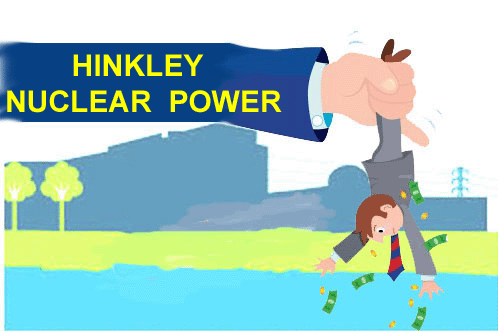 Stop Hinkley 29th Jan 2019 UK Energy Policy is at a tipping point. Following the withdrawal of two
Japanese giants – Toshiba and Hitachi – from nuclear projects at Moorside
in Cumbria and Wylfa on Anglesey – it is now clearer than ever that it
would be cheaper to build new renewable capacity rather than continue
building Hinkley Point C.
It’s now time to cut our losses and abandon the
Hinkley Point C project altogether. Even Business Secretary, Greg Clark has
recognised that “The cost of renewable technologies such as offshore wind
has fallen dramatically, to the point where they now require very little
public subsidy and will soon require none.” And the cost reductions for
offshore wind are far from over.
Stop Hinkley spokesperson Roy Pumfrey
said: “It is time to scrap the welfare scheme for the dying nuclear
industry called Hinkley Point C. Business Secretary Greg Clark has
virtually admitted that nuclear power is past its sell-by-date. If Hitachi
can’t make a profit with ‘significant and generous’ financial support
from the Government, – its share price went up by 10% when Wylfa was
suspended – and even EDF is getting cold feet despite the prospect of a
£50bn bung from consumers – it must be time to get out of nuclear, cancel
Hinkley and stop coming up with new ways of fleecing taxpayers and
consumers to fund new reactors.”
http://www.stophinkley.org/PressReleases/pr190129.pdf
Tax-payer funding for yet another nuclear folly? Rolls Royce’s Small Modular Reactors
 Rolls-Royce seeks government funds for nuclear power project https://www.ft.com/content/1bbfefb0-20bf-11e9-b2f7-97e4dbd3580d Group wants £200m to develop small-scale plants after failure of big schemes Sylvia Pfeifer and David Sheppard– 27 Jan 19
A consortium led by Rolls-Royce has asked for more than £200m in government funding to help develop its project for small nuclear reactors, as ministers scramble to recast Britain’s energy policy after the collapse of plans to build several large reactors. The engineering group and its partners, which include Laing O’Rourke and Arup, want to secure a sum “in the low hundreds of millions”, confirmed one person with knowledge of the request. Any amount would be match-funded by the consortium and be used to develop Rolls-Royce’s technology through to the later stages of the licensing process in order to be able to attract private investment.
The consortium has applied for funding from the government’s industrial strategy challenge fund under UK Research and Innovation. The money would enable the group to develop its design through to the later stages of the “generic design assessment” by the industry regulator. Industry sources with knowledge of the bid said the consortium “entered detailed negotiations” with UKRI before Christmas. Rolls-Royce has previously said it believes its reactor would cost about £2.5bn to build.
It makes sense to exclude Nuclear, Fossils With Carbon Capture,and Biofuels from the Green New Deal
|
Why Excluding Nuclear, Fossils With Carbon Capture, & Biofuels From The Green New Deal Makes Financial & Climate Sense, Clean Technica January 24th, 2019 , By Mark Z. Jacobson & Mark A. DelucchiThe Green New Deal and multiple proposed laws and resolutions in the U.S. House (HRes.540, HR.3314, HR.3671) and Senate (SRes.632, S.987) call for the United States to move entirely from fossil fuels to clean, renewable electricity and/or all energy. A new bill was just introduced by Rep. Ted Lieu (D-Los Angeles County) and Rep. Jimmy Gomez (D-CA), calling for the U.S. to produce 100 percent of its electric power from renewables by 2035. Recently, though, some vocal advocates have pushed back, claiming that the only way prices will stay low with large amounts of renewables on the power grid is to use nuclear power, fossil fuels with carbon capture, and biofuels, which they claim are “zero carbon.” Here is why nuclear, fossils with CCS, and biofuels should be excluded. All three technologies are opportunity costs. They raise costs to consumers and society, slow solutions to global warming and air pollution by increasing carbon and emissions relative to clean, renewables (thus are not zero carbon), and/or create risks that clean, renewables don’t have. For example, onshore wind and utility PV are now the cheapest forms of electricity in most countries, including the U.S. New nuclear today costs 4 to 6 times that of new solar or wind to produce the same electricity. Further, a nuclear plant takes 5 to 17 years longer between planning and operation than does a solar or wind farm. Thus, every dollar spent on nuclear results in 1/5th the energy production and 5 to 17 years more coal and gas burning than if wind or solar were installed instead. This delay and lower energy production from new nuclear condemns millions more to die from air pollution, which today kills 4 to 9 million people worldwide. By choosing to build several nuclear plants a decade ago that have yet to operate, China suffered an increase in its overall CO2 emissions by 1.4 percent between 2016 and 2017 rather than seeing a decrease of 3.4 percent if it had spent the money on wind and solar instead. Given that many 100% renewable policies call for a full transition of electricity by 2035, and given the financial and time requirements of nuclear, it is all but impossible for any more than a few new nuclear plant to be in place in by then. In terms of emissions, nuclear is not zero carbon. A new plant emits 9 to 37 times the carbon emissions over its life as onshore wind, partly due to the fossil fuels used in mining and refining uranium continuously and building the facility but more because coal and gas plants are emitting during the long planning-to-operation time of a nuclear plant. Just as importantly, according to the Intergovernmental Panel on Climate Change, there is “robust evidence and high agreement” that nuclear power raises concerns about weapons proliferation, core meltdown, creation and storage of radioactive waste, and land-use degradation from mining. Wind and solar power do not have these concerns. Next, neither coal nor natural gas with carbon capture and sequestration (CCS) is remotely close to zero carbon. For example, the Petra Nova project in Texas combines a coal plant with CCS. However, a natural gas plant was built just to run the CCS equipment, and when accounting for the actual efficiency, natural gas combustion emissions, CO2 combustion emissions, and methane leaks from mining the gas, the plant reduces only 22 percent of the carbon it was designed to over 20 years – at an additional cost of $4,200/MW. That same investment could have been spent on wind and solar to replace the entire coal plant and 100% of its emissions. Adding CCS to coal plants also increases air pollution and land degradation by about 25 percent. Finally, the captured CO2 is used for enhancing oil recovery, causing even greater damage to climate and health. Thus, CCS represents an enormous opportunity cost compared with developing wind or solar. Finally, biofuels for transportation and electricity cause substantial air pollution, climate-relevant emissions, land degradation, and water drawdown compared with truly clean, renewables such as wind and solar………..https://cleantechnica.com/2019/01/24/why-excluding-nuclear-fossils-with-carbon-capture-biofuels-from-the-green-new-deal-makes-financial-climate-sense-realitycheck/ |
|
|

Bill Gates urging U.S. Congress to spend $billions of tax-payer money for developing new nuclear reactors
 Bill Gates comes to Washington — selling the promise of nuclear energy, WP, By Steven Mufson, January 25
Bill Gates thinks he has a key part of the answer for combating climate change: a return to nuclear power. The Microsoft co-founder is making the rounds on Capitol Hill to persuade Congress to spend billions of dollars over the next decade for pilot projects to test new designs for nuclear power reactors.
Gates, who founded TerraPower in 2006, is telling lawmakers that he personally would invest $1 billion and raise $1 billion more in private capital to go along with federal funds for a pilot of his company’s never-before-used technology, according to congressional staffers…….
Gates said in his year-end public letter. “The problems with today’s reactors, such as the risk of accidents, can be solved through innovation.” …..
But many nuclear experts say that Gates’s company is pursuing a flawed technology and that any new nuclear design is likely to come at a prohibitive economic cost and take decades to perfect, market and construct in any significant numbers.
Lawmakers are listening to him. Through the Energy Department, Congress approved $221 million to help companies develop advanced reactors and smaller modular reactors in fiscal 2019, above the budget request. But Gates and TerraPower, which received a $40 million Energy Department research grant in 2016, are looking for more. …….
Edwin Lyman, a nuclear expert at the Union of Concerned Scientists, said TerraPower is one of many companies that is raising the public’s hopes for advanced nuclear reactor designs even though they’re still on the drawing boards and will remain unable to combat climate change for many years.
“We think the vendors of advanced nuclear power designs are saying they can commercially deploy them in a few years and all over the world,” Lyman said. “We think that is counterproductive because it is misleading the public on how fast and effective these could be.” ……
Many nuclear power experts say that the technology Gates is promoting — called a “traveling wave reactor” — does not work as advertised, at least not yet. “These designs . . . require advances in fuel and materials technology to meet performance objectives,” a Massachusetts Institute of Technology report said last year.
TerraPower has changed key elements of its design and has still not resolved critical problems, experts say……
critics say TerraPower has been stumbling over a handful of obstacles.
First, TerraPower has discovered that the traveling wave didn’t travel so well and that it would not evenly burn the depleted uranium in the “candle.” Second, and partly as a result, it needed to change the design to reshuffle the fuel rods — and do that robotically while keeping the reactor running. Third, it has struggled to find a metal strong enough to protect the fuel rods from a bombardment of neutrons more intense than those commonly used in reactors — and for a much longer period of time…….
In many ways, TerraPower’s design resembles fast breeder reactors. Fast breeders have faster moving neutrons, the subatomic particles that trigger fission.
Allison Macfarlane, former chairman of the Nuclear Regulatory Commission, said earlier versions of fast breeder reactors have turned in a “dismal performance.” The United States built two small reactors at a government laboratory in Idaho, Japan built a commercial unit called Monju, and France built two called Phenix and Superphenix — and all of them have been shut down.
………TerraPower has also been working with the Energy Department on another reactor. If it moved ahead, it could obtain federal funds for 60 percent of the cost of a test reactor, Burkey said. That design would rely on molten salt as both coolant and fuel. TerraPower believes an advanced molten salt reactor could be more efficient and produce less waste than current models.
However, that technology was examined in different countries 60 years ago — and abandoned. Lyman said the molten salt was “highly corrosive, so you need special materials for the reactor. That’s an engineering problem they still have to confront.” …… https://www.washingtonpost.com/national/health-science/bill-gates-comes-to-washington–selling-the-promise-of-nuclear-energy/2019/01/25/4bd9c030-1445-11e9-b6ad-9cfd62dbb0a8_story.html?noredirect=on&utm_term=.115327089881
1 This Month





PLEASE OPPOSE HR 8255 AND S.3639 – bills would accelerate satellite deployment, with no environmental review or safeguards – https://ncstd5li.quorum.us/campaign/169331/
To see nuclear-related stories in greater depth and intensity – go to https://nuclearinformation.wordpress.com
-
Archives
- October 2026 (91)
- September 2026 (339)
- August 2026 (330)
- July 2026 (355)
- June 2026 (287)
- May 2026 (306)
- April 2026 (356)
- March 2026 (251)
- February 2026 (267)
- January 2026 (308)
- December 2025 (358)
- November 2025 (359)
-
Categories
- 1
- 1 NUCLEAR ISSUES
- business and costs
- climate change
- culture and arts
- ENERGY
- environment
- health
- history
- indigenous issues
- Legal
- marketing of nuclear
- media
- opposition to nuclear
- PERSONAL STORIES
- politics
- politics international
- Religion and ethics
- safety
- secrets,lies and civil liberties
- spinbuster
- technology
- Uranium
- wastes
- weapons and war
- Women
- 2 WORLD
- ACTION
- AFRICA
- Atrocities
- AUSTRALIA
- Christina's notes
- Christina's themes
- culture and arts
- Events
- Fuk 2022
- Fuk 2023
- Fukushima 2017
- Fukushima 2018
- fukushima 2019
- Fukushima 2020
- Fukushima 2021
- general
- global warming
- Humour (God we need it)
- Nuclear
- RARE EARTHS
- Reference
- resources – print
- Resources -audiovicual
- Weekly Newsletter
- World
- World Nuclear
- YouTube
-
RSS
Entries RSS
Comments RSS

