Potentially criminal activity in Trump campaign – a nuclear connection
 Report: Trump Inaugural Committee Under Investigation for Possible Finance Crime, Slate By DEC 13, 2018 “………..Prosecutors also asked for documents from Tennessee developer Franklin Haney, the Journal reported. Haney made a $1 million donation to the inaugural committee and, in April, hired Cohen to help him obtain a $5 billion loan from the U.S. government, among other funding, for a pair of nuclear reactors in Alabama. Prosecutors asked him for documents related to any correspondence with members of the committee. ……
This investigation opens another possible route of inquiry into potentially criminal behavior by those in Trump’s orbit during the campaign and transition period. https://slate.com/news-and-politics/2018/12/trump-inaugural-committee-federal-investigation.html
Controversy over nuclear power, as Green New Deal is unveiled

 How the Green New Deal Almost Went Nuclear on Its First Day, Yahoo Finance, Ari Natter and Jennifer A. Dlouhy, Bloomberg, February 9, 2019 — As Democrats unveiled their ambitious Green New Deal to fight climate change on Thursday, a controversy erupted over the role of nuclear power that threatened to undermine the whole effort.
A fact sheet distributed by the office of progressive newcomer Alexandria Ocasio-Cortez, a Democratic representative from New York, said there was no room in the nation’s all renewable-energy future for nuclear plants.
But the reference caught many off guard and back-peddling ensued.
Giselle Barry, a spokeswoman for Senator Ed Markey, a Massachusetts Democrat who is the Green New Deal’s lead Senate backer, disowned the fact sheet and said Markey’s office wasn’t consulted before it was sent out. “We did not draft that fact sheet,” she said.
The stumble irked potential supporters. It also illustrated the political challenges ahead as supporters of the Green New Deal struggle to build consensus on issues that divide environmentalists as well as lawmakers.
Markey sought to do damage control at a midday press conference, emphasizing the proposed resolution doesn’t address specific energy technologies. Language on nuclear power “is not part of this legislation,” he said. “The resolution is silent on any individual technology that can move us to a solution.”
The plan, in the form of a non-binding resolution, weaves together what had been a hodgepodge of progressive proposals and aspirations into a single initiative. It sets a goal of shifting the nation to 100 percent “clean, renewable, and zero-emission energy sources,” within 10 years “to achieve net-zero greenhouse gas emissions through a fair and just transition for all communities and workers.”
The proposal has gathered 60 co-sponsors in the House but has little chance of gaining support in the Republican-controlled Senate, let alone being signed into law by President Donald Trump.
House Speaker Nancy Pelosi, who hasn’t explicitly thrown her support behind the Green New Deal, didn’t appear at the unveiling. She described the plan at another event as “one among many” ways to address climate change.
Some of the biggest climate champions in the Senate, including Sheldon Whitehouse, a Democrat from Rhode Island who delivers frequent floor speeches on the urgent need to act, were notably absent from the news conference unveiling the Green New Deal. For any effort to succeed, it will need support from long-time environmental policy advocates in Congress as well as the ardent activists that have rallied behind Ocasio-Cortez’s vision.
The scale and ambition of the initiative also presents problems. Ocasio-Cortez has pitched it not just as an environmental solution but also a World-War II-style “mobilization” against income inequality and social injustice.
That invites criticism that the whole gambit is socialism run amok. The Chamber of Commerce slammed the proposal in a statement that invoked “failed socialist policies.”
Opposition on the left emerged over the plan’s failure to eventually ban fossil fuels, the leading source of the carbon dioxide emissions linked to global warming.
Friends of the Earth president Erich Pica praised the resolution as “a good first step,” but said it was incomplete. “By failing to expressly call for an end of the fossil fuel era, the resolution misses an opportunity to define the scope of the challenge,” Pica said…………https://finance.yahoo.com/news/green-deal-almost-went-nuclear-090000153.html
Yes, the Green New Deal is expensive,but nothing to compare with the nuclear boondoggle

SOUTH CAROLINA SPENT $9 BILLION TO DIG A HOLE IN THE GROUND AND THEN FILL IT BACK IN, The Intercept, Akela Lacy
But before scoffing at the prospect of the wealthiest nation in the history of the world funding such a project, it’s worth taking a look at what one of the country’s poorest states was recently able to spend.
South Carolina, in a bid to expand its generation of nuclear power in recent years, dropped $9 billion on a single project — and has nothing to show for it.
The boondoggle, which was covered widely in the Palmetto State press but got little attention nationally, sheds light on just how much money is genuinely available for an industrial-level energy transformation, if only the political will were there.
There are no firm figures tied to a Green New Deal, but former Green Party presidential candidate Jill Stein’s proposed version of the project would have cost between $700 billion and $1 trillion. The new plan, being crafted with the help of progressive groups like the Sunrise Movement and pushed to the top of the House legislative agenda by Alexandria Ocasio-Cortez and other progressives, promises more substantial change on a much shorter schedule. In addition to moving the U.S. to 100 percent renewable energy in 10 years, upgrading all residential and industrial buildings for energy efficiency, and eliminating greenhouse gases from manufacturing and agriculture, it includes a jobs guarantee and a recognition of the rights of tribal nations. Ocasio-Cortez and Massachusetts Sen. Ed Markey are planning to introduce legislation for the plan this week, Axios reported.
In South Carolina, lawmakers greenlighted a multibillion-dollar energy project and stuck utility customers with the tab. “In the private sector,” former Nuclear Regulatory Commissioner Gregory Jaczko told The Intercept, “you would never be able to justify this.”
The saga, and related nuclear project failures, calls into question the role of new nuclear energy production in the effort to decarbonize the economy. New plants, Jaczko said, take too long to build for the urgency of the climate crisis and simply aren’t cost effective, given advances in renewable energy. “I don’t see nuclear as a solution to climate change,” Jaczko said. “It’s too expensive, and would take too long if it could even be deployed. There are cheaper, better alternatives. And even better alternatives that are getting cheaper, faster.”
The Nuclear Boondoggle
It started in 2008. SCE&G and Santee Cooper announced plans to add two nuclear reactors to the V.C. Summer Nuclear Station in Jenkinsville, South Carolina, ……….
Left With the Tab
Thanks to a state law passed in 2007, residents in South Carolina are footing the bill for a massive failed nuclear reactor program that cost a total of $9 billion. Analysts say that corporate mismanagement and poor oversight means residents and their families will be paying for that failed energy program — which never produced a watt of energy — for the next 20 years or more.
South Carolina Attorney General Alan Wilson has since called parts of the law, the Base Load Review Act, “constitutionally suspect,” and state senators have voted to overturn it — but that wouldn’t necessarily get ratepayers off the hook for paying for the failed project.
Both the Justice Department and the Securities and Exchange Commissionopened separate investigations into the failed project, and at least 19 lawsuits have been filed against one company involved.
The two South Carolina companies, South Carolina Electric & Gas and Santee Cooper, a state-owned utility, spent $9 billion on a plan to build two nuclear reactors and eventually canceled it due to a series of cost miscalculations and corporate buyouts that left one construction company bankrupt and sent shockwaves all the way to Japanese tech giant Toshiba.
……….because nuclear power involves heavier upfront capital costs and financing charges, Jaczko explained, states looking to revive nuclear power tried to bypass those extra costs by passing laws allowing companies to save money by recovering the cost of financing the projects during the period of construction.
“Even the law that was written in South Carolina envisioned the fact that the project could get canceled. But of course everybody promised that that wouldn’t happen,” Jaczko said……..
For conservatives and corporate-friendly Democrats, the idea of spending absurd amounts of money on a comprehensive national plan to wean the economy off dirty energy and create sustainable jobs is out of the question. It’s an idea much easier to swallow when its stated purpose is corporate profit, as in South Carolina. Or at the federal level, national defense. President Donald Trump signed into law last summer a $717 billion defense bill, up from $600 billion in 2016, and around $300 billionin 2000. In December the president tweeted that U.S. military spending was “Crazy!”
For scale, the national deficit for fiscal year 2019 is just shy of $1 trillion. Of the $4.4 trillion federal budget, military spending across agencies makes up close to $800 billion. The federal government spent about $1.1 trillion on health care in 2018. The latest government shutdown cost the U.S. an estimated $11 billion, the Congressional Budget Office reported. Trump requested $5.7 billion for a border wall, and Republicans in the House found it.
But $9 billion and zero nuclear reactors later, ratepayers in South Carolina have no say after their legislators played with the state’s resources and lost. If one state can throw away $9 billion on a project that never happened, legislators in Washington will have a difficult time claiming that they can’t find federal dollars to finance a plan that 81 percent of registered voters support.
“We can pay for a Green New Deal in the same way we pay for — whether it’s wars, or tax cuts, or any of the other great social programs that we have,” Greg Carlock told The Intercept. He’s a senior adviser at Data for Progress, where he authored a report outlining policy proposals for the Green New Deal. Unlike Ocasio-Cortez, Carlock says he disagrees with the argument that you have to tax the wealthy, or the middle class, to pay for a Green New Deal. Instead, he argues, Congress should just authorize new spending, like it does for everything else………
Investing in clean energy, sustainable jobs, and a basic standard of health care would actually save money in the long run — tens to hundreds of billions of dollars per year, according to a climate assessment released under the Trump administration this year. The argument that the money isn’t there just doesn’t hold up.
“Any politician whose first question about the Green New Deal is how to pay for it isn’t taking seriously the millions who will die if we fail to take action on the scale scientists say we need,” Stephen Hanlon, communications director for the Sunrise Movement, said in a statement to The Intercept.
“What we are talking about is a putting millions of people to work so they can buy food for their families, etc. This is the greatest investment in the American economy in generations, and that kind of investment pays substantial dividends,” Hanlon said.
“We will pay for this the same way we paid for the WWII (sic) and the original New Deal: deciding it’s a priority as a nation and that we can’t afford not to take action.”
Meanwhile, a $28 billion nuclear project in Georgia is headed for a similar fate. https://theintercept.com/2019/02/06/south-caroline-green-new-deal-south-carolina-nuclear-energy/
Call for taxpayers not to fund Bill Gates’ small modular nuclear reactor folly
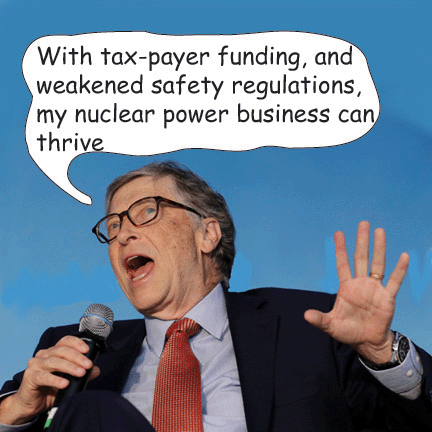
| Taxpayers should not fund Bill Gates’ nuclear albatross https://thinkprogress.org/nuclear-power-is-so-uneconomical-even-bill-gates-cant-make-it-work-without-taxpayer-funding-faea0cdb60de/
Nuclear power is so uneconomical even Gates can’t make it work without billions from taxpayers. JOE ROMMFEB 4, 2019Nuclear power is so uneconomical that even Bill Gates, who is worth $90 billion, can’t make it work without massive taxpayer funding. Gates has been going around Capitol Hill in recent weeks trying “to persuade Congress to spend billions of dollars over the next decade… for a pilot of his company’s never-before-used technology, according to congressional staffers,” the Washington Post reported. “This plea for federal largesse from a decabillionaire illustrates why further nuclear subsidies make no sense,” energy and finance expert Greg Kats writes in a forthcoming article for GreenBiz.com shared with ThinkProgress. Kats served as director of finance for the Department of Energy’s (DOE) Office of Energy Efficiency and Renewable Energy in the mid-1990s. (Disclosure: The author of this piece worked with Kats at the time as DOE acting assistant secretary.) The reality is that nuclear power is so uneconomical that existing U.S. nuclear power plants are bleeding cash — and in many places it’s now cheaper to build and run new wind or solar farms than to simply run an existing nuclear power plant. Saving the existing unprofitable nuclear plants would require a subsidy of at least $5 billion a year, according to an analysis last July by the Brattle Group. So, given existing plants are so uneconomic, it’s no shock that building and financing an entire new fleet of nuclear plants is wildly unaffordable — especially since a new nuclear plant can cost $10 billion or more. The nuclear industry has effectively priced itself out of the market for new power plants, at least in market-based economies. That’s why nuclear power’s share of global power generation has dropped to around 11 percent — its lowest level in decades. The November “Cost of Energy Analysis 2018” by the financial firm Lazard Ltd makes clear just how untenable nuclear power is. Even worse for nuclear, the price of electricity from new renewable plants and new nuclear plants have been headed in opposite directions for this entire decade. Lazard reports that since 2010, the cost of wind power has dropped by 66 percent, the cost of solar power has dropped 83 percent, but the cost of nuclear power has increased by more than 50 percent. The average lifecycle cost of electricity from new nuclear plants is now $151 per megawatt-hour, or 15.1 cents per kilowatt-hour (c/kWh). Meanwhile it is 4.3 c/kWh for utility scale solar and 4.2 c/kWh for wind. By comparison, the average price for electricity in the United States is under 11 cents per kWh. Gates and his company, TerraPower, are working on so-called small modular reactors (SMRs), which use unproven next-generation technology and would be much smaller than current nuclear plants. Gates claims that this technology is needed in order to help drive down the price of nuclear power. But the reality is that an SMR “worsens” the cost problem, as physicist M.V. Ramana explained in a December 2017 analysis. “Larger reactors are cheaper on a per megawatt basis,” Ramana pointed out, “because their material and work requirements do not scale linearly with generation capacity.” In short, bigger reactors deliver cheaper power than smaller ones — that’s why the industry has kept scaling up the size over the years. Yet in 2016, a major study by South Australia’s nuclear royal commission concluded that both large nukes and SMRs “consistently deliver strongly negative NPVs” (net present values) for both 2030 and 2050 — even for the strong climate action scenario. In other words, both large and small nuclear plants are projected to be unprofitable even in a future where carbon pollution has a high price. Even the nuclear-friendly French — who get 70 percent of their power from nuclear — can’t build an affordable, on-schedule next generation power plant. Last summer, for instance, the French utility EDF announced another delay and cost over-run for what would be the country’s first “third-generation” pressurized water reactor. Power magazine reported the price tag has “ballooned to €10.9 billion (USD $12.75 billion), triple the original budget.” As for Gates’ TerraPower, analysts looking at the company’s specific design approach say the technology is just not ready for primetime. Last year, a major Massachusetts Institute of Technology report by nuclear power experts concluded such designs “require advances in fuel and materials technology to meet performance objectives.” The company itself told the Washington Post in an email that it “has been researching new steel alloys.” But such alloys would need to be tested for years if not decades to prove they can withstand the intense bombardment of neutrons over the lifetime of the reactor. The reality is that next generation nuclear power is still at the research phase. It is far from ready for a pilot that would be so expensive that even the world’s second richest man (after Amazon’s Jeff Bezos) isn’t willing to finance it himself, but has to go begging for federal money. Gates asserted in a year-end blog post that “Nuclear is ideal for dealing with climate change, because it is the only carbon-free, scalable energy source that’s available 24 hours a day,” But in fact, battery storage costs have plummeted this decade some 80 percent, meaning that we can increasingly use wind power when it isn’t windy and solar power when it isn’t sunny. In places like Colorado, both wind power with storage and solar power with storage are vastly cheaper than new nuclear plants. Indeed, new Colorado wind farms with batteries already provide power at the same price as just running existing nuclear power plants. Certainly, the climate crisis demands that we pursue all practical and economical approaches to cutting carbon pollution. And even some environmental groups are in favor of keeping existing nuclear plants running longer. But as Kats explained, right now, new nuclear power plants are just far too expensive. What’s more, major investments in multibillion-dollar pilots and reactors could actually take away funds from clean energy technologies that would reduce vastly more That’s not to say we shouldn’t keep investing in nuclear power research in the hope that someday it becomes affordable. But given that we must make deep cuts in carbon pollution this decade to even have a chance of avoiding catastrophic climate change, we must focus the vast majority of our money today on vastly more affordable carbon-cutting technologies. |
Belgium heading for a nuclear-free future
Looking towards Belgium’s nuclear-free future, Power Technology By
The recent closure of six out of seven nuclear reactors raised concerns over the ability of Belgium to cope without its nuclear power in the coming months. How will the country react and what lessons can the power industry learn when looking forward to the 2025 nuclear phase-out plan? ……….
Reasons for the closures
The closure of six of the nuclear reactors was for various unplanned reasons, but linked to nuclear safety, according to Engie Electrabel.
Engie Electrabel spokesperson Hellen Smeets says: “Some of our reactors [Doel 3 and 4, Tihange 1 and 2] have been under inspection programmes regarding the concrete on the ceilings of the bunkers. Those bunkers are right next to the reactor and we have noticed a bit of deterioration of the concrete because in those specific bunkers there were pipes where there was a lot of steam.”
The high levels of steam made the bunkers very hot and moist, and so a small amount of degradation occurred to the concrete ceiling.
Meanwhile, other reactors were in the stages of planned overhaul, in order to extend their life by ten years…………
The approach taken by the Belgium power industry to handle any potential power shortages this winter could pose some interesting challenges and solutions when looking forward to the country’s nuclear phase-out plan.
The draft bill for Belgium to become a nuclear-free country, known as the Energy Pact, was announced in December 2017. In October 2018, the government confirmed its commitment to the pledge as long as alternative sources are found to meet demand in the next seven or so years. It’s no small feat, as the seven nuclear reactors contribute around 6GW of energy capacity, which would need to be replaced.
The solution could be simpler than replacing the huge amount of capacity supplied by the nuclear plants. If the whole population, both businesses and residents, can reduce its energy consumption, then there will be less of a strain on energy companies to meet demand.
Smeets says: “The big question is how will Belgium cope if that [2025] decision stands? I think we should really think about how to be as efficient as possible. Energy efficiency is really important.
“If we all consume less electricity there wouldn’t be the need to produce more and more. There wouldn’t be the need to replace all capacities, so I think we should really look into that and try to work on that because there is a lot of opportunity for everyone.”
Interestingly, large swathes of power consumption in Belgium are used for powering its old, energy inefficient buildings, according to Engie Electrabel.“We can help people, firms, and authorities to help make their buildings more energy efficient and consume less energy. I think there is a lot of opportunity there,” says Smeets.
“There are a lot of old buildings in Belgium and I think around 40% of energy consumption in Belgium goes into powering buildings – not industry, but buildings. If we could reduce the electricity consumption in buildings that would get us somewhere.”
Looking forward, Engie also plans to invest more in its renewables business, such as wind power.
“We have a lot of wind turbines and we are definitely looking further into expanding that and biogas, hydraulic power stations, etc. We think that is the future. So we are really trying to work on and expand that side of our services,” adds Smeets……..https://www.power-technology.com/features/belgiums-nuclear-free-future/
Utah Senate committee calls for nuclear power – not everyone is happy
Nuclear power in Utah? Senators say ‘yes, please,by Michael Locklear, February 5th 2019 , SALT LAKE CITY (KUTV) — State lawmakers are considering a non-binding resolution welcoming nuclear power to Utah, although opponents are concerned about the radioactive waste it would generate.
It “recognizes that advanced nuclear technology is a safe, resilient, and environmentally sustainable energy resource.”……..
Utah Associated Municipal Power Systems, working with a company called NuScale, is planning a nuclear facility to be built in Idaho. It’s now moving through the regulatory process. Construction could begin in 2026. ………
Michael Simpson, the chair of the University of Utah’s metallurgical engineering department said nuclear power is cleaner, but he raised concerns about the cost and the nuclear waste.
“The state of Utah should be wary of starting a project to build a nuclear reactor if there’s no place for them to send the fuel,” Simpson said.
“It really is incredibly poisonous stuff,” said Michael Shea of the environmental nonprofit HEAL Utah, “and even if they can store it within the site itself, there’s still a lot of potential for contamination or accidents.” ………
A spokeswoman for Rocky Mountain Power said the utility had no plans to build a nuclear facility, with a statement that reads: “Our most recent Integrated Resource Plan (2017 IRP) included a cost analysis that reflected nuclear generation to be more costly than other resources. However, we are always evaluating emerging technologies to support future needs.”
The resolution now moves to the full Senate. https://kutv.com/news/local/nuclear-power-in-utah-senators-say-yes-please
New Hampshire must say no to nuclear war
Events here at home and abroad have brought renewed attention to this issue. Americans have suddenly realized that U.S. presidents have authority to order a nuclear weapon strike without consulting anyone. Just one phone call and hundreds of U.S. nuclear missiles can be launched in less than 10 minutes. Meanwhile, national security experts are speculating about a renewed nuclear arms race as the U.S. and Russia develop new nuclear weapons and the U.S. prepares to withdraw from arms control treaties, including the landmark 1987 Intermediate-range Nuclear Forces (INF) Treaty that President Ronald Reagan signed with Soviet leader Mikhail Gorbachev. Both sides accuse the other of violating the treaty.
Cities and towns across New Hampshire and the country – including Durham and New London, N.H., Baltimore, Los Angeles and Portland, Maine – are passing resolutions calling on the United States to limit the risk of nuclear war by changing U.S. policies. About a dozen other New Hampshire cities are considering following suit. California and the U.S. Conference of Mayors have passed similar resolutions. Organizations including the Unitarian Universalist Association, Union of Concerned Scientists, Federation of American Scientists and Physicians for Social Responsibility have joined the call.
The resolutions recommend a number of steps that would make nuclear war less likely. Most importantly, they call on the U.S. to state that it will never use a nuclear weapon first; no U.S. president should ever start a nuclear war.
The N.H. General Court may be the next to take a position on this issue. The State-Federal Relations and Veterans Affairs Committee in the N.H. House will hold a hearing today on HCR 7, a resolution introduced by Rep. Chuck Grassie that calls on the U.S. to establish a “no first use” policy.
If enacted, the measure would throw New Hampshire’s support behind legislation, introduced in Congress last week by House Armed Services Committee Chair Adam Smith and Senate Armed Services Committee member Elizabeth Warren, to make it U.S. policy not to use nuclear weapons first.
As the world’s most powerful country, the only reason the U.S. needs nuclear weapons is to deter a nuclear attack on America or its allies. The threat that the U.S. may use its nuclear weapons first is counterproductive and could prompt a pre-emptive strike from a nuclear-armed adversary if it feared a U.S. nuclear launch was imminent.
Knowing that the U.S. could respond to a nuclear attack with its own nuclear strike, however, is a real deterrent; that is the message a no-first-use policy would send to the rest of the world.
When cities and states enact resolutions like the one before the N.H. Legislature, it sends a strong message to Washington decision-makers, both in Congress and the White House, that they must act for the safety of all Americans.
(Mindi Messmer of Rye is an environmental scientist working with the Union of Concerned Scientists and a former N.H. state representative.)
UK: The Nuclear Free Local Authorities (NFLA) calls for a more thorough plan for nuclear wastes and phaseout of nuclear power
NFLA 5th Feb 2019 The Nuclear Free Local Authorities (NFLA) publishes today its views on the proposed Scottish Nuclear Sector Plan document being consulted on by the Scottish Environmental Protection Agency (SEPA).
SEPA has been consulting
on its draft Nuclear Sector Plan with ‘considerable input’ from the
nuclear industry. The plan is SEPA’s vision of how regulations will be
enforced to ensure that the nuclear industry is fully compliant with its
environmental obligations and is encouraged to go beyond compliance with
environmental regulations to ensure that environmental impacts are
minimised. SEPA has asked for public comments on its draft plan. SEPA says
its draft plan is ‘ambitious’.
The Nuclear Free Local Authorities
(NFLA) rather thinks it should be much more ambitious, recognising that
nuclear power has no medium or long-term place in a sustainable economy,
and that the ‘nuclear waste hierarchy’ should be re-thought to maximise
the protection of the public. The NFLA Scottish Forum has also decided to
respond to SEPA’s consultation by publishing within it its own vision of
a Scotland where nuclear power generation is phased out and the wastes
remaining are managed according to a clear set of environmental principles.
ttp://www.nuclearpolicy.info/news/nfla-views-sepa-scottish-nuclear-sector-plan-decommissioning-nuclear-phase-out-alternative-energy-vision/
How the utilities financial system is rigged to give the nuclear industry the advantage
|
UK Turns Away From Nuclear As Poland Prepares To Embrace It, Clean Technica, February 4th, 2019 by Steve Hanley
…… Nuclear advocates insist atom-powered generating plants are safe in much the same way fossil fuel advocates insist pipelines and supertankers are safe. What they mean is that when things go wrong, the damage can be easily contained and the amount of human suffering is a small price to pay for the enormous profits to be made in the meantime. …….Spent fuel remains dangerously radioactive for thousands of years and nuclear facilities require massive amounts of water to keep things cool inside the containment area. One of the primary reasons nuclear power is beloved by utility companies is because they are guaranteed a certain rate of return on their investments. In order to make more money, spend more money. The way the electric utility game is rigged, customers are automatically saddled with the cost of paying for all new investments made by the companies, often for decades. Once the decision to build a nuclear power plant is made, the cost to pay for it goes on for 30, 40, or more years, even if new, less expensive technology becomes available in the meantime. Nuclear Projects Abandoned In UKHitachi has been planning to build a new nuke on the Welsh island of Anglesey on the site of a previous power plant decommissioned in 2015. However, it has now notified the UK government that it will abandon that project unless the government commits major new financial resources to bring the $26 billion facility to completion. Hitachi has already sunk nearly $3 billion into the proposed Wylfa Newydd project. Last November, another UK nuclear power project in Cunbria, to be built by Toshiba, was abandoned, leaving UK utility customers on the hook for hundreds of millions of dollars already invested by National Grid to build the transmission lines needed to connect that facility to the grid. According to the The Times of London, ratepayers will be paying for those losses for decades via surcharges added to their energy bills. Another Japanese company — Mitsubishi — has also withdrawn recently from a proposal to build a nuclear power plant in Turkey according to Nikkei Asian Review. What is the reason for so many abandonments of nuclear power projects? Money. Investors are looking down the road and seeing renewables getting less expensive. If it takes 30 years or more to recover the cost of a nuclear plant, what are the odds that it will still be making a profit in 2050? If you said somewhere between zero and none, go to the head of the class. Renewables To Blame For Nuclear WoesForbes reports on a rather startling announcement. Greg Clark, the government minister in charge of the UK energy board, told Parliament recently, “The cost of renewable technologies such as offshore wind has fallen dramatically, to the point where they now require very little public subsidy and will soon require none. We have also seen a strengthening in the pipeline of projects coming forward, meaning that renewable energy may now not just be cheap, but also readily available.” In all, three new nuclear plants in the UK are now likely to be abandoned. Together, they were expected to provide up to 15% of the nation’s energy needs in the future. How will the country make up for the loss of that capacity? Forbes says an analysis by the UK Energy and Climate Intelligence Unit shows renewables will do the heavy lifting needed to keep all British tea pots boiling happily for decades to come. Jonathan Marshall, head of analysis at the ECIU says, “In recent years, government has quietly cut back its expectations for nuclear new-build and that’s looking more and more realistic as the price of renewable generation falls and the benefits of the flexible smart grid become more apparent. Filling the nuclear gap with renewables would indeed require an increase in rollout, but one that is well within UK capabilities. With enough focus on smart low-carbon energy, there’s no reason why Britain shouldn’t achieve all its energy objectives despite the cancellation of these nuclear stations.” In particular, the ECIU analysis found a combination of an additional 11.3 GW of onshore wind, 5.7 GW of offshore wind, and 20.8 GW of new solar capacity would be sufficient to fill the nuclear gap. Hitting those targets should be easy, given the acceleration of installed renewable energy capacity taking place today. Poland Set To Move Forward With Its First NukeDespite the hoopla about renewables in the rest of the world, Poland, which currently gets 80% of its electricity from burning coal, expects to move forward with plans to build its first nuclear power plant. The 1.5 GW facility, which could go online by 2033, will be the first of several nukes the country expects to build as it prepares to increase its installed power portfolio to 73 GW as compared to 40 GW today. It expects nuclear power to provide about 10% of that total………. The Polish plan will still see about 60% of the nation’s energy come from burning coal in 2030 with most of the lignite burning facilities being shut down around 2040 or so. Which raises this question. If solar and wind installations can be designed, built, and brought online within a matter of years, why spend $20 billion on last century technology that will take a decade or more before it begins contributing to the nation’s energy supply? A Timid Response To An Urgent ProblemThe answer to that question reveals everything that is wrong with the way most nations are tiptoeing around the global warming emergency. Make lots of flowery promises. Give the people huge helpings of pie in the sky pronouncements. But go as slowly and timidly as possible into the future while funneling profits into well connected pockets all the while. The truth is, the utility industry is used to thinking in terms of 30 to 40 year timelines. It is widely seen as the most risk averse industry in the world. “What was good enough for our grandfathers is good enough for us. Stick with what has worked in the past. Don’t take a chance on new technology that might upset the apple cart.” The problem is, the world can’t wait for the utility industry to dither and dawdle its way to tomorrow. We need bold, decisive action now to slash carbon emissions today, not in 2040. By then it will be too late. Poland may be proud that it is about to get its first nuke. But by celebrating that move, it is admitting it has no realistic plan for protecting its citizens — or the rest of the global community — from the ravages of a warming planet. Just as the UK can obtain all the energy it needs from renewables instead of nuclear facilities, so can Poland, if it only could find the political will to do so. Tepid responses to a global emergency are the things that will doom us all to a planet incapable of supporting human life for many. Poland’s epitaph may well be, “Too little, too late.” https://cleantechnica.com/2019/02/04/uk-turns-away-from-nuclear-as-poland-prepares-to-embrace-it/
|
|
Japan’s propaganda about Fukushima’s ‘recovery’- getting people back to nuclear irradiated areas
The returning residents of Fukushima’s nuclear disaster
Near site of Fukushima nuclear disaster, a shattered town and scattered lives, WP, By Simon Denyer, February 3 2019 NAMIE, Japan — Noboru Honda lost 12 members of his extended family when a tsunami struck the Fukushima prefecture in northern Japan nearly eight years ago. Last year, he was diagnosed with cancer and initially given a few months to live.
Today, he is facing a third sorrow: Watching what may be the last gasps of his hometown.
For six years, Namie was deemed unsafe after a multiple-reactor meltdown at the Fukushima Daiichi Nuclear Power Plant following a 2011 earthquake and tsunami.
In March 2017, the government lifted its evacuation order for the center of Namie. But so far, hardly anyone has ventured back.
Its people are scattered and divided. Families are split. The sense of community is coming apart.
“It has been eight years; we were hoping things would be settled now,” the 66-year-old Honda said. “This is the worst time, the most painful period.”
For the people of Namie and other towns near the Fukushima plant, the pain is sharpened by the way the Japanese government is trying to move beyond the tragedy, to use the 2020 Tokyo Olympics as a symbol of hope and recovery, a sign that life can return to normal after a disaster of this magnitude.
Its charm offensive is also tied up with efforts to restart the country’s nuclear-power industry, one of the world’s most extensive networks of atomic power generation.
Six Olympic softball games and a baseball game will be staged in Fukushima, the prefecture’s bustling and radiation-free capital city, and the Olympic torch relay will start from here.
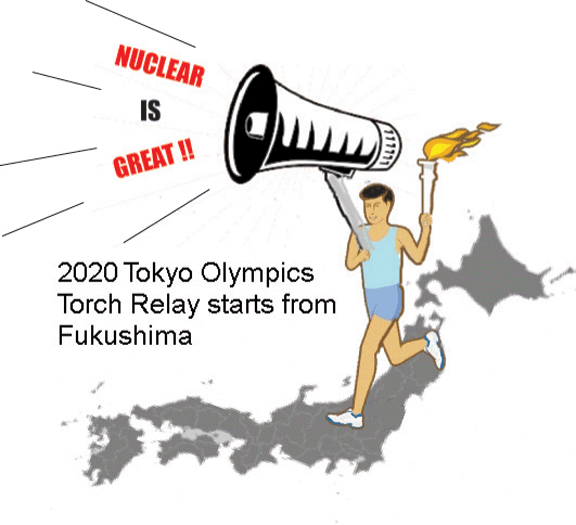
But in Namie, much closer to the ill-fated nuclear plant, that celebration rings hollow, residents say.
This was a close-knit community of farmers, fishermen and potters — of orchards, rice paddies and cattle sandwiched between the mountains and the sea. It was a place where people celebrated and mourned as a community, and families lived together across generations.
That’s all gone. On the main street, a small new shopping arcade has opened. But a short walk away, a barber shop stands abandoned, its empty chairs gathering years of dust. A sign telling customers to make themselves at home is still displayed in a bar, but inside debris litters the floor. A karaoke parlor is boarded up. Wild boars, monkeys and palm civets still roam the streets, residents say.
Just 873 people, or under 5 percent, of an original population of 17,613 have returned. Many are scared — with some obvious justification — that their homes and surroundings are still unsafe. Most of the returnees are elderly. Only six children are enrolled at the gleaming new elementary school. This is not a place for young families.
Four-fifths of Namie’s geographical area is mountain and forest, impossible to decontaminate, still deemed unsafe to return. When it rains, the radioactive cesium in the mountains flows into rivers and underground water sources close to the town.
Greenpeace has been taking thousands of radiation readings for years in the towns around the Fukushima nuclear plant. It says radiation levels in parts of Namie where evacuation orders have been lifted will remain well above international maximum safety recommendations for many decades, raising the risks of leukemia and other cancers to “unjustifiable levels,” especially for children.
In the rural areas around the town, radiation levels are much higher and could remain unsafe for people to live beyond the end of this century, Greenpeace concluded in a 2018 report.
“The scale of the problem is clearly not something the government wants to communicate to the Japanese people, and that’s driving the whole issue of the return of evacuees,” said Shaun Burnie, senior nuclear specialist with Greenpeace. “The idea that an industrial accident closes off an area of Japan, with its limited habitable land, for generations and longer — that would just remind the public why they are right to be opposed to nuclear power.”
Today, Namie’s former residents are scattered across all but one of Japan’s 47 prefectures. Many live in the nearby town of Nihonmatsu, in comfortable but isolating apartment blocks where communal space and interaction are limited. With young people moving away, the elderly, who already feel the loss of Namie most acutely, find themselves even more alone.
………. many residents say the central government is being heavy handed in its attempts to convince people to return, failing to support residents’ efforts to build new communities in places like Nihonmatsu, and then ending compensation payments within a year of evacuation orders being lifted. …….https://www.washingtonpost.com/world/asia_pacific/near-site-of-fukushima-nuclear-disaster-a-shattered-town-and-scattere
America’s Environmental Protection Agency appoints a radiation sceptic to head radiation panel
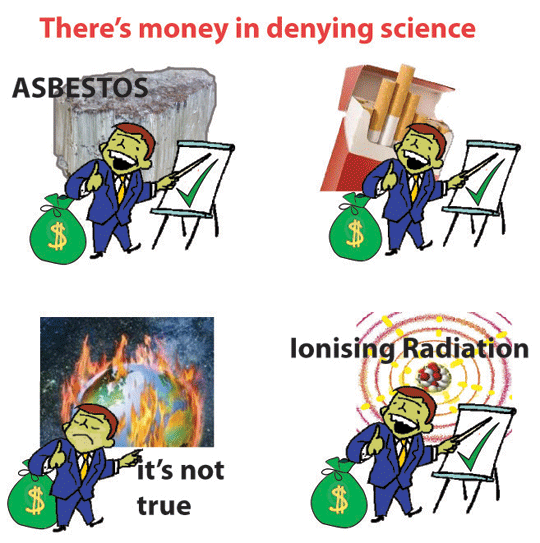
Brant Ulsh, skeptic on radiation limits, to head EPA radiation panel, Japan Times, 2 Feb 19, WASHINGTON  – The Environmental Protection Agency has appointed a scientist who argues for easing regulations on lower-level radiation exposures to lead the agency’s radiation advisory committee.
Acting EPA head Andrew Wheeler on Thursday announced the appointment of Brant Ulsh, a health physicist, as one of the EPA’s science advisers and the panel’s chairman. Ulsh has been a leading critic of the EPA’s decades-old position that exposure to any amount of ionizing radiation is a cancer risk.
In a paper he co-wrote last year, Ulsh and a colleague argued that the position was based on outdated scientific information and forced the “unnecessary burdens of costly clean-ups” on facilities working with radiation.
The EPA under President Donald Trump has targeted a range of environmental protections, in line with Trump’s arguments that overly strict environmental rules have hurt U.S. businesses. Environmental and public health advocates say the rollbacks threaten the health and safety of Americans.
Some environmental groups and scientists have criticized what they say is the administration’s openness to an outlier position on radiation risks.
“Once again the Trump administration is moving to the fringe for its scientific advice, choosing someone who could undercut foundational protections from radiation,” Bemnet Alemayehu, a staff scientist at the Natural Resources Defense Council environmental advocacy group, said in a statement Friday. “We need sound science to dictate health protections, not dangerous theories.”
EPA spokesman John Konkus declined comment Friday, referring a reporter to a news release announcing the appointment.
Ulsh did not immediately respond to an email Friday asking for comment, including whether he intended to use the advisory position to encourage reconsideration of the EPA’s no-tolerance policy on lower doses of radiation exposure……… https://www.japantimes.co.jp/news/2019/02/02/world/science-health-world/brant-ulsh-skeptic-radiation-limits-head-epa-radiation-panel/#.XFdRStIzbGg
Countries going into deep nuclear debt to Russia; Hungary the latest victim of this political blackmail
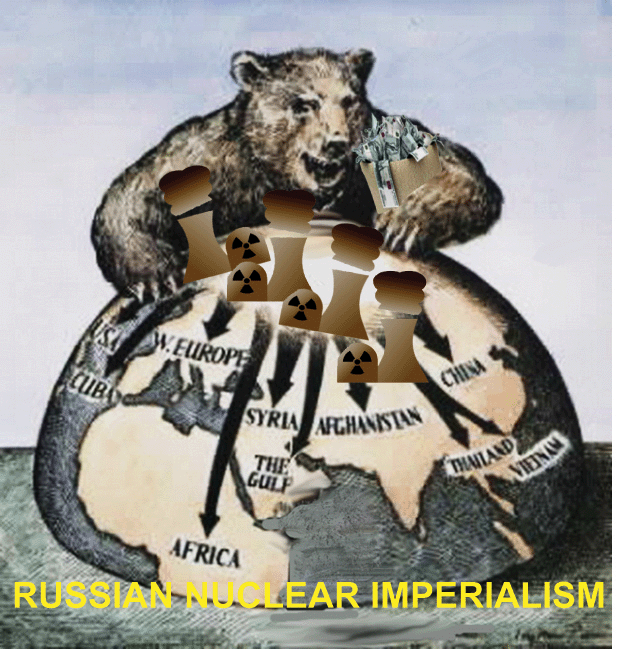
Hungary seeks to postpone loan payback to Russia for Nuclear power plant: What will the final cost be?Bellona February 1, 2019 by Charles Digges Budapest is seeking to modify the terms of a loan it must repay to Russia for building two new VVER-1200 type reactors that will eventually replace Hungary’s Paks nuclear power plant, according to a report from Reuters.
The reactors, which will constitute a plant called Paks II, will be built by Rosatom, Russia’s state nuclear power company, at a cost of 10 billion euro ($12 billion), and will replace the older Soviet-built nuclear plant that supplies half of the country’s electricity.
Rosatom’s construction contract, which includes the loan for Paks II, was the subject of a hotly-debated probe by the EU’s Organization for Economic Co-Operation and Development, which investigated whether the Russian bid violated European competition statutes.
At the time, EU officials and commentators viewed the deal as a Trojan Horse to help cement Moscow’s influence over the right-leaning, rabidly anti-globalist government of Hungarian Prime Minister Viktor Orban.
The EU eventually dropped its investigation in 2017 and granted Hungary permission to build the reactors – partly in an effort to entice Orban, who was insistent about contracting Rosatom, back into the democratic fold. Now Budapest is citing the delay caused by the competition review as reason to renegotiate when it begins paying Rosatom back.
Hungarian financial authorities plan to ask Moscow to postpone collecting on the debt until after the new reactors begin to generate electricity – but it is as yet unclear whether Rosatom will accept new terms. The plant’s construction, meanwhile, is running late. The build was supposed to begin last year………
While the terms of the Paks II loan remain in the shadows, other financing arrangements Moscow has made for building nuclear reactors in other countries suggest that the interest alone could prove to be very expensive for Budapest.
An $11.4 billion, 30-year agreement Rosatom signed with Bangladesh to build the Roopur nuclear plant will net Moscow $8 billion in interest. A $25 billion deal Rosatom is pursuing with Egypt to build that country’s Dabaa plant could, over the 35-year term of that loan, swell to $71 billion.
Another enormous $76 billion deal between Rosatom and South Africa was eventually thwarted by environmentalists when it was revealed the project had been secretly negotiated. Had the deal held it would have siphoned off a quarter of South Africa’s gross domestic product before the reactors even began operation.
Terms like this could spell trouble for Hungary in light of Moscow’s tendency to be a kneecapping creditor when it comes to energy projects – especially when Russia sours on the politics of its debtors.
In 2014, at the height of East-West tensions over Russia’s annexation of Crimea, Kremlin officials threatened to cut nuclear fuel supplies to Ukraine’s Soviet built reactors – which would have interrupted their chain reactions and likely caused a catastrophic accident.
Rosatom eventually walked the threat back. But the lurid message in Moscow’s head-fake toward igniting a second Chernobyl was clear: Russian-built reactors are a useful new tool for political blackmail………..
Many in Europe – Hungary included – subsequently sought to diversify their energy supply in favor of nuclear. Yet, in a devious twist, Rosatom has emerged as the most stable and eager nuclear builder on the international market.
For now, Rosatom can afford to offer risky loans thanks to the enormous state subsidies it receives. These subsidies can be funneled into more loans, and the loans then boost the company’s profits on paper. But for the past several years, it has become clear that these subsidies to the company will likely decrease or dry up altogether in 2020.
As a result, Rosatom is amassing so-called memorandums of understanding from any country vaguely interested in nuclear power. The company says is currently has dozens of these MOUs amounting to more than $130 billion in incoming business.
But that claim should be viewed skeptically, as many of the countries for which Rosatom is promising to build reactors – countries like Jordan, Algeria, Nigeria, the Republic of Congo and Bolivia – won’t have the infrastructure to support nuclear power for decades.
For now, it’s not difficult to imagine Moscow extending the terms of its loan to Hungary for as long as Budapest likes. It will, after all, remain profitable on paper. But in the end, Budapest will be left holding the bag for Rosatom’s over extended balance sheet. But so long as Orban’s government continues it rightward lurch, Moscow is unlikely to call in its marker. http://bellona.org/news/nuclear-issues/2019-02-hungary-seeks-to-postpone-loan-payback-to-russia-for-nuclear-power-plant-what-will-the-final-cost-be
There’s money in climate denialism, as 150 U.S. Congressional Republicans have found!

 150 Congressional Republicans Represent Fossil Fuel Companies Instead of Their Communities https://www.desmogblog.com/2019/01/30/150-congressional-republicans-climate-deniers-fossil-fuel-companies?utm_source=dsb%20newsletter , January 30, 2019 by ClimateDenierRoundup.Last week, we mocked the fossil fuel industry’s use of an outlet it owns to brag about perverting democracy — but we didn’t actually call out the politicians in the industry’s pocket.
Lucky for us, the Center for American Progress Action Fund did just that this week. A new analysis from CAP tallies up the climate deniers in the 116th Congress. As it turns out, there are a lot: 150.
But that’s actually an improvement from last year, when there were 180. Of those 180, 47 are no longer serving: 22 were defeated in 2018, 16 retired, five resigned, and four went to other positions.
United States 150 out of 335 United States Members of Congress are climate deniers, collecting $68,359,582 in dirty money.
Top recipients
Mitch McConnell (R) – $3,018,793
Jim Inhofe (R) – $2,111,110
John Cornyn (R) – $3,444,515
Ted Cruz (R) – $3,372,000
Kevin Brady (R) – $1,753,762
The number of climate deniers receiving fossil fuel funding elected to the 116th Congress. Credit: Center for American Progress Action Fund
This may explain why the industry was so keen last week to assert the influence their money has. As it turns out, taking the cash may actually be a bad move for a candidate, since fossil-fuel funded candidates lost 30 seats in the 2018 elections (not factoring in the myriad of other factors at play, of course).
And make no mistake — it is the fossil fuel industry that demands denial, not average Americans. CAP Action Fund cites polling that shows a majority of Americans, including Republicans, know that climate change is real, that it is making weather more extreme, and that we should take action to reduce fossil fuel use.
Exact numbers obviously depend on the poll, but by and large it’s safe to say that a majority of all Americans, including some 55 percent to 66 percent of Republicans, support various types of climate action, including the policies in the Green New Deal.
What drives politicians to take positions opposed by the majority of people who vote for them? Well, money, of course. That’s why the report comes with a nifty interactive that shows you how many of each state’s members of Congress are in denial, as well as how much money they’ve received directly from the fossil fuel industry.
Mitch McConnell and Jim Inhofe top the list at $3 million and $2 million in dirty money over their careers, while the lifetime average among the 150 deniers is a scant $455,731 — which certainly sounds low. But that doesn’t include money spent on outside PACs and support.
The Kochs, for example, planned to spend $400 million on the 2018 election. That doesn’t include the additional money the Kochs spend bankrolling fake news operations like the Daily Caller. And even that’s hardly the only fossil fuel propaganda outlet! For example, there’s the Western Wire, where two of their writers, who also work as public relations strategists representing Exxon, recently posed as reporters to try and get information about one of the Exxon cases.
Australian Labor Party stands firm against nuclear industry development

 Excerpt from radio interview, MARK BUTLER MP SHADOW MINISTER FOR CLIMATE CHANGE AND ENERGY
E&OE TRANSCRIPT, RADIO INTERVIEW, ABC RN BREAKFAST, 22 JANUARY 2019
KELLY: You’re listening to RN Breakfast; our guest is the Shadow Climate and Energy Minister, Mark Butler. Mark Butler, Tanya Constable who is the Chief Executive of the Minerals Council of Australia is today proposing in news.compapers that nuclear energy be allowed to be developed as a zero emissions fuel. She says Australia will only be catching up with the rest of the world, there are new technologies in this area ready to be deployable, they produce zero emissions and thirty other countries around the world use them. Is Labor prepared to exercise or even consider that option?
BUTLER: No, this is not a technology that has any opportunity for Australia. There are legal barriers to it, which we reindorsed at our National Conference just before Christmas as Labor Party policy. Where nuclear power is being explored, new nuclear power plants around the developed world in particular, for example the UK, it is extraordinarily expensive power as well. Rather than focus on these sorts of technologies that really are of no practical use to Australia, we want to focus on renewable energy which is going to bring down emissions, bring down power prices, and power thousands and thousands of jobs.
North Dakota Community Alliance urges public to watch progress of Bill on high-level radioactive waste
|
Concerned citizens track bill on high-level radioactive waste, AMY DALRYMPLE Bismarck Tribune, MIKE MCCLEARY, TRIBUNE, 3 Feb 19,
|
|
1 This Month





PLEASE OPPOSE HR 8255 AND S.3639 – bills would accelerate satellite deployment, with no environmental review or safeguards – https://ncstd5li.quorum.us/campaign/169331/
To see nuclear-related stories in greater depth and intensity – go to https://nuclearinformation.wordpress.com
-
Archives
- October 2026 (91)
- September 2026 (339)
- August 2026 (330)
- July 2026 (355)
- June 2026 (287)
- May 2026 (306)
- April 2026 (356)
- March 2026 (251)
- February 2026 (267)
- January 2026 (308)
- December 2025 (358)
- November 2025 (359)
-
Categories
- 1
- 1 NUCLEAR ISSUES
- business and costs
- climate change
- culture and arts
- ENERGY
- environment
- health
- history
- indigenous issues
- Legal
- marketing of nuclear
- media
- opposition to nuclear
- PERSONAL STORIES
- politics
- politics international
- Religion and ethics
- safety
- secrets,lies and civil liberties
- spinbuster
- technology
- Uranium
- wastes
- weapons and war
- Women
- 2 WORLD
- ACTION
- AFRICA
- Atrocities
- AUSTRALIA
- Christina's notes
- Christina's themes
- culture and arts
- Events
- Fuk 2022
- Fuk 2023
- Fukushima 2017
- Fukushima 2018
- fukushima 2019
- Fukushima 2020
- Fukushima 2021
- general
- global warming
- Humour (God we need it)
- Nuclear
- RARE EARTHS
- Reference
- resources – print
- Resources -audiovicual
- Weekly Newsletter
- World
- World Nuclear
- YouTube
-
RSS
Entries RSS
Comments RSS

