JUSTIN TRUDEAU FACES CALLS TO RESIGN RE: SNC-LAVALIN SCANDAL
As reported by Newsweek.
Liberal Party Canadian Prime Minister Justin Trudeau now faces calls from his Conservative Party challenger in this autumn’s election to resign over a scandal involving SNC-Lavalin, a giant engineering firm based in Montreal, Quebec. SNC-Lavalin has been accused of bribery, fraud, and other corruption over its practices in Libya. If convicted of such  wrongdoing, SNC-Lavalin could be barred from Canadian federal contracts for a decade. (SNC-Lavalin has been previously barred for a decade from World Bank contracts.)
Holtec International has teamed with SNC-Lavalin to form a nuclear power plant decommissioning consortium. Already, the Holtec/SNC-Lavalin consortium has taken over ownership of the permanently shutdown Oyster Creek atomic reactor in NJ. This includes on-site irradiated nuclear fuel management.
Holtec & SNC-Lavalin are also vying for taking over the ownership of such other soon-to-be decommissioning nuclear power plants as Pilgrim in MA, and Palisades in MI.
Holtec is also the proponent for a national centralized interim storage facility for irradiated nuclear fuel in southeastern New Mexico.
Its partnership with a corrupt company like SNC-Lavalin calls into question Holtec’s own judgment.
 However, Holtec itself has engaged in bribery, at the Tennessee Valley Authority’s Browns Ferry nuclear power plant; in addition, Holtec CEO Krishna Singh has been accused by whistleblowers Oscar Shirani (Commonwealth Edison/Exelon) and Dr. Ross Landsman (NRC Region 3) of attempting to bribe them into silence, re: QA violations (see below).
And Holtec CEO Krishna Singh has also made racist remarks re: his own African American and Puerto Rican American workers in Camden, NJ.
Holtec is also infamous for QA (Quality Assurance) violations in the manufacture of its irradiated nuclear fuel canisters, brought to light by whistleblowers.
See these previous Beyond Nuclear website posts, for more info. on concerns re: SNC-Lavalin:…….. http://www.beyondnuclear.org/centralized-storage/
March 9, 2019
Posted by Christina Macpherson |
Canada, politics, secrets,lies and civil liberties |
3 Comments
Times 7th March 2019 Britain needs a new economy that works for everyone and to move beyond the
old, broken systems and status quo that left many people behind. A green
new deal for the UK could give us just that. Climate change has muscled its
way back onto the political agenda. It was debated by MPs last week for the
first time in two years.
It seems that the momentum around Alexandria
Ocasio-Cortez and Senator Ed Markey’s green new deal in the US, the
audacious climate march on Westminster by schoolchildren last month and
increasingly rising temperatures may have finally jolted our politicians
out of their climate stupor.
Four months ago, a group of experts on the
Intergovernmental Panel on Climate Change (IPCC) delivered the news that
the world must halve carbon emissions in a little over a decade. Responding
would require an almighty push to green our economy – one that would touch
on every aspect of our lives.
Despite this stark warning from scientists,
the political establishment in Westminster barely flinched. There was no
commitment to redouble our efforts, no renewed urgency or call to action.
Instead, our politics continued to be consumed by Brexit. But the IPCC
report was a sobering wake-up call for many. A movement of activists in the
US, backed by a new generation of Democrats, including the Justice
Democrats, are reacting with the urgency needed. The green new deal – an
idea that came from organisations including the New Economics Foundation
(NEF) a decade ago – has emerged as a forceful response.
The idea is
simple: an unprecedented mobilisation of resources to achieve 100 per cent
renewable energy and eliminating greenhouse gas emissions within a decade
while creating millions of jobs and lifting living standards.
https://www.thetimes.co.uk/article/0ab3eb08-403c-11e9-aa0a-30b9d78dd63b
March 9, 2019
Posted by Christina Macpherson |
ENERGY, politics, UK |
Leave a comment
The use of nuclear power in Germany will come to an end by the end of 2022 as planned, operators of the country’s remaining nuclear plants have told the Frankfurter Allgemeine Zeitung in reaction to a survey in which almost half of the respondents said nuclear plants should run longer than coal plants. Energy company EnBW said that the political regulation means that “nuclear energy is finished in Germany,” adding that its two remaining plants would be deconstructed right after they are taken off the grid. Ralf Güldner, head of the German Nuclear Forum, said ending nuclear power while at the same time phasing out coal and struggling to expand the power grid could mean that Germany’s autonomous power supply security becomes threatened. However, Güldner too said the political situation was “very clear.” Plant operator Preussen-Elektra said “we certainly don’t think about any plan B.” According to the article, operators say that they will not have qualified staff anymore to keep nuclear plants running longer than agreed.
In the survey, 49.5 percent of respondents said the planned decommissioning of the last nuclear plant by 2022 and of the last coal plant by 2038 is the right order, while 44.1 percent said closing nuclear plants before coal plants is wrong from a climate perspective.
March 7, 2019
Posted by Christina Macpherson |
business and costs, Greece, politics |
Leave a comment

 Act would give states voice on nuclear waste dumps, Las Vegas Sun, March 5, 2019 The Nuclear Waste Informed Consent Act would require approval of the governor and impacted local governments and tribes before any money could be spent on a nuclear waste repository from the federal Nuclear Waste Fund. The act would be applicable to all states.
The act was introduced by most of the Nevada delegation, including U.S. Sens. Catherine Cortez Masto and Jacky Rosen and U.S. Reps. Dina Titus, Susie Lee and Steven Horsford, all Democrats.
Members of Nevada’s congressional delegation are attempting to ensure states have a voice in the construction of nuclear waste repositories.
Nevada is home to the dormant Yucca Mountain nuclear waste depository.
Titus, who has introduced a similar bill multiple times in the past, said the federal government should not force a waste site on any community.
“The Trump Administration’s attempt to treat our state as the dumping ground for the nation’s nuclear waste is based on dirty politics, not sound science. No state or community should have a nuclear waste dump forced upon them. I’m reintroducing this legislation as part of our strategy to put an end to the Yucca Mountain project once and for all,” she said in a statement…….
Lee, Horsford and Titus characterized Yucca Mountain as a push to turn Nevada into the nation’s dumping ground.
“I refuse to sit by and watch my community be used as a dumping ground for the nation’s nuclear waste,” Horsford said in a statement. “Yucca Mountain is an ongoing threat to the safety of Nevada families and to the Silver State’s $40 billion tourism industry.” https://lasvegassun.com/news/2019/mar/05/act-would-give-states-voice-on-nuclear-waste-dumps/
March 7, 2019
Posted by Christina Macpherson |
politics, USA, wastes |
Leave a comment
https://www.wabe.org/atlanta-adopts-plan-to-get-off-fossil-fuels-and-nuclear-by-2035/
MOLLY SAMUEL • MAR 4, 2019 Atlanta will move to 100 percent “clean energy” by 2035, according to a resolution passed Monday by Atlanta City Council.
The goal is to have Atlanta use renewable energy, like wind and solar, and move away from power sources like coal, natural gas and nuclear.
In the plan approved by City Council, both the city of Atlanta and all residences and businesses in it would achieve that goal by 2035. That’s a change from the original proposal that set a deadline of 2025 for city operations, and 2035 for everything and everyone else.
The City Council had already voted unanimously to transition to what it calls clean energy, but Monday’s vote officially adopts the plan laying out how to do, and modifies those earlier dates. The resolution emphasizes finding ways to save energy and to make sure the switch is affordable.
March 7, 2019
Posted by Christina Macpherson |
politics, renewable, USA |
Leave a comment
 Necsa’s financial fissures required dealing with the hangover of Zuma’s nuclear push, Daily Maverick, By Marianne Merten• 6 March 2019
Preparing for the bonanza of a new nuclear build that never came emerged as a key reason for the financial ruptures at the South African Nuclear Energy Corporation Ltd (Necsa), Parliament’s energy committee heard on Tuesday.
The impact of the push of former president Jacob Zuma’s administration for nuclear power was highlighted when the Necsa board and officials briefed MPs on its annual report – tabled months after the statutory September deadline in 2018, with 12 disclaimers and doubts over its status as a going concern.
The Jacob Zuma administration, and going big on nuclear with an extra 9,6 GigaWatts, are inextricably linked since his second term after the 2014 elections. And the opposition of National Treasury to the nuclear deal, widely costed at R1-trillion, is at the heart of the politics of State Capture, including the sacking of finance minister Nhlanhla Nene in December 2015 when he refused to endorse a nuclear deal with Russia.
As recently as 18 February 2019 the Zondo Commission of Inquiry into State Capture heard about the behind-the-scenes machinations when former National Treasury director-general Lungisa Fuzile confirmed earlier testimony from two former finance ministers he had worked with – Nene, and Pravin Gordhan, who today is public enterprises minister.
At one meeting called to discuss the nuclear deal, Fuzile testified as to how Gordhan insisted that “every rule in the book” would have to be followed if the country were to proceed with a nuclear deal.
“He (Gordhan) told him (Zuma) this was important because failure to do that would turn the arms deal problems into a Sunday school picnic.”
But he added at a later stage: “It would seem that people had other interests.”………
At this stage, it is unclear how the Necsa board intents not only to cut the salary bill, but also turn the SOE’s fortunes around. The board has been given a two-month extension to submit its strategic plan by April 2019.
The reality is that there will be no new nuclear build. In July 2018, on the sidelines of the BRICS Summit, Ramaphosa told Russian President Vladimir Putin there would be no nuclear deal as South Africa could not afford it, as it was widely reported. Feathers were ruffled and smoothed back into place, for now, by all accounts.
But for Necsa, the hangover of the second Zuma administration’s nuclear push must now be dealt with. https://www.dailymaverick.co.za/article/2019-03-06-necsas-financial-fissures-required-dealing-with-the-hangover-of-zumas-nuclear-push/
March 7, 2019
Posted by Christina Macpherson |
politics, South Africa |
Leave a comment
 Bridgwater Mercury 5th March 2019 R
oy Pumfrey, Cannington resident and Stop Hinkley spokesman has a number of
concerns about the new EDF Sedgemoor Campus off Bath Road.
The opening of ‘Barcode City’, the Bath Road hostel for Hinkley C workers (‘Hinkley Campus open’, Mercury, February 26) serves yet again to highlight the multiple problems with this project. Why is the ‘campus’ so small and so late on the scene? Rooms for 986 may sound a lot, but EDF have just announced that they want a 2,400 bed hostel at Sizewell in Suffolk. Oh, and it is a hostel by the way, not a hotel as a recent BBC radio programme claimed.
If it’s only for Hinkley workers and the public can’t get a room, it’s a hostel! And why have we had to wait until the pressure on the local rental property market was so great before any EDF accommodation has appeared? One bedroom rents locally have risen from £380pcm 18 months ago to around £550 now. That’s a 45 per cent increase that people not
working at Hinkley simply won’t have been able to afford.
EDF is forever banging on about 25,000 Hinkley C jobs. It would be more honest of them if they admitted that they mean 24,100 notices of termination, as there are just 900 permanent jobs at HPC, if and when it is ever working. The prospect of that happening gets less by the week.
The French Government is taking nuclear back under state control, which makes Hinkley an oddity, and EDF can’t get Flamanville to work, which puts the vital UK Government loan guarantees for Hinkley C in danger of disappearing. The future fate of the Bath Road site was left hanging in your article. Let’s be in no doubt about what won’t be happening.
The nature of the blunt instrument that is a Development Consent Order means the only permanent legacy Bridgwater will
see is the power station and an enormous radioactive waste store, twice the size of what EDF originally proposed. All the temporary structures – the jetty, two hostel sites, park and rides, office blocks, freight lay-downs etc etc – have to be removed. EDF has already said its fantasy is to spirit the Bath Road units away to its improbable development at Sizewell.
As for the sites, acres of tumbleweed are all we have to look forward to.
https://www.bridgwatermercury.co.uk/news/17478105.letter-what-will-become-of-barcode-city/
March 7, 2019
Posted by Christina Macpherson |
politics, UK |
Leave a comment
State nuclear company needs to be ‘reshaped’ amid crisis, MPs hear. Business Live, CAROL PATON, 06 MARCH 2019
The Nuclear Energy Corporation of SA made a loss over the past two years, with the IRP unlikely to include nuclear -The Nuclear Energy Corporation of SA (Necsa) group of companies are in crisis and must be “reshaped” now that the nuclear build programme looks likely to be pushed out into the distant future, Rob Adam, the new chair of the board of directors, told MPs on Tuesday………
March 7, 2019
Posted by Christina Macpherson |
politics, South Africa |
Leave a comment
The Nuclear Energy Industry Goes MAGA to Win Over Trump
A U.S. uranium company set up shop at CPAC and started spreading Clinton scare stories. The Daily Beast, Lachlan Markay, 03.03.19 A leading U.S. uranium producer is confident that President Donald Trump is going to crack down on its foreign competitors. But in the spirit of not taking any chances, the company rented space at the annual Conservative Political Action Conference, enlisted a top Trumpworld public relations executive, and invoked a well-worn Trump attack line on his 2016 campaign opponent to try to nail down a policy win.
The Texas-based Uranium Energy Corporation posted up in the exhibition hall of the annual conservative confab this week, where it courted conservative activists, radio hosts, and at least one senior White House official with its pitch to crack down on foreign competition in the name of national security.
Specifically, the company is pressing the Department of Commerce to impose quotas on uranium imports that would carve out a quarter of the market purely for domestic producers. The department is scheduled to present its findings to President Trump in April, when he will decide whether to invoke his authority to impose “national security” trade restrictions.
UEC’s pitch isn’t just boilerplate national security or protectionist rhetoric. It has something most other companies vying for attention at this year’s CPAC do not: an opponent that’s been repeatedly called out and demonized by President Trump and his allies—Uranium One.
A Canadian company, Uranium One is a major uranium importer to the U.S., which pits it against UEC’s policy agenda. It is also a boogeyman for conservatives, who believe that then-Secretary of State Hillary Clinton shepherded its acquisition by Rosatom, a nuclear energy company owned by Russia’s state atomic energy agency, after Uranium One’s chairman donated millions of dollars to her family’s foundation.
The conspiracy theory fails to account for the fact Clinton was just one of a board of nine federal officials who signed off on the deal. But that didn’t stop Scott Melbye, UEC’s executive vice president of Uranium Energy Corp, from warning about it while manning the company’s booth at CPAC……..
The UEC company’s presence at CPAC underscores the ways in which private interests frequently attempt to leverage the conference, and its influential attendees, often by tailoring communications and advocacy strategies to the pet issues and causes that animate the moment’s conservative voters, activists, and officials.
UEC wasn’t listed on the conference’s website as either a sponsor or an exhibitor. But a source familiar with its work there said it signed on late as an exhibitor—the lowest level of CPAC sponsorship—which comes at a $4,000 price tag.
Helping to organize UEC’s CPAC presence was Alexandra Preate, a public relations executive who works closely with former White House strategist and leading protectionist Steve Bannon, who formerly ran the pro-Trump website Breitbart. Also mulling about UEC’s exhibit was Matt Boyle, Breitbart’s political editor. ……….
UEC is using the access CPAC offers its sponsors and exhibitors to pursue a strategy tailor-made for Trump-era conservatives. https://www.thedailybeast.com/the-nuclear-energy-industry-goes-maga-to-win-over-t
March 5, 2019
Posted by Christina Macpherson |
business and costs, Canada, politics, Uranium, USA |
Leave a comment
Le Temps 3rd March 2019 [Machine Translation] Replace the fossil with fissile, is it really so easy? A small calculation will allow to quickly give the answer. This is
the rule of 3 x 10: 10 years of work before the commissioning of a nuclear
reactor, $ 10 billion per unit of production of 1000 MWe, 10% of
electricity production is nuclear in the world. 10 years of work: the
construction and authorization file, the preparation of the site, the civil
works, the installation itself, the tests. 10 billion, without the costs of
decommissioning (estimated at half of this amount) and waste management.
10% of the world’s electricity, which itself represents 20% of the global
energy mix, so it’s … 2%. The fossil represents about 75% of this mix,
the balance being biomass (wood …). These 2% are insured today by some
450 reactors.
To even double this share, from 2% to about 5% (assuming a
stabilization of consumption, which is unfortunately far from being
achieved), it would take 10 years, spend 4500 billion … for an effect
condemned to remain very limited.
Unless … as some pronuclearaires do not
hesitate to claim it, we accelerate the pace. Thus, the German newspaper
Die Welt, published on February 27th, stated that 115 reactors a year
should be built in the world!
The strategy of developing decentralized
renewable energies, geothermal, wind, solar, hydraulic, biomass combined
with a real desire to achieve an economical use of energy is infinitely
more realistic. It is clearly better in terms of efficiency in terms of
output, commitment of resources and resilience of the energy system,
including in terms of diversified and local jobs.
https://blogs.letemps.ch/rene-longet/2019/03/03/squattant-le-debat-climatique-lhydre-nucleaire-releve-la-tete/
March 5, 2019
Posted by Christina Macpherson |
2 WORLD, politics |
Leave a comment
U.S. still has no place for spent nuclear fuel, so Maine Yankee’s owner gets millions
The award will help pay for the roughly $10 million per year to maintain the repository at the closed nuclear plant in Wiscasset. PressHerald, BY TUX TURKEL STAFF WRITER 3 Mar 19, For the fourth time since 1998, a federal judge has awarded the owners of three closed nuclear power plants, including Maine Yankee, millions of dollars for the federal government’s failure to remove spent nuclear fuel.
According to Connecticut Yankee Atomic Power Co., Yankee Atomic Electric Co., and Maine Yankee Atomic Power Co., the owners won a partial summary judgment last week totaling $103.2 million. Maine Yankee’s share is $34.4 million.
The award will help offset the roughly $10 million per year cost of operating an interim spent fuel storage site on plant property in Wiscasset. It will indirectly benefit ratepayers, who otherwise foot the bill. The actual financial impact hasn’t been determined, but is expected to be minimal.
In 2016, for instance, Maine Yankee was awarded about $24.6 million. Roughly $3.6 million of the total award was returned to utilities, including Central Maine Power. The balance, $21 million, went to operate the spent fuel storage site…….
Wayne Norton, president of the three companies urged Congress to authorize funding for a pilot program to remove and consolidate spent nuclear fuel and high-level waste from closed reactor sites, and to complete a review for a permanent repository at Yucca Mountain in Nevada.
Maine Yankee operated from 1972 to 1996. Although activists fought for years to close the plant, it was the company’s board that ultimately voted to pull the plug rather than fix expensive, safety-related problems.
Yankee, in Rowe, Massachusetts, closed in 1992. Connecticut Yankee shut down in 1996.
By law, the federal government is charged with coming up with a long-term solution for disposing of radioactive waste from nuclear reactors. It was supposed to begin removing waste in 1998. Facing ongoing public and political opposition, that process hasn’t happened.
Plans to build a permanent waste repository in the Nevada desert were scrapped in 2009 by President Obama. The Trump administration has sent mixed signals about whether it supports reviving Yucca Mountain.
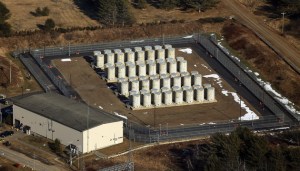 For the foreseeable future, highly radioactive fuel rods are being stored in 60 airtight steel canisters and housed in concrete casks in Wiscasset. Another four canisters hold radioactive steel from the decommissioning process. Maintaining them costs roughly $10 million a year, according to Maine Yankee.
The current award is for a period from 2013 to 2016, and the three companies are seeking an additional $1.2 million in costs. The federal government has 60 days to appeal the award.
Tux Turkel can be contacted at 791-6462 or at:
tturkel@pressherald.com https://www.pressherald.com/2019/02/25/judge-awards-34-million-to-offset-costs-of-storing-spent-fuel-rods-in-wiscasset/
March 4, 2019
Posted by Christina Macpherson |
politics, USA, wastes |
2 Comments
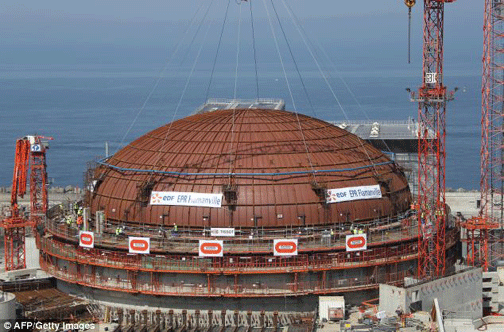
 France Info 1st March 2019 Machine Translation] Cracks, failed welds … How the site of the EPR Flamanville has turned into a fiasco to nearly 11 billion euros.
The third generation nuclear reactor, which was to take office in 2012, will finally be operational only in 2020 after the discovery of new defects. Back on those days when the yard slipped. It was to be the flagship of the French nuclear industry, the EPR of Flamanville (Manche) is today its ball.
The construction site of the European Pressurized Reactor (EPR) experienced numerous delays, the last of which occurred on July 25, 2018, after the discovery of poorly made welds. Originally scheduled for 2012, its entry into service is (for the moment) postponed to 2020. And nothing says that the yard will be spared by new counter-time. The Nuclear Safety Authority (ASN) thus pinned EDF on Wednesday (February 27th) for a lack of “traceability” of certain equipment qualification operations on the EPR.
https://www.francetvinfo.fr/societe/nucleaire/fissures-soudures-ratees-comment-le-chantier-de-l-epr-de-flamanville-s-est-transforme-en-un-fiasco-a-pres-de-11-milliards-d-euros_2874077.amp
March 4, 2019
Posted by Christina Macpherson |
business and costs, France, politics, safety |
Leave a comment
Think Progress 1st March 2019 , For the first time in history, a major presidential candidate is putting
climate change center stage in their campaign. Washington Gov. Jay Inslee
(D) announced on Friday he will seek to challenge President Donald Trump in
2020. “This is our moment, our climate, our mission — together, we can
defeat climate change. That’s why I’m running for president,” Inslee
said on Twitter. In a video announcing his presidential campaign, he called
climate change “the most urgent challenge of our time,” adding,
“we’re the first generation to feel the sting of climate change. And
we’re the last that can do something about it.”
https://thinkprogress.org/washington-governor-jay-inslee-running-for-president-climate-change-6cd8755ed1d7/
March 4, 2019
Posted by Christina Macpherson |
climate change, politics, USA |
Leave a comment
|
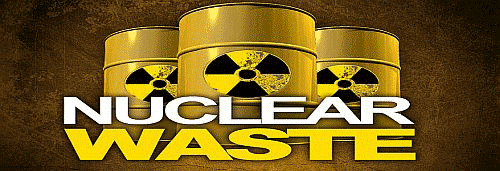
‘Reset’ on nation’s nuclear waste policy includes Yucca Mountain By Gary Martin / Las Vegas Review-Journal
February 27, 2019 WASHINGTON — A panel of scientists are urging a “reset” of the nation’s stalled nuclear waste management system and recommendations to manage and store the material that include using Yucca Mountain as a potential repository.
The proposals were included in a 126-page report, “Reset of America’s Nuclear Waste Management,” that addresses the buildup of highly radioactive waste from commercial power plants and military programs stranded at 75 sites around the country.
Scientists involved with the report were on Capitol Hill on Wednesday to discuss a way forward, or a reset of current management and policy to address the lack of safe storage for the waste.
The report, released in January, includes development of a consensus-based siting process, but one that would still include Yucca Mountain as a candidate.
The inclusion of the site located 90 miles northwest of Las Vegas would continue the travesty of the 1987 decision by Congress that singled out “Yucca Mountain as the only site to be considered for development of a national nuclear waste repository,” said Steve Frishman, a technical consultant to the state of Nevada.
He noted that state, local and tribal leaders, as well as business groups and environmentalists in Nevada, are staunchly opposed to permanent waste storage in Nevada, and claim that the site is unsafe despite Department of Energy studies and recommendations.
Opposition to Yucca Mountain has led to an impasse on storing nuclear waste.
“The site for the proposed Yucca Mountain repository was formally selected in 2002,” the reported noted. “Today, the fate of that site is in political limbo.”
The report further noted that there is “no clear path forward” to manage nuclear waste produced by commercial power plants.
The report compiled by scientists at Stanford University and George Washington University recommends taking the management of nuclear waste storage away from the DOE and creating either a new single-purpose nuclear waste management organization, or a non-profit corporation owned by the nuclear utility industry to handle the waste.
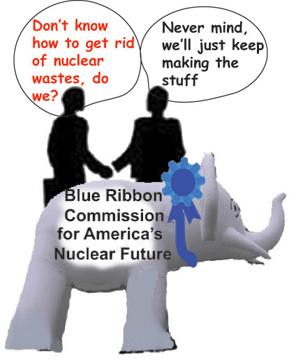
Many of the topics covered in the reset report were also covered, with differing emphasis, by the Blue Ribbon Commission on America’s Nuclear Future in 2012, Frishman said. The commission did not consider Yucca Mountain as a potential repository.
The report comes as Sen. Lamar Alexander, R-Tenn., plans a push in the Senate to resolve the three-decade impasse that has left nuclear waste piled up at generating plants across the country……..
Former Sen. Harry Reid, D-Nev., told the Review-Journal in an interview this month that Yucca Mountain would never be developed because of the astronomical cost to complete the facility. He suggested utility companies place the waste in dry casks and bury them on site. …..
President Donald Trump has proposed restarting the licensing process in his past two budget proposals to Congress. The House also passed a law to streamline the procedure, but all attempts died in the Senate, which stripped out funding in spending bills and never took up the House bill.
If the licensing process restarts, Nevada has filed 218 “contentions,” or objections that would have to be settled before a construction permit is issued.
Experts testified before the House in 2016 that that process could take three to five years.
Meanwhile, two private groups have filed applications with the Nuclear Regulatory Commission for permits to build interim storage facilities in New Mexico and Texas.
Alexander said he favors developing interim storage sites while a strategy on permanent storage can be settled. He told his subcommittee last year that he views Yucca Mountain as part of the solution. https://www.reviewjournal.com/local/local-nevada/reset-on-nations-nuclear-waste-policy-includes-yucca-mountain-1606813/
Contact Gary Martin at gmartin@reviewjournal.com or 202-662-7390. Follow @garymartindc on Twitter.

|
|
March 2, 2019
Posted by Christina Macpherson |
politics, USA, wastes |
Leave a comment
Nuclear waste meeting in Swansea is cancelled and replaced with an online event Wales Online, By Robert DallingSenior Reporter 1 MAR 2019
It was one of a series of meetings taking place across the country to discuss where to bury the country’s most dangerous radioactive waste.
The organisation that had planned a meeting in Swansea about where to store nuclear waste has cancelled it, and said it’s staging an online event instead.
Government-run Radioactive Waste Management was behind the meetings in Swansea and Llandudno to discuss where to create a geological disposal facility for burying the UK’s stockpile of the most dangerous radioactive waste.
No details of any potential sites were made public and it was understood that the body was seeking “a willing host community” where radioactive waste could be stored hundreds of metres underground.
The Swansea meeting was planned for Tuesday, March 1
A statement from the firm read: “Radioactive Waste Management (RWM) respects the views expressed by Swansea Council in their proposed motion (for consideration on 28 February) about hosting a Geological Disposal Facility (GDF) in their area.
“RWM also reaffirms that none of its regional events, including the one for Swansea , is linked in any way to where a GDF might be sited and no site anywhere in England or Wales has been targeted, proposed or chosen. A GDF can only be sited in Wales if a community is willing to host it…….
It is expected that the process of selecting an underground site and going through the planning and construction process will take decades with any chosen site first receiving waste in the 2040s.
The Government said communities interested in hosting a GDF could receive up to £1m a year initially and up to £2.5m a year if deep borehole investigations took place.
Swansea Lib Dem councillor Peter Black criticised the move to cancel the physical meeting.
He said: “I think we should have met them face to face so as to get some clarity as to what exactly they were proposing.
“A webinar means that many people who might want to contribute to this debate, who are not on the internet, will now be excluded.”
Leader of Swansea Council, Rob Stewart said: “I’m pleased that RWM has listened to the very strong representations that we have made and cancelled this meeting in Swansea.
“We note that they have replaced it with an online event so I will make it clear that we will not let up on in our fight until the Swansea Bay area is ruled-out as a potential location for a dump for radioactive waste.
“The reaction of most councillors, our local residents and businesses is clear – nuclear waste is not and never will be welcome here and we will not allow it.” https://www.walesonline.co.uk/news/wales-news/nuclear-waste-meeting-swansea-cancelled-15901315
March 2, 2019
Posted by Christina Macpherson |
politics, UK, wastes |
Leave a comment
 wrongdoing, SNC-Lavalin could be barred from Canadian federal contracts for a decade. (SNC-Lavalin has been previously barred for a decade from World Bank contracts.)
 However, Holtec itself has engaged in bribery, at the Tennessee Valley Authority’s Browns Ferry nuclear power plant; in addition, Holtec CEO Krishna Singh has been accused by whistleblowers Oscar Shirani (Commonwealth Edison/Exelon) and Dr. Ross Landsman (NRC Region 3) of attempting to bribe them into silence, re: QA violations (see below).