Department of Energy Further Advances Nuclear Energy Technology through Industry Awards of $19 Million,, Office of Nuclear Energy, MARCH 27, 2019 WASHINGTON, D.C. – The U.S. Department of Energy (DOE) today announced funding selectees for multiple domestic advanced nuclear technology projects. Four projects in two states will receive varying amounts for a total of approximately $19 million in funding. The projects are cost-shared and will allow industry-led teams, including participants from federal agencies, public and private laboratories, institutions of higher education, and other domestic entities, to advance the state of U.S. commercial nuclear capability.
The awards are through the Office of Nuclear Energy’s (NE) funding opportunity announcement (FOA) U.S. Industry Opportunities for Advanced Nuclear Technology Development. This is the fourth round of funding through this FOA. The first group was announced on April 27, the second group was announced on July 10, and the third group was announced on November 13, 2018. The total of the four rounds of awards is approximately $117 million. Subsequent quarterly application review and selection processes will be conducted over the next four years.
March 30, 2019
Posted by Christina Macpherson |
politics, USA |
Leave a comment
https://www.cagw.org/thewastewatcher/nuclear-bailouts-radioactive-cost-taxpayers March 29, 2019 – 10:11 — Allen  Johnson
On March 22, 2019, the Trump Administration took another step to act on the president’s campaign promise to financially support coal and nuclear power.
The Department of Energy announced that it would be providing a $3.7 billion loan guarantee to the Vogtle Electric Generation Plant located in near Waynesboro Georgia. That brings the total government financing on this project to $12 billion.
President Obama allocated an $8.3 billion loan to complete the Vogtle facility back in 2010 with the goal of constructing of the first new nuclear plant in the U.S. in 30 years. However, since President Obama’s initial loan, cost increases and delays (in part due to a contractor’s bankruptcy) have left the plant unfinished. Yet, taxpayers will now be forced to throw further good taxpayer money after bad.
Our March 22, 2019, blog highlighted how state-level bailout plans for failing nuclear power generation plants are gaining steam in several states, with the administration’s encouragement. The saga at Vogtle Electric underscores the hefty risk taxpayers would incur as bailouts continue across the country. For an administration keen on cutting wasteful government spending, an additional $3.9 billion loan undercuts that commitment and could be the first step toward a larger grid-intervention policy that will cost taxpayers dearly.
A July 19, 2018, report by the Brattle Group estimated it will cost taxpayers $34 billion over two years if every coal and nuclear plant in the country were bailed out as the administration originally proposed. That is a steep price to pay when those funds could be used for more practical measures like strengthening the nation’s energy grid, investing in cyber-protection technologies, or upgrading general infrastructure to bolster the nation’s natural gas supply.
To bailout a power plant that a private corporation has failed to keep within budget and on schedule brings this flawed policy to a new level. The latest announcement from Secretary Perry signals unnecessary political interference in energy markets. A corporation that cannot manage its projects properly doesn’t deserve a federal bailout by taxpayers. Taxpayer dollars are intended to serve the public, not support corporate irresponsibility.
March 30, 2019
Posted by Christina Macpherson |
business and costs, politics, USA |
Leave a comment
 Illinois lawmakers move ahead with bill to benefit nuclear power plants, The Neighbour, By Cole Lauterbach | Watchdog.org, 29Mar19,
 Illinois lawmakers have set the wheels in motion to allow for power provider Exelon’s nuclear fleet, as well as wind and solar power providers, to sell energy to a state authority that opponents say will give it preferential pricing over coal and natural gas sources.
March 30, 2019
Posted by Christina Macpherson |
politics, USA |
Leave a comment
Nuclear Energy Policy after the Fukushima Nuclear Accident: An Analysis of “Polarized Debate” in Japan, Intechopen, By Tatsujiro Suzuki February 6th 2019
DOI: 10.5772/intechopen.83435
Abstract
The Tokyo Electric Power’s Fukushima Daiichi nuclear accident in 2011 was a turning point for Japan’s nuclear energy and overall energy policy. In reality, Japan has reduced its dependence on nuclear energy drastically despite the government’s policy to maintain nuclear energy as a major power source. Even with sharp drop in production from nuclear energy, Japan could achieve carbon reduction of around 60–70% by 2050 even without nuclear power. But the biggest impact of the Fukushima accident is the loss of public trust. The policy debate on nuclear energy is now divided between “pro” and “anti” of nuclear power. The aim of this study is to analyze why such “polarized debate” has not been resolved and find a way to restore public trust. This study analyzes three important nuclear energy policy issues, i.e., decommissioning of Fukushima Daiichi nuclear plant, spent nuclear fuel and waste management, and plutonium stockpile management. The analysis of these three cases suggest that lack of independent oversight organizations is a common cause of impasse of nuclear energy policy debate. The author argues that Japan needs to establish independent oversight organizations in order to gain public trust and solve important policy issues regardless of the future of nuclear energy………. https://www.intechopen.com/online-first/nuclear-energy-policy-after-the-fukushima-nuclear-accident-an-analysis-of-polarized-debate-in-japan?fbclid=IwAR1UJO5oepfNQeoUK82tXQzZUDRwvP9GQclVPkI2ONiq3dQ56w4LBRhbQIY
March 27, 2019
Posted by Christina Macpherson |
Japan, politics |
Leave a comment

Nuclear Energy Institute Seizes on Climate Momentum to Push for Policy Boost
“The answer to the climate crisis won’t be as simple as replacing carbon with renewables and batteries,” according to NEI’s president and CEO. Greentech Media
EMMA FOEHRINGER MERCHANT MARCH 26, 2019 In an annual briefing on the state of the nuclear industry, Nuclear Energy Institute President and CEO Maria Korsnick laid out a vision of a glowing future for the technology — if the industry receives the proper investment and policy support.
Korsnick argued that nuclear’s cultural capital is on the rise, helped along by concerns about climate change and calls for 100 percent clean energy, but she suggested the industry needs better federal and state policy to grow.
….. Energy Secretary Rick Perry announced $3.7 billion in additional loan support for the expansion of the Vogtle nuclear plant in Georgia. …..
Vogtle is a polarizing but important point of focus for the nuclear industry’s future. The Georgia expansion is the only large-scale nuclear project underway in the nation — another, V.C. Summer in South Carolina, was canceled in 2017 — and the first to be built in the U.S. in decades. It’s also billions of dollars over budget and significantly behind schedule, in part because key contractor Westinghouse announced Chapter 11 bankruptcy during construction.
……. Korsnick said more states should follow Connecticut, New Jersey, New York and Illinois in allowing nuclear plants to compete as carbon-free sources or receive credits. Efforts to advance similar policies failed in Minnesota and are currently underway in Ohio and Pennsylvania.
Though environmental groups have mixed views on nuclear, groups in both Ohio and Pennsylvania have spoken out against the support packages.
But Korsnick said a boost in conversations around climate action, the Green New Deal and state-level clean energy goals is bringing more positive attention to the technology.
“It’s this realization that 100 percent renewables — it’s not going to happen,” she said.
Not everyone agrees. On Monday, Puerto Rico committed to 100 percent renewables, joining Hawaii and Washington, D.C. Illinois is considering a similar measure. …. https://www.greentechmedia.com/articles/read/nei-climate-momentum-boost-nuclear#gs.35vnl9
March 27, 2019
Posted by Christina Macpherson |
climate change, psychology and culture, USA |
Leave a comment
 Bailout chances may be good for FirstEnergy Solutions’ Ohio nuclear plants, Crains Cleveland Business
The company is hoping the state will grant what are known as zero emissions credits to the plants, which would effectively subsidize them, through fees on Ohio electricity users.
FES announced the plant closures in March 2018. Soon after, it entered bankruptcy proceedings and moved to split from its parent, FirstEnergy. FES has since reached a restructuring agreement with its creditors, but that plan is still working its way through the courts. FES now operates independently of its parent, as a result of its bankruptcy case, but FirstEnergy remains the owner of FES pending a resolution of that case. …….
“Bailing out uneconomic power plants will only distort markets and restrict innovative and competitive technologies,” said Dick Munson, director of Midwest Clean Energy at the New York-based Environmental Defense Fund, in an email. The fund has noted the “resurgence of interest” in an Ohio subsidy for FES that it attributes to the company’s lobbying and campaign contributions.
Before its bankruptcy proceedings, FES tried a similar approach but its lobbying efforts failed to gain support among lawmakers or then-Gov. John Kasich. That bailout, had it been enacted, would have cost the average Ohio electricity customer about $5 per month and generated $300 million a year for FirstEnergy’s retail customers.
What’s different now? The occupants of the statehouse and the governor’s mansion, Brakey and Rains said.
“All three Ohio House Republican leadership spots are occupied by supporters of the state’s nuclear plants, including House Speaker Larry Householder, Floor Leader Rep. Bill Seitz and Assistant Floor Leader Rep. Anthony DeVitis,” Rains wrote in a February report that he shared. “The odds favor approval of some measure to support the Buckeye State’s ailing nuclear fleet before the end of June, when the state’s budget is due.”
As for Ohio Gov. Mike DeWine, when running for election last year, he said he favored keeping the nuclear plants open……..
With legislation not yet introduced, it’s not known what the cost of a potential bailout would be or how ratepayers would be affected……..
If lawmakers choose to bail out Ohio’s plants, they may have to choose between making the entire state less competitive in terms of electricity costs or making much of Northern Ohio even less competitive with a subsidy spread among fewer customers. Brakey suggested lawmakers look at ways to relieve the burden on other industries that also produce valuable jobs in the state, such as exempting some heavy industrial users from having the fee be applied to all of their electricity.
“There is always a hidden economic loss with a subsidy like this…….. https://www.crainscleveland.com/energy-and-environment/bailout-chances-may-be-good-firstenergy-solutions-ohio-nuclear-plants
March 25, 2019
Posted by Christina Macpherson |
politics, USA |
Leave a comment
 Nuclear power company backs Ford government energy plan, Canada’s National Observer , By Alastair Sharp March 21st 2019 Premier Doug Ford’s Progressive Conservative government said on Thursday it will reform Ontario’s electricity system in a bid to reduce costs overall and lower rates for businesses, a move critics say limits the most efficient way to save money in the power grid and threatens thousands of clean energy jobs.
The plan, announced by Energy Minister Greg Rickford, confirm details reported exclusively by National Observer on Wednesday about a series of cuts to programs that were designed to save energy in buildings. …….
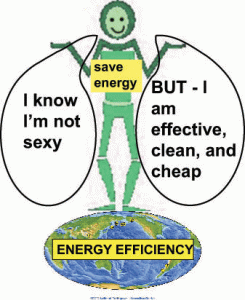
Environmental groups and opposition political parties say the moves don’t make economic sense, pointing to the IESO’s estimates that it costs more than four times more to produce nuclear energy than to conserve electricity, with nuclear costs likely to double in coming years.
The IESO estimates that it costs 1.7 cents to save a kilowatt hour (kWh) of electricity while Ontario Power Generation’s (OPG) nuclear electricity costs 8.8 cents per kWh and is forecast to rise to 16.5 cents per kWh by 2025 to pay for the re-building of the Darlington Nuclear Station.
“I’m worried that today’s announcement might set the stage for the abandonment of energy efficiency efforts while going all-in on expensive, outdated nuclear power,” Ontario Green Party Leader Mike Schreiner said in a statement.
Rickford’s plan would also threaten thousands of jobs in companies working on energy efficiency projects, according to Efficiency Canada, a lobby group that represents companies that provide energy efficiency products and services.
Corey Diamond, executive director of Efficiency Canada, said that this field of the economy has the potential to create over 14,000 jobs per year.
“Energy efficiency is the best bang for the buck for the people of Ontario,” said Diamond in a statement. “Scaling back on programs means fewer local jobs in communities across the province,” he said.
The group representing local power distributors also criticized the changes, citing IESO data showing local hydro utilities had saved over 5.8 billion kWh, enough to power more than 640,000 homes for a full year.
Local distribution companies “have made a vital contribution to delivering savings to all customers across Ontario, including families, small businesses, farmers, medium and large businesses,” said Teresa Sarkesian, president and CEO of the Electricity Distributors Association (EDA).
Ontario NDP energy and climate change critic Peter Tabuns said he agreed that the previous government’s plan was disastrous, but said that the Ford government was about to make the situation worse.
“For years, families saw their utility bills skyrocket under the Wynne Liberals and were left struggling to make ends meet each month,” Tabuns said. “Instead of making things better, and dropping the disastrous Liberal hydro borrowing scheme, the Conservatives are ripping up programs that help everyday families save money on their utility bills, so families and businesses will see their bills jump, yet again.” https://www.nationalobserver.com/2019/03/21/news/nuclear-power-company-backs-ford-government-energy-plan
March 25, 2019
Posted by Christina Macpherson |
Canada, politics |
1 Comment
Zuma said the country would have spent trillions over a short period, but it would have been able to make returns.
But energy expert Tobias Bischof-Niemz disagrees with Zuma, saying the process could have taken about ten years, leaving the country in crisis till 2023.
“The nuclear project that was in discussion for years stems from the integrated nuclear plan.
“As for that plan, the first reactor would have come online in 2023,” said Bischof-Niemz.
“Even if we had implemented the IRP 2010, the first reactor would come online in four years from now.”
March 25, 2019
Posted by Christina Macpherson |
politics, South Africa |
Leave a comment
To Save a Nuclear Plant, Trump Taps the Solyndra Loan Program He Tried to Cut, Bloomberg, By Ari Natter, March 23, 2019,
- $3.7 billion loan guarantee a key lifeline for nuclear project
- Aid to Southern Co. raises concerns with taxpayer watchdogs
President Donald Trump is dipping into a federal loan program that his administration has repeatedly sought to kill as a way to rescue a struggling nuclear power project in Georgia that critics say poses a credit risk to U.S. taxpayers.
The Trump administration announced Friday it’s finalizing a $3.7 billion loan guarantee for two nuclear reactors being built by Southern Co. Called Plant Vogtle, it’s the only nuclear facility under construction in the U.S. and one seen as vital for an industry that’s lagged due to competition from cheaper natural gas and renewable energy.
 “This is the real new green deal,” Energy Secretary Rick Perry said Friday during a visit to the site near Waynesboro, Georgia, alongside Georgia Governor Brian Kemp and Southern Chief Executive Officer Tom Fanning. “If you want clean energy that helps your environment, there is no source that is cleaner than nuclear energy. This is it.”
The source of the aid is an Energy Department loan program that’s been in the cross-hairs of the Trump team since before his inauguration, when his transition team saw it as corporate welfare. Trump has asked Congress to ax the program for three years running, including in the budget submitted this month, arguing that financing provided by the fund should come from the private sector instead.
…….. The aid to Southern and its partners building the plant comes on top of a record $8.3 billion in loan guarantees inked by the Obama administration for the project, bringing the total amount of exposure to taxpayers to $12 billion.
That’s raised concerns among watchdog groups and critics of the project, which is supposed to be completed in late 2022, who are questioning the wisdom of more government loans.
“It would be a gross understatement to say this decision is fiscally reckless,” said Ryan Alexander, president of Taxpayers for Common Sense, a non-partisan group based in Washington. “Putting the full faith and credit of the U.S. Treasury behind a project after it’s been plagued by skyrocketing costs and multi-year delays is an unjustifiable handout to the well-heeled Southern Company and its partners. Throwing good money after bad is never good policy.”
Behind Schedule
The project, which is more than five years behind schedule and has doubled in cost to $28 billion, was dealt a major setback after contractor Westinghouse Electric Co. went bankrupt in 2017. Southern assumed responsibility for managing construction of the project after that…….. https://www.bloomberg.com/news/articles/2019-03-22/trump-taps-solyndra-loan-program-he-wants-cut-for-nuclear-plant
March 23, 2019
Posted by Christina Macpherson |
business and costs, politics, USA |
Leave a comment
|
 Fight over America’s nuclear arsenal heats up in Congress, Defense News, By: Joe Gould 23 Mar 19, WASHINGTON — U.S. lawmakers have drawn battle lines over whether full nuclear modernization is worth the cost, and now they’re gathering ammunition. Fight over America’s nuclear arsenal heats up in Congress, Defense News, By: Joe Gould 23 Mar 19, WASHINGTON — U.S. lawmakers have drawn battle lines over whether full nuclear modernization is worth the cost, and now they’re gathering ammunition.
As the Republican-led Senate and Democratic-led House prepare competing versions of the annual defense policy bill, they’ve been soliciting expert testimony to build their arguments on one of the key defense budget fights to come: How much nuclear modernization does America need?
Citing a $1.2 trillion Congressional Budget Office estimate, House Armed Services Committee Chairman Adam Smith, D-Wash., supports nuclear modernization but argues that America can spend less and still deter its foes. He’s called for America to adopt a no-first-use policy for nuclear arms and opposed both the Obama-era Long-Range Standoff Weapon and the Trump administration’s low-yield W76-2 warhead.
Smith hosted a March 6 hearing with outside experts at which Bruce Blair, a former U.S. missile-launch officer and now a nuclear security expert at Princeton University, said the nation could maintain “a fully adequate deterrent threat” with a monad of five Ohio-class nuclear-powered submarines — rather than the established triad of submarines, bombers and intercontinental ballistic missiles.
The focus, Blair said, should be on repairing dangerous vulnerabilities in nuclear command-and-control infrastructure. “There’s concern that the president who has only about five minutes under current strategy to make a decision on whether and how to retaliate to an attack — five minutes [in which he] may have to rely on information that has been corrupted,” Blair said. ….. https://www.defensenews.com/congress/2019/03/22/fight-over-americas-nuclear-arsenal-heats-up-in-congress/
|
|
March 23, 2019
Posted by Christina Macpherson |
politics, USA, weapons and war |
Leave a comment
 Australia is back in the nuclear game, Independent Australia, By Noel Wauchope | 24 March 2019, One of Australia’s chief advocates for nuclear power Dr Adi Paterson, CEO of Australian Nuclear Science and Technology Organisation, (ANSTO), has done it again.
This time in China, he quietly signed Australia up to spend taxpayers’ money on developing a new nuclear gimmick — the Thorium Molten Salt Reactor (TMSR).
This new nuclear reactor does not physically exist and there is no market for it. So its development depends on government funding.
Proponents claim that this nuclear reactor would be better and cheaper than the existing (very expensive) pressurised water reactors, but this claim has been refuted. The TMSR has been described by analyst Oliver Tickell as not “green”, not “viable” and not likely. More recently, the plan has been criticised as, among other things, just too expensive — not feasible as a profitable commercial energy source.
Paterson’s trip to China and his signing up to this agreement received no Parliamentary discussion and no public information. The news just appeared in a relatively obscure engineering journal.
The public remains unaware of this.
In 2017, we learned through the Senate Committee process that Dr Paterson had, in June 2016, signed Australia up to the Framework Agreement for International Collaboration on Research and Development of Generation IV Nuclear Energy Systems (also accessible by Parliament Hansard Economics Legislation Committee 30/05/2017).
This was in advance of any Parliamentary discussion and despite Australia’s law prohibiting nuclear power development. Paterson’s decision was later rubber-stamped by a Senate Committee……..
Dr Paterson was then obviously supremely confident in his ability to make pro-nuclear decisions for Australia.
Nothing seems to have changed in Paterson’s confidence levels about making decisions on behalf of Australia.
Interestingly, Bill Gates has abandoned his nuclear co-operation with China. His company TerraPower was to develop Generation IV nuclear reactors. Gates decided to pull out of this because the Trump Administration, led by the Energy Department, announced in October that it was implementing measures to prevent China’s illegal diversion of U.S. civil nuclear technology for military or other unauthorised purposes.
Apparently, these considerations have not weighed heavily on the Australian Parliament.
Is this because the Parliament doesn’t know anything about Dr Paterson’s trip to China and his agreement for Australia to partner with the Shanghai Institute of Applied Physics (SINAP) in developing Thorium Molten Salt Reactors? https://independentaustralia.net/environment/environment-display/australia-is-back-in-the-nuclear-game,12488#.XJWdhxDqitc.twitter
March 23, 2019
Posted by Christina Macpherson |
AUSTRALIA, politics, politics international |
Leave a comment
Truthout, Mike Ludwig, March 22, 2019 As politicians and pundits opined on the 16-year anniversary of the U.S. invasion of Iraq this week, organizer and veteran Perry O’Brien observed that people who were born after the 9/11 attacks and the beginning of the global war on terror are now
old enough to join the military and deploy to Afghanistan, where fragile
peace talks between with the Taliban continue.
Blood is still spilling in Kandahar, the province in Afghanistan where O’Brien served as a medic during the early years of the Afghan war.
“In 2003, the idea of being in Afghanistan even five more years would have sounded unlikely; 15 years would have been madness,” O’Brien said in an interview with Truthout.
Nowdays, O’Brien is a political organizer with Common Defense, a nationwide group of progressive veterans that grew out of protests against President Trump’s racist remarks on the 2016 campaign trail. Conservative political forces have long held a monopoly on the public image of military service and patriotism, O’Brien said, but the nationwide community of progressive veterans is actually “enormous.”
“We didn’t want to be props for Trump’s campaign for hate,” O’Brien said. “We were outraged by his remarks about Muslims and immigrants, and the whole platform and were, you know, angry with … how he wraps himself in the flag and the symbols of service even though he has never served anything other than himself.”
Common Defense organizes and trains veterans to advocate on issues ranging from racial and economic justice to opposing the Trump administration’s ban transgender troops, but after nearly two decades of seemingly endless war, O’Brien and other vets want to make it glaringly clear to policymakers that supporting U.S. military intervention has nothing to do with supporting the troops.
“There is a mistaken view that the military community wants you to show your support for the troops by being pro-intervention,” O’Brien said. “Nothing could be further from the truth in terms of what the military community really wants.”
Congress Debates U.S. Militarism Under TrumpCommon Defense is one of several veterans’ groups on both the left and the right that are putting mounting pressure on Congress to bring a clear end to the “forever wars.” Now that the war on terror has come to 80 countries, directly caused nearly half-a-million deaths and cost taxpayers more than $5.9 trillion since 2011, momentum among lawmakers to reassert their constitutional war-making authority is gaining steam after years of inaction and failed bipartisan attempts to rein in the White House and Pentagon.
Both the House and Senate have approved resolutions to end U.S. support for the Saudi-led coalition fighting in Yemen’s bloody civil war, a clear rebuke of both the Saudi royal government and its cozy relationship with President Trump. Lawmakers in both chambers, particularly Democrats, have warned against U.S. military intervention in Venezuela, where hawks in the Trump administration are actively supporting a right-wing opposition leader as the country suffers an ongoing political and humanitarian crisis. …… https://truthout.org/articles/veterans-demand-congress-end-the-forever-wars/
March 23, 2019
Posted by Christina Macpherson |
politics, USA, weapons and war |
Leave a comment

Trump to finalise $3.7 billion in aid for troubled nuclear reactor project https://www.business-standard.com/article/international/trump-to-finalise-3-7-billion-in-aid-for-troubled-nuclear-reactor-project-119032001089_1.html
The plant is seen as critical to the nuclear industry’s future because existing reactors are struggling to compete with cheap natural gas and renewable energy Ari Natter | Bloomberg March 20, 2019
The Trump administration will finalize $3.7 billion in loan guarantees to Southern Co. and its partners who are building a troubled nuclear reactor project in Georgia — the last of its kind under construction in the U.S. — according to two people familiar with the matter.
The guarantees, expected to be announced Friday when U.S. Energy Secretary Rick Perry visits Plant Vogtle alongside Georgia Governor Brian Kemp and Southern Chief Executive Officer Tom Fanning, represents a critical lifeline for the project, which is more than five years behind schedule and has doubled in cost to $28 billion.
The additional help also puts taxpayers on the hook for more money if the project were to collapse. Southern and its partners in Plant Vogtle were already recipients of record $8.3 billion in federally-backed loan guarantees from the Obama administration, but asked the Trump administration to come to their aid amid ballooning costs and setbacks caused in part by the bankruptcy of a contractor, Westinghouse Electric Co.
The plant, near Waynesboro, Georgia, is seen as critical to the nuclear industry’s future because existing reactors are struggling to compete with cheap natural gas and renewable energy. Scana Corp. abandoned its plans to build two reactors in South Carolina after expenses spiraled above $20 billion.
President Donald Trump has made the revival of the coal and nuclear industry a priority. His administration in 2017 announced it would provide a conditional loan guarantee for the Plant Vogtle project.
Representatives of the Energy Department and Southern didn’t immediately respond to requests for comments.
March 21, 2019
Posted by Christina Macpherson |
politics, USA |
1 Comment
THE ASAHI SHIMBUN March 20, 2019 Tohoku Electric Power Co. plans to give an estimated 400 million yen ($3.58 million) to a village that hosts one of its nuclear power plants, but denies it is compensation for losses stemming from the facility’s suspension since the 2011 Fukushima nuclear disaster.
The utility said March 19 it will make a donation to Higashidori, Aomori Prefecture, where its Higashidori nuclear power plant is located, through a corporate version of the “furusato nozei” (hometown tax payment) system.
The company did not disclose the amount, but only said it wants to donate “about half” the maximum amount that the village is allowed to receive under this system. The ceiling for the village is about 800 million yen.
The village government called for Tohoku Electric’s response because the volume of work related to the nuclear plant, such as maintenance, declined due to the suspension and a number of accommodations relying on plant workers have closed.
Satoshi Shimoyashiki, vice manager of Tohoku Electric’s Aomori branch, rejected the notion that the donation was meant as compensation for such economic losses and emphasized that it is being made as “part of corporate social responsibility (CSR).”…….. http://www.asahi.com/ajw/articles/AJ201903200054.html
March 21, 2019
Posted by Christina Macpherson |
Japan, politics |
Leave a comment
Campaigning in Vegas, Gabbard calls for end of ‘wasteful wars,’ nuclear tension, http://www.hawaiinewsnow.com/2019/03/19/campaigning-vegas-gabbard-calls-end-wasteful-wars-nuclear-tension/March 19, 2019 at 4:48 AM HST – Updated March 19 at 4:48 AM
LAS VEGAS (AP) – Democratic presidential candidate Tulsi Gabbard says her top priorities if she’s elected to the White House in 2020 would be to end military action in countries like Iraq and Syria and to de-escalate tensions with nuclear-armed countries like Russia and China.
The Hawaii congresswoman told a small but diverse crowd in Las Vegas on Monday afternoon that she wants to end what she called “wasteful regime change wars” that are costing the country trillions of dollars and instead spend that money on health care, education and other needs in the U.S.
Gabbard, a 37-year-old combat veteran, was making her first foray into early-nominating state Nevada as a presidential candidate.
She planned to hold a “meet and greet luau” west of the Las Vegas Strip later in the evening.
March 21, 2019
Posted by Christina Macpherson |
politics, USA |
2 Comments