Desperate times for the nuclear industry – could Australia be its saviour?
the number one goal of the nuclear lobby is to remove Australia’s national and state laws that prohibit the nuclear industry.
the campaign by the global nuclear industry, particularly the American industry, to kickstart another “nuclear renaissance”, before it’s too late.

Australia is the great ‘white’ hope for the global nuclear industry, Independent Australia, By Noel Wauchope | 19 November 2019, The global nuclear industry is in crisis but that doesn’t stop the pro-nuclear lobby from peddling exorbitantly expensive nuclear as a “green alternative”. Noel Wauchope reports.
The global nuclear industry is in crisis. Well, in the Western world, anyway. It is hard to get a clear picture of Russia and China, who appear to be happy putting developing nations into debt, as they market their nuclear reactors overseas with very generous loans — it helps to have stte-owned companies funding this effort.
But when it comes to Western democracies, where the industry is supposed to be commercially viable, there’s trouble. The latest news from S&P Global Ratings has made it plain: nuclear power can survive only with massive tax-payer support. Existing large nuclear reactors need subsidies to continue, while the expense of building new ones has scared off investors.
So, for the nuclear lobby, ultimate survival seems to depend on developing and mass marketing “Generation IV” small and medium reactors (SMRs). …..
for the U.S. marketers, Australia, as a politically stable English-speaking ally, is a particularly desirable target. Australia’s geographic situation has advantages. One is the possibility of making Australia a hub for taking in radioactive wastes from South-East Asian countries. That’s a long-term goal of the global nuclear lobby. …..
In particular, small nuclear reactors are marketed for submarines. That’s especially important now, as a new type of non-nuclear submarine – the Air Independent Propulsion (AIP) submarine, faster and much cheaper – could be making nuclear submarines obsolete. The Australian nuclear lobby is very keen on nuclear submarines: they are now promoting SMRs with propagandists such as Heiko Timmers, from Australian National University. This is an additional reason why Australia is the great white hope.
I use the word “white” advisedly here because Australia has a remarkable history of distrust and opposition to this industry form Indigenous Australians…..
The hunt for a national waste dump site is one problematic side of the nuclear lobby’s push for Australia. While accepted international policy on nuclear waste storage is that the site should be as near as possible to the point of production, the Australian Government’s plan is to set up a temporary site for nuclear waste, some 1700 km from its production at Lucas Heights. The other equally problematic issue is how to gain political and public support for the industry, which is currently banned by both Federal and state laws. SMR companies like NuScale are loath to spend money on winning hearts and minds in Australia while nuclear prohibition laws remain.
 Ziggy Switkowski, a long-time promoter of the nuclear industry, has now renewed this campaign — although he covers himself well, in case it all goes bad, noting that nuclear energy for Australia could be a “catastrophic failure“. ……
his submission (No. 41) to the current Federal Inquiry into nuclear power sets out only one aim, that
‘… all obstacles … be removed to the consideration of nuclear power as part of the national energy strategy debate.’
So the Environmental Protection and Biodiversity Conservation Act (EPBC Act) should be changed, according to Switkowski. In an article in The Australian, NSW State Liberal MP Taylor Martin suggested that the Federal and state laws be changed to prohibit existing forms of nuclear power technology but to allow small modular reactors.
Switkowski makes it clear that the number one goal of the nuclear lobby is to remove Australia’s national and state laws that prohibit the nuclear industry. And, from reading many pro-nuclear submissions to the Federal Inquiry, this emerges as their most significant aim.
It does not appear that the Australian public is currently all agog about nuclear power. So, it does seem a great coincidence that so many of their representatives in parliaments – Federal, Victorian, New South Wales, South Australia and members of a new party in Western Australia – are now advocating nuclear inquiries, leading to the repeal of nuclear prohibition laws.
We can only conclude that this new, seemingly coincidental push to overturn Australia’s nuclear prohibition laws, is in concert with the push for a national nuclear waste dump in rural South Australia — part of the campaign by the global nuclear industry, particularly the American industry, to kickstart another “nuclear renaissance”, before it’s too late.
Despite its relatively small population, Australia does “punch above its weight” in terms of its international reputation and as a commercial market. The repeal of Australia’s laws banning the nuclear industry would be a very significant symbol for much-needed new credibility for the pro-nuclear lobby. It would open the door for a clever publicity drive, no doubt using “action on climate change” as the rationale for developing nuclear power.
In the meantime, Australia has abundant natural resources for sun, wind and wave energy, and could become a leader in the South-East Asian region for developing and exporting renewable energy — a much quicker and more credible way to combat global warming. https://independentaustralia.net/politics/politics-display/australia-is-the-great-white-hope-for-the-global-nuclear-industry,13326
The emerging potential new nuclear industry political scam
 Does Nuclear Power Slow Or Speed Climate Change? Forbes, Amory B. Lovins 17 Nov 19,
 2. Through generally regulated utility tariffs, customers paid for the plants’ construction and financing, including a just and reasonable return on capital.
3. Customers paid over decades for the plants’ operation, including major repairs, power upratings, and safety upgrades.
4. Many customers reimbursed owners for “stranded-asset costs” totaling upwards of $70 billion to support the owner-demanded transition to competitive wholesale markets.
5. Over the past few years, when reactors generating 2 percent of U.S. electricity proved unable to compete in those wholesale markets (though most of their owners kept their finances secret and kept reporting profits to investors), the owners persuaded state legislators in Illinois, New York, New Jersey, Connecticut, and Ohio to vote billions of dollars a year for new multi-year operating subsidies.
6. Exelon, the nation’s largest nuclear operator and the leading player in the previous two steps, successfully sought Federal regulatory approval for greater capacity payments from power pools whose auctions found nuclear power uncompetitive and whose own rules were thrown off-balance by the new state subsidies. And now, as the annual logrolling season of “tax extenders” rolls around in Congress:
7. For the third year, Exelon is advancing a “Nuclear Powers America Act” to create a new federal investment tax credit on nuclear fuel and maintenance expenses to “help level the playing fuel with other clean energy sources”—whose temporary tax credits are meanwhile being phased down or out. This follows a longstanding pattern of giving different kinds of subsidies to renewables than to nuclear, then “leveling the playing field” by trying to duplicate renewables’ specific forms of subsidies with new ones for nuclear, but never the reverse.
This saga of selling the same hay seven times—and those clever lawyers aren’t done yet—doesn’t include many additional federal and state subsidies. It also doesn’t include an emerging potential scam that could end up with ratepayers’ and federal taxpayers’ getting stuck with vast decommissioning and waste-management liabilities. This emerging pattern has an LLC buy a closed reactor. Absent oversight or rules to stop misbehavior, the LLC could then choose to strip the accumulated customer-funded multi-billion-dollar cash decommissioning fund, not finish the job, and walk away, leaving the parent company whole and electricity customers or taxpayers holding the bag. Watch this space.
Exelon’s proposed “nuclear investment tax credit” has ingenious new features:
– By redefining normal accounting categories so fuel becomes a capital investment, it repays utilities for an “investment” that’s really just a normal operating cost—thus trying to make nuclear operating costs look small by shifting much of them to taxpayers.
The nuclear operating costs it covers have no counterpart for renewables (fuel, nuclear waste management, protection against catastrophic releases of radioactivity), or almost none (operation & maintenance costs), so a tax credit for them would specifically advantage nuclear against renewables.
– Nuclear owners may be able to double-dip, collecting the new federal subsidy and new state subsidies for the same plants and thus turning dead dinosaurs into juicy cash cows.
– There’s virtually no “means test”: the new federal subsidy would apply to about 95% of US operating reactors, including those that the industry claims are currently profitable.
– The proposed legislation, obscurely written in tax-law jargon, appears to be a 30% tax credit (phasing down to 26% in 2024, 22% in 2025, and a permanent 10% in and after 2026), and to cost ~$22–26 billion over the first decade, or ~$33 billion counting the crowding-out of cheaper competitors. Every billion dollars thus bilked from taxpayers is unavailable to provide more electrical services and save more carbon by cheaper means.
– By further distorting the delicate balance between federal, regional, and state regulation, the subsidy seems tailored to weaken or destroy the efficient regional power markets where renewables beat nuclear power. The goal is thus to pay nuclear power for values it doesn’t deliver, while blocking its most potent competitors from continuing to provide the values they do deliver.
– Unlike renewable credits that have helped to mature important new technologies, the nuclear credit would elicit no new production, capacity, or innovation. It would simply transfer tens of billions of dollars to the owners of uncompetitive nuclear assets bought decades ago—if they apply for license extension by 2026, as nearly all have done.
This covert attack on renewables is logical because renewables are now the supply-side competitor nuclear must beat but can’t. The nuclear industry is reluctant to admit that renewables are a legitimate competitor, since this would contradict its claims that renewables can’t supply reliable power. Renewables, unlike nuclear power, are also widely popular. Nuclear advocates therefore tend to blame their woes instead on cheap natural gas. However, new and often even existing combined-cycle gas-fired power plants no longer have a business case: a September 2019 study found that at least 90% of the 88 proposed US gas-fired plants are pre-stranded assets. ………https://www.forbes.com/sites/amorylovins/2019/11/18/does-nuclear-power-slow-or-speed-climate-change/#5b47c988506b
Hinkley Point C nuclear, a super-expensive project for a dubious short term gain
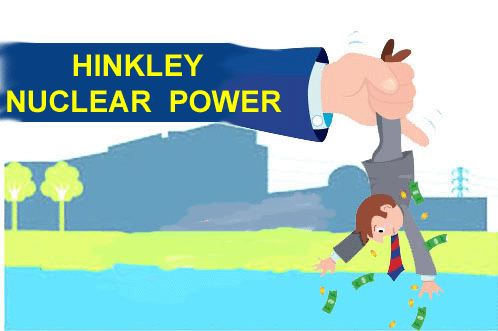 This is the West Country 17th Nov 2019, Stop Hinkley spokesman Roy Pumfrey questions whether the economic boost from Hinkley C is worth the cost I get tired of reading how easily impressed councillors are when they visit the giant incomplete building site that is HPC.
“biggest economic boost” is necessarily a good thing when it is also hugely
problematic and costly for anyone not directly involved? In our case,
economic growth also means a host of problems. There are more traffic jams
all around gridlocked Bridgwater. I’d like to travel from Bridgwater to
Taunton using the Taunton Road, but that simply adds 30 minutes to the
journey time.
schedule.
\ them to the reality of the massive hazard an untried new nuclear power
station running adjacent to her constituency represents.
Confusion in UK over Jeremy Corbyn’s nuclear weapons policy
 What is Jeremy Corbyn’s nuclear weapons policy? The Week, Nov 18, 2019 Labour leader has been quizzed again on future of Trident. Jeremy Corbyn’s position on nuclear weapons is back in the headlines after he refused to rule out scrapping Trident as part of a post-election deal with the Scottish National Party.
Asked on The Andrew Marr Show whether he would scrap Trident, the Labour leader said: “I think the SNP would actually agree with me… that the priority has to be giving realism to the nuclear non-proliferation treaty, giving realism to the six-party talks in Korea, giving realism to the whole question of non-proliferation of nuclear weapons.”
Pressed further on the matter, he replied: “Obviously if you went into non-proliferation treaty discussions then clearly every country’s nuclear weapons go into that equation.” ……. https://www.theweek.co.uk/104380/what-is-jeremy-corbyn-s-nuclear-weapons-policy
Jeremy Corbyn could scrap UK’s nuclear weapons, in deal with Scottish National Party
 Jeremy Corbyn suggests he could SCRAP Britain’s nuclear weapons as the SNP demands he ‘gets rid’ of Trident missiles to win its backing in a government coalition, Daily Mail Labour leader said he wanted to add ‘realism’ to nuclear non-proliferation treaty Jeremy Corbyn suggests he could SCRAP Britain’s nuclear weapons as the SNP demands he ‘gets rid’ of Trident missiles to win its backing in a government coalition, Daily Mail Labour leader said he wanted to add ‘realism’ to nuclear non-proliferation treaty
By DAVID WILCOCK, WHITEHALL CORRESPONDENT FOR MAILONLINE 18 November 2019 Jeremy Corbyn today suggested he would be prepared to give up the UK’s nuclear weapons after the SNP signalled it would be part of their price for propping up his future government. The Labour leader said he wanted to add ‘realism’ to the nuclear non-proliferation treaty (NNPT), with discussions about ‘every country’s nuclear weapons’. He also had a dig at Nato, disagreeing with a claim last week by General Sir Nick Carter, the professional head of the British Army, that the alliance was the most successful in history. His BBC interview came after the Scottish National Party’s Westminster leader Ian Blackford had said the upcoming election was ‘an opportunity to get rid of Trident’ – the UK’s atomic missile system…… The SNP has made removing Britain’s nuclear submarine fleet – based on the Clyde – out of Scotland a mainstay of its party policy. And Mr Corbyn, a former chairman of the Stop the War Coalition, has long opposed Britain’s nuclear weapons programme…. https://www.dailymail.co.uk/news/article-7694603/Now-SNP-demands-Jeremy-Corbyn-scrap-Britains-NUCLEAR-WEAPONS-win-votes-coalition.html |
|
The plight of Fukushima nuclear workers getting leukaemia
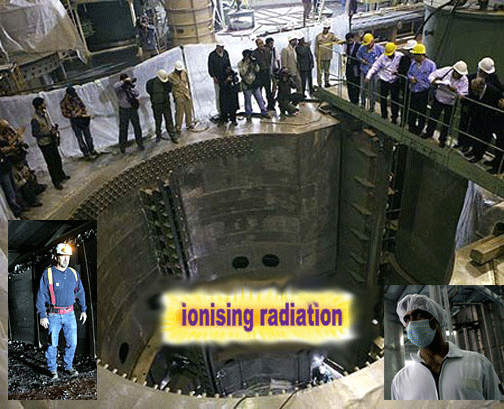 Fukushima Workers Battle Leukemia – and Bureaucracy Unseen Japan Fukushima Workers Battle Leukemia – and Bureaucracy Unseen Japan
by Hiro Ugaya, November 13, 2019 The March 2011 tsunami, and the subsequent meltdown of three reactors at the Fukushima nuclear power plant, has had a devastating impact on Japan. Eight years later, and most journalists – in Japan and abroad – have forgotten about the story. But for many, the struggle continues.
This is especially true of workers who helped assist in the cleanup effort at Fukushima. Some Fukushima workers have contracted severe diseases – including cancer and leukemia – since their work concluded. The government of Japan has even certified that some cases are a result of recovery work. But workers who are fighting for their lives also find themselves fighting the system. Tokyo Electric (TEPCO), which led the recovery effort, refuses to admit any connection between the cleanup work and subsequent diseases in workers. And many insurance companies are pointing to the fine print in private insurance contracts stating they don’t cover accidents at nuclear facilities. Unseen Japan has been pleased to partner with photojournalist Hiro Ugaya (烏賀陽弘道) to translate his interviews with evacuees and former evacuees, and to document the ongoing struggle of the victims of this tragedy. We previously published Hiro’s interview with a mother in the city of Minamisoma. In this installment, we share the first part of Hiro’s interview with Mr. Ikeda (pseudonym), a Fukushima nuclear reactor cleanup volunteer who now finds himself fighting two uphill battles. Translation from an article originally published on Note.mu. Translation by Jay, Editor/Publisher, Unseen Japan. All photos used with permission of Hiro Ugaya.) Ikeda’s StoryFor this installment of the Fukushima Report, I visited Northern Kyushu City in Fukuoka prefecture. I departed from Tokyo and flew west, in the direction opposite Fukushima. I went to Fukuoka, which is quite far from Fukushima. That’s where the leukemia-stricken Ikeda Kazuya (age 44; pseudonym) has lived since participating in the Daichi Nuclear Reactor reconstruction efforts. I had visited Ikeda once in 2017 to hear his story. Among all my interviews here in the Fukushima Report, it’s the one that’s reverberated the loudest. Mr. Ikeda volunteered to participate in the restoration work at the Fukushima Daiichi nuclear power plant. By trade, he’s an independent welder. In March 2011, when so many people died due to the tsunami, he looked at the report of the death of a small child and thought, “I need to do something useful for Tohoku” [Editor: the region of Japan hit by the tsunami]. He asked permission from his boss and threw himself into the reconstruction effort. The interior of the heavy machinery room of Reactor 4 butts up against the nuclear fuel rod pool. But in 2013, Mr. Ikeda came down with leukemia. Mr. Ikeda is one of the first cancer patients that the country recognizes as a work-related accident connected to the Fukushima Daiichi nuclear power plant. Two Fukushima workers contracted leukemia (bone marrow cancer), and one contracted thyroid cancer. The first case of leukemia was recognized in October 2015. The second was recognized in August 2016. The third person, who had thyroid cancer, was certified in December 2016. As of May 2019, there are six patients in the country whose cases have been recognized as occupational accidents caused by work at the Fukushima Daiichi nuclear power plant. To tell the truth, I was quite surprised that the country recognized them as occupational accidents. Judging from the history of pollution diseases, such as Minamata disease and Itai-itai disease, I predicted the government would probably prevaricate and not admit a causal relationship. But the government admitted it readily (employing a lot of rhetoric, of course, such as “This is not an admission of a scientific, causal relationship”). From a global and historical perspective, the admission is rare. In the Three Mile Island nuclear accident (1979) in the US, more than 2000 lawsuits have been filed, but no relationship between health damage and exposure has been admitted in even a single case. The state government naturally won’t admit it, and the courts don’t either. Due to this admission, the assertion that “the radiation leakage from the Fukushima Daiichi nuclear accident is mild enough not to damage health” fell apart. In the Chernobyl nuclear accident in the former Soviet Union, the first to suffer serious harm were the so-called “Liquidators,” the firefighters and soldiers who were the first responders. Nearly 5,000 people died. Naturally, people who are close to radiation-intensive sites will become seriously ill. The same phenomenon occurred in the Fukushima Daiichi nuclear power plant accident. While the case was recognized as a workplace injury, Mr. Ikeda filed a lawsuit against Tokyo Electric (TEPCO), which ran the restoration project. That’s because TEPCO doesn’t “recognize a causal relationship between Mr. Ikeda’s leukemia and exposure to radiation at the Fukushima Daiichi nuclear power plant.” I’ve long found it mysterious that not a single TV station, weekly newspaper, web media or other news outlet has done an article on those like Mr. Ikeda who contracted deadly diseases from the nuclear reactor recovery work. Since the government’s announcement certifying them as workplace injuries, there’s been dead silence. Those affected can’t be heard in their own voices. ……. Mr. Ikeda pointed out something important. People who work in nuclear facilities such as nuclear power plants are not covered by private insurance, even if they have an accident or get sick. It’s in the so-called “disclaimer.” If People who engaged in the dangerous work of recovering the nuclear power plant post-meltdown have been left naked and defenseless. And few people notice it. Even insurance companies don’t care. I want to fix this abnormality…… (Interview: -) There are six people, including yourself, who have been certified as workplace accidents due to cancer or death from overwork in the recovery work of the Fukushima Daiichi nuclear power plant accident. Any contact from them? No, none. I’ve caught sight of the wife of one of the Fukushima workers who died from overwork (karoshi) at rallies in Tokyo. It seems that TEPCO employees and primary subcontractors who got sick will receive 30 million yen [around USD $274,000]. But in return, they can’t sue. That’s what my lawyer emphasized at trial. But that offer doesn’t extend to us (second-tier subcontractors). The owner who hired me also had business owner insurance. Just in case we have an industrial accident. However, we found out later that it wasn’t valid in nuclear facilities, such as nuclear power plants. The insurance companies say it’s too dangerous a place to cover via employer insurance. And yet TEPCO denies responsibility for my leukemia. That’s what you’re contesting in court. That’s right. They’re denying everything. They say it was too low of a dose to bear any relationship. In the previous trial, TEPCO says I developed leukemia due to smoking, drinking, and a vegetable deficiency. That took me aback (laughs). They talk to us like we’re alcoholics…… What evidence is TEPCO presenting to refute you? Search for the stories of scholars who kowtow to the government, you’ll find it (laughs). Who’s providing testimony, besides you? There are various people I think. TEPCO won’t recognize the causal relationship between your leukemia and radiation exposure, correct? If they did, it’ll become a serious obstacle to future nuclear power policy. I was the first person certified, and there’ve been a number since. So there has to be a causal relationship, right? What total dose did you receive? A total of 19.8 millisieverts. Others received more. TEPCO is terrible. It’d be better if they just copped to it. “Others Will End Up Like Me”Why do you think TEPCO should admit responsibility? When this happens to someone else, this won’t be any guarantee, but it’ll give them peace of mind, you know? I mean, it’s not like you can tell people, “Don’t help with recovery efforts.” Other industries offer insurance – who’s going to guarantee workers who enter a nuclear facility if the employer’s primary insurance won’t? That’s what I want to tell people. Fukushima workers who entered the facility had no idea their employer’s primary insurance wouldn’t cover it……. https://unseenjapan.com/fukushima-workers-leukemia-bureaucracy/ |
|
Trump picks another lackey of the coal and nuclear industries as US Energy Secretary
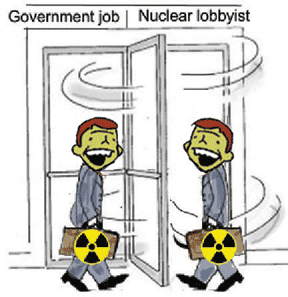
Dan Brouillette, 57, a former lobbyist at Ford Motor Co and Louisiana state energy regulator, would replace Rick Perry, who has said he is stepping down on Dec. 1.
Perry became known as one of the “three amigos” in a side-channel Ukraine policy led by Trump’s personal lawyer, Rudy Giuliani, that has been at the center of the Trump impeachment probe. But Perry has said he was not involved in any conversations where former Vice President Joe Biden was brought up…….
If, as expected, he is confirmed by the Senate Energy Committee and then by the full Senate, Brouillette will work to carry out Trump’s “energy dominance” agenda of boosting U.S. production of oil and natural gas.
Brouillette told Republican senators from Wyoming and Louisiana that he supports technology on curbing climate change by capturing and storing underground carbon dioxide from coal and natural gas facilities, adding that fossil fuels would power a large portion of global energy needs for the next 40 to 50 years…….
Brouillette also said he wants to support development of advanced nuclear power plants, hopefully one day bringing microreactors that provide relatively small amounts of power to remote places like rural Louisiana, where he was born, to Alaska. ……
Democratic senators not on the Energy Committee, including Ed Markey and Tim Kaine, sent Brouillette a letter on Wednesday asking whether he supported nonproliferation standards in any deal on sharing U.S. nuclear power technology with Saudi Arabia, a question he will likely continue to face if he is confirmed.
Reporting by Timothy Gardner; Editing by Peter Cooney and Tom Brown https://www.reuters.com/article/us-usa-trump-energy/trump-energy-pick-to-face-questions-on-coal-nuclear-power-idUSKBN1XO1OH
Before he’s even in the job, USA’s new Energy Secretary Dan Brouillette is busily promoting SMRs for his REAL bosses, the nuclear industryg
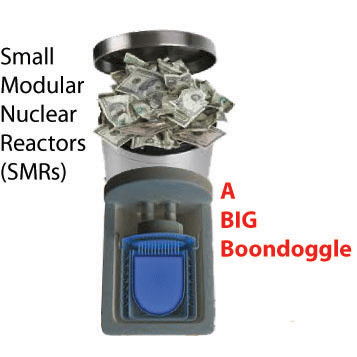 Could tiny nuclear reactors power Alaska villages?
“We want to get to a place where we can develop small micro-reactors, one to five megawatts,” Dan Brouillette said Thursday at his confirmation hearing in the U.S. Senate Energy Committee. …..
Brouillette is now the deputy secretary. He told Murkowski there’s reason to be optimistic about the development of reactors that are a fraction of the size of those in use today. ….. https://www.alaskapublic.org/2019/11/14/energy-secretary-nominee-says-tiny-nuclear-reactors-could-power-alaska-villages/
France considering building 6 new EDF nuclear reactors at a cost of at least 46 billion euros ($51 billion)
 France’s EDF expects six new nuclear reactors to cost 46 billion euros: Le Monde, PARIS (Reuters) 11 Nov 19 – French power utility EDF estimates it would cost at least 46 billion euros ($51 billion) to build six of its latest generation EPR nuclear reactors if the government decides to build them, French newspaper Le Monde reported on Saturday.The estimate was in a confidential document presented to the board of state-controlled EDF at the end of July, it said.
However, the Flamanville EPR reactor under construction in northern France has been plagued by cost overruns and a series of technical problems resulting in years of delays.
EDF, in which the state has an 84% stake, said in October the project which began in 2006 would cost 1.5 billion euros more than previously expected, raising the total cost to 12.4 billion euros.
Reporting by Leigh Thomas; Editing by Edmund Blair full story https://www.reuters.com/article/us-edf-nuclear-epr/frances-edf-expects-six-new-nuclear-reactors-to-cost-46-billion-euros-le-monde-idUSKBN1XJ074
A UK Labour govt would make ‘collective’ decision over use of nuclear weapons?
|
General election: Labour government would make ‘collective’ decision over use of nuclear weaponsEmily Thornberry, the shadow foreign secretary, says Labour would maintain ‘ambiguity’ over circumstances in which Trident deterrent might be used , Independent Andrew WoodcockPolitical Editor @andywoodcock, 11 Nov 19
A Jeremy Corbyn-led Labour government would make a “collective” decision on whether to use nuclear weapons in response to an imminent threat, the party’s shadow foreign secretary has said. Emily Thornberry came under fire from Conservatives after suggesting that Mr Corbyn would share the decision on whether to press the nuclear button with senior colleagues. Labour’s official policy is to retain the UK’s independent Trident deterrent, but the party leader has previously said that he would not be willing to use nuclear weapons…… https://www.independent.co.uk/news/uk/politics/general-election-labour-nuclear-weapons-trident-corbyn-thornberry-deterrent-a9198881.html |
|
Scottish National Party could want scrapping of Trident nuclear system, in return for co-operating with minority Labor government
Questioned about whether the issue of Trident would stop the SNP holding negotiations with another political party in the case of a hung parliament, Mr Blackford said the SNP had been “pretty consistent” that they did “not wish to see nuclear weapons” on Scottish soil.
He explained how his party would “come up with a wish-list” of policies they would want to secure for a potential confidence and supply deal with a future UK Government…….
The SNP’s parliamentary candidate for Ross, Skye and Lochaber described Britain’s nuclear arsenal as “not fit for purpose,” explaining: “The simple fact of the matter is I’m not sure that we’re taking our responsibilities for conventional defences as seriously as we should be doing and to waste up to £200 billion on these weapons of mass destruction that can never be used is a fallacy.”
During campaigning last week, Nicola Sturgeon made clear she wanted nuclear weapons removed from Scotland “as soon as it is safely possible”. The First Minister explained: “When we’re talking about nuclear weapons, safety has to be the primary consideration but the SNP is implacably opposed to nuclear weapons.”
The First Minister explained: “When we’re talking about nuclear weapons, safety has to be the primary consideration but the SNP is implacably opposed to nuclear weapons.”……..
Although Jeremy Corbyn is well-known as being personally opposed to Britain retaining nuclear weapons and Scottish Labour has come out against Trident, the UK Labour Party backs the policy and included support for renewing the nuclear arsenal in its last manifesto……. https://www.heraldscotland.com/news/18026979.blackford-signals-scrapping-trident-part-snp-wish-list-support-corbyn-govt/
Philippines not prepared for the dangers of nuclear energy
Philippines unprepared for nuclear energy: Senate energy panel chair, https://news.abs-cbn.com/business/11/06/19/philippines-unprepared-for-nuclear-energy-senate-energy-panel-chair, Katrina Domingo, ABS-CBN News, Nov 06 2019 MANILA – The Philippines is “not ready” to use nuclear power as an energy source, a senator said Wednesday, adding more should be done to prepare for potential risks.
The Department of Energy announced recently its plan to draft a national nuclear program, which the Senate Energy Committee, chaired by Sen. Sherwin Gatchalian, will investigate.
“Saan natin itatapon ang nuclear waste? Pag may leakage ano ang gagawin natin? Meron ba tayong capability? Handa ba tayo in case of a nuclear leak?” he told reporters.
(Where will we dump nuclear waste? What will we do in case of a leak? Do we have the capability? Are we ready in case of a nuclear leak?)
The DOE should be more transparent about the benefits of harnessing nuclear power before it drafts a nationwide plan. Coal and solar are cheaper alternatives, he said.
“Nuclear energy is a very controversial source of energy dahil ang risk ay napakataas (because the risk is very high),” he said.
The government is eyeing the deployment of modular nuclear plants to some islands where electricity supply is low, Energy Sec. Alfonso Cusi earlier said.
The Philippines also signed a memorandum with Russia’s state-owned Rosatom for a pre-feasibility study for nuclear power plants. President Rodrigo Duterte “wants to learn more” about nuclear power, which could lower electricity prices and stabilize supply, Cusi said.
“We are hungry for power and we will tap any sources that would satisfy our own needs now,” he said.
Iran building a second nuclear reactor at Bushehr plant
|
Iran begins constructing second nuclear reactor at Bushehr plant, Aljazeera, 10 Nov 19,
New reactor – and a third planned to be built – will each add more than 1,000 megawatts to Iran’s power grid. Iran began constructing a second nuclear reactor at its Bushehr power plant – a facility being fuelled by uranium enriched further than the limits outlined in the faltering 2015 nuclear deal with world powers.While celebrating the start of construction on Sunday, Iranian officials also condemned United States pressure campaign of sanctions that blocks Tehran from exporting its crude oil. On Sunday, trucks with spinning concrete mixers poured their slurry into the prepared base of the second reactor as journalists watched in Bushehr, some 700km (440 miles) south from Iran’s capital, Tehran. Bushehr’s working reactor stood behind it. …….https://www.aljazeera.com/news/2019/11/191110133645713.html |
Boris Johnson and the UK plan for nuclear fusion
Boris Johnson’s nuclear energy pledge backed by UK firm with ‘answer to world’s problem’ By CALLUM HOARE. Express UK, Nov 5, 2019 A UK firm has pledged to build on Boris Johnson’s plans to take the “big step” in treading the path for nuclear energy which the Prime Minister claimed will be on sale “around the world” during the Conservative Party conference in Manchester.
The only thing that’s going to restrict us is capital.
“To an investor – no one wants to invest in fusion for safety, it’s very high risk – don’t worry about cracking fusion, it’s about cracking the finance.”
Pulsar Fusion recently opened up the UK’s biggest nuclear fusion centre in a secret location near Bletchley, Buckinghamshire.
Mr Dinan is confident his company will, during the next few months, create matter hot enough to replicate the temperature of the Sun in the UK.
A vacuum chamber will form the heart of the reactor and it is claimed it could soon reach temperatures above 100 million degrees Celsius.

UK firms given £18m for mini nuclear power stations

|
Firms handed £18m for mini nuclear power stations, Construction Enquirer , Aaron Morby, 8 Nov 19,
A consortium including BAM Nuttall and Laing O’Rourke has netted Government match funding to develop the next generation of compact nuclear power stations. The new small-scale power stations are being designed to be manufactured in sections in regional factories, before being transported to existing nuclear sites for rapid assembly inside a weatherproof canopy…… Firms involved include: Assystem, BAM Nuttall, Laing O’Rourke, National Nuclear Laboratory, Rolls-Royce, Atkins, Wood, The Welding Institute and Nuclear AMRC. The consortium ultimately aims to generate a joint investment of £500m focused on designing a first-of-its-kind small modular reactor, which would form the core of the new compact plants…… https://www.constructionenquirer.com/2019/11/08/firms-handed-18m-for-mini-nuclear-power-stations/ |
|
1 This Month





PLEASE OPPOSE HR 8255 AND S.3639 – bills would accelerate satellite deployment, with no environmental review or safeguards – https://ncstd5li.quorum.us/campaign/169331/
To see nuclear-related stories in greater depth and intensity – go to https://nuclearinformation.wordpress.com
-
Archives
- October 2026 (67)
- September 2026 (339)
- August 2026 (330)
- July 2026 (355)
- June 2026 (287)
- May 2026 (306)
- April 2026 (356)
- March 2026 (251)
- February 2026 (267)
- January 2026 (308)
- December 2025 (358)
- November 2025 (359)
-
Categories
- 1
- 1 NUCLEAR ISSUES
- business and costs
- climate change
- culture and arts
- ENERGY
- environment
- health
- history
- indigenous issues
- Legal
- marketing of nuclear
- media
- opposition to nuclear
- PERSONAL STORIES
- politics
- politics international
- Religion and ethics
- safety
- secrets,lies and civil liberties
- spinbuster
- technology
- Uranium
- wastes
- weapons and war
- Women
- 2 WORLD
- ACTION
- AFRICA
- Atrocities
- AUSTRALIA
- Christina's notes
- Christina's themes
- culture and arts
- Events
- Fuk 2022
- Fuk 2023
- Fukushima 2017
- Fukushima 2018
- fukushima 2019
- Fukushima 2020
- Fukushima 2021
- general
- global warming
- Humour (God we need it)
- Nuclear
- RARE EARTHS
- Reference
- resources – print
- Resources -audiovicual
- Weekly Newsletter
- World
- World Nuclear
- YouTube
-
RSS
Entries RSS
Comments RSS

