USA’s intercontinental ballistic missiles- epitome of nuclear corruption
   Why Are We Rebuilding the ‘Nuclear Sponge’? https://nationalinterest.org/feature/why-are-we-rebuilding-%E2%80%98nuclear-sponge%E2%80%99-94371
Welcome to the “nuclear sponge.” A bizarre idea that has outlived its questionable Cold War-era usefulness, the nuclear sponge is the United States’ collection of land-based intercontinental ballistic missiles intended to “soak up” a nuclear attack. by Tom Z. Collina Akshai Vikram 6 Nov 19, The media is abuzz about the epic battle between corporate titans Northrop Grumman and Boeing over who will win the $100 billion contract to build a new nuclear-armed ballistic missile. For those who are keeping score, it looks like Northrop will win a sole-source contract, which would be a disaster for taxpayers.
But media coverage of the Clash of the Titans is missing the real story. This is not about contractor wars or sweet-heart deals. This is about the integrity of our government: why, thirty years after the end of the Cold War, are we rebuilding nuclear weapons that we do not need? Why are we spending national treasure to buy weapons that make us less safe?
What if we told you that residents of Colorado, Montana, Nebraska, North Dakota, and Wyoming are being used as bait in a nuclear war with Russia? Surely, no sane person would accept or offer such terms. However, if you live anywhere near these states, you already have a nuclear target on your back. Welcome to the “nuclear sponge.” A bizarre idea that has outlived its questionable Cold War-era usefulness, the nuclear sponge is the United States’ collection of land-based intercontinental ballistic missiles (ICBMs) intended to “soak up” a nuclear attack. Before the development of nuclear-armed submarines that can hide their locations at sea, ICBMs were the crux of American nuclear strategy. Today, however, their only purpose is to draw fire away from other targets (like New York and San Francisco) in the (suicidal and thus highly unlikely) event of a first strike by Russia. The Air Force does not plan to launch the missiles in a war, but to have them draw a nuclear attack to the Upper Midwest.
We’re not making this up—that’s what former Defense Secretary Jim Mattis told Congress. However, sacrificing the Upper Midwest not only undervalues the people who live there but would not actually spare the residents of other states. A major nuclear war with Russia would doom the entire nation. It would little matter whether one resides in Manhattan or Montana.
Why then are we rebuilding the nuclear sponge? The answer, as House Armed Services Committee Chair Adam Smith (R-CA) recently highlighted, has much more to do with parochial interests and money than national security. When asked at a recent press conference why states would want to host the missiles, and thereby put themselves at risk, Smith said, only partly in jest, “They’re fond of their missiles. Apparently, they want to be targeted in a nuclear first strike.” And then, more seriously, he said “They want the jobs . . . no matter the circumstances. And that’s not rational. It’s parochial.”
 With current ICBMs getting older, the Trump administration has greenlit a new cohort of missiles as part of an almost $2 trillion nuclear rebuild plan over the next thirty years. The price tag for the new ICBM alone is potentially $140 billion. That contract is currently slated to go to Northrop Grumman, even as it fights off a Federal Trade Commission investigation for unfair competition, which may cost taxpayers “billions.” With current ICBMs getting older, the Trump administration has greenlit a new cohort of missiles as part of an almost $2 trillion nuclear rebuild plan over the next thirty years. The price tag for the new ICBM alone is potentially $140 billion. That contract is currently slated to go to Northrop Grumman, even as it fights off a Federal Trade Commission investigation for unfair competition, which may cost taxpayers “billions.”Northrop Grumman and others have hijacked the nuclear-security agenda of the United States through the usual Washington channels: lobbying and
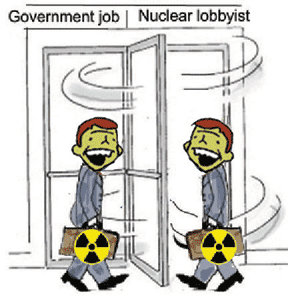
 campaign contributions. In the 2018 election cycle, Northrop spent $5.6 million in campaign contributions. In fact, Northrop spends more than any other defense contractor on lobbying and is just behind Amazon and Facebook. Defense contractors have grown even more powerful with a willing ally in the White House. Simply put, the Trump administration has filled its top national-security ranks with people holding extensive ties to major defense contractors. campaign contributions. In the 2018 election cycle, Northrop spent $5.6 million in campaign contributions. In fact, Northrop spends more than any other defense contractor on lobbying and is just behind Amazon and Facebook. Defense contractors have grown even more powerful with a willing ally in the White House. Simply put, the Trump administration has filled its top national-security ranks with people holding extensive ties to major defense contractors. Mattis worked for General Dynamics and received speaking fees from Northrop Grumman. The current defense secretary, Mark Esper, worked for Raytheon. Ex-White House Chief of Staff John Kelly worked for DynCorp; former Deputy Defense Secretary Mike Shanahan’s employment history at Boeing goes back over thirty years. Meanwhile, Undersecretary of Defense for Policy John Rood worked for Lockheed Martin as did former Secretary of the Air Force Heather Wilson. In fact, that’s where she skirted lobbying restrictions. This list goes on. Mattis worked for General Dynamics and received speaking fees from Northrop Grumman. The current defense secretary, Mark Esper, worked for Raytheon. Ex-White House Chief of Staff John Kelly worked for DynCorp; former Deputy Defense Secretary Mike Shanahan’s employment history at Boeing goes back over thirty years. Meanwhile, Undersecretary of Defense for Policy John Rood worked for Lockheed Martin as did former Secretary of the Air Force Heather Wilson. In fact, that’s where she skirted lobbying restrictions. This list goes on. Programs such as a new ICBM are strategically unnecessary, economically unsustainable, and morally abhorrent. The missiles would be destroyed in a first strike (Russia knows where they are; you can find them on Google Maps) and serve no purpose except to “absorb” blows in a war whose fallout would kill most Americans anyway. Some jobs are created—but far more jobs could be created if the money was spent in other ways. In 2019, there are surely better ways to employ people than to have them guard Cold War relics. As Smith observed after visiting bases that host nuclear weapons, “what struck me was that the job is unbelievably boring.” Maybe that’s why substance abuse continues to plague these sites, with service members literally falling asleep on duty. Clearly, our nuclear policy needs a reboot. As Sen. Elizabeth Warren(D-MA) has said “Take any big problem we have in America today and you don’t have to dig very deep to see the same system at work . . . despite our being the strongest and wealthiest country in the history of the world, our democracy is paralyzed. And why? Because giant corporations have bought off our government.” Warren was talking about climate change, guns, and healthcare, but her remarks hold just as true for nuclear weapons. The next president must tackle corruption in nuclear policy aggressively—by throwing away the nuclear sponge. Tom Collina is Policy Director and Akshai Vikram is a Hale Fellow at Ploughshares Fund, a global security foundation in Washington DC. |
|
Senator Elizabeth Warren questions Holtec Exemption from Emergency Planning Requirements at the Pilgrim Nuclear Power Station
 Senator Warren Statement on Holtec Exemption from Emergency Planning Requirements at the Pilgrim Nuclear Power Station, https://www.warren.senate.gov/newsroom/press-releases/senator-warren-statement-on-holtec-exemption-from-emergency-planning-requirements-at-the-pilgrim-nuclear-power-station 4 Nov 19, Boston, MA – United States Senator Elizabeth Warren (D-Mass.) released the following statement today following news federal regulators at the Nuclear Regulatory Commission (NRC) plan to exempt Holtec International from emergency planning regulations as the firm works to decommission the Pilgrim Nuclear Power Station: Senator Warren Statement on Holtec Exemption from Emergency Planning Requirements at the Pilgrim Nuclear Power Station, https://www.warren.senate.gov/newsroom/press-releases/senator-warren-statement-on-holtec-exemption-from-emergency-planning-requirements-at-the-pilgrim-nuclear-power-station 4 Nov 19, Boston, MA – United States Senator Elizabeth Warren (D-Mass.) released the following statement today following news federal regulators at the Nuclear Regulatory Commission (NRC) plan to exempt Holtec International from emergency planning regulations as the firm works to decommission the Pilgrim Nuclear Power Station:
“I’m disappointed to learn Holtec will be exempt from important emergency preparation and planning safeguards as it decommissions the Pilgrim Nuclear Power Station,” said Senator Warren. “The Southeastern Massachusetts community has rightly continued to raise important questions about the plant’s decommissioning and they deserve answers, not more strong-arming.”
In October 2018, Senator Warren raised concerns about safety and lack of public input during Pilgrim’s shutdown last year and raised similar concerns regarding communications with local residents in her statement. In August 2019, she called for community concerns to be addressed before Pilgrim was allowed to change hands from Entergy Nuclear Operations, Inc. to Holtec.
|
|
Wyoming’s Governor Gordon OK with the idea of nuclear waste dump
|
Gov. Gordon open to nuclear waste storage
https://www.sfchronicle.com/news/article/Gov-Gordon-open-to-nuclear-waste-storage-14805930.php
Nov. 3, 2019 CHEYENNE, Wyo. (AP) — Gov. Mark Gordon says he is open to Wyoming pursuing a nuclear waste storage facility though he doesn’t personally believe it’s the best industry for the state.
Gordon told the Wyoming Tribune Eagle’s editorial board last week that if a good reason can be found for such an industry in Wyoming and it has adequate safeguards, he’s not going to stand in its way. The governor says he will wait to see what the state Legislature finds in its studies of the idea before making a decision. |
|
A USA Bill to make sensible but significant cuts to “nuclear weapons and delivery systems.”
 New Bill Renews Debate on Nuclear Modernization, https://www.cato.org/blog/new-bill-renews-debate-nuclear-modernization November 1, 2019 By Eric Gomez
On Tuesday, Senator Ed Markey (D-MA) and Representative Earl Blumenauer (D-OR) reintroduced bicameral legislation that would save U.S. taxpayers $75 billion on nuclear modernization costs over the next decade. The “Smarter Approach to Nuclear Expenditures Act,” or SANE Act, proposes sensible but significant cuts to “nuclear weapons and delivery systems.”
According to a press release from Sen. Markey’s office, the SANE Act will include the following:
- Reduce the purchase of Columbia-class submarines from 12 to 8, cut the existing ICBM fleet from over 400 to 150, and reduce deployed strategic warheads from approximately 1,500 to 1,000 – saving $13.1 billion
- Cancel the development of a new air-launched cruise missile and an associated warhead life extension program – saving $13.3 billion
- Reduce to 80 the purchase of new B-21 long-range bombers – saving $11.6 billion
- Cancel the development of new ICBMs and a new nuclear warhead – saving $13.6 billion
- Cancel the development of a new submarine-launched cruise missile – saving $9 billion
- Limit the plutonium pit production target to 30 per year – saving $9 billion
Sen. Markey stated that “The United States should fund education, not annihilation; that is our future…We need sanity when crafting America’s budget priorities, and more and improved nuclear weapons defies common sense.”
Rep. Blumenauer added that “these disastrous weapons will never be the answer to solving our complex and ever-changing national security threats…We should not be investing trillions of dollars of our budget on an outdated and irresponsible nuclear arsenal.”
At the time of the press release, the SANE Act was co-sponsored by Sen. Bernie Sanders (I-VT) and by eight members in the House. It has also been endorsed by several prominent organizations, including the Ploughshares Fund, Women’s Action for New Directions (WAND), Peace Action, Friends Committee on National Legislation (FCNL), Global Security Institute, and World Future Council.
Caroline Dorminey, policy director of WAND and my former colleague here at Cato, stated, “With defense budgets skyrocketing and a bow wave of costs bearing down on the Pentagon in upcoming years, now is the time for hard choices. Senator Markey, Representative Blumenauer, and cosponsors offer a clear alternative that will keep Americans safe without wasting their tax dollars on weapon systems that serve our past, not our future.”
Dorminey, who also co-edited Cato’s recently released America’s Nuclear Crossroads: A Forward-Looking Anthology with me and whose recommendations from her chapter on how best to manage nuclear modernization echo many of the proposals within the bill, also noted that “the SANE Act demonstrates [that] there are ample opportunities to craft a revised nuclear modernization plan that better reflects the shifting strategic priorities and evolution of threats facing the United States.”
Sen. Markey and Rep. Blumenauer have introduced various versions of the SANE Act in past years without success. Given current fiscal and political realities, perhaps this time will be different. Yet, whether the SANE Act passes or not, the legislation highlights the need for policymakers to have a robust debate on the merits of the modernization plan, if not America’s nuclear posture more broadly.
You can read the full bill here. To learn more about this and other pressing issues in nuclear deterrence and arms control, download a copy of America’s Nuclear Crossroads.
Exelon wants tax-payer subsidies for nuclear reactors – threatens to close 4, otherwise.
 Exelon threatens to close four nuclear plants in Illinois if Springfield doesn’t act https://www.thecentersquare.com/illinois/exelon-threatens-to-close-four-nuclear-plants-in-illinois-if/article_b4d2cc7e-fbff-11e9-9619-ab5ee6984f21.html, By Cole Lauterbach | The Center Square, Oct 31, 2019
Exelon’s CEO said Thursday that four of the company’s nuclear facilities in Illinois could be shuttered if state lawmakers don’t take action to make them more profitable.
Exelon President and CEO Christopher Crane said in an earnings call Thursday that the company “can’t sit here for years and bleed cash and build up debt” by keeping four of our nuclear plants operating in the absence of legislation from Springfield that would make those plants more profitable.”
The company had previously said the Byron, Braidwood and Dresden plants were in danger of being shuttered. On Thursday, the company said the LaSalle plant also was at risk of closure.
“Some are more dire than others at this point and we need to move forward with the legislation to prevent the loss for the state from an environmental perspective and an economic perspective,” Crane said.
The four Illinois plants represent a significant portion of Exelon’s nuclear fleet.
At issue is the interaction between federal regulators and Exelon’s Illinois-based facilities that get green-energy credits, allowing those facilities to sell energy on the wholesale market at more competitive rates than other energy providers, such as coal plants.
Crane’s comments came two weeks after one of the company’s former executives, Exelon Utilities CEO Anne Prammagiore, abruptly retired and the corporation disclosed that it had been served with multiple subpoenas in connection to a federal probe involving state Sen. Martin Sandoval and the company’s lobbying practices. This week, Prammagiore also resigned as chair of the Federal Reserve Bank of Chicago, according to media reports.
A veteran legislator told Crain’s Chicago Business last week that it would be difficult for Exelon to get much done in Springfield until lawmakers know more about the federal investigations.
Two of Exelon’s nuclear facilities benefit from legislation that Crane said kept them open, which included rate increases on consumers.
Wyoming legislators and their secret vote about nuclear waste dump
|
Secret Wyoming nuke dump vote merits public outrage, https://www.wyofile.com/secret-wyoming-nuke-dump-vote-merits-public-outrage/ July 23, 2019 by Kerry Drake 16 Seven Republican legislators pulled a skunk out of a hat with a secret vote to once again explore storing nuclear waste in Wyoming. This must be the “Wyoming way” so many state lawmakers boast about when describing how they do the people’s work.
The plan to store spent nuclear fuel rods at old uranium mines in the Gas Hills and Shirley Basin was hatched by Sen. Jim Anderson (R-Casper) and Rep. Mike Greear (R-Worland), co-chairmen of the Joint Minerals, Business and Economic Development Committee. The Legislative Management Council did not assign the topic to their committee or any other before the Legislature adjourned in March. There was no discussion of the topic in an open meeting, no posted notice that it was up for consideration and zero public input. Hiring the state out as a nuclear waste dump appeared in no legislative documents prior to the Management Council’s July 8 email vote to approve study of the matter. The only reason anyone knows that we’re spending taxpayer dollars to study this hairbrained scheme is because WyoFile requested a record of all recent email votes by the Management Council. House Speaker Steve Harshman and Senate President Drew Perkins, both Casper Republicans, didn’t talk about the proposed interim topic or announce the vote to the public. They just went along and passed it. House Majority Leader Eric Barlow (R-Gillette) joined five Democrats who opposed the measure. Anderson told WyoFile reporter Angus Thuermer Jr., who broke the story about the vote, that “temporarily” storing the spent nuclear fuel rods here could bring in up to a billion dollars a year from the federal government. Wyoming could have been making a haul off nuclear waste for decades, Anderson added, if “environmental terrorists” hadn’t stopped the so-called Monitored Retrievable Storage site in Fremont County. Then-Gov. Mike Sullivan, responding to polls that showed four-fifths of Wyomingites opposed the project, wisely halted it in 1992. “I think they’ll be back terrorizing us again,” Anderson told Thuermer. It’s nice to know what he thinks of opponents to a project he tried to hide. Oh, there will be protests all right. Now that the public knows what’s been going on behind their backs, people will be able to decide for themselves who is truly concerned with trying to protect Wyoming’s priceless environment and who is trying to make billions of quick bucks putting it at risk. Is it too much to ask for legislators to give us a break on this issue and bury it instead of highly radioactive nuclear waste? It’s long worn out its welcome. |
|
Get the facts straight on nuclear energy
To Editor of the Reformer, I was disturbed by the letter written by Kendall Neutron of San Diego, CA (“Nuclear waste can be dealt with safely”) and published in the Oct. 19-20 Reformer. Neutron claims to be a nuclear engineer who also claims to have a simple solution to the problem of safe storage and disposal of nuclear waste.I question the cost and safety of the solutions that are described.
Over 140 scientists from all over the world collaborated to write the book “Drawdown” edited by Paul Hawkin and published in 2017. They rank nuclear energy at No. 20 in the top 100 strategies to reduce or reverse global warming and describe these warnings:
Gen. 1 and 2 nuclear reactors (which include those built at Chernobyl and Fukushima and all those in the U.S.) use water to slow down nuclear chain reactions and use enriched uranium fuel. These are all located near major rivers or oceans making them capable of spewing nuclear radiation into major water supplies should any accident occur. The world watched this happen in Chernobyl and Fukushima, and to say that “nuclear energy is already the safest, cleanest, most eco-friendly, and least resource intensive way of generating constant power” is UNTRUE.
In addition to this, “Drawdown” reports this fact: “While virtually every other form of energy has gone down (in cost) over time, a nuclear power plant’s (cost) is four to eight times higher than it was four decades ago. According to the U.S. Department of Energy, advanced nuclear is the most expensive form of energy besides conventional gas turbines, which are comparatively inefficient. Onshore wind is a quarter of the cost of nuclear power.”
This is why the U.S. and Germany are closing down their older nuclear facilities and not planning new ones. China has 33 nuclear plants in operation and about 22 under construction as they move away from coal fired plants due to air pollution and global warming. China is also building solar and wind power at a very fast rate and producing electric vehicles of all kinds and is committed to reaching peak carbon dioxide in 2030 with a reduction of its carbon footprint from that day forward.
Let’s get the facts straight and continue to implement all kinds of less costly and less dangerous ways of producing and storing energy. In New England let’s work on replacing our last few aging nuclear plants with large offshore wind arrays such as Vineyard Wind which could produce at least 400 megawatts of power in its first stage of development.
Turkey Has Long Had Nuclear Dreams
In September, Turkish President Recep Tayyip Erdogan told members of his party that it is time for his country to acquire its own nuclear bomb.
Such a move would mark a sharp break from previous obligations by Turkey, a signatory of the Nuclear Non-Proliferation Treaty, which bars non-nuclear states from acquiring nuclear weapons. But this is not the first time that Turkey—which has played host to U.S. nuclear weapons since the late 1950s—has craved its own nuclear weapons program.
As part of our Document of the Week series, Foreign Policy is posting a copy of a Sept. 26, 1966, memo describing to then-Ambassador Parker T. Hart a troubling conversation Clarence Wendel, the U.S. minerals attache at the U.S. Embassy in Ankara, had with a “reliable” Turkish scientist on Turkey’s nuclear ambitions.
The memo, one of 20 previously declassified documents on nuclear weapons in Turkey compiled this week by the National Security Archive, claims the source disclosed that officials from Turkey’s General Directorate of Mineral Research and Exploration “had been asked to cooperate with General [Refik] Tulga and Professor Omer Inonu (Professor of Physics at METU) [Middle East Technical University] in a Turkish program to develop an ‘Atomic Bomb.’”
Wendel, according to the memo, had flagged a number of developments suggesting the claim may be credible, including: “Repeated Turkish assertions that a 200 mega-watt nuclear reactor is planned for Istanbul”; the stockpiling of reserves of 300 to 600 tons of uranium in low-grade ore deposits; and the “delaying and haggling tactics of the Turkish negotiators during discussions of the extension of the bilateral agreement on peaceful uses of atomic energy which primarily concerned the transfer of safeguards responsibility from the U.S.A. to the International Atomic Energy Agency.”……..https://foreignpolicy.com/2019/11/01/turkey-long-nuclear-dreams-erdogan-bomb/
No nuclear in South Africa’s future energy mix
The plan – which builds on a relatively well-received draft announced last year – makes some significant advances in changing South Africa’s energy mix. For example, it significantly ups the contribution of wind as well as solar power to South Africa’s overall energy allocation. The production of power from wind is expected to grow by 900% by 2030, and power from solar photovoltaic by 560%……
Ultimately economic realities dictate that coal and nuclear cannot compete with renewable technologies. These are already much cheaper, and their cost continues to drop by the year.
Even with maximum political will, a nuclear build cannot be realised without convincing investors and the public that it makes economic sense. It doesn’t……..https://theconversation.com/south-africas-future-energy-mix-wind-solar-and-coal-but-no-nuclear-111106
Brexit’s threat to Scotland’s environmental protection
Environment Protection Agency, the national regulator, said there was a
need for a “new and coherent” governance system to act as a safeguard once
EU protections and oversight disappear after Britain’s departure from the
bloc. Last year, The Herald revealed Scottish Environment LINK’s concerns
that Scotland’s rarest species north of the Border face being obliterated
in the fall-out from Brexit unless urgent new laws and funding are brought
in to safeguard vital conservation work.https://www.heraldscotland.com/news/17996856.scots-natural-environment-risk-inadequate-brexit-plans/
France’s government demands that EDF fix Flamanville nuclear reactor within one month
EDF given a month to draw up a fix for Flamanville’s nuclear woes French energy group under pressure to address faults highlighted in a new report. https://www.ft.com/content/877eedae-f987-11e9-a354-36acbbb0d9b6 David Keohane in Paris, 28 Oct 19.

The reprehensible pro nuclear campaign for bailing out nuclear power in Ohio
 Melting Ice, Crumbling Nukes, Cecile Pineta Newsletter Sunday, October 27, 2019 For anyone following or attempting to follow nuclear energy news in the United States, what’s been going on in the State of Ohio is a solid indicator of just where we stand, technologically, and from a style of government standpoint.
Without going into stupefying background detail, I’ll try to sum up the Ohio situation with help from the summary published Oct. 26 by Bob Fitrakis and Harvey Wasserman who have been birddogging this issue for decades now. And I quote:
- In July, the gerrymandered Ohio Legislature passed HB6, a massive
[1 billion-dollar] bailout to keep the two dying nukes operating on Lake Erie, [Davis-Besse, and Perry].
- Akron-based First Energy is bankrupt…[demanding] a promised $1 billion bailout.
- Signature gatherers were offered as much as $2,500 to turn over their signed petitions. [Contrast this with receiving only $.25 cents a signature.]
While disrupting legitimate [signature] gatherers, pro-nuke thugs aggressively collected multiple duplicate signatures for a fake non-binding petition.
Deep Pockets
- First Energy then claimed it had gathered more than 800,000 “pro-nuke’ signatures.
- First Energy accompanied [thug] assaults with a massive radio/TV/mailer campaign [with the ridiculous claim that] “Chinese Communists” were buying Ohio’s grid.
- OACB’s court filing showed that state regulations imposed on certification have vastly reduced the number of referenda Ohioans can vote on.
- Wednesday last, Oct. 26, a federal judge rejected OACB’s request for more time to gather signatures, and sent the case to the Ohio GOP-dominated Supreme Court.
- OACB is rumored to have about 225,000 signatures on hand, 40,000 short of the threshold. Far more will be needed to overcome a [Republican] Secretary of State certain to disallow as many as [possible].
- [And here’s the kicker:] Polls show Ohioans [who will be the rate-payers] vehemently opposed to the bailout. [That’s why] most observers believe if it [got] on the ballot, the referendum would pass by a large margin.
- [But] should Federal appeals fail, and the Ohio Supreme Court refuse the request for more time, the referendum process will have suffered a potential death blow nationwide. It will mean Fascist thugs will be free to assault legitimate signature gatherers at will.
This last point is the main take-away. First Energy mounted this campaign in major Ohio cities: Youngstown, Akron, Toledo, and Columbus among them. It underwrote its million-dollar-plus cost-of-doing business in flyers, TV/radio/mailer announcements. It paid thousands of goon-disrupters to do their thuggish business on the streets.
At play is a $1 billion bailout. A million-dollar cost-of-doing business is a mere investment, a drop in the corporate bucket. At issue is that its cost will be passed directly to ratepayers.
Core tests conducted at Davis Besse show that its containment vessel is critically embrittled. Should there be an accident (like Three-Mile Island for example} Lake Erie is at serious risk of nuclear contamination. First Energy’s ratepayers draw their water from Lake Erie, the fourth largest of the Great Lakes and source of fresh water for Canadians and Americans living in the area.
Already in 2011, following the nuclear catastrophe at Fukushima, I covered the issue of Davis Besse’s critical embrittlement in Devil’s Tango: How I Learned the Fukushima Step by Step.
That was 8 years ago….. https://devilstangobook.blogspot.com/2019/10/melting-ice-crumbling-nukes.html?showComment=1572237519303#c7332297197888828316
National nuclear commission strategy for Marshall Islands
Marshalls endorses nuclear commission strategy, https://www.rnz.co.nz/international/pacific-news/401921/marshalls-endorses-nuclear-commission-strategy The Marshall Islands government has endorsed the adoption of a national nuclear commission strategy for the next three years.
The strategy honours the legacy of Marshallese nuclear heroes and heroines who fought and continue to demand accountability for their communities.
The strategy was mandated in the Marshall Islands parliament, or Nitijela, as part of the National Nuclear Commission Act of 2017.
It focuses on five broad themes for nuclear justice: compensation, health care, the environment, national capacity, and education and awareness.
From 1946 to 1958, the US used the Marshall Islands to test its nuclear weapons.
The commission also aims to establish an independent panel of scientists and specialists in fields related to radiation exposure, to provide the republic’s citizens access to trusted, independent science.
The commission’s chair, Rhea Moss-Christian, said the NNC strategy was a tool for all Marshallese, whether living in the islands or overseas, to use in their individual and collective efforts to respond to the devastation resulting from the US nuclear weapons testing program in the Marshall Islands.
“It is also a resource for our partners and friends outside the Marshall Islands to understand the nuclear testing impacts that persist today and how they can support the Marshallese people,” Ms Moss-Christian said.
Governments manipulate social media – Twitter executive is a British army psychological operations officer
 governments have a long history of trying to manipulate the media,” and are steadily moving into the realm of social media.
Media Ignore Unmasking of Twitter Exec as British Psyops Officer https://fair.org/home/media-ignore-unmasking-of-twitter-exec-as-british-psyops-officer/comment-page-1/#comment-3169114
Government penetration and control over media of little interest to those who are subject to it, ALAN MACLEOD, 24 Oct 19, A recent investigation from independent news outlet Middle East Eye (9/30/19) uncovered that a senior Twitter executive is, in fact, an officer in the British Army’s 77th Brigade, a unit dedicated to psychological operations (psyops), propaganda and online warfare.
For media so committed to covering news of foreign interference with US public opinion online (see FAIR.org, 8/24/16, 12/13/17, 7/27/18), the response was distinctly muted.The story did not appear at all in the New York Times, Washington Post, CNN, CNBC, MSNBC, Fox News or virtually any other mainstream national outlet. In fact, the only corporate US outlet of any note covering the news that a person deciding what you see in your Twitter feed is a foreign psyops officer was Newsweek, which published a detailed analysis from Tareq Haddad (10/1/19). When asked by FAIR why he believed this was, Haddad agreed it was major news, but downplayed the idea of media malevolence, suggesting that because it was a small British outlet breaking news involving a British officer, US media may have overlooked it.
Deep State and Fourth Estate
A Fact-Free Zone
Yet factchecking organizations are not neutral arbiters of truth, but part of an increasingly elite class of people with their own biases and preconceptions. In practice, they have tended to espouse a “centrist” ideology—a word with its own problems (FAIR.org, 3/23/19)—and are hostile to anyone challenging the status quo from either right or left. Factcheckers have been carrying out something of a war against Bernie Sanders’ campaign, constantly rating the Vermont Senator’s statements as misleading or untrue without due reason.
Furthermore, the choice of who gets to decide what is true and what is false is an important one. Facebook has already partnered with conservative magazine the Weekly Standard, a publication that was crucial in pushing arguably the greatest fake news stories of the 21st century: those of Iraqi weapons of mass destruction and Saddam Hussein’s links to 9/11 (Extra!, 9/09). “There is no debate about the facts” that “the Iraqi threat” to the US is “enormous” and that Saddam’s henchmen helped Osama Bin Laden, it wrote in 2002 (1/21/02). Yet Facebook picked this organization to help it gauge the veracity of viral stories across its platform.
Silencing Dissent Online
In September, Twitter suspended multiple accounts belonging to Cuban state media. And along with Facebook and YouTube, it also suspended hundreds of Chinese accounts it claimed were attempting to “sow political discord in Hong Kong” by “undermining the legitimacy” of the protest movement. These social media giants have already deleted thousands of Venezuelan, Russian and Iranian accounts and pages that were, in their own words, “in line with” those governments’ positions. The message is clear: Sharing opinions that do not fall in line with official US doctrine will not be tolerated online.
In contrast, Western politicians can continually flout Twitter’s terms of service with no consequences. Sen. Marco Rubio threatened Venezuelan President Nicolas Maduro with torture and execution, sharing a video of Moammar Gadhafi being tortured and killed in a not-so-subtle message that broke multiple Twitter rules. Meanwhile, Donald Trump announced that we would “totally destroy” North Korea with “fire and fury,” and promised he would bring about the “official end” of Iran if it angered him again. Twitter has continually refused to delete tweets like that on the grounds that this would “hamper necessary discussion,” although it later saw fit to delete those from Iran’s Ayatollah Ali Khamenei.
Decisions like these highlight how there is one rule for the powerful and quite another for the rest of us, and how the big social media platforms are increasingly acting like arms of Western governments, adopting their perspectives on what are and are not acceptable political viewpoints.
For the climate’s sake, the $multibillion nuclear industry bailouts must stop
|
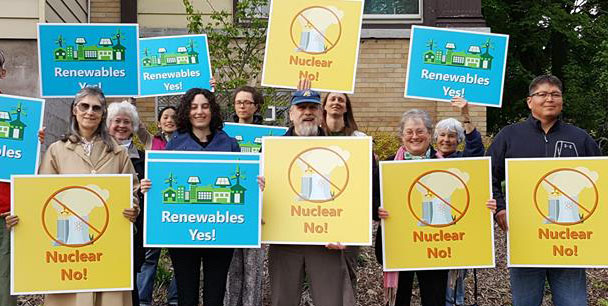
Nuclear Industry’s $23 Billion Bailout Request Shows Why It Should Have ‘No Role to Play’ in Solving Climate Crisis: Study “For the sake of taxpayers, electricity consumers and the climate, Congress must stop this endless nuclear boondoggle.” by Eoin Higgins, staff writer A proposed bailout of the U.S. nuclear power industry that could cost taxpayers $23 billion over the next 10 years is a perfect example of why the climate crisis needs solutions that focus on renewable resources, green advocacy group Friends of the Earth said Thursday.”The dying nuclear industry wants a massive bailout at the expense of taxpayers and the climate,” the group’s senior policy analyst Lukas Ross said in a statement. Friends of the Earth commissioned a study (pdf) on the Nuclear Powers America Act of 2019, a nuclear industry-backed bill making its way through Congress that would continue subsidies for the industry for decades. Vermont Law School fellow Mark Cooper, who authored the study, wrote that the consequences of continuing tax credits for the industry would have the effect of making other potential technologies unviable for reducing emissions. “Subsidizing nuclear keeps reactors on-line and crowds out the alternatives,” said Cooper. “It slows the transition to an electrical grid based on low-carbon distributed resources.” While renewables are a major part of the push from climate activists and advocates to solve the climate crisis, using nuclear power to reduce emissions has been floated as a potential piece of the Green New Deal. The technology was notably left out of the legislation by Rep. Alexandria Ocasio-Cortez (D-N.Y.) and Sen. Ed Markey (D-Mass.), a decision that Popular Mechanics writer Avery Thompson hailed in February as a “great idea.” “Reactors are gigantic beasts, and sustaining a nuclear reaction while drawing power from it requires an absurd level of engineering,” wrote Thompson. “Reactors are expensive, bulky, and complicated, to say nothing of the waste products they produce or the fear of a catastrophe like Chernobyl or Fukushima.” The proposed nuclear industry bailout, warns Cooper in the new report, is an attempt to reverse economic trends that have never been favorable to nuclear power standing by itself. The industry, Cooper said, hasn’t earned the right to be considered as a realistic solution to the climate crisis or U.S. energy needs. “Nuclear has failed for over 50 years to control its costs, even with help from massive subsidies, and alternatives are available to reduce greenhouse gas emissions at a much lower cost,” wrote Cooper. Time is of the essence, said Friends of the Earth’s Ross. “With just a decade left to prevent the worst of the climate crisis, we shouldn’t dump more money into ancient nuclear reactors at the expense of cleaner and much cheaper renewables,” he said. |
|
1 This Month





PLEASE OPPOSE HR 8255 AND S.3639 – bills would accelerate satellite deployment, with no environmental review or safeguards – https://ncstd5li.quorum.us/campaign/169331/
To see nuclear-related stories in greater depth and intensity – go to https://nuclearinformation.wordpress.com
-
Archives
- October 2026 (67)
- September 2026 (339)
- August 2026 (330)
- July 2026 (355)
- June 2026 (287)
- May 2026 (306)
- April 2026 (356)
- March 2026 (251)
- February 2026 (267)
- January 2026 (308)
- December 2025 (358)
- November 2025 (359)
-
Categories
- 1
- 1 NUCLEAR ISSUES
- business and costs
- climate change
- culture and arts
- ENERGY
- environment
- health
- history
- indigenous issues
- Legal
- marketing of nuclear
- media
- opposition to nuclear
- PERSONAL STORIES
- politics
- politics international
- Religion and ethics
- safety
- secrets,lies and civil liberties
- spinbuster
- technology
- Uranium
- wastes
- weapons and war
- Women
- 2 WORLD
- ACTION
- AFRICA
- Atrocities
- AUSTRALIA
- Christina's notes
- Christina's themes
- culture and arts
- Events
- Fuk 2022
- Fuk 2023
- Fukushima 2017
- Fukushima 2018
- fukushima 2019
- Fukushima 2020
- Fukushima 2021
- general
- global warming
- Humour (God we need it)
- Nuclear
- RARE EARTHS
- Reference
- resources – print
- Resources -audiovicual
- Weekly Newsletter
- World
- World Nuclear
- YouTube
-
RSS
Entries RSS
Comments RSS

