No chance of re-using spent mixed-oxide (MOX) fuel, its storage highly dangerous
|
Mainichi 15th Jan 2020, There are no prospects that spent mixed-oxide (MOX) fuel, made by reprocessing spent nuclear material, can be further reprocessed and reused for nuclear power generation in accordance with the Japanese government’s energy policy.
Storing such fuel for a long period has thus raised safety
concerns. The Nuclear Regulation Authority (NRA) has expressed concerns that the storage of spent MOX fuel in the pool over such a long period is highly dangerous. In case of a power blackout, the temperature of the water in the pool could not be maintained at a certain level and it would become unable to cool the fuel just as was the case with the Fukushima nuclear crisis. https://mainichi.jp/english/articles/20200115/p2a/00m/0na/029000c |
|
In UK, energy bosses bullying locals into submission over Sizewell nuclear build?
East Anglian Daily Times 16th Jan 2020, Villagers whose properties would be affected by a bypass included in Sizewell C plans, claim energy bosses are trying to pressure them into submission.
A group of households in Farnham claim EDF Energy’s valuers
have attempted to hold complex discussions over financial mitigation
related to the new section of the A12 with little notice and no time to
prepare.
https://www.eadt.co.uk/news/farnham-residents-criticse-edf-over-a12-bypass-route-1-6468545
Europe’s Just Transition Mechanism excludes nuclear from the European Green Deal
|
Nuclear ‘excluded’ from EU’s new Just Transition Fund, By Beatriz Rios reporting from Strasbourg | EURACTIV.com, Jan 15, 2020 The EU’s regional policy Commissioner Elisa Ferreira revealed on Tuesday (14 January) details of the €100 billion Just Transition Mechanism, a key financial component of the European Green Deal that should make the bloc climate neutral by 2050.
“Nuclear energy is excluded from the Just Transition Mechanism,” Ferreira told a small group of journalists ahead of the college meeting of the European Commission that approved the proposal for the fund aimed at supporting poorer EU regions achieve climate neutrality. EU leaders agreed in December on a bloc-wide objective of reaching climate neutrality by 2050. In order to convince Hungary and the Czech Republic to sign up, they also reaffirmed the right of countries to decide on their own energy mix, including nuclear. Poland refused to sign up, saying it needed more EU funding to help phase out coal. The Just Transition Fund is intended to support regions that will be particularly affected by the changes brought by ‘greening’ the economy. Ferreira confirmed “no country or region” will be excluded but the objective is to concentrate on those areas facing the most dramatic challenges. The Commission will, therefore, take into account the intensity of greenhouse gas emissions of the industrial sector compared to the EU average and the impact in terms of employment of the transition for these industries. The relative prosperity of the country will also be considered. ……… The fund in detail The Fund will provide financial aid to countries in their work towards climate neutrality. Within a wider mechanism, the Commission aims to provide technical assistance and ease state aid rules for green investments. The fund will be based on €7.5 billion of “fresh money”, to be topped up with financing from the European Regional Development Fund and the European Social Fund Plus, both part of the EU’s cohesion policy, but its use will be limited to a 20% of the total allocation. Ferreira admitted the money is not huge but hoped it could help leverage up to €100 billion for the period 2021-2027 in investments through the support of private investors. …….. https://www.euractiv.com/section/economy-jobs/news/nuclear-excluded-from-eus-new-just-transition-fund/ |
|
|
The highly controversial question of how to fund UK’s nuclear build
|
Momentum Builds for UK Government to Self-Fund New Nuclear Plants https://www.greentechmedia.com/articles/read/momentum-builds-for-uk-government-to-fund-new-nuclear-itself
The U.K. government wants new nuclear capacity. How it will be funded remains a highly contentious question. JOHN PARNELL JANUARY 15, 2020 When the U.K. government unveiled its contract for difference with EDF’s 3.2-gigawatt Hinkley Point C nuclear power station in 2012, it proudly proclaimed that the arrangement proved new nuclear did not need direct subsidy.
Since then, three other U.K. projects have been put on an indefinite pause after Hitachi and Toshiba said their respective ventures had failed to attract investors. While the 35-year contract for difference (CFD) awarded to EDF is considered generous at £92.50 ($120) per megawatt-hour, the French energy giant is on the hook for overrun costs — no small concession. A 2014 study found that of a global sample of 180 nuclear power plants, 97 percent ended up over budget. There is an acceptance in the nuclear industry and at the government level that the CFD approach won’t be used for nuclear again in the U.K. Yet all but one of the country’s 15 working reactors are going offline by 2030, and the process of replacing them is behind schedule. A new approach is needed — and quickly. Sizewell C is the next active nuclear project in the U.K. pipeline. It will be a carbon copy of EDF’s Hinkley C, offering project savings and a readymade supply chain. The plan is to switch the workforce from one site to the other. How Sizewell C will be funded, however, remains an open question. The government launched a consultation in July 2019 on a new method that could be used for Sizewell C. That process closed in October, but between Brexit and an election, there has been no response from the government since. EDF has reportedly become twitchy about the timeline, telling the government it needs to know how Sizewell C will be funded by the end of the year if it’s to have any chance of starting construction in 2022. The Department for Business, Energy & Industrial Strategy told GTM it would follow up on the consultation’s responses “in due course.” RAB: Nuclear’s next top model?The government is seeking feedback on one possible new approach for Sizewell C known as regulated asset base (RAB), which is already in use for other big infrastructure projects. The RAB model basically gives the project developer a means to recover its investment through consumer bills under the watchful gaze of a regulator — including payments during the construction phase. It’s the model used by the country’s water monopolies to pay for their infrastructure. But pipes and pumps are generally simpler and cheaper than new nuclear. The biggest RAB deal in the U.K. so far is the £13.5 billion extension of Heathrow Airport. The most conservative estimate for Sizewell C is £20 billion ($26 billion). (Its forerunner Hinkley Point C is sitting at £22 billion and counting.) Taking this approach would be a first for the energy sector and a first for RABs. An entirely new entity, within or outside current regulator Ofgem, would have to step up to monitor how funds were being recouped from bills. EDF and other nuclear developers wouldn’t be paid if projects never make it to financial close, potentially leaving them exposed to the predevelopment costs. But clarity is still needed on which entities would be exposed to various other risks, and there is danger that in the event of project costs rising, billpayers would be stuck with the tab. Another option: State-backed nuclear funding?Meanwhile, a number of respondents to the government’s consultation say the government should take another, more controversial route: stepping in to build new nuclear itself, then quickly selling completed plants to the private sector. The U.K. government celebrated the fact that it wasn’t sinking state money into Hinkley Point C when the CFD was awarded. But after all, that project is being developed by two other state-run companies, albeit ones from France and China. In its response to the government’s consultation on funding options, the independent Nuclear Energy Consulting Group called for a new nuclear Crown Corporation, a state-backed investment vehicle, to step in to build nuclear projects. “This new entity would act as an owner or funder of new [nuclear power] projects from inception to commercial operation, with project risks and benefits during development and construction remaining with [HM government],” write authors Edward Kee, Ruediger Koenig, Paul Murphy and Xavier Rollat. In an email to GTM, Edward Kee, the CEO of Nuclear Energy Consulting Group, shared the group’s reservations about the RAB model. “We have doubts that developing and implementing a nuclear power RAB framework would happen fast enough. It is also unclear that the RAB approach would deliver the needed nuclear power investment, even when put into place,” said Kee. The International Project Finance Association, whose members include the World Bank, the U.S. Treasury and many major investors, agreed that the U.K. government should consider funding nuclear projects. “An alternative structure would be for government to procure construction on the balance sheet (so that the government would own the project and pay for construction as the costs are incurred), and then look to sell the project to the private sector once operational,” the IPFA suggested in its response. Energy Systems Catapult, a not-for-profit innovation center established by the government itself, also backs using the national balance sheet to build new nuclear at the lowest cost. The potential funding pool for new nuclear in Europe shrank in December when the EU published a definitive list of what can be considered for “sustainable finance.” Nuclear power did not make the grade, and nuclear won’t be financed as part of the EU’s recently announced Green Deal. Whether financial institutions follow the EU’s lead remains to be seen. The government declined to comment on its position toward directly funding and owning new nuclear power assets. “New nuclear has an important role to play in providing reliable, low-carbon power as part of our future energy mix as we aim to eliminate our contribution to climate change by 2050,” a spokesperson said. “However, we are clear that any energy project must offer value for money for consumers.” Does the U.K. need new nuclear at all?Other influential groups remain open or even supportive of the RAB model for funding new nuclear. The union Unite is receptive to a RAB framework but began its own response by saying it “favors a policy of state ownership of the energy sector.” The union also warned against letting what it views as inevitable cost overruns be passed on to energy-intensive consumers, which might then take their operations and jobs elsewhere. Trade body EnergyUK said it supports the development of an RAB model but added that it views a levy on consumer bills as a more regressive approach to funding than using general taxation. At the same time, other groups are questioning the government’s commitment to new nuclear. Citizens Advice, the powerful consumer watchdog, said it does not believe RAB would deliver good value. The union Unite is receptive to a RAB framework but began its own response by saying it “favors a policy of state ownership of the energy sector.” The union also warned against letting what it views as inevitable cost overruns be passed on to energy-intensive consumers, which might then take their operations and jobs elsewhere. Trade body EnergyUK said it supports the development of an RAB model but added that it views a levy on consumer bills as a more regressive approach to funding than using general taxation. At the same time, other groups are questioning the government’s commitment to new nuclear. Citizens Advice, the powerful consumer watchdog, said it does not believe RAB would deliver good value. “Several of the government’s own advisors, including both the Committee on Climate Change and the National Infrastructure Commission, are less definitive on the case for new nuclear than it is,” the group states in its response to the consultation. “If new nuclear is an option rather than a necessity, its economics come more sharply into play, and they are challenging when compared to a range of other low-carbon options.” Citizens Advice said it wants to see a detailed business case for new nuclear prior to any contracts being signed. It claims the value-for-money assessment on Hinkley C was published after the deal was legally binding and was only three pages long. The group also pointed out the elephant in the room: Brexit. To date, the investor pool for new U.K. nuclear has been largely populated by firms backed by foreign governments, including those that we may need to strike trade deals with in the coming years, meaning that there are political as well as economic considerations at play,” it wrote. “These factors would make it extremely hard for any regulator to take any steps that might result in the abandonment of a new nuclear project, even if costs were to escalate significantly. This would dilute their ability to act in consumers’ best interests.” |
|
Britons want real action on climate change, but Boris Johnson’s govt missing in action on this
  UK Energy Policy, Independent 12th Jan 2020 UK Energy Policy, Independent 12th Jan 2020Boris Johnson was today facing calls to step up action on global warming, after a poll for The Independent found overwhelming support for radical change to end the UK’s net carbon emissions by the end of the decade. Some 70 per cent of those questioned by pollsters BMG said they supported the target of net-zero emissions by 2030, with only 7 per cent opposing it. And support for swift action over the next 10 years was high across all age ranges, social groups and parts of the country, countering perceptions of a generational or urban/rural split on the climate emergency. Independent 8th Jan 2020, Ministers are under fire after revealing their strategy to achieve net-zero carbon emissions by 2050 will not be released until the end of the year. It means the plans – which will require huge and potentially unpopular changes to transport, energy and agriculture – will only emerge more than a year after the legal commitment was made. “If this is true, it doesn’t really smack of a government treating this issue as a climate emergency,” said Clive Lewis, Labour’s Treasury spokesman and a
leadership candidate. And Wera Hobhouse, the Liberal Democrat climate emergency spokesperson, pointing to the wildfire crisis in Australia, said: “While the world is waking up to the dangers of climate change, this Tory government is still on holiday. |
|
Britain’s Sizewell nuclear project in jeopardy, as EDF struggles to get funding
 Sizewell, Times 13th Jan 2020, EDF is in a race against time to secure a funding deal for its proposed nuclear power station in Suffolk as delays risk making the project prohibitively expensive. The French energy giant has hired Rothschild as financial adviser for the Sizewell C project and says it wants a “definitive way forward” from the government this year so it can start construction in 2022. The company building the £22 billion Hinkley Point C plant in Somerset has promised it can significantly reduce the cost of the sister plant in Suffolk, including by transferring workers and equipment Sizewell, Times 13th Jan 2020, EDF is in a race against time to secure a funding deal for its proposed nuclear power station in Suffolk as delays risk making the project prohibitively expensive. The French energy giant has hired Rothschild as financial adviser for the Sizewell C project and says it wants a “definitive way forward” from the government this year so it can start construction in 2022. The company building the £22 billion Hinkley Point C plant in Somerset has promised it can significantly reduce the cost of the sister plant in Suffolk, including by transferring workers and equipmentbetween the two. Delays to funding that result in a hiatus between the
projects would erode such savings and jeopardise Sizewell, which the government has said must be cheaper than Hinkley. A senior executive at Sizewell recently admitted that if funding proposals ended up “outside an acceptable price range for the government, then the project probably won’t go ahead — it’s as simple as that”.
EDF has proposed an alternative, funding model for Sizewell C, under which consumers would pay for the project while it is still under construction. This would cut borrowing costs but also put consumers on the hook for cost overruns.
The government ran a consultation last year on adopting the model but is yet to give its verdict. An EDF spokeswoman said: “We hope to see a way forward on nuclear financing in 2020 ahead of COP26 [the Glasgow climate change summit]. This would ensure we can maximise the benefits of replicating the design of Hinkley Point C at Sizewell C.”
|
The fallout from a false nuclear alarm
Associate Professor of Disaster and Emergency Management, York University, CanadaJanuary 14, 2020 On Sunday at 7:23 a.m., residents of the Greater Toronto Area were abruptly awakened by an alert issued by Ontario’s Emergency Alert Ready System stating: “An incident was reported at the Pickering Nuclear Generating Station. There has been NO abnormal release of radioactivity from the station and emergency staff are responding to the situation.”At 8:06 a.m., the Ontario Power Generation released a statement that the alert was issued in error and that there was no danger to the public or the environment. At 9:11 a.m., another message from the Provincial Alert Ready System stated that the initial nuclear alert was “in error.”………..
Other false nuclear alerts This false alarm is not the first time that a nuclear-related alert has been issued during in error during an exercise. In January 2018, an alert was issued in Hawaii warning of an impending ballistic missile attack. Thirty-eight minutes later, the alert was rescinded as a false alarm.
In the Hawaii case, similar to what happened in Ontario on January 12, a public alert was accidentally issued during a routine internal test of the Emergency Alert System. The Hawaii Emergency Management Agency released a statement that the false alert was due to human error.
Jeopardizing trust
Within hours of the false nuclear alarm, the office of Ontario’s Solicitor General released a statement of apology and said a full investigation has been launched into the error made during the routine training exercise. Those initial actions are only the first steps in attempting to repair the damage.
If we take the incident in Hawaii as a guide, the fallout was far-reaching. In the immediate term, all upcoming emergency drills and exercises were suspended. Changes were put in place, such as a two-person verification rule along with a new cancellation command system for public alerts. As the false alarm became a scandal, state-level emergency management officials resigned. Human error and poor software design were identified as root causes, and investigations suggested revamping the system, specifically in terms of oversight of the Integrated Public Alert & Warning System in the United States.
The bottom line is that a false alarm for an incident at a nuclear power station erodes public safety efforts. Fortunately, the risks realized from the Ontario emergency alert were not related to actual radioactive fallout. The fallout from the false alarm is that the public’s trust in emergency alert systems was jeopardized. https://theconversation.com/the-fallout-from-a-false-nuclear-alarm-129766
U.S. Senate must reaffirm that the power to make war rests with Congress, NOT the President
 The U.S. Public Doesn’t Want War With Iran. The U.S. Public Doesn’t Want War With Iran.  TheSenate Must Reaffirm That. Hassan El-Tayyab, Truthout, January 12, 2020 As early as this coming week, the U.S. Senate may vote on whether to join the House of Representatives in asserting the rightful role of the U.S. Congress in deciding whether the president is authorized to wage war against Iran. TheSenate Must Reaffirm That. Hassan El-Tayyab, Truthout, January 12, 2020 As early as this coming week, the U.S. Senate may vote on whether to join the House of Representatives in asserting the rightful role of the U.S. Congress in deciding whether the president is authorized to wage war against Iran.
It’s not looking likely that the Senate will vote on the same bill passed by a bipartisan majority of 224-194 in the House on Thursday because Republicans leadership may not allow this bill to get out of committee. The passage of that bill, H.Con.Res.83, which was introduced by Rep. Elissa Slotkin, was a critical move by Congress at this moment of escalating tensions, making clear that the House doesn’t want more military aggression against Iran. Senate Republicans should obey the law and bring this up for a vote, as the War Powers Act of 1973 explicitly states that this concurrent resolution is privileged and must be brought to the floor. If not, the Senate will have the chance to vote on Senator Tim Kaine’s Iran War Powers Resolution, S.J.Res.68, regardless. A Symbolic Victory in the House or Something More?The bill passed by the House on Thursday invoked the War Powers Act of 1973 to limit the president’s ability to launch unauthorized war against Iran by forcing him to obtain congressional authorization before taking further military action. Three Republicans voted in favor of the resolution, including Republicans Reps. Matt Gaetz and Francis Rooney of Florida as well as Rep. Thomas Massie of Kentucky. It was less than many supporters of the bill had hoped for, as a similar provision to the FY2020 Defense policy bill had 27 Republicans vote in support, but it was still a significant statement of bipartisanship in support for congressional war powers……….. The Senate Vote AheadNow that the House has spoken out, the question of Iran War Powers goes to the Senate, which is expected to vote on Sen. Kaine’s Iran War Powers Resolution either this week or next. Kaine’s resolution was structured as a joint resolution and will not face the same legal criticisms as Rep. Slotkin’s concurrent resolution, since there is no question that a joint resolution can be enacted into law……… A Momentous Moment While we wait for the Senate to act, it’s important to reflect on the importance of this House vote and this moment. The War Powers Act reaffirms what’s already in Article 1, Section 8 of the Constitution and makes explicitly clear where war powers reside – Congress. The law was passed in 1973, not just as a rebuke to President Nixon for bombing Cambodia in secret and the unpopular Vietnam war, but to also ensure that Congress going forward had a mechanism to force votes and debates on where and when we go to war. It’s a welcome sign to see members reasserting a constitutional power that has been left on the shelf to gather dust for decades without use. The House has made it clear that Trump does not have the authority to attack Iran. The House vote also showed that members of Congress are with the American people, who according to recent polling, overwhelmingly want no war with Iran and a diplomacy-based approach for easing tensions. …….https://truthout.org/articles/the-u-s-public-doesnt-want-war-with-iran-the-senate-must-reaffirm-that/?eType=EmailBlastContent&eId=fb6a8c04-9558-40e1-acbf-c48a6b025c64 |
|
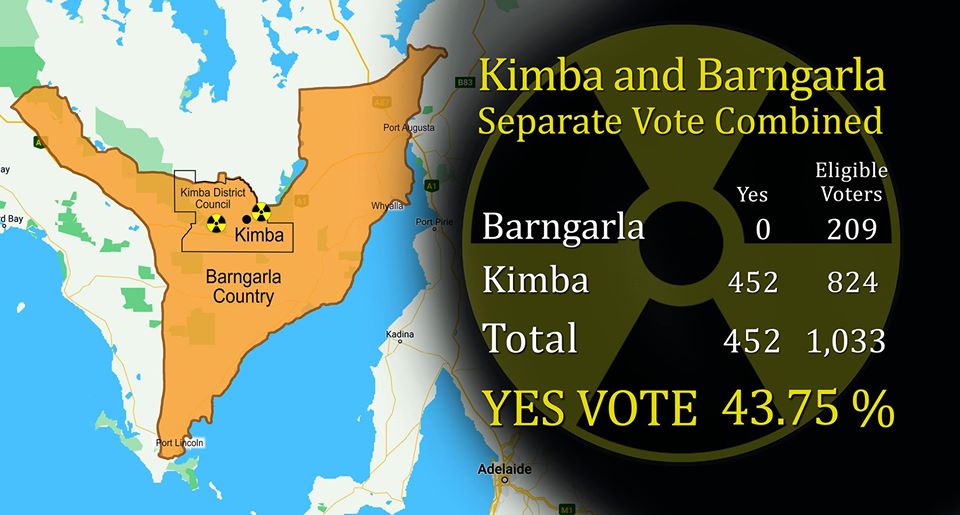
White Kimba, Australia, voted “Yes” to a nuclear waste dump, but the traditional Aboriginal owners held a separate ballot, with a “No” result
“Barngarla Speak Out” : vimeo.com/382855709
“SAVE SA Farmland – Kimba, Eyre Peninsula” : vimeo.com/381938156
U.S. Republican law-maker opposes Canada storing high-level nuclear waste near Lake Huron

Resolution calls on Canada to nix proposal to bury nuclear waste near the Great Lakes
State Rep. Gary Howell, R-North Branch, has introduced a resolution to prevent the Canadian government from proceeding with the proposed construction of an underground nuclear waste repository on the shores of Lake Huron. Howell serves as chairman of the House Committee on Natural Resources. The Resolution is cosponsored by State Rep. Shane Hernandez, R-Port Huron.
Howell’s House Concurrent Resolution 12 calls on Congress to prevent Canada’s most dangerous nuclear waste from being buried near the shores of Lake Huron. The nuclear waste dump is being proposed by the Ontario Power Generation Company for a site directly across the lake from Michigan’s Thumb.
“It is not in the best interest of the people of the United States or Canada to allow this outrageous proposal to proceed,” Howell said. “This would be high-level nuclear waste from every nuclear plant in Canada. The waste would be placed at Kincardine, Ontario less than a mile from the Lake Huron shore and only 1,300 feet below the lake level – making for a potential catastrophe waiting to happen. We cannot jeopardize the safety of our citizens – especially when the Great Lakes provide drinking water for more than 40 million people.
“This is a high-risk venture that could have long-term devastating effects on millions of lives,” Howell said. “To construct an underground waste repository in limestone, the very first of its kind, would be totally irresponsible. Limestone has never been tested to demonstrate that it will work in practice. The potential damage to the Great Lakes from any leak of radioactivity far outweighs any benefits that could be derived from disposing of radioactive waste at this site.
“The ecology of the Great Lakes is valuable beyond measure to the health and economic well-being of our entire region,” Howell said. “I strongly urge Congress to take every legal action possible to prevent this from happening. Just look at Germany – it is spending billions of dollars right now to dig up low-to-intermediate radioactive waste stored in a salt mine due to a leakage and other environmental concerns. This proposal involves much more serious high-level nuclear waste – the worst of the worst. We don’t need to create these types of problems on the Great Lakes.”
If adopted, House Concurrent Resolution 12 would be sent to the President of the United States, the members of the Michigan congressional delegation, the United States Nuclear Regulatory Commission, and Canadian officials
UK nuclear weapons programme £1.3bn over budget.
BBC 10th Jan 2020, UK nuclear weapons programme £1.3bn over budget. The Ministry Of Defence’s “poor management” of Britain’s nuclear weapons programme has led to rising costs and lengthy delays, according to the government spending watchdog.
Nuclear energy for Uganda – a bad option
|
Our nuclear energy option a bad deal, Daily Monitor, TUESDAY JANUARY 7 2020 BY SAM MUCUNGUZI In September 2019, Uganda signed an Inter-Governmental Agreement (IGA) with Russia to build capacity to exploit nuclear technology for energy, medical and other peaceful purposes (the definitions for peaceful can be looked at another day). The government selected Buyende, Nakasongola, Mubende, Lamwo and Kiruhura districts as the potential sites for nuclear power stations. State minister for Energy Simon D’Ujanga attributes the selection of these districts to the presence of water bodies nearby, As we are obsessed with nuclear energy, all seven of Germany’s nuclear power plants are slated to close by 2022, but where will the European country safely bury nearly 28,000 cubic meters of radioactive waste that will stay there for the next million years, as CNN reported? ……. According to the summary of nuclear generation plan from an AF-Consult Switzerland Limited report, the high case scenario for Uganda’s nuclear would involve the setting up of a two-unit nuclear power plant of an installed capacity of 2,300 megawatts (MW). In this scenario, the plant would be commissioned in 2028. Putting up two units with an installed capacity of 2,000MW and the first unit of these two would be commissioned in 2031.The low case scenario would involve the setting up of a one-unit, 1, 000MW nuclear power station, and commissioned in 2034. The summary said the capital expenditure for Uganda’s nuclear power programme 2020–2040 would be about Shs37.2 trillion for the best case scenario. For the low case scenario, the capital expenditure would be Shs18.6
The financing of this project will most likely be oil money which is anticipated at $3.6b ( about Shs13.6 trillion) annually from oil and gas. Oil will last for 25 years, however, if the current and future generation is to benefit, we need to stop looking at investments that don’t worsen the already damaged environment and worsening climate change.
If the superpower with experience, money and technology is closing who are we to venture into this risky and dangerous energy source?
Government has ignored to look at the smart and clean options of renewable energy generation for Uganda. Solar energy, for instance, is cheap, safe and clean, we have all year round good weather. Noor complex for example, located in Sahara desert (Morocco) will produce 580 MW when completed in 2020, and aims to produce enough energy to power over one million homes by the end of the year and reduce carbon emissions by an estimated 760,000 tonnes per year. This is slightly below what Uganda consumes at peak power demand by only 45mw. Noor only cost $625m. Coordinator, Citizens’ Concern Africa https://www.monitor.co.ug/OpEd/Letters/nuclear-energy-government-Inter-Governmental-Agreement-bad-deal/806314-5409596-sua1p0/index.html
|
|
UK Leading Labour leadership candidate Rebecca Long-Bailey would use nuclear weapons
|
8 January 2020 Leading Labour leadership candidate Rebecca Long-Bailey has said she would be prepared to use nuclear weapons as prime minister.It is a marked contrast to the policy of outgoing leader Jeremy Corbyn, a passionate and long-standing advocate of nuclear disarmament. Ms Long-Bailey, a staunch defender of Mr Corbyn’s failed leadership of the party, has previously been accused of being his “continuity candidate”. Asked on BBC Radio 4’s Today programme whether she would be prepared to launch a nuclear strike, Ms Long-Bailey said: “If you have a deterrent you have to be prepared to use it.”…. https://au.news.yahoo.com/rebecca-long-bailey-labour-leadership-nuclear-weapons-134918253.html |
|
|
UK govt trying to finance new nuclear plants, – complicated relations with China and USA
boss Vincent de Rivaz ill-advisedly said that customers would be using
electricity from the planned Hinkley Point C power plant to cook their
Christmas turkeys by 2017. Two years on from that self-imposed deadline,
the £21bn nuclear power station is still being built over a sprawling site
in the Somerset countryside – while the very future of nuclear power in
the UK is up for debate as other sources of energy snap at its heels and
investment in the sector gets harder to find.
backdrop of wariness about the source of potential investments:
state-backed China General Nuclear (CGN) is one of few investors willing to
pour money into the risky nuclear sector – but the communist
superpower’s involvement has brought political and security concerns as
well as opposition from the US.
beset by controversy, with Theresa May, the former prime minister,
reversing George Osborne’s courting of China in 2016 when she ordered a
review of China’s involvement in the UK’s nuclear industry, amid
concerns about national security.
consultation opened in the summer on the potential new financing mechanism for nuclear power plants which will see consumers pay for nuclear power plants before they start producing, in an attempt to bring down the costs of financing.
https://www.telegraph.co.uk/business/2020/01/05/britain-heading-fallout-nuclear-conundrum/

Trump’s plan to systematically remove environmental protection
 Trump’s 2020 plan: Change the rules on rules, Kelsey Brugger, E&E News reporter Greenwire: Friday, January 3, 2020 In the first half of 2020, Trump officials are hurrying to fundamentally change the way environmental rules are crafted.The administration plans to finalize regulations that could hamstring future presidents from making rules that rely on public health studies or fail to fully consider the benefits to Americans.
Trump’s regulatory plan released last fall showed hundreds of “economically significant” actions that the administration plans to finalize this year. Of those, at least 18 are noteworthy environmental rules — on air pollution and emissions to drilling and water quality.
But it’s Trump’s rules on the rulemaking process itself that could have the most lasting impact, according to experts.
For example, EPA’s proposed rule, “Strengthening Transparency in Regulatory Science,” could restrict the scientific evidence used to write air pollution rules.
The Trump administration also plans to change the way cost-benefit analyses are calculated, weakening future limits on power plant emissions, for example. Both rules are expected to advance in early 2020.
“Those are foundational,” said Betsy Southerland, a former longtime senior EPA career staffer and member of the Environmental Protection Network. “If they are finalized, from now on all environmental rules cannot count co-benefits and cannot use public health studies, then they can paralyze future rulemaking while the litigation slowly winds forward.”
It would take considerable time for a new administration to reverse those rollbacks, and certain Trump actions could get lost in the morass. The Obama EPA similarly could not undo some George W. Bush-era Clean Air Act permits that allowed aging facilities to continue to operate.
But time is running out.
The administration is up against a May deadline: Any regulations completed after that point would be subject to review under the Congressional Review Act. If 2021 ushers in a new president and a left-leaning Congress, the pair could undo many of Trump’s controversial triumphs.
Generally, not much happens in the federal government during an election year, when administrations tend to enter “political lockdown.” But in the Trump era, “unprecedented” is typical. And Trump continues to campaign on aggressive deregulation………
n 2020, the administration is expected to complete several environmental priorities.
The changes most concerning to Southerland included the WOTUS rewrite, the Affordable Clean Energy repeal and other pesticide reviews that are being done under the Toxic Substances Control Act, she said. “They are racing to finalize all of the damaging rollbacks in 2020,” she said.
Other drafts expected to be released in the coming weeks or months include the National Environmental Policy Act, which Trump ordered to be revised to ease permitting requirements when he first entered office; the Mercury and Air Toxics Standards, which would revoke past findings of mercury emissions and other pollutants; and the clean car standards, a joint effort of EPA and the Department of Transportation.
That two-part effort would weaken Obama-era fuel economy standards and prevent California from setting its own stricter standards (Greenwire, Nov. 20, 2019).
The Trump mantra, in a large part, has simply been to undo what Obama did…….Twitter: @kelseybrugger Email: kbrugger@eenews.net https://www.eenews.net/stories/1061984181
1 This Month





PLEASE OPPOSE HR 8255 AND S.3639 – bills would accelerate satellite deployment, with no environmental review or safeguards – https://ncstd5li.quorum.us/campaign/169331/
To see nuclear-related stories in greater depth and intensity – go to https://nuclearinformation.wordpress.com
-
Archives
- October 2026 (67)
- September 2026 (339)
- August 2026 (330)
- July 2026 (355)
- June 2026 (287)
- May 2026 (306)
- April 2026 (356)
- March 2026 (251)
- February 2026 (267)
- January 2026 (308)
- December 2025 (358)
- November 2025 (359)
-
Categories
- 1
- 1 NUCLEAR ISSUES
- business and costs
- climate change
- culture and arts
- ENERGY
- environment
- health
- history
- indigenous issues
- Legal
- marketing of nuclear
- media
- opposition to nuclear
- PERSONAL STORIES
- politics
- politics international
- Religion and ethics
- safety
- secrets,lies and civil liberties
- spinbuster
- technology
- Uranium
- wastes
- weapons and war
- Women
- 2 WORLD
- ACTION
- AFRICA
- Atrocities
- AUSTRALIA
- Christina's notes
- Christina's themes
- culture and arts
- Events
- Fuk 2022
- Fuk 2023
- Fukushima 2017
- Fukushima 2018
- fukushima 2019
- Fukushima 2020
- Fukushima 2021
- general
- global warming
- Humour (God we need it)
- Nuclear
- RARE EARTHS
- Reference
- resources – print
- Resources -audiovicual
- Weekly Newsletter
- World
- World Nuclear
- YouTube
-
RSS
Entries RSS
Comments RSS

