Ignoring Aboriginal opposition, Australian government chooses nuclear waste dump site
|
Federal Government chooses Kimba farm Napandee on the Eyre Peninsula for nuclear dump, ABC, 1 Feb 2020 The Federal Government has selected a farm on South Australia’s Eyre Peninsula as the site of a controversial nuclear waste dump. Key points:
Jeff Baldock’s Napandee property 20 kilometres west of Kimba will be used to permanently store low-level waste and temporarily store intermediate-level waste. The decision to use the 160-hectare area for what the Government calls a “disposal and storage facility” was made after four years of consultation. Nearly 62 per cent of people voted in favour of the site being used in November, while a site near Hawker in the Flinders Ranges was opposed by Aboriginal traditional owners and residents……. Dump to consolidate nuclear wasteLocal federal Liberal MP Rowan Ramsey said waste would come in from more than 100 sites around Australia, such as hospitals and universities, and the Lucas Heights nuclear reactor in Sydney. Processed medium-level nuclear fuel rods from Lucas Heights will be temporarily stored at Kimba while a permanent site is found for them, he said. Mr Ramsey, who tried to nominate his own property near Kimba for the dump but was barred as a federal MP, said there would be no fly-in, fly-out workers at the facility……. Aboriginal group opposed the voteThe Barngarla Determination Aboriginal Corporation launched legal action in 2018 against the District Council of Kimba, arguing it contravened the Racial Discrimination Act by excluding native title holders from a ballot due to be held that year. The Federal Court dismissed the claim last year because it said no contraventions of the Racial Discrimination Act had been established…….. The Howard government proposed a similar dump in South Australia in 1998 but withdrew its plans after losing a fight with the South Australian Labor government in the Federal Court. In 2007, a property called Mukaty Station in the Northern Territory was put forward to host the nuclear waste facility. The plan was abandoned in 2014, again because of legal action, this time by the area’s traditional owners. A group called No Radioactive Waste Facility for Kimba District held a rally against the decision in the town on Sunday.Friends of the Earth national nuclear campaigner Jim Green said the Federal Government promised the facility would not be approved unless it received at least 65 per cent of community support. “They’ve ignored the traditional owners, ignored South Australians. South Australia’s got legislation banning the imposition of nuclear waste dumps and that’s been ignored and it’s just disrespectful from start to finish,” he said. “South Australians have got greater ambitions for our state than to be someone else’s nuclear waste dump.”https://mobile.abc.net.au/news/2020-02-01/kimba-farm-eyre-peninsula-chosen-for-nuclear-dump/11920514 |
|
Political instability adds to the danger of nuclear power for Bolivia
|
Bolivian unrest: what now for the country’s nuclear ambitions? Power Technology, By Heidi Vella 31 Jan 2020, Backed by Russia, Bolivia had set its sights on building new nuclear energy capacity to supply the country’s growing demand for electricity – but could recent political instability put these plans into doubt? We investigate the progress and potential of Bolivia’s atomic energy ambitions.
Russia had agreed to support a $300m nuclear research reactor near the Bolivian capital of La PaztHome to part of the Andean mountain range, as well as some of the highest above-sea-level cities in the world, the developing South American state of Bolivia is not an obvious candidate for new nuclear energy capacity. Yet, since 2013, the now ousted former-Bolivian President, Evo Morales, has been pursing plans to reduce the country’s heavy reliance on fossil fuels by investing in nuclear power…… Five years on however, Bolivia finds itself in political turmoil. Morales, who ran the country for 14 years and was the first ever indigenous president, has exiled himself to Mexico following weeks of violent protests and unrest amid accusations of electoral fraud at the end of 2019. As such, the country’s nuclear ambitions now appear firmly on hold.
Prior to Morales’ fall from power, his administration had kick-started the often-lengthy process of initiating nuclear power capabilities. It founded The Bolivarian Agency for Nuclear Energy and had started working with the IAEA to establish a development framework for nuclear. In 2018, it signed a Country Programme Framework with the IAEA leading up to 2023. Plans for uranium mining in the country had also been floated, but the government halted these and instead decided it could import nuclear fuel from France and Canada. Further agreements were penned with Rosatom for the building of the research centre, which, if it is ever finished, will be the highest in the world at 4000 metres above sea level. The centre is expected to encompass a pool-type reactor of between 100 and 200 kilowatts, a multi-purpose gamma irradiation unit, a cyclotron for nuclear pharmacy purposes, an engineering department, and several research laboratories. Challenges ahead Bolivia is one of only a handful of countries in South America that is either exploring capital intensive nuclear power or already has capacity. Argentina and Brazil both have nuclear reactors in action. However, the rising cost of current technology – several projects in Europe have run years over schedule and millions over budget – can make it difficult, but not impossible, for developing nations such as Bolivia to adopt atomic energy…….. Political instability Since the resignation of Morales in November, a conservative interim government has assumed power and elections are expected in May……….with accusations of vote rigging in the last election, there’s little assurance the upcoming polls will not result in more violence and political stability, both of which will likely keep away potential investors. Therefore, it remains very early days for nuclear energy development in Bolivia. In fact, the World Nuclear Association doesn’t expect much growth in the nuclear power sector to come from any developing nations, including Bolivia. Instead, the country is more likely to remain part of a long list of developing nations that has penned agreements with Russia, such as Indonesia, Vietnam and Sudan, but are yet to see them come fully into fruition, at least until it wrestles back democracy. https://www.power-technology.com/features/bolivian-unrest-what-now-for-the-countrys-nuclear-ambitions/ |
|
Historic vote on nuclear waste underway in Bruce County, Ontario
 Historic vote on nuclear waste underway in Bruce County, Ont.London CTV News, Scott MillerVideographer @ScottMillerCTV Contact, January 31, 2020 SOUTHAMPTON, ONT. — Plans to build Canada’s first permanent home to nuclear waste are being decided by a local First Nations band Friday. Historic vote on nuclear waste underway in Bruce County, Ont.London CTV News, Scott MillerVideographer @ScottMillerCTV Contact, January 31, 2020 SOUTHAMPTON, ONT. — Plans to build Canada’s first permanent home to nuclear waste are being decided by a local First Nations band Friday.Over 4,500 members of the Saugeen Ojibway Nation (SON) were eligible to vote on whether to approve the plan to bury Ontario’s low- and intermediate-level nuclear waste along the shores of Lake Huron. Ontario Power Generation (OPG) plans to bury 200,000 cubic metres of nuclear waste in a facility, 680 metres under the Bruce Power site, north of Kincardine, Ont. The Deep Geological Repository or DGR falls within the traditional territory of the SON, so OPG has committed to not moving forward without the band’s support. Whatever SON members decide, it will have far-reaching impacts. There are over 230 resolutions by various levels of government around the Great Lakes, including London, Sarnia and Toronto, opposing the plan. In Michigan, Congressman Dan Kildee has been leading the charge against the DGR. “Permanently storing nuclear waste less than a mile from Lake Huron just doesn’t make sense. Surely in the vast land mass that comprises Canada, there is a better place to permanently store nuclear waste than on the shores of the world’s largest supply of fresh water,” he says…….. https://london.ctvnews.ca/historic-vote-on-nuclear-waste-underway-in-bruce-county-ont-1.4792113 |
|
Surplus nuclear power has become an embarrassment. Inflexible baseload power no longer needed.
Out of earshot of the politicians, the question of what to do with all the surplus power when demand is low is being tackled by increasing storage capacity but also by making green hydrogen. Some nuclear buffs are even suggesting hydrogen production might be the only viable hope for using up their spare power.
Long Island Power Authority ratepayers will have to Subsidize Upstate Nuclear Power Plants
LIPA Customers To Subsidize Upstate Nuclear Power Plants.wshu, By JAY SHAH 29 Jan 2020 Long Island Power Authority ratepayers could spend more than $800 million over the next decade to help fund upstate nuclear power plants.
LIPA will have to buy zero-emission credits through a state agency, which subsidizes energy generators that don’t emit greenhouse gases, like [?] nuclear power plants. …….https://www.wshu.org/post/lipa-customers-subsidize-upstate-nuclear-power-plants#stream/0
Republicans try to get nuclear power accepted as “renewable” in California
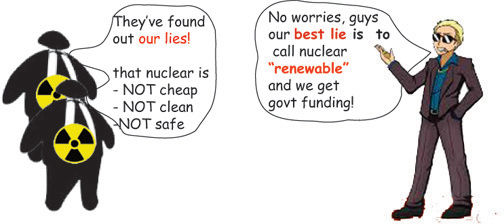
- California Republicans on Tuesday introduced legislation to temporarily halt the requirements of the state’s Renewables Portfolio Standard (RPS) program and redirect funds to ensure utilities improve their infrastructure and vegetation management programs.
- The proposed bill would also, if and when the program is reinstated, include nuclear generation and all hydroelectric facilities operating as of January 1, 2021 in the program’s definition of an “eligible renewable energy resource.”
- The bill, along with a second piece of legislation introduced by state Assemblyman James Gallagher, R, and Sen. Jim Nielsen, R, “will help prevent future wildfires and utility power shutoff events,” according to a press release. But environmental advocates say that the move to extend RPS eligibility to hydro and nuclear facilities might not go far in California’s current political landscape.
Dive Insight:
California established its RPS program in 2002, requiring at the time that renewable resources make up 20% of electricity retail sales by 2017. However, the program’s targets have changed over the years; the state passed Senate Bill 100 in 2018, accelerating RPS requirements to 60% by 2030, as well as requiring that carbon-free resources supply all of the state’s electricity by 2045.
Large hydropower and nuclear generation don’t currently count toward the RPS standard requirements, but the state is still defining the zero-carbon requirement passed in SB 100, Alex Jackson, senior attorney at the Natural Resources Defense Council, told Utility Dive.
In the last three years, California utilities have also been wrestling with the increased threat of wildfires posed by their infrastructure. Devastating fires in 2017, 2018 and 2019 have caused billions of dollars in damage across the state, pushing Pacific Gas & Electric to declare bankruptcy in early 2019.
To reduce this risk, the utility adopted a public safety power shut-off (PSPS) program, proactively de-energizing areas that are particularly prone to fires during windy or dry weather conditions. The shut-offs have drawn widespread criticism from regulators, lawmakers and customers in Northern California……..
Environmental advocates pushed back against the proposal to include both large hydropower and nuclear generation as eligible resources under the RPS program.
The RPS is part of a deliberate state move away from fossil fuels, and utilities already get a lot of their power from hydro, so counting it in the RPS requirements would discourage investments in wind, solar, and other renewables, Kathryn Phillips, director of Sierra Club California, told Utility Dive…..
On the nuclear energy front, “there’s no way you can call nuclear renewable,” she said. “It doesn’t emit carbon, but it has lots of other very intense environmental impacts.”
“Nuclear is being phased out not because of its ineligibility for RPS requirements, but because these large inflexible baseload plants are increasingly incompatible with a system that’s predominantly run on intermittent clean energy resources,” according to Jackson.
Flexibility is key going forward and the high operating costs of nuclear plants is what led PG&E to propose the retirement of the Diablo Canyon plant in the first place, he added. …….https://www.utilitydive.com/news/proposed-bill-include-large-hydro-nuclear-power-californias-rps/570919/
USA Politicians on both sides sucked in by propaganda for fantasy new nuclear reactors


|
Reporter’s notebook: Nuclear reactors prove tough tech, despite
bipartisan push, https://www.houstonchronicle.com/business/energy/article/Reporter-s-notebook-Nuclear-reactors-prove-15000083.php
James Osborne Jan. 24, 2020 WASHINGTON – If there’s any clear area of agreement between Republicans and Democrats on climate change, it’s on the need to develop a new generation of nuclear power plants as quickly as possible. More precisely, it’s the need to bring down the multi-billion dollars costs of existing plants and create a meltdown-proof reactor that can run on recycled uranium and plutonium rods, which power companies and environmentalist alike can get behind. But getting bipartisan agreement on the need for those reactors has proven far easier than developing them, as companies look to overhaul a nuclear reactor design that has changed little since they first began operation in the United States in the 1950s. One year after the Senate passed a law requiring the government’s leading nuclear authority, the Nuclear Regulatory Commission, to overhaul its processes for approving nuclear power plants to account for the new reactors, senators are already beginning to exhibit impatience. At a hearing earlier this month, Sen. Sheldon Whitehouse, a Rhode Island Democrat, quizzed NRC officials about why they thought the Senate passed the law. When one of them said, “You really want me to guess,” he responded: “I would hope you would know, that it would be so clear why we gave you this power.” Two-fer The point, Whitehouse said, is to create a new carbon-free energy source that could also be fueled by the growing stockpiles of spent nuclear rods at reactors around the country, ending a decades-long debate about where to dispose of them. “I don’t know if that’s going to pan out, but people who are very smart and have invested millions of dollars tell me that is their intention,” Whitehouse said. “We want to see that focus on turning that waste into something positive.” With backers like billionaire Bill Gates, a wave of startups is trying to develop a reactor that uses materials such as molten salt or liquid metal to cool itself — instead of water — allowing a reactor that loses power to cool down on its own. But so far only one company, California-based Oklo, is ready to submit plans for its reactor to the NRC for review, said Scott Burnell, a spokesman for the agency. |
|
|
In UK “big” nuclear power versus “small” (both unaffordable) at Wylfa
 The global nuclear lobby might look like a unified force – it’s anything but!. The nuclear nations fight each other in desperately trying to flog off their unaffordable white elephant nuclear reactors to ‘developing’ countries, or to any sucker, really. .
The nuclear industry itself is divided – the ‘conventional’ big nuclear reactors versus the (not yet existing) Small and Medium Nuclear Reactors (SMRs)
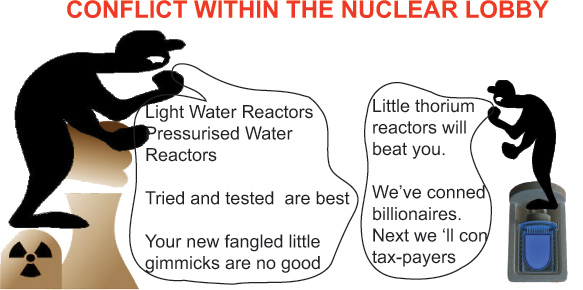
‘No plans’ for Wylfa mini nuclear power station according to developer, https://www.dailypost.co.uk/news/north-wales-news/no-plans-wylfa-mini-nuclear-17599188, Owen Hughes, Business correspondent, 20 JAN 2020
Horizon Nuclear Power said its full focus is on delivering a full scale nuke plant.
Wylfa Newydd developer Horizon Nuclear Power says there are “no plans” to build mini reactors at its Anglesey site.
Rolls Royce is currently leading a consortium developing the technology for Small Modular Reactors (SMRs) – supported by the UK Government. Trawsfynydd in Gwynedd has been tipped at a prime spot for one of the reactors and over the weekend Wylfa was also reported as a target location.
But Horizon has released a statement making clear the Wylfa site is not being put forward for this technology as they press on with the current plan for a full scale nuclear site.
A spokesman said: “There are no plans to deploy a Rolls Royce Small Modular Reactor at the Wylfa Newydd site.”
He added: “Activity on the Horizon project is currently suspended, but we’re working hard to establish the conditions for a restart using our tried and tested reactor design, which has already cleared the UK regulators’ assessment process.
Energy Secretary Andrea Leadsom wants additional information before deciding whether to give planning permission for Wylfa Newydd.
She deferred the decision on the site in October.
If permission is granted then the next step will be securing funding to make the project happen.
When it comes to SMRs, Alan Woods, strategy and business development director for Rolls-Royce, said they were focusing on sites in Wales and the north of England. Modular reactors are smaller and, once the first is approved and built, manufacturers hope mass-production will lead to shorter construction times and lower costs for each unit.
The consortium will need to establish factories to produce the small modular reactors with the pre-fabricated modules transported to sites for construction.
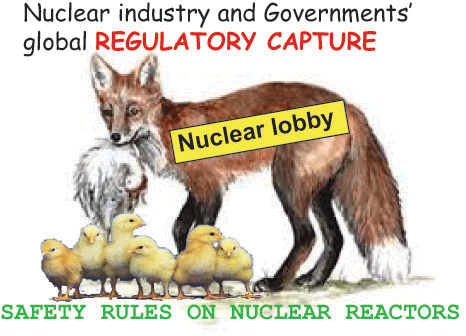
India – a case study in regulatory capture by the nuclear industry
 Leaflet SONALI HURIA, January 22,2020
 In this piece, the author while discussing the issues around nuclear safety, debates on why it is important to re-examine the proposed Nuclear Safety Regulatory Authority Bill for better regulation, transparency, and liability. SINCE returning to power last year with an overwhelming majority in the 2019 general elections, the Modi-led government has passed a series of legislations in rapid succession without any credible dialogue both within and outside Parliament – …………even as there has been exceptional eagerness to push these amendments and pass new legislation, including notifying the Citizenship (Amendment) Act, 2019 despite intense country-wide protests and a raging debate on its underlying intent, there are urgent issues, such as, nuclear safety, which remain in indefinite suspension.
The UPA-II government, under Dr Manmohan Singh, had introduced the Nuclear Safety Regulatory Authority (NSRA) Bill in the Lok Sabha on 07 September 2011, aimed at replacing India’s existing nuclear regulator, the Atomic Energy Regulatory Board (AERB) with a purportedly improved and more autonomous Nuclear Safety Regulatory Authority (NSRA) which would have the mandate to ‘regulate nuclear safety and activities related to nuclear material and facilities’.
The Bill, however, which had been referred to the Department-related Parliamentary Standing Committee on Science and Technology, Environment and Forests, did not come up for discussion before the dissolution of the 15th Lok Sabha, and subsequently, lapsed. The Standing Committee had reportedly endorsed the Bill with only minor suggestions for changes, while two members of the Committee from the CPI(M), gave dissent notes, arguing that the Bill provided ‘no substantive autonomy’ to the proposed NSRA. According to available information, in April 2017, the Union Minister of State (Independent Charge) Atomic Energy and Space, Dr Jitendra Singh, in a written response to a question in the Lok Sabha had stated that a ‘fresh Bill’ similar to the earlier NSRA Bill, was ‘under examination’……….India’s nuclear regulatory framework has long been criticized for being so thoroughly enmeshed within the government structure so as to render its requisite independence, practically meaningless. Nuclear safety in India has been the remit of the AERB, which was set up in November of 1983 by an executive order of the Secretary of the DAE under Section 27 of the Atomic Energy Act, 1962, with modifications made in April 2000 to “exclude all BARC facilities from (its) oversight, (following) the declaration of BARC as a nuclear weapons laboratory”.
The AERB has had the dishonourable reputation of being subservient to India’s exclusively public sector operators, which it is required to monitor, and is also acknowledged as suffering from an acute lack of independence from industry and government.
As things stand, the AERB is responsible for monitoring the safety of the various nuclear facilities operated by agencies such as, the Nuclear Power Corporation of India Limited (NPCIL) and the Uranium Corporation of India Limited (UCIL), which fall under the purview of the Department of Atomic Energy (DAE). However, the Board is required to report to the Atomic Energy Commission (AEC), whose chairman is the Secretary of the DAE and one of whose members is the Chair of the NPCIL, and which overall, comes under the direct control of the Prime Minister of India. Thus, the regulatory board reports to the very agency it is required to assess and monitor in the interest of public safety.
Moreover, the AERB frequently draws upon the ‘expertise’ of scientists and engineers provided by the DAE – “almost 95% of the members in AERB’s review and advisory committees are drawn from among retired employees of the DAE, either from one of their research institutes like the Bhabha Atomic Research Center or a power generation company like the Nuclear Power Corporation of India Ltd.” – thus, calling into question the AERB’s functional autonomy.
Dr A Gopalakrishnan, the former Chairman of the AERB has been at pains to explain how the present institutional setup makes nuclear safety regulation in India a ‘mere sham’ and that for the AERB to function effectively, the DAE’s hold on the Board needs to be urgently done away with. In 1995, during Dr Gopalakrishnan’s tenure as the nuclear regulator, the AERB had prepared a comprehensive ‘Document on Safety Issues in DAE Installations’ – a report detailing nearly 130 safety issues across India’s nuclear installations with 95 of them having been designated ‘top priority’, to which the first reactions from the NPCIL and BARC according to Dr Gopalakrishnan, were of denial and questioning AERB’s own technical expertise to review safety matters.
A 2012 Performance Audit Report on the AERB prepared by the Comptroller and Auditor General of India (CAG) and submitted to the Indian Parliament labelled the AERB a ‘subordinate office, exercising delegated functions of Central government and not that of the regulator’.
The Public Accounts Committee (PAC) scrutinizing the CAG report in 2013 castigated the Regulatory Board for failing to prepare a ‘comprehensive nuclear radiation safety policy despite a specific mandate in its constitution order of 1983’. The International Atomic Energy Agency’s (IAEA) Peer Review of India’s Nuclear Regulatory Framework in 2015 was also categorical in asserting that the AERB was in need of being separated from ‘other entities having responsibilities or interests that could unduly influence its decision making’.
As has been pointed out by MV Ramana, physicist and author of The Power of Promise, there have been accidents of ‘varying severity’ at several of the nuclear facilities being operated by the DAE, yet the regulatory board has frequently been seen downplaying the seriousness of such incidents, “postponing essential repairs to suit the DAE’s time schedules, and allowing continued operation of installations when public safety considerations would warrant their immediate shutdown and repair”. The charade of the AERB’s professed independence is further underscored by its conspicuous silence on the recent cybersecurity breach at the Koodankulam Nuclear Power Plant in Tirunelveli District in Tamil Nadu in October 2019.
It is these glaring frailties of the nuclear regulatory framework coupled with the obdurate insistence of the Central government to massively expand its activities along the entire nuclear fuel cycle, despite unsettled safety concerns, a long-standing and vociferous people’s resistance against uranium mining and nuclear energy projects, and concerns surrounding the health, environmental, economic, and democratic costs of this expansion, that make imperative, the need for a fiercely independent and non-partisan nuclear regulator.
Does the proposed NSRA fit the bill?
The NSRA Bill, 2011 upon its introduction, had failed to invoke any enthusiasm among independent experts, nuclear sector watchers, and civil society actors, and instead, was met with grim scepticism given that among other things, it made light of the principle of ‘separation’ as required under Article 8 of the IAEA Convention on Nuclear Safety to which India is a State Party.
The NSRA Bill provides for the establishment of a ‘Council of Nuclear Safety’, headed by the Prime Minister and comprised of five or more Union Ministers, the Cabinet Secretary, Chairman of the AEC, and other ‘eminent experts’ nominated by the Central government, which in turn, will constitute ‘search committees’ to select the Chair and Members of the proposed Regulatory Authority. Moreover, under Article 14 of the Bill, the Chairperson and Members of the NSRA can be removed by an order of the Central government.
Dr Gopalakrishnan argues that the Bill makes only an ornamental show of granting independence to the NSRA by requiring the Authority to report to the Parliament instead of a government department, ministry or official. Concomitantly, however, the Bill also unambiguously provides for the supersession of and the assumption of ‘all the powers, functions and duties’ of the Authority by the Central Government, if in its ‘opinion’ the Authority fails to function in concert with the provisions of the proposed Act, and, requires the Authority to seek approval of the central government prior to initiating any interaction with nuclear regulators of other countries and/or international organizations ‘engaged in activities relevant to…nuclear/radiation safety, physical security of nuclear material and facilities, transportation of nuclear and radioactive materials and nuclear and radiation safety and regulation’.
Article 20 (q) of the Bill mandates the NSRA to ‘discharge its functions and powers in a manner consistent with the international obligations of India’. This provision, argues Dr Gopalakrishnan is deeply worrisome for it “could mean, that if the Prime Minister has promised the French President in 2008 that India would buy six European Pressurised Reactors (EPRs)…(this) unilateral and personal commitment…will now (be) labelled ‘India’s international obligation’, and the NSRA cannot question, even on strong safety grounds, the setting up of those six EPR units, since that will violate the said clause of the Bill” – this might prove disastrous for both, public and environmental safety in the long term.
Experts argue that far from separating the regulator from the government, these provisions contained in the NSRA Bill will only mean absolute government control over nuclear regulation, including over appointment and dismissal procedures, thus, opening the way for ‘pliant technocrats’ to occupy prominent positions within the Authority.
The proposed Bill is also fuzzy on the question of which nuclear facilities will fall under the purview of the NSRA – it empowers, for instance, the central government to exempt “any nuclear material, radioactive material, facilities, premises and activities” from the jurisdiction of the Authority, on grounds of ‘national defence and security’. ……….
These and other provisions of the Bill are a stark reminder that the DAE has no love lost for transparency and public oversight – take, for instance, Article 45 which requires the Chairperson, Members, and other employees of the Authority to sign a ‘declaration of fidelity and secrecy’ “to not communicate or allow to be communicated to any person not legally entitled to any information relating to the affairs of the Authority”. It is for these reasons that the former nuclear regulator, Dr Gopalakrishnan has described the proposed NSRA Bill as an exercise in ‘boxing in’ nuclear regulation “from all sides by government controls, diktats, and threats of retaliation”, thus making it even more emaciated than the existing nuclear regulator – the AERB. …..https://theleaflet.in/in-a-season-of-impetuous-lawmaking-whither-nuclear-safety/
Swedish Parliament Rejects Proposal to Halt Nuclear Shutdown
Swedish Parliament Rejects Proposal to Halt Nuclear Shutdown, Bloomberg, By Niclas Rolander, January 23, 2020,
A majority in the Swedish parliament rejected a proposal from the nationalist Sweden Democrats to stop Vattenfall AB’s plans to close two nuclear reactors, in a victory for the Social Democrat-led government.
The Sweden Democrats had support from three parties but failed to secure a majority. Its proposal to give the state-owned utility instructions to reverse its plans to wind down the Ringhals 1 reactor and to restart another reactor that was shuttered Dec. 30 lost by a single vote on Wednesday afternoon.
Vattenfall has repeatedly said it isn’t economically viable to keep running the two reactors, which were commissioned in 1975 and 1976, respectively. The company also operates two newer reactors at the plant, which produces a sixth of Sweden’s electricity, and is owned jointly with Germany’s Uniper SE, which holds a 29.6% stake through a subsidiary. ……. https://www.bloomberg.com/news/articles/2020-01-22/swedish-parliament-rejects-proposal-to-halt-nuclear-shutdown
Japan’s Olympics – recovery for Fukushima? rescue for the nuclear industry?

Can Japan’s ‘Recovery Olympics’ heal Fukushima’s nuclear scars?fFukushima’s power plant. Three nuclear reactors melted down, spewing radioactive particles into the air. Jan. 14, 2020, By Keir Simmons, Yuka Tachibana and Henry Austin, FUTABA, Japan — Nine years after “Fukushima” became synonymous with nuclear disaster, the area will help kick off the 2020 Summer Olympics in Tokyo by hosting the opening ceremony’s torch relay near its devastated power plant.
But this symbol of rebirth — part of a planned renaissance for a region ravaged by the strongest earthquake in Japan’s history and deadly tsunami that engulfed entire communities — raises questions of whether nearly a decade is enough time to recover and make the area safe.
Officials in Japan told NBC News they were hopeful that the games, which open on July 24 and have been dubbed the country’s “Recovery Olympics,” would convince skeptics that the answer is yes.
“It’s an opportunity for Japan to change people’s perception, people’s view of Fukushima,” said Naoto Hisajima, the director general of disarmament, nonproliferation and science for Japan’s Foreign Ministry. “The Olympic torch will pass through Fukushima, and there’re going to be Olympic events in Fukushima.”
……… Three nuclear reactors melted down, spewing radioactive particles into the air.
Authorities acted quickly, scrubbing buildings and removing about 4 inches of soil and vegetation from the surrounding area. That lowered radioactivity to levels that are safe for people to be in contact with, according to Dr. Claire Corkhill of the U.K.’s University of Sheffield.
Corkhill’s team is helping plant operators come up with a plan to dispose of the highly radioactive melted cores — the parts of the power plant’s nuclear reactors that contained fuel components, like uranium and plutonium, that generated the heat to produce the power.
They are so toxic that only remotely controlled robots can get to them, but the robots are unable to remove them because “the intense radiation tends to fry their circuits,” she said.
Corkhill said that it will take decades to completely shut down the plant and that the operators still don’t know how to reach the cores.
Space to store the 1 million tons of water — equal to 400 Olympic-size swimming pools — that must be pumped through the reactor to keep the fuel cool is also running out, she warned.
While the water has been treated to remove most of the most dangerous radioactive components, traces of tritium remain.
Japanese authorities have suggested releasing the water slowly into the sea over a number of years, which Corkhill said was standard practice for power stations around the world.
It’s “the most feasible option at the moment,” she said.
Many residents are doubtful, however — particularly fishermen and women who test every catch for radiation…..
Sean Bonner and Azby Brown are part of environmental organization Safecast, which gives Geiger counters to Fukushima residents, as well as other people across Japan, to take radiation readings. It then collates the data and publishes them live on their website, which is an open source for radiation information.
Brown described trust as a “nonrenewable resource.”
“Once you’ve lost it, you don’t get it back,” Bonner said. “So we see our system as a side effect of people desperate to find something they can trust, because they’re not trusting information from the news. They’re not trusting information from authorities or institutions.”
While the cleanup continues, some areas remain off limits. Two miles from the plant, the town of Futaba remains uninhabited. Radiation levels are so high that former residents have to seek special permission to enter the town.
Katushide Okada, 75, said he had run a rose garden in the town since he was 23.
“We left with only what we were wearing,” he said. “We haven’t been able to go home since.”
Okada, who now lives in Tsukuba, about 130 miles to the south, in Ibaragi Prefecture, added, “This is a manmade disaster.”
Radiation hotspots have been found in J-Village, the starting point of the Olympic torch relay, according to Greenpeace.
After conducting its own tests, Greenpeace said radioactive contamination still remained in the parking lot and the nearby forests at the Olympic sports complex in Fukushima Prefecture. …….. Keir Simmons and Yuka Tachibana reported from Futaba, Japan, and Henry Austin from London. https://www.nbcnews.com/news/world/can-japan-s-recovery-olympics-heal-fukushima-s-nuclear-scars-n1114361
Belgium lawmakers narrowly agree to keep U.S. nuclear weapons, Belgian public overwhelmingly opposes this
Belgium debates phase-out of US nuclear weapons on its soil, By Alexandra Brzozowski | EURACTIV.com Jan 17, 2020 It’s one of Belgium’s worst kept secrets. Lawmakers on Thursday (16 January) narrowly rejected a resolution asking for the removal of US nuclear weapons stationed in the country and joining the UN Treaty on the Prohibition of Nuclear Weapons (TPNW).
66 MPs voted in favour of the resolution while 74 rejected it.
Those in favour included the Socialists, Greens, centrists (cdH), the workers party (PVDA) and the francophone party DéFI. The 74 that voted against included the nationalist Flemish party N-VA, the Flemish Christian Democrats (CD&V), the far-right Vlaams Belang and both Flemish and francophone Liberals.
Just before the Christmas recess, the parliament’s Foreign Affairs Committee approved a motion calling for the withdrawal of nuclear weapons from Belgian territory and the accession of Belgium to the International Treaty on the Prohibition of Nuclear Weapons. The resolution was led by Flemish socialist John Crombez (sp.a).
With this resolution, the chamber requested the Belgian government “to draw up, as soon as possible, a roadmap aiming at the withdrawal of nuclear weapons on Belgian territory”.
The December resolution was voted in the absence of two liberal MPs, even though the text was already watered down.
According to Flemish daily De Morgen, the American ambassador to Belgium was “particularly worried” about the resolution before Thursday’s vote and a number of MPs were approached by the US embassy for a discussion.
The controversy was sparked by a debate to replace the US-made F-16 fighter aircraft in the Belgian army with American F-35s, a more advanced plane capable of carrying nuclear weapons…….
Although the Belgian government had so far adopted a policy of “to neither confirm, nor deny” their presence on Belgian soil, military officials have called it one of Belgium’s “most poorly kept secrets”.
According to De Morgen, which obtained a leaked copy of the document before its final paragraph was replaced, the report stated:
“In the context of NATO, the United States is deploying around 150 nuclear weapons in Europe, in particular B61 free-bombs, which can be deployed by both US and Allied planes. These bombs are stored in six American and European bases: Kleine Brogel in Belgium, Büchel in Germany, Aviano and Ghedi-Torre in Italy, Volkel in the Netherlands and Inçirlik in Turkey……..
Belgium, as a NATO country, so far has not supported the 2017 UN Treaty on the Prohibition of Nuclear Weapons (TPNW), the first legally binding international agreement to comprehensively prohibit nuclear weapons, with the goal of leading towards their total elimination.
However, the resolution voted on Thursday was meant to change that. A public opinion poll conducted by YouGov in April 2019 found that 64% of Belgians believe that their government should sign the treaty, with only 17% opposed to signing. https://www.euractiv.com/section/defence-and-security/news/belgium-debates-phase-out-of-us-nuclear-weapons-on-its-soil/
A new law in USA pushes regulators to approve new nuclear reactor plans
- NRC taking steps toward regulatory path for advanced reactors
- Barrasso says nuclear industry shrinking
The Nuclear Regulatory Commission expects its first application for a new generation of advanced nuclear reactors in a few weeks, as it works to implement a 2019 law meant to spur such technologies, agency officials told the Senate Environment and Public Works Committee Wednesday.
The 2019 law, the Nuclear Energy Innovation and Modernization Act (P. Law 115-439), introduced by Sen. John Barrasso (R-Wyo.) and signed by President Donald Trump in 2019, was cosponsored by the top Democrat on the Senate environment panel, Sen. Tom Carper (Del.), and seven other Democrats…….(subscribers only) https://news.bloombergenvironment.com/environment-and-energy/regulators-urged-to-spur-advanced-nuclear-power-under-new-law
No chance of re-using spent mixed-oxide (MOX) fuel, its storage highly dangerous
|
Mainichi 15th Jan 2020, There are no prospects that spent mixed-oxide (MOX) fuel, made by reprocessing spent nuclear material, can be further reprocessed and reused for nuclear power generation in accordance with the Japanese government’s energy policy.
Storing such fuel for a long period has thus raised safety
concerns. The Nuclear Regulation Authority (NRA) has expressed concerns that the storage of spent MOX fuel in the pool over such a long period is highly dangerous. In case of a power blackout, the temperature of the water in the pool could not be maintained at a certain level and it would become unable to cool the fuel just as was the case with the Fukushima nuclear crisis. https://mainichi.jp/english/articles/20200115/p2a/00m/0na/029000c |
|
In UK, energy bosses bullying locals into submission over Sizewell nuclear build?
East Anglian Daily Times 16th Jan 2020, Villagers whose properties would be affected by a bypass included in Sizewell C plans, claim energy bosses are trying to pressure them into submission.
A group of households in Farnham claim EDF Energy’s valuers
have attempted to hold complex discussions over financial mitigation
related to the new section of the A12 with little notice and no time to
prepare.
https://www.eadt.co.uk/news/farnham-residents-criticse-edf-over-a12-bypass-route-1-6468545
1 This Month





PLEASE OPPOSE HR 8255 AND S.3639 – bills would accelerate satellite deployment, with no environmental review or safeguards – https://ncstd5li.quorum.us/campaign/169331/
To see nuclear-related stories in greater depth and intensity – go to https://nuclearinformation.wordpress.com
-
Archives
- October 2026 (58)
- September 2026 (339)
- August 2026 (330)
- July 2026 (355)
- June 2026 (287)
- May 2026 (306)
- April 2026 (356)
- March 2026 (251)
- February 2026 (267)
- January 2026 (308)
- December 2025 (358)
- November 2025 (359)
-
Categories
- 1
- 1 NUCLEAR ISSUES
- business and costs
- climate change
- culture and arts
- ENERGY
- environment
- health
- history
- indigenous issues
- Legal
- marketing of nuclear
- media
- opposition to nuclear
- PERSONAL STORIES
- politics
- politics international
- Religion and ethics
- safety
- secrets,lies and civil liberties
- spinbuster
- technology
- Uranium
- wastes
- weapons and war
- Women
- 2 WORLD
- ACTION
- AFRICA
- Atrocities
- AUSTRALIA
- Christina's notes
- Christina's themes
- culture and arts
- Events
- Fuk 2022
- Fuk 2023
- Fukushima 2017
- Fukushima 2018
- fukushima 2019
- Fukushima 2020
- Fukushima 2021
- general
- global warming
- Humour (God we need it)
- Nuclear
- RARE EARTHS
- Reference
- resources – print
- Resources -audiovicual
- Weekly Newsletter
- World
- World Nuclear
- YouTube
-
RSS
Entries RSS
Comments RSS

