Chinese-led nuclear company pretending that Sizewell project is a ‘fait accompli’ – no, it is far from it.
 BANNG 1
 020, The Blackwater Against New Nuclear Group (BANNG) has learned that GNSL, the Chinese-led company seeking to build a mammoth new nuclear power station at Bradwell, is preparing to launch its pre-application public consultation for planning permission later this year.
This will be long before detailed discussions with the nuclear regulators are concluded. There are major issues and challenges still to be confronted. ‘It seems that the Chinese developers are taking a risk in trying to present the public and politicians with an apparent ‘fait accompli’ well before major design
and environmental hurdles have been crossed’ said Prof. Andy Blowers,
Chair of BANNG.
GNSL greeted the announcement that the Generic Design
Assessment (GDA) for Bradwell B had begun Step 4 as a major milestone,
clearing the path for deployment of Chinese nuclear technology in Britain.
That is far from the case. Moving to Step 4 in the GDA is like reaching a
hurdle, not passing a milestone. It is at this stage that all the tricky
issues facing the Bradwell B project must be confronted, including the
cooling system, site suitability, security, coastal defence, impacts on
marine and terrestrial environments and so on.
Step 4 is a long and intensive process between the developer and the independent regulators, the Office for Nuclear Regulation (ONR) and the Environment Agency (EA). It is not expected to be concluded for another two years. A pre-application should follow, not overlap, Step 4 of the GDA.
https://www.banng.info/news/press-release-18th-february-2020/
New Energy Deputy Secretary nominee (?unwisely) contradicts Trump on Yucca Mountain and nuclear wastes.
Energy deputy secretary nominee faces heat after contradicting Trump https://www.axios.com/energy-deputy-secretary-nominee-contradicts-trump-yucca-mountain-1395063d-bd50-4c20-8494-4150483b0773.html
Alayna Treene, Jonathan Swan, 18 Feb 20, Trump administration officials are internally raising concerns about President Trump’s nominee for Energy deputy secretary, who appeared to openly contradict the president on nuclear waste storage at Nevada’s Yucca Mountain last week.
Driving the news: While speaking at a House Energy and Commerce subcommittee hearing last Wednesday, Mark Menezes told members of the panel that the Trump administration is still interested in storing nuclear waste at Yucca Mountain and that “what we’re trying to do is to put together a process that will give us a path to permanent storage at Yucca.”
- His statement came just weeks after Trump tweeted that he hears and respects Nevadans’ concerns about the nuclear waste repository — part of a long-standing “not in my backyard” battle. “[M]y Administration is committed to exploring innovative approaches – I’m confident we can get it done!”
- Menezes’ remarks also came just days after the White House unveiled its fiscal year 2021 budget, which does not include funding for Yucca Mountain. The administration’s previous budget requests included $120 million and $116 million, respectively, to maintain licensing for the site.
What we’re hearing: Menezes’ comments were flagged internally to White House officials who have been working on Yucca Mountain, an administration official told Axios.
- “It’s a big deal that the possible No. 2 at the Department of Energy came out in defiance [of] the president’s very strong position on a huge issue,” the official said, calling it “shocking” that Menezes would “basically give a middle finger to the president.”
-
- A second administration official told Axios that Menezes knew for weeks that funding for Yucca Mountain was going to be seized, adding to internal frustration over his comments last week: “When the budget comes out, and it has made a change from previous years, everyone’s notified of that. Department of Energy is clearly in the know about that because it’s a core change.”
The other side: “I have spoken to the White House and the Administration will not be pursuing Yucca Mountain as a solution for nuclear waste, and there are no funds in the budget to do so. I am fully supportive of the President’s decision and applaud him for taking action when so many others have failed to do so,” Menezes told Axios.
- A White House official said, “There is zero daylight between the President and Under Secretary Menezes on the issue.”
- Why it matters: Trump’s comments about Yucca Mountain, as well as his decision to cease funding for the repository, come as his re-election campaign seeks to turn Nevada red again after narrowly losing the state to Hillary Clinton in 2016.
- As the New York Times first reported, two of Trump’s top political advisers, Bill Stepien and Justin Clark, have opposed storing nuclear waste at Yucca Mountain for years, and they see the president’s decision to side with Nevada residents as positive for his re-election campaign.
- Trump heads to Nevada this week, where he’ll host a rally in Las Vegas on the eve of the Nevada Democratic caucus and speak at a Hope for Prisoners graduation ceremony at police department headquarters. He’ll stay overnight at his hotel on the Strip.
The backstory: Menezes, currently the Energy undersecretary, was officially nominated as deputy secretary on Thursday, a day after his remarks before members of Congress.
- However, administration officials say these nominations are normally planned weeks before being announced.
Al Gore’s goal to beat climate change – get Trump out of office!
 Al Gore’s New Campaign To Save The Planet Is Focused On Getting Donald Trump Out Of Office
“For those of us concerned about the future of the Earth’s climate and balance, this election is extremely important,” Gore said.
Zahra HirjiBuzzFeed News Reporter – 19 Feb 20, Former vice president Al Gore is launching a voter registration campaign this week to increase voter turnout in November, focusing on young people concerned about the rapidly warming planet.This new effort by Gore, who starred in the 2006 climate documentary An Inconvenient Truth and won a 2007 Nobel Peace Prize for his climate activism, comes amid dire scientific warnings about the climate crisis and a new explosion in climate activism, driven mostly by young people skipping school and challenging politicians to take action. …
“Young people in particular have been both more concerned about climate than other age groups and traditionally less likely to vote in large percentages,” said Gore. “I want to do everything I possibly can to contribute to the registration and turnout and voting by those who are concerned about the climate crisis.”
The effort will initially focus on key battleground states. Gore will kick off with a voter registration rally on Wednesday at the Texas Southern University, a historically black public college in Houston, followed by visits to the University of Nevada, Las Vegas, on March 10 and the University of Pittsburgh on March 17. Voter registration drives are also being planned at eight additional college and university campuses in Florida, Michigan, Pennsylvania, and Texas over the coming months, and Gore plans to add more sites in the future.
And although he’s largely focused on influencing the presidential election, Gore will encourage voters to consider climate across the ballot…..
https://www.buzzfeednews.com/article/zahrahirji/al-gore-climate-voter-registration-2020
European Pressurised Reactor at Flamanville: nuclear is expensive and it doesn’t work.

 France Culture 14th Feb 2020, EPR: nuclear is expensive and it doesn’t work. A kind of modern replica of the Danaïdes barrel, the EPR at Flamanville, in the Manche department, is once again being talked about: between construction delays (delivery scheduled for 2010, “potentially promised” now in 2022) and additional costs ( estimated three billion, we would exceed 12 billion today), is there ultimately a future for what was sold in the late 90s (1998-2000) as
the new wonder of the genre?
Tortuous progress, ever-increasing costs for UK’s Sizewell and Hinkley Point C nuclear projectsy
 Reports: EDF readies plans for £16bn Sizewell C nuclear plant, Business Green , Michael Holder, 17 Feb 20, EDF is gearing up to formally submit plans for a new £16bn-£20bn nuclear power station at Sizewell in Suffolk within weeks, which if approved could generate enough energy for around six million UK homes, according to reports.The French state-controlled energy giant has again teamed up with CGN – the Chinese state-owned company with which it is currently developing Hinkley Point C power station in Somerset – on the project, which would include two new EPR reactors, reports The Telegraph. Reports: EDF readies plans for £16bn Sizewell C nuclear plant, Business Green , Michael Holder, 17 Feb 20, EDF is gearing up to formally submit plans for a new £16bn-£20bn nuclear power station at Sizewell in Suffolk within weeks, which if approved could generate enough energy for around six million UK homes, according to reports.The French state-controlled energy giant has again teamed up with CGN – the Chinese state-owned company with which it is currently developing Hinkley Point C power station in Somerset – on the project, which would include two new EPR reactors, reports The Telegraph.
A planning application is currently being prepared for the new Suffolk nuclear plant, which would be located at the same site as EDF’s existing Sizewell B nuclear plant, and could be lodged by as soon as the end of this month, or potentially in March, the newspaper revealed on Saturday. Due to the size of the development, the project requires a Development Consent Order (DSO) to proceed from the UK’s Planning Inspectorate, which could take around a year to approve or reject the application. …. concerns reportedly remain about flood risk at the site due to its low lying coastal location, while a framework for funding the new Sizewell nuclear plant still needs to be ironed out, which could potentially delay the plant’s development, according to the newspaper. A spokesperson for EDF said work on the DSO application “is continuing” but declined to comment any further when contacted by BusinessGreen. It comes in the wake of criticism over the decision to proceed with the two firms’ other flagship nuclear project Hinkley Point C due to the high cost associated with the project, which is being paid for through a surcharge on consumer energy bills. In September EDF was once again forced to increase its cost estimates for the Somerset project, admitting that costs are likely to soar £2.9bn over the original budget, and that it may not start generating electricity until 2026, 15 months later than previously scheduled. More broadly the UK’s nuclear sector has suffered setbacks over the past couple of years, with two other major projects at Wylfa in North Wales and Moorside in Cumbria having both been shelved by developers over cost concerns…….. https://www.businessgreen.com/news/4010867/reports-edf-readies-plans-gbp16bn-sizewell-nuclear-plant |
|
French govt considers a “0% nuclear” energy plan: and problems in existing nukes
 Europe1 16th Feb 2020, The government is considering a “0% nuclear” energy plan and the Flamanville EPR, still under construction, should open, at best, ten years behind schedule: in the coming years, there will be no shortage of challenges for the first producer electricity in France. If the group
Electricity of France (EDF), will supply “all the sites of Paris 2024 in
renewable energies” , all is not however rosy on the side of the first
electricity supplier in Europe. Several points are to be reviewed on its
copy in the coming years, especially around the construction of new nuclear
power plants in France, including that of Flamanville.
https://www.europe1.fr/economie/epr-de-flamanville-et-part-du-nucleaire-les-defis-dedf-3949806
Three South Carolina lawmakers Pressed Trump for More Nuclear Funding
|
Wilson, Graham, Scott Pressed Trump for More Nuclear Funding, Letters Show, Aviation Pros, — Three South Carolina lawmakers, in the weeks before President Donald Trump’s fiscal year 2021 budget request was unveiled, lobbied the president to direct more money to the National Nuclear Security Administration and nuclear weapons, Colin Demarest, Aiken Standard, S.C. Feb. 13–ALEXANDRIA, Va. — Three South Carolina lawmakers, in the weeks before President Donald Trump’s fiscal year 2021 budget request was unveiled, lobbied the president to direct more money to the National Nuclear Security Administration and nuclear weapons work, in general, two memos reviewed by the Aiken Standard show. U.S. Sens. Lindsey Graham and Tim Scott and U.S. Rep. Joe Wilson, all Palmetto State Republicans, urged the president on Jan. 16 and 17, respectively, to revise the fiscal year 2021 “topline for the NNSA to $20 billion.” The two memos — one from senators and one from congressmen — are signed by a total 41 people. Not getting the $20 billion, they warned in writing, could jeopardize a slew of nuclear warhead programs as well as plutonium pit production, an enduring weapons mission with a majority stake in South Carolina — specifically the Savannah River Site, a sprawling nuclear reserve near Aiken that Wilson has represented for years…….. Trump’s fiscal year 2021 blueprint — unveiled Monday at a total $4.8 trillion — included $19.8 billion for the NNSA, the U.S. Department of Energy’s weapons-and-nonproliferation arm. About $15.6 billion of that was flagged for nuclear weapons programs, a roughly 25% increase compared to the 2020 enacted level. ….. https://www.aviationpros.com/aircraft/defense/news/21125621/wilson-graham-scott-pressed-trump-for-more-nuclear-funding-letters-show |
|
Plutonium-affected U.S. airmen, cancers, deaths, and a new legal ruling
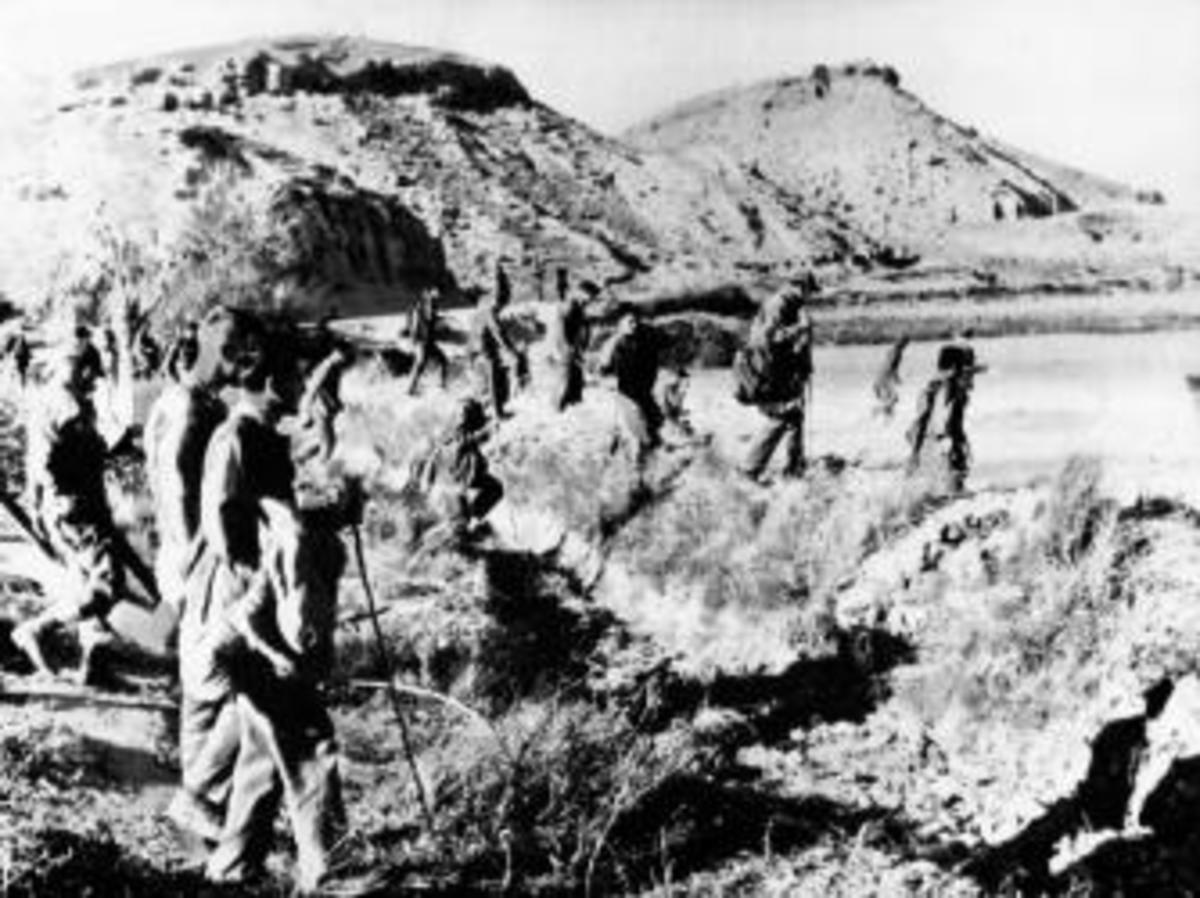
The Palomares disaster occurred on Jan. 17, 1966, when an American B-52 bomber on a Cold War patrol exploded during a midair refueling accident, sending four hydrogen bombs hurtling toward the ground. They were not armed, so there was no nuclear detonation, but the conventional explosives in two of the bombs blew up on impact, scattering pulverized plutonium over a patchwork of farm fields and stucco houses.
Plutonium is extremely toxic, but it often acts slowly. The alpha-particle radiation it gives off travels only a few inches and would not penetrate skin. But inhaled plutonium dust can lodge in the lungs and steadily irradiate surrounding tissue, gradually inflicting damage that can cause cancer and other ailments, sometimes decades later. A single microgram absorbed in the body is enough to be harmful; according to declassified Atomic Energy Commission reports, the bombs that blew apart at Palomares contained more than 3 billion micrograms.
|
For Many Who Cleaned Up a Nuclear Mess, a Key Ruling Comes Too Late
Air Force veterans who dealt with a Cold War-era atomic accident in Spain won the right to sue collectively for health benefits — but not before many had lost battles with cancer. https://www.nytimes.com/2020/02/11/us/palomares-air-force-nuclear.html By Dave Philipps SPRINGFIELD, Mo. — On Christmas Eve, Victor Skaar mailed a stack of letters to Air Force veterans he had served with in Palomares, Spain, scrawling a simple headline at the top of each one: “Great News!” Mr. Skaar, a retired chief master sergeant, was one of 1,600 troops scrambled by the Air Force in 1966 to clean up a classified nuclear disaster by collecting debris and shoveling up plutonium-laced soil. Many were later stricken with cancer and other ailments, and tried without success to get the federal government to take responsibility and pay for their medical care. He wanted to spread the word about an encouraging development: A lawsuit he had filed against the Department of Veterans Affairs had been certified as a class action, meaning that there was finally a chance to set the plutonium case straight, not just for him but for everyone who was there. But his letters soon began trickling back to him: Undeliverable. No forwarding address. One brought a reply from a widow. Each one in his mailbox made his heart sink. “For many of them, it’s too late,” he said of his comrades. “They’re gone.” As one of the first cases ever granted class-action status by the Court of Appeals for Veterans Claims, the Skaar lawsuit represents a major step forward for veterans with long-term health issues linked to toxic exposure in the service.
|
Cuts to public benefit programs,$billions to nuclear weapons – Trump’s 2021 budget
 Trump’s 2021 budget: More nuclear spending, less of almost everything else, Bulletin of the Atomic Scientists By Lawrence J. Korb, February 12, 2020 Trump’s 2021 budget: More nuclear spending, less of almost everything else, Bulletin of the Atomic Scientists By Lawrence J. Korb, February 12, 2020 The Trump administration’s budget request for 2021 has its priorities backward. Rather than expand the nuclear weapons budget at the expense of everything else, the United States could meet its goals with a much leaner nuclear force, leaving more money for the programs that will actually make the country safer.
Given that the US defense secretary has been arguing for the Pentagon to focus more resources on challenges from strategic competitors such as China and Russia, one would have expected that ships and combat aircraft programs would have received increased funding in the Trump administration’s latest request. But, in that request, not only did these programs not grow, they were actually cut back both from their projected increases and below fiscal 2020 levels. But what did grow in real terms was funding for nuclear weapons programs. In fiscal 2020, the Defense Department will spend about $25 billion on modernizing the weapons in its nuclear arsenal. For 2021, it seeks to grow that account by $4 billion, to a total of about $29 billion, a 16 percent increase. The National Nuclear Security Administration (NNSA), the part of the Energy Department that develops nuclear technology, wants to spend another $20 billion, a $3 billion (or 19 percent) increase over 2020. Together this means that the Trump administration proposes to spend about $50 billion on its nuclear weapon programs. If one adds what it will spend on cleaning up nuclear sites and on missile defense, that number climbs to about $75 billion. …….. To spend its money more wisely, the Trump administration needs to extend the New START treaty with the Russians and get back to the bargaining table, so it can begin cutting its nuclear arsenal to no more than 1,000 deployed nuclear weapons and cancel both the long range standoff weapon and the land-based portion of its nuclear modernization program. That will allow the United States to devote more of its limited resources to programs that actually make the country and the world safer. https://thebulletin.org/2020/02/trumps-2021-budget-more-nuclear-spending-less-of-almost-everything-else/ |
|
Trump’s 2021 budget boosts nuclear energy
Trump’s budget continues to boost nuclear energy, He proposed $1.2 billion for nuclear energy programs and R&D, The Verge, By Justine Calma@justcalma Feb 10, 2020, Donald Trump’s budget proposal for 2021 earmarks $1.2 billion for nuclear energy research and development and related programs. That’s significantly more than the $824 million Trump proposed in his budget the previous year. Even with the sizable increase in requested funds, the amount is less than the $1.5 billion that Congress allocated for nuclear energy last year.
Trump sold the bump in funding as a way to promote “revitalization of the domestic industry and the ability of domestic technologies to compete abroad.” His administration also wants to ramp up uranium production in the US, calling it “an issue of national security.”
Keeping the nation’s nuclear reactors online has been a priority for Trump since taking office. Two bills he signed into law sped up the development of advanced nuclear reactors and streamlined the permitting processes. He’s also allocated funds, including $300 million in this year’s proposal, toward a Versatile Test Reactor (VTR) meant to test and develop advanced reactor fuels and materials. Nuclear power currently makes up 20 percent of the US energy mix and half of its carbon-free electricity. Nevertheless, nuclear energy has struggled to gain a larger foothold in the US.
…….. Last week, Trump seemingly backed away from a proposed waste site at Yucca Mountain in Nevada, which has been controversial ever since it was proposed in 1987. The proposed dump for radioactive waste is political kryptonite for someone who might want the state’s votes (Trump lost Nevada in 2016). “Nevada, I hear you on Yucca Mountain and my Administration will RESPECT you!” Trump tweeted on February 6th. “My Administration is committed to exploring innovative approaches – I’m confident we can get it done!” Trump had previously asked for funds to complete the nuclear waste repository in previous budget proposals…….
Trump’s $4.8 trillion budget proposal still needs to make its way through Congress, where it’s likely to face a fight. But there has been bipartisan support for nuclear energy in the past — last year, Congress upped the 2020 budget for nuclear energy by nearly $700 million.
“This sends a strong message that the Department of Energy (DOE) is all in on new nuclear,” Rita Baranwal, assistant secretary for the Office of Nuclear Energy, said in a statement after Trump signed off on the 2020 spending bill in December…… https://www.theverge.com/2020/2/10/21131701/trump-budget-proposal-nuclear-energy-programs-spending
Malaysia – a definite NO to nuclear power
 Malaysia won’t use nuclear power, says PM https://www.nst.com.my/news/government-public-policy/2020/02/564295/malaysia-wont-use-nuclear-power-says-pm By Nor Ain Mohamed Radhi – February 10, 2020 Malaysia won’t use nuclear power, says PM https://www.nst.com.my/news/government-public-policy/2020/02/564295/malaysia-wont-use-nuclear-power-says-pm By Nor Ain Mohamed Radhi – February 10, 2020
CYBERJAYA: Malaysia will not use nuclear power as a renewable energy source as the country’s knowledge in the field is inadequate, said Prime Minister Tun Dr Mahathir Mohamad. He said to date, the world has yet to find the best and safest way to dispose of radioactive waste generated. “If you have a nuclear power plant, you will accumulate nuclear waste, which is radioactive, and until now they do not know how to reverse the process. “That is why we cannot use nuclear materials because it stays on for a million years. We do not want this country to be full of such waste thrown all over the place and affecting people. “That is why, until we discover a way of reversing the process, we should not use nuclear materials,” he told reporters after a dialogue session with the French business community in Malaysia here, today. The event was organised by the Chamber of Commerce and Industry France Malaysia. Dr Mahathir during the dialogue was asked on Malaysia’s vision on renewable energy sources, after a pledge by Energy, Science, Technology, Environment, and Climate Change Minister Yeo Bee Yin in September to have Malaysia increase its renewable energy use to 20 per cent by 2025. Dr Mahathir said the country was working on reducing the usage of traditional energy sources namely oil, gas, and coal to lessen the amount of pollution in the air. |
|
Trump’s budget – slashes foreign aid, but $billions more for nuclear weapons
 The 2 most controversial national security items in Trump’s new budget The 2 most controversial national security items in Trump’s new budget
Trump wants to gut foreign aid and beef up America’s nuclear force. Vox, By Alex Ward@AlexWardVoxalex.ward@vox.com Feb 10, 2020 President Donald Trump is about to propose a budget that leans much more heavily on military might — including new spending on modernized nuclear weapons — than diplomatic prowess, funding a muscular foreign policy some worry could lack the necessary finesse to deal effectively with global crises. The White House’s FY 2021 budget — standing at a whopping $4.8 trillion — is already making waves for deep cuts to social safety net programs like Medicare and Medicaid. Since Congress has to sign off on government spending, the full request is likely dead on arrival due to Democrats’ control of the House. And with no agreed-upon budget, there is no agreed-upon spending. It’s almost guaranteed, then, that the next few months will be filled with partisan fighting and wrangling over how to use taxpayer funds. Which means the White House’s budget document really serves more as a statement of principles and priorities — the budget, as some say, is policy. When it comes to defense and foreign policy, Trump has once again shown a preference for a stronger military partly at the expense of a weaker diplomatic and development tools. The two main national security takeaways from the budget’s expected toplines:
The problem, however, is that this foreign aid funding isn’t just charity: Taking nearly $12 billion out of the foreign aid budget would severely harm US diplomatic efforts. For one, giving nations money they need to keep volatile situations stable enhances global security, and could actually prove cost-effective to the US if the money helps prevent catastrophe at home or abroad down the line……….. In years past, Republicans and Democrats have pushed back against these draconian slashes to foreign aid, and they are likely to do so again. But the president’s insistence on tearing down America’s assistance programs to bare bones — even though they hover at only around 1 percent of the federal budget — shows how misguided he is about their outsize impact. Trump’s decision to modernize America’s nuclear arsenal is costlyThe United States has the second-largest nuclear arsenal in the world, behind Russia, but with many of these systems dating back to the Cold War, keeping warheads, bombs, and delivery systems up to date is extremely expensive. In 2017, the nonpartisan Congressional Budget Office estimated that modernizing the nuclear arsenal would cost $1.2 trillion over 30 years. That would require a herculean effort on behalf of multiple, subsequent administrations — not to mention the continued patience of taxpayers — to ensure it was completed. Trump’s proposed billions, championed by Republicans and criticized by Democrats, is one step in that direction……. Kingston Reif of the Arms Control Association, says “The administration’s nuclear weapons spending plans are unnecessary and unsustainable,” he told me. “The costs and opportunity costs of the plans are real and growing, and the biggest nuclear modernization bills are just beginning to hit.” Reif offered an alternative: “Scaling back the plans for new delivery systems, warheads, and infrastructure would make the modernization effort easier to execute and reduce the threat to other defense programs while still leaving a devastating deterrent.” It’s worth noting that Trump has pulled the US out of a massive arms control treaty with Russia, and it may not extend another vital one next year. Some experts worry that could lead to an arms race, causing the US to spend even more on nuclear systems down the line. …………https://www.vox.com/2020/2/10/21131273/trump-budget-fy2021-foreign-aid-nuclear |
|
Presidential nuclear decision by Twitter: Trump confuses about policy on Yucca for waste dump
|
Trump tweets reversal of push for Nevada nuclear waste dump, MyNorthWest, FEBRUARY 6, 2020 LAS VEGAS (AP) — PRESIDENT DONALD TRUMP ON THURSDAY APPEARED TO REVERSE HIS POSITION ON A PROPOSAL TO CREATE A NATIONAL NUCLEAR WASTE DUMP AT YUCCA MOUNTAIN IN NEVADA AFTER HIS ADMINISTRATION TRIED FOR SEVERAL YEARS TO REVIVE THE MOTHBALLED PROJECT. “Nevada, I hear you on Yucca Mountain and my Administration will RESPECT you!” Trump said in a tweet. “Congress and previous Administrations have long failed to find lasting solutions – my Administration is committed to exploring innovative approaches – I’m confident we can get it done! Adam Laxalt, Trump’s Republican re-election campaign chief in Nevada, said he believed the president was expressing support for opponents of the project, which was first proposed in the 1980s to entomb 77,000 tons (70,000 metric tons) of the nation’s most highly radioactive spent nuclear fuel in tunnels under an ancient volcanic ridge northwest of Las Vegas. Laxalt, a former state attorney general, fought federal efforts to resume work at the site using a wide range of objections revolving around safety, security and science. Yucca Mountain was among topics he said he discussed with the president last weekend at Trump International Golf Club in West Palm Beach, Florida. Laxalt on Thursday tweeted thanks to Trump, saying, “We are so fortunate that you listened to us.” “I know others have been speaking with him about Yucca Mountain,” Laxalt told The Associated Press. “We don’t support it. It’s not good for the state.” Trump administration officials and Nevada’s congressional delegation did not immediately have details to share about the president’s new position. The U.S. Department of Energy referred questions about the president’s tweet to the White House. The White House referred questions to the Office of Management and Budget, which did not immediately respond. State officials have argued that seismic activity and nearby Air Force testing would make the site about 100 miles (161 kilometers) from Las Vegas unsuitable to safely store radioactive material from elsewhere in the U.S. Nevada is a political swing state that Trump lost in 2016. His re-election campaign is targeting Nevada in 2020 as a battleground state it hopes to capture. As a presidential candidate, Trump was ambiguous about the Yucca Mountain project. Once he took office, his administration included requests for money to revive federal licensing for the project in his budget proposals, though Nevada’s congressional delegation successfully fought to keep the funding out of the budget…….. https://mynorthwest.com/1705762/trump-backs-away-from-push-for-nevada-nuclear-waste-dump/? |
|
Norways Nuclear Naughtiness – Censored Secrets and Haldens Hurtful History
5 February 2020
Out of respect to the Author of the article under unfair use I had to change the copy to fair use as requested. More changes may happen as the days, weeks and years go on depending on how fair use I am allowed. Takk!
“One of the documents TU has received “partial access” in. In addition to the email’s metadata, we can glimpse what might be the letter “d” in the upper left corner on page 4 of the document. (Illustration: Ole Petter Pedersen)”

The Norwegian nuclear reactor that recently shut down is estimated to cost some 20 billion Kroner. A lack of transparency overshadows the whole project against the recommendations of the IAEA`s report on the Failings of the Fukushima nuclear disaster.
On the January 29, Martiniussen and Peterson sent a complaint to the Civil Ombudsman requesting transparency and good practice be followed by giving details of the plans for a nuclear waste dump.
They were refused access to crucial documentation that should have been released to the public (Tax Paying funders) documenting a meeting between the Norwegian Minister of Industry and the Director-General of the OECD-NEA,
How to blank out history, the present and the future
The only major information to their request for data was the letter “d” on page 4.
The scary issue here is that Many countries including Russia funded aspects of the IFA nuclear experiments at Halden. The site was closed down in a furor of condemnation and suspicion. Was the nuclear industry allied to the Norwegian Salmon industry? Many questions remained to be answered!

Totally unrelated Salmon picture that didnt end up in Russia
Norway, having no experience in nuclear waste turned to the French nuclear company Orano and the Swedish company Studsvik,. Not the best idea in the world as these companies eyed an opportunity for profit and maybe, just maybe a few kilos of moldy farm salmon as well. But we will never know because of the Letter D (The only letter to be transparently offered to the FOI request by these 2 brave and intrepid sleuths).
Norway is now left with 17 tonnes of highly active, spent nuclear fuel thanks to those dastardly Russians and their American hug bunnies.
“All technical options are more or less known already, and NND’s general assessments of different directions cannot be kept secret”
But they are actually a secret of great National importance. So are the farmed Salmon deals that are also not to transparent (Possibly against OECD guidelines, but we will never know the truth!)
The Ministry of Trade and Industry claims that information must be kept secret for competition reasons. Luckily for the dodgy companies that will, may (we really dont know) be involved or how they will be involved. Shades of Fukushima radioactive Salmon perhaps?

Both the Minister of Industry and Employees in the Ministry of Trade and Industry Have decided to take a more top down anti democratic approach to transparency.
“That is why it is also crucial for TU’s social mission, to pursue cases where the authorities deny the citizens access. The Public Law is in practice the guarantee of the citizens that it is possible to control those we have given power and authority to carry out important social tasks.”
Must have a public conversation
The waste is dangerous and has a whole series of unknowns attached to it.
“Furthermore, the Norwegian nuclear fuel to be treated is of a metallic type that hardly any other country has. Therefore, there is no market for the treatment methods Studsvik investigates on behalf of NND. The treatment methods are specially designed for the Norwegian nuclear waste. The general methods Studsvik can offer were also publicly known through a report that was published in 2014.”
The request for data (More than the letter D) is nearly two years old.
“The Civil Ombudsman is the only body where it is possible to examine the ministry’s crush in unnecessary secrecy.”
So pre planning before the reactor was quickly ignored amongst the barrage of Russian troll bots and dubious bloggers highlighting the polluting and dangerous ways of the Halden reactor that proved that this should not be a private conversation only between two people.
“There are representatives at the highest level. In that case, the inhabitants must subsequently have the opportunity to gain insight into what is being discussed.”
Original article in full on the source url below
Fukushima and the 2020 Olympics
|
Fukushima and the 2020 Olympics https://www.greenpeace.org/international/story/28509/fukushima-and-the-2020-olympics/
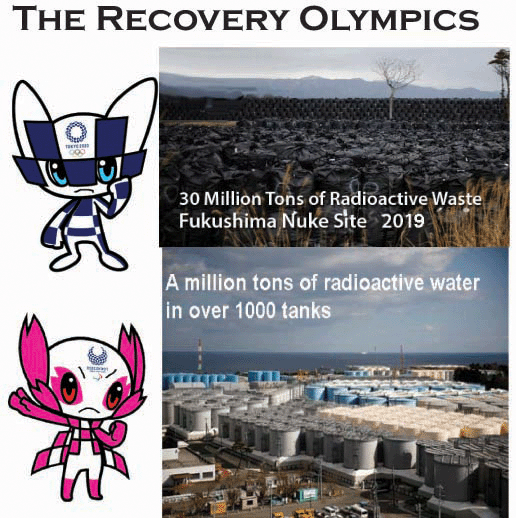
by Shaun Burnie 5 February 2020 As 2020 is the year the Olympics and Paralympics come to Japan, this is an exciting time for sports and for the people of Japan. Amidst all the excitement however, there is the ongoing nuclear crisis in Fukushima prefecture. Labeled as the ‘Reconstruction Olympics’, Prime Minister Abe in 2013 declared that the situation at Fukushima Daiichi was under control. Seven years later there still remains a nuclear emergency at the nuclear plant and surrounding areas. In addition to the enormous challenges of how to safely manage over 1 million tonnes of contaminated water at the site and as much as 880 tonnes of molten nuclear fuel for which there is no credible solution, there remain wider issues regarding radioactive contamination of the environment, its effect on workers and Fukushima citizens, including evacuees and their human rights.
These issues were the subject of a 28 January 2020 documentary broadcast by the U.S. network HBO as an investigative report by the program ‘Real Sports with Bryant Gumbel ’, the U.S.’s most-honored sports journalism series (with 33 Sports Emmy Awards, including 19 for Outstanding Sports Journalism) during the opening episode of its 26th season.
What does it mean to host the Olympics and Paralympics in the context of an ongoing nuclear disaster, the effects of which are still being felt by tens of thousands of Japanese citizens? What does it tell about the Japanese government and its commitment to respecting the values of transparency and the human rights of its citizens? These are some of the important questions raised by HBO and they warrant careful consideration in the months leading up to this year’s summer games.
Greenpeace Japan applauds Olympic values and spirit, while recognizing that the International Olympic Committee (IOC) has the responsibility to ensure the Olympic Games have a minimum impact on the environment and leave a positive legacy for those hosting the Games. The IOC has an opportunity to do this in a way that fulfills the ideals of the environment as the third pillar of Olympism – sustainability – by making the Games a showcase for environmental solutions. Simultaneously, we recognize that hosting the Olympics and Paralympics requires the Japanese Government to ensure absolute safety for athletes, international visitors, and the Japanese public alike.
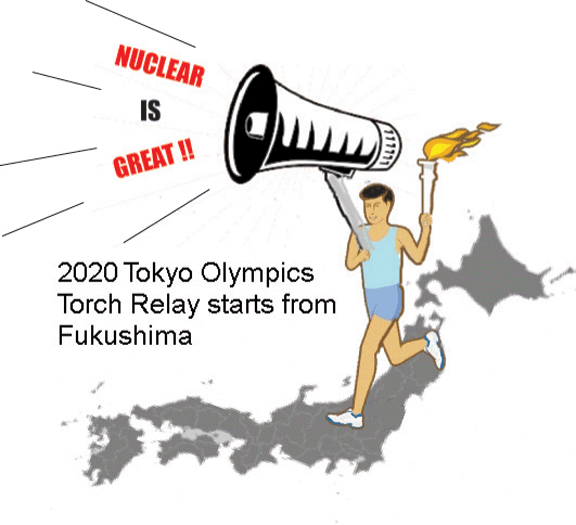 The decision to host two sporting events in Fukushima city raises genuine and important questions over radiation risks. The route of the Olympic Torch relay in all the municipalities of Fukushima prefecture includes the districts of Iitate, Namie, and Okuma where Greenpeace Japan’s Nuclear Monitoring & Radiation Protection Team has discovered radioactive hotspots, both in the open areas as well as in the remaining radiation exclusion zones, that remain too high even by revised governmental standards. What does all this mean for the hosting of Olympic events, including for athletes and visitors?
By conducting extensive radiation investigations, Greenpeace Japan attempts to explain the complex radiological environment, where nothing is straightforward, and where judging precise risks to health at the individual level is near impossible. In an effort to better understand and explain the radiological situation in parts of Fukushima, as well as the ongoing issues of human rights for both Fukushima citizens and decontamination workers, Greenpeace Japan will be publishing its latest radiation survey results in early March 2020. Shaun Burnie is Senior Nuclear Specialist at Greenpeace Germany.
|
|
1 This Month





PLEASE OPPOSE HR 8255 AND S.3639 – bills would accelerate satellite deployment, with no environmental review or safeguards – https://ncstd5li.quorum.us/campaign/169331/
To see nuclear-related stories in greater depth and intensity – go to https://nuclearinformation.wordpress.com
-
Archives
- October 2026 (58)
- September 2026 (339)
- August 2026 (330)
- July 2026 (355)
- June 2026 (287)
- May 2026 (306)
- April 2026 (356)
- March 2026 (251)
- February 2026 (267)
- January 2026 (308)
- December 2025 (358)
- November 2025 (359)
-
Categories
- 1
- 1 NUCLEAR ISSUES
- business and costs
- climate change
- culture and arts
- ENERGY
- environment
- health
- history
- indigenous issues
- Legal
- marketing of nuclear
- media
- opposition to nuclear
- PERSONAL STORIES
- politics
- politics international
- Religion and ethics
- safety
- secrets,lies and civil liberties
- spinbuster
- technology
- Uranium
- wastes
- weapons and war
- Women
- 2 WORLD
- ACTION
- AFRICA
- Atrocities
- AUSTRALIA
- Christina's notes
- Christina's themes
- culture and arts
- Events
- Fuk 2022
- Fuk 2023
- Fukushima 2017
- Fukushima 2018
- fukushima 2019
- Fukushima 2020
- Fukushima 2021
- general
- global warming
- Humour (God we need it)
- Nuclear
- RARE EARTHS
- Reference
- resources – print
- Resources -audiovicual
- Weekly Newsletter
- World
- World Nuclear
- YouTube
-
RSS
Entries RSS
Comments RSS

