Poland’s nuclear power development with USA to cost $15.56 billion
|
Poland faces $15 bln nuclear power bill over 20 years – minister , https://www.reuters.com/article/poland-energy-nuclear/poland-faces-15-bln-nuclear-power-bill-over-20-years-minister-idUSL8N2AX3G7 RUDA SLASKA, Poland, March 4 (Reuters) – Poland will have to spend 60 billion zlotys ($15.56 billion) on its planned nuclear power plants over the next 20 years, the Polish minister responsible for energy infrastructure Piotr Naimski said on Wednesday.Poland generates most of its electricity from carbon-intensive coal and is the only EU state that has not pledged to achieve climate neutrality in 2050.
But facing pressure from the European Union to reduce emissions, it has planned to build 6-9 gigawatts (GW) of nuclear generation by 2040. “This will require spending 60 billion zlotys. These are huge amounts but our state can afford it,” Naimski told a conference in Silesia, a coal region in south of Poland. Poland hopes to cooperate with the United States on its nuclear energy project. Also French President Emmanuel Macron said last month that France supports Poland’s transition away from coal by using nuclear technology to produce electricity. ($1 = 3.8564 zlotys) (Reporting by Wojciech Zurawski; writing by Agnieszka Barteczko; editing by Barbara Lewis) |
|
Busting the lies of the Australian Government about “new” nuclear reactors
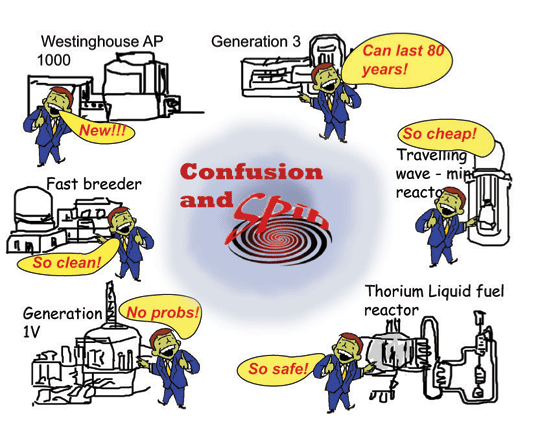
The core propositions of non-traditional reactor proponents – improved economics, proliferation resistance, safety margins, and waste management – should be reevaluated.
Before construction of non-traditional reactors begins, the economic implications of the back end of these nontraditional fuel cycles must be analyzed in detail; disposal costs may be unpalatable………. reprocessing remains a security liability of dubious economic benefit
Non-traditional” is used to encompass both small modular light water reactors (Generation III+) and Generation IV reactors (including fast reactors, thermal-spectrum molten salt reactors, and high temperature gas reactors)
|
Burning waste or playing with fire? Waste management considerations for non-traditional reactors Full Text
The Industry Push to Force Nuclear Power in Australia https://nonuclearpowerinaustralia.wordpress.com/2020/03/02/burning-waste-or-playing-with-fire-waste-management-considerations-for-non-traditional-reactors-full-text/ by nuclearhistory March 2, 2020 The following paper is copied here in order to counter the false, incorrect and erroneous propaganda published by the Australian Government and its Parliamentary Committee for lying to the Australian people about so-called new nuclear reactor designs, all of which were rejected by competent authorities in the 1950s, 1960s, and 1970s. The residues produced by these test reactors continue to cost the American taxpayer money and continue to present the American people with stored, hazardous radioactive waste which is also high chemically reactive. |
Big climate change policy unlikely no matter who wins the White House

Big climate change policy unlikely no matter who wins the White House
 Amy Harder Don’t hold your breath for big climate policy changes — even if a Democrat wins the White House.
Why it matters: Congress is likely to remain gridlocked on the matter, leading to either more of the same with President Trump’s re-election or a regulatory swing back to the left no matter which Democrat wins — but far short of a legislative overhaul.
The big picture: Climate change is reaching a new high-water mark as a political concern for American voters, and Democratic presidential nominees are promising aggressive policies.
- That in and of itself is a sea change from prior elections. Even still, these worries and pledges are unlikely to translate into any major new laws in the next few years (at least).
Here’s why, with potential scenarios mapped out.
Trump wins re-election
While Trump is uniquely unpredictable in presidential history, he’s made it clear since moving into the White House that he’s not interested in pursuing any sort of actual climate legislation on Capitol Hill.
More of the same is most likely, in two important ways:
- More curtailing of environmental regulations — and defending them in court.
- More pressure on other actors — like companies, states and other countries — to take bigger action on their own as the void of U.S. presidential leadership grows.
Any Democrat wins
All Democrats have aggressive climate plans, but it’s an open question whether any would first push climate legislation over other priorities — especially health care………
Regardless of congressional priority, any Democratic president would swing Washington’s executive-action pendulum far back in the other direction. …..
A progressive Democrat wins
… like Bernie Sanders or Elizabeth Warren. ……This type of all-encompassing and hyper-aggressive legislation is unlikely to get universal support among Democrats (to say nothing of universal Republican opposition) — which makes them extremely unlikely to get through the Senate.
- This is because Democrats with more moderate ideologies or those representing energy-intensive states are unlikely to support the broader socioeconomic measures and such aggressive moves away from fossil fuels, partly because many of those jobs are represented by unions……..
A more moderate Democrat wins
… like Joe Biden, Amy Klobuchar or Michael Bloomberg.
I anticipate these politicians would be (relatively) more open to trying to work with Republicans on climate change than their progressive counterparts……
As Congress talks climate policy, carbon price gets no love
New lobbying urging Congress to support a price on carbon emissions is not convincing lawmakers to warm up to the policy.
Why it matters: A carbon price is widely considered one of the most economically efficient ways to tackle climate change. But, economics be damned, its politics remain deeply unpopular. https://www.axios.com/climate-policy-changes-unlikely-7ecf6cc3-c42c-4d7c-b492-41d73433a015.html?utm_source=newsletter&utm_medium=email&utm_campaign=newsletter_axiosam&stream=top
Nuclear power not economic, nor safe, but it bolsters a secretive autocratic regime, United Arab Emirates
|
In February, the UAE government in Abu Dhabi licensed the first of four 1.4 gigawatt nuclear reactors after 12 years of construction on the Persian Gulf coast at Barakah, just east of the UAE border with Saudi Arabia. When the remaining three reactors at the $25 billion plant are completed, Barakah will reach its total nameplate capacity of 5.6 gigawatts. As the South Korea-led consortium loads fuel rods and tests the reactor’s output, the UAE will finally have a major source of zero-carbon [?] electricity on a power grid that relies upon fossil fuels—mainly natural gas—for 97 percent of its electric power generation, a much higher percentage than that of other countries where consumption is high. …… The UAE is now the third nuclear-competent state in the Middle East. Israel, with its stockpiles of nuclear weapons, was the first. Iran, with its single one-gigawatt nuclear power plant at Bushehr (just across the Gulf from the UAE’s) was second. Iran’s uranium enrichment program has extended to levels beyond that needed for electricity production, suggesting that it might follow the secretive Israeli path toward weaponization. The UAE is leveraging nuclear power in a different way. It has committed to the nuclear Non-Proliferation Treaty and the International Atomic Energy Agency’s Convention on Nuclear Safety to secure international cooperation. The UAE’s 2009 agreement with the United States explicitly bans the Gulf country from developing technologies needed to enrich uranium and reprocess spent reactor fuel. Advocates tout the “Abu Dhabi model” as a path to climate-friendly electricity while safeguarding against proliferation and the potential for development of a breakout nuclear weapons capability. The drawbacks. Abu Dhabi’s experience with nuclear power has been difficult, and the country’s National Energy Strategy 2050 suggests that no further nuclear development is in the cards. Cost thresholds and completion deadlines fell by the wayside years prior to completion of the first reactor. The complexity, toxicity, and strategic sensitivity of nuclear power make it an uncompetitive choice based solely on competitive cost calculations. Abu Dhabi’s difficulties with Barakah began at launch in 2008 with the over-ambitious nine-year start-up deadline, then set for 2017. Unrealistic expectations were undermined during construction by revelations that the main South Korean contractor KEPCO justified its low bid for the plant by dropping post-Chernobyl safety features, including an extra wall in the reactor containment building. KEPCO was also said to have built Barakah’s prototype reactor in South Korea using counterfeit cables and other parts procured using forged safety documents. Retrofitting of the Korean plant delayed the training of the team of UAE operators. Some counterfeit Korean parts were apparently installed in the Barakah plant as well, but few details have emerged about whether they have been replaced. Separately, inspectors were said to have found that all four reactor containment buildings suffered cracks in concrete walls that required repair. These issues contributed to the three-year delay in bringing the all four Barakah rectors online. The project has been subject to criticism by analysts who argue that the plant’s reduced safety features and other deficiencies render it more susceptible to a radiation release, including in the event of a military strike. The latter is not a remote possibility; in 2017, Houthi rebels battling UAE forces inside Yemen claimed to have targeted the Barakah plant in an apparently unsuccessful cruise missile strike…….. From the perspective of an autocratic regime like that in Abu Dhabi, there are further political benefits from civil nuclear power. Nuclearization tends to involve measures that bolster the strength and control of the state through increased internal security and enhanced coercive apparatus, justified by the technology’s inherent hazards. Vulnerabilities in nuclear systems also create new requirements for secrecy and surveillance, and less tolerance for dissent. In these ways, protecting the fuel cycle does double duty in bolstering regime security and vigilance..….. https://thebulletin.org/2020/03/for-uae-the-political-perks-of-nuclear-power-eclipse-economics/# |
|

Nuclear lobby attack’s Anti Nuclear laws of Australian State of Victoria
Nuclear lobby takes aim at Victoria to tackle prohibitions, Michael West Media, by Noel Wauchope | Feb 26, 2020 Having dithered on real action to tackle global warming, some in the Coalition are now taking a keen interest in solving it — by going nuclear. Noel Wauchope investigates what’s behind the sudden push to overturn legislation prohibiting the exploration and mining of thorium and uranium and puts a definitive case against a nuclear industry in Australia.
A batch of Coalition MP’s are pushing nuclear power as Australia’s answer to climate change. The group includes Katie Allen inner-city Melbourne Liberal, Ted O’Brien, Queensland LNP, Trent Zimmerman, North Sydney Liberal, Bridget Archer Tasmanian Liberal, David Gillespie Nationals NSW, Rick Wilson West Australian Liberal, and Keith Pitt, LNP from North Queensland, who was this week promoted to cabinet as Resources Minister. Former deputy prime minister and Nationals leader, Barnaby Joyce, is also a staunch proponent of nuclear power.
Arguing that nuclear power is the answer to bushfires and a heating climate when these are conversely nuclear’s greatest threat is akin to an argument by the Mad Hatter and the March Hare. The US National Academies Press compiled a lengthy and comprehensive report on risks of transporting nuclear wastes. They concluded that among various risks, the most serious and significant is fire. And indeed, climate change, in general, carries serious threats to nuclear reactors and the entire nuclear fuel chain.
But any port in a storm when you’re trying to sell a product that is expensive, unpopular, illegal in Australia and has the problem of long-lasting toxic wastes.
The Australian public’s renewed enthusiasm for action on climate change was timely. The nuclear lobby had, coincidentally already geared itself up for a campaign to overturn Australia’s State and Federal nuclear prohibition laws. The current Victorian inquiry is the latest in a spate of Parliamentary Inquiries aimed at removing these laws. Submissions are due by this Friday, 28 February.
The Inquiry’s Terms of Reference (TOR) are narrow:……..
It is clear the goal is to remove Victoria’s Nuclear Activities (Prohibitions) Act 1983. The very first TOR makes the mining of uranium and thorium as the prime concern. Given Victoria could run a nuclear power station with uranium/thorium sourced from elsewhere, it is clear that, after years of pressure by thorium lobbyists, the underlying goal of this inquiry is to overturn the legislation prohibiting the exploration and mining of thorium and uranium in Victoria.
The Victorian legislation was brought in to protect this State’s precious agricultural land and iconic ocean coast from polluting mining industries. South Gippsland is particularly rich in thorium.
Nuclear lobby tries to water down Victorian prohibition
The Terms of Reference are overtly biased: with no qualification, they promote the nuclear industry as undoubtedly beneficial to Victoria. This is ludicrous, as the global nuclear industry is in a state of decline.
Meanwhile, the renewable energy technologies of wind, solar and storage are now recognised by CSIRO and the Australian Energy Market Operator as, by far, the cheapest form of low carbon options for Australia, and are likely to dominate the global energy mix in coming decades
This first Term of Reference assumes that the “exploration and production” will result in nuclear power plants for Victoria, otherwise why do it? It also assumes that nuclear power will be effective in lowering C02 emissions.
However, there is no point in this “exploration and production” as it has been repeatedly demonstrated that nuclear power is no solution to climate change as in Dr. Paul Dorfman et al’s response to James Hansen on 20 December 2019 in the Financial Times.…….
The Terms of Reference are overtly biased: with no qualification, they promote the nuclear industry as undoubtedly beneficial to Victoria. This is ludicrous, as the global nuclear industry is in a state of decline.
Meanwhile, the renewable energy technologies of wind, solar and storage are now recognised by CSIRO and the Australian Energy Market Operator as, by far, the cheapest form of low carbon options for Australia, and are likely to dominate the global energy mix in coming decades
This first Term of Reference assumes that the “exploration and production” will result in nuclear power plants for Victoria, otherwise why do it? It also assumes that nuclear power will be effective in lowering C02 emissions.
However, there is no point in this “exploration and production” as it has been repeatedly demonstrated that nuclear power is no solution to climate change as in Dr. Paul Dorfman et al’s response to James Hansen on 20 December 2019 in the Financial Times.……… .https://www.michaelwest.com.au/nuclear-lobby-takes-aim-at-victoria-to-tackle-prohibitions/
New Mexico’s elected leaders waver on Holtec’s nuclear waste plan
|
Congresswoman: Science Should Guide Nuclear Storage Decision, By The Associated Press, Feb. 25, 2020, ALBUQUERQUE, N.M. — A member of New Mexico’s congressional delegation wants to ensure a “sound and robust” scientific review is done before federal regulators decide whether to sign off on plans for a multibillion-dollar temporary storage facility for spent nuclear fuel. U.S. Rep. Xochitl Torres Small in an interview with The Associated Press acknowledged that the growing stockpile of used fuel at commercial reactors around the U.S. is a national problem and that elected leaders need to ensure New Mexico does not pay an unfair price as part of the solution. “My concern is making sure that we’re looking at the science and that we are doing our best to evaluate based on that, not based on economic considerations or based on fear or bias, but based on how do we solve a challenge that is a national challenge,” the Democrat said. While elected leaders in Eddy and Lea counties support the project, it has garnered fierce opposition from nuclear watchdog groups, New Mexico Gov. Michelle Lujan Grisham and other members of the state’s congressional delegation. They are concerned about the state becoming a permanent dump since the federal government is far from having any long-term plan for dealing with the tons of spent fuel building up at nuclear power plants around the nation……. New Jersey-based Holtec International is seeking a 40-year license from federal regulators to build what it has described as a state-of-the-art complex near Carlsbad. The site in southeastern New Mexico is remote and geologically stable, the company has said. Holtec executives also have said the four-layer casks that would hold the spent fuel would be made of thick steel and lead and transported on a designated train with guards and guns. The Nuclear Regulatory Commission is in the process of considering Holtec’s application. It could be next year before a decision is made. Torres Small said the clock is ticking for elected leaders to find a permanent solution as spent fuel is now stored at a variety of dangerous locations scattered across the U.S., including near important waterways. New Mexico already is home to the U.S. government’s only underground repository for Cold War-era waste generated over decades by nuclear research and bomb-making. Some watchdogs are concerned the Waste Isolation Pilot Plant could become the final destination for other types of waste as the government prepares to ramp up production of the plutonium cores that serve as triggers for weapons in the nation’s nuclear arsenal. Torres Small couched her support for production of the plutonium coresby saying New Mexico has a long history of bearing a burden when it comes to nuclear development and waste. She said the focus should be on making sure the state and its residents are kept “whole and strong” as national security obligations are met. https://www.nytimes.com/aponline/2020/02/25/business/ap-us-nuclear-waste-new-mexico.html  |
|
Is Cumbria about to become the world’s plutonium dump?

 February 24, 2020During the last search process for a burial site for the UK’s nuclear waste, which ended in January 2013, the Nuclear Decommissioning Authority (NDA) offered repeated assurances that only the UK’s nuclear waste would be buried in a UK Geological Disposal Facility (GDF). Many questioned at the time whether the NDA could be trusted to keep its word, and it became apparent in mid-2012 that it could not be trusted. The NDA had accepted 4 tonnes of plutonium from Germany in a ‘commercially advantageous arrangement’ according to Charles Hendry, the UK’s Energy Minister at the time. In other words the NDA had been paid to take ownership of the German plutonium.
President Trump, eyeing the election campaign contradicts his administration on Nevada nuclear waste dump
 One Side of a Nuclear Waste Fight: Trump. The Other: His Administration.
The president, eyeing the battleground state of Nevada, has made clear he opposes a nuclear waste site at Yucca Mountain, reversing a policy that was made in his name.
-
Mr. Trump, who in recent weeks seemed to end his administration’s support for moving nuclear waste to Yucca Mountain, a proposal that had been embraced by his appointees for three years despite his own lack of interest
- “Why should you have nuclear waste in your backyard?” Mr. Trump asked the crowd at a rally in Las Vegas on Friday, to applause, noting that his recently released budget proposal did not include funding to license the site, as previous ones had. applause, noting that his recently released budget proposal did not include funding to license the site, as previous ones had.
|
The story of the muddled and shifting position on Yucca Mountain is partly one of an administration focused on Mr. Trump’s re-election chances in a battleground state that he lost to Hillary Clinton by two percentage points in 2016. But it is also emblematic of a White House where the president has strong impulses on only a narrow set of issues, and policy is sometimes made in his name regardless of whether he approves of it. ………..
The president made his latest move after a monthslong policy debate inside the White House over finally breaking with support for Yucca, officials said…….
Nationally, Republicans have long favored the proposal, which was developed in the late 1980s and signed into law by President George W. Bush in 2002. But Nevada politicians of both parties have remained steadfastly opposed to the policy, which is deeply unpopular in the state…….
most Republican leaders outside of the state remained supportive. While the plans for Yucca remain law as set under Mr. Bush, Congress has never moved to fund it since…..
previous energy secretary, Rick Perry, supported the measure, and as the Office of Management and Budget listed $120 million in the president’s budget to restart the licensing process of the site. It was listed as one of the administration’s priorities. ……..
At a House energy subcommittee hearing two weeks ago, Mark W. Menezes, the president’s nominee for deputy energy secretary, prompted alarm at the White House when he said, “What we’re trying to do is to put together a process that will give us a path to permanent storage at Yucca.” After White House officials expressed concern, Mr. Menezes put out a statement saying that he fully supported Mr. Trump’s decision.
Whether that will be enough to reassure Nevadans about Mr. Trump’s intentions remains to be seen. “Nevadans aren’t going to just forget that Trump spent the first three years of his administration trying to treat the state as a dumping site,” said Rebecca Kirszner Katz, a former adviser to Mr. Reid. “Donald Trump had an opportunity to be on the right side of a major issue in a huge battleground state, and he bungled it.” https://www.nytimes.com/2020/02/23/us/politics/trump-yucca-mountain-nevada.html
AT THE BEGINNING Before the 2018 midterm elections, Senator Dean Heller stood with President Trump in the glittering Trump International Hotel near the Las Vegas Strip, looking out from the top floor, and pointed.
“I said, ‘See those railroad tracks?’” Mr. Heller, a Nevada Republican who lost his seat later that year, recalled in an interview. Nuclear waste to be carted to Yucca Mountain for permanent storage would have to travel along the tracks, within a half-mile of the hotel, Mr. Heller said.
I think he calculated pretty quickly what that meant,” Mr. Heller said. “I think it all made sense. There was a moment of reflection, of, ‘Oh, OK.’” Whether the waste would have traveled along those particular tracks is a subject of debate. But the conversation appears to have helped focus Mr. Trump, who in recent weeks seemed to end his administration’s support for moving nuclear waste to Yucca Mountain, a proposal that had been embraced by his appointees for three years despite his own lack of interest. bungled it.” https://www.nytimes.com/2020/02/23/us/politics/trump-yucca-mountain-nevada.html
|
|
No vote on high level nuclear waste storage in New Mexico, despite Memorial opposing the dump
 New Mexico lawmakers unopposed to high-level nuclear waste storage as House kills memorial. Adrian Hedden, Carlsbad Current-Argus Feb. 24, 2020 A measure that would have called on the New Mexico Legislature to formally oppose the transportation and storage of high-level nuclear waste, as a project was ongoing to do so the southeast corner of the state, died while in committee as the 2020 session closed without a vote.
House Memorial 21 did pass the House Energy and Natural Resources Committee on a 8-5 vote during a Feb. 1 hearing, but was never brought to a vote on the House floor and thus did not proceed to be signed into law.
HM 21, sponsored by Matthew McQueen (D-50) cited an “unacceptable risk” created by the storage of high-level waste from the eastern United States, which the memorial cited as holding “90 percent” of nuclear reactors.
The memorial also said the risk would be spread to “40 other state” through the transportation of spent nuclear fuel by rail.
The facility that the memorial blamed for creating such as risk was proposed by Holtec International, which applied for a license to build a consolidated interim storage facility (CISF) for spent nuclear fuel rods in a remote location between Carlsbad and Hobbs.
New Mexico Gov. Michelle Lujan Grisham and State Land Commissioner Stephanie Garcia Richard both voiced opposition to the project last year, with the Lujan Grisham calling it “economic malpractice” as it could disrupt nearby oil and gas agriculture industries.
“The creation of a high-level radioactive waste storage facility in New Mexico jeopardizes the state’s existing industrial, agricultural and ranching businesses, runs counter to the promotion of tourism and the diversification of New Mexico’s economy and threatens the health and safety of New Mexico residents,” read the memorial….
McQueen worried the facility, although it was proposed as a temporary or “interim” facility could become permanent as a permanent repository was unlikely to be opened during the 40-year term of Holtec’s license application.
“I also believe this is a temporary benefit for really long-term or permanent liability for Mew Mexico. The facility threatens our existing economic activity, not only in the area but statewide,” he said during the Committee hearing.
“It’s amazing how something that temporary pretty much becomes permanent. I believe New Mexico should not be the nation’s nuclear waste dumping ground.”
A New Mexico Senate bill aimed at expanding the State’s oversight to include privately-owned storage for high-level waste also died after it was voted down last week on the Senate floor…… . https://www.currentargus.com/story/news/local/2020/02/24/new-mexico-lawmakers-unopposed-high-level-nuclear-waste-storage/4856468002/
Britain buying new nuclear warheads from USA: Pentagon knew about it, UK Parliament did not
|
The revelation has dismayed MPs and experts who question why they have learned of the move – which will cost the UK billions of pounds – only after the decision has apparently been made. It has also raised questions about the UK’s commitment to staunching nuclear proliferation and the country’s reliance on the US for a central plank of its defence strategy. Earlier this month, Pentagon officials confirmed that its proposed W93 sea-launched warhead, the nuclear tip of the next generation of submarine-launched ballistic missiles, would share technology with the UK’s next nuclear weapon, implying that a decision had been taken between the two countries to work on the programme. In public, the UK has not confirmed whether it intends to commission a new nuclear warhead. The Ministry of Defence’s annual update to parliament, published just before Christmas, says only: “Work also continues to develop the evidence to support a government decision when replacing the warhead.” But last week Admiral Charles Richard, commander of the US strategic command, told the Senate defence committee that there was a requirement for a new warhead, which would be called the W93 or Mk7. Richard said: “This effort will also support a parallel replacement warhead programme in the United Kingdom, whose nuclear deterrent plays an absolutely vital role in Nato’s overall defence posture.” Ed Davey, acting leader of the Liberal Democrats, said: “It is totally unacceptable that the government seems to have given the green light to the development of new nuclear weapon technologies with zero consultation and zero scrutiny. Britain under Johnson increasingly looks like putty in Trump’s hands. That Britain’s major defence decisions are being debated in the United States, but not in the UK, is a scandal. Under Johnson, it seems that where Trump leads, we must follow.” ………. https://www.theguardian.com/uk-news/2020/feb/22/pentagon-gaffe-reveals-uk-deal-replace-trident-nuclear-weapon |
|

Nuclear power for Australia a fantasy – Australian Labor Party
  Labor’s Chris Bowen: Renewables make much more sense than ‘nuclear fantasy’, The New Daily, Colin Brinsden 23 Feb 20, Labor’s Chris Bowen: Renewables make much more sense than ‘nuclear fantasy’, The New Daily, Colin Brinsden 23 Feb 20,
Federal Labor frontbencher Chris Bowen has criticised the Morrison government for even considering nuclear power as an option in the future energy mix, calling it a “fantasy and a furphy”……… Mr Bowen, the former shadow treasurer and now the opposition’s health spokesman, told reporters in Sydney that billions of dollars will be “unleashed” by renewable energy investment that will create jobs. Asked by a journalist if he would be open to nuclear power, Mr Bowen said: “No”. “The economics of nuclear power don’t stack up. You could start building a nuclear power station today and it wouldn’t be ready for decades,” Mr Bowen said. “The idea that this is part of the mix to Australia’s response to global warming is a fantasy and a furphy.”……. https://thenewdaily.com.au/news/national/2020/02/22/labors-bowen-rejects-going-nuclear/ |
|
|
Australian MP calls on #ScottyFromMarketing (Australia’s Prime Minister) to help save Julian Assange from extradition to U.S.
|
A Spanish private security company is under investigation over allegations it spied on Mr Assange while he was living at the Ecuadorian embassy, passing on hundreds of hours of recordings and other surveillance to American intelligence, according to former workers at the Spanish company. The ABC reported on Sunday that Mr Assange’s Australian lawyers, including prominent QC Geoffrey Robertson, were also among those spied on in “Operation Hotel”. Mr Wilkie, who met with Mr Assange as part of Australian parliamentary delegation in London last week, told The Sydney Morning Herald and The Age the actions were “immoral and illegal”. “It alone should be the basis for the extradition to be dropped this week,” Mr Wilkie said. “If the court doesn’t drop the proceedings in light of these allegations, a question mark hangs over the court’s neutrality. It just adds to the injustice that’s being experienced by Julian”. The ABC reported the covert surveillance was uncovered through a public investigation into the Spanish company, UC Global, contracted by the Ecuadorian government to provide security at the embassy. WikiLeaks Spanish lawyer, Aitor Martinez, told the ABC it came to light after Mr Assange was arrested, when former UC Global employees provided a large file of material.
Hundreds of supporters of Julian Assange marched through London on Saturday to pressure the British government into refusing to extradite the WikiLeaks founder to the United States to face spying charges. Famous backers, including Pink Floyd’s Roger Waters, Pretenders singer Chrissie Hynde and fashion designer Vivienne Westwood joined the crowd protesting the US espionage charges against the founder of the secret-spilling website. He will again face an extradition hearing on Monday night (Australian time) relating to US criminal charges against him for his role in the WikiLeaks releases of classified US government material. WikiLeaks adviser Jennifer Robinson, one of the Australian lawyers caught in the spying operation, said the federal government had not done enough to protect Mr Assange. “His Australian lawyers — all of us Australian citizens — have [also] had our rights as lawyers and our ability to give him a proper defence superseded by the US and potentially the UK government,” she told the ABC. “This is something that the Australian government ought to be taking very seriously and ought to be raising, both with the UK and with the United States. It is time the Australian government stands up for this Australian citizen and stops his extradition.” A spokesman for the Department of Foreign Affairs and Trade said the Australian government had discussed Julian Assange’s circumstances with partners, including as recently as during the UK Foreign Secretary Dominic Raab’s visit. “In the past 12 months, we have sought relevant assurances on multiple occasions from the UK,” the spokesman said. |
|

Confusion and contradiction in Trump’s policy on nuclear waste and Yucca Mountain
The Yucca Mountain nuclear waste site has always been a political football. Trump is the latest president to fumble, Bulletin of the Atomic Scientists, By Allison Macfarlane, February 21, 2020 As with much policy-setting in the Trump administration, a single tweet from the president on February 6 appeared to reverse a previous stance. The message about Yucca Mountain, the nation’s proposed geologic repository for spent nuclear fuel and other high-level radioactive waste, set the media alight with speculation about new actions in US nuclear waste policy. But has anything changed, really?The new policy, if it is such a thing, is a little wobbly. It’s unclear whether the administration is or is not supporting Yucca Mountain as a waste repository. The Energy Department’s Undersecretary for Nuclear Energy and nominee for Deputy Secretary, Mark Menezes, stated six days later in a House Energy and Commerce subcommittee hearing that “what we’re trying to do is to put together a process that will give us a path to permanent storage at Yucca.” A White House official tried to square the circle of conflicting messages, stating: “There is zero daylight between the President and Undersecretary Menezes on the issue.”
At the same time, Trump’s fiscal year 2021 budget did not include funds for Yucca Mountain, unlike in previous years. In point of fact, though, Congress has not appropriated funding for Yucca Mountain in the past decade. The proposed repository site made it about halfway through the licensing process at the Nuclear Regulatory Commission and halted when the Obama administration’s Energy Department tried to pull the license application. The state of Nevada still strongly opposes Yucca Mountain and hasn’t changed its tune since passage of the Nuclear Waste Policy Act Amendments in 1987 (colloquially known in Nevada as the Screw Nevada Bill), which designated Yucca Mountain as the proposed repository site.
Trump’s tweet acknowledges the fierce and long-standing opposition to Yucca Mountain in a swing state he lost by a slim margin in 2016. The Democratic presidential candidates are unanimously opposed to storing nuclear waste at Yucca Mountain.
A permanent impasse. Yucca Mountain has spent much of its existence as a political football. The original Nuclear Waste Policy Act of 1982 required detailed characterization of three potential repository sites for the disposal of the nation’s spent commercial nuclear fuel and high-level radioactive waste from the nuclear weapons complex. By 1986 it was clear that work on three sites would be very costly, and Congress balked at the price tag. Political wrangling ensued, and it was no accident that among the three states under consideration—Nevada, Texas, and Washington—the one with the most-junior congressional delegation, including a newly elected Senator Harry Reid, was selected as the only site to be characterized by the Energy Department for suitability as a repository. ………
At the moment, no one involved in the process has an incentive to make progress. An extremely partisan House and Senate are at a permanent impasse on an issue that bears little on re-election chances (except in Nevada). The nuclear industry has found they can build new reactors—the two Westinghouse AP1000 units under construction in Georgia—without a solution to their spent fuel problem. The Energy Department, originally tasked with solving the problem, has no legal authority (or appropriations) to move forward. The Nuclear Regulatory Commission, which passed a Continued Storage Rule in 2014, vacated its ability to force a solution. And many anti-nuclear interest groups that oppose waste transport and repositories have called for “hardened on-site storage.”…….. https://thebulletin.org/2020/02/the-yucca-mountain-nuclear-waste-site-has-always-been-a-political-football-trump-is-the-latest-president-to-fumble/#
France starts out on the path to withdraw from nuclear energy
|
France Takes First Steps to Reduce Nuclear Energy Dependence https://www.voanews.com/europe/france-takes-first-steps-reduce-nuclear-energy-dependence, By Lisa Bryant, 21 Feb 20
February 21, 2020 France, the world’s most nuclear energy-dependent nation, is taking its first steps to shift to more renewables to power up.
On Saturday, the country begins a gradual shutdown of its aging Fessenheim plant. The move fits into the government’s broader energy strategy to reduce French dependence on nuclear energy from supplying three-quarters of its electricity to about half by 2035. Prime Minister Edouard Philippe says the plant’s first reactor will be closed Saturday, and the second in June. Another dozen reactors must close by 2035 to meet the phase-down target. The plan also sees France closing its remaining coal plants, and moving to renewables like solar and wind to close the energy gap and help fight climate change. For Charlotte Mijeon, spokesperson for anti-nuclear group Sortir du nucléaire, the Fessenheim shutdown is welcome news — but not enough. “It’s great that it’s eventually closed; however, we fear that Fessenheim is something like the tree hiding the forest,” she said. “The government is closing one nuclear power plant, but it should not make us forget that the rest of the nuclear fleet is aging.” France has 58 nuclear power plants, thanks to an energy strategy dating back to the 1970s oil crisis. Supporters say nuclear energy is a clean way to fight climate change while also meeting national energy needs. But critics say the plants have received billions in subsidies and nuclear lobbies are powerful, making it harder for renewables to compete. And they say the remaining plants pose mounting safety concerns as they age. “Regarding the climate emergency, we have no time left,” Mijeon said. “So we have to invest in green climate solutions, not in nuclear power, which is not only dirty, but also very expensive and slow.” While the reactor shutdown is a first for France, other countries, including Switzerland, Sweden and the United States, have also shut plants for a mix of budgetary, safety and environmental reasons. Neighboring Germany aims to phase out of nuclear power completely by 2022. It has been pushing for years for the shutdown of Fessenheim, which is located near its border |
|
France shuts down Fessenheim reactor in first phase of retreat from nuclear power
Reactor No. 1 will be halted on Saturday and the entire complex will come to a halt on June 30, the statement said.
Germany has long called for the plant, France’s oldest, to be shut down. It is the first nuclear complex to be closed under Macron’s plan.
France depends more on nuclear energy than any other country, getting about three-quarters of its electricity from the plants. Macron said in 2018, outlining France’s energy strategy for the next 30 years, that 14 nuclear reactors out of the 58 now running at 19 plants would be shut down by 2035. France would cap the amount of electricity it derives from nuclear plants at 50% by then.
1 This Month





PLEASE OPPOSE HR 8255 AND S.3639 – bills would accelerate satellite deployment, with no environmental review or safeguards – https://ncstd5li.quorum.us/campaign/169331/
To see nuclear-related stories in greater depth and intensity – go to https://nuclearinformation.wordpress.com
-
Archives
- October 2026 (58)
- September 2026 (339)
- August 2026 (330)
- July 2026 (355)
- June 2026 (287)
- May 2026 (306)
- April 2026 (356)
- March 2026 (251)
- February 2026 (267)
- January 2026 (308)
- December 2025 (358)
- November 2025 (359)
-
Categories
- 1
- 1 NUCLEAR ISSUES
- business and costs
- climate change
- culture and arts
- ENERGY
- environment
- health
- history
- indigenous issues
- Legal
- marketing of nuclear
- media
- opposition to nuclear
- PERSONAL STORIES
- politics
- politics international
- Religion and ethics
- safety
- secrets,lies and civil liberties
- spinbuster
- technology
- Uranium
- wastes
- weapons and war
- Women
- 2 WORLD
- ACTION
- AFRICA
- Atrocities
- AUSTRALIA
- Christina's notes
- Christina's themes
- culture and arts
- Events
- Fuk 2022
- Fuk 2023
- Fukushima 2017
- Fukushima 2018
- fukushima 2019
- Fukushima 2020
- Fukushima 2021
- general
- global warming
- Humour (God we need it)
- Nuclear
- RARE EARTHS
- Reference
- resources – print
- Resources -audiovicual
- Weekly Newsletter
- World
- World Nuclear
- YouTube
-
RSS
Entries RSS
Comments RSS

