
- Satellite photos show North Korea leader’s train near compound
-
Kim’s two-week absence fuels speculation about his health Speculation about Kim Jong Un’s health intensified over the weekend after tantalizing — yet unverified — reports about a visit by a Chinese medical team and movements of the North Korean leader’s armored train.
China sent a team including doctors and senior diplomats to advise its neighbor and longtime ally, Reuters reported on Saturday, citing three people familiar with the matter. Meanwhile, a train resembling one long used by North Korean rulers was parked last week near a coastal leadership compound in Wonsan, according to an analysis of satellite imagery released Sunday by the website 38 North. A prominent South Korea adviser also rejected the notion that Kim was ailing or dead…….
Any leadership change in North Korea could increase the threat of instability on China’s border and raise questions about control of the country’s expanding nuclear arsenal. Kim has also been central to U.S. President Donald Trump’s so far unsuccessful efforts to get him to reduce his weapons stockpile. …..
Could President Trump launch a nuclear attack via Twitter?
|
The proverbial “big red button” is one of the most important responsibilities that a U.S. President has. But Americans know very little about it.
Last week, he said that is ordering the Navy to “shoot down and destroy” Iranian boats that get too close to U.S. ships, and then the Pentagon turned it into a reminder that “our ships retain the right of self-defense.” Do you see any situations where the President says something ambiguous, and then the military has to figure out whether he meant to use nuclear weapons, or some other similarly drastic measure?…….. The modern military has long adapted to the idea that nuclear weapons are a relatively clunky think to imagine using in practice. They might work as a strategic threat, but the United States benefits a lot more from not using them, and from using our many conventional options that are very diverse and capable, instead.
If we normalize the use of nuclear weapons, we are a very big target…….
I do worry about—it’s somewhat clear that the President and the military have a complicated communications relationship. There have a number of things that the President announced via Twitter, that he clearly did not get full consent from the military on or did not even inform them on……. Maybe your secure phone lines don’t work. Maybe your regular phone lines don’t work. You could imagine a situation in which Twitter is the only channel by which the President can communicate with the military, and he would tweet out an order on it, but it would have to be a very well-formed order. ……
if the President’s Twitter account suddenly started tweeting legitimate nuclear authentication codes and nuclear launch orders, I think that would raise a lot of questions for the military. Even in that situation, assuming they don’t see incoming missiles coming at them—which is to say, they’re not under any belief that this is a true, obviously unambiguous nuclear war situation—I think that would go through rather extreme efforts to contact the White House, or the Secretary of Defense, and/or anybody around there, just to find out if this was real or not.
That would definitely be a weird way for the world to end. |
|
South Korea’s government dismissed rumours about North Korean leader Kim Jong Un being gravely ill
 North Korean leader Kim Jong-un health rumours dismissed by South Korean intelligence, ABC News, 27 Apr 20, South Korea’s Government has dismissed rumours that North Korean leader Kim Jong-un is in a fragile condition, as speculation about his health intensifies amid the North’s silence on his whereabouts.
Unification Minister Kim Yeon-chul told a closed-door forum in Seoul that South Korea had “enough intelligence to confidently say that there are no unusual developments” in rival North Korea that would back up speculation about Mr Kim’s health, his ministry said.
The minister did not reveal what specific intelligence led to that conclusion, but stressed that it was reached after a thorough analysis.
His comments are a reiteration of earlier South Korean statements that Mr Kim appeared to be handling state affairs normally and that no unusual activities had been detected in North Korea.
Those comments, however, failed to dispel the rumours about Mr Kim, partly because past outside intelligence reports on developments in North Korea have sometimes turned out to be wrong. …..
As the absolute leader of a country with a nuclear weapons program, Mr Kim’s health is a matter of intense interest both regionally and globally.
If something were to happen to him, it could lead to instability in North Korea. Mr Kim hasn’t publicly anointed a successor, and that has prompted questions about who would take control of North Korea if he is gravely ill or dies…..
serious unrest could occur if a power struggle erupts between those supporting the Kim dynasty and those who want non-Kim rule…….. https://www.abc.net.au/news/2020-04-28/kim-jong-un-health-rumours-south-korea-intelligence/12191504
U.S. govt disregards nuclear diseconomics, pushes new nuclear power to support nuclear weapons
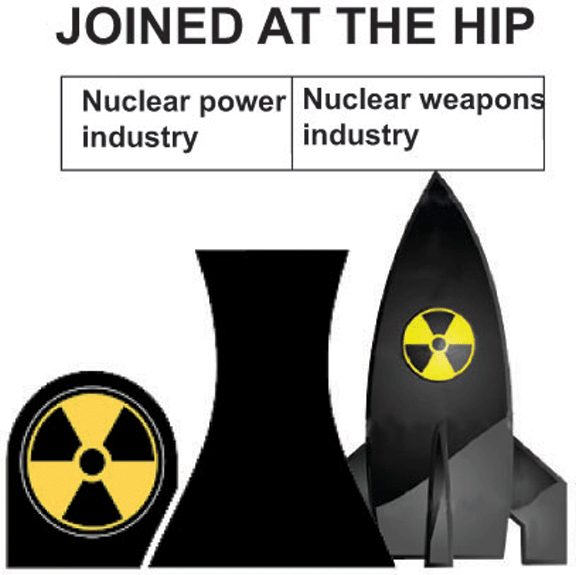 On April 23 the strongly pro-nuclear results of the Nuclear Fuel Working Group (NFWG) were made public by the US Department of Energy (DoE)
Energy Secretary Dan Brouillette announced the NFWG’s results and urged:
- Taking immediate and bold action to strengthen the uranium mining and conversion industries and restore the viability of the entire front-end of the nuclear fuel cycle.
• Utilizing American technological innovation and advanced nuclear RD&D investments to consolidate technical advances and strengthen American leadership in the next generation of nuclear energy technologies.
• Ensuring that there will be a healthy and growing nuclear energy sector to which uranium miners, fuel cycle providers, and reactor vendors can sell their products and services.
• Taking a whole-of-government approach to supporting the U.S. nuclear energy industry in exporting civil nuclear technology in competition with state-owned enterprises.”
Brouillette’s announcement also undermines the long-cultivated narrative that ‘peaceful / civil use’ and military application of nuclear power would be separate – instead, it explicitly references the connection between the civil and military nuclear sectors:
“The United States currently has two well-defined future defense needs for domestic uranium supply: low-enriched uranium needed to produce tritium required for nuclear weapons in the 2040s, and highly-enriched uranium needed to fuel Navy nuclear reactors in the 2050s.
The Strategy also recognizes that U.S. national security is truly integrated with the health of the front-end of the nuclear fuel cycle – the United States needs a strong civil nuclear industry to enable national defense.” (underlining not in the original)
US DoE at the same date published a NFWG Factsheet: Strategy to Restore American Nuclear Energy Leadership
Poll shows that Americans favour a no-first-use of nuclear weapons policy
|
Poll: What the American public likes and hates about Trump’s nuclear policies, Bulletin of the Atomic Scientists, Jonathon Baron, Stephen Herzog, April 27, 2020 It is difficult to overstate the importance of nuclear policy in determining a US presidential candidate’s fitness to be commander-in-chief. Such priorities are evident in the Bulletin’s recently published special issue dedicated to discussing nuclear weapons policy ahead of the 2020 election. Nuclear issues played a prominent role in the 2016 election, but despite some anomalies, they have hardly factored into the 2020 campaign. This is almost certain to change even as priority is given to the COVID-19 pandemic response. Nevertheless, very few recent polls (with one notable exception) have attempted to identify preferences among the US population for President Donald Trump’s nuclear policies.
To fill this gap, we worked with the firm YouGov in late 2018 after the release of the Trump administration’s Nuclear Posture Review to conduct a nationally representative survey of 1,000 Americans. Previous surveys have illuminated US public attitudes on nuclear energy, extending the New START treaty, and even hypothetical nuclear retaliatory scenarios. It isn’t clear, however, how Americans view the core elements of the Trump administration’s nuclear policy: its Nuclear Posture Review and its overall strategies toward Iran and North Korea. We report our study results publicly for the first time here, offering insights for policymakers and presidential candidates as they weigh their positions on nuclear issues Nuclear Posture Review. The study highlights how the US public as a whole and various demographic groups view Trump’s positions on nuclear weapons. To begin, we asked respondents to indicate whether they supported, opposed, or were unsure about key parts of the 2018 Nuclear Posture Review. Of course, many elements of the Trump administration’s nuclear posture are continuations of longstanding US policy that have been preserved by Republican and Democratic presidents alike. Our survey questions did not indicate the current US administration’s policy on different parts of the Nuclear Posture Review. So the results convey the respondents’ natural preferences for the policies themselves, not for the current occupant of the White House. Such data should prove useful to politicians staking out campaign stances on nuclear weapons that would have broad public appeal. Our findings reveal that Americans overall express fairly low support for the administration’s nuclear weapons policies, though indecision also runs high among the public. Further, the table of group preferences indicates—with a few surprising exceptions—that males, Republicans, and older Americans are the most likely groups to back President Trump on nuclear issues. Even so, support is relatively modest among Trump’s base, and several elements of the Nuclear Posture Review do not receive majority or even plurality support from Republicans……. Only 34 percent of Americans support the longstanding policy of providing the nuclear umbrella in principle, and that number drops to 27.9 percent for nuclear deployments in Europe. …..men and Republicans remain the most supportive of the nuclear umbrella and forward-deployed B61 nuclear bombs. Women, Democrats, and Independents respond less favorably. Additionally, Americans who came of age during the Cold War are more favorable toward these policies than their Millennial and Generation Z counterparts……. fewer than 20 percent of Americans support possible US first use of nuclear weapons. By contrast, disapproval stands at 63.5 percent……The public is also broadly unsupportive of using nuclear weapons in response to cyberattacks……. a majority of every demographic group of Americans—whether by gender, political party, age, race, education, income, or region of residence—oppose a first-use doctrine. Public opinion may accordingly present opportunities for presidential candidates to favor a policy of no first use of nuclear weapons………. https://thebulletin.org/2020/04/poll-what-the-american-public-likes-and-hates-about-trumps-nuclear-policies/# |
|
|
Under cover of Coronavirus constraints, EDF could speed application for £14 billion Sizewell nuclear reactor build, without pubic consultation
East Anglian Daily Times 27 April 2020 Suffolk MP has joined growing concern that EDF Energy will submit its planning application for the Sizewell C nuclear power station during the coronavirus crisis.
Already 54 town and parish councils, along with campaign groups, have voiced their frustration at the possibility – amid concerns that it would be “intolerable and unfair” to add extra anxiety
to people at this time. Now Central Suffolk and North Ipswich MP, Dr Dan Poulter has written to Government ministers saying the Covid-19 restrictions would inhibit full and proper consideration of the application and it would “not be appropriate” yet.
EDF has already delayed its submission of a Development Consent Order (DCO) for the £14 billion twin reactor for a month but there are worries it could submit the documents in
May. Dr Poulter has been contacted by a large number of residents who have
a number of concerns in regards to the DCO. He is concerned there would be
pressure on council officers dealing with Covid-19 to respond to issues and
questions raised by the submission and opportunities for public
consultation curtailed as public meetings are not permitted.
https://www.eadt.co.uk/news/mp-dan-poulter-sizewell-c-letter-to-ministers-1-6624715
North Korea: Expert reveals ‘power struggle’ for ‘control of nuclear weapons and military’
NORTH KOREA’s lack of a formal succession plan for Kim Jong-un could spark a “power struggle” in the region as speculation continues to grow surrounding the supreme leader’s health, according to foreign policy expert Bruce Klingner. Express UK, By SVAR NANAN-SEN, Apr 27, 2020
Bruce Klingner, a senior researcher for Northeast Asia at The Heritage Foundation told Fox News that there could be a power struggle in North Korea regarding who succeeds Kim Jong-un. The Supreme Leader of North Korea has not been seen for over two weeks and his absence has led to speculation over his health and the future of his country.
Mr Klinger said: “As was the case when his father passed away, there is no formal succession plan in the North Korea constitution.
“We don’t know if they have anything planned behind the scenes. So right now, we are all speculating who the next leader might be.
“We are speculating that his sister may be the next leader. In the last couple of years, she has gained power, she has gained authority, we have seen her coming out of the shadows in the last couple of years…….. https://www.express.co.uk/news/world/1274376/North-Korea-Kim-Jong-Un-death-health-successor-nuclear-weapons-military-latest-news
Kim Jong Un Mystery Grows on Reports of Train, Medical Team
Kim Jong Un Mystery Grows on Reports of Train, Medical Team, Bloomberg By Kanga Kong and Ros Krasny, Where is North Korea’s Kim Jong Un?
Kim Jong-un’s death may lead to brutal power struggle and unknown finger on nuke button, https://www.express.co.uk/news/world/1273890/Kim-Jong-un-dead-North-Korea-nuclear-weapon-news-latest-death-USKIM JONG-UN’S death could spark a power struggle in nuclear-armed North Korea and even an attack on its neighbour in the South, according to an expert on conflict in the Korean peninsula.By GERRARD KAONGAKim Jong-un’s death could result in multiple worst-case scenarios according to Korean expert and senior research fellow Bruce Klingner of think tank The Heritage Foundation. Chinese and Japanese media outlets have claimed the North Korean dictator has died following complications from heart surgery earlier this month. The North Korean state is yet to confirm whether the nation’s leader has died.
While on Fox News Mr Klingner said if the reports of Kim Jong-un’s death were correct the resulting power vacuum would be a cause for international concern.
Mr Klingner warned the death of the leader could result in power struggles, military faction infighting, and even the nation lashing out at its neighbour in the South.
He insisted this was particularly concerning as he said North Korea was a nation with nuclear weapon capabilities.
Mr Klingner said: “There is always a concern when you have a nuclear weapon state if you don’t know who the next leader is.
“It could be a smooth transition or it could be a power struggle where everyone is trying to grab the ring of power. “Then it is a question of who has control over nuclear weapons and the military.”
Mr Klingner also outlined the worst possible scenarios that could occur if Kim Jong-un is confirmed, by North Korea, to be dead.
He continued: “There are a lot of worst-case scenarios.
“Things like a regime collapse and a struggle for power or unknown actions from military factions warring against each other. “There is a concern that there could be an explosion in the sense of North Korea lashing out against its neighbours.
“Or even an implosion with the regime collapse and instability.”
Mr Klingner closed by insisting nations remain concerned similarly to the last death of a North Korean leader.He said: “We were equally concerned during the two previous successions of the father and the grandfather when they passed away.
“The system worked and there was a maintaining of stability so it is more likely the regime will maintain itself.”
There have been conflicting reports regarding the death of North Korean leader Kim Jong-un.
Earliest reports of his death came from the vice director of HKSTV Hong Kong Satellite Television Shijan Xingzou who claimed a very solid source told her the North Korean leader had died.
Japanese weekly magazine Shukan Gendai argued the dictator had not yet died but is currently in a vegetative state and will not recover.
Trump administration to boost uranium mining, weaken environmental regulations
|
Trump officials pitch nuclear plan that would bolster struggling uranium industry, The Hill
BY REBECCA BEITSCH – 04/23/20 The Trump administration on Thursday outlined its plan for revitalizing the U.S. nuclear energy industry in a move that would boost uranium mining while benefiting just a handful of companies.The report from the Nuclear Fuel Working Group includes a set of recommendations to the White House and comes as the price of uranium has steadily fallen over the past decade. he effort to shore up nuclear power is sure to be controversial. Uranium mining has been floated in sensitive areas, including land near the Grand Canyon. …. Nuclear energy has also struggled to remain competitive with other energy sources, leaving some states to bail out nuclear reactors to the tune of tens of millions of dollars to keep them afloat…. To revitalize the industry, however, the new report backs President Trump’s proposal to spend $150 million on a uranium reserve, which would buy U.S.-mined uranium from the small number of domestic producers. The Uranium Producers of America identifies just eight members on its website……. Also at risk is nearly 1,562 square miles just outside the boundaries of the Grand Canyon that since 2012 have been off limits for production. Critics have worried Trump might seek to overturn that ban since he declared uranium a critical mineral for national security purposes at the end of 2017. Some uranium mining companies already own some of that land, and there’s been a push from some Republicans lawmakers to open the area for mining. “It’s despicable to risk irreversible harm to spectacular wild places by propping up uranium companies that can’t compete in global markets,” Taylor McKinnon with the Center for Biological Diversity said in a statement Thursday…….. The report published Thursday, however, calls for “expand[ing] access to uranium deposits on federal lands, including support for necessary legislation” and reconsidering categorical exclusions that bar mining in certain areas. It also recommends overhauling regulations to more quickly spur any number of nuclear projects and easing requirements under the National Environmental Policy Act (NEPA). The Trump administration has already proposed a major rollback of NEPA that is set to be finalized in the coming months, including provisions that give companies a greater role in assessing the environmental safety of their own projects. The report also identified potential new financing sources for nuclear projects, like the Export-Import Bank, and changing “legacy policies that disallow support for nuclear projects” to open up financing from the U.S. International Development Finance Corporation…… https://thehill.com/policy/energy-environment/494315-trump-officials-pitch-nuclear-plan-that-would-bolster-struggling |
|
France’s nuclear company EDF in spiralling debt crisis
|
New York Times 22nd April 2020, Plummeting electricity demand and falling power prices during the coronavirus outbreak could leave EDF in need of a capital injection by the
end of 2020 to avoid a spiralling debt crisis, a source close to the French firm and analysts said. The state-controlled utility, which operates the
world’s largest nuclear fleet, has long been weighed down by a 41.1 billion-euro debt pile. Shrinking income due to the health crisis and likely delays in reforming France’s electricity market, which could have boosted the firm’s earnings power, are now adding to its challenges and pressuring its financial ratios. A source close to EDF’s management said
the company may need a capital injection towards the end of the year to cushion the shock, with one analyst putting the size of any rights issue at several billion euros. |
|
U.S. Environmental and Labor Groups Team Up to Demand COVID-19 Relief
 Environmental and Labor Groups Team Up to Demand COVID-19 Relief, Candice Bernd,
 Truthout, 22Apr 20
This story is published as part of Covering Climate Now, a global journalism collaboration strengthening coverage of the climate story.
As the COVID-19 pandemic continues to devastate the U.S. economy, national environmental organizations are stepping up to support labor unions and frontline workers across the country in their push for personal protective equipment, sick and hazard pay, safe working conditions, and other forms of relief as the crisis intensifies.
The Labor Network for Sustainability (LNS), which partners labor and environmental groups, is facilitating a loose coalition of more than 100 unions and environmental organizations working to pressure the Trump administration to do more to protect frontline workers. The groups are also supporting nine days of action from Earth Day to May Day to demonstrate the interconnection of climate justice and worker justice……… This story is published as part of Covering Climate Now, a global journalism collaboration strengthening coverage of the climate story.
As the COVID-19 pandemic continues to devastate the U.S. economy, national environmental organizations are stepping up to support labor unions and frontline workers across the country in their push for personal protective equipment, sick and hazard pay, safe working conditions, and other forms of relief as the crisis intensifies.
The Labor Network for Sustainability (LNS), which partners labor and environmental groups, is facilitating a loose coalition of more than 100 unions and environmental organizations working to pressure the Trump administration to do more to protect frontline workers. The groups are also supporting nine days of action from Earth Day to May Day to demonstrate the interconnection of climate justice and worker justice…… https://truthout.org/articles/environmental-and-labor-groups-team-up-to-demand-covid-19-relief/?eType=EmailBlastContent&eId=de9b2e7e-e70c-405a-830f-e0ea3203ca88
North Korean leader Kim Jong-Un’s health speculation raises question over nuclear weapons future
|
North Korean leader Kim Jong-Un’s health speculation raises question over nuclear weapons future, 9 news, By CNN, Apr 22, 2020 Confusing and sometimes conflicting reports have emerged about the health of North Korean leader Kim Jong Un.
Those were followed by intense speculation on his whereabouts, his medical condition and the future of the world’s only hereditary communist state.
Initial rumblings began after North Korea’s most important holiday came and went on April 15 without an appearance by Kim, which was unusual.
Then Daily NK, an online publication based in South Korea that focuses on the north, reported that Kim had received a cardiovascular system procedure on April 12 and was being treated in a villa in Hyangsan County.
The reports have also sparked speculation over the security and question of what happens to North Korea’s nuclear weapons in the event of some sort of leadership transition, which is likely of concern in Washington, Seoul and Beijing……..
North Korea’s nuclear weapons are another closely guarded secret inside the country.
Little is known about how many Pyongyang has, how reliable they are, if its missiles and submarines could successfully fire them or even how Kim oversees their command and control apparatus…….
Though North Korea is still technically at war with the South and the United States, many of Pyongyang’s nuclear weapons may be sitting disassembled and “there are probably very few ready systems,” Narang said.
But Narang said he wouldn’t be terribly concerned about the security of North Korea’s nuclear weapons in the event Kim died of natural causes……. https://www.9news.com.au/world/north-korea-kim-jong-un-health-status-confusion-nuclear-weapons-future-usa-south-korea-world-news/6c8663e8-9416-4635-ab90-9036d3e63246
|
|
To save the planet, cultural, social and political transformation is essential; new technologies only part of the answer.

Why relying on new technology won’t save the planet https://www.sciencedaily.com/releases/2020/04/200420125510.htm April 20, 2020, Lancaster University
- Summary:
- Over-reliance on promises of new technology to solve climate change is enabling delay, say researchers. They argue instead for cultural, social and political transformation to enable widespread deployment of both behavioral and technological responses to climate change.
-
Overreliance on promises of new technology to solve climate change is enabling delay, say researchers from Lancaster University.
Their research published in Nature Climate Change calls for an end to a longstanding cycle of technological promises and reframed climate change targets.
Contemporary technological proposals for responding to climate change include nuclear fusion power, giant carbon sucking machines, ice-restoration using millions of wind-powered pumps, and spraying particulates in the stratosphere.
Researchers Duncan McLaren and Nils Markusson from Lancaster Environment Centre say that: “For forty years, climate action has been delayed by technological promises. Contemporary promises are equally dangerous. Our work exposes how such promises have raised expectations of more effective policy options becoming available in the future, and thereby enabled a continued politics of prevarication and inadequate action.
- “Prevarication is not necessarily intentional, but such promises can feed systemic ‘moral corruption’, in which current elites are enabled to pursue self-serving pathways, while passing off risk onto vulnerable people in the future and in the global South.
The article describes a history of such promises, showing how the overarching international goal of ‘avoiding dangerous climate change’ has been reinterpreted and differently represented in the light of new modelling methods, scenarios and technological promises.
The researchers argue that the targets, models and technologies have co-evolved in ways that enable delay: “Each novel promise not only competes with existing ideas, but also downplays any sense of urgency, enabling the repeated deferral of political deadlines for climate action and undermining societal commitment to meaningful responses.
They conclude: “Putting our hopes in yet more new technologies is unwise. Instead, cultural, social and political transformation is essential to enable widespread deployment of both behavioural and technological responses to climate change.”
The researchers map the history of climate targets in five phases: “stabilization,” followed by a focus on “percentage emissions reductions,” shifting to “atmospheric concentrations” (expressed in parts per million), “cumulative budgets” (in tonnes of carbon dioxide), and currently “outcome temperatures.”
- In the first phase (around Rio, 1992) technological promises included improved energy efficiency, large-scale enhancement of carbon sinks, and nuclear power
- In the second phase around the Kyoto summit (1997) policy promises focused on cutting emissions with efficiency, fuel switching and carbon capture and storage (CCS).
- In the third phase (around Copenhagen, 2009), CCS became linked to bioenergy, while policy focused on atmospheric concentrations.
- Phase four saw the development of sophisticated global carbon budgeting models and the emergence of a range of putative negative emissions technologies.
- Policy in phase five focused increasingly on temperature outcomes, formalised with the Paris accord of 2015.
Story Source:
Materials provided by Lancaster University. Note: Content may be edited for style and length.
Outcry as uranium industry exploits Covid 19 to call for financial bailout
 Uranium Industry’s COVID-19 Bailout Request Sparks a Disgusted Pushback, Phoenix New Times, Uranium Industry’s COVID-19 Bailout Request Sparks a Disgusted Pushback, Phoenix New Times,
ELIZABETH WHITMAN | APRIL 14, 2020 , When Jamescita Peshlakai was a little girl, she herded sheep along the Little Colorado River, which courses through the Navajo Nation in northern Arizona.
One July morning in 1979, a dam containing tailings from United Nuclear Corporation’s uranium mill some 200 miles away broke, letting loose more than 1,000 tons of waste. Ninety-four million gallons of radioactive water gushed into the Puerco River, which feeds the Little Colorado. More than 40 years later, the Church Rock spill is still the biggest release of radioactive material in American history. The lambs born soon after that disaster barely lasted after birth, recalled Peshlakai, now an Arizona state senator. “Once the umbilical cord was cut, they simply died,” she said. “That happened to a lot of livestock at that time, and we did not know it was because of the Church Rock spill.” Uranium mining has left a toxic, indelible imprint on the Navajo Nation. Mining companies would come in over the years to hire Navajo people for the backbreaking work of picking at uranium ore and hauling it in wheelbarrows. When the companies were ready to move on, they abandoned more than 500 mines on the Navajo Nation, the water they had contaminated, and the people who worked them, many of whom died of cancer and whose offspring were born with birth defects, Peshlakai said. “They never did anything to fix the land, and fix the communities or the tribal nations that they used,” Peshlakai said. That legacy has done nothing to stop America’s dwindling uranium mining industry from going to the federal government and asking to be bailed out in the midst of a public health crisis. At the end of March, two uranium companies penned a letter to President Donald Trump asking for a $150 million bailout, citing the economic impacts of COVID-19. One of them was Energy Fuels Resources, which hopes to open a uranium mine south of the Grand Canyon and whose exploratory operations already have led to it trucking radioactive water across the Navajo Nation. The request quickly sparked disgust and fury among those who oppose the industry’s deleterious effects on people and the land. Last Friday, a cohort of 75 conservation and grassroots groups penned a missive of their own and sent it to four congressional leaders, asking them to reject any bailout for an industry that has wreaked so much destruction, and calling into question the companies’ claims that a public health crisis like COVID-19 justifies extending a lifeline to a declining industry. Leaders of the Navajo Nation also oppose the request. Jared Touchin, a spokesperson for Navajo Nation President Jonathan Nez and Vice President Myron Lizer, said that the two leaders “would not support this effort if it proposes to use uranium resources that impact the Navajo people.” Peshlakai also rejected the idea that the industry, which has never been held accountable for its operations in Arizona, receive a bailout. “This industry should not be left off the hook,” she said. In their letter to Senate Majority Leader Mitch McConnell, Senate Minority Leader Chuck Schumer, Speaker of the House of Representatives Nancy Pelosi, and House Minority Leader Kevin McCarthy, the 75 groups declared that the uranium industry was “falsely” suggesting that the COVID-19 pandemic had led to uranium shortages that threatened supply chains. Rather than helping the industry, they said, Congress should “invest stimulus funds towards the assessment, reclamation, and cleanup of the hundreds of thousands of abandoned hardrock mines on public and tribal lands, which are currently polluting roughly 40 percent of western headwaters.” Among the signatories were the Sierra Club, the Wilderness Society, the Grand Canyon Trust, and the Natural Resources Defense Council…….. To the 75 groups who wrote in protest, because the U.S. uranium industry has been in decline for years, the two companies [ Energy Fuels Resources, and Ur-Energy USA], are unjustly invoking the COVID-19 pandemic in an effort to make funding that the administration promised months ago finally materialize. The industry is “seeking to take advantage of the global Coronavirus pandemic for their own benefit by seeking $150 million for the establishment of a uranium reserve,” they wrote. Citing the fact that Arizona Public Service, which operates the country’s largest nuclear power plant, Palo Verde, recently said it was “confident” it could provide reliable service throughout the pandemic, they suggested that the industry’s warning of supply chain disruptions was misleading. “Industry reports are telling us that they have more than enough uranium,” said Ray Rasker, executive director of the Montana-based Headwaters Economics, a nonprofit land management research firm. The U.S. already has a stockpile of uranium, he explained. Because of a global oversupply or uranium, prices have also fallen low, Rasker said; right now, prices are below $30 a pound. And if they were to rise again, the most economically viable deposits of uranium in North America are in Saskatchewan, Canada — an ally of the U.S. “There’s no national security concern,” Rasker said. Past statements suggest that the industry is now invoking COVID-19 to seek what it believes it is due……. In an investigation in 2018, Phoenix New Times found that reviving uranium mining in the U.S. made little sense, because of the low quality of deposits in the country, an oversaturated global market, and the lack of benefits for local economies. https://www.phoenixnewtimes.com/news/uranium-industry-asks-for-bailout-during-covid-19-arizona-11465201 |
|
For UK’s new Labour leader, climate action and Green New Deal will be key goals
Business Green 14th April 2020, Newly appointed Labour leader Sir Keir Starmer completed his front bench
team late last week, handing key green positions to a raft of experienced
MPs. Starmer is widely expected to make climate action and Labour’s Green
New Deal a key plank in the Opposition’s offer to the public – a fact
underlined by the handing of specific green briefs to senior MPs. But it
remains to be seen if he retains the unprecedented levels of low carbon
infrastructure funding pledges and nationalisation programmes proposed
under Corbyn’s leadership.
https://www.businessgreen.com/news/4013864/labour-completes-green-shadow-ministerial-lin
1 This Month





PLEASE OPPOSE HR 8255 AND S.3639 – bills would accelerate satellite deployment, with no environmental review or safeguards – https://ncstd5li.quorum.us/campaign/169331/
To see nuclear-related stories in greater depth and intensity – go to https://nuclearinformation.wordpress.com
-
Archives
- October 2026 (58)
- September 2026 (339)
- August 2026 (330)
- July 2026 (355)
- June 2026 (287)
- May 2026 (306)
- April 2026 (356)
- March 2026 (251)
- February 2026 (267)
- January 2026 (308)
- December 2025 (358)
- November 2025 (359)
-
Categories
- 1
- 1 NUCLEAR ISSUES
- business and costs
- climate change
- culture and arts
- ENERGY
- environment
- health
- history
- indigenous issues
- Legal
- marketing of nuclear
- media
- opposition to nuclear
- PERSONAL STORIES
- politics
- politics international
- Religion and ethics
- safety
- secrets,lies and civil liberties
- spinbuster
- technology
- Uranium
- wastes
- weapons and war
- Women
- 2 WORLD
- ACTION
- AFRICA
- Atrocities
- AUSTRALIA
- Christina's notes
- Christina's themes
- culture and arts
- Events
- Fuk 2022
- Fuk 2023
- Fukushima 2017
- Fukushima 2018
- fukushima 2019
- Fukushima 2020
- Fukushima 2021
- general
- global warming
- Humour (God we need it)
- Nuclear
- RARE EARTHS
- Reference
- resources – print
- Resources -audiovicual
- Weekly Newsletter
- World
- World Nuclear
- YouTube
-
RSS
Entries RSS
Comments RSS

