Britain’s Ministry of Defence continues its costly mistakes in nuclear weapons and submarines
 Dundee Courier 16th May 2020, A Fife MP has lifted the lid on “astonishing and deeply worrying”
mistakes made by the Ministry of Defence, which have led to the costs of replacing Britain’s nuclear weapons and nuclear submarines soaring by a staggering £1.35 billion.
Glenrothes and Central Fife SNP MP Peter Grant, who sits on parliament’s Public Accounts Committee, has described the situation as “unacceptable” following the release of a new report that
suggests errors made by the MoD are being repeated more than 30 years after
they were first highlighted by Britain’s public spending watchdog.
French government tries to downgrade radiation risk, avoid compensating Polynesian victims of nuclear testing
Outrage in Tahiti over French nuclear law moves, https://www.rnz.co.nz/international/pacific-news/416865/outrage-in-tahiti-over-french-nuclear-law-moves There has been an outcry in French Polynesia over moves by the French National Assembly to slip a clause about compensation over nuclear weapons testing into Covid-19 legislation.
A French Polynesian member of the French Assembly Moetai Brotherson said it was a scandal that this was added into deliberations when French Polynesia’s members were away from Paris because of the pandemic.
The nuclear test veterans organisations, Moruroa e tatou and Association 193, also expressed outrage.
The French government wants to re-introduce the concept of neglible risk of the tests in compensation cases after a court ruling had done away with it.
Over a 30-year period of France’s weapons tests in the South Pacific some of the atmospheric blasts irradiated most islands.
Mr Brotherson said he had only just heard about the National Assembly move and wondered what the French Polynesian people had ever done to be so detested by the French state.
Hiro Tefaarere of Moruroa e tatou said he was outraged but not surprised about the way France was going about it.
He said all presidents, from de Gaulle to Macron, couldn’t care less about Polynesians, and although France was responsible for public health in Tahiti it failed to keep a register to see how many people died because of fallout from the weapons tests.
Auguste Uebe Carlson, who heads Association 193, said France kept refusing to recognise the impact of the tests, using instead propaganda to say they were clean or a thing of the past.
He said nothing was recognised, with health problems now being attributed to poor diet and life-style choices.
ast year, French Polynesia’s social security agency calculated that it had so far spent $US770 million on health care costs for people deemed to have radiation-induced illnesses.
Profiteering from the pandemic, the Pentagon and nuclear industry exploit the situation

Beware the Pentagon’s Pandemic Profiteers, Hasn’t the Military-Industrial Complex Taken
 enough of Our Money? POGO, BY MANDY SMITHBERGER | FILED UNDER ANALYSIS | MAY 04, 2020 This piece originally appeared on TomDispatch.com.
At this moment of unprecedented crisis, you might think that those not overcome by the economic and mortal consequences of the coronavirus would be asking, “What can we do to help?” A few companies have indeed pivoted to making masks and ventilators for an overwhelmed medical establishment. Unfortunately, when it comes to the top officials of the Pentagon and the CEOs running a large part of the arms industry, examples abound of them asking what they can do to help themselves.
It’s important to grasp just how staggeringly well the defense industry has done in these last nearly 19 years since 9/11. Its companies (filled with ex-military and defense officials) have received trillions of dollars in government contracts, which they’ve largely used to feather their own nests. Data compiled by the New York Times showed that the chief executive officers of the top five military-industrial contractors received nearly $90 million in compensation in 2017. An investigation that same year by the Providence Journal discovered that, from 2005 to the first half of 2017, the top five defense contractors spent more than $114 billion repurchasing their own company stocks and so boosting their value at the expense of new investment.
To put this in perspective in the midst of a pandemic, the co-directors of the Costs of War Project at Brown University recently pointed out that allocations for the Food and Drug Administration, the Centers for Disease Control and Prevention, and the National Institutes of Health for 2020 amounted to less than 1% of what the U.S. government has spent on the wars in Iraq and Afghanistan alone since 9/11. While just about every imaginable government agency and industry has been impacted by the still-spreading coronavirus, the role of the defense industry and the military in responding to it has, in truth, been limited indeed. The highly publicized use of military hospital ships in New York City and Los Angeles, for example, not only had relatively little impact on the crises in those cities but came to serve as a symbol of just how dysfunctional the military response has truly been.
Bailing Out the Military-Industrial Complex in the COVID-19 Moment
Demands to use the Defense Production Act to direct firms to produce equipment needed to combat COVID-19 have sputtered, provoking strong resistance from industries worried first and foremost about their own profits. Even conservative Washington Post columnist Max Boot, a longtime supporter of increased Pentagon spending, has recently recanted, noting how just such budget priorities have weakened the ability of the United States to keep Americans safe from the virus. “It never made any sense, as Trump’s 2021 budget had initially proposed, to increase spending on nuclear weapons by $7 billion while cutting Centers for Disease Control and Prevention funding by $1.2 billion,” he wrote. “Or to create an unnecessary Space Force out of the U.S. Air Force while eliminating the vitally important directorate of global health by folding it into another office within the National Security Council.”
In fact, continuing to prioritize the U.S. military will only further weaken the country’s public health system. ……..
How Not to Deal With COVID-19
Along with those military-industrial bailouts came the fleecing of American taxpayers. While many Americans were anxiously awaiting their $1,200 payments from that congressional aid and relief package, the Department of Defense was expediting contract payments to the arms industry. Shay Assad, a former senior Pentagon official, accurately called it a “taxpayer rip-off” that industries with so many resources, not to speak of the ability to borrow money at incredibly low interest rates, were being so richly and quickly rewarded in tough times. Giving defense giants such funding at this moment was like giving a housing contractor 90% of upfront costs for renovations when it was unclear whether you could even afford your next mortgage payment.
Right now, the defense industry is having similar success in persuading the Pentagon that basic accountability should be tossed out the window. ……..
Unfortunately, as COVID-19 spread on the aircraft carrier the USS Theodore Roosevelt, that ship became emblematic of how ill-prepared the current Pentagon leadership proved to be in combatting the virus. Despite at least 100 cases being reported on board—955 crewmembers would, in the end, test positive for the disease and Chief Petty Officer Charles Robert Thacker Jr. would die of it—senior Navy leaders were slow to respond. Instead, they kept those sailors at close quarters and in an untenable situation of increasing risk. When an emailed letter expressing the concerns of the ship’s commander, Captain Brett Crozier, was leaked to the press he was quickly removed from command. But while his bosses may not have appreciated his efforts for his crew, his sailors did. He left the ship to a hero’s farewell. ……… https://www.pogo.org/analysis/2020/05/beware-the-pentagons-pandemic-profiteers/
If You Like Covid-19, You’ll Love Nuclear War
 Might this unsteady and unseemly American president soon become subject to still more serious forms of personal dissemblance and/or psychological debility? Leaving aside Trump’s largely unprecedented and breathtaking venality,[5] his open indifference to history and above all his continuing malfeasance and shameless dishonesty, should he still be allowed to decide whether we Americans should live or die?
It also reveals his incapacity to feel even a scintilla of human empathy for other human beings.
What does all this really mean? In what specific policy directions should we Americans now be propelled? Continue reading
Alabama joins Kentucky, South Dakota and West Virginia to criminalize fossil fuel protests
In March, Kentucky, South Dakota and West Virginia passed laws restricting pipeline protests. Alabama is poised to become the fourth.
By Alexander C. Kaufman 10 May 20 Alabama lawmakers this week advanced legislation to add new criminal penalties to nonviolent protests against pipelines and other fossil fuel projects, setting a course to become the fourth state to enact such measures amid the chaos of the coronavirus pandemic.
Kentucky, South Dakota and West Virginia enacted similar measures in March, just as states started implementing lockdowns to contain the outbreak of COVID-19, the respiratory illness caused by the virus.
The Alabama Senate passed the bill on March 12, just befohe Alabama Senate passed the bill on March 12, just before state officials, alarmed at the spread of the virus, postponed legislative hearings for a month. When the capitol reopened in Montgomery on May 4, state Democrats remained in their home districts, but enough Republican lawmakers returned to restart work on the legislation. On Monday, the House version of the bill was introduced and referred to the committee that oversees utilities and infrastructure. Continue reading
Ukraine’s Energy ministry limits operations of nuclear power plants
Energy ministry limits operations of nuclear power plants UNIAN Information Agency 9 May 20 Ukraine “…..This week, the issue of a nuclear power units’ shutdown widely reverberated in a public discourse. From May 5, only 10 of 15 nuclear power units have been operating in Ukraine (four were put on scheduled repairs and one was put into reserve mode). According to the operating schedule for 2020, nine nuclear power units will operate at limited capacities. The government decided to take such a step in connection with the drop in electricity consumption caused by quarantine and record generation from renewables.
South Africa’s financially difficult nuclear ambitions
South Africa to develop plan for new 2,500 MW nuclear plant, CAPE TOWN, May 7 (Reuters) – South Africa will soon start developing a plan for a new 2,500 megawatt (MW) nuclear power plant, the energy ministry told lawmakers on Thursday.
Africa’s most industrialised economy, which operates the continent’s only nuclear power plant near Cape Town, said last year that it was considering adding more nuclear capacity in the long term, after abandoning in 2018 a massive nuclear expansion championed by former president Jacob Zuma.
Analysts had expressed serious concern about Zuma’s project for a fleet of nuclear plants totalling 9,600 MW because it would have put massive additional strain on public finances at a time of credit rating downgrades. …..
The presentation showed South Africa wanted to complete the procurement of the new nuclear plant by 2024 but gave no indication as to when it wanted construction of the plant to start or for when the plant would come online……
financing those nuclear ambitions could be difficult at a time that the country’s recession-hit economy is being hammered by the coronavirus pandemic, with this year’s budget deficit expected to stretch into double digits.
Answering questions, Energy Minister Gwede Mantashe said on Thursday that the government would first “test the market” and hear what potential investors or consortia had to say about building the new nuclear facility…… https://af.reuters.com/article/southAfricaNews/idAFL8N2CP8M8
Pandemic may force USA to cut back on bloated spending on nuclear weapons
|
Pandemic spending will force US defense budget cuts—some of which should come from nuclear weapons programs https://thebulletin.org/2020/05/pandemic-spending-will-force-us-defense-budget-cuts-some-of-which-should-come-in-nuclear-weapons-programs/#
By Lawrence J. Korb, May 8, 2020 Even supporters of increased US defense budgets expect that, because the US government will likely spend trillions of dollars trying to rescue the economy from the effects of the COVID-19 pandemic, military spending in the United States is likely to decline significantly over the next couple of years. Those predicting such a decline include experts at the Stockholm International Peace Research Institute (SIPRI), the Center for Strategic and International Studies, (CSIS), American Enterprise Institute (AEI), the Center for Strategic and Budgetary Analysis, the RAND Corporation, and retired generals like David Barno and Hawk Carlisle. According to SIPRI’s latest report, global defense spending has grown for five straight years and in 2019 amounted to almost $2 trillion. US defense spending has also grown significantly over this period. Since President Trump took office, the annual defense budget—which, at $740 billion, consumes more than half of federal discretionary spending—has increased by almost $100 billion compared to Obama’s last budget, and during the Trump presidency, total US defense spending has amounted to almost $3 trillion. As a result, the US alone now accounts for about 40 percent of the world’s total military expenditures and spends more than the next 10 highest defense spenders combined (seven of whom are our allies). In real terms—that is, taking inflation into account—the US defense budget is higher than it was during the Reagan military buildup or the wars in Korea and Vietnam. In 2019, the combined budget of our two primary strategic competitors, Russia and China, was $326 billion—less than half of the Pentagon’s annual spending. Continue reading |
Close to 100 USA Environmental Rules now removed by Trump govt: here’s the list
The Trump Administration Is Reversing Nearly 100 Environmental Rules. Here’s the Full List. NYT, By NADJA POPOVICH, LIVIA ALBECK-RIPKA and KENDRA PIERRE-LOUIS May 6, 2020
After three years in office, the Trump administration has dismantled most of the major climate and environmental policies the president promised to undo.
Calling the rules unnecessary and burdensome to the fossil fuel industry and other businesses, his administration has weakened Obama-era limits on planet-warming carbon dioxide emissions from power plants and from cars and trucks, and rolled back many more rules governing clean air, water and toxic chemicals. Several major reversals have been finalized in recent weeks as the country has struggled to contain the spread of the new coronavirus.
In all, a New York Times analysis, based on research from Harvard Law School, Columbia Law School and other sources, counts more than 60 environmental rules and regulations officially reversed, revoked or otherwise rolled back under Mr. Trump. An additional 34 rollbacks are still in progress.
With elections looming, the administration has sought to wrap up some of its biggest regulatory priorities quickly, said Hana V. Vizcarra, a staff attorney at Harvard Law School’s Environmental and Energy Law Program. Further delays could leave the new rules vulnerable to reversal under the Congressional Review Act if Democrats are able to retake Congress and the White House in November, she said.
The bulk of the rollbacks identified by the Times have been carried out by the Environmental Protection Agency, which repealed and replaced the Obama-era emissions rules for power plants and vehicles; weakened protections for more than half the nation’s wetlands; and withdrew the legal justification for restricting mercury emissions from power plants.
At the same time, the Interior Department has worked to open up more land for oil and gas leasing by cutting back protected areas and limiting wildlife protections……
All told, the Trump administration’s environmental rollbacks could significantly increase greenhouse gas emissions and lead to thousands of extra deaths from poor air quality each year, according to energy and legal analysts.
Below, [on original] we have summarized each rule that has been targeted for reversal over the past three years.
Are there rollbacks we missed? Email climateteam@nytimes.com or tweet @nytclimate. https://www.nytimes.com/interactive/2020/climate/trump-environment-rollbacks.html
South Korea sticking to its policy of phasing out nuclear power, switching to renewables
Seoul keeps to plan of weaning the country off nuclear fuel, expand renewables to 40%, Pulse, By Oh Chan-jong and Lee Eun-joo 8 May 20, South Korea on Friday kept its plan to phase out of nuclear fuel intact despite snowballing losses at state utility firms as the result, with a goal to replace energy sourcing with renewables to 40 percent by 2034 through retiring aged fossil and nuclear powered stations.
According to the ninth long-term plan announced by a working group under the Ministry of Trade Industry and Energy on Friday, the government plans to close all coal-fired power plants whose 30 years of operational years expire by 2034 and replace the fuel with liquefied natural gas (LNG). It will also reduce the number of nuclear power stations to 17 units by 2034 after a peak at 26 units in 2024.
Under the plan, the government will reduce dependence on nuclear and fossil fuel from current 46.3 percent to 24.8 percent by 2034 while expand dependence on renewables from 15.1 percent to 40 percent.
Renewable energy will take up 40 percent of total power supply by 2034, up from 15.1 percent. In addition to the closing down of 10 coal-fired plants as announced during the previous roadmap, 14 additional units will shut down by 2030. The government expected to be able to reach its goal announced in July, 2018, to reduce domestic greenhouse gas emissions by 32.5 percent by 2030.
Trump plans to divert development aid for poor countries, to promoting the nuclear industry
|
In a list of official recommendations to President Trump last month, the Nuclear Fuels Working Group argued the U.S. needs to sell nuclear power technology abroad and battle the influence of countries like China and Russia that have become dominant suppliers. One way to do that, the group said, is to lift restrictions at the U.S. International Development Finance Corporation (DFC) to let the agency fund nuclear projects alongside other development work. But development groups worry that tapping the DFC to greenlight nuclear projects will do more to promote American interests than alleviate poverty.
“I struggle to see it as something they should be doing,” Conor Savoy, executive director of the Modernizing Foreign Assistance Network. There’s also a concern that the projects won’t benefit the poorer countries the DFC is charged with helping. Setting up nuclear power systems requires a higher level of infrastructure, meaning overseas projects might be more likely to find a home in Eastern Europe than Sub-Saharan Africa. “The DFC was supposed to invest in those countries very sparingly,” Savoy said of wealthier nations.
To access DFC funds for an initiative of this kind, the agency would have to lift its prohibition on supporting nuclear projects, a move that only requires an internal policy change, without any congressional action. The agency has signaled a willingness to make that change. “DFC welcomes the recommendation in the administration’s Nuclear Fuel Working Group report to remove DFC’s prohibition on financing nuclear power projects in developing countries. Access to affordable and reliable power is essential for developing countries to advance their economies,” the agency said in a statement Monday…….
The DFC was started in 2019, replacing its predecessor — the Overseas Private Investment Corporation — with double the funding and fewer restrictions on how to spend it. But the $60 billion agency also has an expanded mission: elevating the world’s poorest countries while also advancing U.S. foreign policy. Development experts, however, say there’s been an imbalance between those two goals in the agency’s short history…….
There’s been a skewing toward more national security areas. They’ve tried to counter that by highlighting their more development-focused projects, but in terms of volume of commitments, in terms of sheer volume of money, it does seem to be skewing more toward national security priorities and less toward development,” Savoy said…….. https://thehill.com/policy/energy-environment/496295-trumps-push-to-use-global-aid-for-nuclear-projects-alarms
|
|

U.S. Congress kept in the dark about government nuclear negotiations with Saudi Arabia
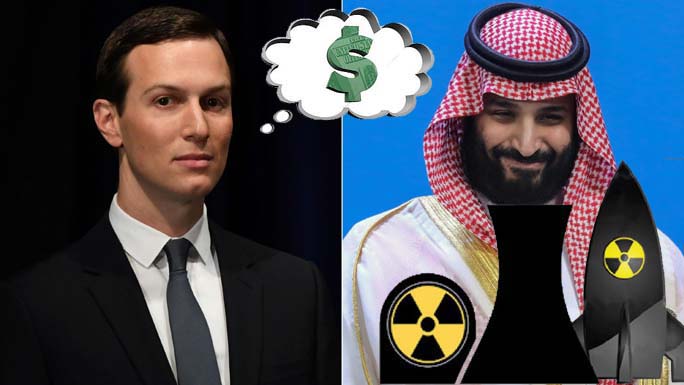 U.S. should keep Congress informed about nuclear talks with Saudis: GAO, https://www.reuters.com/article/us-usa-saudi-nuclearpower/us-should-keep-congress-informed-about-nuclear-talks-with-saudis-gao-idUSKBN22G2X Timothy Gardner
6 May 20, WASHINGTON (Reuters) – The U.S. Departments of State and Energy should commit to regular briefings to relevant committees in Congress on talks about nuclear power cooperation with Saudi Arabia, a congressional watchdog said in a report on Monday.
The Government Accountability Office, or GAO, report said Congress should consider amending the 1954 Atomic Energy Act, or AEA, to require the briefings for the House Committee on Foreign Affairs and the Senate Committee on Foreign Relations about negotiations on nuclear power sharing.
Lawmakers concerned about nonproliferation issues associated with nuclear power development had complained they were being kept in the dark about Trump administration talks with Saudi Arabia, many of which were led by former Energy Secretary Rick Perry. Concern grew after Crown Prince Mohammed bin Salman told CBS in 2018 that the kingdom did not want to acquire a nuclear bomb, but would do so if its rival Iran did so.
Some U.S. lawmakers want the United States to insist that Saudi Arabia agree to a so-called gold standard that restricts enrichment and reprocessing, potential pathways to making fissile material for nuclear weapons. The United States struck such an agreement with the United Arab Emirates in 2009. If Saudi Arabia develops nuclear power without the gold standard, the UAE would likely seek to be released from its agreement.
Senators Robert Menendez, a Democrat, and Marco Rubio, a Republican, had asked the GAO last year to review U.S. agency negotiations with Saudi Arabia on nuclear power, partially because they were concerned the Energy Department, not the State Department took the lead.
The senators said they would explore legislative changes recommended by the GAO. “Congress must reassert its critical role in reviewing nuclear cooperation agreements to ensure these agreements do not pose an unnecessary risk to the United States” they said.
The senators said they would explore legislative changes recommended by the GAO. “Congress must reassert its critical role in reviewing nuclear cooperation agreements to ensure these agreements do not pose an unnecessary risk to the United States” they said.
Big drop in France’s nuclear power generation.
The fall in output is “due to a drop in demand and prolonged (nuclear reactor) outages linked in particular to the health crisis,” EDF said.
Electricity consumption has plunged across Europe due to shutdown measures ordered by governments to halt the spread of the virus.
The utility added that its nuclear generation in Britain fell 18.7% year-on-year in April to 3.7 TWh, while total output since January was at 15.6 TWh, down 5.3% compared with the same period in 2019.
EDF’s subsidiary in Britain, EDF Energy has been asked to temporarily reduce output at its Sizewell B nuclear plant in the east of England to help balance the grid and prevent blackouts, due to the fall in energy demand, EDF and grid operator National Grid said separately on Wednesday. (Reporting by Bate Felix; Editing by GV De Clercq and Elaine Hardcastle) AT TOP https://af.reuters.com/article/commoditiesNews/idAFL8N2CO843
SPD, junior partner in Germany’s coalition government, calls to withdraw US nuclear arms
|
Germany: SPD call to withdraw US nuclear arms stokes debate, DW, 4 May 20, The parliamentary leader of the SPD, the junior partner in Germany’s coalition government, has called for US atomic weapons to be withdrawn from the country. But other parties remain opposed to such a move.The presence of US nuclear weapons on German soil is a danger to Germany’s security and should be terminated, according to the parliamentary leader of the Social Democratic Party (SPD), Rolf Mützenich.
Read more: US military in Germany: What you need to know Mützenich, whose party is junior partner to Chancellor Angela Merkel’s conservative CDU/CSU bloc in Germany’s coalition government, told the paper Tagesspiegel am Sonntag that “atomic weapons on German territory do not heighten our security, on the contrary.” “It is time that Germany ruled out their deployment in future,” he added, stressing that such a move would not call Germany’s membership in NATO into question. Read more: US set to upgrade controversial nukes stationed in Germany Changed US nuclear strategy He justified his call largely by referring to the change in US nuclear strategy under President Donald Trump, saying that Trump’s administration saw atomic weapons not solely as deterrents but as weapons of aggression, making the risk of escalation “incalculable.”……. https://www.dw.com/en/germany-spd-call-to-withdraw-us-nuclear-arms-stokes-debate/a-53314883 |
|
|
Raytheon selected to Build New Nuclear Cruise Missile [ Trump has shares]
Raytheon to Build New Nuclear Cruise Missile , Arms Control Association, May 2020, By Kingston Reif
The U.S. Air Force announced last month that it plans to continue development of a new fleet of nuclear air-launched cruise missiles (ALCMs) with Raytheon Co. as the sole contractor.
“After an extensive evaluation of contractor programmatic and technical approach during…preliminary design reviews, the Air Force decided to focus on Raytheon’s design,” according to an April 17 service press release.
In August 2017, the Air Force awarded a $900 million contract to Raytheon and a $900 million contract to Lockheed Martin Corp. to proceed with development of the ALCM replacement, known as the long-range standoff (LRSO) weapon. (See ACT, October 2017.) The contracts were intended to cover a 54-month period of development after which the Air Force would choose one of the contractors to complete development and begin production.
The service’s rationale for focusing on one contractor roughly two years earlier than planned is unclear………The Trump administration is requesting $1.5 billio
n for the missile and warhead in fiscal year 2021.https://www.armscontrol.org/act/2020-05/news/raytheon-build-new-nuclear-cruise-missile
1 This Month





PLEASE OPPOSE HR 8255 AND S.3639 – bills would accelerate satellite deployment, with no environmental review or safeguards – https://ncstd5li.quorum.us/campaign/169331/
To see nuclear-related stories in greater depth and intensity – go to https://nuclearinformation.wordpress.com
-
Archives
- October 2026 (58)
- September 2026 (339)
- August 2026 (330)
- July 2026 (355)
- June 2026 (287)
- May 2026 (306)
- April 2026 (356)
- March 2026 (251)
- February 2026 (267)
- January 2026 (308)
- December 2025 (358)
- November 2025 (359)
-
Categories
- 1
- 1 NUCLEAR ISSUES
- business and costs
- climate change
- culture and arts
- ENERGY
- environment
- health
- history
- indigenous issues
- Legal
- marketing of nuclear
- media
- opposition to nuclear
- PERSONAL STORIES
- politics
- politics international
- Religion and ethics
- safety
- secrets,lies and civil liberties
- spinbuster
- technology
- Uranium
- wastes
- weapons and war
- Women
- 2 WORLD
- ACTION
- AFRICA
- Atrocities
- AUSTRALIA
- Christina's notes
- Christina's themes
- culture and arts
- Events
- Fuk 2022
- Fuk 2023
- Fukushima 2017
- Fukushima 2018
- fukushima 2019
- Fukushima 2020
- Fukushima 2021
- general
- global warming
- Humour (God we need it)
- Nuclear
- RARE EARTHS
- Reference
- resources – print
- Resources -audiovicual
- Weekly Newsletter
- World
- World Nuclear
- YouTube
-
RSS
Entries RSS
Comments RSS

