Opposition by Saugeen-Ojibway nation brings end to plan for nuclear waste near Lake Huron

Ontario Power Generation Formally Ends Effort To Place Nuclear Storage Site Near Lake Huron, WKAR
In letters sent in May, Ontario Power Generation officially withdrew from an environmental assessment of the project and an application for a construction license. Those withdrawals were first reported in the Detroit Free Press.
Fred Kuntz is with OPG. He said after fifteen years the company decided to look elsewhere to build a storage facility.
“You need three things in Ontario for a project like this to proceed. You need good geology, which we had, you need municipal support, which we had, and you need indigenous support. Without that, we couldn’t proceed with the project.”
Kuntz said the company will begin looking for alternate locations. …….
In letters sent in May, Ontario Power Generation officially withdrew from an environmental assessment of the project and an application for a construction license. Those withdrawals were first reported in the Detroit Free Press.
Fred Kuntz is with OPG. He said after fifteen years the company decided to look elsewhere to build a storage facility.
“You need three things in Ontario for a project like this to proceed. You need good geology, which we had, you need municipal support, which we had, and you need indigenous support. Without that, we couldn’t proceed with the project.”
Kuntz said the company will begin looking for alternate locations. …..A second, high-level nuclear storage facility could still be built near Lake Huron. The Canadian Nuclear Waste Management Organization is considering two possible sites for a facility, one of which is near the lake.
A spokesperson for the organization said the Saugeen-Ojibway vote was not a referendum on their plan
The organization is expected to select a site for the facility by 2023. https://www.wkar.org/post/ontario-power-generation-formally-ends-effort-place-nuclear-storage-site-near-lake-huron#stream/0
EDF’s failing nuclear reactors in UK
- NuclearNews No 126 20 June 20,Hinkley’s sister reactors at Hunterston B (all 4 reactors have operated since 1976) have both been closed for much of the past two years. Reactor 3 has been offline for more than two years, since March 2018. Reactor 4 was first shutdown on 2nd October 2018 but was allowed a trial operation between August 2019 and 10th December 2019. The safety case for restarting Reactor 3 was finally been submitted to the Office for Nuclear Regulation (ONR) for its assessment in mid-May and for Reactor 4 on 29th May. EDF now says it is hoping that Reactor 3 can restart on 13th July 2020 and Reactor 4 on 27 July 2020.
EDF may be hoping to restart the two reactors in July but there are increasing concerns regarding revelations the graphite cores have begun to crumble as cracks spread. At least 58 fragments and pieces of debris have broken off the graphite bricks that make up the reactor cores. According to the Office for Nuclear Regulation (ONR) there is “significant uncertainty” about the risks of debris blocking channels for cooling the reactor and causing fuel cladding to melt. Such a disaster could result in a radiation leak and contamination right across the central belt of Scotland. Small wonder then that many local residents are pressing ONR to refuse EDF permission to restart these decrepit 44-year old reactors. (3)
EDF says it has spent more than £200 million on tests, inspections and creating quarter-scale models of the reactor cores that are shaken to mimic a quake to try to prove that the graphite is safe. EDF hopes the new safety cases will be approved in July to allow for six months of operation. That may pave the way for approval for Hinkley Point B with “pretty much the same safety case”.
£200 million may seem like a lot of money, but it’s only about one reactor’s income for one year, so if it helps EDF keep its fourteen AGRs generating for longer it will have been well worth it for the Company.
But, like Hinkley Point B, the two Hunterston reactors are due to shut for good in 2023. EDF chose not to enter the two Hunterston B reactors into the capacity market auction for the period October 2022 to September 2023. Although Hinkley Point B entered into the auction “it exited above the clearing price and therefore did not get an agreement. The revenues at the clearing price did not provide sufficient reward to take on the risk of penalties arising from non-delivery” (4) – probably indicating a lack of confidence at EDF that any of the 4 reactors will make it as far as September 2023.
Another signal that minds at EDF are switching from generation to decommissioning is the fact that the generator has announced plans to submit scoping requests to North Ayrshire Council ahead of planning applications for waste facilities to support future decommissioning activities.
As part of the preparations for decommissioning, EDF is planning to build a new intermediate level waste (ILW) store and two waste processing facilities on the B site with applications for planning permission submitted by early 2021, following a period of consultation with a range of stakeholders.
A final decision has still to be taken on the best route for storage of ILW from Hunterston B and EDF is still looking at a range of options including the shared use of the Hunterston A ILW store. But to ensure the site can move into de-fuelling with no unnecessary downtime, applications are being lodged now to speed up the process should EDF decide to build a new store.
Discussions are also reported to be underway between BEIS, EDF Energy and the NDA, to examine the future decommissioning of the AGR fleet when it is time for the reactors to come off line. As yet no decisions have been made, and those discussions continue.
But it’s not just Hunterston B and Hinkley Point B which are causing sleepless nights for EDF. As Emily Gosden, writing in The Times, points out, all of “the AGRs are scheduled to close permanently between 2023 and 2030, but all also have graphite cores that bring their lifespans into doubt.”
- All the AGRs will eventually exhibit some form of cracking towards the end of life says Richard Bradfield, chief technical officer for generation at EDF Energy: “There are two irreplaceable components on an advanced gas-cooled reactor: the graphite and the boilers.”
- Hartlepool and Heysham 1 Hartlepool and Heysham 1 are both due to shut-down in 2024. Although they were entered into the capacity market auction for October 2023 to September 2024 and EDF says “we are confident they will operate to their scheduled closure date of 2024, they exited above the clearing price and therefore did not secure agreements. The revenues at the clearing price did not provide sufficient reward to take on the risk of penalties arising from non-delivery.” (5)
Heysham 1 Power Station was recently served with an improvement notice by the Office for Nuclear Regulation after contravening safety regulations regarding the pressure systems of their nuclear reactor. The notice was served on June 4 after shortfalls were discovered in the examination and inspection of the Reactor 1 pressure vessel. Nuclear reactor pressure vessels feature hundreds of sealed penetrations which must be routinely inspected to ensure they are free from defects. Out of the 600 penetrations in one of the reactors ONR found that EDF Energy had failed to examine 11 penetrations within the intervals specified in the written maintenance scheme. EDF must comply with the improvement notice served to them by the ONR and complete the 11 overdue examinations by December 18, 2020. (6)
Dungeness B On 27 August 2018 Dungeness B shut down Reactor 22 for its planned statutory outage. On 23 September 2018 Reactor 21 was also shut down for the planned double reactor outage. Both reactors have been shut since. The regular inspections on the reactors in Kent in late summer 2018 identified the need for repairs on steam pipes. The inspections showed that seismic restraints, pipework and storage vessels associated with several systems providing a safety function were found to be “corroded to an unacceptable condition” according to ONR. (7) Measures are being taken to eliminate the corrosion, including the upgrading of more than 300m of pipeline associated with reactor cooling systems and renewal of numerous seismic pipework supports and remediation of carbon dioxide storage vessels. On 26th February 2020 EDF Energy announced further extended outages at the two reactors The Dungeness B21 reactor was due to come back online on April 20 but the outage was extended to July 18. The Dungeness B22 unit was previously due back online on May 2 but that was extended to July 8. The dates given now are 21st September and 11th September. (8)
- The boiler design at Dungeness was “very different” to the other AGRs and probably would be the life-limiting factor for the plant. However, EDF says the issues are “manageable” and that the company aimed to present a safety case shortly to seek to restart in September. (9)
- Torness and Heysham 2 The Office for Nuclear Regulation (ONR) published its Project Assessment Report which allows Torness and Heysham 2 to continue operating for the period 2020 – 2030. (10) The Ferret website reported that cracks in the graphite core are now expected to start appearing six years sooner than previously thought (11)
- ONR said that the cracking could cause debris to inhibit vital cooling of highly radioactive reactor fuel beginning as soon as 2022 rather than 2028. It said Torness and Heysham 2 will be able to keep operating until 2030 – but only if inspections to check for cracks are intensified. ONR promises to “robustly challenge” the plant’s operators, EDF Energy, to ensure that it “remains safe”.
- Campaigners fear that Torness will become increasingly unsafe, and warn it may have to close down sooner than expected. EDF, however, insists that the station will keep generating electricity safely until 2030. NFLA has called on ONR to keep Torness under close scrutiny. “These safety reservations surrounding the Torness periodic safety review need to be cleared up as soon as possible,” said the group’s Scotland convenor, SNP Glasgow councillor, Feargal Dalton. “Whilst EDF is having to spend large resources trying to persuade the regulator that it is safe to restart the Hunterston B reactors, this report emphasises that similar issues with ageing are likely to arise at Torness over coming years.” Councils would press ONR “to forensically scrutinise what look like significant weaknesses in the EDF safety case,” Dalton added. “In the meantime, the Scottish Government should start discussions about a ‘just transition’ for the workers at both Hunterston and Torness so that Scotland can move to a safe, sustainable and nonnuclear economy as quickly as possible.”
ONR made nine recommendations to remedy major “safety shortfalls” at Torness and Heysham 2 and raised 41 minor matters with EDF. These include “weaknesses” in health reviews, as well as issues with “structural integrity”, “corrosion management” and “cyber security”.
Although no cracks have yet been detected, ONR inspectors pointed out there was a significant difference in the design of Torness and Heysham 2 compared to that of Hunterston. The newer stations have seal rings between the graphite bricks that make up the reactor core. ONR quoted EDF saying that there could be “a systematic failure” of the seal rings after cracking. “This could lead to debris with the potential to challenge the ability to move or adequately cool fuel,” said ONR. “If keyway root cracking predictions are realised, then the safety case is unlikely to remain robust for the next ten years periodic safety review period,” observed ONR inspectors.
It could, in fact, be cheaper to build new renewable capacity rather than continue to operate these ageing reactors. This could soon be the case with Torness, especially if it has to keep being turned on and off to inspect the graphite core. Scotland clearly needs to be prepared for the possibility that Torness might be forced to close not long after 2022.
- Flexible Return Dates
- Paul Brown asked EDF “At what point do you cut your losses and close the stations permanently?” but failed to get a sensible reply. On Dungeness B it said: “For the past two years we have undertaken a major investment programme at Dungeness to secure the station’s longer-term future. Since the start of the year we have made great progress in tackling some of the complex problems our works identified. However we still have further engineering works to complete, and a detailed safety case to finalise, before we ask for restart approval from our regulator. Our present position for estimated return to service is 11 September for Reactor 22 and 21 September for Reactor 21.”
Stephen Thomas, professor of energy policy at the University of Greenwich, commented on the constantly postponed start-up dates for the ageing reactors: “It is clear, given that shutdowns expected to take two months are now expected to take two years or more, that EDF has found huge unanticipated problems”, he said. “It is hard to understand why, when the scale of the problems became clear, EDF did not cut its losses and close the reactors, but continues to pour money into plants to get a couple more years of operation out of plants highly likely to be loss-makers. It is depressing that ONR, which has a duty to keep the public informed on such important issues, chooses to hide behind bland statements such as that it will take as long as it takes, and that it will not comment on EDF’s decisions.” (12)
South Africa- financially ruinous coal and nuclear power proposals – will muck up post-Covid-19 recovery
 New coal and nuclear power proposals undermine prospects of a post-Covid-19 economic recovery, Daily Maverick, By Anton Eberhard• 17 June 2020
The Department of Mineral Resources and Energy’s attachment to ‘clean coal’ and new nuclear as immediate options for a post-Covid-19 economic recovery would be comical if they were not financially ruinous. Their fixation on these non-competitive, non-commercial technologies is now wasting scarce public resources.
South Africa is beginning to see the consequences of an energy ministry trapped in the past, beholden to interest groups and oblivious to global innovations in energy technologies and markets. Submissions by the minister and his energy department to Parliament in the past month reveal an economically disastrous commitment to policy, procurement and investment options that have no hope of contributing to our post-Covid-19 economic recovery.
The Department of Mineral Resources and Energy (DMRE) in its strategic and economic plans is promoting the role of nuclear energy (mainly small modular reactors) and clean coal (with carbon capture and storage), but these technologies are neither price competitive nor, in the case of small nuclear, are they currently commercially available.
In a presentation to Parliament on 26 May 2020, Minister Gwede Mantashe proposed several medium-term (6-12 month) interventions in response to the economic impacts of the Covid-19 pandemic. …….
In the same presentation, the minister proposed a number of interventions (also 6-12 months) to enhance electricity supply security, including acceleration of a nuclear build programme, conversion of Eskom’s diesel-fired turbines to gas and the building of a new oil refinery. None of these, of course, can be accomplished within a year and it’s highly unlikely that even contracts for these projects will be placed any time soon, if ever. Implementation of South Africa’s IRP electricity plan, which identifies wind, solar and storage as the next least-cost options to ensure electricity supply security, was evidently not regarded as a priority although – almost as an afterthought – it was offered as a long-term option.
Over the past weekend, DMRE launched a Request for Information (RFI) to commence preparations for a nuclear build programme. Of course, an RFI is non-binding (unlike a Request for Proposals, RFP, in a competitive tender or auction) and participants are perversely incentivised to put forward unrealistically attractive offers and prices which they’ll probably seek to alter when contracts are negotiated. In short, an RFI is not particularly helpful unless you don’t know what you’re doing and want technology and service providers to shape your procurement.
The minister has now appointed a new board chairperson, the retired nuclear chief officer of Eskom, an ex-British navy nuclear submariner, someone who continues, on social media, to rubbish renewable energy alternatives.
The minister has also entertained plans for expanded investment at the Nuclear Energy Corporation of South Africa (NECSA), despite the institution recording unprecedented financial losses. ……..
It’s time for a reality check. No country or private company currently offers commercially proven exports of land-based, small modular nuclear reactors. South Africa tried to develop one – the pebble bed modular reactor (PBMR) – but after spending more than R20-billion (in today’s money), the programme was closed after a decade without even a pilot demonstration plant being built. …….. Clean coal is also a mirage. …….. https://www.dailymaverick.co.za/article/2020-06-17-new-coal-and-nuclear-power-proposals-undermine-prospects-of-a-post-covid-19-economic-recovery/#gsc.tab=0
Donald Trump’s extraordinary ignorance on which countries are nuclear powers
 Bolton Says Trump Impeachment Inquiry Missed Other Troubling Actions, NYT, By Peter Baker, June 17, 2020
-
- “…….Mr. Bolton’s volume is the first tell-all memoir by such a high-ranking official who participated in major foreign policy events and has a lifetime of conservative credentials. It is a withering portrait of a president ignorant of even basic facts about the world, susceptible to transparent flattery by authoritarian leaders manipulating him and prone to false statements, foul-mouthed eruptions and snap decisions that aides try to manage or reverse.
Mr. Trump did not seem to know, for example, that Britain is a nuclear power and asked if Finland is part of Russia, Mr. Bolton writes. He came closer to withdrawing the United States from NATO than previously known. Even top advisers who position themselves as unswervingly loyal mock him behind his back. During Mr. Trump’s 2018 meeting with North Korea’s leader, according to the book, Secretary of State Mike Pompeo slipped Mr. Bolton a note disparaging the president, saying, “He is so full of shit”
Intelligence briefings with the president were a waste of time “since much of the time was spent listening to Trump, rather than Trump listening to the briefers.” Mr. Trump likes pitting staff members against one another, at one point telling Mr. Bolton that former Secretary of State Rex W. Tillerson had once referred to Nikki R. Haley, then the ambassador to the United Nations, by a sexist obscenity — an assertion Mr. Bolton seemed to doubt but found telling that the president would make it.
Mr. Trump said so many things that were wrong or false that Mr. Bolton in the book regularly includes phrases like “(the opposite of the truth)” following some quote from the president. And Mr. Trump in this telling has no overarching philosophy of governance or foreign policy but rather a series of gut-driven instincts that sometimes mirrored Mr. Bolton’s but other times were, in his view, dangerous and reckless……..” https://www.nytimes.com/2020/06/17/us/politics/bolton-book-trump-impeached.html
USA taxpayers’ money can now go to private companies overseas building nuclear reactors!
 Kinzinger Applauds Rule Change On International
  Private Nuclear Programs http://www.wcsjnews.com/news/local/kinzinger-applauds-rule-change-on-international-private-nuclear-programs/article_b54bef56-af18-11ea-8e41-17fada1bb113.html Jun 15, 2020
-
- Congressman Adam Kinzinger is applauding a decision by the U.S. International Development Finance Corporation that would allow America to support civilian nuclear power projects around the world. Kinzinger wrote a letter to the DFC in March expressing his concerns with internal guidelines that prevented the federal organization from cooperating with international civil nuclear projects. Now that the US can invest in foreign private nuclear programs, Kinzinger said this will strengthen our allies in Eastern Europe and deal a blow to the predatory business practices of Russia and China.
South Africa’s environmental watchdogs warn government against new nuclear power
Environmental watchdogs are warning Energy Minister Gwede Mantashe against a new nuclear power programme. Mantashe’s department has indicated that it will be going ahead with the procurement process for a two thousand 500 megawatt programme. The Southern African Faith Communities’ Environment Institute says going forward with the plan would be unlawful. The institute’s Francesca de Gasparis joins us from Cape Town to discuss. Courtesy #DStv403
35 years in construction, Brazil’s very costly Angra 3 nuclear plant to be delayed yet again
 COVID-19: What next for Brazil’s Angra 3 nuclear plant?
Works on Angra 3 have been ongoing for 35 years and are 62% complete.
The current timetable states that the plant will start operations by 2026, a deadline that has become increasingly unlikely due to COVID-19.
“The expectation was to hold a tender this year but this will depend on how the pandemic evolves, as many of the negotiations with foreign firms cannot be held online. Delays to the start of operations will probably be proportional to those postponements of the tender process,” said Almeida. ……
“The required investments are very high and a part of it will be made by Eletrobras, but another part will come from the negotiations with the firm that wins the tender. Brazil’s currency has been oscillating a lot and although I believe it will stabilize in the future this will have an impact because part of the works that will be contracted abroad,” Almeida said. …..
Some of the companies interested in the works to complete Angra 3 include China’s CNNC, Russia‘s Rosatom, US-based Westinghouse, Areva from France, and South Korean firm Kepco.
Access to financing will be a key factor for who wins the tender, according to sector experts. …..
Construction of the plant started in 1984 and was interrupted for the first time in 1986, as funds became unavailable due to an economic crisis. Works then resumed in 2010 but were halted again in 2015 when corruption allegations emerged as part of the country’s massive Lava Jato corruption investigation.
Former president Michel Temer and former energy minister Wellington Moreira Franco were arrested in March last year for allegedly having received bribes linked to Angra 3 contracts, and those investigations are still ongoing.
Current energy minister Bento Albuquerque, who took office in January last year, has said that Angra 3 would be a priority during his term….. (subscribers only) https://www.bnamericas.com/en/news/covid-19-what-next-for-brazils-angra-3-nuclear-plant
Plan for USA’s taxpayers to fund nuclear power exports
|
US Agency Proposes Financing of Nuclear Power Exports, VOA, By Reuters June 11, 2020 WASHINGTON – A U.S. development agency proposed lifting restrictions that bar the financing of advanced nuclear energy projects abroad, a move the Trump administration hopes will help the industry compete with state-owned companies in China and Russia.
The U.S. International Development Finance Corp., or DFC, late Wednesday opened a 30-day comment period on the proposal. The idea was included in the Trump administration’s Nuclear Fuel Working Group report, released in April, on ways to modernize nuclear energy policy……. The DFC, which replaced the Overseas Private Investment Corp., launched in January with a $60 billion budget. It is seen by analysts as an attempt by Washington to provide an alternative to Beijing’s sweeping Belt and Road Initiative, which sponsors large-scale infrastructure, like nuclear projects, in developing countries. Russia’s state-owned nuclear energy company, Rosatom, is also looking to sell nuclear technology. Ed Lyman, a nuclear power expert at the Union of Concerned Scientists, said it is “utterly irresponsible for the Trump administration to promote the export of unproven and potentially dangerous nuclear technologies to the developing world.” He said Washington should first work with countries to create independent nuclear regulators. …….. Advanced nuclear power is expected to be less expensive than traditional nuclear stations costing tens of billions of dollars. But nonproliferation experts caution that the plants and their supply chains could become targets of attack. https://www.voanews.com/usa/us-agency-proposes-financing-nuclear-power-exports |
|
Brazil government approves plan to complete third nuclear plant
|
Brazil government approves plan to complete third nuclear plant BRASILIA, June 10 (Reuters) – Brazil on Wednesday approved a plan to complete its long-delayed third nuclear reactor Angra 3, with or without a partner joining Eletronuclear, the Eletrobras subsidiary that runs two existing two nuclear plants.State-owned Eletrobras needs a private partner to help it finish the 1,400 megawatt reactor started in 2010. Possible candidates include companies in China, Russia, France and South Korea.
The private partner must be a minority stakeholder, said the Investment Partnership Program (PPI) council that gave the approval. So far, 9 billion reais ($1.8 billion) have been spent on the project that stalled in 2015 due to cost overruns and a corruption scandal involving contractors….. https://www.reuters.com/article/brazil-eletrobras-nuclear/update-1-brazil-government-approves-plan-to-complete-third-nuclear-plant-idUSL1N2DN367 |
|
USA’s reckless nuclear spending as coronovirus hits the nation
Debating US nuclear spending in the age of the coronavirus, Bulletin of the Atomic Scientists  By Kingston Reif, June 10, 2020 As the novel coronavirus pandemic continues to exact a terrible human and economic toll on the United States, Americans are adjusting how they view national security. There also appears to be agreement, even within the senior leadership of the Defense Department, that the military budget, which has seen significant growth during the Trump administration, is likely to be pared back in the coming years as federal deficits soar. By Kingston Reif, June 10, 2020 As the novel coronavirus pandemic continues to exact a terrible human and economic toll on the United States, Americans are adjusting how they view national security. There also appears to be agreement, even within the senior leadership of the Defense Department, that the military budget, which has seen significant growth during the Trump administration, is likely to be pared back in the coming years as federal deficits soar.
So it should be no surprise that the havoc wrought by the virus has also fanned the flames of an ongoing debate about the Trump administration’s aggressive and costly plans to sustain and upgrade the US nuclear arsenal……. The unsustainable nuclear budget. At the Arms Control Association, where I am the director for disarmament and threat reduction policy, we have long argued that the administration’s approach is unnecessary, unsustainable, and unsafe. The financial and opportunity costs have steadily grown and the biggest nuclear weapons modernization bills are just beginning to arrive. Government officials in charge of the nuclear weapons enterprise warn about the “pervasive and overwhelming risk” facing the current nuclear modernization program………. The danger posed by the plans is on full display in the administration’s fiscal year 2021 budget request. The Defense and Energy Departments are requesting $44.5 billion for next year to sustain and modernize US nuclear delivery systems and warheads and their supporting infrastructure, a larger-than-anticipated increase of about $7.3 billion, or 19 percent, from the fiscal year 2020 level. Meanwhile, the administration is recommending a lower overall national defense budget than Congress provided last year. The combination of a decreased topline budget but an increased nuclear budget means that other defense programs would have to be cut. Some programs on the chopping block include the Navy’s planned second Virginia class submarine, the Energy Department’s efforts to clean up nuclear waste leftover from US nuclear weapons production during the Cold War, and the Pentagon’s Cooperative Threat Reduction program, which supports global efforts to detect and secure dangerous pathogens such as the coronavirus. And this was all before the coronavirus began its deadly march across the country and before Congress spent several trillion dollars trying to save the US economy from complete collapse. Although Pentagon officials insist that nuclear weapons should be shielded from possible future defense budget cuts, the pressure on the federal budget imposed by the response to the virus is likely to exacerbate the affordability and execution challenges confronting the administration’s nuclear spending plans. If great power competition with China is the Pentagon’s top priority, is it prudent to sacrifice a Virginia class submarine every year for the next 10 to 15 years to attempt to keep an excessive and overburdened nuclear modernization effort on track? The answer should be no, especially in light of the quantitative and qualitative superiority of the US nuclear arsenal over China’s. In the view of many, the Trump administration’s proposal to expand spending on nuclear weapons is a sad and dangerous illustration of wildly misplaced federal spending priorities. As it proposed a 19 percent increase for nuclear weapons next year, the White House initially planned to slash the budgets for the Centers for Disease Control by 19 percent and the National Institutes of Health by 7 percent. The Pentagon’s proposal to cut the budget for the Cooperative Threat Reduction program in order to fund weapons modernization amid a global pandemic is shockingly reckless…… Inexplicably, the unprecedented economic crisis facing the nation hasn’t stopped some Trump administration officials from raising the prospect of even greater spending on nuclear weapons above and beyond what is already planned. Marshall Billingslea, President Trump’s special envoy for arms control, said recently that if Russia and China don’t agree to US demands for talks on new trilateral arms control to replace the 2010 New Strategic Arms Reduction Treaty (New START), Washington could win a new arms race if necessary. “We know how to win these races, and we know how to spend the adversary into oblivion,” he said. More US spending on nuclear weapons won’t force the current Russian and Chinese leadership to capitulate and would be fraught with peril. The administration’s desire to pursue a more ambitious arms control agreement is the right goal, but it can’t be achieved before New START is slated to expire next February. A new quantitative arms race that could follow the collapse of New START would further undermine stability between the United States and Russia, the health of the global nonproliferation regime, and the US military’s emphasis on competition with China. Our new post-pandemic reality should make it all the more obvious that the current modernization plans need to be reconsidered in a way that eliminates the most excessive and destabilizing elements, saves taxpayer dollars for other pressing national and health security needs, and is in sync with a revitalized and realistic strategy to cap and reduce global nuclear stockpiles…….. Lisa Gordon Hagerty, head of the National Nuclear Security Administration, was asked to explain the rationale for such a large unplanned increase at a Congressional hearing in March, but her attempt at an answer hardly cleared up the situation. Perhaps there is a clearer explanation for why the agency so badly misjudged its funding needs for 2021, but if so the agency has yet to provide it…. (lengthy rebuttal of Frank Miller’s claims about nuclear weapons spending) ……. https://thebulletin.org/2020/06/debating-us-nuclear-spending-in-the-age-of-the-coronavirus/# |
|
|
In U.S. Congress, a Bill to prohibit Trump’s possible plan to use nuclear weapons on hurricanes
 Trump’s plans to use nuclear weapons on hurricanes challenged in new Democratic bill, President repeatedly floated ‘really dumb idea’, according to reports, Independent UK, Maddie Stone 10 June 20,
In August, Donald Trump reportedly asked top national security officials to consider using nuclear bombs to weaken or destroy hurricanes. Now, one member of Congress wants to make it illegal for Mr Trump, or any president, to act on this idea, which experts say would be both ineffective and extremely dangerous.
On 1 June, Sylvia Garcia, Democratic representative for Texas, introduced the Climate Change and Hurricane Correlation and Strategy Act, a bill that explicitly prohibits the president, along with any other federal agency or official, from employing a nuclear bomb or other “strategic weapon” with the goal of “altering weather patterns or addressing climate change”.
Ms Garcia said that the bill was drafted as a direct response to last year’s report that Mr Trump has floated the idea of nuking hurricanes. Mr Trump denied ever making such a suggestion in a tweet shortly after Axios published the initial report.
The bill, which has no co-sponsors and no hearing date, appears unlikely to make it out of committee anytime soon. It has been referred to three committees: Armed Services; Energy and Commerce; and Science, Space and Technology.
With no companion bills in the Senate, the chances of it appearing on the president’s desk, much less being signed into law, are slimmer. But after hearing Mr Trump’s alleged comments on nukes and hurricanes and researching the issue further, Ms Garcia felt she had to at least get the idea of a ban on using nuclear weapons to disrupt the weather on the table…….
The bill comes at the start of the 2020 Atlantic hurricane season, which is off to a quick start, with Tropical Storm Cristobal, the earliest-recorded third named-storm of any season, striking Louisiana on Sunday. The season is expected to bring above-average storm activity, with 14 to 19 named-storms, according to the National Oceanic and Atmospheric Administration (NOOA). ……
Climate studies show that warming seas and air temperatures are making hurricanes more damaging by increasing their rainfall output and favouring higher-end, “major” storms of Category 3 intensity or greater. Scientists have also been seeing a small increase in storms that rapidly intensify from weak to major hurricane status, which is enabled by warm sea surface temperatures, among other factors…….
Axios’s report noted that Mr Trump raised the idea not once, but at multiple points in time, including with top national security and intelligence aides.
Kerry Emanuel, a hurricane expert at MIT, sees things a bit differently.
“If we have a leader who would contemplate using a nuclear weapon on a hurricane,” he said, “we have a much more extensive and serious problem than could be covered by a specific bill like this one”. https://www.independent.co.uk/news/world/americas/trump-nuke-hurricane-bill-climate-change-sylvia-garcia-a9555746.html
USA’s failing nuclear industry will not be saved by new plan to stockpile uranium
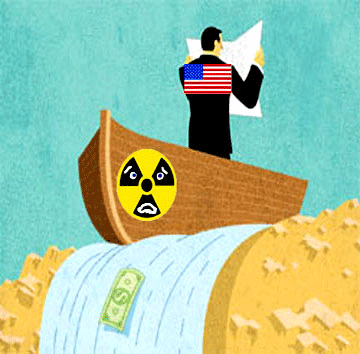 Will More Uranium Really Solve America’s Nuclear Crisis? Oil Price, By Haley Zaremba – Jun 10, 2020, “…….. Even though the United States is responsible for a whopping third of all nuclear energy production worldwide, the country is quickly losing ground as nuclear plants struggle to turn a profit. Hit hard by the influx of cheap oil and natural gas from the domestic shale revolution, the nuclear energy industry in the U.S. is now being pummeled once again by COVID-19, and this time, many experts are wondering whether the industry can weather the storm.
Trump’s dangerous idea on nuclear testing – top Democrats demand answers
 Top Democrats demand answers on Trump administration’s ‘unfathomable’ consideration of nuclear testing The Hill BY REBECCA KHEEL – 06/08/20 A group of top House Democrats is demanding answers from the Trump administration on reported conversations within the administration on whether to resume nuclear testing.“It is unfathomable that the administration is considering something so short-sighted and dangerous, and that directly contradicts its own 2018 Nuclear Posture Review,” the lawmakers wrote in a letter Monday to Energy Secretary Dan Brouillette and Defense Secretary Mark Esper
The posture review, the lawmakers wrote, “which this administration often cites as inviolable, makes clear that ‘the United States will not resume nuclear explosive testing unless necessary to ensure the safety and effectiveness of the U.S. nuclear arsenal.’
The letter was signed by House Armed Services Committee Chairman Adam Smith (D-Wash.) and House Appropriations Committee Chairwoman Nita Lowey (D-N.Y.), along with Reps. Jim Cooper (D-Tenn.), chairman of the Armed Services Subcommittee on Strategic Forces; Marcy Kaptur (D-Ohio), chairwoman of the Appropriations subcommittee on energy and water; and Pete Visclosky (D-Ind.), chairman of the Appropriations Subcommittee on Defense.
The Pentagon declined to comment………
The lawmakers demanded answers to questions by June 22, as well as a briefing by June 25. Questions include under what legal authority and funding testing is being considered, whether the intelligence community is analyzing what the effects of a test would be on U.S. allies and adversaries, and whether there has been any independent assessment requested by the Energy or Defense departments on the need, cost and effect of resuming nuclear testing. https://thehill.com/policy/defense/501687-top-democrats-demand-answers-on-trump-administrations-unfathomable
Nuclear testing ban to be introduced in U.S. Congress

 Reps. Steven Horsford and Dina Titus announce nuclear testing ban legislation, 8 NewsNow by: Kaitlyn Olvera Jun 8, 2020, LAS VEGAS (KLAS) — Congressman Steven Horsford and Congresswoman Dina Titus have introduced a nuclear testing ban. The Preserving Leadership Against Nuclear Explosives Testing (PLANET) Act, introduced Monday, would prevent President Donald Trump from restarting nuclear weapons testing in Nevada.
This legislation “would prevent the Trump administration from restarting explosive nuclear weapons testing by restricting funds for fiscal year 2021 and all previous years from being used for such a purpose,” a release about the legislation stated.
The Washington Post reported the Trump administration had a discussion about conducting a nuclear test with top security officials on May 15, in response to accusations that Russia and China were performing low-yield nuclear tests. This is a claim both countries have denied.
Specifically, the PLANET Act would, according to Rep. Horsford’s office:
- Prohibit the use of funds appropriated in Fiscal Year 2021 or from any previous year to prepare for or to conduct an explosive nuclear test that produces any yield
- Allow for stockpile stewardship activities that are consistent with U.S. law – such as certifying the safety, security and reliability of the U.S. nuclear stockpile – so long as those activities are consistent with the “zero-yield” scope of the Comprehensive Test Ban Treaty (CTBT)…… https://www.8newsnow.com/news/local-news/reps-steven-horsford-and-dina-titus-announce-nuclear-testing-ban-legislation/
Top Democrats promote bill to ban live nuclear tests
 Lead Dems back bill to ban live nuclear tests, Defense News, By: Joe Gould 5 June 20, WASHINGTON ― The Senate’s top Democrat, Sen. Chuck Schumer, is co-sponsoring legislation meant to prevent the Trump administration from restarting explosive nuclear weapons testing.
The Preserving Leadership Against Nuclear Explosives Testing, or PLANET, Act, announced Thursday, would bar any funds from being used for such tests. It follows a Washington Post report of high-level discussions around the possibility of doing a “rapid test” ― potentially America’s first live nuclear test since 1992.
The bill is led by Sen. Ed Markey, D-Mass., and a longtime arms control advocate on the Senate Foreign Relations Committee. While a key administration official has said tests could begin within months if ordered by the president for technical or geopolitical reasons, critics say it could incentivize Russia and China to openly test with little valuable data to show for U.S. tests…….. https://www.defensenews.com/congress/2020/06/04/lead-dems-back-bill-to-ban-live-nuclear-tests/
1 This Month





PLEASE OPPOSE HR 8255 AND S.3639 – bills would accelerate satellite deployment, with no environmental review or safeguards – https://ncstd5li.quorum.us/campaign/169331/
To see nuclear-related stories in greater depth and intensity – go to https://nuclearinformation.wordpress.com
-
Archives
- October 2026 (58)
- September 2026 (339)
- August 2026 (330)
- July 2026 (355)
- June 2026 (287)
- May 2026 (306)
- April 2026 (356)
- March 2026 (251)
- February 2026 (267)
- January 2026 (308)
- December 2025 (358)
- November 2025 (359)
-
Categories
- 1
- 1 NUCLEAR ISSUES
- business and costs
- climate change
- culture and arts
- ENERGY
- environment
- health
- history
- indigenous issues
- Legal
- marketing of nuclear
- media
- opposition to nuclear
- PERSONAL STORIES
- politics
- politics international
- Religion and ethics
- safety
- secrets,lies and civil liberties
- spinbuster
- technology
- Uranium
- wastes
- weapons and war
- Women
- 2 WORLD
- ACTION
- AFRICA
- Atrocities
- AUSTRALIA
- Christina's notes
- Christina's themes
- culture and arts
- Events
- Fuk 2022
- Fuk 2023
- Fukushima 2017
- Fukushima 2018
- fukushima 2019
- Fukushima 2020
- Fukushima 2021
- general
- global warming
- Humour (God we need it)
- Nuclear
- RARE EARTHS
- Reference
- resources – print
- Resources -audiovicual
- Weekly Newsletter
- World
- World Nuclear
- YouTube
-
RSS
Entries RSS
Comments RSS

