If he wins election, Joe Biden would restore Iran nuclear deal
 Biden would restore nuclear deal if he wins elections: George
  Washington University professor, By Javad Heirannia Tehran Times, June 7, 2020
Professor Askari, who served as special advisor to Saudi finance minister, also says a Democratic president “would set about undoing Trump’s foreign policy errors.”
Following is the text of the interview:…………………..
Q: If Joe Biden is elected the next president of the United States, will he change his approach toward China? Also, what would be his approach to Iran and the nuclear deal in general?
A: I think a Biden, or for that matter any Democratic President, would set about undoing Trump’s foreign policy errors. Yes, he would try to chart a new course with China. Tough but with a plan that is step by step to restore workable relations. Not a series of disjointed reactions to the moment in time. He would restore, or rejoin, the nuclear agreement with Iran. But now he would want an extension of the time that Iran could resume for nuclear research and have breakout capabilities. In this way, he would appear as tough but at the same time reduce tensions in the Persian Gulf and America’s military exposure around the world. https://www.tehrantimes.com/news/448604/Biden-would-restore-nuclear-deal-if-he-wins-elections-George
Trump tells Iran they should get “a better deal” with him now, before the U.S. election
 Urging Iran to ‘Make the Big Deal,’ Trump Ties Nuclear Negotiations to Election, The president’s invitation came as international inspectors were said to have found that Iran had boosted its stockpile of low-enriched uranium in the past three months.
Aides to Mr. Pompeo and Mr. Trump declined to explain why, if the United States was negotiating in its own national interest, Iran might get preferential treatment for negotiating with Mr. Trump before the election……
“We had a deal when you entered office,” Iran’s foreign minister, Mohammad Javad Zarif, responded to Mr. Trump in a tweet on Friday. Iran and the other participants in the 2015 agreement — Britain, France, Germany, the European Union, Russia and China — “never left the table,” he said. “Your advisers — most fired by now — made a dumb bet. Up to you to decide *when* you want to fix it.”
Hesameddin Ashena, the top policy adviser to President Hassan Rouhani of Iran also responded. “You are going down on November 3rd and we know that,” he tweeted. “So you’ll need to offer much more than Obama did!”…….. https://www.nytimes.com/2020/06/05/world/middleeast/trump-iran-nuclear.html
The most effective leader in the world – Jacinda Adern
 New Zealand’s Prime Minister May Be the Most Effective Leader on the Planet. Uri Friedman 19 April 20 The Atlantic Amid the Trump administration’s calamitous response to the Covid-19 pandemic, media have been looking to other countries for inspiration in responsible leadership during a period of crisis. New Zealand Prime Minister Jacinda Arden has been one popular pick, having capably managed to limit the damage to only 1,504 infections and 22 deaths, as of June 5.
A widely shared article in the Conversation (4/5/20) described Ardern as putting on a “masterclass in crisis leadership.” The Washington Post (4/7/20) characterized her government’s response as a “triumph of science and leadership.” Elsewhere, she has been praised as “the most effective leader on the planet” (Atlantic, 4/19/20) who “should be teaching the rest of the world” (Guardian, 4/10/20). The Financial Times (4/19/20) unironically anointed her “Saint Jacinda.”
Despite its obvious geographical and economic advantages, New Zealand certainly deserves praise. But less deserving have been the European countries corporate media consistently highlight as outstanding performers. With over 185,000 cases and 8,763 deaths, Germany has one of the highest per capita fatality rates in the world. Yet Chancellor Angela Merkel has drawn effusive praise as somebody who “embraces science” (Atlantic, 4/19/20; Guardian, 4/16/20; Financial Times, 4/3/20). CNN (5/7/20) proclaimed her a “global leader on coronavirus”; Vox (5/21/20) said she’d been “praised for her clear and effective communication with her country — and the world.”
In its editorial on crisis leadership, the New York Times editorial board (4/30/20) also praised Merkel (while attacking China for supposedly covering up the outbreak). They highlighted and applauded the leadership of several other countries, including Denmark, Norway and Finland. Amazingly, the editorial also singled out and commended Italian Prime Minister Giuseppe Conte, whose inept response has led to Italy having the third-highest number of deaths in the world at the time of its publication.
There was far less praise for leaders in the Global South. Indeed, the only one mentioned by name was Taiwan’s Tsai Ing-wen, and this was primarily because she “sent millions of face masks to the United States and Europe”—although with 443 total cases and only seven deaths, Taiwan has had a far more enviable record on Covid-19 than most of the countries featured in the editorial. True Asian leadership, according to the Times editorial board, is helping white people, apparently.
Anti–nuclear resistance in Russia: problems, protests, reprisals

Produced by RSEU’s program “Against nuclear and radioaсtive threats”
Report “Anti–nuclear resistance in Russia: problems, protests, reprisals” Produced by RSEU’s program “Against nuclear and radioaсtive threats”
Editor and translator: Vitaly Servetnik
English editor: Anna WhiteCover
illustration: Anastasia Semenova
Layout: Sergey Fedulov
Saitnt Petersburg 2020
Nuclear energy: failures and lies…….5
Expired reactors……………………………6
Decommissioning problems…………..7
Uranium mining protest………………..8
The Mayak plant: Rosatom’s dirty face………10
Struggle against nuclear repository……………11
A road through a radioactive graveyard……..14
Conclusion: nuclear power is a problem, not a solution….14
Nuclear energy: failures and lies
4 https://7×7–journal.ru/articles/2019/08/09/admin-istraciya–severodvinska–udalila–s–oficialnogo–saj-ta–reliz–o–skachke–radiacii–v–gorode–posle–vzry-va–pri–ispytanii–reaktivnoj–ustanovki–baza–soobshi-la–o–shesti–postradavshih–ot–oblucheniya
8 https://www.tol.org/client/article/23174-nucle-ar-strength-kola.html
9 https://barentsobserver.com/en/sections/nature/ kola-reactor-3-runs-overtime (Eng.)
10 https://barentsobserver.com/en/nature/ ice-cold-swimming-nuclear-protest (Eng.)
11 http://pim.org.ru/old/2005–04–28–answer–mur-manproc.pdf (Rus.)
12 https://profile.ru/society/ekolog–znachit–vrag–13271/
13 https://kec.org.ru/organisation/histrory/
14 http://rusecounion.ru/eng/nuclearstatusre-port2019 (Eng.)
15 http://rusecounion.ru/eng/node/2994 (Eng.),http://rusecounion.ru/eng/node/2991 (Eng.)
16 https://www.rbc.ru/spb_sz/29/12/2018/ 5c2633749a7947f8833fc99817 http://decommission.ru/2019/06/14/laes_sos-nobyl/
18 http://decommission.ru/2017/12/21/yad-news_1_201217/
19 http://rusecounion.ru/eng/node/2993 (Eng.)
20 http://rusecounion.ru/eng/node/2992 (Eng.)
21 http://greenworld.org.ru/?q=human_right_21111622 https://shtab.navalny.com/hq/kurgan/3687/
23 https://novayagazeta.ru/arti-cles/2019/11/08/82647–strana–uraniya
24 https://youtu.be/irqY75jSnA8
25 https://vk.com/wall–141292704_3351
26 https://45.ru/text/gorod/53533571/
27 https://ovdinfo.org/express–news/2020/04/15/v–kurgane–fsb–vozbudilo–ugolovnoe–delo–protiv–ekoaktivistki
28 http://chng.it/xHgMmwkPq5
29 http://rusecounion.ru/ru/no–uf6
30 http://activatica.org/blogs/view/id/8619/title/ pochemu–nuzhno–ostanovit–uranovyy poezd
31 https://www.zaks.ru/new/archive/view/195957
32 http://rusecounion.ru/ru/decomatom_19320
33 https://66.ru/news/society/226814/
34 https://greenpeace.ru/blogs/2019/12/17/peter-burg–ne–hochet–radioaktivnyh–podarkov/
35 https://foeasiapacific.org/2019/07/01/ russia-must-stop-criminal-persecu-tion-of-ecodefense-director-alexandra-koroly-ova-repeal-the-foreign-agent-law-and-promote-envi-ronmental-justice/ (Eng.)
36 https://ecodefense.ru/2019/12/30/alexandra–koroleva–political–refuge/
37 http://rusecounion.ru/ru/decom_mayak_2018
38 http://nuclear.tatar.mtss.ru/fa230907.htm
39 http://chel–portal.ru/enc/dvizhenie_za_yader-nuyu_bezopasnost
40 http://hudoc.echr.coe.int/eng?i=001-103084(Eng.), http://hudoc.echr.coe.int/eng?i=001-158136(Eng.)
41 https://www.vesti.ru/doc.html?id=949087
42 https://theins.ru/confession/81445
43 https://www.kommersant.ru/doc/941081
44 https://www.rbc.ru/poli-tics/18/03/2015/550812909a79475f79d367cc
45 https://novayagazeta.ru/ news/2016/12/13/127413–sud–v–chelyabinske–likvid-iroval–priznannyy–inostrannyym–agentom–fond–za–prirodu
46 https://za–prirodu.ru/page/ekspansija–neve-zhestva
47 http://babr24.com/kras/?IDE=198678
48 http://www.change.org/mogilnik
49 https://youtu.be/WTKfCnXt58Q?t=1729
50 https://meduza.io/news/2016/08/25/krasnoyarsk-ogo–aktivista–obvinili–v–razzhiganii–nenavisti–k–at-omschikam
51 http://greenworld.org.ru/sites/default/greenfiles/ Mariasov_doklad_int.pdf
52 https://vk.com/@pitsunova–filkina–gramota–ros-rao
53 https://news.sarbc.ru/main/2019/07/25/235566.html
54 https://regnum.ru/news/polit/2867802.html
55 http://chng.it/5RsJDQfkxq
56 https://ovdinfo.org/express–news/2020/03/11/ kirovskie–vlasti–ne–soglasovali–miting–ni–na–odnoy–iz–31–ploshchadok–no
57 http://rusecounion.ru/ru/horda_msk
58 https://youtu.be/R9_9phYaWBE
59 https://youtu.be/bMKfYD1SLdc
60 https://youtu.be/l5K8agywCNw
61 https://youtu.be/iXOyT0qPUi0
62 http://activatica.org/blogs/view/id/9759/title/ na–sklon–v–moskvoreche–vernulsya–simvol–obo-rony–sob
Czech Fiscal Council warns on the long-term risk of financing a new nuclear reactor

Even the World Nuclear News, voice of the global nuclear industry, admits that nuclear reactors are just too costly
Czech budget council warns of Dukovany cost https://www.world-nuclear-news.org/Articles/Czech-budget-council-warns-of-Dukovany-cost 05 June 2020
 The Czech Fiscal Council, Národní rozpočtová rada (NRR), has warned that financing a new nuclear power unit could have a long-term impact on the country’s budget and could be “a lot higher” than current estimates.
Czech Prime Minister Andrej Babiš said last week that the government will provide a loan to ČEZ to cover 70% of the cost of building a new unit at the Dukovany nuclear power plant, with the majority state-owned utility funding the remaining 30%. The project cost is estimated to be about EUR6.0 billion (USD6.7 billion).
In its latest quarterly report, published on 3 June, the NRR said it was outside its remit to comment on the country’s choice of energy mix, but that it considered it necessary to comment on aspects of policy that significantly affect public budgets.
“In May 2020, the government presented a proposal to provide a loan to ČEZ covering up to 70% of the funds needed for the completion of the Dukovany nuclear power plant, while the costs of project implementation are expected to be around CZK160 billion. It’s obvious that such an amount would have to be secured by the state on the capital markets and thus the share of public debt in GDP would increase,” it said.
v”In addition, experience from the construction of nuclear power plants abroad in recent years has shown that the budgeted amounts are generally significantly exceeded. In the end, the fiscal costs of completing a nuclear power plant may be significantly higher than current estimates. Decisions of similar importance should therefore, in the NRR’s view, be taken on the basis of careful analysis and after a more detailed discussion.”
ČEZ applied to the State Office for Nuclear Safety on 25 March to construct two new reactors at its Dukovany nuclear power plant. Four VVER-440 units are currently in operation at the site, in Vysočina Region.
U.S. Nuclear Regulatory Commission will run environmental study BEFORE relicensing South Carolina nuclear fuel plant
After public outcry, feds will conduct extensive study of SC nuclear fuel plant The State BY SAMMY FRETWELL JUNE 05, 2020 , Following state concerns about previously unknown pollution at an atomic fuel plant near Columbia, the U.S. Nuclear Regulatory Commission announced Friday that it will conduct an extensive environmental study of the Westinghouse fuel factory.
Conducting a detailed study is expected to delay by a year any decision on a new license for the plant while the agency looks into problems that have surfaced in recent years.
The plant has polluted groundwater, some of which has only been discovered since 2018, and neighbors have raised concerns about safety and water contamination.
The NRC’s decision marks the first time the agency has ever conducted a full environmental impact statement before deciding if a nuclear fuel fabrication plant should be relicensed, NRC spokesman Roger Hannah said. The plant’s owner, Westinghouse, wants a new 40-year-operating license for the plant, built in 1969.
“In March 2020, the NRC received new data collected by Westinghouse during ongoing site investigations,’’ the agency said in a news release Friday afternoon. “Based on the NRC’s independent evaluation of the new data .
… the NRC decided it could no longer conclude that renewal of the license would result in a finding of no significant impact’’ to the environment.
The Westinghouse plant, which employs more than 1,000 people, is one of only three nuclear fuel factories of its kind in the United States. The plant makes fuel rods for the nation’s atomic energy plants. Plants in North Carolina and Washington state also make nuclear fuel.
Tom Clements, a nuclear safety watchdog in Columbia, said it appears that the NRC listened to concerns by the public and state regulators.
“That is very encouraging to hear,’’ said Clements, who said the full study is needed. “It took a clamor from the public before they would do the right thing. I’m glad they have finally done this.’’
The S.C. Department of Health and Environmental Control called for a full environmental impact statement after finding rising pollution levels in ponds on the site.. …… https://www.thestate.com/news/local/environment/article243310956.html
Desperate nuclear lobby tries to con the European Commission with its bogus claim about climate solving

|
Industry urges EC to recognise nuclear’s role in economic recovery, WNN,03 June 2020The European nuclear industry has written an open letter to the European Commission, saying it is ready to play an important part in supporting a low-carbon economic revival. The letter, addressed to EC President Gertrud von der Leyen, European Parliament President David Maria Sassoli and European Council President Charles Michel, was signed by 25 companies and 14 associations, including European nuclear trade body Foratom.
Last week, Foratom said it was regrettable that the European Commission had ignored the need for nuclear power as a clean, dispatchable and European source of energy in its green recovery plan from the coronavirus pandemic. The EC’s plan – Next Generation EU – aims to boost the EU budget with new financing raised on the financial markets for 2021-2024, and a reinforced long-term budget of the European Union for 2021-2027. Today’s letter reads as follows:…… https://www.world-nuclear-news.org/Articles/Industry-urges-EC-to-recognise-nuclear-s-role-in-e |
|
China’s nuclear power ambitions face delays, waste problems, and the growing success of renewables
It’s a pity that nuclear energy is so easily described as “climate-friendly”. Yes, the actual nuclear reactor can be said to be cutting carbon emissions. But why does everyone ignore the huge carbon emissions from the entire nuclear fuel chain, from uranium mining through to burial of radioactive wastes? Why ignore the emissions of ionising radiation, another unseen, but dangerous pollutant?
And why ignore climate change’s effects on nuclear power? Far from nuclear energy stopping global heating, it’s more likely that global heating will stop nuclear power. Nuclear is highly water-guzzling, so most reactors are perched neat the sea, or near rivers – meaning in danger of sea level rise, as well as other extremes such as hurricanes. The water requirements mean that nuclear is affected by extreme heat – and plants have to cut down, or even shut down.
China to Dominate Nuclear as Beijing Bets on Homegrown Reactors
China probably won’t hit its nuclear energy target this year, but that’s unlikely to derail a broader ambition to become the planet’s chief proponent of the climate-friendly [what!!] fuel
Bloomberg, 1 June 20
German Parliament in debate on basing of nuclear weapons
|
German Politicians Renew Nuclear Basing Debate Arms Control June 2020
By Oliver Meier A senior member of the German Parliament has revitalized the debate over whether the nation should host U.S. nuclear weapons on German soil. “It is about time that Germany in the future excludes the deployment” of nuclear weapons on its territory, said Rolf Mützenich, the leader of the Social Democrat (SPD) group in the Bundestag, in a May 2 interview with Der Tagesspiegel. The German Social Democrats are coalition partners of the conservative Christian Democrat Union (CDU). The SPD leadership backed Mützenich’s comments. The discussion followed a mid-April decision by the Defense Ministry to replace Germany’s current fleet of Tornado aircraft, some of which are dual-capable with 90 Eurofighter Typhoon and 45 U.S. F-18 fighter aircraft. Thirty of the F-18s would be certified to carry U.S. nuclear weapons. Under nuclear sharing arrangements, NATO allies jointly discuss, plan, and train nuclear missions. According to Hans Kristensen of the Federation of American Scientists, Belgium, Germany, Italy, the Netherlands, and Turkey host up to 150 U.S. B-61 nuclear gravity bombs on their territory. These countries, except Turkey, provide their own aircraft capable of delivering nuclear weapons in times of war. Details of the arrangements remain shrouded in secrecy, but 20 U.S. nuclear weapons are estimated to be deployed at Büchel air base in western Germany.
The Tornado replacement has been controversial for years. Washington has been lobbying Berlin to follow the example of other host nations and buy U.S. F-35 aircraft as the future nuclear weapons carrier.
France prefers a European approach, and it is jointly developing with Germany and Spain the Future Combat Air System (FCAS), a sixth-generation fighter aircraft that will have a nuclear capability in the French Air Force. Germany’s selection of the F-18 was thus a political compromise which Defense Minister Annegret Kramp-Karrenbauer presented as a “bridge solution” until the FCAS becomes operational after 2040. Germany plans to retire the Tornado between 2025 and 2030.
Kramp-Karrenbauer may have mishandled the process by not sufficiently consulting with SPD members in the parliament. She has conceded that the Bundestag would not need to make a decision until 2022 at the earliest and said that there would thus be “space for a debate” on the dual-capable aircraft decision in the campaign for the September 2021 parliamentary elections and negotiations on a new coalition government thereafter. In a May 7 article in Internationale Politik und Gesellschaft, Mützenich took up that invitation, saying that he would like “an open and honest debate about the rationale for nuclear sharing.” Social Democrats “are not calling for the immediate denuclearization of NATO,” but want to discuss the need “to spend billions on the procurement and maintenance of U.S. aircraft whose sole purpose is to drop American nuclear bombs,” he wrote.
Katja Keul, spokeswoman on disarmament policy for the Green party, told Arms Control Today in a May 14 interview that the Greens “do not want to put Germany on a path of continued involvement in technical sharing arrangements by committing to the procurement of a new nuclear-capable aircraft now.” Based on current polls, many expect the Greens to be part of Germany’s next government. Keul, like other proponents of change, separated Germany’s role as a host nation from the continued participation in NATO political bodies associated with nuclear sharing, such as the Nuclear Planning Group. By contrast, those who have argued in favor of preserving the nuclear status quo have often conflated technical and political dimensions of sharing arrangements, equating the end of forward deployment of U.S. nuclear weapons with a denuclearization of the alliance or even the end of deterrence……..
Keul said the Greens want “Germany to push for a new consensus in NATO that would pave the way for the withdrawal of U.S. nuclear weapons from Europe. That would be our plan A.” She cautioned that “because such a consensus will be difficult to achieve, our plan B would be to ask for understanding that Germany will end the deployment of U.S. nuclear weapons on its territory once the Tornado reaches the end of its lifetime.”……
Like others, Keul believes that “the future of nuclear sharing should certainly be on the agenda of the NATO experts group” established by Secretary-General Jens Stoltenberg at end of March. Kiesewetter agrees that “we need an informed debate, including by experts, on the future of nuclear sharing arrangements.” The group, co-chaired by former U.S. diplomat A. Wess Mitchell and former German Defense Minister Lothar de Maizière, is to discuss NATO’s political role. Heinrich suggested that it would also be “useful if the experts include civil society in their deliberations.”…….https://www.armscontrol.org/act/2020-06/news/german-politicians-renew-nuclear-basing-debate
|
|
Now with the pandemic, it is a free-for-all for the nuclear operators
COVID Infects World Nuclear Plants, May 27, 2020, by Alex Smith, Radio Ecoshock, “……….During this pandemic, the nuclear industry is another disaster not just waiting to happen, but already dancing with it. Some reactors have been shut down due to the pandemic. But most atomic companies demanded to stay open.
They call themselves essential services, despite a glut of electricity priced well below what the nuclear industry can match. In many countries, taxpayers are paying billions for mal-investments in nuclear power. In America, the private operators and their investors demanded the federal government top up user bills in order to compete with electricity from cheap wind and natural gas. They want safety regulations cut back, inspections and rules developed after major nuclear accidents to be relaxed.
In America, the Trump Administration is ready to help. Three of the 5 commissioners of the Nuclear Regulatory Commission were nominated by President Trump. Along with other environmental protection rules, the Trump Administration has been dropping safety requirements at nuclear plants. Now with the pandemic, it is a free-for-all for the nuclear operators – as they struggle to avoid painful bankruptcies across the nation.
In just one small example, the former on-site nuclear plant inspectors, found in all nuclear power plants by law, are now making their “inspections” over the phone. There is fear of massive absenteeism of nuclear employees as the pandemic infects workers and their families or contacts. In Georgia, 120 nuclear plant workers had to quarantine. American companies admit they have plans to keep emergency staff, thousands of them, at the reactors in a 24/7 lock down, sleeping on cots. But they won’t say if that is already happening or where. During this pandemic, a nuclear reactor in the United States is sunk down in ground flooded in Michigan. You probably did not hear about that. We will ask big questions about nuclear safety during the pandemic with our guest Grant Smith, Senior Energy Policy Advisor with EWG, the Environmental Working Group.
But it is not just America. The international scene is just as scary. Many companies said they had pandemic plans, but few did, or no plan on this scale. A few reactors in the UK and France were closed down because they could not be operated safely during a pandemic. Almost all the rest stay on, full power, despite workers getting infected, and essential supply chains in doubt. The Russian state atomic company Rosatom brags “Nuclear Is Not Afraid of COVID-19”. Construction on the first nuclear power plant in impoverished Bangladesh is continuing, they say, even though a few hundred Russian nuclear construction experts were called home during the pandemic. I guess it is up to the Bangladeshis to build it completely safely. Rosatom reports construction of new reactors in Egypt and Turkey continues through the pandemic.
Russian nuclear operators have been infected with this virus. Probably every country with a reactor or nuclear weapon has these infections and risks, without reporting it. What could go wrong? I summarize carefully worded reports that explain so much. A nuclear accident during a pandemic would be a dire twist in history. Maybe with a bit of sunlight and public voice, we can avoid that?
The industry reports terrorists threatened to attack nuclear facilities during this plague. Experts point to spikes in attempts to hack nuclear control systems, even while some reactor employees work from home computers. I hope they are not using Windows 10 with botched and hackable updates.. In all countries, from Finland to Canada to Australia, the problems or policies meant to cope with nuclear-sized risks during this pandemic are shrouded in secrecy.
A watchdog group reports major decisions approved by the U.S. Nuclear Regulatory Commission require, by law, public consultation and information. The pandemic has excused all that, the brakes are off, the deregulators are not regulating. The NRC claims it rules the operation of nuclear plants, but not worker health. The NRC has not provided a public plan for nuclear plants during COVID-19. Other national governments are distracted. They are already politically and financially enmeshed in the nuclear game. That leaves safety up to nuclear plant owners and investors, the unseen wealthy and their CEOs, the ones already facing oblivion as dangerous aging reactors shut down one after another, and wind power blows them away.
I’m Alex Smith. This is Radio Ecoshock. Before I cover the convergence of a pandemic, climate change, and grave nuclear risks in many countries, let’s start out with our guest in America. …… https://www.ecoshock.org/2020/05/covid-infects-world-nuclear-plants.html
The claim that nuclear power is needed for national security is a masked money-grab
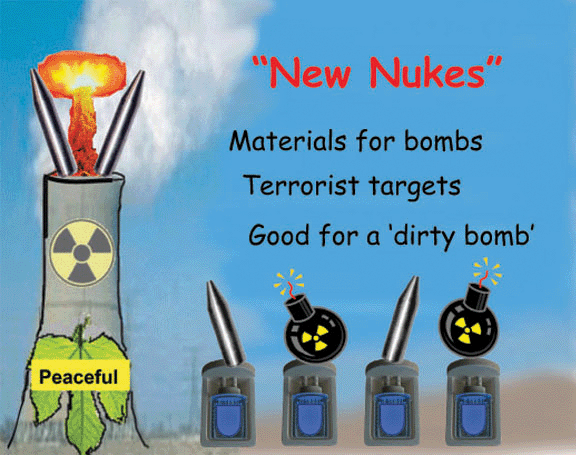

that price won’t only be paid by emptying our wallets . It will also be paid in health and safety. State senators with dollar signs twinkling in their eyes are lining up for relief handouts that will do nothing to fix our healthcare crises — laid bare under the coronavirus crisis — nor our economy. But they are playing the Russia card to get the money.
Make Nuclear Great Again? https://beyondnuclearinternational.org/2020/05/31/make-nuclear-great-again/, May 31, 2020 by beyondnuclearinternational By Linda Pentz Gunter
The claim that nuclear power is needed for national security is a masked money-grab
The US Department of Energy’s assertions about Russian and Chinese supremacy in the nuclear sector is reminiscent of the “Commie plot” rhetoric of the 1950s. But it’s a thinly disguised ploy to feed at the federal subsidies trough and revive a moribund industry.
A few years ago I attended two days of the Nuclear Deterrence Summit, held just outside Washington, DC. In my defense, I’ll say it was a necessity. I really wanted to get inside how these people think. There was plenty of talk about the need for nuclear weapons, their range and potency, all done with a calm equilibrium devoid of conscience. It was chilling.
But it was also the theatre of the absurd. At one point there was actually talk about a “missile gap.” The Russians were getting ahead. This must be stopped. Was I on the set of a remake of Dr. Strangelove? Was this General ‘Buck’ Turgidson railing about “commie plots” and “mineshaft gaps”?
Life, as it turns out, is routinely stranger than any fiction. Turgidson is still with us, and he has extended his brief to include “civilian” nuclear power plants in the competition with the “Ruskies” and now, the Chinese. Continue reading
Oleg Bodrov on the status of the Russian nuclear industry
Oleg Bodrov: Rosatom has agreements to build 36 nuclear power plants outside of Russia https://www.pressenza.com/2020/05/oleg-bodrov-rosatom-has-agreements-to-build-36-nuclear-power-plants-outside-of-russia/ 31.05.2020 – St Petersburg, Russia – Abolition 2000, On the 23rd of May, 2020, the Abolition 2000 Global Network to Eliminate Nuclear Weapons held its Annual General Meeting online for the first time due to the coronavirus pandemic. A large part of the meeting was dedicated to reflecting on the implications of covid-19 on the work of nuclear abolition. Oleg Bodrov of Public Council of the South Coast of the Gulf of Finland, near St Petersburg, Russia shared his views in a pre-recorded interview. We share it here for readers of Pressenza.
Transcript below
Dear colleagues, my name is Oleg Bodrov, I am a physicist, ecologist and peace movement activist from the south coast of the Gulf of Finland, in the Eastern Part of the Baltic Sea Region, close to St. Petersburg, Russia. I am the Chairman of the Public Council of the South Coast of the Gulf of Finland.
I worked in the Russian nuclear industry for 17 years but left it after the Chernobyl disaster. For the past 30 years, I have been working on issues of environmental protection, nuclear safety and the prohibition of nuclear weapons. I live on the border of the confrontation between NATO and Russia, on the southern coast of the Gulf of Finland.
So, the point which I will present just now, will be based on my personal experience and activities in the last years.
First of all I’d like to say something about the status of the Russian nuclear industry in the context of nuclear weapons and the export of “civil nuclear technologies” before the NPT Review Conference.First of all Russia, according to the official doctrine, could be the first to use nuclear weapons. It is a very important message. The Ministry of Foreign Affairs of the Russian Federation declared that: “The prohibition of nuclear weapons is contrary to our national interests”. And the president of the Russian Federation has demonstrated his psychological readiness to use nuclear weapons. He has personally launched four transcontinental missiles from submarines, air and ground-based facilities. Last but not least, the Russian state corporation, Rosatom, has agreements to build 36 nuclear power plants outside of Russia in different countries. Consumers of the nuclear electricity from these nuclear power plants outside of Russia may be investors in Russian military programs.
So the top level of Russian politicians are already ready to use nuclear weapons and develop the nuclear infrastructure outside of Russia which is possible to support Russian military programmes. This is number 1 of my message to my colleagues.
Some lessons after the pandemic Covid-19.
All countries, including nuclear weapons countries, have been powerless against the new virus.
Covid19 has stimulated the development of the economic crisis, and leaders of nuclear countries are using the crisis to find enemies outside of their counties. Thus, instead of joining forces against the virus, the political confrontation between countries deepens. What can we do, our international peace movement?
First of all I’d like to say that we have a SICK planet and we have no planet B! So now we need to not only protect our planet from nuclear weapons, but also reduce greenhouse gas emissions, stop “civil nuclear” expansion, which is part of military nuclear industry. We need to provide safe decommissioning of the more 400 nuclear power plants on our planet, and we need to promote sustainable development of our countries.
I think, first of all, we need to develop cooperation with our colleagues from non-governmental organisations working in the field of protection of traditional lifestyles of indigenous peoples, NGOs against climate change, and NGOs against the export of nuclear power plants.
It is reasonable to stimulate transboundary cooperation between NGOs, municipal and regional authorities close to the border between NATO and non-NATO countries.
I think that the politicians of NATO and Russia are trying to make us enemies 75 years after the Second World War. I think let’s hold hands, friends, in Russia, Europe, China and USA. We are friends and not enemies!
Nuclear industry brazenly exploiting Pandemic to get tax-payer funding
The Nuclear Industry at the Feeding Trough https://www.the-american-interest.com/2020/05/15/the-nuclear-industry-at-the-feeding-trough/ VICTOR GILINSKY & HENRY SOKOLSKI, 15 May, 20
The nuclear lobby is playing the national security card in trying to justify Federal handouts. It’s a con.
We are getting used to brazen coronavirus claims for federal largess, but it’s hard to beat the claims coming from the nuclear industry. Even before the pandemic hit, it had for the most part given up competing for new power plant sales in the domestic and international energy marketplace and instead was wrapping itself in the flag and declaring itself essential to U.S. national security, and therefore deserving of generous federal support.
This approach has the full backing of the Trump Energy Department, and has been dutifully rolled out as part of the broader scramble for federal relief funds unleashed by the coronavirus crisis. As Energy Secretary Danny Ray Brouillette made clear to radio talk show host Hugh Hewitt in an April 28 interview:
We’ve lost our leadership both on the technology side and on the market side… to the Russians and the Chinese. And why does that matter? Well, obviously it matters, because we are, we were the world leader not only in the development of nuclear technology, but in the export of this technology around the world. And we lost that, and it leads to a national defense issue.
And, indeed, DOE’s web site announces: “Nuclear power is intrinsically tied to National Security.” Among the ways DOE plans to restore American nuclear energy leadership are “minimizing commercial fleet fiscal vulnerabilities [DOE-speak for subsidizing],” and “leveling the playing field against state-owned enterprises.”
The implication is that other countries are not competing fairly, as if they snuck around us to jump the line. Now, to cope with this, we have to sweeten the deals we offer to get the sales. And as a thriving nuclear sector is supposedly a necessary condition for gaining foreign sales, we have to prop up domestic nuclear plants, too.
If nothing else, there is a stunning lack of self-awareness in this view. Yes, the United States pioneered the light water reactor technology used around the world. But, as a result of U.S. business decisions, in part reflecting the unfavorable economics of nuclear power in the United States but also poor management, we effectively no longer have any reactor manufacturers.
Combustion Engineering, a company with 28,000 employees, a pressurized water reactor manufacturer, sold itself in 1989 to the European firm ABB Asea Brown Boveri Ltd. The great Westinghouse firm, once the world leader on pressurized water reactors, blundered financially into becoming a subsidiary of the CBS Corporation. In 1995, CBS sold it to British Nuclear Fuels Limited. BNFL in turn sold Westinghouse nuclear activities to Toshiba in 2006.
Westinghouse, by then a shell of its former self, performed so miserably in constructing the last large reactors to be built in the United States in South Carolina and Georgia that it went bankrupt and almost took Toshiba down, too. The South Carolina owners canceled their two plants, and the remaining two in Georgia will cost nearly $30 billion, double the original contract price. After this experience, it is hard to see any future sales of large reactors in the United States.
General Electric used to build boiling water reactors, but it only offers sales abroad as a junior partner to Japan’s Hitachi Corporation. Its reputation is anyway tarnished because it designed the plants that failed during the 2011 Fukushima accident. In short, U.S. nuclear plant manufacturing capabilities are much diminished, and the domestic market just isn’t there. And it isn’t there because nuclear economics are extremely unfavorable.
Currently, the US still has 95 power reactors online, supplying a bit less than 20 percent of America’s electrical demand. They are on average 39 years old. Only two plants, the ones in Georgia, are now under construction and they are expected to be the last large ones to be built for some time.
That hasn’t fazed the nuclear faithful both in and out of government. They still think, as their predecessors thought sixty years ago, that nuclear power is the technology of the future. They paint a picture of our putative arch-enemies, Russia and China, selling nuclear power plants and locking up nuclear relationships with numerous states, including important friendly states such as Saudi Arabia and Turkey, relationships that will last for the rest of the century. We will be frozen out and will thereby lose influence throughout the world. But it’s still not too late if we follow the advice of the Energy Department, the nuclear industry, and a gaggle of consultants looking to cash in.
What is it we have to do? The battles in Washington turn on so-called agreements for cooperation with potential customers that are prerequisites for sales of major reactors and components. The main issue concerns whether we will accept customers that also want to acquire acquires auxiliary facilities that can be used to produce plutonium and highly enriched uranium, the fuels that are also the explosives used in nuclear weapons. The only position consistent with non-proliferation, halting the spread of nuclear weapons, is “no.”
But the nuclear enthusiasts say that’s too strict, that others have more accommodating terms, and that if we sell with looser terms, we’ll have more influence. They have their eye especially on Saudi Arabia, a country that at one point said, implausibly, it was going to build 16 nuclear power plants. They don’t seem to pay attention to the other thing the Saudis said—the crown prince’s statement that if Iran was going to get a bomb, he was going to get one, too, and fast.
It’s not just the Trump crowd that opposes tightening security rules over nuclear exports (in the name, they say, of security). President Obama’s Energy Secretary, Ernest Moniz, has been arguing that subsidizing domestic nuclear power and encouraging nuclear sales without especially tight security restrictions—restrictions that go by the rubric of “gold standard”—are in the interests of U.S. nuclear security, and even support the deterrence value of our nuclear weapons.
All this is a bit much. Do we really think that Russia, with a GNP below that of Italy, is capable of freezing us out of the world? Does it have the financial capacity to offer generous terms on many projects? Will they ever be completed?
Nuclear power is just one U.S. export technology, and not exactly the most promising. For example, the U.S. exported $136 billion in aircraft last year; U.S. nuclear exports for the same period could only be measured in millions of dollars. China is building a comparatively large number of nuclear plants but nuclear power supplies less than five percent of its electrical demand and is only projected to account for seven percent by 2040. Any large accident will turn this program off.
There are many more exciting technologies to share with others. We don’t have to sell out our nonproliferation policies. If anything, we should be strengthening them, and convincing Russia and China to conform to them, as well.
As for the DOE and industry sales pitch, we should see it for what it is: a con to get at the federal trough. May 15, 2020
Sizewell C nuclear project now becoming prohibitively expensive?
 NS Energy 27th May 2020, EDF has predicted the
  cost of Sizewell C will be 20% lower than Hinkley Point C – which is set to cost about £20bn ($26bn) – because of the similarities between the stations and established infrastructure. But in an interview with The Times in April 2018, the company’s UK chief executive Simone Rossi questioned whether the project would remain “feasible” without faster progress being made at the Hinkley Point C site – which has suffered from rising costs and delays – and a government guarantee.
The firm is still talking with the government about workable funding models that can convince it to stay at the table. Speaking about the possibility of no functional funding model appearing, Mr Rossi said: “This is the year where we need to understand whether this whole thing is really
feasible or not. “If we were to conclude that maybe it’s not feasible, then at that point maybe we say we are not in a position to continue the project.” In January 2020, it was reported that EDF was running out of time to secure a funding deal before the project became prohibitively expensive.
https://www.nsenergybusiness.com/features/sizewell-c-nuclear-power-station/
Chinese involvement in Sizewell nuclear plant the ‘next Huawei
 Telegraph 27th May 2020, Chinese involvement in Sizewell nuclear plant the ‘next Huawei’, MPs warn.
Call for energy policy and how the UK interacts with China to be reviewed.
Chinese involvement in the Sizewell C nuclear power station will be the
“next Huawei,” MPs have warned, as they called for an entire overhaul
of the energy policy.
It comes after EDF, the French energy company on
Wednesday submitted an application to build the next nuclear power plant in
Suffolk, which it intends to develop with the state-owned energy company,
China General Nuclear Power Group (CGN).
However Sir Iain Duncan Smith, the
former Conservative leader, warned the power plant was “the next
Huawei”. “It is another major manifestation of the problem we face
having set out on the wrong path with China years ago,” Sir Iain told The
Daily Telegraph.
1 This Month





PLEASE OPPOSE HR 8255 AND S.3639 – bills would accelerate satellite deployment, with no environmental review or safeguards – https://ncstd5li.quorum.us/campaign/169331/
To see nuclear-related stories in greater depth and intensity – go to https://nuclearinformation.wordpress.com
-
Archives
- October 2026 (58)
- September 2026 (339)
- August 2026 (330)
- July 2026 (355)
- June 2026 (287)
- May 2026 (306)
- April 2026 (356)
- March 2026 (251)
- February 2026 (267)
- January 2026 (308)
- December 2025 (358)
- November 2025 (359)
-
Categories
- 1
- 1 NUCLEAR ISSUES
- business and costs
- climate change
- culture and arts
- ENERGY
- environment
- health
- history
- indigenous issues
- Legal
- marketing of nuclear
- media
- opposition to nuclear
- PERSONAL STORIES
- politics
- politics international
- Religion and ethics
- safety
- secrets,lies and civil liberties
- spinbuster
- technology
- Uranium
- wastes
- weapons and war
- Women
- 2 WORLD
- ACTION
- AFRICA
- Atrocities
- AUSTRALIA
- Christina's notes
- Christina's themes
- culture and arts
- Events
- Fuk 2022
- Fuk 2023
- Fukushima 2017
- Fukushima 2018
- fukushima 2019
- Fukushima 2020
- Fukushima 2021
- general
- global warming
- Humour (God we need it)
- Nuclear
- RARE EARTHS
- Reference
- resources – print
- Resources -audiovicual
- Weekly Newsletter
- World
- World Nuclear
- YouTube
-
RSS
Entries RSS
Comments RSS

