UK govt to give EDF a blank cheque for building Sizewell C nuclear power plant.
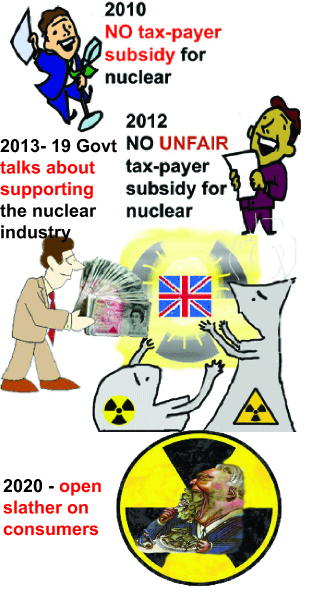 Dave Toke’s Blog 29th Sept 2020, It is looking increasingly likely that the British Government is about to cave-in to EDF’s demand that the British energy consumers should pay what could be massive cost overruns for building Sizewell C nuclear power plant.
http://realfeed-intariffs.blogspot.com/2020/09/is-treasury-about-to-cave-in-over-edfs.html
Plans for Bradwell B nuclear power station could collapse
 Campaigners claim plans for Bradwell B nuclear power station could collapse, Clacton Gazette , By Alex Gidden Reporter 28 Sept 20, CAMPAIGNERS claim plans to build a nuclear power station off the coast of Essex could collapse before the end of the year.
Group chairman Prof Andy Blowers made the bold claim after seeing Japanese firm Hitachi pull out of plans to build its own nuclear power station in north Wales.
He says Hitachi’s decision underlines the “huge expense” associated with building nuclear power stations and believes the Bradwell B project will be binned because of the costs and scale of opposition.
Both Colchester and Maldon councils have rejected planning applications for the power station in the past month.
The applications were jointly submitted by the China General Nuclear Power Group, also known as CGN, and energy firm EDF.
A spokesman for the Blackwater Against New Nuclear Group said: “CGN is now fully aware of the mountain it has to climb to get anywhere near planning permission for its massive nuclear juggernaut, which will utterly destroy the environment and wellbeing of the Blackwater region.
“Widespread public protest and influential councils have produced a powerful coalition of outright opposition to the proposals.
Its progress will not be straightforward and will take years to complete.
“By the time it could start operating, it will be a white elephant, unnecessary, uneconomic and redundant……… https://www.clactonandfrintongazette.co.uk/news/north_essex_news/18749213.campaigners-claim-plans-bradwell-b-nuclear-power-station-collapse/
Greater Cleveland Partnership calls for repeal of Ohio nuclear bailout law
|
Greater Cleveland Partnership calls for repeal of Ohio nuclear bailout law, By staff | cleveland.com28 Sept 20, CLEVELAND, Ohio – The Greater Cleveland Partnership is calling on Ohio lawmakers to repeal and possibly replace House Bill 6, the $1.3 billion nuclear plant bailout law that federal authorities say was the product of a massive corruption scheme.
“We recommend a repeal and replace stance on HB 6 to remove the alleged stain of corruption on the law and to enable the restoration of the energy efficiency programs supported by our members,” said Joe Roman, President and CEO of the GCP. “Our membership continues to encourage policies that provide incentives for businesses to leverage energy programming to foster growth. We recognize a level of flexibility may be needed to meet those goals, reverse HB 6, and balance Ohio’s energy environment………. A select committee of lawmakers is considering whether to repeal and replace the law. The committee has held hearings but hasn’t yet recommended specific actions. The nuclear bailout is funded by new monthly surcharges ranging from 85 cents for residential customers to as much as $2,400 for large industrial plants. In addition to the nuclear plant bailout, House Bill 6 provides subsidies to specific coal and solar plants around the state, dismantles the state’s green-energy standards for utilities, and allows FirstEnergy Corp. and other utilities to lock in a guaranteed level of ratepayer revenue for years to come. https://www.cleveland.com/open/2020/09/greater-cleveland-partnership-calls-for-repeal-of-ohio-nuclear-bailout-law.html |
|
Do Ohio nuclear stations really need a bailout ? Where’s the evidence?
 Where’s the proof that nuclear power plants need a bailout? This Week in the CLE, By Laura Johnston, cleveland.com 28 Sept 20, CLEVELAND, Ohio — How do Ohioans know Energy Harbor’s nuclear power plants need a $1.3 billion bailout? Cleveland.com
The company hasn’t said, and we’re talking about the lack of disclosure on This Week in the CLE…….
Here are the questions we’re answering today:
French taxpayers don’t want to pay for Sizewell nuclear station, neither do British.
 France’s EDF demands clarity on British nuclear power plans Times John Collingridge 27 Sept 20, French energy giant EDF is set for a showdown with the Treasury over state funding for nuclear power stations as Britain’s atomic future faces a make-or-break moment.Jean-Bernard Lévy, chairman and chief executive of Électricité de France, will speak to chancellor Rishi Sunak via video link on Wednesday to demand clarity over Britain’s plans for funding nuclear power.
The industry was left reeling this month when Japan’s Hitachi quit its Horizon project to build a £20bn plant on Anglesey.
That shock retreat, after years of prevarication by Westminster over state support for nuclear power and turmoil in the Japanese nuclear industry, left only EDF and China General Nuclear with plans for atomic power stations in the UK.
EDF and China are building the delayed and over-budget £22.5bn Hinkley Point C power station in Somerset, but Paris has balked at
the prospect of French taxpayers funding the next nuclear project in Britain.
Instead, EDF, which is 84% owned by the French state, wants British taxpayers to underwrite a new plant at Sizewell in Suffolk. A
proposed new financial structure, the regulated asset base, would levy a tax on UK household energy bills to help pay for the project.
Other options include the British government taking a stake — although that has worried the Treasury, which is anxious about adding to its debt mountain.
EDF declined to comment. With most of Britain’s ageing reactors due to close by the end of the decade, Sunak and Boris Johnson face the dilemma of whether to fund more big nuclear plants, or rely on wind, solar, gas, small reactors and imported power to keep the lights on.
The American government has warned Hitachi against selling the Anglesey site to China, and is understood to be considering bankrolling US companies to take it over. Westinghouse, which makes the AP1000 nuclear plant, and NuScale Power,
which is developing small, modular reactors, are both believed to be
exploring options for the site. South Korea’s Kepco is also understood to
be interested, as is EDF.
Former UK Energy Minister Sir Ed Davey says new Sizewell nuclear station is too expensive
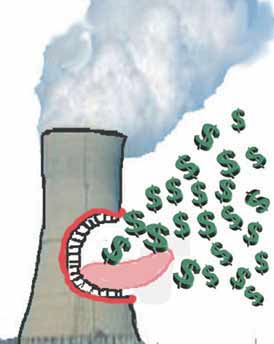 Suffolk’s Sizewell C too expensive, says Sir Ed Davey, BBC, By Vikki Irwin & Chris Bond
28 Sept 20, Former energy secretary Sir Ed Davey has said building a new nuclear power station at Sizewell is “too expensive”.
Trump Appoints Pair of Climate Science Deniers to National Oceanic and Atmospheric Administration (NOAA While Climate-Fueled Fires and Storms Rage
|
The White House has made a pair of controversial appointments to the National Oceanic and Atmospheric Administration (NOAA), positioning within the climate science agency two individuals who consistently misrepresent and disagree with the scientific consensus on various issues concerning climate change and who have notable ties with conservative think tanks that disseminate climate science denial. As the Washington Post first reported this week, President Trump is naming Ryan Maue to the role of chief scientist at NOAA, a position that will help enforce its scientific integrity process. Maue is a meteorologist who has downplayed the degree and impacts of global warming, particularly ties between extreme weather events and human-caused climate change, and he has a past connection with the Cato Institute. Maue’s appointment follows the White House’s appointment last week of climate science denier David Legates as NOAA’s deputy assistant secretary of commerce for observation and prediction. Legates refutes the well-established scientific understanding that human activity is causing climate breakdown and he is affiliated with the Heartland Institute, which has and continues to traffic in climate denial and disinformation……. These appointments of climate science deniers to NOAA — the agency charged with monitoring changes in the climate system and informing Americans on this science — come at a time when there is rising concern over the Trump administration’s embrace of pseudoscience and apparent attempts to interfere with or attack nonpartisan scientific and public health agencies like NOAA, the Environmental Protection Agency (EPA), the Food and Drug Administration (FDA), and the Centers for Disease Control and Prevention (CDC). A study published in April surveying federal scientists found a perceived loss of scientific integrity under the Trump administration. The new NOAA appointments also arrive as climate-fueled disasters such as unprecedented wildfires and a litany of tropical storms and hurricanes have roiled the nation. It is therefore worth taking a closer look at the backgrounds of these two individuals questioning mainstream climate science………….https://www.desmogblog.com/2020/09/24/trump-noaa-david-legates-ryan-maue-climate-denial?utm_source=DeSmog%20Weekly%20Newsletter |
|
|

Ohio. Amid debate over repealing House Bill 6, Energy Harbor still won’t say whether its nuclear plants are profitable.

|
Amid debate over repealing House Bill 6, Energy Harbor still won’t say whether its nuclear plants are profitable
Cleveland. com Sep 25, 2020, By Jeremy Pelzer, COLUMBUS, Ohio—State lawmakers are looking at whether to keep in place a $1.3 billion public bailout for the Davis-Besse and Perry nuclear power plants along Lake Erie, a law that federal authorities say was corruptly enacted. But throughout the debate, there’s still a glaring problem: the owner of the nuclear plants refuses to disclose whether they are profitable or not. And so far, there’s been no attempt by state lawmakers to compel the company to release its numbers before the bailout takes effect. During last year’s debate over whether to pass the bailout as part of House Bill 6, Energy Harbor – then known as FirstEnergy Solutions – asserted it needed public subsidies or it would close the plants. But the company wouldn’t open its books to lawmakers or the public to prove that it actually needed the money, leading legislators to rely on estimates, industry averages and company officials’ word. At the time, FirstEnergy Solutions told cleveland.com the reason it couldn’t open its books was because it was involved in bankruptcy proceedings. Those proceedings have been over for months, yet Energy Harbor still won’t say whether the plants are profitable. And this time, the company is not offering a reason…………. https://www.cleveland.com/open/2020/09/amid-debate-over-repealing-house-bill-6-energy-harbor-still-wont-say-whether-its-nuclear-plants-are-profitable.html
|
|
|
EDF wants cash-strapped UK government to subsidise costly Sizewell nuclear plan
Ministers urged to support new nuclear at a critical time for the industry
The energy giant is pressing the case for a plant at Sizewell but backing from a cash-strapped government could be limited, Sky News, Ian King 23 Sept 20, This is a critical time for the UK’s nuclear energy industry.
The construction of the UK’s first new nuclear power station for a generation, Hinkley Point C in Somerset, is well advanced and EDF Energy, the French-owned energy giant building the plant, is keen to pick up the pace on its next big infrastructure project.
Saudi Arabia may be able to produce its own nuclear fuel – with its uranium reserves
|
Revealed: Saudi Arabia may have enough uranium ore to produce nuclear fuel, Guardian
Emma Graham-Harrison, Stephanie Kirchgaessner and Julian Borger, 18 Sep 2020 Confidential Chinese report seen by the Guardian intensifies concerns about possible weapons programme, Saudi Arabia likely has enough mineable uranium ore reserves to pave the way for the domestic production of nuclear fuel, according to confidential documents seen by the Guardian.Details of the stocks are contained in reports prepared for the kingdom by Chinese geologists, who have been scrambling to help Riyadh map its uranium reserves at breakneck speed as part of their nuclear energy cooperation agreement. The disclosure will intensify concerns about Riyadh’s interest in an atomic weapons programme…….. The 2019 survey suggests that the reserves could potentially provide Saudi Arabia with both fuel for the reactors it wants to build, and surplus for export. ……. “If you are considering nuclear weapons development, the more indigenous your nuclear program is, the better. In some cases, foreign suppliers of uranium will require peaceful-use commitments from end users, so if your uranium is indigenous, you don’t have to be concerned about that constraint,” said Mark Hibbs, senior fellow in the nuclear policy program at the Carnegie Endowment for Peace. Another expert, Bruce Riedel at the Brookings Institution, said the information showed that the Saudis were “aggressively pursuing the prerequisites” for either an energy or weapons programme and that securing a domestic source of uranium would boost their effort……… The greatest international concern is over the kingdom’s lack of transparency. Under a 2005 agreement with the International Atomic Energy Agency (IAEA), Saudi Arabia avoided inspections through a small quantities protocol (SQP), which waives IAEA monitoring up to the point where fissile fuel is introduced into a reactor. The nuclear watchdog has been trying to convince the Saudi monarchy to now accept a full monitoring programme, but the Saudis have so far fended off that request. ……… https://www.theguardian.com/world/2020/sep/17/revealed-saudi-arabia-may-have-enough-uranium-ore-to-produce-nuclear-fuel |
Japan’s nuclear regulator approves restart of Kashiwazaki-Kariwa plant, but still hurdles to overcome

The Nuclear Regulation Authority’s green light now shifts the focus over to whether local governments will agree in the coming months to restart the
TEPCO is keen to get the plant back up and running. It has been financially reeling from the closure of its nuclear plants in Fukushima Prefecture following the triple meltdown at the Fukushima No. 1 nuclear plant in 2011 triggered by the earthquake and tsunami disaster.
The company plans to bring the No. 6 and No. 7 reactors back online at the Kashiwazaki-Kariwa nuclear complex, which is among the world’s largest nuclear plants.
The two reactors each boast 1.35 gigawatts in output capacity. They are the newest of the seven reactors there, first put into service between 1996 and 1997.
TEPCO has not revealed specific plans yet on what to do with the older five reactors……..http://www.asahi.com/ajw/articles/13753076
USA Government Accountabilty Office calls for assessment of costs for planned new nuclear warheads
 NUCLEAR WEAPONS: NNSA Should Further Develop Cost, Schedule, and Risk Information for the W87-1 Warhead Program, https://www.gao.gov/products/GAO-20-703 NUCLEAR WEAPONS: NNSA Should Further Develop Cost, Schedule, and Risk Information for the W87-1 Warhead Program, https://www.gao.gov/products/GAO-20-703
GAO-20-703: Sep 23, 2020. The National Nuclear Security Administration plans to replace the W78—an older type of nuclear warhead used in intercontinental ballistic missiles—with the W87-1, starting in 2030. But it’s unclear if NNSA can produce enough of the W87-1’s fissile cores in time to meet its planned production schedule.NNSA estimated that the new warhead could cost up to $14.8 billion, which could make it the most expensive program of this type to date. Upcoming design decisions for the weapon could affect cost. But the agency didn’t have formal plans to assess the costs and benefits of these decisions. Our recommendations address these and other concerns. |
|
|
Britain’s nuclear power plans in tatters
Climate News Network 23rd Sept 2020, The decision by the Japanese company Hitachi to abandon its plan to buildtwo large nuclear plants in the United Kingdom leaves the British government’s energy plans in tatters, and the UK nuclear industry
reeling.
The UK’s official plan is still to build ten nuclear stations in
Britain, but only three schemes remain. Most have now been cancelled by the
companies that planned to build them, principally because they cannot raise
the capital to do so.
This leaves only the debt-laden French giant EdF and
the Chinese state-owned industry still in the field. At the same time,
Britain’s existing nuclear plants are in trouble. They are not ageing
gracefully, cracks in their graphite cores and rust in their pipework
causing ever-lengthening shutdowns and retirement dates to be brought
forward.
The plants at Hunterston B in Scotland, Hinkley Point B in
Somerset in the West of England, and Dungeness B in Kent on the south-east
coast, are all struggling to survive.
https://climatenewsnetwork.net/uk-nuclear-industry-seeks-subsidies-for-survival/
Britain’s nuclear power dreams melting away – with soaring costs, and political problems
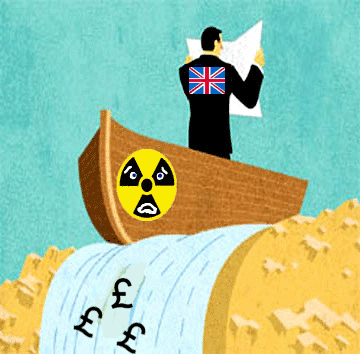 U.K. Nuclear Fleet Plans Evaporating Amid Economic, Political Problems, https://www.enr.com/articles/50109-uk-nuclear-fleet-plans-evaporating-amid-economic-political-problems September 20, 2020, Peter Reina
The U.K.’s hopes for a fleet of new nuclear plants, potentially exceeding 13,000 MW, took another hit when Japan’s Hitachi Ltd. recently pulled out of a major project in Wales. With Chinese investment in two other projects alsolmore doubtful, only the 3,300MW Hinkley Point C project in Somerset, England, has so far progressed to construction
Having suspended development work on the Welsh two-unit plant at Wylfa Newydd in January 2019, Hitachi earlier this month announced that the already difficult investment environment had “become increasingly severe due to the impact of COVID-19.” The company wrote off $2.8 billion of investment in the Welsh plant last year.
Hitachi’s departure followed the Toshiba Corp.’s decision in late 2018 to quit the 3,400-MW Moorside plant, in Cumbria. It had failed to find co-investors for its Westinghouse powered project.
With uncertainty growing, Hinkley Point C is the only U.K. nuclear project o have started work, which is so far largely on schedule, according to Electricité de France (EdF), which controls 66.5% of the deal. China General Nuclear Corp. owns 33.5% of project, which will be powered by two French EPR pressurized water reactors.
Hitachi’s withdrawal from the U.K. market has alarmed supporters of the nuclear industry, since it also casts a cloud over the planned 3,340-MW Sizewell C project in Cumbria.
“For the first time in a generation the U.K has developed a world class nuclear construction and engineering supply chain. Without Sizewell C, we will not sustain it,” says Cameron Gilmour, spokesperson for the Sizewell C Consortium lobby group of key companies in the sector.
The Sizewell C plant would replicate Hinkley Point C and is “shovel ready” according to Gilmour. The U.K. Planning Inspectorate is considering an application for the project submitted this May. The agency’s recommendations will end up on the government’s desk for a final decision at some point.
However, general investment uncertainties and increasingly frosty relations between the U.K and Chinese governments bode ill for the deal, says Stephen Thomas, an energy policy specialist at the University of Greenwich, London.
Set up under a previous conservative administration, the Hinkley Point C deal included CGNC’s participation as a junior partner in Sizewell C. Also, CGNC would have full responsibility for a proposed 2,300 MW Bradwell plant in Essex.
Bradwell would be a global showcase for the technology as it would be the first plant in an industrialized country to use the Chinese Hualong One reactors, Thomas says.
However, the Chinese government was angered over the U.K.’s rejection this July of Huawei technology for the cell phone networks. At the same time, criticism by the country’s lawmakers of China’s participation in critical infrastructure is increasing.
Both developments make the Bradwell deal uncertain. And if Bradwell falls, the Chinese are unlikely to remain merely as passive, junior investors in Sizewell C, potentially scuppering the whole deal, says Thomas.
Investment uncertainties lie at the heart of the U.K.’s fading nuclear hopes. The government offered the Hitachi team a far less generous deal than the one secured by EdF for Hinkley Point C.
While the Hinkley deal protects U.K. electricity consumers from cost escalations, it comes at a high price, according to Thomas. The deal is based on a “contract for differences” which sets an index linked energy price of $120 per MWh at 2012 prices for 35 years. That is hugely more than the $51 per MWh now being bid for offshore wind contracts, he says.
For subsequent deals, the government last year turned to the Regulatory Asset Base (RAB) form of funding used by water and types of utilities. Rather than having a target energy price, electricity tariffs would be controlled by the regulator, which would consider factors such as need for investment and a fair rate of return on capital.
The government completed a review of the system this January but has yet to make a decision, adding to investment uncertainty, says Thomas.
Meanwhile, in the west of England, contractors recently placed the 170-tonne base of the second reactor’s steel containment liner at Hinkley Point on time, despite pandemic working restrictions.
EdF claims to have met critical path goals during the pandemic, but it has yet to reveal the extent of delays on other parts of the job. The site’s workforce is now back to its pre-pandemic level of 4,500 having fallen to 2,000 after February.
Civil and building work is being handled by a joint venture of Paris-based Bouygues Travaux Publics and the U.K.’s Laing O’Rourke Plc. in a contract signed in late 2017, then valued at around $3.6 billion.
However, “challenging ground conditions” and additional design effort have contributed to an overall project cost rise to $29 billion from around $23 billion in 2016, reports EdF. The company still plans to commission the first unit in 2025, but the project has yet to enter its trickier nuclear component phase, officials concede.
Europe’s only two other projects using the same reactor design and involving Bouygues are hugely over schedule. Finland’s Olkiluoto 3 plant and EdF’s flagship French project at Flamanvile are both running about a decade late.
With this track record and future financing doubts, prospects for new projects around the world look bleak, says Thomas.
But nuclear power “has had a history of climbing out of the coffin,” he adds.
Japanese government dangles financial carrot to persuade reluctant communities to take nuclear wastess
 But there is no prospect for the establishment of such a recycling system which would allow for disposing only of the
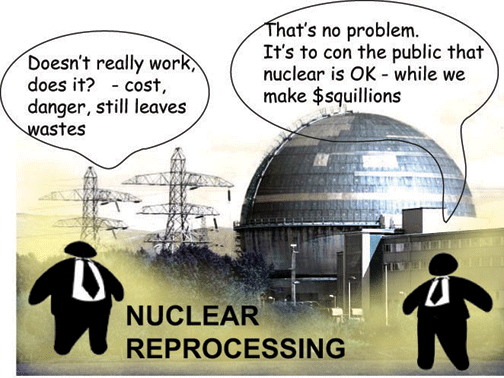 waste from reprocessing and recycling.
Eventually, Japan, like most other countries with nuclear power plants, will be forced to map out plans for “direct disposal,” or disposing of spent fuel from nuclear reactors in underground repositories.
Hokkaido Governor Suzuki has taken a dim view of the financial incentive offered to encourage local governments to apply for the first stage of the selection process, criticizing the proposed subsidies as “a wad of cash used as a powerful carrot.”
|
EDITORIAL: Much at stake in picking a final nuclear waste disposal site, http://www.asahi.com/ajw/articles/13749856 21 Sept 20, Two local communities in Hokkaido are considering pitching themselves as candidates for the site for final disposal of highly radioactive waste from nuclear power plants.Last month, the mayor of Suttsu in the northernmost main island said the municipal government is thinking to apply for the first stage of the three-stage process of selecting the site for the nation’s final repository for nuclear waste. During this period, past records about natural disasters and geological conditions for the candidate area are examined. Town authorities are holding meetings with local residents to explain its intentions. In Kamoenai, a village also in Hokkaido, the local chamber of commerce and industry submitted a petition to the local assembly to consider an application for the process. The issue was discussed at an assembly committee. However, the assembly decided to postpone making a decision after further discussion. Both communities are located close to the Tomari nuclear power plant operated by Hokkaido Electric Power Co. and struggling with common rural problems such as a dwindling population and industrial and economic stagnation. The law decrees that when the first stage of the selection process starts, the municipality that is picked will receive up to 2 billion yen ($19.1 million) in state subsidies for two years. But the Ministry of Economy, Trade and Industry and the Nuclear Waste Management Organization of Japan (NUMO), which are in charge of the selection process, have promised it will not move to the second stage if the prefectural governor or local mayor voices an objection. Hokkaido Governor Naomichi Suzuki has already expressed his opposition. A huge amount of spent nuclear fuel has been produced by nuclear plants in Japan, and it needs to be stored and disposed of somewhere in this country. This policy challenge requires a solid consensus among a broad range of people, including residents of cities who have been beneficiaries of electricity generated at nuclear plants. The two Hokkaido municipalities’ moves to consider applying for the first stage of the selection process should be taken as an opportunity for national debate on the issue. The first step should be to establish a system for local communities to discuss the issue thoroughly from a broad perspective. It is crucial to prevent bitter, acrimonious divisions in local communities between supporters and opponents. The central government and other parties involved need to provide whatever information is needed from a fair and neutral position to help create an environment for healthy, in-depth debate. There is also a crucial need to fix the problems with the current plan to build a final repository for radioactive waste. Under the plan, which is based on the assumption that a nuclear fuel recycling system will eventually be established, the repository will be used to store waste to be left after spent nuclear fuel is reprocessed to recover and recycle plutonium and uranium. But there is no prospect for the establishment of such a recycling system which would allow for disposing only of the waste from reprocessing and recycling. Eventually, Japan, like most other countries with nuclear power plants, will be forced to map out plans for “direct disposal,” or disposing of spent fuel from nuclear reactors in underground repositories. The central government has not changed its policy of maintaining nuclear power generation as a major power source. If nuclear reactors keep operating, they will continue producing spent fuel. The government will find it difficult to win local support for the planned repository unless it makes clear what kind of and how much radioactive material will be stored at the site. Many local governments are facing a fiscal crunch partly because of the impact of the COVID-19 pandemic. Hokkaido Governor Suzuki has taken a dim view of the financial incentive offered to encourage local governments to apply for the first stage of the selection process, criticizing the proposed subsidies as “a wad of cash used as a powerful carrot.” It takes tens of thousands of years for the radioactivity of spent nuclear fuel to decline to sufficiently safe levels. Trying to stem local opposition by dangling temporary subsidies could create a serious problem for the future in the communities. It is vital to ensure that the repository plan will secure a long-term policy commitment to the development of the local communities and ensure benefits for the entire areas. September 22, 2020 |
|
1 This Month



Shut down the radiation-damaged Heysham nuclear reactors now
To see nuclear-related stories in greater depth and intensity – go to https://nuclearinformation.wordpress.com

Say No to NASA’s Reckless Nuclear Reactor on the Moon
Say No to NASA’s Reckless Nuclear Reactor on the Moon
-
Archives
- October 2026 (256)
- September 2026 (339)
- August 2026 (330)
- July 2026 (355)
- June 2026 (287)
- May 2026 (306)
- April 2026 (356)
- March 2026 (251)
- February 2026 (267)
- January 2026 (308)
- December 2025 (358)
- November 2025 (359)
-
Categories
- 1
- 1 NUCLEAR ISSUES
- business and costs
- climate change
- culture and arts
- ENERGY
- environment
- health
- history
- indigenous issues
- Legal
- marketing of nuclear
- media
- opposition to nuclear
- PERSONAL STORIES
- politics
- politics international
- Religion and ethics
- safety
- secrets,lies and civil liberties
- spinbuster
- technology
- Uranium
- wastes
- weapons and war
- Women
- 2 WORLD
- ACTION
- AFRICA
- Atrocities
- AUSTRALIA
- Christina's notes
- Christina's themes
- culture and arts
- Events
- Fuk 2022
- Fuk 2023
- Fukushima 2017
- Fukushima 2018
- fukushima 2019
- Fukushima 2020
- Fukushima 2021
- general
- global warming
- Humour (God we need it)
- Nuclear
- RARE EARTHS
- Reference
- resources – print
- Resources -audiovicual
- Weekly Newsletter
- World
- World Nuclear
- YouTube
-
RSS
Entries RSS
Comments RSS

