Conservative UK government is considering a carbon tax, in its commitment to reduce greenhouse gas emissions
 Times 9th Oct 2020, Rishi Sunak is examining proposals for a UK-wide carbon tax that could
raise billions of pounds while encouraging the drive towards net-zero emissions. The chancellor is seeking to replace existing EU carbon-reduction schemes with the new tax when the transition period finishes at the end of the year.
“The danger with relying solely on a carbon tax is that no one believes politicians will not scrap it when things get tough, so no one invests. A cap and trade scheme that guarantees an outcome, alongside regulation and innovation support, is much more likely to lead to cuts in emissions.”https://www.thetimes.co.uk/edition/news/sunak-plans-carbon-emissions-tax-to-help-rebuild-economy-jbl3gs993
Will the UK government sacrifice the beautiful Suffolk coast in its misguided, uneconomic, Sizewell nuclear power push?
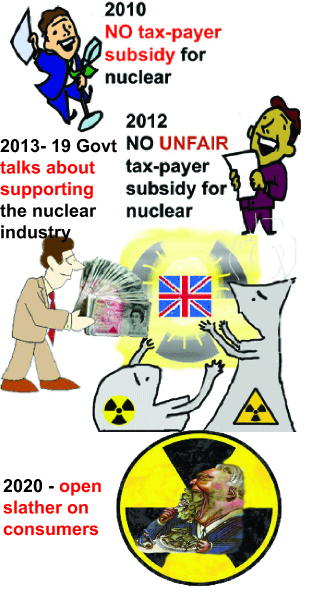 East Anglian Daily Times 8th Oct 2020, As councils lose patience with EDF, will Suffolk businesses follow suit?
Today East Suffolk lies at a crossroads – the future of the east of the county now seems certain to rest in the hands of London-based civil servants and ministers – and to be honest I don’t know which way they will jump when push comes to shove. The deadline has now passed for councils, businesses, and residents to have their say on whether a two new nuclear reactors should be built on the Suffolk coast at Eastbridge, north of the existing stations at Sizewell.
landscape. But I do worry that there are some in government who do not understand the value of this area to the country as a whole who will be prepared to look on Sizewell C as a shiny investment to try to kick-start the UK economy after the pandemic and in a world no longer governed by EU rules, will pour in government subsidies to make up for the loss of Chinese money.
https://www.eadt.co.uk/ea-life/last-chance-to-stop-sizewell-c-1-6871419?s=09
BBC 8th Oct 2020, Campaigners against a new nuclear power station say they are “resolute”
after their bid to protect woodland was thrown out by the High Court. EDF
Energy, which wants to build two new reactors next to Sizewell B in
Suffolk, was given approval in 2019 to fell Coronation Wood on the site.
Together Against Sizewell C (Tasc) sought a judicial review, claiming that
decision was unlawful.
3 Canadian provinces sucked in by propaganda from 3 Small Nuclear Reactor companies

|
The two big-name companies that won’t be designing Ontario’s next nuclear reactor The province has passed over two major players on its shortlist for a small-modular-reactor design. Will that mean a more competitive process? TVO By John Michael McGrath – Oct 09, 2020 The Ontario government — along with the governments of New Brunswick, Saskatchewan, and (probably) Alberta — wants to develop a new generation of nuclear reactors in Canada. This week, the provincially owned Ontario Power Generation announced it was taking the latest step toward that goal and would be working with three different companies to refine their engineering and design work so that eventually one can be selected for completion.
The three lucky companies are Terrestrial Energy (covered previously on TVO.org), GE Hitachi (with generations of nuclear experience in the United States), and X-energy. At least as notable, however, are two major omissions: NuScale and SNC-Lavalin, which makes the CANDU reactors that Ontario has relied on for decades……….. The problem for NuScale is that its design is meant to be packaged in clusters of up to 12, which is fine if you need 12 — but, right now, Ontario is looking to find one reactor that it could build reasonably quickly, to prove the design works and can be built economically, and then to reproduce it in other provinces, such as Saskatchewan……… In June of this year, however, SNC-Lavalin announced it was submitting a reactor design to the Canadian regulator in the 300-megawatt range — putting it on the larger end of the spectrum for something that’s still supposed to be “small” but is still smaller than traditional CANDU designs. Terrestrial Energy, by comparison, is offering a 195-megawatt design. Canada’s nuclear industry tried to market a 300-megawatt CANDU reactor in the 1980s (the CANDU 3) but never found a buyer. ……… handing the prize to SNC-Lavalin out of nostalgia for the CANDU design would have been a poor guarantee of value for electricity customers. https://www.tvo.org/article/the-two-big-name-companies-that-wont-be-designing-ontarios-next-nuclear-reactor |
|
Poland to build nuclear reactor starting in 2026, excludes Small Modular Reactors (SMRs)
Construction of Poland’s first nuclear power plant to start in 2026, The government has adopted a resolution to update the Polish Nuclear Power Programme (PPEJ), the Ministry of Climate announced on Friday.
The updated PPEJ provides for the construction of six nuclear reactors with a total capacity of 6-9 GW. The first reactor should be operational in 2033…….
The programme excludes the use of boiling water reactors (BWRs) and small modular reactors, referred to as SMRs……… https://www.thefirstnews.com/article/construction-of-polands-first-nuclear-power-plant-to-start-in-2026-16542
Trump’s COVID infection shows why it’s time to retire the nuclear football
 Trump’s COVID infection shows why it’s time to retire the nuclear football, Bulletin of the Atomic Scientists , By Tom Z. Collina, October 6, 2020 President John Kennedy took powerful pain medications. President Richard Nixon was a heavy drinker. President Ronald Reagan had dementia. And now President Donald Trump has the coronavirus. These conditions can significantly impair one’s ability to think clearly. And yet, as president, each had—or, in Trump’s case, still has–the unilateral authority to launch US nuclear weapons within minutes.
President Trump is followed 24/7 by a military aide that carries the “football,” the briefcase that holds all he would need to order the immediate launch of up to 1,000 nuclear weapons, more than enough megatonnage to blow the world back into the stone age. He does not need the approval of Congress or the secretary of defense. Shockingly, there are no checks and balances on this ultimate executive power.
President Trump took the nuclear football with him to Walter Reed Medical Center, where he received treatment for COVID-19. According to Trump’s doctor, the president’s blood oxygen levels had dipped. And this, according to independent health experts, can impair decision-making ability. He is taking dexamethasone, which can cause mood swings and “frank psychotic manifestations.” Yet as far as we know, at no point did the president transfer his powers to the vice president, as allowed under the 25th Amendment.
To state the obvious, we should not entrust nuclear launch authority to someone who is not fully lucid. (Reagan transferred authority temporarily before planned surgery, as did President George W. Bush before a medical procedure that required his sedation.) A nuclear crisis can happen at any time, including at the worst possible time. If such a crisis takes place when a president’s thinking is compromised for any reason, the results could be catastrophic. ……..
If the president or his advisors have reason to believe that Trump’s thinking may be compromised, nuclear launch authority should be transferred to the vice president, Mike Pence. If Pence also gets COVID, the football could then be passed to House Speaker Nancy Pelosi, President Pro Tempore of the Senate Chuck Grassley, and the secretaries of State, Treasury and Defense, in that order.
But kicking the football down the line does not solve the problem—and in fact shows why the system is broken. Does anyone really believe that the president pro tem of the Senate or the Treasury Secretary has spent much time preparing for nuclear war? And even if they had prepared, the central dilemma remains: All humans are imperfect, and we should not trust the fate of the world to any one person.
The whole concept of giving the president unilateral nuclear authority is built on the false assumption that Russia might launch a surprise first strike. In fact, Russia has never seriously considered a first strike against the United States for a simple reason: It would be national suicide. Both sides have to assume that an attack would provoke an unacceptable nuclear retaliation. Both nations, and much of the rest of the globe, would be obliterated. Starting such a war would be insanity………
It is time to retire the nuclear football. The only thing standing between us and nuclear holocaust is one man with COVID on heavy meds. That is the plan? Ending sole authority is better than entrusting it to any individual. In a vibrant democracy, no one person should have the unchecked power to destroy the world. https://thebulletin.org/2020/10/trumps-covid-infection-shows-why-its-time-to-retire-the-nuclear-football/
Countries that have included nuclear in their green stimulus plans may want to rethink their strategy

now, a new study spearheaded by the UK’s University of Sussex (UoS) for the scientific journal Nature Energy, shows that nuclear might not even be that great for lowering carbon emissions.
In fact, the study found that renewables are “up to seven times more effective at reducing carbon emissions than nuclear power.” As summarized by PV Magazine, the study “concluded nuclear could no longer be considered an effective low carbon energy technology, and suggests that countries aiming to rapidly and cost-effectively reduce their energy emissions should prioritize renewables.” …………
This study comes at an essential moment in which nations around the world are designing economic stimulus packages to overcome the recession being ushered in by the novel coronavirus pandemic. Countries that have included nuclear in their green stimulus plans may want to rethink their strategy–even if it’s in concert with investment in renewables. Another report by Science Daily this week shows that trying to adopt a hybrid approach that includes both nuclear and renewables is even less effective. At a time when the world is reckoning with and engineering a “new energy order” and a “great reset, such findings have never been so important, and governments around the world would do well to read the reports. https://oilprice.com/Alternative-Energy/Nuclear-Power/The-Biggest-Obstacle-For-Nuclear-Energy.html
The very costly effort of trying to resuscitate the dying nuclear industry

Nuclear Energy — The High Cost Of A Dying Industry, Clean Technica, October 6th, 2020 by Johnna Crider
Nuclear energy has had a seriously rough year. In an article by OilPrice.com, the author asked a question: “Why is nuclear energy so expensive?” One answer, besides the obvious 2020 curse that was activated when Egyptian authorities opened up 30 ancient wooden coffins in 2019, is that other sources have just gotten much cheaper while nuclear hasn’t……….
As we know, in 2020, the coronavirus pandemic shut down US energy demand, and this added nuclear energy to a long list of energy industries that are begging for taxpayer money — well, in the case of nuclear, even more taxpayer money. And the Trump administration came through for this dying and expensive industry. Back in June, the Department of Energy announced that it would award more than $65 million in nuclear energy research. This would cross-cut technology development, facility access, and infrastructure awards.
PowerTechnology reported that these awards would be for these departments’ nuclear energy programs:
- The Nuclear Energy University Programme
- Nuclear Energy Enabling Technologies
- Nuclear Science User Facilities.
That $65 million will also be poured into 93 advanced nuclear technology projects in 28 states. And the Office of Nuclear Energy, which is part of the US Department of Energy (DOE), has spent more than $800 million on research since 2009. OilPrice noted that the $65 million would probably be “too little, too late for domestic nuclear energy.” CleanTechnica‘s perspective is that nuclear has been long dead and we’re just waiting for the green leaves of the tree (existing power plans) to turn brown (close down). New nuclear is financially hopeless, many times more expensive than renewable energy options even with energy storage costs included.
Global State Of Nuclear Energy
Antony Froggat, who co-authored the report and is a Senior Research Fellow at Chatham House in London, said, “At the same time, COVID-19 puts additional stress on the sector. In economic terms, renewables continue to pull away from nuclear power, over the past decade the cost estimates for utility-scale solar dropped by 89 percent, wind by 70 percent, while nuclear increased by 26 percent.”
Also in the US, force-on-force exercises were suspended. These are simulated terrorist attacks on nuclear power plants that use a mock adversary force to replicate design basis threat characteristics during an attack. These are supposed to help assess and improve readiness in case of an actual terrorist attack on a nuclear reactor.
In Russia and Sweden, control room staff were made to isolate in housing that was located onsite. They lived at their jobs. In Russia, one national operation reported weekly on infections among the nuclear staff. In July, there were a total of 4,500 cases.
Technology Costs
The report compared the costs of solar, onshore wind, and nuclear. The report looked at analyses for the US conducted by Lazard at the end of 2019, which advises on financial matters while managing investment portfolios. This is what they found out in a nutshell:
- Solar PV (crystalline, utility-scale) averaged $40/MWh, compared to $65/MWh in 2015.
- Onshore wind was $41/MWh, compared to $55/MWh in 2015.
- Nuclear is $155/MWh, compared to $117/MWh in 2015.
The report points out that over the past 5 years, the annual Levelized Cost of Energy (LCOE) for nuclear has risen by over 50%. In stark contrast, renewables have become the most inexpensive of any type of power generation. “What is remarkable about these trends is that the costs of renewables continue to fall due to incremental manufacturing and installation improvements, while nuclear, despite over half a century of industrial experience, continue to see costs rising. Nuclear power is now the most expensive form of generation, except for gas peaking plants.”
The report also states that even though Trump’s White House supports nuclear power and coal, both have not thrived at all under his presidency. This is due, the report says, to renewables being cheaper and basic economics. Lazard also assessed that the costs of renewables continue to fall. You can learn more about the nuclear report here.
Whether it’s the curse of 2020 or humans are slowly evolving, we are phasing out of the old and phasing in the new. In the case of energy, it’s renewables, which will benefit not only our planet but the health and well-being of people all across the globe. For now, though, it seems that taxpayers will continue footing nuclear’s expensive high maintenance bills. https://cleantechnica.com/2020/10/06/nuclear-energy-the-high-cost-of-a-dying-industry/
Ukraine’s President enthuses over their nuclear reactors – but they’re all ageing Soviet ones

On a visit to Ukraine’s Rivne nuclear plant, President Volodomyr Zelensky issue full throated support for the development of his country’s nuclear industry, despite opposition from other countries and a fleet of elderly Soviet-era reactors that are reaching retirement age, Interfax reported.
His remarks came on October 1 and highlight his recent decree that orders the government to submit bills concerning the country’s nuclear power sector for parliamentary debate. Ukraine’s 15 reactors – all of which were built while the country was still a republic of the Soviet Union – supply more than half of the domestic electricity supply.
“We have a strategy for the development of nuclear energy and the completion of nuclear power plants in Ukraine,” the Zelensky said, addressing the possibility of completing two reactors at the country’s Khmelnitsky nuclear plant. The construction of those reactors, which are Russian-designed VVER-1000 units, began in the 1980s but was shelved in 1990.
He also dismissed opposition to nuclear development on grounds of safety, saying: “We understand that if professionals are doing the construction, if the state is working on the safety of nuclear power plants, then there is no threat either to the environment or the climate. It’s a safe form of electricity.”
Pushing back against a host of European countries that have begun to back away from nuclear power, Zelensky said Ukraine would instead embrace it as a national priority.
“In the coming years, many countries will work against nuclear power generation,” he said. “We, on the other hand, will defend it. We must do this because today we have every opportunity to be among the first [in nuclear energy], both in Europe and in the world.”
Zelensky’s remarks come as work to fully clean up the site of the 1986 Chernobyl disaster is still ongoing. Since 2015, an enormous steel dome, called the New Safe Confinement, has enclosed the plant’s exploded No 4 reactor, trapping radiation and facilitating risky dismantlement efforts. But most experts say it will take another 20,000 years before the area immediately surrounding the plant – called the exclusion zone from which more than 100,000 people were evacuated – will again be fit for human habitation.
When the Soviet Union collapsed in 1991, Ukraine inherited not only the embers of Chernobyl, but also four other nuclear power plants: The Rivne plant in the country’s northwest; the Khmelnitsky plant, to Rivne’s south; The South Ukraine plant, near the Black Sea, and the Zaporizhia plant, whose six VVER-1000 reactors make it the largest nuclear power plant in Europe.
All but three of Ukraine’s reactors began operations in the 1980s, putting most of them troublingly close to the end of their engineered lifespans of 40 years. In fact, 12 of Ukraine’s reactors were slated to retire this year.
To continue to produce some 52 percent of the country’s energy, it is presumed that all of these reactors will eventually be granted extensions on their runtimes of several decades.
Given the age of the nuclear industry as a whole, such lifetime extensions have become common practice worldwide. But two recent Bellona publications – one on Ukraine’s nuclear industry, and another on the practice of reactor lifetime extensions – have cast light on the dangers of this approach.
One study by Ukrainian experts, cited in Bellona’s report, shows that Ukraine’s older reactors are becoming more prone to accidents and malfunctions. It is hoped that safety upgrades that would precede the granting of lifetime would eliminate such technical glitches.
But the Bellona study highlighted that two reactors at the Rivne plant – the one Zelensky visited – had been given lifetime extensions without any safety upgrades at all.
The longer Ukraine’s reactors operate, the more they will contribute to the country’s supply of radioactive waste, which is currently the second largest in Europe. This problem has only gotten more serious since 2018, when Russia began returning to Ukraine the spent nuclear fuel and radioactive waste Moscow had been accepting and reprocessing after the Soviet Union dissolved.
The problem of Ukraine’s overabundant radioactive waste would seem less critical if the country were taking steps to build a long-term repository, such as finding a suitable location for one – or indeed even had plans to do so. But as the Bellona report reveals, the bureaucracies in Kiev that are responsible for such questions are inefficient, if not, in some instance, entirely lacking, and in any case have little in the way of public faith in their competent operation.
Prospects are slightly brighter when it comes to dealing with spent fuel from Ukraine’s nuclear reactors. Ukrainian nuclear Officials know how much there is and they intend to build a centralized facility to store it. But as is the case in other parts of the industry, Kiev has little hope of building it without significant funding from other countries.
While it’s unclear if Zelensky’s new embrace of nuclear energy has taken full account of the issues facing his aging reactors, it is hoped that any continued reliance on Ukraine’s Soviet inheritance will do so.
Too much power to USA president, to control nuclear war strategy: what if he is ill?
Why The President Is The Weakest Link In U.S. Nuclear Strategy, Forbes, Loren Thompson 7 Oct 20 President Trump’s hospitalization after testing positive for Covid-19 is one of many instances in which the performance of the nation’s chief executive has been impaired by medical issues.
Eisenhower had a massive heart attack in 1955. His successor, John F. Kennedy, was afflicted by Addison’s disease and various other maladies that required heavy use of painkillers. Kennedy’s successor, Lyndon Johnson, was hospitalized during the Hong Kong flu pandemic of 1968.
Other presidents have seen their performance compromised by psychological issues.
Richard Nixon became clinically depressed during the Watergate controversy and took to drinking heavily. Ronald Reagan may have exhibited early symptoms of Alzheimer’s disease during the closing years of his presidency.
Such frailties have long been a part of the human condition, but the advent of nuclear weapons raised alarming possibilities about where presidential disability might lead. You see, the president has unilateral authority to launch nuclear weapons, and that power is one of the few places in the federal system where no checks and balances exist.
Thus, the prosect that a president might be physically or mentally impaired is alarming………
Mr. Trump’s recent hospitalization highlights some of the things that might go wrong. A report released this week by the Northwestern Medicine healthcare system found that a third of the patients hospitalized for Covid-19 in the system’s Chicago-area facilities developed altered mental states, including confusion and delirium.
In addition, President Trump’s doctors administered a heavy regimen of drugs aimed at mitigating the health consequences of his infection. Unfortunately, one of those drugs was a steroid, and steroids are known to cause psychological symptoms in some patients such as anxiety, agitation and mood swings.
When you consider the awesome nuclear authorities vested in the president, it is unsettling to contemplate how impaired judgment or medical disability might impact decision-making in a crisis……… https://www.forbes.com/sites/lorenthompson/2020/10/07/why-the-president-is-the-weakest-link-in-us-nuclear-strategy/#7f5796d76aee

Pressure on U.S. Congress to reinstate research on links between nuclear stations and cancer

Activists push Congress to revive probe into links between nuclear plants and cancer
Nuclear Regulatory Commission killed study in 2015 after spending five years and $1.5 million on the effort, Orange County Register, By TERI SFORZA | tsforza@scng.com | October 5, 2020 Scientists and activists were stunned back in 2015 when the Nuclear Regulatory Commission pulled the plug on what was designed to be the best study of cancer near nuclear power plants ever done.
Last week, a petition with some 1,200 signatures demanding that the study resume went to members of Congress representing Southern and Central California.
“This is a scientific endeavor which will improve our understanding of cancer, the leading cause of death in California,” the petition states. “It is especially important for women, children, and the human fetus who are much more vulnerable to the biological effects of harmful ionizing radiation.”
No one knows threat
The retired San Onofre and Diablo nuclear power plants, both shut down in 2013, have been discharging low-level radioactivity into the ocean and atmosphere for decades, the petition continues, and no one knows for sure whether that poses a threat to nearby residents………
More modern studies in Europe have found that children living within 3 miles of nuclear power plants had double the risk of developing acute leukemia as those living farther away, with the peak impact on children ages 2-4.
Bart Ziegler, president of the Samuel Lawrence Foundation, said the inquiry is long overdue and must begin right away. https://www.ocregister.com/2020/10/05/activists-push-congress-to-revive-probe-into-links-between-nuclear-plants-and-cancer/
Design not even finished! But UK govt to subsidise Small Nuclear Reactors (SMRs)
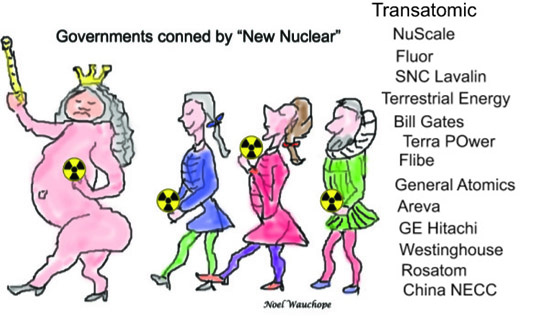
The plan is for 16 of them – at ? £2bn each?
FT 7th Oct 2020, Downing St considers £2bn support for mini nuclear reactors
Consortium wants to build up to 16 generators . Downing Street is supporting plans to spend up to £2bn of taxpayers’ money on a
new generation of mini nuclear reactors. Consortium wants to build up to 16 generators to help UK meet carbon emissions targets. The first SMR is expected to cost £2.2bn and be online by 2029.
Government and industry figures confirmed that a pledge of £1.5bn-£2bn is being discussed which could even see taxpayers acquire an equity stake in the programme.
However, discussions are still ongoing and any final decision will be subject to the Treasury’s current multiyear spending review, which is due later this year. The government could also commission the first mini power station, giving confidence to suppliers and investors. The consortium, which also includes the National Nuclear Laboratory, will seek additional funding of at least £2bn, including from private investors and the capital markets.
Support for SMR technology is expected to form part of Boris Johnson’s “10-point plan for a green industrial revolution” which he will set out later in the autumn. …….. Under the plans being considered by Number 10, the small
modular reactors would be manufactured on production lines in central plants and then transported to sites for assembly. Each mini power station would operate for up to 60 years, providing 440MW of electricity per year — enough to power a city the size of Leeds.
The government’s support “should deliver sufficient cash to get the consortium through building
factories and well on the way to construction of power stations prior to finding more money from other sources,” said one person with knowledge of the situation.
The consortium is expected to finalise the SMR design by April next year, when it hopes to launch the four-year licensing process.
During that time it hopes to begin recruiting employees for the business, and identifying the sites for powers stations and the factories to build the components and modules for the SMRs. The business department hasalready pledged £18m towards the consortium’s early-stage plans.
https://www.ft.com/content/d7016b80-e0c4-4444-a059-2daf32b9a4ab
Ohio nuclear reactors expect tax-payer subsidy, they’re making a profit anyway !
 Nuclear plants at center of Ohio subsidy fight operating above wholesale prices, S and P Global,Darren Sweeney, Gaurang Dholakia 5 Oct 20,
As the owner of two Ohio nuclear plants is pressed to open its books on the profitability of the units, the timing of subsidies at the center of a federal criminal investigation may be a larger issue.
An S&P Global Market Intelligence analysis shows Energy Harbor Corp.’s 908-MW Davis-Besse and 1,268-MW Perry nuclear plants, both in northern Ohio, have operating costs higher than wholesale electricity prices. A mid-2019 analysis showed the plants with operating costs running below wholesale electricity prices.
The most recent analysis shows wholesale prices in the PJM Interconnection rising through the end of 2020 and into 2021, which is when Ohio’s clean air credit for nuclear plants kicks in.
House Bill 6, which establishes a $9/MWh credit for clean air resources, provides $150 million in annual financial support for the Davis-Besse and Perry nuclear units beginning Jan. 1, 2021, through Dec. 31, 2027…………
Ohio Attorney General Dave Yost has reportedly told state lawmakers to bring Energy Harbor and FirstEnergy Corp. officials before legislative committees to disclose whether the nuclear plants need the subsidies.
In addition, Yost on Sept. 23 filed a civil lawsuit to halt the collection of ratepayer-backed subsidies for the state’s nuclear plants.
The lawsuit and legislative hearings come after federal prosecutors in July filed bribery charges against former Ohio House Speaker Larry Householder and four associates. They have been indicted and accused of using “more than $59 million” through a “slush fund” to steer H.B. 6 through the Ohio Legislature. An affidavit filed by an FBI special agent implies that FirstEnergy and affiliated entities, though not mentioned by name, wired funds through a 501(c)(4) nonprofit group called Generation Now to support H.B. 6 and combat a statewide referendum to repeal the law.
Former FirstEnergy subsidiary FirstEnergy Solutions Corp. emerged from bankruptcy in late February as Energy Harbor. https://www.spglobal.com/marketintelligence/en/news-insights/latest-news-headlines/nuclear-plants-at-center-of-ohio-subsidy-fight-operating-above-wholesale-prices-60569193
Cost and safety dangers should rule out nuclear power for the Philippines
A report this year placed the cost of reviving the BNPP, as estimated by a foreign group, at $3 billion to $4 billion. Reviving it will go against a trend in other countries to reduce nuclear power in their energy mix, because of safety concerns in the power plants as well as the risks posed by nuclear waste, which remains radioactive and cannot be destroyed or recycled……..
Like Japan, the Philippines sits along the Pacific Ring of Fire. Before the start of this year’s pandemic, Taal Volcano’s powerful phreatic explosion emptied surrounding communities, displaced thousands and blanketed towns and cities all the way to Metro Manila with toxic, suffocating ash. Earthquakes and aftershocks continue to be recorded in Taal, with seismologists warning of the possibility of a cataclysmic eruption.
If the BNPP is revived, at great cost to a cash-strapped government, what happens if Mount Natib also acts up, or if an earthquake hits Bataan? If all the proponents of nuclear energy will live together with their immediate families near the BNPP – and not just for show, buying a house nearby while the kids live in an exclusive village far from harm’s way – then by all means, go ahead with the project. https://www.philstar.com/opinion/2020/10/03/2046802/editorial-going-nuclear
America’s nuclear waste crisis doesn’t get a mention in Democrats’ or Republicans’ platform


|
Four powerful players want a nuclear waste solution. What’s stopping them? Bulletin of the Atomic Scientists By David Klaus, September 29, 2020 The 92-page platform adopted at the Democratic National Convention does not include a single sentence on the issue of how to manage the more than 80,000 tons of spent nuclear fuel sitting at 70 sites in communities across the country. The Republicans adjourned without adopting any new platform for 2020, leaving their 2016 platform in place—but it also did not address the nuclear waste issue.
Ironically, political interest in addressing the spent fuel issue is decreasing at a time when the number of closed nuclear plants in the United States is increasing—and it is common practice to level the plant and leave the spent fuel behind. If the issue had been as significant a political priority today as it was in the past, it would have been included in one or both of the platforms. In its 2004 and 2008 platforms, the Democratic Party committed to “protect Nevada and its communities from the high-level nuclear waste dump at Yucca Mountain, which has not been proven to be safe by sound science.” Republicans, in their 2012 platform, focused on how “[t]he federal government’s failure to address the storage and disposal of spent nuclear fuel has left huge bills for States and taxpayers.” with the 2020 elections around the corner and Congress winding down, it is clear that is nothing is going to happen anytime soon. Why? Because none of the organizations claiming they want a permanent waste disposal facility is actually serious about a solution. The missing coalition. There should be a powerful coalition of diverse interests working to find a permanent disposal path for the thousands of tons of spent nuclear fuel held in temporary storage facilities at commercial nuclear plants across the country. That coalition would include:
Such a coalition of diverse interests should be an effective political force. Why hasn’t it produced any results? The answer is that, notwithstanding their public statements, none of these potential interests really supports addressing the spent fuel issue or is willing to make it a political priority. Economic disincentives. For the nuclear utility companies, nuclear waste management is a matter of simple economics. Under current court orders, the US government covers the utilities’ cost for storing spent nuclear fuel. In addition, the courts have put a freeze on utility payments to the Nuclear Waste Fund. Every legislative proposal to address the spent fuel issue reinstates utility payments to the fund and potentially shifts short-term storage costs back to the utilities. For Congress and the White House, enthusiasm for ending the current $600 million per year payments to the utilities is complicated by budget scoring rules. Today, payments to utilities are made out of the federal government’s Judgment Fund, because they are required by court order rather than statute. The Judgment Fund is an indefinite appropriation and is considered to be off-budget, which means payments from the fund are not counted in the budget scoring system or allocated against specific accounts. Legislation to address the spent fuel issue would change that, forcing appropriators to find $600 million in savings from other programs or to identify new revenue sources to offset the expenditure. It’s easier for Congress and the administration to keep their heads in the sand. The nuclear industry’s position in support of spent fuel legislation is tempered by a combination of reality and priorities. While the industry regularly testifies in favor of finding a long-term solution to the spent fuel problem, the reality is that state legislative prohibitions on the construction of new nuclear reactors are meaningless, given that no new reactors are planned in the foreseeable future. It is uneconomic and/or not politically viable to build a new reactor in the United States—even one of the small modular reactors under development. The nuclear industry has other significant political issues related to its existing fleet of reactors, and these have pushed the spent fuel issue toward the bottom of the priority list. ………. Ultimately, leadership on the issue is going to have to come from a president and congressional leaders who take seriously the US government’s legal obligation to accept commercial spent fuel and build a long-term repository to hold it. This obligation is grounded in nonproliferation policy and was established by statute in the Nuclear Waste Policy Act of 1982. ……. https://thebulletin.org/2020/09/four-powerful-players-want-a-nuclear-waste-solution-whats-stopping-them/ |
|
|
False claims of hacked voter information likely intended to cast doubt on legitimacy of U.S. elections
 FALSE CLAIMS OF HACKED VOTER INFORMATION LIKELY INTENDED TO CAST DOUBT ON LEGITIMACY OF U.S. ELECTIONS https://www.ic3.gov/media/2020/200928.aspx, September 28, 2020 Questions regarding this PSA should be directed to your local FBI Field Office. FALSE CLAIMS OF HACKED VOTER INFORMATION LIKELY INTENDED TO CAST DOUBT ON LEGITIMACY OF U.S. ELECTIONS https://www.ic3.gov/media/2020/200928.aspx, September 28, 2020 Questions regarding this PSA should be directed to your local FBI Field Office.Local Field Office Locations: www.fbi.gov/contact-us/field-offices The FBI and CISA are issuing this PSA as a part of a series on threats to the 2020 election to enable the American public to be prepared, patient, and participating voters. The Federal Bureau of Investigation (FBI) and the Cybersecurity and Infrastructure Security Agency (CISA) are issuing this announcement to raise awareness of the potential threat posed by attempts to spread disinformation regarding cyberattacks on U.S. voter registration databases or voting systems.During the 2020 election season, foreign actors and cyber criminals are spreading false and inconsistent information through various online platforms in an attempt to manipulate public opinion, discredit the electoral process, and undermine confidence in U.S. democratic institutions. These malicious actors could use these forums to also spread disinformation suggesting successful cyber operations have compromised election infrastructure and facilitated the “hacking” and “leaking” of U.S. voter registration data.
In reality, much U.S. voter information can be purchased or acquired through publicly available sources. While cyber actors have in recent years obtained voter registration information, the acquisition of this data did not impact the voting process or the integrity of election results. In addition, the FBI and CISA have no information suggesting any cyberattack on U.S. election infrastructure has prevented an election from occurring, compromised the accuracy of voter registration information, prevented a registered voter from casting a ballot, or compromised the integrity of any ballots cast. RECOMMENDATIONS
The FBI and CISA coordinate closely with federal, state, and local election partners and provide services and information to safeguard U.S. voting processes and maintain the integrity of U.S. elections. Both organizations urge the American public to critically evaluate the sources of the information they consume and to seek out reliable and verified information. The FBI is responsible for investigating malign foreign influence operations and malicious cyber activity targeting election infrastructure and other U.S. democratic institutions. CISA is responsible for protecting the nation’s critical infrastructure from physical and cyber threats and has provided voluntary guidance, training, exercises, and other resources to help state and local election officials secure their voter registration systems and data. VICTIM REPORTING AND ADDITIONAL INFORMATIONThe FBI encourages the public to report information concerning suspicious or criminal activity to their local field office (www.fbi.gov/contact-us/field-offices) or to the FBI’s Internet Crime Complaint Center (www.ic3.gov). For additional assistance, best practices, and common terms, please visit the following websites:
|
|
1 This Month



Shut down the radiation-damaged Heysham nuclear reactors now
To see nuclear-related stories in greater depth and intensity – go to https://nuclearinformation.wordpress.com

Say No to NASA’s Reckless Nuclear Reactor on the Moon
Say No to NASA’s Reckless Nuclear Reactor on the Moon
-
Archives
- October 2026 (256)
- September 2026 (339)
- August 2026 (330)
- July 2026 (355)
- June 2026 (287)
- May 2026 (306)
- April 2026 (356)
- March 2026 (251)
- February 2026 (267)
- January 2026 (308)
- December 2025 (358)
- November 2025 (359)
-
Categories
- 1
- 1 NUCLEAR ISSUES
- business and costs
- climate change
- culture and arts
- ENERGY
- environment
- health
- history
- indigenous issues
- Legal
- marketing of nuclear
- media
- opposition to nuclear
- PERSONAL STORIES
- politics
- politics international
- Religion and ethics
- safety
- secrets,lies and civil liberties
- spinbuster
- technology
- Uranium
- wastes
- weapons and war
- Women
- 2 WORLD
- ACTION
- AFRICA
- Atrocities
- AUSTRALIA
- Christina's notes
- Christina's themes
- culture and arts
- Events
- Fuk 2022
- Fuk 2023
- Fukushima 2017
- Fukushima 2018
- fukushima 2019
- Fukushima 2020
- Fukushima 2021
- general
- global warming
- Humour (God we need it)
- Nuclear
- RARE EARTHS
- Reference
- resources – print
- Resources -audiovicual
- Weekly Newsletter
- World
- World Nuclear
- YouTube
-
RSS
Entries RSS
Comments RSS

