France’s nuclear company EDF promises a new design pressurised water nuclear reactor (EPR)
|
EDF plans to announce new EPR nuclear reactor by mid-2021By Reuters Staff https://www.reuters.com/article/us-edf-nuclear-idUSKBN2701B8, PARIS (Reuters) 18 Oct 20, – EDF EDF.PA aims to unveil a new, cheaper-to-build version of its EPR nuclear reactor by mid-2021, the French power company said on Thursday. EDF has faced costly delays in the construction of some plants, including its Flamanville 3 nuclear project in France which is more than a decade behind schedule. The French state last year called on the company to improve its record. EDF, which is majority-owned by the government, said in a presentation that next generation EPR reactors would benefit from a reduction in necessary preparatory studies. The group said it was also planning on bringing in new oversight measures for its major projects, after a government audit last year highlighted planning deficiencies and poor coordination at some sites. EDF added in its presentation that it would introduce more of a results-driven relationship with suppliers. The government has put off a decision on whether or not to build new nuclear reactors until after the Flamanville 3 project is operating, which is now expected at the end of 2022. Other EDF projects include the planned Sizewell C nuclear plant in eastern England. EDF is already building Britain’s first new nuclear plant in more than two decades, Hinkley Point C, with backing from China’s CGN. Reporting by Benjamin Mallet, writing by Sarah White; editing by Jason Neely |
Ohio lawmakers likely to repeal the tainted nuclear bailout law, after November 3
 Gov. DeWine Expects Bill to Repeal Bailout of Nuclear Power Plants to Come During Lame Duck Session, WKSU, The Statehouse News Bureau | By Jo Ingles, October 13, 2020 It’s been nearly three months since former Ohio House Speaker Larry Householder and four others connected to him were arrested on federal charges of wrongdoing associated with an energy bill signed into law last year. Gov. DeWine has said he wants that law, HB 6, repealed. But that hasn’t happened yet.The law took effect last year, and there are court challenges over the charges that ratepayers will see on their bills starting in January. And though legislation to repeal the bailout has been stymied in the Ohio Legislature so far, DeWine says he thinks Ohio lawmakers will pass the bill after the Nov. 3 election. Gov. DeWine Expects Bill to Repeal Bailout of Nuclear Power Plants to Come During Lame Duck Session, WKSU, The Statehouse News Bureau | By Jo Ingles, October 13, 2020 It’s been nearly three months since former Ohio House Speaker Larry Householder and four others connected to him were arrested on federal charges of wrongdoing associated with an energy bill signed into law last year. Gov. DeWine has said he wants that law, HB 6, repealed. But that hasn’t happened yet.The law took effect last year, and there are court challenges over the charges that ratepayers will see on their bills starting in January. And though legislation to repeal the bailout has been stymied in the Ohio Legislature so far, DeWine says he thinks Ohio lawmakers will pass the bill after the Nov. 3 election.
“We’ve certainly talked about this, about the importance of it passing and that it needs to pass. I get the impression that the lame duck session will be an interesting session, and I hope very productive,” DeWine sais. ….https://www.wksu.org/government-politics/2020-10-13/gov-dewine-expects-bill-to-repeal-bailout-of-nuclear-power-plants-to-come-during-lame-duck-session |
|
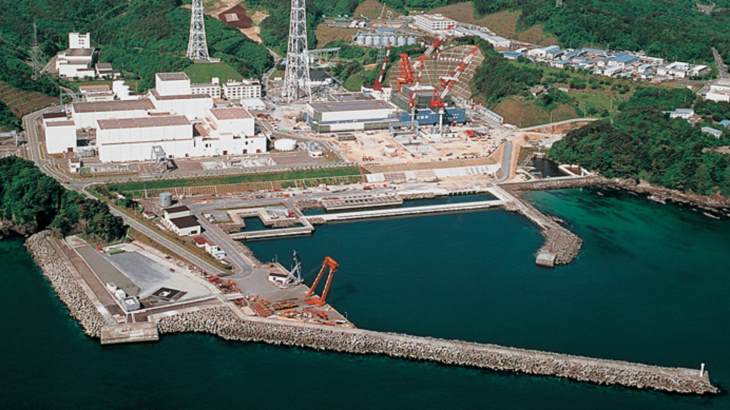
800-meter-long seawall being constructed, as Japan plans to reopen damaged Onagawa nuclear complex
|
Japan’s damaged nuclear reactor set to reopen https://www.aa.com.tr/en/asia-pacific/japan-s-damaged-nuclear-reactor-set-to-reopen/2005798, Quake-hit Onagawa nuclear complex awaits final approval by Miyagi provincial officials, Riyaz ul Khaliq |14.10.2020 ANKARAJapan’s nuclear reactor hit by a 2011 earthquake in the northeastern Miyagi province will resume operations by the end of this year, according to officials, the local media reported on Wednesday.
Miyagi Governor Yoshihiro Murai will formally announce his consent to restart the nuclear reactors at Onagawa complex by the end of the year, the Kyodo News agency said. Early this year, the 825,000-kilowatt reactor, operated by Tohoku Electric Power Company, won the approval of the country’s Nuclear Regulation Authority. All the three reactors were shut down when the massive quake and a 13-meter tsunami hit northeastern Japan on March 11, 2011, flooding the underground floors of the No. 2 unit. Nearly 10,000 people lost their lives while over 4,000 others are still missing. Onagawa nuclear reactor is the second such disaster-ravaged complex, after the Fukushima nuclear disaster, to pass stricter nuclear safety standards. The world has witnessed the worst nuclear disaster in 1986 at Chernobyl in today’s Ukraine. Unlike the Fukushima Daiichi plant of Tokyo Electric Power Company, the Onagawa plant’s emergency cooling system did not fail and underwent no meltdown after hit by the earthquake and tsunami. To restart the Onagawa nuclear reactors, the consent of local government leaders is the last remaining step needed after it cleared a national safety screening in February. Tohoku aims to restart the No. 2 unit of Onagawa nuclear complex in 2022 at the earliest. Currently, a 800-meter-long seawall at the plant is under construction. The operator has already decided to scrap unit No. 1. Murai would be the first governor of a disaster-hit province to allow resumption of a damaged nuclear reactor’s operations. The 2011 earthquake and tsunami triggered one of the world’s worst nuclear crises in Japan’s Fukushima province which caused all of Japan’s 54 reactors to halt. However, since then, nine units at five plants of the country have restarted following regulatory and local approvals. “When the plenary session [of the local assembly] shows its stance, I will make a decision upon hearing the opinions of mayors of cities, towns, and villages within the prefecture,” Murai said. |
USA starts off $3.2 billion subsidy program with $80 million each for “next generation” nuclear reactors

|
US DOE awards TerraPower, X-energy $80 million each for advanced nuclear reactors, S and P Global , Joniel Cha William Freebairn , EditorDerek Sands 14 Oct 20, Washington — The US Department of Energy has awarded two companies proposing next-generation nuclear reactors $80 million each in an initial award as part of a $3.2 billion program to build two advanced reactors that can be operational within seven years, Energy Secretary Dan Brouillette said Oct. 13.
One award went to a group including TerraPower, a company co-founded by billionaire Bill Gates, working with a General Electric and Hitachi joint venture, while the other is X-energy, a start-up that is advancing a reactor design originally developed in Germany. The awards are part of DOE’s Advanced Nuclear Reactor Demonstration Program, and future funding is dependent on appropriations, Brouillette said. Regarding advanced reactors, which generally use a different coolant than all operating commercial reactors in the US, “We want to make them more affordable to build, and we want to make them more affordable to operate,” Brouillette said. Brouillette said “it is likely” the advanced reactors will be built in Washington state, where he said a site is available. The key criteria to select applicants included that the reactor design represent a truly advanced technology dissimilar from existing reactors, Brouillette said. A second key factor was DOE’s assessment that the management team of the winning groups be able to supply the required 50-50 match in resources and deliver the projects within seven years, he said. TerraPower partnered with GE Hitachi, engineering and construction company Bechtel, and utilities Energy Northwest, Duke Energy and Pacificorp for its Natrium sodium fast reactor. The system will be supported by a new fuel fabrication facility to supply fuel for the unit, DOE said in a statement Oct. 13. That Natrium reactor and storage system is a 345-MW net reactor system coupled with a molten-salt-based energy storage system that will provide greater operating flexibility for owners, the companies have said. The Natrium system is designed to cost under $1 billion excluding financing costs. …… Congress appropriated $230 million to start a new demonstration program for advanced reactors in the fiscal 2020 budget. DOE said in May it would award $80 million each to two projects that could be operational in the next five to seven years. Additional funding was to be made available to up to five additional projects with anticipated deployment later than the near-term time frame. The other funding awards will be made in December, DOE said in the statement. https://www.spglobal.com/platts/en/market-insights/latest-news/electric-power/101320-us-doe-awards-terrapower-x-energy-80-million-each-for-advanced-nuclear-reactors X-energy is developing an 80-MW high temperature gas-cooled reactor, the Xe-100, which has begun a vendor design review with the Canadian Nuclear Safety Commission. It is working with Canadian engineering company Hatch on potential Canadian projects to deploy the Xe-100. The X-energy proposal includes four Xe-100 reactors and completion of a commercial-scale fuel fabrication facility. |
|
UK: consultation with 2300 people about radioactive waste dump – only 13 people supported it.
 Northern Echo 13th Oct 2020, THOUSANDS of people have written to the Environment Agency over concerns that plans to dump radioactive waste in Teesside will pose a risk to
communities. An application has been made by Augean North Ltd for a low
level radioactive waste permit at their existing Port Clarence site,
between Stockton and Billingham.
The Environment Agency, which held a
consultation which ended in January, published its report yesterday. About
2,300 people took part in the four-month exercise, with only 13 supporting
the application.
The Environment Agency is now considering these in
determining whether to grant the permit, taking into account information
submitted by Augean North. The operator has been asked to provide further
information, with a decision expected to be made by the end of January
2021.
Members of the public, as well members of Stockton on Tees Borough
Council and Redcar and Cleveland Borough Council commented on the
socioeconomic impact and the general impact on the area, as well as the
potential impact on regeneration plans. Last year, Tees Valley Mayor Ben
Houchen criticised the plans, which he said were against the interests of
those living in surrounding areas. The report can be viewed by visiting
consult.environment-agency.gov.uk/north-east/port-clarence-landfill-permit-application
.S. govt funds small nuclear reactors, with $billions more tax-payer money to follow
DOE Awards $160M to TerraPower and X-Energy to Build Advanced Nuclear Plants by 2027, Greentech Media, 14 Oct 20 The U.S. Department of Energy has awarded $160 million to X-energy and TerraPower with the potential for billions more in federal funding, as the companies strive to build a working model of their smaller scale, more flexible advanced nuclear reactor designs by 2027. TerraPower is partnered with the GE Hitachi Nuclear Energy, a nuclear industry joint venture formed in 2007.
DOE’s Advanced Reactor Demonstration Program will provide $80 million to each award winner, DOE Secretary Dan Brouillette said Tuesday. DOE intends to invest about $3.2 billion over the next seven years into advanced nuclear, subject to future congressional appropriations, he said………
Smaller reactors are critical to rejuvenate an industry that’s struggling to finance and build the massive, gigawatt-plus power plants that make up the world’s existing nuclear fleet. In the U.S., several of these have been canceled, and Southern Company’s Plant Vogtle expansion is behind schedule and over budget.
Meanwhile, existing reactors in Pennsylvania and Illinois are facing the threat of closure due to challenging energy market economics, and California’s sole remaining nuclear reactor is set to close by mid-decade…………
TerraPower’s initial plans for what it calls a traveling wave reactor drew investment from Gates and Sun Microsystems billionaire Vinod Khosla with its promise of using depleted uranium rather than enriched uranium-235. But that project was abandoned last year after the Trump administration imposed limits on U.S.-China technology transfer forced it to cancel its partnership with China National Nuclear Corp. ……..
X-energy’s advanced pebble-bed reactor…… has yet to be proven in commercial form. A 15 MW demonstration reactor in Germany operated for two decades, but a second, larger-scale version was shut down after only four years of operation. China has built a 10 MW demonstration reactor, and a 250 MW unit began construction in 2012, but plans to start operations in 2019 have been pushed back, with no new completion date announced. ……
What to do about the USA President’s sole authority to launch a nuclear pre-emptive strike?
|
Quote of the week: “Ours is a world of nuclear giants and ethical infants… We have grasped the mystery of the atom and rejected the Sermon on the Mount.” The President of the United States has unrestricted powers to use nuclear weapons first if he or she deems this necessary. Concerns about the absence of checks and balances on the first use of nuclear weapons have spiked because of Donald Trump’s bellicose temperament and shallow understanding of nuclear flash points. They have been exacerbated by his erratic behavior and remarks while recovering from the COVID virus. What to do? Some on Capitol Hill have introduced legislation that would prohibit the president from launching a nuclear first strike without a declaration of war by the Congress. In my view, this is the wrong remedy. Instead, I propose a three person rule for crossing the nuclear threshold first that can be enacted by executive order and reaffirmed by the Congress………… https://www.armscontrolwonk.com/archive/1210154/the-presidents-sole-authority-for-first-use/ |

Struggling Japanese towns look to nuclear waste storing and the money associated
|
MANSION WITHOUT A TOILET: TOWNS IN JAPAN SEEK TO HOUSE, STORE NUCLEAR WASTE OUT OF NECESSITY, https://www.firstpost.com/tech/science/mansion-without-a-toilet-towns-in-japan-seek-to-house-store-nuclear-waste-out-of-necessity-8904851.html Radioactive waste needs to be stored away for a few centuries in thick concrete structures underground so it won’t affect humans and the environment.
Two remote towns in northern Japan struggling with rapidly graying and shrinking populations signed up Friday to possibly host a high-level radioactive waste storage site as a means of economic survival.
Japanese utilities have about 16,000 tons of highly radioactive spent fuel rods stored in cooling pools or other interim sites, and there is no final repository for them in Japan — a situation called “a mansion without a toilet.”
Japan is in a dire situation following the virtual failure of an ambitious nuclear fuel recycling plan, in which plutonium extracted from spent fuel was to be used in still-unbuilt fast breeder reactors. The problem of accumulating nuclear waste came to the fore after the 2011 Fukushima nuclear power plant disaster. Finding a community willing to host a radioactive dump site is difficult, even with a raft of financial enticements.
On Friday, Haruo Kataoka, the mayor of Suttsu town on the northwestern coast of Hokkaido, applied in Tokyo for preliminary government research on whether its land would be suitable for highly radioactive waste storage for thousands of years. Later Friday in Kamoenai just north of Kamoenai, village chief Masayuki Takahashi announced his decision to also apply for an initial feasibility study. Suttsu, with a population of 2,900, and Kamoenai, with about 800 people, have received annual government subsidies as hosts of the Tomari nuclear power plant. But they are struggling financially because of a declining fishing industry and their aging and shrinking populations. The preliminary research is the first of three steps in selecting a permanent disposal site, with the whole process estimated to take about two decades. Municipalities can receive up to 2 billion yen ($19 million) in government subsidies for two years by participating in the first stage. Moving on to the next stage would bring in more subsidies. “I have tried to tackle the problems of declining population, low birth rates and social welfare, but hardly made progress,” Takahashi told reporters. “I hope that accepting research (into the waste storage) can help the village’s development.” It is unknown whether either place will qualify as a disposal site. Opposition from people across Hokkaido could also hinder the process. A gasoline bomb was thrown into the Suttsu mayor’s home early Thursday, possibly by an opponent of the plan, causing slight damage. Hokkaido Gov. Naomichi Suzuki and local fisheries groups are opposed to hosting such a facility. One mayor in southwestern Japan expressed interest in 2007, but faced massive opposition and the plan was spiked. High-level radioactive waste must be stored in thick concrete structures at least 300 meters (yards) underground so it won’t affect humans and the environment. A 2017 land survey map released by the government indicated parts of Suttsu and Kamoenai could be suitable for a final repository. So far, Finland and Sweden are the only countries that have selected final disposal sites |
|
Groups urge New Mexico governor to take stand against nuclear waste plan

Oct 12, 2020 ALBUQUERQUE, N.M. (AP) — Environmentalists and other watchdog groups want New Mexico Gov. Michelle Lujan Grisham to create a government agency that would be tasked with keeping the state from becoming a permanent dumping ground for spent nuclear fuel and other high-level waste.
Dozens of groups sent a letter Friday to the Democratic governor. They pointed to Nevada’s past success in mothballing the once-proposed Yucca Mountain waste repository project in that state and asked the governor to consider similar measures to protect New Mexico.
“New Mexico’s people and our environment deserve better treatment than a plan offering millions of years of a public health menace from radioactive waste spreading into our soil, air, water and rivers,” the letter states. “Please consider what more aggressive steps can be taken to defeat the Holtec plan.”
New Jersey-based Holtec is seeking a 40-year license from the federal Nuclear Regulatory Commission to build what it has described as a state-of-the-art complex near Carlsbad. Company executives have said the project is needed because the federal government has yet to find a permanent solution for dealing with the tons of spent fuel building up at commercial nuclear power plants around the U.S.
The first phase of the project calls for storing up to 8,680 metric tons of uranium, which would be packed into 500 canisters. Future expansion could make room for as many as 10,000 canisters of spent nuclear fuel……..
State officials in comments recently submitted to federal regulators opposed a preliminary recommendation by staff of the Nuclear Regulatory Commission that a license be granted to Holtec to build the multibillion-dollar facility. They said technical analysis has been inadequate so far and accused regulators of failing to consider environmental justice concerns and meet requirements spelled out by federal environmental laws.
Dave McCoy of Citizen Action is among those who signed the letter sent to Lujan Grisham. He said Monday that there’s a push to approve New Mexico for “interim” storage knowing that the waste will never leave……. https://scnow.com/business/new-mexico-governor-urged-to-take-stand-against-nuclear-plan/article_e167c5c0-4d7b-5a1f-8ebd-30a951f24c71.html
Trump’s psychopathology a threat to US democracy and to global stability.
 There’s one headline about Donald Trump that has not been printed but makes There’s one headline about Donald Trump that has not been printed but makes the most sense of all, https://www.smh.com.au/world/north-america/there-s-one-headline-about-donald-trump-that-has-not-been-printed-but-makes-the-most-sense-of-all-20201008-p563b7.html By Ian Hughes and Alan D. Blotcky, October 11, 2020 For almost four years, there has hardly been a day that Donald Trump has not made front-page news. The unrelenting avalanche of lies and norm-shattering behaviour that Trump has unleashed has presented the mainstream media with an unprecedented challenge. It is a challenge that the media has struggled to meet, largely because of the ethical and practical difficulties that journalists face in dealing with Trump’s mental pathology.Even before his election, mental health professionals were warning that Trump’s psychopathology posed a threat to US democracy and to global stability. After his election, dozens of mental health experts collaborated on the book The Dangerous Case of Donald Trump which became a New York Times bestseller. Over the past three or four months, the number of voices expressing alarm at Trump’s pathology has been growing. the most sense of all, https://www.smh.com.au/world/north-america/there-s-one-headline-about-donald-trump-that-has-not-been-printed-but-makes-the-most-sense-of-all-20201008-p563b7.html By Ian Hughes and Alan D. Blotcky, October 11, 2020 For almost four years, there has hardly been a day that Donald Trump has not made front-page news. The unrelenting avalanche of lies and norm-shattering behaviour that Trump has unleashed has presented the mainstream media with an unprecedented challenge. It is a challenge that the media has struggled to meet, largely because of the ethical and practical difficulties that journalists face in dealing with Trump’s mental pathology.Even before his election, mental health professionals were warning that Trump’s psychopathology posed a threat to US democracy and to global stability. After his election, dozens of mental health experts collaborated on the book The Dangerous Case of Donald Trump which became a New York Times bestseller. Over the past three or four months, the number of voices expressing alarm at Trump’s pathology has been growing.
The media, however, has largely continued to cover Trump’s actions one story at a time, without joining up the dots and accurately describing his pathology. Of all the thousands of headlines, there is one headline that has not been printed but that makes the most sense of all: “Donald Trump suffers from a dangerous incurable narcissistic disorder which makes him incapable of empathy or reason. He is a grave danger to the US and the world.” The failure of the media to emphasise this obvious fact is a lost opportunity to inform and educate the public so that Trump’s pathology is fully appreciated and understood. As mental health professionals know, Trump’s mental disorder manifests itself in a wide variety of behaviours and not in isolated or disconnected events. In these dangerous times, the challenge for the media, difficult though it is, should be to explain Trump’s pathology in all its complexities and ramifications for the public. To illustrate this, consider three separate headlines from the past few days. “The President’s taxes: Long-concealed records show Trump’s chronic losses and years of tax avoidance”, The New York Times, September 27, 2020. Pathological narcissists have a “false self” that they try to maintain at all cost. Trump’s “false self” is that he is smarter and richer and stronger and better looking than anyone else. Anything that undermines or contradicts his “false self” is aggressively defended against. Donald Trump has actively refused to share his federal tax returns with the American people in order to defend this “false self”. He has not wanted to reveal his losses, his fraud, and, perhaps, even his underhanded connections to Russia. The projection of his “false self” is the ultimate lie of a narcissist. Trump’s thousands of lies all join up as a defence against the truth of his true persona as a business failure. “Donald Trump ensures first presidential debate is national humiliation”, The Guardian, September 30, 2020. Donald Trump’s narcissistic pathology did not allow him to engage in reasonable and rational debate with Joe Biden. He is incapable of rational, orderly, and thoughtful discourse, and is compelled and guided instead by his internal needs, wants, and desires. In addition, Trump is increasingly desperate because he knows his poll numbers are dropping. As a narcissist, his reflexive response when his grandiose self- image is threatened is to attack and to bully. Over the past few months, Trump’s pathological response to the threat of failure has been in plain view: wild accusations, lies, scapegoating, conspiracy theories, and gaslighting. His unpresidential debate performance was an extension of this pathological behaviour. “Trump’s reckless joyride tops Bible-holding photo op in Washington”, The Sydney Morning Herald, October 5, 2020 Trump is unable to function without constant praise and adulation. This is the opposite of strength. Pathological narcissists need frequent affirmation to fill up their hollow shells. They need constant confirmation that their “false self” is indeed true – when it is not. With no internal capacity for maintaining a true and authentic identity, Trump is totally dependent on external adulation to function. His neediness now is on full display. In the space of a single week, Trump has exhibited three of the defining features of narcissistic personality disorder – sociopathy in defence of a “false self”, disordered thinking that renders him incapable of reason, and a constant need for adulation. Every headline on this president has spotlighted one or other aspect of his narcissistically disordered mind. The evidence about Trump is overwhelming. A free press is one of the central pillars of a democracy. Its role is to be a watchdog on our political leaders and to inform the public. The media can play a vital role in engaging with the alarming reality of Trump’s pathology, despite the difficulties in doing so. . Donald Trump is part of a much larger picture. Individuals with dangerous personalities have risen to the highest ranks of power throughout modern history – from Nixon to Mao, Stalin to Pol Pot. Some have played a crucial role in steering our world towards disaster. A widespread understanding of this basic fact has now become essential for the protection of democracy. Ian Hughes is the author of Disordered Minds: How Dangerous Personality Disorders Are Destroying Democracy and contributing author to The Dangerous Case of Donald Trump. He is a Senior Research Fellow at the MaREI Centre at University College Cork in Ireland. Alan D. Blotcky is a clinical psychologist in private practice in Birmingham, Alabama |
|
Murdoch media monopoly – an ‘arrogant cancer on our democracy’
|
The warning comes as former prime minister Kevin Rudd called for a royal commission into media concentration on Saturday, launching a petition to Parliament that amassed thousands of signatures within hours of going live. Australia’s media landscape is dominated by two players – Nine Entertainment, which owns the The Age and The Sydney Morning Herald mastheads among others, and News Corp, owned by former Australian Rupert Murdoch, which controls between 60 and 70 per cent of the metropolitan market. Mr Rudd decried the sheer concentration of the Murdoch empire, and pointed to News Corp mastheads’ support for the Liberal Party in the past 18 elections. Murdoch has become a cancer, an arrogant cancer, on our democracy,” Mr Rudd said. “I’m calling on the Parliament to establish a royal commission into the abuse of media monopoly in Australia, and particularly by the Murdoch media, to make recommendations to maximise media diversity ownership for the future lifeblood of our democratic system.” Mr Rudd has had a long-running feud with News Corp, which used its mastheads to hound him during his tenure as prime minister. A petition to Parliament is essentially a request for action, but it does not mean the sitting government has to implement its requests…….. Mr Murdoch’s influential newspapers and television stations have been widely criticised for spreading misinformation about climate change during Australia’s out-of-control bushfires. The Australian has repeatedly argued that this year’s fires are no worse than those of the past – a claim that scientists have dismissed as untrue…….. “We see story after story in the Murdoch papers saying there is no such thing as climate change, then that arsonists were responsible. “There’s never any apology or correcting the record.” News Corp has also been pursuing Victorian Premier Daniel Andrews over the issue of the state’s coronavirus lockdowns, she said. “Every story in The Australian is about ‘Dictator Dan’, it would be like the NZ publications going after ‘General Jacinda’, but there the coverage has been more considered,” Dr Price said. Her dream royal commission on media ownership would also focus on tabloid commentators and the ways in which they target and bully individuals they dislike. “I want a royal commission into the stream of columnists who should have to make amends for their fact-less columns,” Dr Price said………. Dr Muller said the Murdoch influence was not just apparent in Australia. “If you look at the two democracies in the most trouble, the UK and the US, in both the Murdoch empire is dominant and has been an active player in preferring right-wing governments,” he said. “When you have power like that which is not accountable you impair your democracy.”…….. https://thenewdaily.com.au/news/politics/2020/10/11/kevin-rudd-murdoch-royal-commission/ |

Belarus postpones launch of nuclear reactor
Radio Free Europe 9th Oct 2020, Belarus says it has postponed the full launch of the first reactor at its
Astravets nuclear power plant by two years to 2022. The plant, located near
the Lithuanian border, was scheduled to be launched on October 6 until the
cabinet order on October 9. Built by the Russian state firm Rosatom and
financed by Moscow with a $10 billion loan, the project is opposed by
neighboring EU member Lithuania, whose capital, Vilnius, is just 50
kilometers away. Lithuania, Latvia, and Estonia are moving to a full
decoupling from their Soviet-era common power system by 2025.
Conflict of interest – UK’s Centre for Environment, Fisheries and Aquaculture Science (CEFAS)
Stop Hinkley Press Release 8th Oct 2020, EDF’s Hinkley C Nuclear Power Station will be wiping out fish stocks in
Severn Estuary for 60 years. The Stop Hinkley Campaign is accusing
EDFGenco, the French and Chinese owned Company building Hinkley Point C, of
trying to bully the UK Environment Agency into allowing them to destroy
environmentally precious fish stocks for the 60 year lifetime of the
nuclear power station.
A condition placed on EDFGenco by the Environment
Agency was that permission to build Hinkley C was dependent on Acoustic
Fish Deterrents (AFDs) being placed on the two massive cooling water intake
heads 3 kilometres offshore from the Nuclear site.
Now EDFGenco is trying
to renege on its commitment to install AFDs and is seeking a variation on
the planning conditions imposed. EDFGenco claims that the Centre for
Environment, Fisheries and Aquaculture Science (CEFAS) the government’s
marine and freshwater science expert body – is happy for them to go ahead
without AFDs. The Wildfowl and Wetland Trust points out that “CEFAS’s
relationship as a paid contractor to EDFGenco and an agent of Government
raises unavoidable questions of conflict of interest”.
Fishing industry chief opposes releasing Fukushima No. 1 water into sea
Fishing industry chief opposes releasing Fukushima No. 1 water into sea, https://www.japantimes.co.jp/news/2020/10/09/national/zengyoren-fukushima-water-sea/ 9 Oct 20, The head of the National Federation of Fisheries Cooperative Associations, or Zengyoren, has voiced strong opposition against releasing treated water containing radioactive tritium from the disaster-stricken Fukushima No. 1 nuclear plant into the sea.
“We are absolutely against ocean release” as a way to dispose of tainted water at Tokyo Electric Power Company Holdings Inc.’s nuclear plant in Fukushima Prefecture, Hiroshi Kishi, head of Zengyoren, said Thursday at a government hearing in Tokyo.
Kishi said that fishermen who are operating along the coast of Fukushima have been suffering from problems caused by the radioactive fallout from the 2011 meltdowns at the plant, such as fishing restrictions, as well as malicious rumors about the safety of farm and marine products there.
If the government chooses to release radioactive water into the sea, a leading option to get rid of accumulating low-level radioactive water at the plant, it will trash all efforts fishermen have so far made to sweep away such rumors and consequently “will have a devastating impact on the future of Japan’s fishing industry,” Kishi stressed.
Toshihito Ono, head of the prefecture’s fishery product processors association, who joined the hearing via a video call, warned that Fukushima’s processed marine products, including products that use ingredients from other prefectures, will become targets of harmful rumors.
In a report released in February, a government panel pointed out that a realistic option would be releasing the tainted water into the ocean after dilution or into the air through evaporation.
Many people fear that both methods will add to the reputational damage suffered by Fukushima products. But treated water storage at the power plant is expected to reach full capacity as early as autumn 2022.
After the hearing, state industry minister Kiyoshi Ejima told reporters, “We find it unadvisable to put off a decision on how to dispose of the water because not much room is left at the plant for tanks containing the water.”
This was probably the last hearing on the water issue, people familiar with the matter said.
Utah congressman takes action to stop future nuclear weapons testing in U.S.
|
Utah congressman takes action to stop future nuclear weapons testing in U.S. The Daily Universe, By Kaela Cleary, October 9, 2020 With all of the chaos surrounding the U.S. presidential election, word of the Trump administration and Senate Republicans creating legislation to prepare to resume nuclear weapons testing at the Nevada Test Site hasn’t received much public attention.
|
|
1 This Month



Shut down the radiation-damaged Heysham nuclear reactors now
To see nuclear-related stories in greater depth and intensity – go to https://nuclearinformation.wordpress.com

Say No to NASA’s Reckless Nuclear Reactor on the Moon
Say No to NASA’s Reckless Nuclear Reactor on the Moon
-
Archives
- October 2026 (256)
- September 2026 (339)
- August 2026 (330)
- July 2026 (355)
- June 2026 (287)
- May 2026 (306)
- April 2026 (356)
- March 2026 (251)
- February 2026 (267)
- January 2026 (308)
- December 2025 (358)
- November 2025 (359)
-
Categories
- 1
- 1 NUCLEAR ISSUES
- business and costs
- climate change
- culture and arts
- ENERGY
- environment
- health
- history
- indigenous issues
- Legal
- marketing of nuclear
- media
- opposition to nuclear
- PERSONAL STORIES
- politics
- politics international
- Religion and ethics
- safety
- secrets,lies and civil liberties
- spinbuster
- technology
- Uranium
- wastes
- weapons and war
- Women
- 2 WORLD
- ACTION
- AFRICA
- Atrocities
- AUSTRALIA
- Christina's notes
- Christina's themes
- culture and arts
- Events
- Fuk 2022
- Fuk 2023
- Fukushima 2017
- Fukushima 2018
- fukushima 2019
- Fukushima 2020
- Fukushima 2021
- general
- global warming
- Humour (God we need it)
- Nuclear
- RARE EARTHS
- Reference
- resources – print
- Resources -audiovicual
- Weekly Newsletter
- World
- World Nuclear
- YouTube
-
RSS
Entries RSS
Comments RSS

