UK government influenced by pro nuke advisor Dominic Cummins and Rolls Royce to invest in uneconomic nuclear power
By David Thorpe, 8 Nov 20 A secret military agenda. UK defence policy is driving energy policy – with the public kept in the  dark, Beyond Nuclear By David Thorpe, 8 Nov 20 ” ……………..Rolls Royce and Dominic Cummings This sad, radioactive site is operated by – guess who – Rolls-Royce (under the Vulcan Trials Operation and Maintenance contract).
And Rolls Royce is already benefiting from public money flowing into new nuclear. It has for years been lobbying the government to support its small nuclear reactors wheeze.
Its 2017 pitch document contained phrases like “providing 440MW of electricity per year — enough to power a city the size of Leeds” – that Downing Street has literally copied and pasted into the above article fed to the Financial Times.
It doesn’t take much insight to see that Rolls Royce has turned Boris Johnson’s right-hand elf – the one who hates energy efficiency – Dominic Cummings. One can see his hand in the push for SMRs, while BEIS is pushing support for Sizewell C.
Rolls Royce is axing up to 8,000 jobs because of the pandemic-related aviation crash. This troubled company is a huge symbol of Great Britain plc. Millions of public money for SMRs is just what it needs.
But to back both Sizewell and the SMRs would be far too expensive for the public purse, already heavily in debt because of the coronavirus pandemic. Burke believes the SMR pitch is “Cummings fight back against the public pressure for Sizewell from EDF and (Tom) Greatrex”.
Tom Greatrex is the Nuclear Industry Association’s chairman. In a Times article he recently called for “a strong and unambiguous statement of the need for new nuclear to be able to meet the net-zero target” with backing for Sizewell……… https://wordpress.com/read/feeds/72759838/posts/3011373103
Britain’s second option for new nuclear – Big Nuclear Reactors
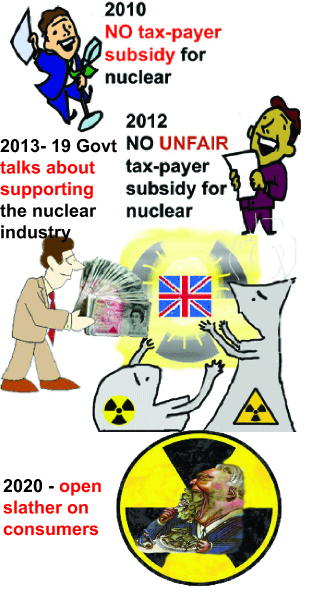 A secret military agenda. UK defence policy is driving energy policy – with the public kept in the dark, Beyond NuclearBy David Thorpe, 8 Nov 20 “……..The second option for new nuclear. While Downing Street is pushing SMRs, BEIS has been looking for a way to finance the £20 billion Sizewell C reactor which EDF has been lobbying to build in Suffolk. This could be why it did not want to bankroll Rolls Royce’s expansion.
One idea being floated by BEIS is the government taking equity stakes in future nuclear plants such as Sizewell C, the energy minister has confirmed.
French energy company EDF is unable to continue with its plans for a new UK nuclear power station without even more government support than it has already had.
The CEO of EDF, Jean-Bernard Lévy, met the Chancellor of the Exchequer Rishi Sunak recently to beg for such support. The head of Greenpeace UK, John Sauven, wrote to the Chancellor saying giving support may be in EDF’s interests, but it is not in the UK’s. Nevertheless, the government is considering taking a direct stake in the project, using a “Regulated Asset Base” (RAB) financing model, where costs are added to consumers’ bills during construction.
This would still result in multibillion-pound liabilities showing on the government’s balance sheet. So the Treasury is studying whether the government should in return have equity stakes in EDF’s Sizewell plant.
The government previously offered to take a one-third stake in Hitachi’s Wylfa plant on Anglesey, but the Japanese company still scrapped the project last month – even then it was too expensive.
The RAB approach is being challenged anyway by the national nuclear regulator, the Office for Nuclear Regulation, because it could introduce a dual regulator for the industry, which it does not regard as sensible or workable.
Renewables can supply UK energy needs and net zero targets sooner and cheaper than nuclear
Renewables are safer, cheaper, quicker to install and genuinely low carbon, with no fuel supply chain.
The Sizewell reactor could not realistically be supplying power until 2034 at the earliest, while wind and solar plants take less than two years to commission, on average.
The ability of the national grid to absorb more fluctuating renewable electricity input is improving, helped by the collapsing cost of batteries, and investment in hydrogen and other forms of storage.
The National Infrastructure Commission has testified that the absorption of 65 per cent renewables on the grid by 2030 is cost-effective – and more is technically achievable.
Implicitly recognising the truth of this, the Ministry of Defence’s Chief Scientific Adviser on nuclear science and technology matters, Robin Grimes, has just opened up another front against renewables.
Grimes is advocating nuclear power’s potential for cogeneration – using its “waste” heat for all manner of things from district heating and seawater desalination to synthetic fuel production and industrial process heat.
This is not likely to make much of a dent in the cost-benefit equation.
Alarm bells should be set ringing when you know that this same Grimes was also co-author of a once-secret report in 2014 for the Ministry of Defence where it was recommended that the UK nuclear submarine industry needs to forge links with civil nuclear power in order to extricate itself from the dire situation it is in.
This secret report discussed what to do about the radiation-leaking Vulcan Naval Reactor Test Establishment, a military submarine reactor testing facility built in 1950 at Dounreay in Scotland.
Engineers with nuclear expertise are dying out with the reactors. New nuclear subs need a new supply chain and new expertise. What better place to tackle all these issues?…………….https://wordpress.com/read/feeds/72759838/posts/3011373103
Small and large new nuclear reactors in Britain’s so-called ‘green industrial revolution’
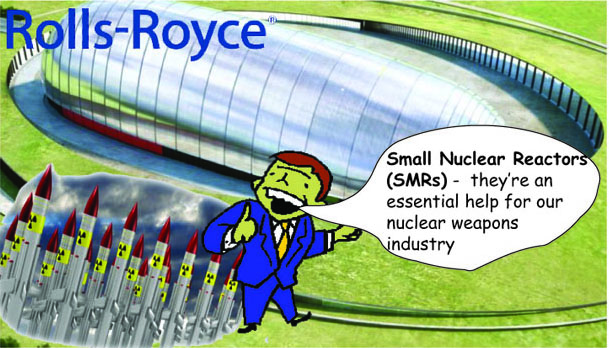 Mail on Sunday 7th Nov 2020, Boris Johnson is poised to launch major plans for a ‘green industrial revolution’ backing a new wave of nuclear power plants to boost the economy and slash Britain’s carbon emissions. The proposals are expected to include the green light to build a nuclear plant at Sizewell C in Suffolk and thenext stage in a programme that would lead to a production line of rapidlyn and more cheaply produced small modular reactors within a decade, The Mail on Sunday understands.
The Government is considering a ‘Made in Britain’ solution that may include a taxpayer-backed injection from an infrastructure growth fund – a plan that would need rubber stamping by the Treasury. Funding could also include backing from British pension funds. It would allow the Government to help subsidise the small modular reactor programme (SMR) with as much as £2billion and a stake in Sizewell C of up to 10 per cent of its £20billion build costs.
Sizewell C is backed by French state-backed EDF Energy, which could become a minority shareholder. Government financing would also help slash the cost of electricity produced by the plant. Britain has eight nuclear power plants, generating about a fifth of the country’s electricity. Seven are due to close by 2030.
The SMR consortium is led by Rolls-Royce and includes construction and engineering companies Assystem, Atkins, BAM Nuttall,
Jacobs and Laing O’Rourke. It hopes to build ten to 15 reactors in the UK, largely on former nuclear sites. Plans are already being discussed for the possibility of joint sites in locations including Moorside in Cumbria – where Japanese multinational Toshiba recently pulled out of developing its own reactor – that could contain a large EDF-backed reactor and a smaller modular reactor, creating a ‘clean energy hub’.
EDF has insisted synergies with Hinkley will mean the cost of energy from a second plant at Sizewell C would be slashed. It is understood site preparations could begin immediately and that planning consent for the project itself could be given
as soon as 2022, meaning the plant could be online by 2032.
https://www.thisismoney.co.uk/money/markets/article-8924115/Lift-GREEN-Industrial-Revolution.html
A win for decency, rationality, co-operation , and science

Joe Biden, Kamala Harris, and the Democrats have won the American election.
For four years, the world has put up with a lying, narcissistic, sociopath as American President. Trump has done such damage to civil systems of health and environment, to democratic institutions, and to international relations. He has epitomised the bullying style of leadership that has become so popular and so dangerous in this 21st century world.
Jo Biden, in the way that he ran his campaign, and in his winning speech, demonstrates a completely opposite style – one of reasonableness, courtesy, and respect for science and democratic agencies.
A key factor today is the appalling state of coronavirus cases, and coronavirus deaths in the USA. That is a no. 1 challenge to the American administration. Now, they will have a leader who understands the seriousness of the pandemic, and cares.
The Democratic leadership understands the climate crisis, and even if the Senate should be dominated by Republicans, Biden can still rejoin the USA to the Paris Climate Accord. Much action against global heating can be done by executive action, bypassing the Senate,
On the nuclear issue, Biden will almost certainly support international arms control agreements, but not the Treaty on the Prohibition of Nuclear Weapons. Unfortunately, the Democratic Party now, as it did under Obama, still basks in the arms of the ”peaceful”nuclear lobby, and the nuclear weapons making industry.
Japan: the next generation of LDP leaders embrace both carbon neutrality and the elimination of nuclear energy.
Nuclear Power and Japan’s 2050 Climate Pledge
Japan’s latest carbon-neutrality pledge puts the spotlight on the challenges facing the country’s nuclear power industry. The Diplomat , By Tom Corben,, November 05, 2020 In his inaugural address to the Diet last month, Japan’s Prime Minister Suga Yoshihide officially announced that his government would revise the country’s carbon-neutrality commitments, aiming for zero emissions by 2050. Suga expressed his intent to “put maximum effort into achieving a green society…..
Of course, the nuclear lobby’s entrenched interests at the highest levels of the government and within the LDP itself will likely continue to frustrate efforts to comprehensively revise Japan’s nuclear energy policies. Indeed, there is every chance that the revised Basic Energy Plan due next year will maintain, if not expand, the share of Japan’s energy mix allocated to nuclear power. Still, without significant changes to the regulatory environment, a more favorable business environment, or a major shift in public opinion or political support, at present it is difficult to see Japan’s nuclear power industry making a major contribution to Japan’s carbon-neutrality goals in the coming decades.
Exploring the reasons why Britain is to ‘re-nationalise’ it’s nuclear weapons
UK Government move to ‘re-nationalise’ Britain’s nuclear weapons, The National
|
By Martin HannanMultimedia Journalist 6th NovemberEARLIER this week the UK Government slipped out a story about Britain’s nuclear deterrent in the form of a ministerial statement that hardly anyone noticed.
It indicated that the Atomic Weapons Establishment (AWE) headquartered on the former site of RAF Aldermaston is effectively going to be re-nationalised. Stripped of civil-servant speak, the statement says that the UK Government is exercising its right to end early a 25-year contract with a consortium of companies that run AWE plc. From next year AWE will become an arms-length operation wholly owned by the Ministry of Defence. That will include AWE’s presence at the Royal Naval Armaments depot at Coulport on Loch Long which services the Clyde Submarine Base at Faslane, home to Britain’s Trident submarines. The statement indicates the change is on grounds of efficiency. It read: “The change in Model will remove the current commercial arrangements, enhancing the MoD’s agility in the future management of the UK’s nuclear deterrent, whilst also delivering on core MoD objectives and value for money to the taxpayer. Forgive the cynical view but that all says “in other words, we’re back in complete charge and will spend what we like on the replacement for Trident with no need for reports to shareholders and that public sort of stuff”. WHEN WAS AWE ORIGINALLY PRIVATISED? THE Act to effectively privatise Aldermaston was passed under John Major’s Tory Government in 1991. The transfer of a previously MoD-run facility to the private sector caused some controversy at the time, but went ahead anyway……….. WHY IS THIS HAPPENING? GOOD question. Obviously somebody somewhere is not happy. Ending a 25-year contract four years early is not a usual tactic of HM Government – quite the opposite with contracts often renewed “on the nod”. It could also be an advance move in a long-rumoured possible project for the MoD to take back more sites and facilities and run them as arms-length operations. Babcock and other private contractors at Faslane and elsewhere will have taken note of the move. ARE ALDERMASTON AND SCOTLAND LINKED? THE convoys that take nuclear weapons between Coulport/Faslane and Aldermaston have been a worry for anti-nuclear campaigners for decades. In an independent Scotland, the Westminster Government would be asked to remove Trident and its ilk, which has always begged the question – what is the MoD’s plan B for Trident or its replacement after independence? Answer: there isn’t one. Go on, ask them yourselves. https://www.thenational.scot/news/18850871.uk-government-move-re-nationalise-britains-nuclear-weapons/ |
|
Canada’s Bruce County Council postpones voting on nuclear waste bunker plan
 Bruce County defers vote to support the science behind a nuclear waste bunker, By Janice MacKay, Blackburn News, November 5, 2020 Bruce County Council has agreed to defer the vote on a motion made at today’s meeting to accept the Nuclear Waste Management’s proposed Deep Geologic Repository to store used nuclear fuel as a matter of settled science.Michelle Stein of the group “no DGR South Bruce” told council via skype Thursday during their meeting that the motion was premature when the science isn’t settled on the proposed nuclear fuel Repository…….. Bruce County defers vote to support the science behind a nuclear waste bunker, By Janice MacKay, Blackburn News, November 5, 2020 Bruce County Council has agreed to defer the vote on a motion made at today’s meeting to accept the Nuclear Waste Management’s proposed Deep Geologic Repository to store used nuclear fuel as a matter of settled science.Michelle Stein of the group “no DGR South Bruce” told council via skype Thursday during their meeting that the motion was premature when the science isn’t settled on the proposed nuclear fuel Repository……..
She says moving the waste could add increased risk as it is transported through local municipalities. She worries that since there is no nuclear fuel DGR operating in the world, developing one in South Bruce would be an experiment which could put local rivers and waterways at risk. She added that the nuclear fuel waste would also still need to be stored at the surface, as “the nuclear waste needs to go into cooling pools, and then it needs to be stored above ground for approximately 30 years before it’s even cool enough to be moved.” https://blackburnnews.com/uncategorized/2020/11/05/bruce-county-defers-vote-support-science-behind-nuclear-waste-bunker/ |
|
Covid-19 divides and weakens the nuclear sector in South Africa
 Covid-19 divides and weakens the nuclear sector in South Africa, Daily Maverick, By Chris Yelland• 5 November 2020 Covid-19 divides and weakens the nuclear sector in South Africa, Daily Maverick, By Chris Yelland• 5 November 2020
The coronavirus crisis is undermining the business plan and turnaround strategy at the Nuclear Energy Corporation of South Africa. The resulting losses are creating debilitating divisions between labour, middle and senior management, executives and boards of Necsa and its subsidiaries – as well as wage increases Following a tumultuous operational and management period for several years, with massive financial losses, new Nuclear Energy Corporation of South Africa (Necsa) chairperson David Nicholls and acting CEO Ayanda Myoli presented a restructuring and turnaround plan to Parliament on 20 May 2020……… While many considered the turnaround plan to be hopelessly optimistic even before the Covid-19 crisis in South Africa from March 2020, the impact of the national and international lockdowns are estimated to have resulted in the Necsa group taking a massive hit, which would increase the expected loss for 2020/21 to more than R300-million. …… While many considered the turnaround plan to be hopelessly optimistic even before the Covid-19 crisis in South Africa from March 2020, the impact of the national and international lockdowns are estimated to have resulted in the Necsa group taking a massive hit, which would increase the expected loss for 2020/21 to more than R300-million. https://www.dailymaverick.co.za/article/2020-11-05-covid-19-divides-and-weakens-the-nuclear-sector-in-south-africa/ |
|
Texas governor wants Trump to oppose nuclear waste dump plan
Gov. Abbott Asks Trump for Help with Nuclear Waste in West Texas, Sanangelo Live, MATT TRAMMELL, NOV 6, 2020, ANDREWS, TX – Governor Greg Abbott sent a letter to President Trump last week urging him to put a stop to storing high levels of nuclear waste in rural West Texas.
In the letter sent to President Trump, on Sep. 29, Abbott gave a number of reasons for his opposition.
The main concerns the Governor has is the risk the nuclear material will bring to the Permian Basin.
Here is the full letter: [ but extract only posted here]
Dear Mr. President: Thank you for all you do to ensure a prosperous economy and strong energy industry in the United States. I write to express my opposition to the license applications to the Nuclear Regulatory Commission (NRC) for the consolidated interim storage of spent nuclear fuel and high-level waste at proposed sites within the state of Texas and within the state of New Mexico, close to the Texas border. A stable oil and gas industry is essential to the economy, and crucial to the security of our great nation. Allowing the interim storage of spent nuclear fuel and high- level nuclear waste at sites near the largest producing oilfield in the world will compromise the safety of the region.
The proposed facilities would be sited in the Permian Basin Region, which is the largest producing oilfield in the world ……..the Permian Basin is a significant economic and natural resource for the entire country, and the proposed storage facilities would place America’s recovering economy and energy security at great risk.
The NRC is currently evaluating issuance of a 40-year license to Interim Storage Partners (ISP) for a consolidated interim storage facility in west Texas as well as issuance of a 40-year license to Holtec International for such a facility in southeastern New Mexico. As proposed, the ISP facility would store commercial spent nuclear fuel and reactor-related materials, presenting a radiological risk greater than currently authorized for storage and disposal in Texas. ISP has also indicated it may seek to renew the license for an additional 20 years, which would result in an operating life of 60 years, or until a permanent facility is established. ……..https://sanangelolive.com/news/politics/2020-11-06/gov-abbott-asks-trump-help-nuclear-waste-west-texas
UK govt’s spin to Scotland, promoting nuclear submarines – but the Scots are nae sae daft
 We cannot defeat our real enemies by using nuclear weapons, https://www.thenational.scot/news/18850915.cannot-defeat-real-enemies-using-nuclear-weapons/, Jim Taylor, Edinburgh, 6 Nov 20
At the conclusion of the programme, Rear Admiral John Weale tells us that no-one really wants nuclear weapons … but “we are planning to have them for the next 50 years”.
So it’s a done deal, whether we Scots support it or not. Our UK Union membership means we will be forced against our will to be party to this inhumane weapon system, and the increased danger it puts us in with its continued location at Faslane.
Trident’s replacement is currently reckoned to cost around £200 billion, before any expected design, construction, operational cost overruns and other usual ongoing cost increases. With the potential for a further cycle of replacement during the next 50 years, going forward, the cost to the nation will rise exponentially.
Clearly the Royal Navy took the unprecedented step to permit this programme being made at the behest of the UK Government trying to warm our feelings about nuclear weapons, recognise a “need” for them and in the hope this will drive a wedge in Scotland’s drive to call upon its Claim of Right and independence.
Isn’t the UK Government’s mistake assuredly that Scots are nae sae daft?
Nuclear now costs twice the price of renewables and the gap is growing. No need for Hinkley C, Sizewell, Bradwell etc

 North writes,
” ………The Green Party have been arguing for many years in recognition of the work by Friends of the Earth, the Centre for Alternative Technology (CAT) in Wales and many others, that we do not need ‘further expansion of nuclear and gas turbines’ but to be far more clever about our energy use, easy to do now that renewables are cheaper than nuclear and new gas.
CAT has been at the forefront of development of research on renewable technology and Green building for some 50 years.
Their latest report ‘Zero Carbon Britain (Rising to the Climate Emergency)’ clearly demonstrates that the UK has the tools and technology to efficiently power this country with 100 per cent renewable technology (read the executive summary, it’s only eight pages long).
By using energy more efficiently we can power down by 60 per cent with particularly large savings in heating buildings and transport.
There is absolutely no need for nuclear power in our energy mix and we cannot afford it, let alone pay for cleaning up the sites at the end which taxpayers always end up paying for.
Nuclear now costs twice the price of renewables and the gap is growing.
How many Herald readers know that the electricity from the Hinkley Point nuclear reactor will cost UK consumers £92.50 per Kwh (the most recent offshore wind turbine fields are half of this)?
The deal was signed by (former Prime Minister) Theresa May and supported by Labour and Lib Dems.
The profits are going to the Chinese government which will run it for 40 years. The French firm (EDF) that has been building Hinkley Point and wants to build more nuclear reactors in the UK wants to cushion the financial blow of future nuclear power stations in this country by charging electricity customers a few extra pounds every month on their bill even now.
This is referred to as a new funding model, I’d call it a rip-off. Are people really happy to put billions of pounds into the coffers of the Chinese government and EDF rather than invest, as part of a Green New Deal, in insulation and draught-proofing of UK homes to keep us warmer, take over two and a half million households out of fuel poverty and permanently reduce everyone’s fuel bills. https://www.cravenherald.co.uk/opinion/opinion_letters/18824349.letter-no-need-nuclear-power/
Nuclear power – simply unaffordable for the Philippines
|
DOE to submit ‘nuclear power plan’ to Duterte this December, Manila Bulletin, November 6, 2020, by Myrna M. Velasco” For BNPP’s repowering, Duterte previously instructed the energy department to also undertake a study on that proposal; and to assess the cost impact that will have on consumers’ pockets.
But on that particular sphere, Senate Committee on Energy Chairman Sherwin T. Gatchalian sounded off cynicism on claims that electricity rates in the Philippines will go down with the proposed repowering of the mothballed 620-megawatt BNPP project. “It’s not true that prices are lower because of the layers of technology that shall be integrated into the nuclear power facility to ensure its safe operations,” he claimed. Gatchalian noted that in Vietnam’s case, that country shelved its planned nuclear power development after determining that the resulting power price will just be comparable with other electric generating facilities — and yet there’s great degree of risk that they have to manage on the safety aspect of technology deployment. ………In the Philippines, the propounded revival of BNPP’s operations had been hurdled by concerns of ‘social acceptance’ in the many years that already passed; and there are also questions on where to source the US$1.0 billion to US$2.0 billion funding for BNPP’s rehabilitation.The other major issue is which entity shall be designated to operate the plant, since the Electric Power Industry Reform Act (EPIRA) already prohibits state-run National Power Corporation (NPC) from engaging into operation or investments in power generation… |
A new nuclear power plant at Sizewell is the wrong choice for a zero carbon Britain
|
A new nuclear power plant at Sizewell is the wrong choice for a zero carbon Britain, The climate column: The proposed Sizewell C will not produce electricity until about 2040, which it means it cannot reduce the UK’s carbon emissions with the speed necessary to avoid catastrophic tipping points The Independent , Donnachadh McCarthy@DonnachadhMc 6 Nov 20,
Just weeks ago, the Climate Assembly set up by parliament rejected nuclear power as an answer to creating a zero-carbon economy. This was due to cost, safety and difficulties with waste storage and decommissioning. Yet Boris Johnson is reported to be about to commit Britain to buying another hugely expensive nuclear power station. As this new plant would not be producing electricity until about 2040, it means it cannot reduce the UK’s carbon emissions with the speed necessary to avoid catastrophic tipping points, whereas cheaper renewables can be up and running within a couple of years of being commissioned. Consider the following analogy. Four years ago, you needed to replace your gas boiler and a company came along and offered to sell you the world’s most expensive experimental boiler ever. It’s been trying to build the first four of them for over 20 years but had not yet got any actually working. The first one it tried to build, in Finland, is already 13 years behind schedule and has more than tripled in price. The second one it tried to build, in France, is 10 years behind schedule, now costs six times the original quote and has encountered monumental safety issues. They then tell you the boiler was filled with lethal toxins, which if the boiler’s seals broke, could explode and kill everybody in your house. All your neighbours would have to be permanently evacuated immediately without being allowed to collect their lethally contaminated belongings and the area around your boiler would become an exclusion zone for generations. The sales-person added that the boiler will cost up to twice as much to run as your current boiler. They demanded you sign a 35-year inflation-proofed deal that makes it difficult to switch to a cheaper renewable energy supplier or use energy efficiency measures to reduce your need for the boiler. Every single bank refused to lend you the money to install your new boiler, as they believed it was a financially insane project to lend money to. There was another problem. The experimental boiler continuously produces highly-toxic explosive waste that the supplier, after 70 years of trying, still has no idea what to do with. You would have to store it in your cellar, until somebody miraculously comes up with a way to store it safely for millennia. The salesperson neglected to add that you had to pay for the costs of removing the boiler at the end of its life but that the process takes hundreds of years to complete. I tell you this imaginary tale to try and explain the utter insanity of what the UK government did when it signed the contract with EDF Energy to build a new Hinkley Point nuclear power plant in 2016. Hinkley is already a year behind schedule and nearly £3bn over budget.
And now imagine this. Despite all of the above and knowing that renewable energy alternatives have already fallen to less than half of the cost of this experimental boiler and that new renewable electricity storage technologies have been likewise collapsing in price, the same contractor comes back to you to persuade you to buy another of these hugely expensive boilers for your second home. Unlike almost every single government in the world, Boris Johnson’s government is reported to be planning on announcing in the next few weeks that the UK will agree to build a second new EDF nuclear power plant at Sizewell in Suffolk. Why would any supposedly sane country sign such crazy energy contracts? ……… https://www.independent.co.uk/voices/nuclear-power-plant-sizewell-boris-johnson-b1622086.html |
|
Poland’s nuclear energy plans not likely to be supported by the European Commission
Nuclear power is not considered environmentally sustainable, and there is little hope this approach will change. Therefore, the possibilities for bankrolling nuclear energy are very limited.
Brussels’s impact on Poland’s nuclear project, https://biznesalert.com/brusselss-impact-on-polands-nuclear-project/ : Paweł Wróbel, @Pawrobel 4 Nov 20, Poland’s nuclear power plant constrsuction program has been riddled with ambiguity for many years. Neverthele, among the few certainties remains the necessity to abide by the EU law on granting state aid. The project cannot happen without Brussels. Investments in nuclear energy are one of the most expensive in the energy sector, which is why building a nuclear plant in Poland will not be possible without state support. Therefore, the European Commission will have to approve the selected financing model – Paweł Wróbel, CEO of Gate Brussels, writes for BiznesAlert.pl.
Sizewell C – Britain walking into a trap that benefits only the nuclear industry
 Sizewell C – Britain walking into a trap that benefits only the nuclear industry, Sizewell C: Dodgy deals and obscure decision-making https://eciu.net/blog/2020/sizewell-c-dodgy-deals-and-obscure-decision-making By Jonathan Marshall, Head of Analysis@JMarshall_ECIU, 02 November 2020 This weekend the BBC reported that the Government was close to reaching a deal with EDF to construct a new nuclear power station at Sizewell in Suffolk. Sizewell C is expected to be a carbon-copy of the plant under construction at Hinkley Point, and will help fill the gap left as Britain’s existing nukes retire.
There is little point in re-hashing the well-worn arguments about whether we need new nuclear in the UK. No changing of minds on either side looks likely, nor is there much point trying to counter the six-or-so lines from either side about why nuclear is a good or bad choice.
What is worth scrutiny, though, is how the Government appears to be making another hash of agreeing terms and penning a contract.
Just three years ago the National Audit Office delivered a stinging rebuke of the deal with EDF for Hinkley Point C, saying it has ‘locked consumers into a risky and expensive project with uncertain strategic and economic benefits’; that efforts to ensure value for money had been overlooked; and that there remained a risk that the developer would come cap-in-hand for more cash before the project was finished, at which point the Government would not be in the strongest position to say no.
Backroom dealings
And it is hard to see how the Government has let itself be backed into this corner, allowing EDF to present itself as ‘the only option’ for the new nuclear it is no doubt saying is essential to reach net zero.
Sizewell has even received public backing from those usually in favour of a small state and as little Government intervention as possible, a position miles away from what is seemingly imminent.
Endless stalling on policy decisions and lack of support for other plants has seen other proposals evaporate, changing economics have seen developers pull out globally (Japan, for example, has said it will get to net zero without new nuclear), and a constant drumroll of political support for the as-yet-to-exist Small Modular Reactors rather than traditional large plant have left EDF as the only player in town.
The Government, well aware of the benefits of pitting projects against each other, has been lauding the successes of doing exactly that in auctions for offshore wind, in the capacity market and in a host of nascent markets for flexible power. Yet, nuclear remains exempt.
And while there are some factors that would make an auction system more difficult – high project start-up costs, lengthy safety sign-offs, etc, it is surely not beyond the wit of ministers and their advisors, and the civil service, to force something into place.
The only winners from the current behind-closed-doors set-up are the nuclear industry, which is not an effective way to make policy.
Time-Limited Backstop
The desperation to bring costs down for nuclear mean British electricity users are set to be on the hook for the costs of building Sizewell before it starts generating.
This situation would raise eyebrows in many instances, but for a scheme based on projects currently running wildly over budget and embarrassingly behind schedule, this seems like madness.
There are few guarantees in British media, but stories about rising energy bills are about as close as one can get. Extra costs on households to pay back investors, rather than for actually producing energy, mean this deal could be a toxic legacy for years to come.
It remains to be seen what protections from overrunning costs are put in place for consumers, and what guarantees that the cost agreed through a Regulated Asset Base (RAB) model will not increase as the project inevitably runs over budget. Both of these are pretty essential for allaying concerns that the public is being sold another white elephant.
Going Blind
On finances, the latest BEIS assessments of generation costs didn’t include nuclear, apparently for commercial confidentiality reasons. We should now expect these to be updated, especially as the latest iteration included the associated ‘system costs’ of different technologies. Doing this for nuclear (which of course imposes other costs on the power grid due to its inflexibility) is now vital.
Where are the assessments of how new nuclear can fit into increasingly smart and flexible power grids? Churning out a constant stream of electrons is good for keeping the country running, but it would be more useful if there was some data to show how it impedes on the rest of the grid.
What thought has been given to location? The Suffolk coast is set to be the landing point for a huge amount of offshore wind capacity – is it the best place for a new nuclear plant? Or just the only place still in the running?
How could the power output from Sizewell be used most effectively? What are the economics behind building an electrolyser nearby to convert excess power into hydrogen? Can the waste heat be made use of?
Providing answers to these sort of questions (just a few of many more) would help us to have a more grown up debate around nuclear, and would help understand the reasons for signing what, at first sight, looks like another dodgy deal.
Theresa May’s decision to sign off Hinkley was met with widespread dismay, for the reasons above and for many more. Without more clarity on Government thought, it appears our current Prime Minister could be walking into the same trap.
1 This Month



Shut down the radiation-damaged Heysham nuclear reactors now
To see nuclear-related stories in greater depth and intensity – go to https://nuclearinformation.wordpress.com

Say No to NASA’s Reckless Nuclear Reactor on the Moon
Say No to NASA’s Reckless Nuclear Reactor on the Moon
-
Archives
- October 2026 (256)
- September 2026 (339)
- August 2026 (330)
- July 2026 (355)
- June 2026 (287)
- May 2026 (306)
- April 2026 (356)
- March 2026 (251)
- February 2026 (267)
- January 2026 (308)
- December 2025 (358)
- November 2025 (359)
-
Categories
- 1
- 1 NUCLEAR ISSUES
- business and costs
- climate change
- culture and arts
- ENERGY
- environment
- health
- history
- indigenous issues
- Legal
- marketing of nuclear
- media
- opposition to nuclear
- PERSONAL STORIES
- politics
- politics international
- Religion and ethics
- safety
- secrets,lies and civil liberties
- spinbuster
- technology
- Uranium
- wastes
- weapons and war
- Women
- 2 WORLD
- ACTION
- AFRICA
- Atrocities
- AUSTRALIA
- Christina's notes
- Christina's themes
- culture and arts
- Events
- Fuk 2022
- Fuk 2023
- Fukushima 2017
- Fukushima 2018
- fukushima 2019
- Fukushima 2020
- Fukushima 2021
- general
- global warming
- Humour (God we need it)
- Nuclear
- RARE EARTHS
- Reference
- resources – print
- Resources -audiovicual
- Weekly Newsletter
- World
- World Nuclear
- YouTube
-
RSS
Entries RSS
Comments RSS

